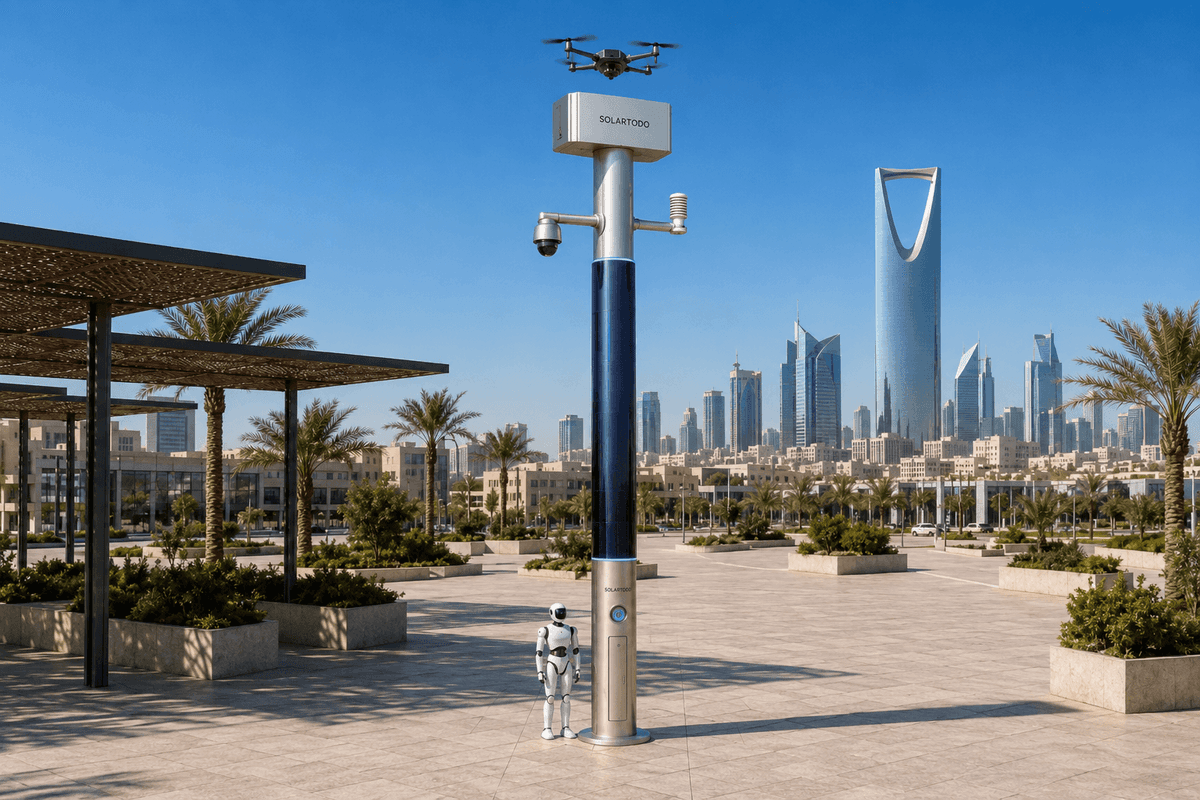
A City AI Pole is a non-lighting physical-AI edge node that combines off-grid energy, local compute, sensing, drone operations and robot support in one pole-form micro-station. In Warsaw, SOLARTODO Sentinel Sky Hub is proposed for port-corridor night patrol, keeping raw data on the pole while coordinating battery-swapped drone sorties and ground response.
1. Warsaw Port-Corridor Task
This proposed Warsaw deployment is framed around a practical emergency-management task: maintaining night patrol coverage across a river-port and logistics corridor when fixed connectivity is degraded, intermittent or intentionally unavailable. Warsaw is an inland capital shaped by the Vistula River, bridge approaches, industrial edges, service roads, rail-adjacent yards and utility corridors. Those conditions make the port archetype relevant even without assuming a named seaport project: the operating problem is not tourism or decorative urban furniture, but a working corridor where access, inspection and emergency response must continue after dark.
The seasonal trigger is a typhoon-season-style readiness window: the kind of severe-weather preparation used by coastal cities, adapted here as a planning discipline for heavy wind, rain, flooding risk, debris movement and night-time disruption. For emergency-management teams, the core pain point is a network outage during the exact hours when patrol demand rises. A conventional camera network can become blind if backhaul is unstable. Manual patrols can become slower, more exposed and harder to coordinate when roads are wet, access gates are closed, or staff must cover several sites at once.
The Sentinel Sky Hub corridor model treats each pole as a local physical-AI station. It is not a smart streetlight and does not include a lighting system. It is a pure smart pole: sensing, compute, energy storage, drone battery hot-swap, drone operations management, robot charging and command-view metadata are integrated into a fully off-grid node. The Warsaw case is therefore not about replacing lamps. It is about replacing repetitive manual inspection loops with a resilient, edge-processed patrol layer that continues operating when city, site or grid power is unavailable.
2. Configuration Around PTZ-Led Night Patrol
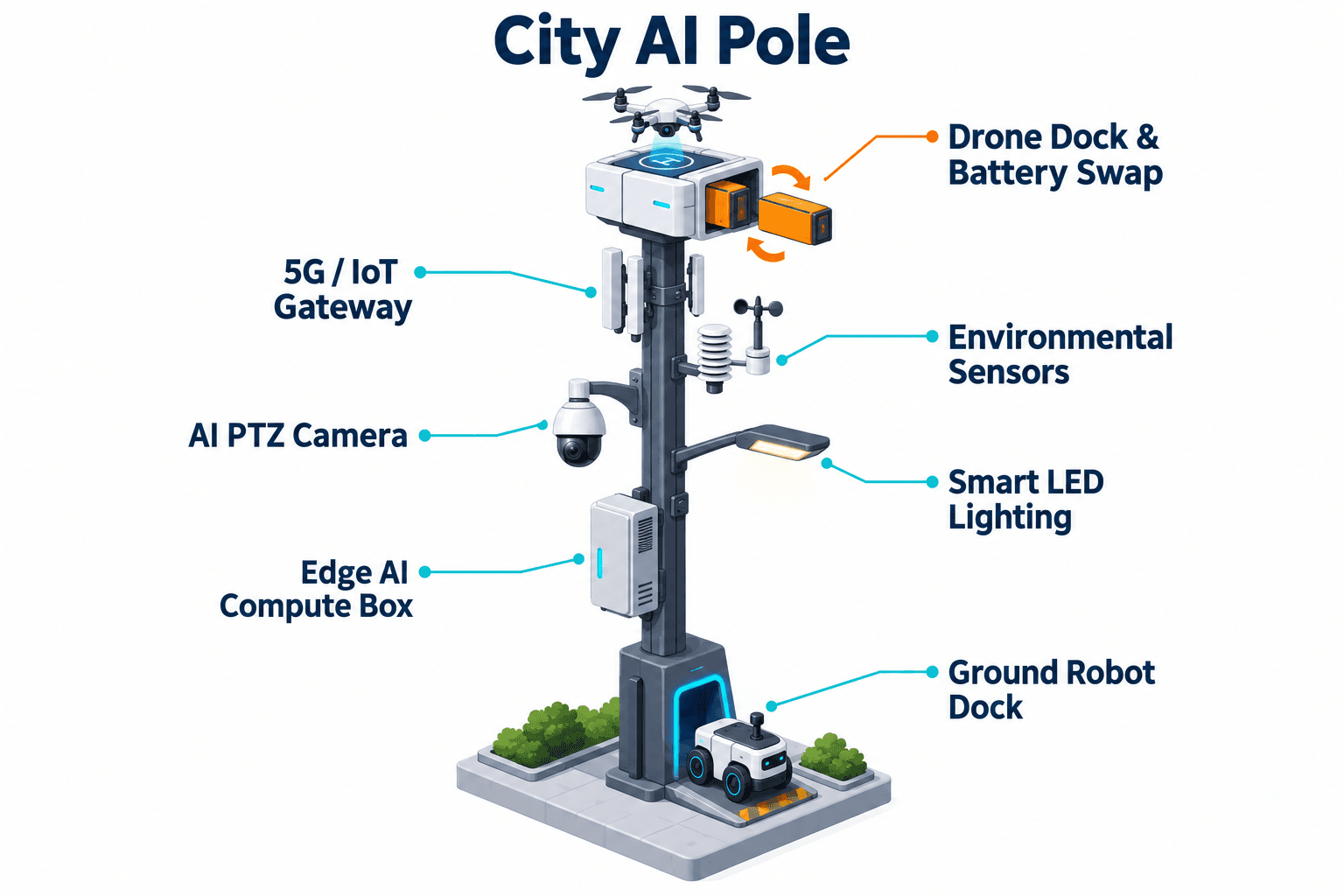
The module focus for this Warsaw configuration is the PTZ camera because night-patrol decisions begin with trusted local observation. The pole-mounted PTZ performs scheduled sweeps of gates, quay-side service lanes, perimeter fences, storage edges and bridge-adjacent access points. Local perception supports anonymous vehicle counts, crowd-density estimation, intrusion awareness and perimeter alerts. It does not claim face recognition or licence-plate recognition as an active deployed capability. The design goal is to reduce unnecessary dispatches while still escalating genuine anomalies to the emergency-management command view.
Each Sky Hub is proposed as part of a corridor deployment rather than a single isolated asset. Nodes would be placed at practical patrol intervals subject to final engineering confirmation, with fields of view, safe drone approach geometry, robot return paths and solar exposure assessed on site. The PTZ camera provides the first event signal; the edge compute cabinet classifies and scores the event; the operations manager decides whether a drone sortie, ground robot response, or human inspection is needed.
Drone operations are designed for autonomous launch, regional patrol, inspection, return and task redeployment without an operator stationed at the pole. The battery hot-swap magazine is central to the use case: a landed drone receives an automated rear-service battery exchange from a multi-bay magazine, then relaunches for the next route segment. Multiple charged bays allow several consecutive sorties as a planning target, subject to battery state, weather, payload and safety rules.
Ground robot operations complete the air-ground layer. A humanoid or service robot can patrol defined ground paths, inspect alarms close to the base, coordinate with aerial observation and return to the pole base for wireless charging. The result is a common operating picture, not a product demo: emergency-management staff see event metadata, route status, battery and swap state, fleet health and mission logs in one command view.
3. Off-Grid Energy and Network-Outage Resilience
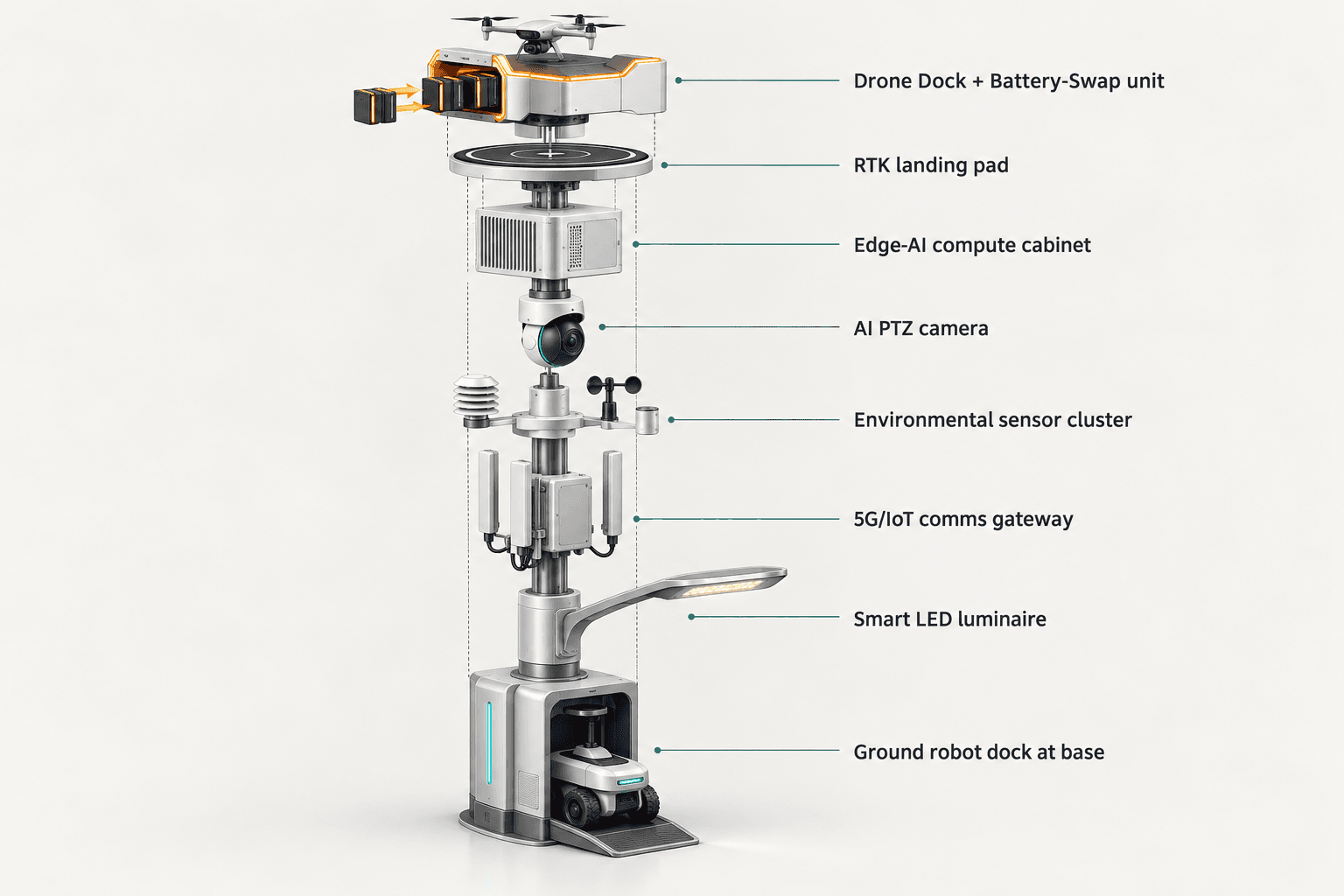
The Warsaw corridor proposal assumes the pole must operate as a fully off-grid, battery-backed micro-station. It does not depend on grid, city or site power. The Sky Hub cylindrical body carries about 15 square meters of 360-degree wrapped flexible CIGS thin-film solar over a vertical body roughly 8 meters tall and about 0.6 meters wide, with approximately 2.4 to 2.7 kWp nameplate. The realistic operating point is intentionally stated conservatively: because a vertical cylinder collects direct sun on its sun-facing projection rather than across the full wrap at once, clear-sky output in a high-irradiance region such as Saudi Arabia is roughly 0.8 to 1.1 kW DC peak, often peaking mid-morning or mid-afternoon rather than at noon, with about 6 to 9 kWh per day.
For Warsaw planning, that high-irradiance reference should not be copied as a guaranteed local yield. It is a sizing anchor that shows the solar layer is supplemental replenishment, not unlimited pure-solar self-sufficiency. Night patrol, drone relaunches, PTZ sweeps, edge inference and robot charging are buffered by 5 to 20 kWh-class battery storage and scheduled by duty cycle. The emergency-management KPI is therefore not theoretical energy autonomy; it is how many manual patrol loops can be replaced while preserving reserve capacity during a storm-readiness period.
Network-outage resilience comes from local processing. Raw video and sensor data stay on the pole and are processed locally. Only de-identified event and status metadata may leave the pole when communications are available. If backhaul is degraded, the pole continues sensing, scoring, logging and executing authorized tasks. When connectivity returns, mission logs and metadata can synchronize to the COP command view. This PDPL-LGPD-oriented design supports privacy-by-design procurement discussions without claiming certification or completed compliance.
4. Human-Authorized Operations Loop
The operating loop follows the sensing to authorized response to edge-compute scheduling to field operations and maintenance pattern. In practical Warsaw night-patrol terms, the PTZ camera flags an anomaly near a closed gate or service-road edge. The edge module classifies the scene locally and assigns a confidence score. The COP presents the event, location, current battery state, weather data and available assets to an authorized emergency-management operator. The operator can approve a drone route, send the ground robot, request a human patrol, or dismiss the event as non-actionable.
This is also where counter-UAS coordination fits into the workflow. The pole may detect and track an unauthorized drone through its own sensing and, where integrated, optional partner-sensor inputs. Radar is not built into the pole; if radar data is used, it is an external or partner input. Mitigation is non-lethal and human-authorized only. The node can command its own friendly drone to perform soft aerial net-capture or close-approach deterrence when allowed by local rules, but the deployment does not involve shoot-downs, jamming, denial, weapons or autonomous attack.
The environmental monitoring package adds context to each decision. Wind speed, wind direction, temperature, humidity, atmospheric pressure, noise, PM10, PM2.5 and illuminance help determine whether a sortie is appropriate, whether a ground robot is safer, or whether the task should wait. For a typhoon-season-style readiness window, this matters because the highest-value labor replacement comes from avoiding avoidable exposure: fewer staff walking dark perimeter roads in bad weather, fewer repeat trips to confirm false alarms, and better use of limited emergency-management personnel.
The ROI structure is deliberately planning-based. No achieved result is claimed. The buyer can recompute assumptions using its own patrol routes, shift calendars, labor model, severe-weather policies and acceptable reserve margins.
5. ROI Analysis for Labor Replacement
The strongest business case is labor replacement in repetitive inspection, not a promise to remove human authority. A Warsaw emergency-management buyer can model the corridor as a set of night patrol obligations: perimeter sweeps, gate checks, river-edge inspections, intrusion triage, environmental checks and post-alarm verification. Sky Hub replaces a portion of these loops with PTZ-led local detection, battery-swapped drone sorties and ground robot response, while humans remain responsible for authorization, escalation and final intervention.
A practical evaluation could compare three operating states. First, the baseline: manual patrols performed by staff or contractors, with radio or mobile coordination and limited visibility during outages. Second, the assisted state: fixed sensing raises alerts, but staff still travel to confirm most events. Third, the Sentinel state: local edge AI filters events, the PTZ camera confirms scene context, a drone performs a regional aerial pass after battery swap, and a ground robot handles short-distance inspection near the pole base. The measurable target is the reduction of routine night patrol loops and repeat confirmation trips, not a fabricated coverage area or detection-rate claim.
The same analysis should include energy scheduling. High-power tasks are not continuous; they are assigned by duty cycle. The battery magazine supports consecutive drone sorties when the mission queue requires it, but the COP should expose battery state, swap availability, weather constraints and reserve policy before each approval. Robot patrols can be scheduled around lower-load periods, while PTZ sweeps and local inference continue as the baseline watch layer.
Subject to final engineering confirmation, this configuration gives Warsaw emergency-management teams a procurement-ready way to evaluate physical-AI infrastructure: corridor by corridor, shift by shift and task by task. It stays honest about energy, privacy and mitigation limits while giving the buyer a concrete path to quantify labor replacement during network-outage night patrol conditions.
System Configuration
| Parameter | Configuration |
|---|---|
| Pole type | SOLARTODO Sentinel Sky Hub pure smart pole; non-lighting physical-AI city edge node |
| Energy system | Fully off-grid battery-backed micro-station with 360-degree wrapped flexible CIGS replenishment and 5 to 20 kWh-class storage |
| Camera | AI PTZ camera for scheduled patrol, anonymous vehicle count, crowd density, intrusion and perimeter awareness |
| Edge AI compute | Jetson-class on-pole inference cabinet for local processing, workload scheduling and event scoring |
| Drone operations | Autonomous launch, patrol, inspection, return, task queueing, mission logs and multi-bay automated battery hot-swap |
| Ground robot support | Service or humanoid robot patrol support with pole-base wireless charging and air-ground coordination |
| Environmental package | Wind speed, wind direction, temperature, humidity, atmospheric pressure, noise, PM10, PM2.5 and illuminance |
How It Works
- On-pole PTZ camera flags a night-time perimeter anomaly in the Warsaw port corridor.
- Edge AI classifies the event locally and sends only de-identified event metadata to the COP.
- An authorized emergency-management operator approves drone inspection, robot response, or manual dispatch.
- The drone launches, inspects the route, returns and receives an automated battery hot-swap if another sortie is queued.
- The ground robot performs close-range inspection when aerial view is insufficient and returns to the pole base for wireless charging.
- Mission logs, battery state, environmental readings and operator decisions are recorded for evaluation and audit.
Planning Assumptions (Indicative)
Illustrative planning inputs a buyer can recompute — target metrics, not achieved results. Subject to final engineering confirmation.
| Metric | Planning assumption | Indicative value |
|---|---|---|
| Inspection labor | Drone and PTZ patrol replace routine manual night sweeps on defined corridor segments | ~10 to 20 patrol loops per week automated as a planning target |
| Alarm confirmation | PTZ review plus drone or robot follow-up reduces staff trips for low-confidence night alarms | ~30 to 50 percent fewer confirmation dispatches targeted |
| Battery-swap continuity | Multi-bay battery magazine supports several consecutive sorties before manual replenishment | ~3 to 6 sorties per node per night window targeted |
| Operator workload | One emergency-management operator supervises multiple corridor nodes through event metadata and mission state | ~4 to 8 nodes per command-view operator for evaluation |
| Reserve policy | High-power drone and robot tasks are duty-cycled to protect severe-weather emergency reserve | ~30 percent battery reserve maintained as a planning threshold |
Deployed Equipment
- SOLARTODO Sentinel Sky Hub pole body with non-lighting integrated equipment housing
- Flexible CIGS 360-degree wrapped solar replenishment layer
- 5 to 20 kWh-class on-pole battery storage system
- AI PTZ camera assembly
- Jetson-class edge AI compute cabinet
- Multi-bay drone battery hot-swap magazine
- Autonomous drone operations bay and landing interface
- Ground robot wireless charging base
Frequently Asked Questions
Is the Warsaw Sky Hub proposal a smart streetlight replacement?
No. The proposed Warsaw configuration is a pure smart pole and physical-AI edge node, not a streetlight replacement. It includes no lighting system and is not positioned as public illumination infrastructure. Its purpose is emergency-management sensing, local edge processing, drone operations, robot support and off-grid corridor resilience.
How does battery hot-swap change night-patrol operations?
Battery hot-swap lets a returned drone receive a charged pack from a multi-bay rear-service magazine and relaunch for the next assigned sortie. For night patrol, this reduces the need for an operator on site and supports consecutive inspection tasks, subject to weather, safety limits, battery reserve and command authorization.
What happens if the network is down during a storm-readiness window?
The node is designed to continue local sensing, classification, task scheduling and logging when backhaul is unavailable or degraded. Raw video and sensor data stay on the pole. Only de-identified event or status metadata may leave the pole when communications are available, and synchronized logs can support later review.
Does the pole use face recognition or licence-plate recognition?
No active deployment capability is claimed for face recognition or licence-plate recognition. The PTZ and edge AI functions are framed around anonymous vehicle counts, crowd-density estimation, intrusion awareness and perimeter monitoring. This keeps the Warsaw proposal focused on operational safety and PDPL-LGPD-oriented local processing.
Is the system powered only by solar energy?
The system is fully off-grid, but it should not be described as unlimited pure-solar self-sufficiency. The CIGS wrap is a supplemental replenishment layer, while high-power drone and robot tasks are buffered by battery storage and controlled by duty cycle. Final local energy yield requires site engineering confirmation.
How is counter-UAS handled in this configuration?
Counter-UAS coordination is non-lethal and human-authorized only. The node may detect and track an unauthorized drone, then command a friendly drone for soft aerial net-capture or close-approach deterrence where permitted. It does not use shoot-downs, jamming, denial methods, weapons or autonomous attack workflows.
Why is this framed as an ROI analysis rather than achieved results?
This is a proposed and illustrative Warsaw configuration, so the ROI model uses target planning assumptions instead of claimed outcomes. A buyer should recompute the values using its own corridor length, shift pattern, labor model, weather policy, reserve threshold, patrol frequency and engineering survey results.
Explore Further
- City AI Pole / smart streetlight product line
- More smart-city deployment cases
- Talk to our engineering team
Planning a similar physical-AI deployment for streets, campuses or public spaces? Request an engineering consultation