warehouses: How Solar-Powered Security Systems Addresses…

SOLARTODO Editorial Team
Solar Energy & Infrastructure Expert Team
Watch the video
TL;DR
Solar-powered warehouse security is a practical option when no grid power is available. A typical off-grid setup can support 16 cameras and 32 alarm points around the clock, reduce guard labor by 30-60%, and cut diesel dependence. For many remote warehouses, EPC deployment with 1-3 days of battery autonomy delivers the best balance of uptime, cost control, and payback in about 2-4 years.
Solar-powered warehouse security systems keep 16 cameras and 32 detector points running 24/7 without grid power, while reducing guard patrol demand by 30-60% and lowering diesel or temporary-power dependence at remote logistics sites.
Summary
Solar-powered warehouse security systems keep 16 cameras and 32 detector points running 24/7 without grid power, while reducing guard patrol demand by 30-60% and lowering diesel or temporary-power dependence at remote logistics sites.
Key Takeaways
- Replace temporary generators with solar-plus-battery security packages sized for 24/7 duty, typically supporting 16 cameras, 32 detector points, and 1 NVR on off-grid warehouse sites.
- Cut guard labor by 30-60% when AI video analytics, 4 PTZ cameras, and 32 alarm zones reduce manual patrol frequency and speed up event verification.
- Size battery autonomy for at least 1-3 days of backup, with critical loads prioritized to keep intrusion detection, recording, and communications active during poor weather.
- Specify standards-based equipment using IEC 62676, EN 50131, UL 681, and NFPA 72 principles to improve procurement clarity and installation quality.
- Compare FOB, CIF, and EPC pricing early; turnkey deployment typically reduces coordination risk and can shorten commissioning by 10-20% versus split-package sourcing.
- Use hybrid alarm architecture with 64 available zones when 32 zones are active today, leaving 32 spare points for fence sensors, panic buttons, or added doors.
- Improve incident response by combining 12 fixed IP cameras, 4 PTZ cameras, perimeter beams, PIR detectors, and dual-technology detectors in one monitored platform.
- Model ROI against guard wages, diesel fuel, and outage losses; many warehouse operators see payback in roughly 2-4 years when replacing 2-3 guard posts or generator-backed surveillance.
Why Solar-Powered Security Fits Off-Grid Warehouses
Solar-powered warehouse security systems solve the no-grid problem by supplying 24/7 power to 16 cameras, 32 detector points, and communications equipment while reducing guard labor by 30-60% through remote monitoring.
Warehouses outside urban feeders often rely on diesel generators, temporary utility drops, or manual guard patrols to protect inventory, loading bays, and perimeter gates. That approach adds fuel cost, maintenance hours, and blind periods during refueling or generator faults. For sites with 1 main gate, 2-6 loading lanes, and a 1,000-10,000 m2 footprint, the security load is usually modest enough to support with solar generation and battery storage rather than continuous engine runtime.
A practical off-grid architecture combines solar modules, charge control, battery storage, DC distribution, inverter capacity where AC loads are required, and low-power security devices. In warehouse deployments, the critical loads are usually the NVR, network switch, wireless bridge, alarm panel, sirens, and selected cameras. SOLAR TODO typically recommends a layered design so the alarm panel and communications remain active first, while non-critical devices can be shed if battery state of charge falls below a defined threshold such as 20-30%.
According to the International Energy Agency, “Solar PV is set to become the largest renewable power source by 2030,” reflecting the maturity and cost profile of PV for distributed applications. According to NREL (2024), PV-based design tools can estimate annual energy yield using local irradiance and system losses, which is exactly how off-grid security power budgets should be validated before procurement. For warehouse owners, the key point is simple: security loads are predictable, so solar-plus-storage can be sized with more certainty than production loads.
System Architecture for Warehouse Security and Surveillance
A warehouse off-grid security package typically uses 12 fixed cameras, 4 PTZ cameras, 32 detector points, and a 64-zone control platform so operators can protect gates, loading bays, offices, and perimeter lines under one system.
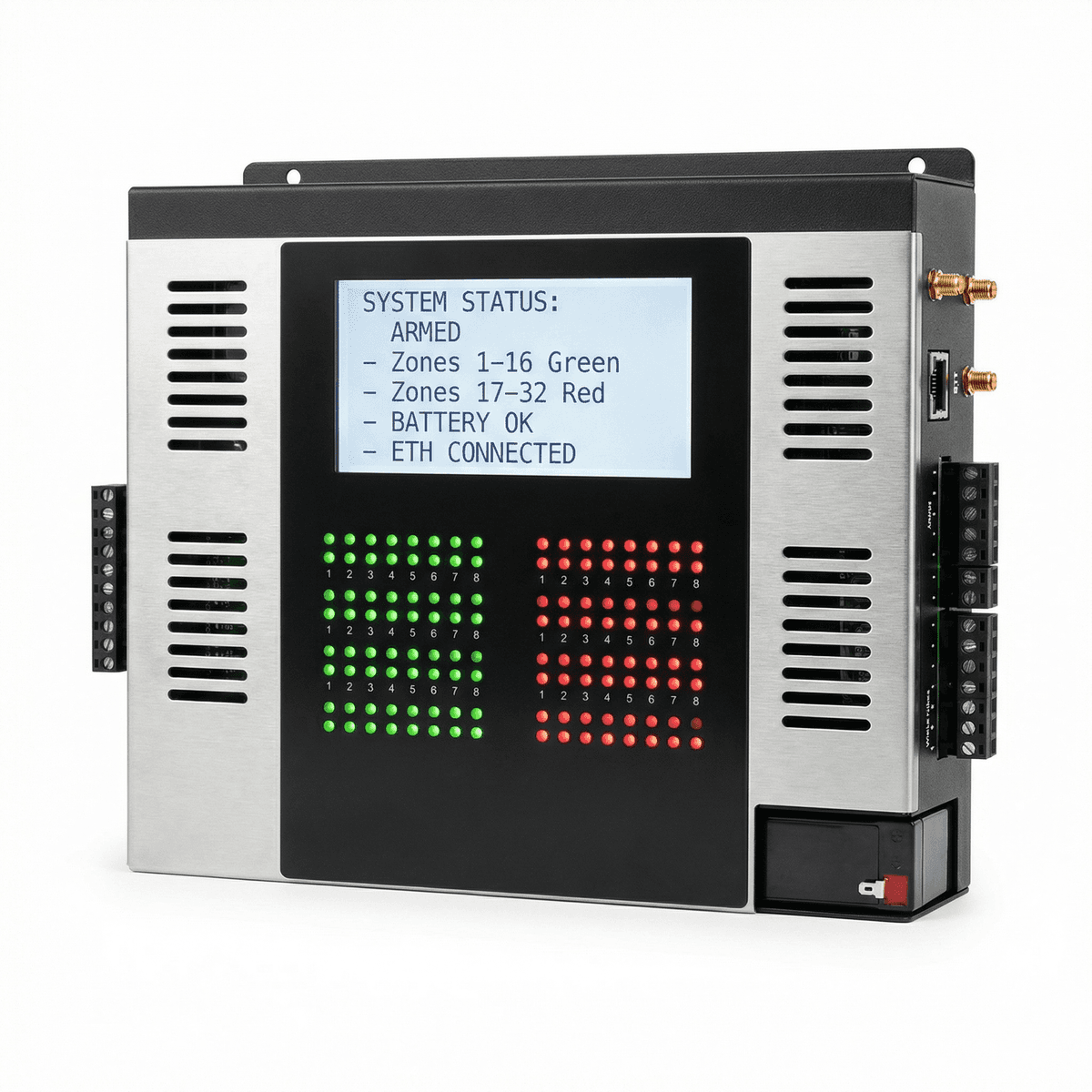
For this category, the closest reference configuration from SOLAR TODO is the Border Checkpoint 32-Zone Off-Grid package because it matches remote-site conditions, layered intrusion logic, and 24/7 operation. The standard arrangement includes 12 HD fixed IP cameras, 4 PTZ cameras, 8 perimeter beam sets, 16 PIR detectors, 16 dual-technology detectors, 1 32-channel NVR, and 1 64-zone hybrid alarm panel configured for 32 active zones. For warehouses, the same architecture can be adapted to 1 gatehouse, 2-6 dock doors, 1 storage hall, 1 office block, and 1 perimeter fence line.
Core power and security blocks
A reliable design starts with a load list in watts and operating hours. Sample deployment scenario (illustrative): if 16 cameras average 8-12 W each, the NVR draws 25-40 W, the PoE switch draws 20-50 W, and communications plus alarm hardware draw 30-80 W, the continuous demand may fall in the 250-400 W range before surge margins. Over 24 hours, that is roughly 6-9.6 kWh/day, which is a manageable off-grid load when paired with correctly sized PV and battery storage.
The alarm side should separate indoor and outdoor risks. PIR detectors work well in sheltered offices, control rooms, and guard posts, while dual-technology detectors are better for thermally unstable areas such as loading canopies or semi-open storage zones. Perimeter beam sets provide early warning at fence lines and vehicle approaches. This layered method reduces nuisance alarms compared with motion-only CCTV because alarm logic can require detector confirmation, camera analytics, or both.
The video side should divide functions clearly. Fixed cameras cover dock doors, aisles, fuel storage, and pedestrian access points. PTZ cameras handle long-range perimeter sweeps, truck queue observation, and event tracking after an alarm. According to IEC 62676 guidance, camera placement, image quality, and recording objectives should be defined by scene purpose, not only by camera count. That matters in warehouses, where license plate capture at 15-25 m is a different task from general overview coverage at 50-100 m.
Communications and monitoring logic
Communications resilience is as important as camera count. A remote warehouse should not depend on a single path. A practical arrangement uses 4G as the primary uplink with Ethernet, fiber, or point-to-point wireless where available. Alarm transmission should stay active even if the NVR fails, and event clips should be pushed to remote users when bandwidth permits. SOLAR TODO can support equipment-only supply, cargo delivery, or EPC scope depending on whether the buyer has an in-house integrator.
According to NFPA 72, alarm signaling reliability depends on supervised pathways, event prioritization, and fault reporting. In simple terms, the warehouse operator needs to know three things within seconds: intrusion event, power fault, and communication loss. A system that records video but does not report battery undervoltage or link failure is incomplete for unattended sites.
How Solar Power Reduces Guard Labor and Operating Cost
Solar-powered security reduces warehouse guard labor by automating detection across 32 zones, improving visual verification with 16 cameras, and allowing 1 remote operator to supervise functions that once required 2-3 patrol positions.
Guard labor is often the largest recurring security cost at remote warehouses. A site that runs 3 shifts may need 2-4 guards per day to cover gate control, perimeter patrol, and after-hours inspection. If analytics, perimeter beams, and remote video verification reduce routine patrol frequency, the operator can often reassign at least 1 position or reduce contracted hours. Sample deployment scenario (illustrative): replacing 1 guard post at USD 700-1,500 per month creates USD 8,400-18,000 in annual savings before considering fuel and outage reduction.
The labor benefit comes from event-driven security rather than constant walking patrols. When a beam set trips at the rear fence, the system can trigger a PTZ preset, send an alarm to the control room, and record tagged footage on the NVR. That means the guard responds to a verified event instead of spending 20-40 minutes per patrol round checking low-risk areas. Over a 24-hour cycle, this can remove several non-productive patrol loops.
According to IRENA (2024), renewable power solutions continue to improve economics in distributed energy applications where diesel logistics are expensive. For warehouse security, the avoided diesel runtime is often more important than the energy yield headline. A small generator running 8-24 hours per day for surveillance power adds fuel delivery, oil changes, noise, and theft risk. Solar power removes most of that burden once the battery bank is correctly sized.
BloombergNEF has repeatedly shown that distributed clean-energy systems are gaining cost competitiveness where fuel volatility is high. The same logic applies to security infrastructure: stable operating expense is easier to budget than variable diesel consumption. SOLAR TODO uses this operating-cost comparison in early-stage project discussions because procurement teams usually need a 3-year and 5-year total cost of ownership view, not only equipment CAPEX.
The International Energy Agency states, “Security of electricity supply is fundamental to modern economies.” For warehouses, that principle extends to the security system itself. If the utility is absent or unreliable, the surveillance platform still needs 24/7 continuity, and solar-plus-storage is often the most practical way to achieve it without permanent generator dependence.
EPC Investment Analysis and Pricing Structure
Warehouse off-grid security projects are usually procured in three tiers—FOB supply, CIF delivered, and EPC turnkey—with EPC packages commonly falling in the USD 7,100-9,200 range for a 32-zone off-grid configuration before site-specific civil and mounting adjustments.
For buyers comparing offers, the delivery model changes both risk and internal workload. Equipment-only supply is lower in upfront scope but leaves design coordination, installation quality, and commissioning responsibility with the buyer. CIF delivered adds freight and import logistics support. EPC turnkey includes engineering, procurement, installation, testing, and commissioning, which is often the better fit when the warehouse has no local low-voltage integrator.
What EPC turnkey usually includes
A standard EPC scope for an off-grid warehouse security package typically includes:
- Site survey and load assessment for 16 cameras, 32 detector points, and communications loads
- Solar array sizing, battery sizing, and autonomy calculation for 24/7 operation
- Supply of cameras, detectors, NVR, alarm panel, poles, brackets, enclosures, and power components
- Cable schedules, mounting layout, and basic commissioning documentation
- Installation, testing, alarm logic setup, and operator training
- Handover with fault list closure and performance verification
Pricing structure and volume guidance
The three-tier commercial structure is usually organized as follows:
| Pricing Tier | What It Includes | Typical Buyer Use Case |
|---|---|---|
| FOB Supply | Equipment ex-works or port basis; buyer handles freight, installation, and commissioning | Buyers with in-house EPC or local integrator |
| CIF Delivered | Equipment plus sea/air freight and cargo delivery support to destination port | Importers needing logistics support but local installation capability |
| EPC Turnkey | Engineering, procurement, installation, testing, and commissioning | End users needing single-point responsibility |
Volume guidance for multi-site rollouts should be discussed early because repeated warehouse layouts reduce engineering time. SOLAR TODO can support indicative volume discounts such as 5% for 50+ units, 10% for 100+ units, and 15% for 250+ units, subject to final scope, battery chemistry, communications hardware, and destination market. Payment terms commonly follow 30% T/T with 70% against B/L, or 100% L/C at sight for qualified transactions. Financing may be available for large projects above USD 1,000K through offline project review. Contact: [email protected].
ROI and payback logic
ROI should be calculated against the cost of conventional alternatives, not against zero. If the current method is 2 guards plus a small generator, the annual baseline may include wages, fuel, maintenance, and theft exposure during outages. Sample deployment scenario (illustrative): if annual savings total USD 6,000-12,000 and turnkey CAPEX is in the low five figures across one warehouse, payback can fall in the 2-4 year range. The exact figure depends on labor rates, local irradiance, battery autonomy target, and whether the system replaces or only supplements guards.
Comparison Guide for Warehouse Buyers
The best warehouse security choice usually combines 32 alarm zones, 16 cameras, 1-3 days of battery autonomy, and standards-based installation rather than choosing the lowest camera price alone.
Procurement teams should compare systems by operating objective: deterrence, detection, verification, evidence retention, and continuity during outages. A low-cost CCTV kit may record video but fail to support supervised alarm paths, battery fault reporting, or perimeter segmentation. For warehouses with high-value stock, those omissions create hidden risk.
| Criteria | Solar Off-Grid Security System | Generator-Backed CCTV Only | Guard-Only Patrol Model |
|---|---|---|---|
| Power continuity | 24/7 with battery autonomy of 1-3 days | Depends on fuel and generator uptime | Depends on site lighting and radios |
| Detection method | 16 cameras + 32 detector points + analytics | Mostly video only | Human observation only |
| Guard labor need | Lower by 30-60% in many cases | Moderate reduction | Highest recurring cost |
| Event verification | Immediate via NVR and PTZ presets | Video review possible | Often delayed or verbal only |
| Fuel dependence | Minimal after commissioning | High | Low to moderate |
| Expansion capacity | 64-zone panel with 32 spare points possible | Limited by recorder and wiring | Labor scaling only |
| Standards alignment | IEC 62676, EN 50131, UL 681, NFPA 72 principles | Often partial | Operational only |
| Best fit | Remote warehouses with no grid power | Temporary sites with existing gensets | Very small or low-risk compounds |
A practical selection checklist should include 8 items: daily load in kWh, required autonomy in days, number of cameras, number of alarm zones, communications path, recording retention days, environmental rating, and installation scope. If any bidder cannot provide these numbers clearly, comparison becomes unreliable. SOLAR TODO generally advises buyers to request a single-line power diagram and zone schedule before approving a purchase order.
FAQ
A well-designed warehouse solar security system can answer most buyer concerns on cost, runtime, standards, and maintenance with measurable figures such as 16 cameras, 32 zones, and 1-3 days of battery autonomy.
Q: How does a solar-powered security system work when a warehouse has no grid power? A: The system uses solar modules to charge batteries during daylight, then powers cameras, alarm panels, communications, and recording equipment from stored energy at night. For a warehouse load of roughly 6-9.6 kWh/day, the design usually includes battery autonomy of 1-3 days and load prioritization so alarms and communications stay active first.
Q: What warehouse areas can a 32-zone security system typically cover? A: A 32-zone layout can usually cover 1 main gate, 2-6 loading bays, office doors, storage rooms, fence lines, and utility spaces. With a 64-zone hybrid panel, 32 zones can remain spare for later expansion such as extra dock doors, panic buttons, or fence vibration sensors.
Q: How much guard labor can solar-powered surveillance actually save? A: Labor savings depend on the current staffing model, but many remote sites reduce guard demand by 30-60% when alarms, PTZ presets, and remote verification replace routine patrol loops. The biggest savings usually come from removing 1 patrol position or cutting contracted patrol hours across 24/7 operation.
Q: What is the difference between PIR and dual-technology detectors in warehouses? A: PIR detectors are better for enclosed or stable indoor spaces such as offices and control rooms. Dual-technology detectors combine PIR with microwave sensing, which helps reduce false alarms in wind-prone, semi-open, or thermally unstable warehouse zones like loading canopies or partially ventilated storage areas.
Q: How long can the system run during cloudy weather or low solar production? A: Runtime depends on battery capacity and load management, but most off-grid warehouse designs target 1-3 days of autonomy. Critical devices such as the alarm panel, communications link, and selected cameras can be prioritized if battery state of charge drops below a threshold like 20-30%.
Q: What standards should buyers ask for in a warehouse security specification? A: Buyers should ask for alignment with IEC 62676 for video surveillance, EN 50131 for intrusion systems, UL 681 for installation practices, and NFPA 72 principles for alarm signaling. These references help procurement teams compare offers on a technical basis instead of camera count alone.
Q: How much does an off-grid warehouse security system cost? A: Cost depends on camera count, battery autonomy, communications hardware, and installation scope. As a reference, a 32-zone off-grid configuration similar to the SOLAR TODO remote-site package is commonly quoted in an EPC turnkey range of about USD 7,100-9,200 before site-specific civil works, taxes, and import duties.
Q: What is included in EPC turnkey delivery? A: EPC turnkey normally includes engineering, procurement, installation, testing, commissioning, and operator training. It may also include site survey, cable schedules, mounting design, battery sizing, and final handover documents, which reduces coordination risk compared with buying cameras, solar hardware, and alarm equipment from separate suppliers.
Q: What payment terms and financing options are available? A: Common export terms are 30% T/T in advance and 70% against B/L, or 100% L/C at sight for approved transactions. For larger programs above USD 1,000K, financing may be reviewed offline based on project scope, buyer profile, and destination market. Contact: [email protected].
Q: How much maintenance does a solar-powered warehouse security system need? A: Maintenance is moderate and mostly preventive. Buyers should plan periodic panel cleaning, battery health checks, detector testing, camera lens cleaning, and communication-path verification every 3-12 months depending on dust levels and site criticality. Firmware review and alarm log analysis should also be part of the maintenance plan.
Q: Is solar security better than using a generator for warehouse surveillance? A: For continuous low-power loads, solar-plus-battery is usually more economical over time because it avoids daily fuel use, refueling logistics, and generator maintenance. Generators may still be kept as emergency backup, but running them full-time for a 250-400 W security load is often inefficient and costly.
Q: How should buyers choose between equipment-only and turnkey supply? A: Equipment-only supply works when the buyer has a qualified local integrator and clear installation standards. Turnkey supply is usually better when the site is remote, the power system is off-grid, or the buyer wants one party responsible for design coordination, commissioning, and performance verification.
References
- NREL (2024): PVWatts Calculator methodology and solar resource modeling used to estimate PV output and system losses for distributed energy systems.
- IEC 62676 (2025): Video surveillance systems for use in security applications, covering system requirements, camera performance, and operational considerations.
- EN 50131 (2024): Intrusion and hold-up alarm systems framework used widely for alarm system grading, detection logic, and system design practice.
- UL 681 (2023): Standard for installation and classification of burglary and holdup alarm systems, relevant to professional security deployment practice.
- NFPA 72 (2022): National Fire Alarm and Signaling Code, referenced for supervised signaling pathways, fault reporting, and alarm communications logic.
- IEA (2024): Renewable energy market analysis and statements on solar PV growth, relevant to distributed off-grid power economics.
- IRENA (2024): Renewable power and distributed energy cost outlooks used to assess diesel displacement and off-grid system economics.
- BloombergNEF (2024): Market intelligence on distributed energy and cost competitiveness trends relevant to off-grid infrastructure investment.
Conclusion
Solar-powered warehouse security is a practical answer when grid power is absent because it can keep 16 cameras and 32 alarm points operating 24/7 while reducing guard labor by 30-60% and cutting generator dependence.
For remote warehouses, the bottom line is straightforward: a standards-based solar security package with 1-3 days of autonomy and EPC delivery often gives the best risk-adjusted value, especially when labor savings support a 2-4 year payback. SOLAR TODO can support equipment supply, delivered cargo, or turnkey EPC based on project scope.
About SOLARTODO
SOLARTODO is a global integrated solution provider specializing in solar power generation systems, energy-storage products, smart street-lighting and solar street-lighting, intelligent security & IoT linkage systems, power transmission towers, telecom communication towers, and smart-agriculture solutions for worldwide B2B customers.
About the Author

SOLARTODO Editorial Team
Solar Energy & Infrastructure Expert Team
SOLAR TODO is a professional supplier of solar energy, energy storage, smart lighting, smart agriculture, security systems, communication towers, and power tower equipment.
Our technical team has over 15 years of experience in renewable energy and infrastructure, providing high-quality products and solutions to B2B customers worldwide.
Expertise: PV system design, energy storage optimization, smart lighting integration, smart agriculture monitoring, security system integration, communication and power tower supply.
Cite This Article
SOLARTODO Editorial Team. (2026). warehouses: How Solar-Powered Security Systems Addresses…. SOLARTODO. Retrieved from https://solartodo.com/knowledge/warehouses-how-solar-powered-security-systems-addresses-no-grid-power-and-improves-guard-labor-savings
@article{solartodo_warehouses_how_solar_powered_security_systems_addresses_no_grid_power_and_improves_guard_labor_savings,
  title = {warehouses: How Solar-Powered Security Systems Addresses…},
  author = {SOLARTODO Editorial Team},
  journal = {SOLARTODO Knowledge Base},
  year = {2026},
  url = {https://solartodo.com/knowledge/warehouses-how-solar-powered-security-systems-addresses-no-grid-power-and-improves-guard-labor-savings},
  note = {Accessed: 2026-10-20}
}
Published: May 13, 2026 | Available at: https://solartodo.com/knowledge/warehouses-how-solar-powered-security-systems-addresses-no-grid-power-and-improves-guard-labor-savings
Subscribe to Our Newsletter
Get the latest solar energy news and insights delivered to your inbox.
View All Articles