Triple Riding and Overloading Detection on Two-Wheelers:…

SOLAR TODO
Solar Energy & Infrastructure Expert Team
Watch the video
TL;DR
Southeast Asian cities can use edge AI traffic cameras to detect triple riding above 94% accuracy, overloading 4+ above 91%, and license plates at 98% accuracy. SOLAR TODO adds solar PV and LFP battery storage for 24/7 operation in weak-grid areas, making pilot deployments at 3-5 sites practical before scaling under FOB, CIF, or EPC turnkey models.
Edge AI detection for two-wheelers helps Southeast Asian cities identify triple riding above 94% accuracy and overloading 4+ passengers above 91%. With 98% license plate recognition and solar-LFP power, agencies can enforce 24/7 in off-grid corridors.
Summary
Edge AI detection for two-wheelers helps Southeast Asian cities identify triple riding above 94% accuracy and overloading 4+ passengers above 91%. With 98% license plate recognition and solar-LFP power, agencies can enforce 24/7 in off-grid corridors.
Key Takeaways
- Deploy edge AI cameras with >94% triple riding detection accuracy to reduce manual enforcement load on corridors where two-wheelers can exceed 60% of traffic mix.
- Specify systems with >91% overloading 4+ passenger detection and 98% license plate recognition to support evidence-based citations and repeat-offender tracking.
- Use solar pole-top PV plus LFP battery storage for 24/7 operation where grid supply is unstable or roadside civil power costs exceed project budgets.
- Prioritize motorcycle-focused analytics at 3-5 pilot intersections in 1-3 months before scaling to 50-100 intersections in 3-9 months.
- Calculate ROI from fewer patrol hours, faster violation processing, and lower crash exposure, with many city programs targeting payback within 24-48 months depending on fine structure and traffic volume.
- Select hardware with IP66 enclosures, 320 km/h speed capture capability, and end-to-end encryption for tropical weather, legal evidence retention, and cybersecurity compliance.
- Integrate emergency and signal priority functions to support broader ITS outcomes, as green-wave coordination can cut stops by up to 40% and emergency response time by up to 50%.
- Structure procurement under FOB, CIF, or EPC turnkey terms, and apply volume discounts of 5% at 50+ units, 10% at 100+, and 15% at 250+ for multi-district rollouts.
Why Triple Riding and Overloading Detection Matters in Southeast Asia
Two-wheeler enforcement needs machine vision because motorcycles and e-bikes often account for more than 60% of urban traffic in developing markets, while AI models now detect triple riding at above 94% and overloading 4+ at above 91% accuracy. Southeast Asian cities face a practical enforcement gap: dense mixed traffic, limited patrol staff, and high-risk passenger behavior that changes lane position within seconds.
Manual roadside checks capture only a small share of violations on corridors carrying 10,000-50,000 vehicles per day. A patrol team may stop dozens of riders in a shift, but fixed cameras can review thousands of trajectories per hour with consistent rules. That difference matters where school travel peaks, market logistics, and informal passenger transport create repeated overloading behavior on 2-wheel and 3-wheel vehicles.
According to the International Energy Agency, "Digitalization can improve the efficiency, reliability and resilience of energy and infrastructure systems." That statement applies directly to traffic enforcement when cities move from officer-dependent checks to timestamped, auditable video evidence. For transport agencies, the goal is not only more fines; it is lower injury exposure, better lane discipline, and measurable deterrence over 6-12 months.
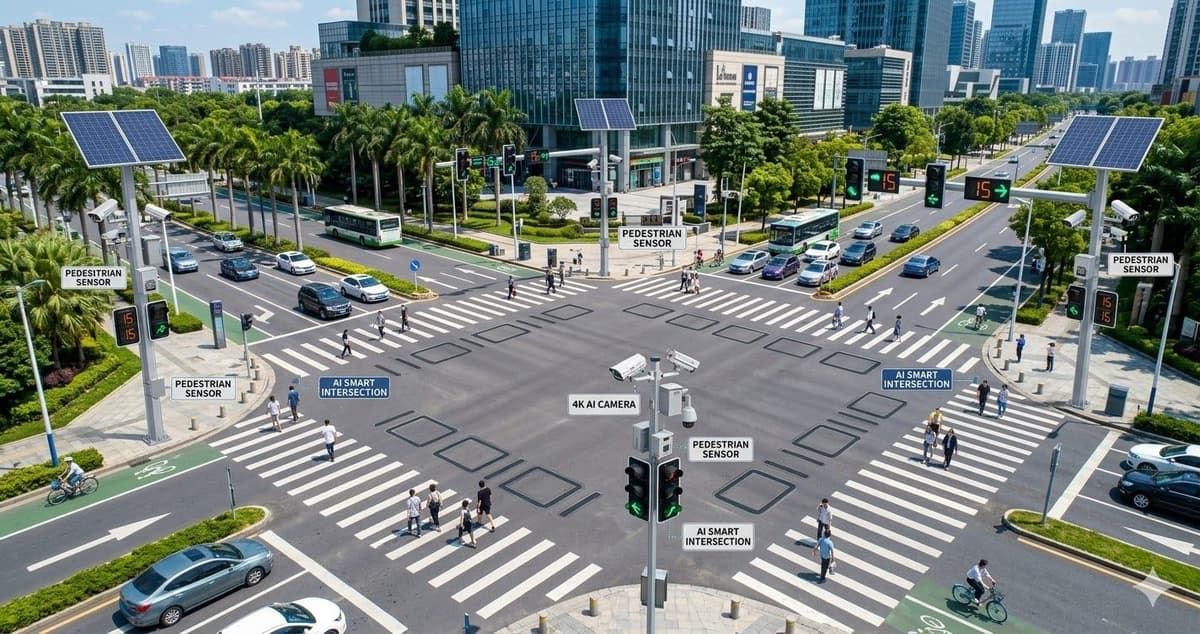
SOLAR TODO addresses this use case with a Smart Traffic Management System that combines AI video analytics, edge processing, and optional solar power on the traffic pole. This configuration is useful in peri-urban roads, island municipalities, and border corridors where utility connection costs can add 15-30% to deployment budgets. It also lets agencies start with a pilot and expand by district instead of waiting for a citywide civil-power program.
How the Edge AI Detection System Works
Edge AI enforcement works by processing video on-site within milliseconds, classifying riders, passengers, helmets, plates, and lane behavior without sending every raw stream to a central server. For two-wheeler safety, the practical benefit is faster event filtering, lower bandwidth use, and higher uptime when 4G or fiber links are unstable.
A typical roadside node includes a high-resolution camera, edge AI processor, illuminator if needed, local storage, communications module, and a power package. The AI model identifies vehicle class, counts visible riders, and flags rule violations such as triple riding, overloading, wrong-way travel, lane intrusion, and helmet non-compliance. SOLAR TODO's smart traffic platform supports detection across 45+ object and violation types, with 98% license plate recognition and maximum speed detection up to 320 km/h.
Detection logic for triple riding and overloading
Triple riding detection uses object segmentation and pose estimation to separate the driver and passengers even when body overlap is high at 15-40 km/h urban speeds. The model evaluates seat occupancy, body contours, and relative rider position across a short frame sequence rather than a single image. That approach improves confidence in congested intersections where pillion passengers often shift posture during braking or turning.
Overloading detection extends the same logic to 4+ passengers or cargo configurations that exceed the expected silhouette envelope of a motorcycle or scooter. In Southeast Asian traffic, the system must distinguish between a child passenger, a side-mounted load, and a stacked commercial delivery setup. SOLAR TODO data indicates overloading 4+ detection above 91% and triple riding above 94%, which is suitable for pre-enforcement review workflows and automated evidence generation.
Edge architecture and evidence chain
Edge processing reduces backhaul traffic by transmitting metadata, snapshots, and short event clips instead of continuous full-resolution video. On a corridor with 20 cameras, this can cut network demand by more than 70% compared with centralized raw-stream analytics, depending on frame rate and retention policy. Local buffering also protects event capture during 5-30 minute telecom outages.
For legal workflows, the system should hash event files, timestamp them, and log operator actions. SOLAR TODO supports a blockchain-secured evidence chain and zero-trust security with end-to-end encryption, which helps agencies maintain integrity from camera capture to adjudication. GDPR-compliant data handling is also relevant for projects funded by multilateral lenders or deployed in jurisdictions aligning with stricter privacy rules.
Solar-powered roadside deployment
Solar traffic poles are practical where trenching, metering, and utility approvals delay projects by 3-9 months. A pole-top PV array with LFP battery storage can keep cameras, edge processors, and communications online for 24/7 operation, with battery chemistry selected for high cycle life and better thermal stability than older lead-acid systems. This is a distinct advantage for flood-prone roads, temporary checkpoints, and rural highways.
According to IRENA (2024), solar PV remains one of the lowest-cost electricity sources in many markets, which supports off-grid enforcement economics when daily loads are predictable. For a sample deployment scenario (illustrative), a node drawing 80-150 W can be served by a properly sized solar module and LFP battery bank with 1-2 days of autonomy, subject to local irradiance, shading, and monsoon season design margins. SOLAR TODO uses this renewable-energy background to combine traffic enforcement with distributed solar generation on the same roadside asset.
Technical Specifications and System Design Considerations
A bankable two-wheeler detection project should define camera angle, pixel density, power autonomy, cybersecurity, and legal evidence retention before procurement, because each parameter affects accuracy, uptime, and admissibility. In practice, poor mounting geometry can reduce rider-count confidence by 10-20 percentage points even when the AI model itself is strong.
Core hardware and software specification list
- Camera resolution: typically 4 MP to 8 MP for rider counting and plate capture
- Frame rate: 25-30 fps for urban mixed traffic and stop-line analysis
- Plate recognition performance: 98% under supported conditions
- Triple riding detection: >94%
- Overloading 4+ detection: >91%
- Max speed capture: 320 km/h
- Enclosure rating: IP66 minimum for tropical rain and dust
- Operating temperature target: -10°C to 60°C depending on local cabinet design
- Communications: 4G/5G, fiber, or Ethernet, with local failover storage
- Cybersecurity: end-to-end encryption and zero-trust access control
- Power option: grid AC or solar PV + LFP battery for 24/7 operation
Placement and calibration
Camera placement should target a view angle that captures the seat line, rider torso separation, and rear plate zone within the same frame. For motorcycles moving at 20-50 km/h near intersections, mounting heights of roughly 5-8 m are often used, but the final value depends on lane width, setback distance, and local pole geometry. A poor side angle can hide the third rider behind the driver, while an excessive top-down angle can reduce plate legibility.
Calibration should include day, night, rain, and helmet-heavy traffic conditions over at least 7-14 days. Southeast Asian deployments need extra validation for ponchos, umbrellas, child passengers, side baskets, and delivery boxes because these create false positives if the model is not tuned on local traffic behavior. Sample deployment scenario (illustrative): validate at 3 intersections with 2 camera angles each before district rollout.
Integration with broader ITS
Two-wheeler violation detection should not remain a standalone camera island. It should connect to the city traffic management center, e-challan or citation platform, police review console, and if available, adaptive signal control. SOLAR TODO positions this as part of a Smart Traffic Management System rather than a single enforcement device.
According to deployment results cited for adaptive traffic systems, Pittsburgh achieved a 25% reduction in travel time and 20% lower emissions with AI signal control, while green-wave coordination can reduce stops by up to 40%. Those metrics matter because cities often justify enforcement budgets more easily when the same pole also supports traffic flow analytics, emergency priority, and future V2X functions from 2026-2028 onward.
Use Cases, ROI, and Comparison for Southeast Asian Cities
Cities get the best value when two-wheeler AI is deployed first on school corridors, market roads, bus interchange approaches, and peri-urban arterials where violation density is high and manual stops disrupt flow. These locations typically produce enough events per day to validate accuracy, deterrence, and staffing savings within the first 90-180 days.
A practical rollout starts with 3-5 intersections or checkpoints in 1-3 months. After calibration and legal workflow approval, the city can expand to 50-100 intersections in 3-9 months, then move to district or citywide coverage in 9-18 months. SOLAR TODO follows this phased model so procurement teams can compare pilot KPIs before committing full CAPEX.
Comparison table: manual enforcement vs edge AI vs solar edge AI
| Criteria | Manual Enforcement | Grid-Powered Edge AI | Solar Edge AI by SOLAR TODO |
|---|---|---|---|
| Violation coverage per hour | Low, officer-limited | High, continuous | High, continuous |
| Triple riding detection | Subjective in heavy traffic | >94% model-based | >94% model-based |
| Overloading 4+ detection | Subjective | >91% model-based | >91% model-based |
| License plate capture | Manual note-taking | 98% LPR | 98% LPR |
| Power requirement | Patrol vehicle/fuel | Grid connection needed | Solar PV + LFP battery |
| Off-grid suitability | Limited | Low | High |
| Evidence chain | Manual paperwork | Digital | Digital + blockchain-secured chain |
| Network dependency | Low | Medium | Medium with local edge buffering |
| CAPEX | Low initial | Medium | Medium to high |
| OPEX over 3-5 years | High labor cost | Moderate | Lower where grid extension is costly |
ROI logic for procurement teams
ROI should be calculated from four streams: reduced patrol labor, higher violation processing efficiency, avoided grid-extension cost, and secondary ITS benefits. If a city currently uses 2-4 officers per corridor per shift, replacing part of that manual workload with automated screening can lower recurring labor and fuel costs by a meaningful margin. The exact payback depends on local wage structure, citation rules, and whether enforcement revenue is retained by the city or transferred to a central authority.
According to the smart traffic market data provided, the broader ITS market is projected to reach $487 billion by 2033 with a 17.8% CAGR, while the smart traffic pole market reaches $5.49 billion in 2025. That growth matters for buyers because it supports component availability, software ecosystem maturity, and multi-function pole economics. For many Southeast Asian municipalities, a reasonable planning assumption is a 24-48 month payback when violation density is high and civil-power costs are avoided.
EPC Investment Analysis and Pricing Structure
A traffic enforcement EPC package should define hardware, civil works, power design, communications, software, testing, and training in one scope, because fragmented procurement often creates 10-15% cost overruns and delayed acceptance. For city buyers, the commercial question is not only unit price; it is total delivered cost, commissioning risk, and 3-5 year serviceability.
What EPC turnkey delivery includes
EPC means Engineering, Procurement, and Construction under one accountable supplier or lead contractor. For a two-wheeler enforcement project, this typically includes site survey, pole and bracket design, camera and edge device supply, solar or grid power package, cabinet fabrication, communications setup, software configuration, integration to the traffic management center, testing, operator training, and handover documentation. Acceptance criteria should include detection accuracy thresholds, uptime targets, and evidence export validation.
Three-tier pricing structure
| Commercial model | What is included | Best fit |
|---|---|---|
| FOB Supply | Equipment ex-factory, basic documents, remote support | Buyers with local installer and customs capability |
| CIF Delivered | Equipment, export packing, sea freight, insurance to destination port | Importers needing delivered logistics but local installation |
| EPC Turnkey | Supply, civil/electrical works, installation, integration, testing, training | Municipal and agency projects needing one-point responsibility |
Pricing varies by camera count, pole height, communications method, solar sizing, and software scope, so SOLAR TODO issues offline quotations after traffic volume and site data review. Volume guidance is clear: 50+ units = 5% discount, 100+ units = 10% discount, and 250+ units = 15% discount. Standard payment terms are 30% T/T + 70% against B/L, or 100% L/C at sight.
ROI, financing, and commercial planning
For budget planning, compare annualized system cost against patrol labor, fuel, maintenance, citation administration, and avoided utility extension. Sample deployment scenario (illustrative): if a district avoids one new grid connection per site and automates first-pass evidence review, the annual savings can materially shorten payback. Large projects above $1,000K may qualify for financing support, which helps agencies spread CAPEX across multi-year smart-city budgets.
SOLAR TODO can support financing discussions for larger deployments and can structure supply around phased acceptance milestones. Procurement teams can request a technical-commercial package through cinn@solartodo.com and align it with local tender rules, legal evidence standards, and service-level requirements. This is especially useful when the project combines enforcement, adaptive signals, and solar roadside power in one program.
FAQ
A well-scoped FAQ helps procurement teams answer technical, legal, and commercial questions in 40-80 words before pilot approval and tender drafting.
Q: What is triple riding detection on two-wheelers? A: Triple riding detection is an AI video function that identifies 3 people on a motorcycle or scooter from roadside camera footage. It uses rider counting, body segmentation, and frame-sequence analysis rather than a single image. In SOLAR TODO's smart traffic application, triple riding detection accuracy is above 94% under supported deployment conditions.
Q: How is overloading different from triple riding? A: Overloading is broader than triple riding because it covers 4+ passengers or unsafe cargo configurations that exceed the expected load profile of a two-wheeler. Triple riding is one specific violation category. SOLAR TODO indicates overloading 4+ detection above 91%, which is useful where informal passenger transport and delivery traffic are common.
Q: Why is edge AI better than sending all video to a central server? A: Edge AI processes events at the pole or roadside cabinet, so it reduces bandwidth use and keeps detection active during network instability. That can lower backhaul demand by more than 70% depending on design. It also speeds up event filtering because only metadata, snapshots, and clips need to be transmitted.
Q: Can the system work in off-grid or weak-grid areas? A: Yes, the system can run on solar PV with LFP battery storage for 24/7 operation where utility power is unavailable or unreliable. This is useful for rural highways, island roads, and temporary checkpoints. Solar power also helps avoid trenching and utility approval delays that can add 3-9 months to deployment.
Q: How accurate is license plate recognition for two-wheeler enforcement? A: License plate recognition can reach 98% in supported conditions when camera angle, lighting, and plate visibility are properly designed. Accuracy depends on mounting height, shutter settings, and local plate formats. For procurement, plate performance should be validated during a 7-14 day pilot before full rollout.
Q: What sites should a city choose for the pilot phase? A: Start with 3-5 intersections or corridors where motorcycles dominate traffic and manual enforcement is difficult. Good pilot sites include school zones, market roads, bus terminal approaches, and peri-urban arterials. These locations usually generate enough events within 30-90 days to test accuracy, legal workflow, and deterrence.
Q: What standards and cybersecurity controls should buyers request? A: Buyers should request compliance with relevant electrical, PV, and interconnection standards such as IEC 61215, IEC 61730, IEEE 1547, and UL 9540 where applicable to the power subsystem. For data security, require end-to-end encryption, role-based access, audit logs, and a documented evidence chain. These controls improve admissibility and reduce cyber risk.
Q: How much maintenance does a solar edge AI traffic pole need? A: Maintenance is moderate and should be scheduled every 6-12 months depending on dust, salt spray, and rainfall. Typical tasks include lens cleaning, battery health checks, firmware updates, bracket inspection, and communication tests. LFP batteries usually reduce maintenance compared with lead-acid systems, but thermal management and enclosure sealing still need review.
Q: How long does deployment usually take? A: A pilot can often be delivered in 1-3 months if site access, permits, and communications are straightforward. Expansion to 50-100 intersections usually takes 3-9 months, while citywide programs can require 9-18 months. The timeline depends on civil works, utility coordination, and legal approval for automated enforcement.
Q: What is included in EPC turnkey delivery for this solution? A: EPC turnkey delivery usually includes engineering, equipment supply, civil and electrical works, installation, software setup, integration, testing, and training. It gives the buyer one accountable delivery structure instead of multiple vendors. This reduces interface risk and is often preferred for municipal projects with 20+ sites.
Q: How is pricing structured for municipal procurement? A: Pricing is usually offered as FOB Supply, CIF Delivered, or EPC Turnkey depending on local installation capability. SOLAR TODO provides volume discounts of 5% at 50+ units, 10% at 100+, and 15% at 250+. Standard payment terms are 30% T/T plus 70% against B/L, or 100% L/C at sight.
Q: Is financing available for large smart traffic projects? A: Yes, financing may be available for larger projects above $1,000K, subject to project scope, buyer profile, and jurisdiction. This can help cities phase CAPEX over multiple budget cycles. Buyers should prepare traffic counts, site lists, and enforcement workflow data before requesting a financing review from SOLAR TODO.
References
Authoritative references help buyers compare AI traffic enforcement claims against recognized standards and energy-system guidance used in public procurement.
- IRENA (2024): Renewable Power Generation Costs in 2023; confirms solar PV remains among the lowest-cost power sources, relevant for off-grid traffic poles.
- IEA (2024): Energy Technology Perspectives and digitalization guidance; supports the role of digital infrastructure in improving system efficiency and resilience.
- NREL (2024): PVWatts Calculator methodology and solar resource modeling; used for sizing PV and battery systems for roadside loads.
- IEC 61215-1 (2021): Terrestrial photovoltaic modules - design qualification and type approval; relevant for solar-powered traffic pole module selection.
- IEC 61730-1 (2023): Photovoltaic module safety qualification - construction requirements; relevant for PV safety in roadside deployments.
- IEEE 1547 (2018): Standard for interconnection and interoperability of distributed energy resources; relevant where traffic poles connect to utility-backed systems.
- UL 9540 (2023): Energy storage system safety standard; relevant for battery-integrated roadside cabinets and procurement safety review.
- IEC 60826 (2017): Design criteria of overhead transmission lines; useful as a reference point for structural loading logic where pole design and wind exposure are critical.
Conclusion
Edge AI two-wheeler enforcement is commercially viable when cities need above 94% triple riding detection, above 91% overloading detection, and 24/7 operation without waiting 3-9 months for grid extension. For Southeast Asian corridors with heavy motorcycle traffic, SOLAR TODO offers a practical path: start with a 3-5 site pilot, validate legal workflow and ROI, then scale under FOB, CIF, or EPC turnkey delivery.
About SOLARTODO
SOLARTODO is a global integrated solution provider specializing in solar power generation systems, energy-storage products, smart street-lighting and solar street-lighting, intelligent security & IoT linkage systems, power transmission towers, telecom communication towers, and smart-agriculture solutions for worldwide B2B customers.
About the Author

SOLAR TODO
Solar Energy & Infrastructure Expert Team
SOLAR TODO is a professional supplier of solar energy, energy storage, smart lighting, smart agriculture, security systems, communication towers, and power tower equipment.
Our technical team has over 15 years of experience in renewable energy and infrastructure, providing high-quality products and solutions to B2B customers worldwide.
Expertise: PV system design, energy storage optimization, smart lighting integration, smart agriculture monitoring, security system integration, communication and power tower supply.
Cite This Article
SOLAR TODO. (2026). Triple Riding and Overloading Detection on Two-Wheelers:…. SOLAR TODO. Retrieved from https://solartodo.com/knowledge/triple-riding-and-overloading-detection-on-two-wheelers-edge-ai-solution-for-southeast-asian-cities
@article{solartodo_triple_riding_and_overloading_detection_on_two_wheelers_edge_ai_solution_for_southeast_asian_cities,
  title = {Triple Riding and Overloading Detection on Two-Wheelers:…},
  author = {SOLAR TODO},
  journal = {SOLAR TODO Knowledge Base},
  year = {2026},
  url = {https://solartodo.com/knowledge/triple-riding-and-overloading-detection-on-two-wheelers-edge-ai-solution-for-southeast-asian-cities},
  note = {Accessed: 2026-04-28}
}
Published: April 28, 2026 | Available at: https://solartodo.com/knowledge/triple-riding-and-overloading-detection-on-two-wheelers-edge-ai-solution-for-southeast-asian-cities
Subscribe to Our Newsletter
Get the latest solar energy news and insights delivered to your inbox.
View All Articles