AI Traffic Congestion Prediction and OD Matrix Guide

SOLAR TODO
Solar Energy & Infrastructure Expert Team
Watch the video
TL;DR
AI traffic congestion prediction works best when 30-minute forecasts are linked to signal control, OD matrix analysis, and reliable field hardware. Buyers should verify 15-30 minute forecast outputs, 98% plate recognition, cybersecurity compliance, and EPC scope. With adaptive actions, corridors can cut stops by up to 40%, while solar-backed poles from SOLAR TODO help maintain 24/7 operation in weak-grid or off-grid locations.
AI-based traffic congestion prediction combines 30-minute forecasts, 98% license plate recognition, and Origin-Destination matrix analysis to cut stops by up to 40% and support signal timing, enforcement, and corridor planning with measurable ROI.
Summary
AI-based traffic congestion prediction combines 30-minute forecasts, 98% license plate recognition, and Origin-Destination matrix analysis to cut stops by up to 40% and support signal timing, enforcement, and corridor planning with measurable ROI.
Key Takeaways
- Deploy 30-minute AI traffic forecasts to adjust signal timing every 5-15 minutes and reduce corridor stops by up to 40% in coordinated green-wave operation.
- Use Origin-Destination matrix analysis from camera, ANPR, and probe data to quantify trip patterns across 50-100 intersections before city-wide expansion.
- Prioritize two-wheeler detection where motorcycles and e-bikes exceed 60% of traffic, using AI models with more than 93% accuracy for key violation classes.
- Specify edge-to-cloud architecture with 24/7 operation, LFP battery backup, and solar pole integration for off-grid sites with 0 grid dependence.
- Validate enforcement-grade inputs with 98% license plate recognition and speed detection up to 320 km/h for highways, tunnels, and urban arterials.
- Compare FOB, CIF, and EPC turnkey pricing early, then apply volume discounts of 5% at 50+ units, 10% at 100+, and 15% at 250+ units.
- Estimate ROI from lower delay, fewer incidents, and reduced fuel burn; pilot projects at 3-5 intersections typically generate decision data within 1-3 months.
- Require standards-based cybersecurity and interoperability, including IEEE 802.11p, IEC 62443, and GDPR-aligned data governance for legal and operational use.
What AI Traffic Congestion Prediction Means for 30-Minute Operations
AI traffic congestion prediction can forecast corridor conditions 30 minutes ahead with decision-ready outputs every 5-15 minutes, giving operators enough time to retime signals, reroute flows, and protect incident-prone links before queues spill back.
For B2B buyers, the practical value is not the forecast alone but the action window. A 30-minute horizon is long enough to modify offsets, phase splits, bus priority, and variable message guidance, yet short enough to remain operationally relevant. According to the product deployment data available for smart traffic systems, green-wave coordination can reduce stops by up to 40%, while transit and emergency priority can cut response time by up to 50%.
The core workflow combines live detection, historical traffic patterns, and Origin-Destination matrix analysis. Cameras, radar, loop inputs, ANPR, GPS probe feeds, and event logs are fused into a time-series model that predicts volume, speed, queue length, and lane occupancy for the next 30 minutes. SOLAR TODO uses this approach in smart traffic deployments where solar-powered poles and LFP battery storage support 24/7 operation in urban and off-grid corridors.
According to the International Energy Agency, "Digitalization is becoming a key tool for improving energy and infrastructure system efficiency." That statement applies directly to traffic operations because each avoided stop reduces fuel use, emissions, and lost labor time. According to the deployment results cited in the product knowledge, Pittsburgh reported a 25% reduction in travel time and a 20% reduction in emissions with adaptive AI signal control.
How 30-Minute Forecasting and Origin-Destination Matrix Analysis Work
A 30-minute congestion forecast is built from second-by-second field data and 5-15 minute aggregation windows, while an Origin-Destination matrix converts those observations into trip flows between zones, ramps, districts, or intersections.
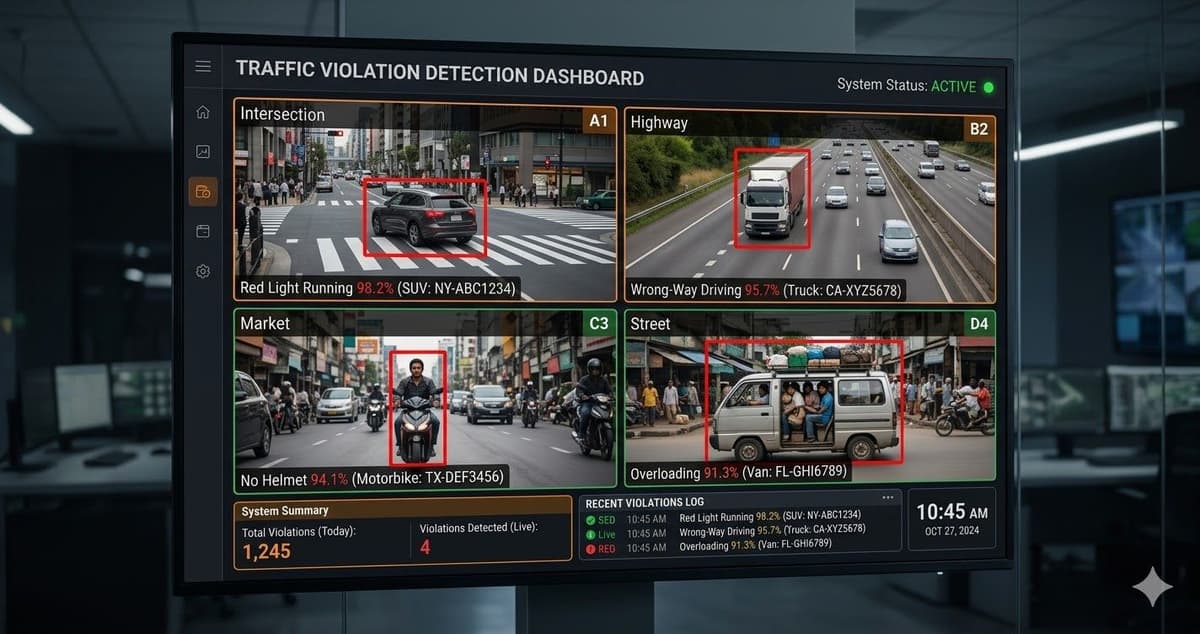
At the field layer, the system captures classified objects and events. The available smart traffic AI stack detects 45+ object and violation types, including sedan, SUV, bus, truck, bicycle, pedestrian, e-bike, and emergency vehicle. It also supports 98% license plate recognition, speed detection up to 320 km/h, and high-accuracy two-wheeler behavior detection above 93% for several violation classes.
Data inputs used for prediction
A reliable 30-minute forecast usually uses at least 4 data classes:
- Real-time traffic counts by lane and direction at 1-60 second intervals
- Speed, occupancy, and queue indicators aggregated every 5 minutes
- ANPR or probe traces for trip chaining and travel-time estimation
- Context signals such as rain, incidents, school peaks, and event schedules
Origin-Destination matrix analysis estimates how many trips move from zone A to zone B during a defined interval such as 15, 30, or 60 minutes. In practice, the matrix can be built from ANPR re-identification, connected vehicle data, mobile probes, ticketing data, or fused camera analytics. For a city pilot, operators often start with 3-5 intersections and 8-20 traffic analysis zones, then scale to 50-100 intersections after calibration.
Model architecture and forecast logic
Most production systems combine three model layers:
- A short-horizon time-series model for 5-30 minute speed and flow prediction
- A graph-based network model that captures spillback between adjacent nodes
- An OD estimation layer that explains where trips are coming from and where they are going
This architecture matters because congestion is networked, not isolated. A queue at one intersection can propagate 200-800 meters upstream and distort the next 2-4 signals. OD analysis identifies whether the queue is local turning demand, through-traffic, freight peaking, school traffic, or diversion from an incident. SOLAR TODO can support these deployments with solar-integrated poles, edge compute, and encrypted communications for distributed intersections.
According to the International Energy Agency, "Data and digital technologies can unlock large efficiency gains across infrastructure systems." In traffic terms, that means a forecast becomes valuable only when it changes timing plans, lane control, or traveler information within the next 30 minutes.
Technical Architecture, Accuracy Benchmarks, and Deployment Design
A practical AI traffic prediction system needs 4 layers—sensing, edge processing, communications, and control integration—and forecast accuracy should be measured with MAE, RMSE, MAPE, and corridor travel-time error over 15-30 minute horizons.
Procurement teams should ask a simple question first: what accuracy is good enough to trigger action? For urban signal control, many agencies use threshold-based decisions rather than a single headline percentage. A model may be acceptable if 30-minute corridor speed error stays within 8-15%, queue-length classification is correct above 85%, and incident-related congestion onset is detected within 2-5 minutes.
Recommended system stack
| Layer | Typical specification | Procurement note |
|---|---|---|
| Sensing | 4MP-8MP cameras, radar, ANPR, loop or magnetometer inputs | Use mixed sensing for rain, glare, and night conditions |
| Edge compute | GPU/NPU edge box, 8-32 GB RAM, 256 GB-1 TB storage | Keep 24-72 hours local buffering |
| Communications | Fiber, 4G/5G, or microwave with VPN and IEC 62443 controls | Plan latency below 200 ms for signal actions |
| Power | Grid or solar pole with LFP battery backup for 24/7 duty | Off-grid corridors need autonomy sizing |
| Control | ATC/UTC interface, API, or NTCIP-compatible middleware | Confirm existing controller compatibility |
For accuracy benchmarking, use at least 8-12 weeks of baseline data and include weekday, weekend, incident, and weather conditions. A common mistake is reporting only average forecast accuracy during stable periods. Buyers should request performance by peak hour, rainy conditions, school peaks, and event surges because those periods drive most operational cost.
The available deployment references show why this matters. London reported travel-time reductions of 10% to 30% with smart traffic optimization. Singapore reported a 15% commute reduction using digital twin methods. These numbers do not guarantee identical results elsewhere, but they show the operational range when prediction is linked to control actions.
For developing markets, two-wheeler intelligence is not optional. Where motorcycles and e-bikes account for more than 60% of traffic, OD estimation must distinguish two-wheelers from cars and heavy vehicles. The smart traffic AI data available here includes helmet non-compliance detection at 97.7% mAP and 92.7% F1, triple riding above 94%, wrong-way riding above 95%, and restricted-zone entry above 93%, which improves both safety analytics and demand modeling.
Use Cases, ROI Drivers, and Operational Benefits
AI congestion prediction delivers the highest ROI when it is tied to measurable actions such as adaptive signal timing, bus priority, incident diversion, freight window management, and enforcement-backed corridor analytics within 1-3 months of a pilot.
The first use case is adaptive signal control. If a 30-minute forecast shows demand rising 12-18% on a corridor, the system can shift green splits, adjust offsets, and activate progression before queues exceed storage length. Based on the deployment data provided, green-wave coordination can cut stops by up to 40%, and emergency or transit priority can reduce response time by up to 50%.
The second use case is OD-based corridor planning. An OD matrix often reveals that a congested node is not under-capacity but misallocated. For example, 25-35% of peak demand may be through-traffic that can be redirected, while only 10-15% may be local access demand. That distinction changes whether the buyer should invest in timing plans, turn restrictions, freight windows, or a new link.
The third use case is enforcement and legal evidence. With 98% license plate recognition and blockchain-secured evidence chain support in the smart traffic platform, agencies can connect congestion hotspots with recurring violations such as wrong-way riding, lane intrusion, and overloaded motorcycles. That matters in regions where safety and flow are tightly linked.
Sample deployment scenario (illustrative)
A 20-intersection arterial with 180,000 daily vehicle movements installs AI cameras, edge processors, and a central prediction engine. If average peak delay falls by 12%, fuel waste drops by 6-10%, and bus punctuality improves by 8%, the annual savings can justify expansion before a city-wide rollout. Exact ROI depends on labor cost, fuel price, controller compatibility, and civil works.
SOLAR TODO adds a useful infrastructure option here: solar panels integrated on pole tops with LFP battery storage. For corridors with weak grid supply, this reduces trenching, shortens deployment time, and keeps detection and communications online during outages. In rural highways and developing regions, that can be the difference between a pilot that runs 24/7 and one that loses data during power interruptions.
Comparison and Selection Guide for B2B Buyers
For most city and highway projects, the best buying decision is the system that combines 30-minute forecast accuracy, OD matrix transparency, 24/7 power resilience, and standards-based cybersecurity at the lowest 5-year operating cost.
A procurement comparison should cover more than camera count. It should include data quality, model retraining frequency, edge autonomy, controller integration, and legal evidence handling. Buyers should also compare whether the supplier can support off-grid deployment, because power availability can add 10-20% to project risk in remote corridors.
| Evaluation factor | Basic monitoring system | AI prediction system | SOLAR TODO smart traffic option |
|---|---|---|---|
| Forecast horizon | 0-5 min alerts | 15-30 min prediction | 15-30 min prediction with solar-backed field power |
| OD matrix capability | Limited | Yes, from ANPR/probe fusion | Yes, with camera analytics and edge processing |
| Detection scope | Vehicle counts only | Multi-class objects and events | 45+ detection types |
| Plate recognition | Optional | Common | 98% recognition |
| Off-grid operation | Rare | Partial | Yes, solar + LFP battery |
| Legal evidence chain | Basic storage | Varies | Blockchain-secured evidence chain |
| Expansion path | Monitoring only | Adaptive control | Adaptive control, digital twin, future V2X |
Selection checklist
- Confirm 30-minute forecast outputs at 5-15 minute refresh intervals
- Require OD matrix export by zone, corridor, and time band
- Verify 98% ANPR performance claims with local plate formats
- Check night, rain, dust, and glare performance on 7-14 day field tests
- Specify cybersecurity controls aligned with IEC 62443 and encrypted communications
- Ask for API or controller integration details before award
- Review 3-year to 5-year software, retraining, and maintenance scope
EPC Investment Analysis and Pricing Structure
For smart traffic projects, EPC turnkey delivery usually includes design, procurement, civil works, pole and cabinet installation, power system integration, communications setup, software commissioning, and operator training across 3 project phases.
EPC means Engineering, Procurement, and Construction under one delivery scope. In a traffic prediction project, that usually covers site survey, traffic study, pole foundation checks, camera and cabinet selection, solar and battery sizing where needed, communications design, controller integration, software setup, testing, and handover. For a pilot of 3-5 intersections, implementation commonly takes 1-3 months; expansion to 50-100 intersections may take 3-9 months; city-wide deployment may take 9-18 months.
Three-tier pricing structure
| Pricing model | What is included | Best use case |
|---|---|---|
| FOB Supply | Hardware and software supply at port of origin | Buyers with local installers and integrators |
| CIF Delivered | Supply plus freight and insurance to destination port | Buyers managing local installation but needing import support |
| EPC Turnkey | Design, supply, installation, commissioning, and training | Municipal, highway, and corridor projects needing one contract |
Volume pricing guidance for standard hardware packages is as follows:
- 50+ units: 5% discount
- 100+ units: 10% discount
- 250+ units: 15% discount
Payment terms typically follow one of two structures:
- 30% T/T deposit + 70% against B/L
- 100% L/C at sight
For large projects above $1,000K, financing is available subject to project review, buyer profile, and jurisdiction. For quotation requests, EPC scope clarification, and financing discussions, contact cinn@solartodo.com. SOLAR TODO handles these projects through inquiry and offline quotation rather than online checkout.
ROI logic for buyers
A traffic AI project usually pays back through 4 channels:
- Reduced delay and labor loss from lower travel time
- Lower fuel burn and emissions from fewer stops and less idling
- Lower incident cost through earlier detection and priority control
- Enforcement and compliance improvement where legally permitted
If a corridor reduces travel time by 10-15%, cuts stops by up to 40%, and lowers incident response time by up to 50%, payback can be materially shorter than conventional monitoring-only systems. Exact payback depends on corridor volume, controller readiness, energy cost, and whether solar-powered poles avoid trenching and backup power costs.
FAQ
Q: What is traffic congestion prediction with AI? A: Traffic congestion prediction with AI uses live traffic data and historical patterns to estimate speeds, queues, and delays 15-30 minutes ahead. The goal is to trigger actions such as signal retiming, route guidance, or priority control before congestion spreads to adjacent intersections.
Q: How accurate is a 30-minute traffic forecast in real operations? A: A useful 30-minute forecast is usually judged by operational error bands, not one headline number. Many agencies look for 8-15% corridor speed error, more than 85% queue-state classification, and stable performance across peak hours, rain, incidents, and special events.
Q: What is an Origin-Destination matrix and why does it matter? A: An Origin-Destination matrix shows how many trips move from one zone to another during a set period such as 15, 30, or 60 minutes. It matters because it explains whether congestion comes from through-traffic, local access, freight peaks, school trips, or diversion from another corridor.
Q: What data sources are needed for OD matrix analysis? A: OD analysis usually combines at least 3-5 data sources, such as ANPR, camera analytics, GPS probe data, loop detectors, and event logs. The best mix depends on privacy rules, road geometry, and whether the buyer needs planning outputs, real-time control, or enforcement-grade evidence.
Q: How does SOLAR TODO support off-grid or unreliable-grid traffic projects? A: SOLAR TODO can supply smart traffic poles with top-mounted solar panels and LFP battery storage for 24/7 operation. This is useful on rural highways, border roads, and developing-market corridors where grid outages would otherwise interrupt detection, communications, and evidence capture.
Q: Can AI traffic prediction improve signal timing and emergency response? A: Yes. When prediction is linked to adaptive control, operators can change offsets, phase splits, and priority windows before queues spill back. Available deployment data indicates green-wave coordination can reduce stops by up to 40%, while emergency and transit priority can cut response time by up to 50%.
Q: What technical specifications should procurement teams verify first? A: Start with forecast horizon, refresh interval, night accuracy, weather performance, ANPR accuracy, local storage, and controller integration. For many projects, key numbers include 15-30 minute forecasting, 5-15 minute refresh cycles, 98% plate recognition, and encrypted communications aligned with IEC 62443.
Q: How long does deployment usually take? A: A pilot at 3-5 intersections often takes 1-3 months including survey, installation, and calibration. Expansion to 50-100 intersections may take 3-9 months, while a city-wide program with digital twin functions can take 9-18 months depending on civil works and controller compatibility.
Q: What is the difference between monitoring-only and predictive traffic systems? A: Monitoring-only systems show current conditions, while predictive systems estimate what will happen in the next 15-30 minutes. That difference matters because operators can act earlier, reducing queue spillback, bus delay, and incident impact instead of reacting after congestion is already established.
Q: How are pricing, EPC scope, and payment terms usually structured? A: Buyers typically choose among FOB Supply, CIF Delivered, and EPC Turnkey. Standard terms are 30% T/T plus 70% against B/L, or 100% L/C at sight, with volume discounts of 5% at 50+ units, 10% at 100+, and 15% at 250+ units.
Q: What maintenance is required after commissioning? A: Most systems need quarterly cleaning and visual checks, plus software health review and model performance validation every 1-3 months. Battery health, camera alignment, storage capacity, and communication uptime should be audited regularly, especially where temperatures exceed 40°C or dust levels are high.
Q: How should buyers evaluate cybersecurity and legal compliance? A: Buyers should require encrypted communications, role-based access, audit logs, and controls aligned with IEC 62443. If the project uses plate data or personal data, the supplier should define retention periods, lawful use cases, and privacy controls consistent with local law and GDPR-style governance where applicable.
References
- IEA (2024): Digitalization and energy system efficiency guidance relevant to infrastructure operations and data-driven optimization.
- IRENA (2024): Renewable power and system efficiency publications supporting lower-emission infrastructure and solar-powered field assets.
- IEEE (2010): IEEE 802.11p standard for wireless access in vehicular environments, relevant to connected traffic systems.
- IEC 62443 (2023): Industrial communication networks and network/system security requirements for operational technology environments.
- NREL (2024): Solar resource and system performance methodologies relevant to off-grid solar-powered traffic poles and backup sizing.
- UL 1973 (2022): Standard for batteries for use in stationary and motive auxiliary power applications, relevant to LFP storage systems.
- IEEE 1547-2018 (2018): Interconnection and interoperability standard relevant where solar-backed traffic assets connect to distribution systems.
- IEA (2023): Transport and digital efficiency reporting relevant to congestion reduction, operational analytics, and emissions impacts.
Conclusion
AI traffic congestion prediction is most valuable when 30-minute forecasts, OD matrix analysis, and adaptive control are deployed together, enabling up to 40% fewer stops and materially faster response decisions across 3-5 intersection pilots or 50-100 intersection programs.
For municipalities, highway operators, and integrators, the bottom line is clear: choose a system that proves forecast accuracy under peak conditions, exports OD matrices, and supports resilient 24/7 field power. SOLAR TODO is a practical option where solar-backed poles, encrypted traffic analytics, and EPC delivery reduce deployment risk and improve long-term operating cost.
About SOLARTODO
SOLARTODO is a global integrated solution provider specializing in solar power generation systems, energy-storage products, smart street-lighting and solar street-lighting, intelligent security & IoT linkage systems, power transmission towers, telecom communication towers, and smart-agriculture solutions for worldwide B2B customers.
About the Author

SOLAR TODO
Solar Energy & Infrastructure Expert Team
SOLAR TODO is a professional supplier of solar energy, energy storage, smart lighting, smart agriculture, security systems, communication towers, and power tower equipment.
Our technical team has over 15 years of experience in renewable energy and infrastructure, providing high-quality products and solutions to B2B customers worldwide.
Expertise: PV system design, energy storage optimization, smart lighting integration, smart agriculture monitoring, security system integration, communication and power tower supply.
Cite This Article
SOLAR TODO. (2026). AI Traffic Congestion Prediction and OD Matrix Guide. SOLAR TODO. Retrieved from https://solartodo.com/knowledge/traffic-congestion-prediction-with-ai-30-minute-forecast-accuracy-and-origin-destination-matrix-analysis
@article{solartodo_traffic_congestion_prediction_with_ai_30_minute_forecast_accuracy_and_origin_destination_matrix_analysis,
  title = {AI Traffic Congestion Prediction and OD Matrix Guide},
  author = {SOLAR TODO},
  journal = {SOLAR TODO Knowledge Base},
  year = {2026},
  url = {https://solartodo.com/knowledge/traffic-congestion-prediction-with-ai-30-minute-forecast-accuracy-and-origin-destination-matrix-analysis},
  note = {Accessed: 2026-04-26}
}
Published: April 26, 2026 | Available at: https://solartodo.com/knowledge/traffic-congestion-prediction-with-ai-30-minute-forecast-accuracy-and-origin-destination-matrix-analysis
Subscribe to Our Newsletter
Get the latest solar energy news and insights delivered to your inbox.
View All Articles