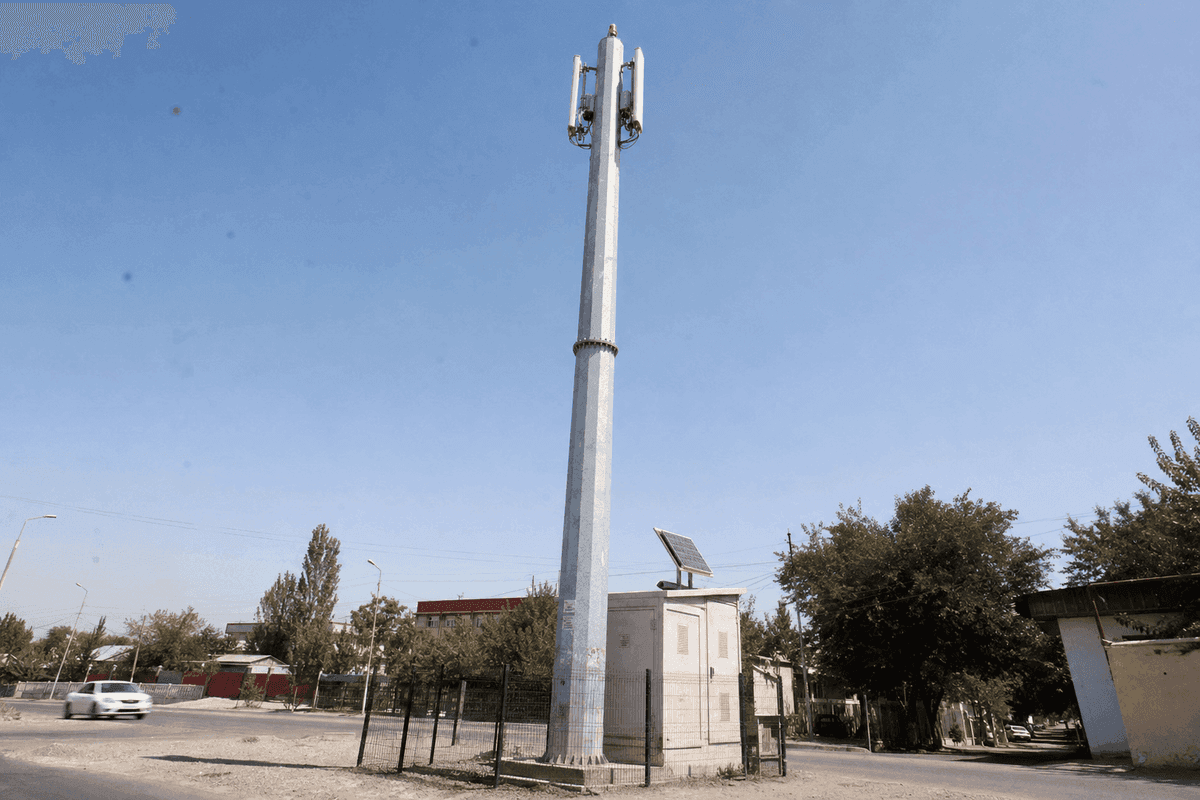
Tashkent Telecom Tower Market Analysis: 20m Urban Macro Monopole Configuration Guide
Summary
Tashkent's 3.04 million residents, 327 km2 urban area, and 5G densification needs support a typical 56-unit, 20m steel Telecom Tower configuration with 50 m/s wind design and 30-year life.
Key Takeaways
A Tashkent urban macro Telecom Tower program should prioritize 20m galvanized monopoles, 50 m/s wind design, and CKD logistics for dense city rollout.
- A typical 56-unit deployment of this scale would use 20m tapered steel monopoles, approximately 7t per tower, or 350 kg/m.
- The recommended structure is hot-dip galvanized Q345 steel with Wind Class 2, rated at 50 m/s with a 1.15 load factor.
- Tashkent City had about 3.0408 million residents at the start of 2024, according to Uzbekistan's Statistics Agency.
- The antenna configuration should allow 3 panel antennas, 1 microwave dish, RRU, and small cell equipment on 2 platforms.
- Drilled concrete pier foundations fit compact urban macro sites where rooftop access, utilities, and road corridors constrain pad foundations.
- CKD shipment can reduce transport volume by 60-70%, improving container utilization for 56 sectional monopoles.
- A 30-45 day production window is realistic before site civil works, tower erection, grounding, and RF commissioning.
- SOLARTODO should position this as an urban macro Telecom Tower fit, not a lattice tower, FRP pole, or joint-use utility pole.
Market Context for Tashkent
Tashkent's telecom tower demand is shaped by a 3 million-plus capital city, dense transport corridors, and national digital-infrastructure policy.
Tashkent is Uzbekistan's capital and the country's highest-density commercial market. According to the Statistics Agency of Uzbekistan (2024), Tashkent City recorded approximately 3.0408 million permanent residents at the beginning of 2024. Public demographic summaries list the administrative city area at about 327 km2, which implies high pressure on low-footprint macro sites and infill coverage assets.
According to the World Bank (2023), Uzbekistan's Digital Inclusion Project is intended to expand digital infrastructure, support IT-sector growth, and improve access to digital services. The same project materials reference training more than 6,200 young professionals and engaging over 200 local and international companies, indicating that connectivity demand is not only consumer-led but also tied to enterprise and public-service digitization.
According to ITU (2024), 5G coverage reached 51% of the world population in 2024, while 4G remained available to 92% globally. ITU states, 'More than half of the world's population now covered by 5G.' For Tashkent, this supports a densification logic: taller rural towers are less important than repeatable 20m urban macro monopoles that can carry mixed panel, microwave, RRU, and small-cell loads.
Tashkent also imposes environmental and civil-engineering constraints. Uzbekistan's continental climate creates hot summers, winter freeze exposure, dust, and urban corrosion risk. The World Bank Climate Change Knowledge Portal describes Uzbekistan as arid to semi-arid, with much of the country receiving low annual precipitation; for tower procurement this means corrosion protection, grounding, lightning protection, and foundation detailing should be specified at the start rather than treated as accessories.
Recommended Technical Configuration
A typical 56-unit Tashkent Telecom Tower package would use 20m urban macro monopoles with drilled pier foundations and mixed 4G/5G antenna capacity.
The recommended configuration is approximately 56 units of 20m tapered steel monopole towers. This sits within the 15-25m size class: rooftop or urban infill applications, 1 platform baseline, 3-6 panel antennas, and 8-15t per tower. The project-specific configuration uses 2 antenna platforms and approximately 7t per tower; that lower weight is acceptable because the specified 20m telecom monopole is 350 kg/m, below the general 500 kg/m rule used for taller heavy-duty towers.
For Tashkent, the product should remain a steel monopole Telecom Tower only: tapered round or octagonal steel tube, hot-dip galvanized Q345 steel, and flanged bolt-on sectional construction for CKD shipping. It should not be described as lattice, FRP, joint-use, or a power transmission structure. SOLARTODO's Telecom Tower positioning should focus on compact urban macro coverage, fast logistics, and standardized civil works.
A typical N-unit deployment in this profile would consist of approximately 56 monopoles, each with 3 panel antennas, 1 microwave dish, RRU, and small cell equipment. The specified accessory package includes climbing ladder, cable tray, aircraft warning light, grounding system, lightning rod, 2 antenna platforms, and safety cage. This creates a repeatable urban macro site template for Tashkent districts, transport corridors, business areas, and residential infill zones.
Technical Specifications
The 20m Tashkent configuration uses Q345 galvanized steel, 50 m/s wind design, drilled pier foundations, and 30-year structural design life.
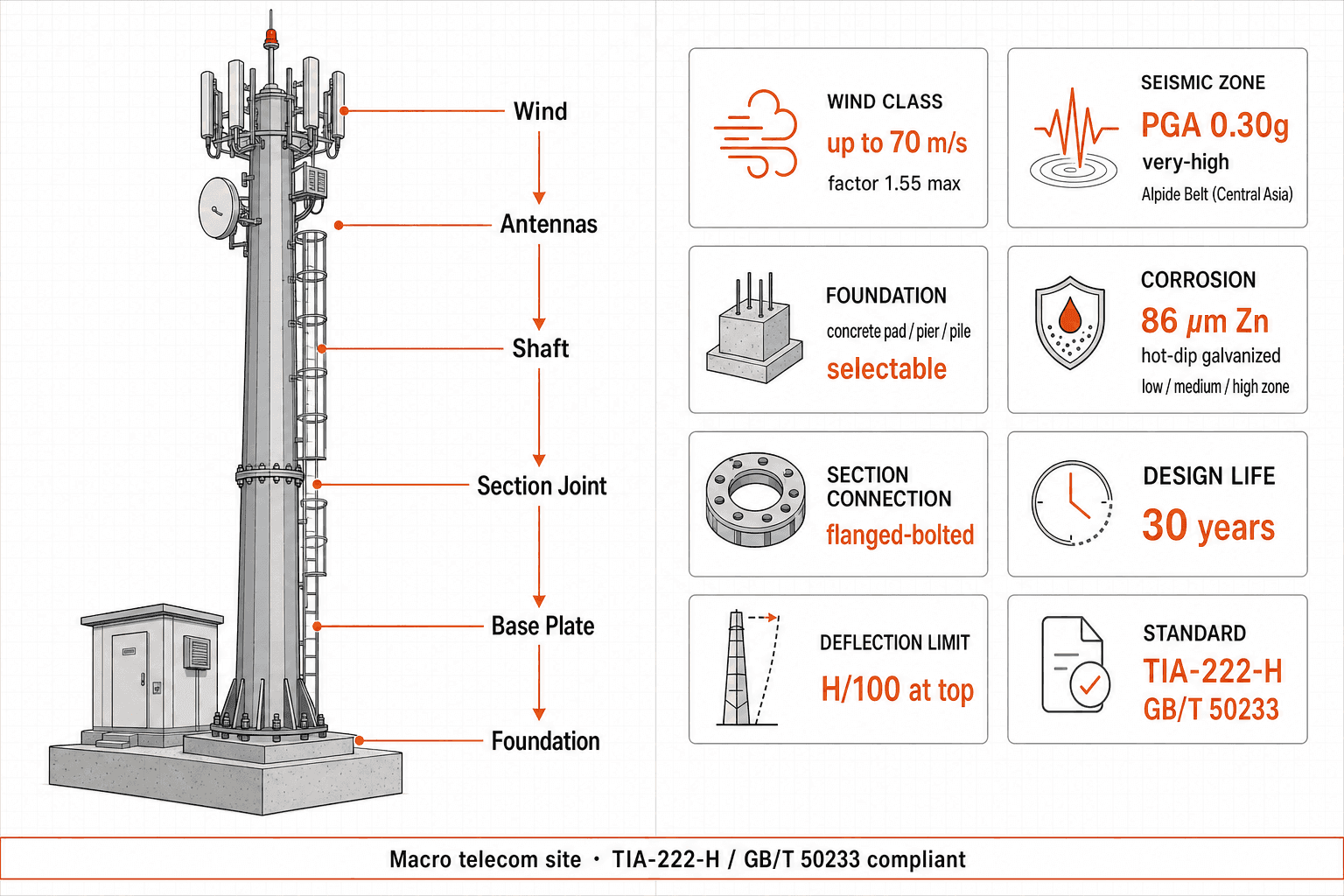
- Product form: tapered steel monopole Telecom Tower, not lattice, FRP, or joint-use.
- Quantity basis: approximately 56 units for a typical city-scale urban macro package.
- Height: 20m, matching the 15-25m rooftop or urban infill size class.
- Pole class: urban macro site.
- Material: hot-dip galvanized Q345 steel.
- Approximate tower weight: 7t per tower, equal to about 350 kg/m.
- Wind design: Wind Class 2, 50 m/s, factor 1.15, aligned with TIA-222-H wind-loading practice.
- Corrosion zone: high, addressed through galvanizing, grounding continuity, and maintenance inspection.
- Antenna load: 3 panel antennas, 1 microwave dish, RRU, and small cell equipment.
- Platforms and access: 2 antenna platforms, climbing ladder, cable tray, and safety cage.
- Foundation: concrete pier, drilled pier type, selected for urban footprint control.
- Electrical protection: grounding system, lightning rod, and aircraft warning light.
- Connection and shipping: flanged sectional design, shipped CKD with 60-70% volume reduction.
- Production lead time: 30-45 days before shipping and installation sequencing.
- Design life: 30 years under documented inspection and maintenance.
- Standards basis: TIA-222-H for antenna-supporting structures and GB/T 50233 for steel tower construction reference.
According to TIA (2017), TIA-222-H is the referenced structural standard family for antenna-supporting structures and related wind-loading design. TIA states, 'Structural Standard for Antenna Supporting Structures and Antennas.' According to GB/T 50233 (2014), steel tower construction should control member assembly, bolting, foundation interface, and acceptance procedures through documented engineering inspection.
Implementation Approach
A 56-unit urban Telecom Tower rollout in Tashkent would normally progress through survey, fabrication, CKD shipping, foundation works, erection, and RF commissioning.
The first phase is site qualification. Engineers would map candidate urban macro locations against RF coverage gaps, microwave line-of-sight, fiber availability, property access, utility conflicts, and soil constraints. For 20m poles, the main civil decision is usually drilled pier diameter, reinforcement cage design, embedment depth, and grounding ring layout rather than large concrete pad footprint.
The second phase is engineering approval and fabrication. SOLARTODO would prepare tower drawings, antenna loading assumptions, bolt schedules, galvanizing requirements, foundation reactions, and packing lists. Production should be planned around a 30-45 day window, with CKD packing used to reduce volume by 60-70% and improve port-to-site transport efficiency across Central Asia.
The third phase is civil installation. A drilled pier foundation would be excavated or augered, reinforced, concreted, cured, and checked for anchor-bolt alignment before tower delivery. The flanged steel sections would then be assembled by crane, followed by ladder, cable tray, safety cage, grounding, lightning rod, aircraft warning light, antenna platforms, and RF equipment installation.
The final phase is acceptance and commissioning. Telecom contractors would verify bolt torque, verticality, grounding resistance, aviation light operation, feeder routing, microwave alignment, RRU mounting, and safety access. RF optimization should be handled after physical acceptance because a 20m urban macro site depends on downtilt, azimuth, and interference coordination more than raw height.
Expected Performance & ROI
A 20m urban macro monopole can improve Tashkent infill capacity by supporting 3 panels, microwave backhaul, RRU, and small-cell equipment on one compact site.
The expected performance gain is coverage reliability and capacity density rather than a single guaranteed throughput number. According to ITU (2024), 4G networks cover 99% of global urban areas, but 5G urban coverage remains uneven, with 67% of urban residents globally having 5G access. Tashkent's business districts, metro corridors, and new residential areas therefore need repeatable macro-infill structures that can host both sector antennas and localized small-cell equipment.
From an ROI perspective, the payback model depends on tenancy, site lease terms, backhaul availability, and operator sharing. A typical 56-unit deployment would reduce repeated engineering cost because the same 20m monopole, drilled pier template, accessory package, and CKD logistics plan can be reused across sites. For tower companies, the highest-value scenario is multi-operator tenancy where one 20m asset supports 3 sectors, microwave backhaul, RRU, and future small-cell densification.
Lifecycle economics should be evaluated over 30 years. The high-corrosion specification, hot-dip galvanizing, grounding system, and lightning rod reduce outage and maintenance risk. Periodic maintenance should include 6-month visual inspection after commissioning, annual bolt and corrosion checks, and post-storm inspection after extreme wind events approaching the 50 m/s design basis.
Results and Impact
A recommended 56-unit Tashkent configuration would create a standardized 20m macro-infill platform for urban coverage, backhaul, and 5G densification.
The practical impact is a repeatable engineering template for districts where rooftop leasing is constrained and 35-45m towers would face permitting, visual, or land-acquisition resistance. At 20m, the tower remains within the 15-25m urban infill class while still carrying 3 panel antennas, 1 microwave dish, RRU, and small cell equipment.
The larger market impact is procurement discipline. Buyers can compare the same Q345 galvanized steel, Wind Class 2, drilled pier foundation, 30-year design life, and CKD shipping assumptions across all sites. This reduces variation in civil works, improves spare-part planning, and supports faster acceptance by telecom operators, EPC firms, and municipal reviewers.
Comparison Table
The recommended 20m Telecom Tower is best matched to Tashkent urban infill, while taller monopoles fit suburban, highway, or rural coverage roles.
| Tower option | Best application | Typical antenna loading | Weight class | Tashkent fit |
|---|---|---|---|---|
| 20m tapered Q345 monopole | Urban macro or infill | 3 panels + 1 microwave + RRU + small cell | ~7t per tower | Recommended for 56-unit city package |
| 25m steel monopole | Rooftop edge or residential infill | 3-6 panels | 8-15t per tower | Viable where zoning allows extra height |
| 30-35m steel monopole | Suburban or residential macro | 6-9 panels, 2 platforms | 15-22t per tower | Better for outer districts than dense core |
| 40-45m steel monopole | Highway or peri-urban | 6-9 panels + 1-2 microwave dishes | 22-30t per tower | Use only where coverage radius matters |
| Lattice telecom tower | Large rural compound | Heavy multi-operator loading | Site-specific | Not recommended for compact Tashkent infill |
| FRP pole | Light utility or specialty use | Limited telecom loading | Light-duty | Not suitable for this macro configuration |
Pricing & Quotation
SOLARTODO provides 3 quotation paths for Telecom Tower buyers: FOB supply, CIF delivery, and EPC turnkey, without publishing fixed project prices.
SOLARTODO offers three pricing tiers for this product line: FOB Supply (equipment ex-works China), CIF Delivered (including ocean freight and insurance), and EPC Turnkey (fully installed, commissioned, with 1-year warranty). Volume discounts are available for large-scale deployments. Configure your system online for an instant estimate, or request a custom quotation from our engineering team at [email protected].
For a Tashkent inquiry, the quotation package should include tower drawings, antenna loading schedule, foundation reaction data, galvanizing specification, CKD packing list, production lead time, and installation scope. Buyers can contact us with site coordinates, soil assumptions, antenna inventory, and preferred Incoterms.
Frequently Asked Questions
These 10 answers address tower specification, timeline, ROI, maintenance, installation, EPC scope, warranty, and comparison for a 20m Tashkent Telecom Tower package.
Q1: What Telecom Tower configuration is recommended for Tashkent urban macro sites? A typical recommendation is approximately 56 units of 20m tapered steel monopole towers using hot-dip galvanized Q345 steel. Each tower would support 3 panel antennas, 1 microwave dish, RRU, and small cell equipment on 2 platforms. The design basis is Wind Class 2 at 50 m/s with a 30-year design life.
Q2: Why is a 20m monopole selected instead of a 35m or 45m tower? Tashkent's dense urban profile favors compact infill over wide-area rural coverage. A 20m tower fits the 15-25m urban infill class, reduces visual impact, and simplifies site acquisition. Taller 35-45m towers are better suited to highway or peri-urban corridors where coverage radius matters more than zoning flexibility.
Q3: How long would production and deployment typically take? Production for the specified 20m Q345 galvanized monopoles is typically 30-45 days after drawings, antenna loads, and commercial terms are approved. Deployment time depends on site permits, drilled pier curing, crane access, and RF commissioning. A phased rollout normally separates fabrication, foundation works, tower erection, and operator acceptance.
Q4: What foundation is recommended for this Tashkent configuration? The recommended foundation is a concrete drilled pier because it suits compact urban sites and controls land footprint. Final pier diameter, embedment depth, reinforcement, and anchor-bolt layout should be confirmed through soil testing and structural calculations. This is more appropriate than a broad pad foundation where roads, utilities, or property boundaries restrict space.
Q5: What maintenance is required over a 30-year design life? Maintenance should include a 6-month post-commissioning inspection, annual bolt torque sampling, corrosion checks, grounding verification, ladder and safety cage inspection, and post-storm checks after severe wind events. In a high-corrosion urban environment, damaged galvanizing should be repaired promptly, especially around flanges, cable trays, grounding points, and platform connections.
Q6: How should ROI or payback be evaluated for telecom towers? ROI should be calculated from tenancy, avoided coverage gaps, site lease terms, backhaul cost, maintenance cost, and operator sharing. The tower itself does not create revenue unless antennas are leased or operated. A standardized 56-unit configuration can improve payback by reducing engineering variation, accelerating rollout, and supporting future small-cell upgrades.
Q7: How does this monopole compare with lattice and FRP alternatives? A steel monopole is better for Tashkent infill because it has a smaller footprint and cleaner urban appearance than lattice towers. FRP poles are lighter but not suitable for the specified macro antenna load. The recommended structure is a flanged Q345 steel monopole, shipped CKD, with 50 m/s wind design and full access accessories.
Q8: What is included in EPC turnkey scope? EPC turnkey scope can include engineering drawings, foundation construction, tower supply, CKD logistics, erection, grounding, lightning protection, antenna platform installation, aircraft warning light, safety cage, and commissioning support. RF optimization, operator spectrum planning, power connection, and backhaul service activation should be clarified because these may sit outside tower EPC scope.
Q9: Does SOLARTODO publish fixed prices for this article configuration? No fixed prices should be used for this configuration because freight route, steel market conditions, site access, foundation depth, installation scope, and warranty terms change the final quotation. SOLARTODO can price the same 20m tower under FOB Supply, CIF Delivered, or EPC Turnkey models after receiving site and antenna-loading data.
Q10: What warranty is typical for this product line? The pricing structure references EPC Turnkey with a 1-year warranty, while the structural design life is 30 years under proper installation and maintenance. Warranty review should distinguish manufacturing defects, galvanizing quality, installation workmanship, and force-majeure events. Buyers should request warranty language that matches Incoterms and local installation responsibility.
References
The references below combine 7 public data, telecom, climate, and structural-standard sources used to frame the Tashkent Telecom Tower recommendation.
- Statistics Agency of Uzbekistan (2024): Regional population table listing Tashkent City at approximately 3.0408 million residents at the start of 2024. https://stat.uz/en/
- World Bank (2023): Uzbekistan Digital Inclusion Project P179108, covering digital infrastructure, IT-sector growth, skills development, and digital-service access. https://projects.worldbank.org/en/projects-operations/project-detail/P179108
- ITU (2024): Facts and Figures 2024 reports 51% global 5G population coverage, 92% global 4G coverage, and 99% urban 4G coverage. https://www.itu.int/itu-d/reports/statistics/2024/11/10/ff24-mobile-network-coverage/
- World Bank Climate Change Knowledge Portal (2024): Uzbekistan climate profile describes arid to semi-arid conditions relevant to corrosion, heat, and maintenance planning. https://climateknowledgeportal.worldbank.org/country/uzbekistan
- TIA (2017): ANSI/TIA-222-H Structural Standard for Antenna Supporting Structures, Antennas, and Small Wind Turbine Support Structures. https://www.tiaonline.org/
- GB/T 50233 (2014): Code for construction and acceptance of tower and pole structures for transmission lines, used as a steel tower construction reference. https://www.sac.gov.cn/
- ITU-R (2023): IMT-2030 framework identifies future mobile-network evolution needs, reinforcing the value of upgradeable macro and small-cell infrastructure. https://www.itu.int/rec/R-REC-M.2160
Equipment Deployed
- 56 units x 20m tapered Q345 steel Telecom Tower, hot-dip galvanized
- Wind Class 2 design: 50 m/s with 1.15 factor per TIA-222-H basis
- Approximate tower weight: 7t per tower, about 350 kg/m
- Antenna load: 3 panel antennas + 1 microwave dish + RRU + small cell
- Concrete drilled pier foundation for urban macro sites
- 2 antenna platforms with climbing ladder, cable tray, and safety cage
- Grounding system, lightning rod, and aircraft warning light
- Flanged sectional CKD shipping package with 60-70% volume reduction
- High-corrosion protection package with hot-dip galvanizing
- 30-year structural design life with 30-45 day production window