Solving maintenance labor cost: Smart Solar Streetlight…

SOLAR TODO
Solar Energy & Infrastructure Expert Team
Watch the video
TL;DR
To reduce maintenance labor cost in smart solar streetlight projects, size LiFePO4 batteries for 2-3 nights of autonomy, keep routine discharge near 70-80%, and use smart dimming profiles that cut nightly energy by 30-50%. Integrated poles and remote alarms can reduce field visits by 20% or more, improving 5-10 year total cost of ownership.
Smart solar streetlight systems cut maintenance labor by consolidating controls, reducing truck rolls by 20%+ and lowering visible field assets from 5 devices to 1 pole in integrated designs. Correct battery sizing at 2-3 nights autonomy and smart dimming can reduce lifecycle cost by 15-30%.
Summary
Smart solar streetlight systems cut maintenance labor by consolidating controls, reducing truck rolls by 20%+ and lowering visible field assets from 5 devices to 1 pole in integrated designs. Correct battery sizing at 2-3 nights autonomy and smart dimming can reduce lifecycle cost by 15-30%.
Key Takeaways
- Quantify maintenance labor first: audit failure visits, travel time, and lamp replacement cycles over 12 months to identify whether 20-40% of OPEX comes from dispatch and manual inspection.
- Size batteries for 2-3 nights of autonomy and limit routine depth of discharge to about 70-80% to extend LiFePO4 service life beyond 4,000-6,000 cycles.
- Apply smart lighting control profiles such as 100%-50%-30% dimming by time block to cut nightly energy demand by 30-50% versus fixed-output operation.
- Select integrated poles that replace 3-5 separate roadside assets with 1 structure to reduce maintenance points, trench interfaces, and spare-parts complexity.
- Specify outdoor protection at IP66 and operating temperature from -20°C to +55°C or wider, because enclosure failure often drives premature battery and controller service calls.
- Use remote fault alarms and energy telemetry at 15-minute or hourly intervals to reduce manual inspection frequency and improve outage response time by more than 20%.
- Compare three procurement models—FOB supply, CIF delivered, and EPC turnkey—because installed project cost can differ by 25-40% once foundations, commissioning, and training are included.
- Verify compliance with IEC 60598, IEC 62722, IEC 62446 guidance, and battery safety requirements so that maintenance savings are not lost to non-compliant component failures.
Why Maintenance Labor Cost Is the Core Problem in Solar Streetlighting
Maintenance labor is often the largest controllable operating cost in solar streetlighting, and smart control plus correct battery sizing can reduce field service events by 20-40% over a typical 5-year operating period.
For many municipal roads, industrial parks, campuses, and perimeter roads, the issue is not only fixture price. The real burden comes from repeated site visits, night inspections, battery replacement, controller troubleshooting, and inconsistent spare-parts management. A conventional layout may require separate attention to the luminaire, battery box, controller, pole wiring, and communication device, which multiplies labor time per pole.
According to the International Energy Agency, "digitalization can improve the management and operation of electricity systems" through better monitoring and control. That statement matters at pole level because each avoided truck roll can save labor hours, fuel, and traffic management cost. In remote roads or distributed sites, one maintenance dispatch can cost more than a minor component itself.
SOLAR TODO addresses this cost problem by combining smart lighting control, integrated pole design, and battery sizing logic into one project workflow. Instead of treating lighting, storage, and monitoring as separate packages, SOLAR TODO evaluates daily load, autonomy target, solar resource, and maintenance access conditions together. That approach is more useful for B2B buyers than comparing lamp wattage alone.
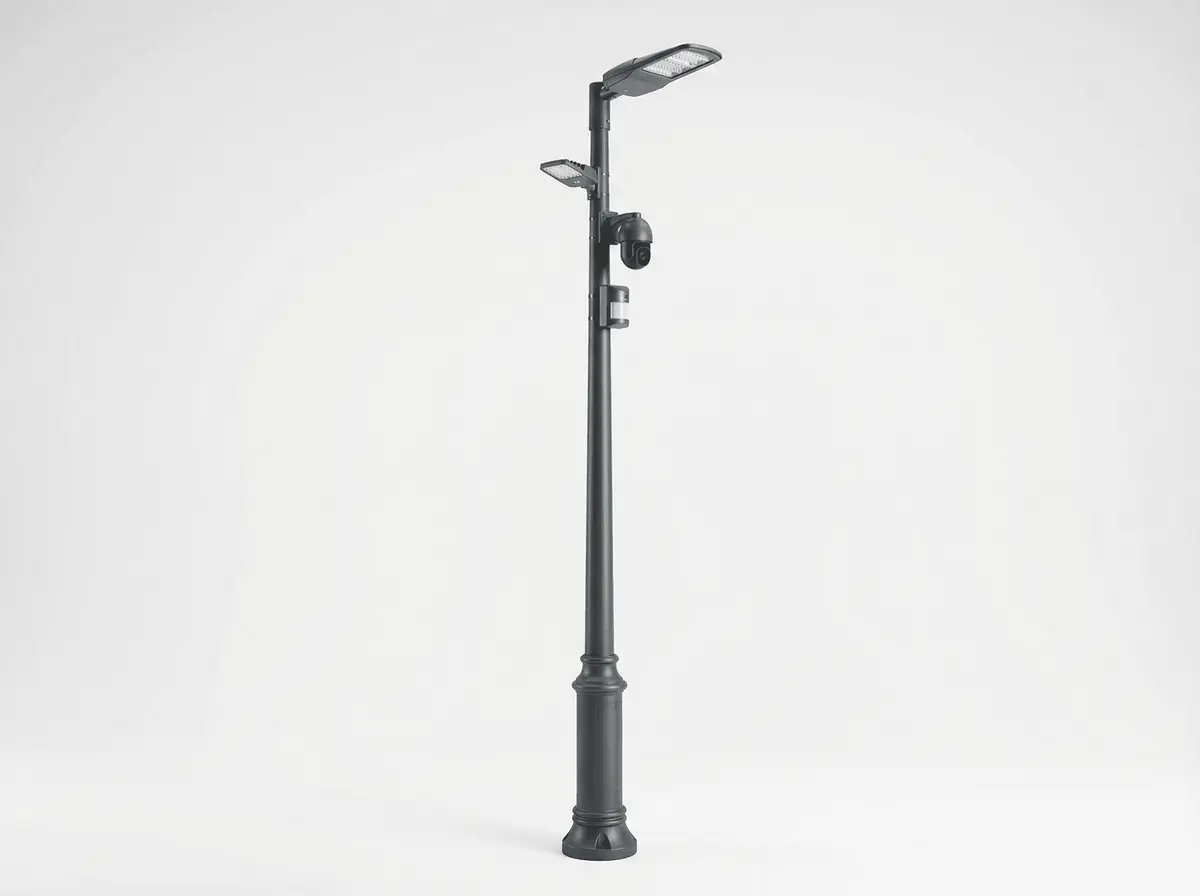
A practical example from integrated smart pole design shows the value of consolidation. The 8m Campus/Park Environmental Smart Streetlight combines 5 functions in 1 pole and can reduce civil interfaces by roughly 40-60% compared with multi-device layouts. Fewer interfaces usually mean fewer failure points, fewer maintenance records, and fewer site visits over the asset life.
System Design Logic: Smart Lighting Control and Battery Sizing
Smart lighting control and battery sizing should be calculated together because a 30-50% reduction in nightly load can directly reduce battery capacity, panel size, and replacement frequency.
The design sequence should start with the load profile, not the battery catalog. If a project uses an 80 W, 120 W, or 200 W LED luminaire, the actual nightly energy draw depends on dimming schedule, controller losses, driver efficiency, and seasonal operating hours. A lamp running 12 hours at fixed full power has a very different storage requirement from one running 4 hours at 100%, 4 hours at 60%, and 4 hours at 30%.
According to NREL (2024), system modeling accuracy improves when real operating assumptions are used rather than nameplate-only inputs. The same principle applies to solar streetlights. For example, a nominal 120 W light at full output for 12 hours consumes 1.44 kWh before system losses, while a stepped dimming profile may reduce that to about 0.80-1.00 kWh, depending on driver and controller efficiency.
Battery sizing method for maintenance cost control
Battery sizing for lower maintenance cost usually targets 2-3 nights of autonomy, controlled depth of discharge, and temperature margin rather than the smallest possible Ah value.
A simplified sizing method uses five inputs:
- LED load in watts
- Nightly operating hours, often 10-12 hours
- Dimming schedule by time block
- System losses, often 10-15%
- Required autonomy, usually 2-3 nights
Sample deployment scenario (illustrative): a 120 W luminaire runs 4 hours at 100%, 4 hours at 60%, and 4 hours at 30%. Nightly lighting energy is 480 Wh + 288 Wh + 144 Wh = 912 Wh. Add 12% system losses and the battery must supply about 1,021 Wh per night. For 3 nights of autonomy, usable energy becomes about 3,063 Wh. If LiFePO4 usable depth of discharge is limited to 80%, nominal battery capacity should be about 3,829 Wh.
At a 25.6 V battery platform, that example needs roughly 150 Ah nominal capacity. If the project instead uses fixed 100% output for 12 hours, nominal battery capacity rises substantially, which increases battery cost, cabinet size, and replacement exposure. This is why dimming strategy is not only an energy topic; it is a maintenance labor topic.
Why LiFePO4 chemistry is usually preferred
LiFePO4 batteries usually lower maintenance frequency because cycle life commonly reaches 4,000-6,000 cycles at controlled depth of discharge, far above lead-acid alternatives in streetlight duty.
For B2B procurement, the relevant metrics are not only Ah and voltage. Buyers should compare cycle life at 80% depth of discharge, temperature behavior above 45°C, battery management system functions, and replacement logistics. A lower-cost battery with 1,200-1,500 cycles may look acceptable at bid stage but can create labor-heavy replacement programs within a few years.
According to IRENA (2024), battery storage economics continue improving, but application-specific design remains essential. In solar streetlights, oversizing the battery by a moderate margin can reduce deep cycling and extend service life, while undersizing creates repeated low-voltage events, nuisance shutdowns, and unnecessary maintenance dispatches.
Implementation Models and Product Options for B2B Projects
Integrated smart poles reduce maintenance touchpoints by replacing 3-5 roadside devices with 1 managed asset, which can simplify inspection routines, spare-parts planning, and fault isolation.
Not every project needs the same pole architecture. Some roads only need solar lighting with remote dimming and battery telemetry. Others need camera, environmental sensing, display, WiFi, or public audio. The maintenance labor question should guide the configuration: every added module must justify its inspection and replacement burden.
SOLAR TODO offers several relevant smart streetlight configurations that illustrate how integration changes maintenance economics. The 8m Campus/Park Environmental Smart Streetlight combines an 80 W LED luminaire, AI camera, environmental sensor, WiFi module, and USB charging interface in one IP66 pole with a 25-year design life. The 9m Commercial Street 6-in-1 with Display adds 120 W lighting, 4K camera surveillance, LED display, WiFi, and IP public audio, reducing visible street furniture count by up to 60% compared with separate assets.
For higher-demand threshold lighting, the 10m Tunnel Entrance Smart Pole uses a 200 W LED module at 170 lm/W, delivering about 34,000 lumens, with AI camera, environmental sensor, and LED display in one 10 m octagonal steel pole. Although tunnel entrance projects are usually grid-powered rather than stand-alone solar, the same maintenance principle applies: one integrated structure is easier to inspect and manage than 3-4 separate roadside assets.
Comparison of relevant smart streetlight configurations
The right smart streetlight configuration depends on pole height, lighting load, module count, and whether the project prioritizes autonomy, surveillance, or public information functions.
| Model | Pole Height | Lighting | Integrated Functions | Protection | Typical Installed Budget |
|---|---|---|---|---|---|
| 8m Campus/Park Environmental Smart Streetlight | 8 m | 80 W | AI camera, environmental sensor, WiFi, USB | IP66 | USD 1,400-1,600 |
| 9m Commercial Street 6-in-1 with Display | 9 m | 120 W | 4K camera, environmental sensing, LED display, WiFi, IP audio | IP66 | Project-based quotation |
| 10m Tunnel Entrance Smart Pole | 10 m | 200 W | AI camera, environmental sensor, LED display | IP66 | USD 1,800-2,200 |
For solar projects, these integrated logic points still apply even when the exact product package differs. If one pole replaces multiple devices, maintenance routes become shorter, fault tracing becomes simpler, and spare inventory can be standardized around fewer SKUs. That is often more valuable than saving a small amount on first cost.
EPC Investment Analysis and Pricing Structure
EPC turnkey delivery usually provides the lowest lifecycle risk because it combines design, procurement, installation, commissioning, and training into one scope, even if initial price is 15-25% above basic supply.
For B2B buyers, pricing must be separated into supply scope and installed scope. A low ex-works or FOB unit price does not include foundations, solar resource verification, battery commissioning, control programming, or operator training. Those omissions often reappear later as change orders or labor inefficiencies.
A practical three-tier structure is:
- FOB Supply: equipment only, typically pole, luminaire, controller, battery, PV module, brackets, and standard documentation
- CIF Delivered: FOB scope plus freight and insurance to destination port
- EPC Turnkey: delivered equipment plus civil works, installation, commissioning, lighting profile setup, testing, and handover training
Typical commercial guidance for smart solar streetlight procurement is shown below.
| Pricing Model | What It Includes | Best Use Case | Cost Position |
|---|---|---|---|
| FOB Supply | Equipment, factory test, packing | Contractors with local installation teams | Lowest initial price |
| CIF Delivered | FOB plus ocean freight and insurance | Importers managing local works | Mid-level landed price |
| EPC Turnkey | CIF-equivalent supply, foundations, erection, commissioning, training | Municipal or industrial owners seeking one-point responsibility | Highest initial price, lower execution risk |
Volume pricing guidance for planning:
- 50+ units: about 5% discount
- 100+ units: about 10% discount
- 250+ units: about 15% discount
Payment terms commonly used by SOLAR TODO are:
- 30% T/T deposit and 70% against B/L
- 100% L/C at sight for qualified transactions
For large projects above USD 1,000,000, financing support may be available after technical and commercial review. For quotation support, buyers can contact [email protected] or call +6585559114.
ROI and maintenance labor savings
Smart lighting control and correct battery sizing can shorten payback by reducing battery replacements, outage visits, and night patrol labor, often improving lifecycle economics by 15-30% versus poorly sized fixed-output systems.
Sample deployment scenario (illustrative): assume a conventional non-networked solar streetlight fleet of 100 poles requires 2 inspection rounds per month, with each round taking 2 technicians and 1 vehicle for 8 hours. If remote monitoring and alarm-based dispatch reduce routine visits by 25%, annual labor and vehicle hours decline materially before counting reduced battery failures from better sizing. If battery replacement frequency also drops by 1 cycle over the project term, the savings can exceed the incremental cost of smart controllers.
The International Energy Agency states, "Digital technologies are becoming essential tools for managing energy systems efficiently." In streetlighting, that means telemetry, dimming schedules, and fault codes should be treated as cost-control tools, not optional extras. SOLAR TODO typically recommends evaluating 5-year and 10-year total cost of ownership, not first-year capex only.
Selection Criteria, Maintenance Planning, and Common Failure Prevention
The lowest-maintenance solar streetlight system usually combines IP66 hardware, LiFePO4 storage, remote diagnostics, and a verified dimming profile that keeps average nightly discharge below about 70-80%.
Procurement teams should request a design sheet that shows solar module wattage, battery nominal voltage and Ah, controller rating, autonomy target, local peak sun hours, and expected nightly Wh consumption. Without those numbers, it is difficult to judge whether the battery is correctly sized or simply minimized to reduce bid price.
A practical maintenance-focused checklist includes:
- Pole material and corrosion protection, such as galvanized steel with fluorocarbon coating
- Wind resistance, often 150 km/h or higher for exposed roads
- Ingress protection at IP66 for luminaire and control compartments
- Operating temperature range, such as -40°C to +55°C for harsh climates
- Controller features including dimming schedule, low-voltage disconnect, and remote alarm
- Battery chemistry, cycle life, and BMS protections
- Spare-parts strategy for drivers, controllers, and communication modules
According to IEC 60598 and IEC 62722 guidance, luminaire safety and LED performance stability are central to long-term operation. According to UL and IEEE interconnection and safety practice, control electronics and battery systems also need disciplined protection design. In field terms, many service calls come from water ingress, thermal stress, loose terminals, or repeated deep discharge rather than from the LED chips themselves.
Common mistakes that increase labor cost
Undersized batteries, uncontrolled full-night output, and missing telemetry are the three most common design errors that drive avoidable maintenance visits within the first 24-36 months.
If the battery is sized only for ideal weather, one cloudy period can trigger repeated low-voltage shutdowns. If the luminaire stays at 100% output all night, battery cycling becomes deeper and service life shortens. If there is no remote monitoring, technicians must visit poles simply to identify whether the problem is the lamp, controller, battery, or solar module.
SOLAR TODO recommends matching control strategy to road class and service priority. A perimeter road may accept aggressive dimming after midnight, while a logistics yard or transport corridor may require a higher minimum output. The correct answer is not one universal battery size; it is a documented energy budget tied to the application.
FAQ
Q: How do smart solar streetlights reduce maintenance labor cost? A: Smart solar streetlights reduce maintenance labor by using remote monitoring, scheduled dimming, and integrated components that cut unnecessary site visits. When one pole replaces 3-5 separate assets and sends fault alarms automatically, technicians spend less time on inspection rounds, night patrols, and manual troubleshooting.
Q: What battery autonomy is recommended for solar streetlight projects? A: Most B2B projects target 2-3 nights of autonomy, depending on local solar resource and road criticality. That range usually balances capex and reliability better than minimum-size designs, especially when LiFePO4 batteries are kept within about 70-80% routine depth of discharge.
Q: Why is battery sizing linked to maintenance cost instead of only performance? A: Battery sizing directly affects replacement frequency, low-voltage shutdowns, and emergency service calls. An undersized battery may still pass a short factory test, but repeated deep discharge can shorten life and create labor-heavy troubleshooting within 24-36 months.
Q: What dimming strategy works best for reducing lifecycle cost? A: A stepped schedule such as 4 hours at 100%, 4 hours at 60%, and 4 hours at 30% is a common starting point for many roads. The best profile depends on traffic density, security requirements, and local standards, but smart dimming often cuts nightly energy demand by 30-50%.
Q: Which battery chemistry is usually preferred for smart solar streetlights? A: LiFePO4 is usually preferred because it offers higher cycle life, better depth-of-discharge tolerance, and lower maintenance frequency than lead-acid in most streetlight duty cycles. Buyers should still verify BMS protection, temperature limits, and cycle-life data at a stated discharge level such as 80% DoD.
Q: What should be included in an EPC turnkey streetlight package? A: EPC turnkey scope should include design verification, equipment supply, foundations, pole erection, controller programming, commissioning, and operator training. For larger projects, it should also include battery commissioning records, lighting profile setup, spare-parts planning, and as-built documentation.
Q: How do FOB, CIF, and EPC prices differ for procurement decisions? A: FOB covers equipment supply only, CIF adds freight and insurance to the destination port, and EPC includes installation and commissioning. The price gap can look large at bid stage, but EPC often lowers execution risk and avoids hidden labor costs from incomplete scope definition.
Q: What payment terms are common for SOLAR TODO projects? A: Common terms are 30% T/T in advance and 70% against B/L, or 100% L/C at sight for suitable transactions. For projects above USD 1,000,000, financing support may be available after technical review and commercial assessment.
Q: How often should smart solar streetlights be inspected? A: Inspection frequency depends on environment and control visibility, but remote-monitored systems usually allow fewer routine visits than non-networked poles. Many operators still schedule periodic checks every 6-12 months for structural condition, cleaning, terminal torque, and battery health verification.
Q: What standards should buyers check before approving a supplier? A: Buyers should review luminaire compliance with IEC 60598 and LED performance guidance under IEC 62722, then confirm battery, controller, and electrical safety documentation. For integrated poles, they should also review structural data, wind resistance, ingress protection, and corrosion protection details.
Q: When does an integrated smart pole make more sense than separate devices? A: An integrated pole makes more sense when the project needs lighting plus surveillance, sensing, display, or connectivity in the same corridor. Replacing several roadside devices with 1 managed structure can reduce trenching interfaces, maintenance records, and dispatch complexity over the asset life.
Q: How can buyers contact SOLAR TODO for project pricing? A: Buyers can request an offline quotation from SOLAR TODO based on pole height, lighting load, battery autonomy, and smart-control scope. For commercial support, contact [email protected] or call +6585559114 with project quantity, site conditions, and preferred delivery model.
References
- NREL (2024): PV performance modeling methods and solar resource assessment principles used for energy yield and storage sizing.
- IEC 60598 (2024): Luminaires safety requirements relevant to outdoor streetlighting equipment and protection design.
- IEC 62722 (2016): LED luminaire performance requirements used to evaluate output stability and product consistency.
- IEA (2023): Energy digitalization guidance showing how monitoring and control improve system operation and maintenance efficiency.
- IRENA (2024): Battery and renewable integration analysis supporting lifecycle-based storage selection rather than capex-only decisions.
- IEEE 1547 (2018): Interconnection and interoperability principles relevant to control, communications, and distributed energy system interfaces.
- UL 1973 (2022): Safety requirements for batteries used in stationary and auxiliary power applications, relevant to storage system risk control.
Conclusion
Smart solar streetlight systems lower maintenance labor cost when battery autonomy is set at 2-3 nights, routine discharge is controlled near 70-80%, and remote dimming cuts nightly energy by 30-50%.
For B2B projects, the bottom line is simple: choose a documented energy budget, integrated control, and lifecycle-based EPC scope instead of the lowest battery size on paper. SOLAR TODO can support that process with project-specific quotation, technical review, and financing options for larger deployments.
About SOLARTODO
SOLARTODO is a global integrated solution provider specializing in solar power generation systems, energy-storage products, smart street-lighting and solar street-lighting, intelligent security & IoT linkage systems, power transmission towers, telecom communication towers, and smart-agriculture solutions for worldwide B2B customers.
About the Author

SOLAR TODO
Solar Energy & Infrastructure Expert Team
SOLAR TODO is a professional supplier of solar energy, energy storage, smart lighting, smart agriculture, security systems, communication towers, and power tower equipment.
Our technical team has over 15 years of experience in renewable energy and infrastructure, providing high-quality products and solutions to B2B customers worldwide.
Expertise: PV system design, energy storage optimization, smart lighting integration, smart agriculture monitoring, security system integration, communication and power tower supply.
Cite This Article
SOLAR TODO. (2026). Solving maintenance labor cost: Smart Solar Streetlight…. SOLAR TODO. Retrieved from https://solartodo.com/knowledge/solving-maintenance-labor-cost-smart-solar-streetlight-systems-implementation-with-smart-lighting-control-and-battery
@article{solartodo_solving_maintenance_labor_cost_smart_solar_streetlight_systems_implementation_with_smart_lighting_control_and_battery,
  title = {Solving maintenance labor cost: Smart Solar Streetlight…},
  author = {SOLAR TODO},
  journal = {SOLAR TODO Knowledge Base},
  year = {2026},
  url = {https://solartodo.com/knowledge/solving-maintenance-labor-cost-smart-solar-streetlight-systems-implementation-with-smart-lighting-control-and-battery},
  note = {Accessed: 2026-04-30}
}
Published: April 30, 2026 | Available at: https://solartodo.com/knowledge/solving-maintenance-labor-cost-smart-solar-streetlight-systems-implementation-with-smart-lighting-control-and-battery
Subscribe to Our Newsletter
Get the latest solar energy news and insights delivered to your inbox.
View All Articles