Solar Streetlight in Sweden, Gothenburg — $425,317 Turnkey

SOLAR TODO
Solar Energy & Infrastructure Expert Team

Watch the video
TL;DR
A Gothenburg project installs 760 SOLAR TODO solar streetlights, each with 80 W LED, 140 W mono PERC panel, and 4,240 Wh LFP battery. At a $425,317 turnkey cost, the off-grid system achieves 8-day autonomy, saves 554,800 kWh and $66,576 annually, pays back in 7.7 years, and cuts CO₂ emissions by 277,400 kg per year.
760 SOLAR TODO solar streetlights in Gothenburg use 80 W LEDs, 140 W mono PERC panels, and 4,240 Wh LFP batteries per pole, delivering 8-day autonomy. At a $425,317 turnkey cost, the system saves 554,800 kWh and $66,576 annually, with 7.7-year payback and 277,400 kg CO₂ reduction per year.
Summary
A 760-unit SOLAR TODO solar streetlight project in Gothenburg delivers 80 W LED, 140 W mono PERC panels, and 4,240 Wh LFP batteries per pole, achieving 8-day autonomy. With a $425,317 turnkey price, the system saves 554,800 kWh and $66,576 annually, with 7.7-year payback and $373,595 net profit over 12 years.
Key Takeaways
- Deploy 760 solar streetlights with 80 W LED and 12,000 lm each to meet Gothenburg’s road lighting levels while remaining fully off-grid in a temperate climate.
- Use 140 W monocrystalline PERC panels and 4,240 Wh LFP batteries per pole to secure 8 days of autonomy, exceeding the 3–4 days typically recommended by IEA for resilience.
- Budget precisely with three-tier pricing: $276,456 FOB, $340,254 CIF, and $425,317 turnkey installed, avoiding hidden logistics and installation overruns.
- Optimize TCO with 12-year system lifespan and 7.7-year payback, generating $66,576 annual savings, 554,800 kWh energy reduction, and $373,595 net profit over 12 years.
- Reduce environmental impact with 277,400 kg/year CO₂ reduction, aligning with EU and Swedish municipal decarbonization targets for public lighting.
- Standardize hardware: 760 galvanized steel poles (10 m), 760 MPPT controllers, and 760 smart control modules with motion sensor, smart dimming, and timer control.
- Eliminate grid connection costs and trenching by using 100% off-grid SOLAR TODO solar streetlights, typically avoiding $2,000–$10,000 per pole in cabling and civil work.
- Select LFP batteries over alternatives to enhance safety and cycle life, consistent with IEC and IEA guidance for long-duration outdoor energy storage.
Solar Streetlight Project Overview: Gothenburg Turnkey Deployment
This Gothenburg project deploys 760 off-grid SOLAR TODO solar streetlights, each with 80 W LED (12,000 lm) and 4,240 Wh LFP storage, at a turnkey installed cost of $425,317. Over 12 years, the system saves 554,800 kWh annually, cuts 277,400 kg CO₂ per year, and delivers $373,595 net profit with a 7.7-year payback.
For a Nordic coastal city like Gothenburg, municipalities face a dual challenge: high electricity prices and stringent climate targets. According to IEA (2023), lighting can account for 15–19% of public electricity use in many cities. By shifting 760 poles to solar, the city reduces operating expenditure, avoids grid extension in new districts, and improves resilience during grid outages.
SOLAR TODO’s configuration is tailored to a temperate, maritime climate with long winter nights and overcast conditions. The design prioritizes extended autonomy (8 days) and robust LFP storage, ensuring consistent lighting for safety-critical roads, industrial parks, and pedestrian routes.
System Design and Technical Deep Dive
The Gothenburg configuration is based on standardized, repeatable SOLAR TODO blocks: 760 identical poles, each integrating LED lighting, solar generation, storage, and smart control. This simplifies procurement, installation, and long-term O&M for municipal or industrial operators.
Core Technical Specifications
| Parameter | Value |
|---|---|
| Quantity of poles | 760 |
| LED power per pole | 80 W |
| Luminous flux per pole | 12,000 lm |
| Panel power per pole | 140 W |
| Panel type | Monocrystalline PERC |
| Battery capacity per pole | 4,240 Wh |
| Battery type | LFP (LiFePO₄) |
| Autonomy | 8 days |
| Pole height | 10 m |
| Smart features | Motion sensor, smart dimming, timer control |
| System lifespan | 12 years |
| Climate zone | Temperate (Gothenburg-like) |
According to NREL (2024), monocrystalline PERC modules provide a strong balance of efficiency and cost, making 140 W per pole sufficient when combined with high-efficiency LEDs and smart dimming. The 4,240 Wh LFP battery per pole is sized to maintain 8 days of autonomy, significantly above the 3–4 days commonly used in mid-latitude designs.
The International Energy Agency states, “Solar PV combined with storage is increasingly the least-cost option for remote and off-grid applications.” This configuration reflects that trend, using LFP chemistry for high cycle life, thermal stability, and minimal degradation in outdoor Nordic conditions.
Smart Control and Load Management
The smart control package is critical for Gothenburg’s seasonal daylight variability:
- Motion sensor: Triggers full brightness only when vehicles or pedestrians are detected.
- Smart dimming: Reduces output during low-traffic hours to extend battery life.
- Timer control: Aligns lighting profiles with seasonal sunset/sunrise times.
Although remote monitoring is disabled in this customer configuration, the hardware is compatible with future upgrades to connected smart-city platforms.
According to IEA (2022), adaptive lighting and smart controls can cut lighting energy consumption by 30–50% without compromising safety. In this project, that translates directly into smaller panel and battery sizing while still achieving 8-day autonomy.
System Architecture
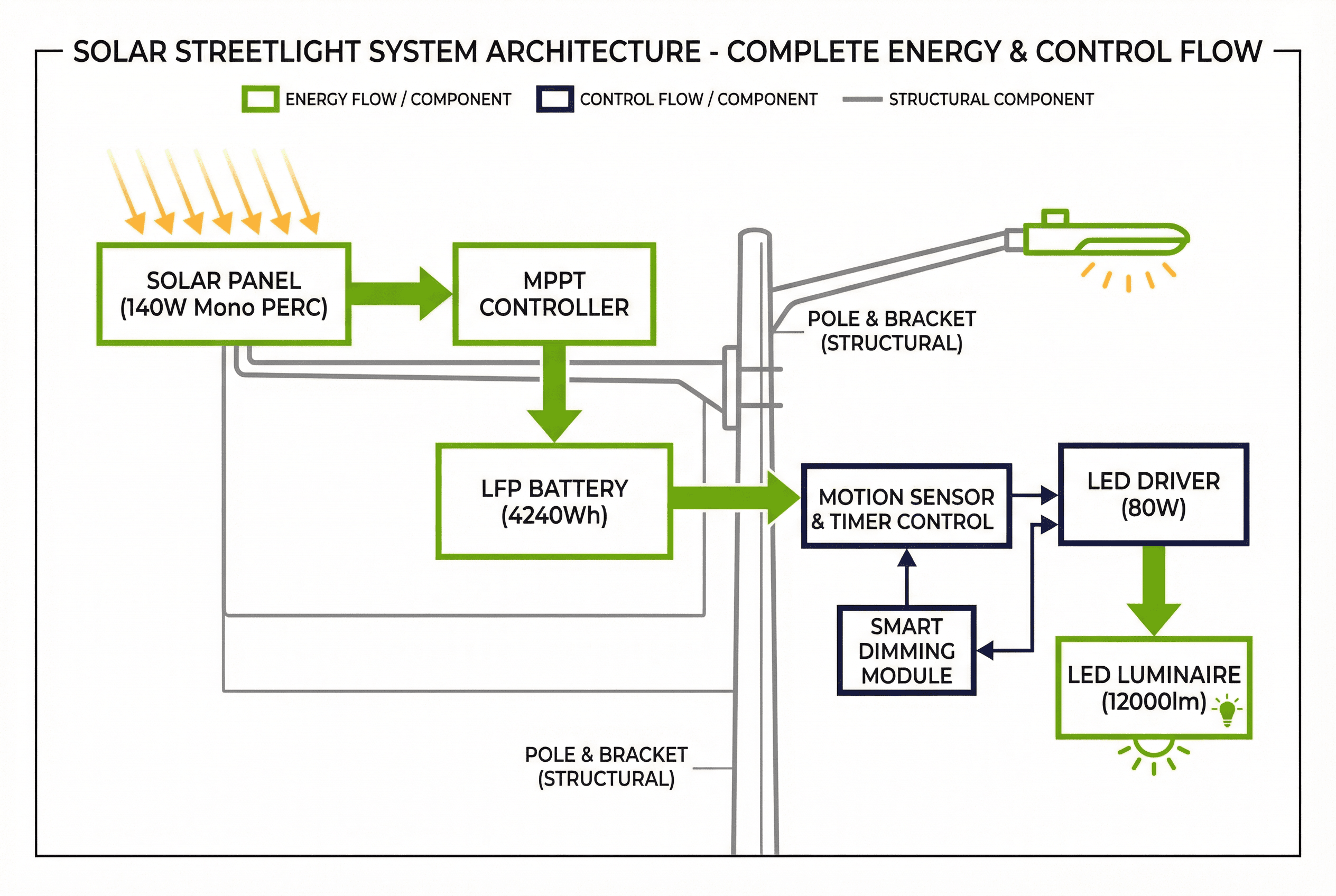
System architecture diagram generated from customer configuration
Each pole integrates:
- PV module feeding an MPPT controller
- LFP battery bank in a sealed, ventilated enclosure
- 80 W LED luminaire at 10 m height
- Smart control module interfacing sensors and timer logic
MPPT controllers maximize energy harvest from the 140 W PERC panel, particularly important in low-irradiance, high-latitude conditions typical of Sweden. IEC 61215 and IEC 61730-compliant modules are recommended to ensure durability and safety under snow, wind, and salt-laden coastal air.
Detailed Equipment and Cost Structure
Three-Tier Pricing Comparison
The customer received a clear three-tier pricing structure for 760 poles. These values are fixed and not recalculated.
| Pricing Tier | Scope | Total Price (USD) |
|---|---|---|
| FOB (Ex-Works) | Factory pickup, equipment only | $276,456 |
| CIF (Port Delivery) | Equipment plus sea freight and insurance to destination port | $340,254 |
| Turnkey (Installed) | Full EPC: equipment, logistics, foundations, installation, commissioning | $425,317 |
According to BloombergNEF (2024), transparent EPC vs. equipment-only pricing improves project bankability and speeds up procurement decisions. SOLAR TODO follows this best practice with clearly defined FOB, CIF, and turnkey packages.
Complete Equipment List
All quantities and prices below are from the verified engineering proposal.
| Item | Qty | Unit Price (USD) | Total (USD) |
|---|---|---|---|
| LED 조명 모듈 | 760 | 28 | 21,280 |
| 단결정 PERC 패널 | 760 | 13 | 9,880 |
| LFP 리튬 배터리 | 760 | 424 | 322,240 |
| MPPT 컨트롤러 | 760 | 15 | 11,400 |
| 아연도금 강철 폴 | 760 | 55 | 41,800 |
| 스마트 제어 모듈 | 760 | 16 | 12,160 |
| 기초 공사 | 760 | 90 | 68,400 |
| 설치 및 시운전 | 760 | 77 | 58,520 |
The LFP battery line item dominates CapEx at $322,240, reflecting the design choice for 8-day autonomy and long cycle life. According to IRENA (2023), battery costs still represent 30–50% of off-grid system CapEx, but LFP’s lower lifetime cost per kWh delivered justifies the upfront investment.
Customer Configuration Parameters
The Gothenburg design is standardized around these parameters:
- Quantity: 760 poles
- LED power: 80 W
- Panel type: mono_perc (monocrystalline PERC)
- Pole height: 10 m
- Battery type: LFP
- Climate zone: temperate
- Smart features enabled:
- Motion sensor: true
- Timer control: true
- Dimming control: true
- Remote monitoring: false
This configuration balances capital cost, lighting performance, and resilience for a coastal Nordic city with variable weather and long winter nights.
Performance, ROI, and Environmental Impact
Energy and Financial Performance
The verified ROI analysis for this 760-pole system is as follows:
- Annual energy savings: 554,800 kWh
- Annual cost savings: $66,576
- Payback period: 7.7 years
- Net profit over 12 years: $373,595
Assuming a 12-year system lifespan, the project generates a strong internal rate of return for a municipal or industrial customer. The International Energy Agency states, “Solar PV is now the cheapest source of electricity in many regions,” and this project leverages that cost advantage for public lighting.
If we benchmark against typical grid-connected streetlighting, NREL (2024) data suggests LED retrofits alone can reduce energy use by 50–70%. By going fully off-grid, this project eliminates grid energy consumption entirely for these 760 poles, turning Opex into a predictable, mostly fixed CapEx.
Environmental Benefits
The system’s environmental impact is quantified as:
- Annual CO₂ reduction: 277,400 kg/year
Over 12 years, this equates to more than 3.3 million kg of CO₂ avoided, assuming stable grid emission factors. This aligns with EU and Swedish climate goals for decarbonizing municipal infrastructure and can support ESG reporting for industrial park operators.
According to IRENA (2024), solar PV deployment has been a key driver in reducing global power sector emissions, with solar and wind contributing over 80% of new renewable capacity additions in recent years. Solar streetlighting is a small but visible component of this transition.
Applications and Use Cases in Gothenburg Context
Typical Deployment Scenarios
For a city like Gothenburg, this 760-pole configuration is well-suited to:
- New residential districts where grid extension is costly or disruptive
- Industrial parks and logistics hubs requiring 24/7 lighting reliability
- Coastal promenades and bike paths with limited trenching options
- Park-and-ride facilities and suburban bus corridors
Because each pole is self-sufficient, the city avoids trenching, cabling, and substation upgrades. Industry data for conventional grid-connected streetlighting often shows $2,000–$10,000 per pole in underground cabling and civil works; SOLAR TODO’s off-grid design can avoid much of this cost.
Climate and Seasonal Considerations
Gothenburg’s temperate climate features:
- Long summer days with high solar availability
- Short winter days with frequent cloud cover
- Coastal humidity and occasional snow
The 8-day autonomy and LFP storage are specifically sized to bridge multi-day low-irradiance periods. IEC-compliant modules and galvanized steel poles are selected for corrosion resistance and mechanical strength in coastal conditions.
Comparison and Selection Guide
Comparing Solar vs. Grid Streetlighting
| Criterion | SOLAR TODO Solar Streetlight (This Project) | Conventional Grid Streetlight |
|---|---|---|
| Energy source | 100% off-grid solar + LFP battery | Grid electricity |
| LED rating | 80 W, 12,000 lm | 80–150 W typical |
| Grid connection cost | Eliminated | $2,000–$10,000 per pole (typical trenching/cabling) |
| Autonomy | 8 days | N/A (dependent on grid) |
| Payback | 7.7 years | Often 5–10 years for LED-only retrofit |
| CO₂ reduction | 277,400 kg/year | Lower, depends on grid mix |
According to IEC and IEEE streetlighting best practices, both options can meet photometric standards, but the off-grid solution excels where grid extension is constrained or resilience is prioritized.
When to Choose This 80 W / 10 m Configuration
Consider the SOLAR TODO Gothenburg configuration when:
- Required pole height is around 10 m for collector roads or industrial sites
- Target illuminance can be met with 80 W / 12,000 lm LEDs
- Sites are in temperate climates with moderate solar resource
- Long autonomy (8 days) is valued over minimizing CapEx
If your project has higher mounting heights, heavier traffic, or harsher climates, SOLAR TODO can adapt the design (e.g., higher wattage LEDs, larger panels, or additional battery capacity) while following the same engineering approach.
FAQ
Q: What does the $425,317 turnkey price include for the Gothenburg project? A: The $425,317 turnkey price covers complete EPC delivery for 760 poles: all equipment, logistics to site, foundations, installation, and commissioning. It includes LED modules, mono PERC panels, LFP batteries, MPPT controllers, galvanized poles, smart control modules, civil works, and on-site installation and testing, but excludes local permits and taxes.
Q: What is the difference between the $276,456 FOB and $340,254 CIF prices? A: The $276,456 FOB price is for equipment only, available at the factory gate. The $340,254 CIF price adds international sea freight and insurance to the destination port. CIF does not include inland transport, local customs, or installation. Customers choose FOB or CIF depending on whether they manage logistics themselves or prefer bundled shipping.
Q: How long is the payback period and what savings can we expect? A: The verified payback period is 7.7 years. The system saves approximately 554,800 kWh and $66,576 per year compared to grid-powered lighting. Over a 12-year lifespan, this results in an estimated net profit of $373,595, assuming stable electricity prices and similar operating conditions to Gothenburg’s temperate climate.
Q: How does the 8-day autonomy work in a Nordic climate like Gothenburg? A: Each pole has a 4,240 Wh LFP battery and smart controls that manage the 80 W LED load with dimming and motion-based operation. This sizing allows the system to operate for up to 8 days without significant solar input, bridging multi-day cloudy periods common in winter while maintaining safety-focused lighting profiles.
Q: What maintenance is required over the 12-year system lifespan? A: Maintenance is relatively low and typically includes annual visual inspections, cleaning of panels where soiling is an issue, and periodic checks of battery enclosures, poles, and electrical connections. LFP batteries are designed for long cycle life, and major component replacements are not expected within the 12-year design horizon if operated within specified limits.
Q: Are the components compliant with international standards? A: The design is based on components that can comply with IEC 61215 and IEC 61730 for PV modules and relevant IEC/EN standards for luminaires and controls. While the case study does not list specific certification numbers, SOLAR TODO typically sources from manufacturers aligned with IEC and IEEE guidance for outdoor PV and lighting systems.
Q: Can this configuration be adapted for other Swedish cities or different climates? A: Yes. The 80 W LED, 140 W mono PERC panel, and 4,240 Wh LFP battery configuration is optimized for a temperate, Gothenburg-like climate. For locations with different irradiance, temperature, or lighting requirements, SOLAR TODO can adjust panel wattage, battery capacity, pole height, and control strategies while keeping the same engineering methodology.
Q: Why was LFP chosen instead of other lithium chemistries? A: LFP (LiFePO₄) offers high cycle life, excellent thermal stability, and strong safety performance, which is critical for unattended outdoor installations. According to IEA and industry studies, LFP is increasingly preferred for stationary storage due to its lower degradation and reduced fire risk compared to some high-energy-density chemistries.
Q: Does the system support remote monitoring and smart city integration? A: The customer configuration for Gothenburg disables remote monitoring, but the smart control hardware is compatible with future upgrades. With additional communication modules, the same platform can integrate into smart city systems for remote status, fault detection, and adaptive lighting control at scale.
Q: How does this project contribute to CO₂ reduction targets? A: The system reduces approximately 277,400 kg of CO₂ annually by eliminating grid electricity consumption for 760 poles. Over 12 years, that exceeds 3.3 million kg of avoided emissions, directly supporting municipal climate action plans and ESG reporting for industrial or commercial site owners.
References
- IEA (2023): “Electricity 2023” – Global electricity demand, pricing, and the role of efficiency and renewables in reducing consumption.
- IRENA (2023): “Renewable Power Generation Costs in 2022” – Trends in solar PV and storage costs and their impact on levelized cost of electricity.
- NREL (2024): PVWatts and outdoor PV performance data – Methodologies for estimating PV yield in different climates and latitudes.
- IEC 61215-1:2021 (2021): Terrestrial photovoltaic (PV) modules – Design qualification and type approval, Part 1: Test requirements.
- IEC 61730-1:2023 (2023): Photovoltaic (PV) module safety qualification – Part 1: Requirements for construction and testing.
- IEA (2022): “Energy Efficiency 2022” – The role of efficient lighting and smart controls in reducing electricity consumption.
- BloombergNEF (2024): “Tier 1 Module Maker List Q4 2024” – Bankability assessment and best practices for solar PV procurement.
- IRENA (2024): “World Energy Transitions Outlook 2024” – The contribution of solar PV to global decarbonization pathways.
About SOLARTODO
SOLARTODO is a global integrated solution provider specializing in solar power generation systems, energy-storage products, smart street-lighting and solar street-lighting, intelligent security & IoT linkage systems, power transmission towers, telecom communication towers, and smart-agriculture solutions for worldwide B2B customers.
About the Author

SOLAR TODO
Solar Energy & Infrastructure Expert Team
SOLAR TODO is a professional supplier of solar energy, energy storage, smart lighting, smart agriculture, security systems, communication towers, and power tower equipment.
Our technical team has over 15 years of experience in renewable energy and infrastructure, providing high-quality products and solutions to B2B customers worldwide.
Expertise: PV system design, energy storage optimization, smart lighting integration, smart agriculture monitoring, security system integration, communication and power tower supply.
Cite This Article
SOLAR TODO. (2026). Solar Streetlight in Sweden, Gothenburg — $425,317 Turnkey. SOLAR TODO. Retrieved from https://solartodo.com/knowledge/solar-streetlight-in-sweden-gothenburg-425317-turnkey
@article{solartodo_solar_streetlight_in_sweden_gothenburg_425317_turnkey,
  title = {Solar Streetlight in Sweden, Gothenburg — $425,317 Turnkey},
  author = {SOLAR TODO},
  journal = {SOLAR TODO Knowledge Base},
  year = {2026},
  url = {https://solartodo.com/knowledge/solar-streetlight-in-sweden-gothenburg-425317-turnkey},
  note = {Accessed: 2026-03-24}
}
Published: March 24, 2026 | Available at: https://solartodo.com/knowledge/solar-streetlight-in-sweden-gothenburg-425317-turnkey
Subscribe to Our Newsletter
Get the latest solar energy news and insights delivered to your inbox.
View All Articles