solar street light with LiFePO4 battery | SOLARTODO

Cinn Song
Founder & Chief Solutions Architect
TL;DR
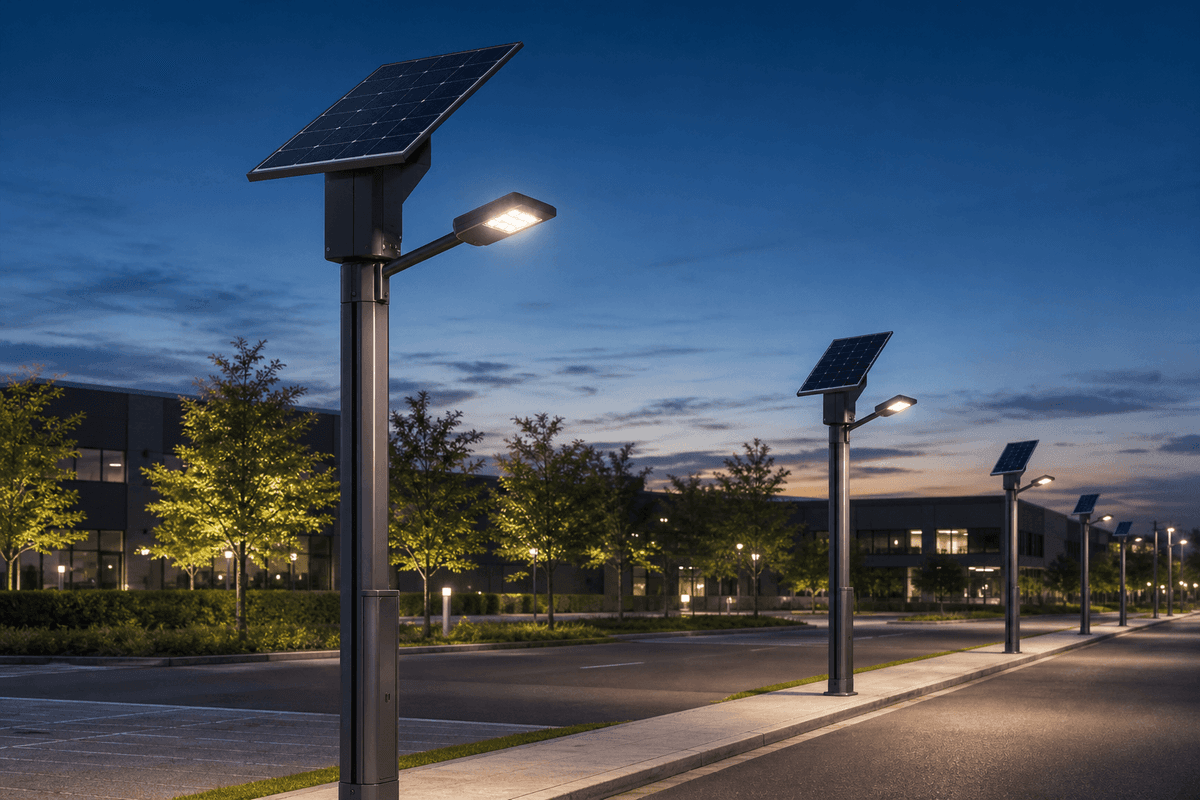
A solar street light with LiFePO4 battery is a standalone lighting system for roads, parking lots, industrial yards, and security perimeters. Specify 60W-150W LED output, 180Wp+ PV input, 720Wh-class storage, MPPT charging, IP65/IP66 protection, and 3-4 nights of autonomy. For B2B projects, compare FOB, CIF, and EPC turnkey pricing with expected 3-6 year payback.
Solar street lights with LiFePO4 batteries combine 60W-150W LED output, 720Wh-class storage, and 3-4 days of autonomy for off-grid roads, parking, campuses, and security perimeters.
Summary
Solar street lights with LiFePO4 batteries combine 60W-150W LED output, 720Wh-class storage, and 3-4 days of autonomy for off-grid roads, parking, campuses, and security perimeters.
Key Takeaways
LiFePO4 solar street lights are best specified by matching 3-4 days of autonomy, IP65/IP66 protection, and site-specific irradiance before procurement.
- Specify 720Wh or larger LiFePO4 storage for 60W security street lights requiring 4 nights of cloudy-weather autonomy.
- Require IP65/IP66 housings and corrosion-resistant poles for ports, highways, coastal roads, and industrial yards with 10-year design expectations.
- Use 180Wp TOPCon modules for 60W all-in-one lights when low-light yield and 22%+ module efficiency matter.
- Compare FOB, CIF, and EPC turnkey pricing for 50, 100, and 250+ pole projects before issuing a purchase order.
- Model payback in 3-6 years by comparing trenching, cabling, utility energy, diesel backup, and maintenance costs.
- Select MPPT controllers to improve solar charging by 10-30% versus basic PWM controllers in variable irradiance markets.
- Plan 12-month inspections for panels, batteries, poles, fasteners, camera modules, and lighting schedules across the asset fleet.
- Request IEC 61215, IEC 61730, IEC 62124, and battery safety documentation before approving supplier qualification.
Solar Street Light With LiFePO4 Battery: B2B Procurement Context
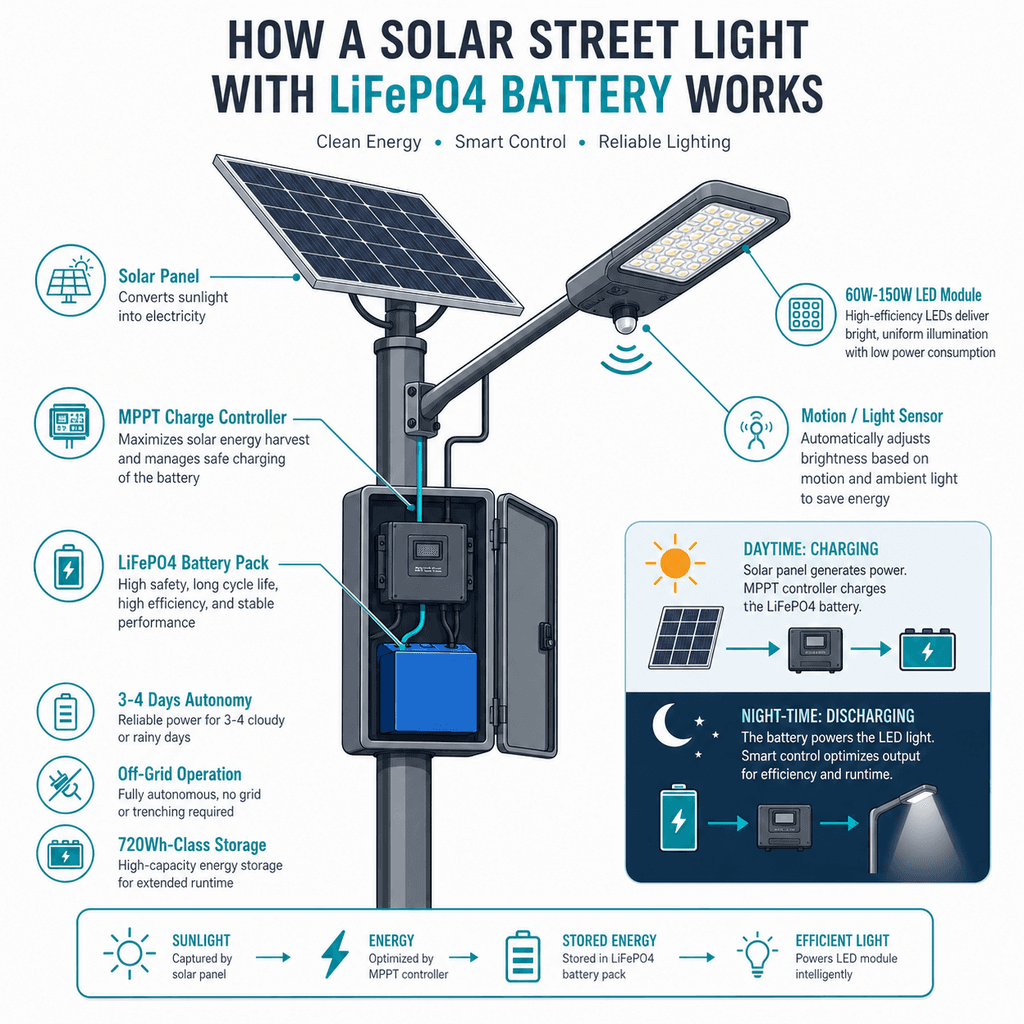
A solar street light with LiFePO4 battery typically combines a 60W-150W LED luminaire, 180Wp-450Wp solar input, and 3-4 days of autonomy for off-grid infrastructure.
For procurement managers and EPC teams, the product is not only a lamp. It is a small standalone power system with generation, storage, charge control, lighting control, pole structure, optional communications, and maintenance planning. The buying decision should therefore be based on lighting performance, battery reserve, solar resource, installation risk, and after-sales support, not only wattage.
SOLARTODO supplies solar streetlights for municipal roads, industrial parks, telecom sites, border areas, public parks, parking lots, agricultural facilities, and perimeter security projects. A typical SOLARTODO 8m security all-in-one model uses a 60W LED luminaire, 180Wp TOPCon solar panel, 720Wh LiFePO4 battery, MPPT charge controller, and optional 2MP infrared 4G camera with 7 days of onboard video storage.
According to IRENA (2025), 91% of newly commissioned utility-scale renewable capacity in 2024 delivered lower-cost power than the cheapest new fossil alternative. IRENA states, 'renewables continued to represent the most cost-competitive source of new electricity generation in 2024.' For remote lighting, this cost trend matters because solar street lights avoid trenching, grid extension, diesel logistics, and utility metering.
LiFePO4 chemistry is preferred over lead-acid and many older lithium chemistries because it offers higher thermal stability, deeper usable discharge, and longer cycle life. For street lighting projects in Latin America, the Middle East, Africa, Southeast Asia, and Europe, this reduces battery replacement risk and supports predictable O&M budgets.
Technical Architecture and Performance Design
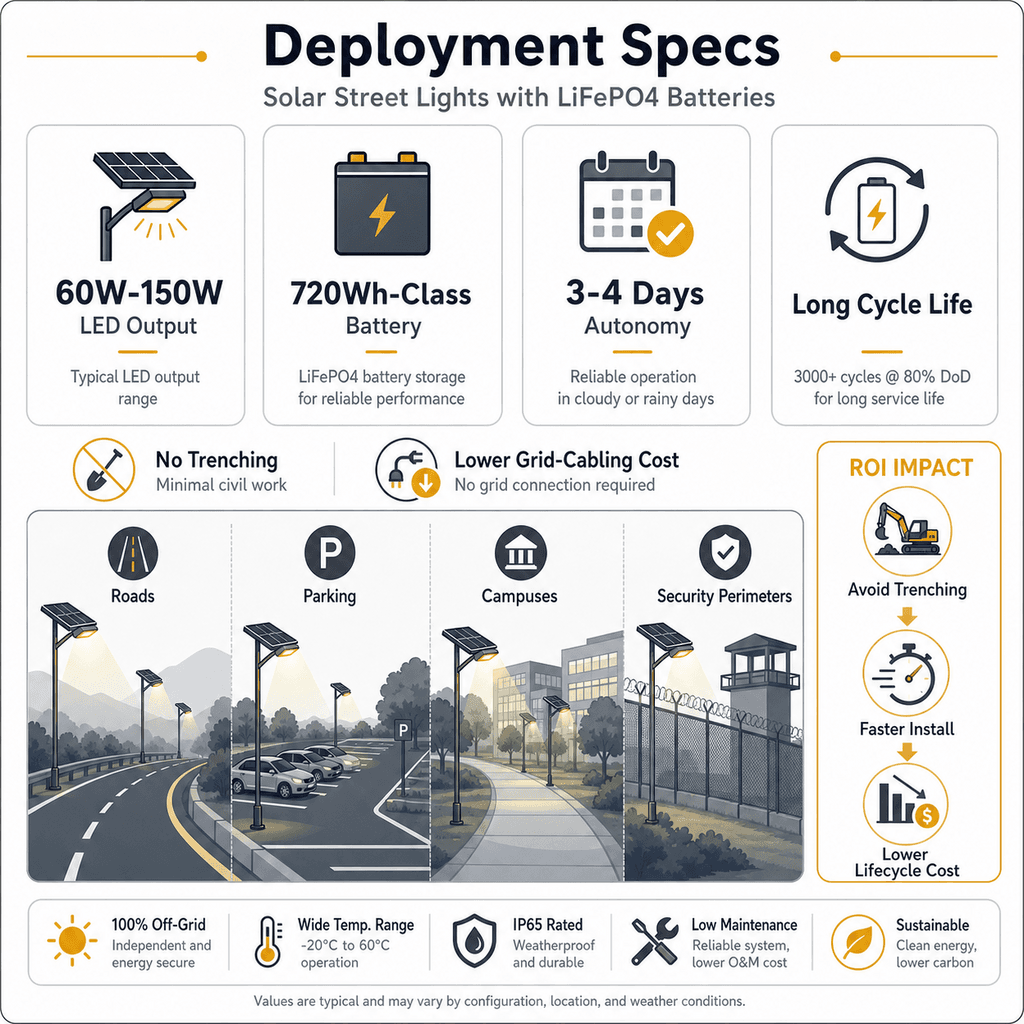
A reliable LiFePO4 solar street light needs correctly matched PV wattage, battery Wh capacity, LED load, MPPT control, and dimming schedule for 365-night operation.
The core sizing equation is simple: daily energy consumption must be lower than the recoverable solar energy and the battery reserve must cover low-irradiance days. A 60W LED running at full power for 12 hours would consume 720Wh per night, but intelligent dimming can reduce actual consumption by 35-60%. For example, a schedule using 100% output for 4 hours, 50% for 6 hours, and 30% for 2 hours reduces overnight load to about 444Wh.
A 180Wp TOPCon module can recharge the system effectively in many subtropical and tropical regions when the installation has clear sun exposure and correct tilt. According to NREL PVWatts (2026), PV output estimates use long-term weather data to represent interannual solar variation. For B2B projects, this means every bid should include location-specific irradiance assumptions, not a generic autonomy claim.
The LiFePO4 battery is the most important lifetime component. A 720Wh battery rated for more than 2,000 deep discharge cycles at 80% depth of discharge can support roughly 5 years of daily cycling under conservative thermal management. In hot climates, battery enclosure design, ventilation, BMS protection, and charge voltage limits matter as much as nominal capacity.
According to IEA (2024), battery storage is the fastest-growing clean energy technology in the power sector, and global battery deployment reached 85GW after more than 130% growth from the previous year. IEA states, 'battery storage is the fastest growing clean energy technology on the market.' This momentum is improving battery availability, cost structure, and supplier depth for distributed infrastructure.
Core Specification Checklist
Buyers should request measurable specifications rather than broad claims. Critical items include LED luminous efficacy, total lumens, battery chemistry, rated Wh capacity, solar panel Wp, controller type, charge/discharge protection, pole height, wind-load design, operating temperature, ingress protection, corrosion treatment, and warranty terms.
For SOLARTODO projects, standard solar streetlight options range from 4m decorative garden lights at about 15W to 12m industrial dual-head systems at about 150W and 25,500 lumens. Premium configurations can use TOPCon modules, LiFePO4 batteries, MPPT charging, IP65/IP66 housings, and smart control options.
Applications, Use Cases, and Selection Guide
LiFePO4 solar street lights fit projects where 30-minute pole deployment, 0 grid trenching, and 3-4 cloudy-day autonomy improve schedule certainty.
Municipal roads benefit when civil works are expensive or grid availability is limited. Because each pole is electrically independent, a failure on one unit does not darken a complete feeder line. This is useful for rural roads, new housing areas, bus corridors, parking areas, and temporary public works zones.
Industrial buyers use solar street lights for warehouses, logistics yards, mines, oil and gas roads, telecom compounds, and perimeter fences. Optional 4G camera integration converts a lighting pole into a security node, reducing the need for separate surveillance poles, AC cabling, and backup power supplies.
Agriculture and smart infrastructure projects use solar lighting for access roads, irrigation facilities, storage yards, and monitoring points. In these cases, the battery reserve must support both lighting and auxiliary electronics. A 2MP infrared 4G camera, PIR sensor, or LoRa/NB-IoT controller should be included in the load calculation.
| Project scenario | Recommended configuration | Key procurement metric | Typical benefit |
|---|---|---|---|
| Rural road | 40W-60W LED, 6m-8m pole, 120Wp-180Wp PV | 3-night autonomy | Avoids grid extension |
| Parking lot | 60W-100W LED, 8m pole, motion dimming | 10-25 lux target | Improves safety and visibility |
| Industrial yard | 100W-150W LED, 10m-12m pole, dual head | 15,000-25,500 lumens | Covers wider work zones |
| Security perimeter | 60W LED, 180Wp TOPCon, 720Wh battery, 4G camera | 7-day video storage | Combines lighting and surveillance |
| Coastal highway | IP66, hot-dip galvanized pole, anti-corrosion coating | Wind and salt resistance | Reduces structural maintenance |
EPC Investment Analysis and Pricing Structure
EPC turnkey solar streetlight projects should compare FOB supply, CIF delivery, and installed pricing across 50, 100, and 250+ pole volumes.
EPC means Engineering, Procurement, and Construction. For solar street lighting, turnkey delivery normally includes lighting design, solar sizing, pole foundation guidance, bill of materials, manufacturing, logistics, installation supervision or installation labor, commissioning, training, as-built documentation, and warranty support. SOLARTODO can support inquiry-based quotations and project financing for qualified large deployments.
Pricing should be separated into three tiers. FOB Supply covers factory supply at origin and is best for buyers with their own freight forwarder and installation team. CIF Delivered includes sea freight and insurance to the destination port, which helps procurement teams control landed cost. EPC Turnkey includes design, logistics coordination, civil works, installation, commissioning, and handover support, which is usually preferred by municipalities and infrastructure developers.
Volume pricing should be negotiated at the project level. As planning guidance, 50+ units can target about a 5% discount, 100+ units about 10%, and 250+ units about 15%, subject to pole height, battery capacity, camera options, delivery country, and warranty scope. Payment terms normally include 30% T/T deposit plus 70% against bill of lading, or 100% L/C at sight for approved buyers.
ROI depends on what the solar system replaces. Against grid-tied lighting, savings come from avoided trenching, cables, panels, meters, and electricity bills. Against diesel or temporary lighting, savings also include fuel logistics, generator servicing, and downtime. Many off-grid road and industrial projects can justify payback in 3-6 years when avoided civil works and energy costs are included.
For projects above $1,000K, financing may be available after project qualification, technical review, country risk assessment, and buyer documentation. Procurement teams can contact [email protected] or +6585559114 for a project quotation; SOLARTODO is a B2B manufacturer and exporter, not an online marketplace.
Standards, Compliance, and Risk Control
Procurement teams should require at least 5 compliance checks covering PV modules, batteries, luminaires, controllers, structures, and grid interfaces.
IEC 61215-1:2021 defines design qualification and type approval requirements for terrestrial PV modules intended for long-term operation in open-air climates. IEC 61730-1:2023 addresses PV module safety qualification. IEC 62124 covers design verification for standalone PV systems, making it especially relevant for off-grid solar street lights.
For projects with grid interaction, IEEE 1547-2018 provides requirements for interconnection and interoperability of distributed energy resources with electric power systems. Fully off-grid streetlights may not require grid interconnection compliance, but the standard is still useful when hybrid grid-solar controls or centralized monitoring equipment are involved.
Battery documentation should include LiFePO4 cell grade, BMS functions, overcharge protection, over-discharge protection, short-circuit protection, operating temperature, and cycle-life test conditions. For luminaires, buyers should review LED driver certification, surge protection, photometric distribution, ingress protection, and thermal performance. In coastal or desert regions, pole coating thickness, fastener material, and wind-load assumptions should be written into the purchase specification.
FAQ
A well-specified solar street light with LiFePO4 battery should answer 10 common questions on autonomy, cost, installation, maintenance, standards, and warranty.
Q: What is a solar street light with LiFePO4 battery? A: A solar street light with LiFePO4 battery is an off-grid lighting system that combines a PV module, LED luminaire, lithium iron phosphate battery, charge controller, and pole. Typical B2B systems range from 15W garden lights to 150W industrial lights with 3-4 nights of autonomy.
Q: Why is LiFePO4 better than lead-acid for solar street lights? A: LiFePO4 batteries provide deeper usable discharge, longer cycle life, lower maintenance, and better thermal stability than lead-acid batteries. A 720Wh LiFePO4 pack rated above 2,000 cycles can support multi-year daily operation, while lead-acid batteries often need earlier replacement in hot climates.
Q: How much autonomy should a solar street light have? A: Most commercial projects should specify 3-4 nights of autonomy for cloudy or rainy weather. Critical security perimeters, highways, and public safety sites may require larger batteries or more aggressive dimming schedules to maintain illumination during extended low-irradiance periods.
Q: How do I size the battery for a 60W solar street light? A: Start with nightly energy use in Wh, then multiply by required autonomy and divide by allowable depth of discharge. A 60W light using intelligent dimming may consume about 400-500Wh per night, making a 720Wh LiFePO4 battery suitable for many 4-day designs when paired with adequate PV input.
Q: What does EPC turnkey delivery include for solar street lighting? A: EPC turnkey delivery usually includes engineering, procurement, logistics, civil works, installation, commissioning, training, and handover documentation. For 50+ pole projects, it reduces coordination risk because one supplier manages the technical sizing, equipment package, delivery schedule, and site implementation plan.
Q: What is the difference between FOB, CIF, and EPC pricing? A: FOB covers factory supply at origin, CIF adds freight and insurance to the destination port, and EPC includes installed delivery and commissioning. Buyers with local contractors may choose FOB or CIF, while municipalities and infrastructure developers often prefer EPC turnkey pricing for schedule and accountability.
Q: What maintenance is required after installation? A: Maintenance is usually light but should be scheduled every 12 months. Teams should clean panels where dust is heavy, inspect pole bolts and foundations, verify battery health, test lighting schedules, check camera connectivity, and confirm that the MPPT controller logs normal charging behavior.
Q: Can solar street lights work with 4G cameras? A: Yes, security solar street lights can integrate 2MP infrared 4G cameras, onboard storage, and remote monitoring. The camera load must be included in the energy model because 24/7 surveillance increases battery demand beyond lighting-only operation, especially during cloudy periods.
Q: What certifications should buyers request? A: Buyers should request PV module compliance with IEC 61215 and IEC 61730, standalone PV design alignment with IEC 62124, and relevant battery and luminaire safety documentation. For public projects, also confirm IP65/IP66 ratings, surge protection, photometric files, and pole wind-load calculations.
Q: What warranty should a B2B buyer expect? A: Warranty terms vary by specification, but buyers should separate warranties for LED luminaire, PV module, LiFePO4 battery, controller, camera, and pole. A stronger contract defines replacement terms, battery capacity retention, spare parts availability, response times, and whether labor is included.
Q: How fast can a solar street light be installed? A: All-in-one solar street lights can often be mounted in under 30 minutes per pole after foundations are ready. Total project duration depends more on civil works, pole spacing, road permits, logistics, and commissioning than on the luminaire installation itself.
Q: When should I choose SOLARTODO for a project? A: Choose SOLARTODO when the project requires B2B manufacturing support, export logistics, LiFePO4 storage, 3-4 day autonomy, optional 4G cameras, and offline quotation with financing review. It fits roads, industrial sites, parking lots, telecom compounds, and smart infrastructure programs.
References
Authoritative references should include at least 5 standards or agencies covering PV cost, battery markets, module safety, standalone design, and interconnection.
- IRENA (2025): Renewable Power Generation Costs in 2024; reports 91% of new utility-scale renewable capacity was cheaper than fossil alternatives and USD 467 billion in avoided fossil fuel costs. https://www.irena.org/Publications/2025/Jun/Renewable-Power-Generation-Costs-in-2024
- IEA (2024): Batteries and Secure Energy Transitions; identifies battery storage as the fastest-growing clean energy technology and reports 85GW installed battery capacity after 130% annual growth. https://www.iea.org/reports/batteries-and-secure-energy-transitions
- NREL PVWatts (2026): PVWatts Calculator v8.5 methodology; estimates PV energy production using long-term weather and solar resource assumptions for project-specific yield modeling. https://pvwatts.nrel.gov/
- IEC 61215-1:2021 (2021): Terrestrial photovoltaic modules design qualification and type approval, Part 1 test requirements for long-term open-air module operation. https://webstore.iec.ch/en/publication/61345
- IEC 61730-1:2023 (2023): Photovoltaic module safety qualification, Part 1 requirements for construction and safety-related module design.
- IEC 62124 (2004): Photovoltaic standalone systems design verification, relevant for off-grid PV lighting systems with integrated batteries and controllers.
- IEEE 1547-2018 (2018): Standard for interconnection and interoperability of distributed energy resources with electric power systems interfaces. https://standards.ieee.org/ieee/1547/5915/
- IES RP-8-22 (2022): Recommended practice for design and maintenance of roadway and parking facility lighting for roadway visibility and lighting quality.
Conclusion
A solar street light with LiFePO4 battery is a bankable off-grid lighting asset when 60W-150W output, 3-4 day autonomy, and EPC scope are specified clearly.
Bottom line: for roads, parking areas, industrial yards, and security perimeters, SOLARTODO LiFePO4 solar street lights reduce grid-dependence, shorten deployment, and support 3-6 year payback when civil works and energy savings are included.
About SOLARTODO
SOLARTODO is a global integrated solution provider specializing in solar power generation systems, energy-storage products, smart street-lighting and solar street-lighting, intelligent security & IoT linkage systems, power transmission towers, telecom communication towers, and smart-agriculture solutions for worldwide B2B customers.
About the Author

Cinn Song
Founder & Chief Solutions Architect
Cinn Song founded SOLARTODO LIMITED and leads its smart-city infrastructure engineering — from solar, storage and integrated smart poles to the company's push into physical-AI city edge nodes: pole-mounted edge computing, vertical LLMs for smart cities, drone-based O&M with autonomous battery swapping, robotic maintenance, and high-speed counter-UAS interception. Since 2010, he has directed turnkey EPC + BOT delivery across 50+ countries, including telecom monopole supply for national grid operators, off-grid solar street-lighting for African municipalities, and integrated smart-pole programs for Gulf smart cities.
Cite This Article
Cinn Song. (2026). solar street light with LiFePO4 battery | SOLARTODO. SOLARTODO. Retrieved from https://solartodo.com/knowledge/solar-street-light-with-lifepo4-battery
@article{solartodo_solar_street_light_with_lifepo4_battery,
  title = {solar street light with LiFePO4 battery | SOLARTODO},
  author = {Cinn Song},
  journal = {SOLARTODO Knowledge Base},
  year = {2026},
  url = {https://solartodo.com/knowledge/solar-street-light-with-lifepo4-battery},
  note = {Accessed: 2026-09-19}
}
Published: June 24, 2026 | Available at: https://solartodo.com/knowledge/solar-street-light-with-lifepo4-battery
Subscribe to Our Newsletter
Get the latest solar energy news and insights delivered to your inbox.
View All Articles