solar PV system cost per watt wholesale | SOLARTODO

SOLAR TODO
Solar Energy & Infrastructure Expert Team
Watch the video
TL;DR
Wholesale solar PV system cost per watt for B2B buyers typically ranges from about $0.26-$0.45/W for supply-only packages and $0.50-$0.85/W for EPC turnkey systems, with hybrid storage projects priced higher. The right comparison must include scope, standards, annual yield, and warranty, not just headline $/W. For many 50kW-500kW projects, better ROI comes from higher-efficiency TOPCon modules and a complete EPC breakdown.
Wholesale solar PV system pricing for B2B projects typically ranges from $0.26-$0.85/W by scope, with 50kW greenhouse systems at $24,800-$31,600 and 100kW+200kWh hybrid systems at $79,200-$101,200. Module efficiency now reaches 22.5%-24.5%, improving yield and payback.
Summary
Wholesale solar PV system pricing for B2B projects typically ranges from $0.26-$0.85/W by scope, with 50kW greenhouse systems at $24,800-$31,600 and 100kW+200kWh hybrid systems at $79,200-$101,200. Module efficiency now reaches 22.5%-24.5%, improving yield and payback.
Key Takeaways
- Compare wholesale pricing by delivery scope: FOB supply can start near $0.26-$0.45/W, while EPC turnkey commercial systems often land around $0.50-$0.85/W depending on storage, structure, and grid work.
- Size projects against real load data: a 100kWp commercial hybrid system can generate about 150-190MWh/year, which is enough to offset a large share of daytime commercial consumption.
- Select higher-efficiency modules when roof area is limited: N-type TOPCon modules at 22.5%-24.5% efficiency usually improve kWh/m2 and reduce BOS cost per delivered kWh.
- Separate PV-only and PV+storage economics: a 50kW greenhouse rooftop system costs about $24,800-$31,600, while a 100kW + 200kWh hybrid package costs about $79,200-$101,200.
- Use tiered procurement planning: orders above 50 units can target about 5% discount, 100+ about 10%, and 250+ about 15% depending on configuration standardization.
- Verify compliance before comparing quotes: require IEC 61215, IEC 61730, and IEEE 1547-related interconnection compatibility to avoid low-price offers with higher project risk.
- Model ROI with tariff and yield together: at electricity prices of $0.10-$0.18/kWh, annual savings from commercial PV can materially shorten payback to roughly 4-8 years in strong irradiance markets.
- Ask for a full cost breakdown: modules, inverter, mounting, cabling, protection, freight, duties, installation, and commissioning should each be priced so procurement teams can benchmark $/W accurately.
What Wholesale Cost Per Watt Really Means
Wholesale solar PV system cost per watt usually means total project price divided by DC capacity, and for B2B buyers it commonly spans $0.26-$0.85/W depending on whether the quote is FOB supply, CIF delivered, or EPC turnkey.
For procurement managers, the problem is not finding a low number. The problem is comparing unlike scopes. One supplier may quote only modules and inverter at $0.28/W, while another includes structure, combiner boxes, protection, freight, installation, testing, and grid paperwork at $0.62/W. Without a normalized scope, the cheaper quote can become the more expensive project.
A practical B2B comparison starts with three questions. First, is the price based on DC watts or AC watts? Second, does it include storage, civil works, and interconnection? Third, what standards and warranty terms are included? These three items can shift real project cost by 20%-40% on commercial systems above 50kW.
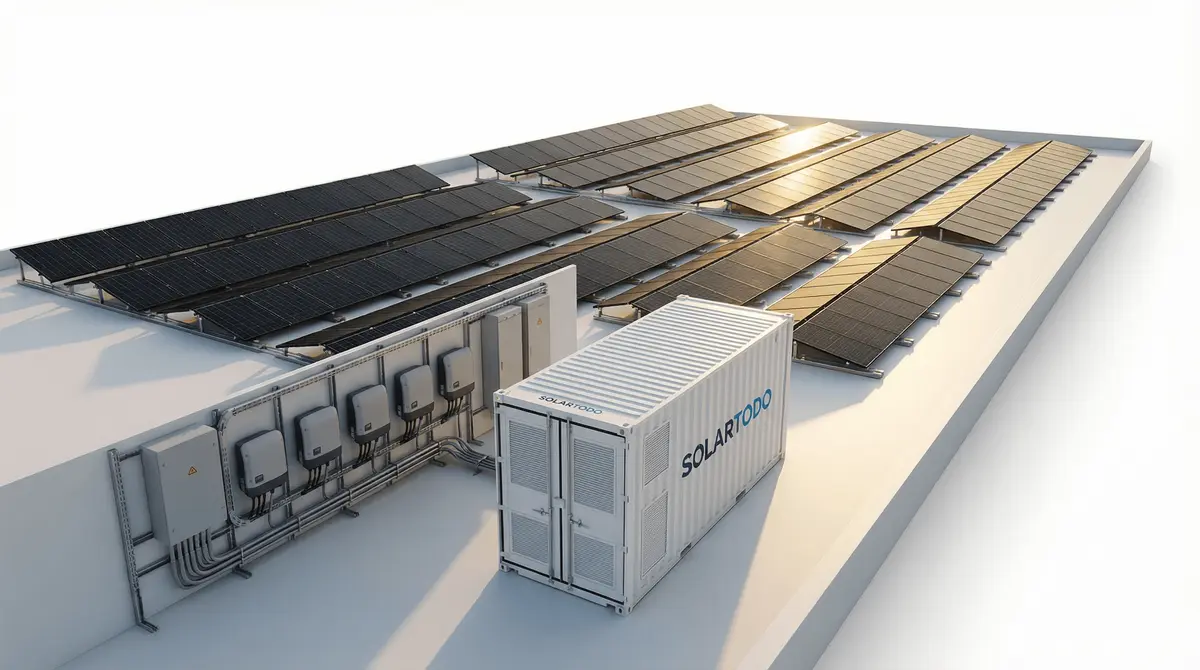
SOLAR TODO typically discusses pricing in project bands rather than a single universal number because a 50kW greenhouse rooftop, a 200kWp factory roof, and a 500kWp industrial hybrid plant do not share the same balance-of-system profile. Based on the available product data, a 50kW agricultural greenhouse rooftop system is priced at $24,800-$31,600, equal to about $0.50-$0.63/W. A 100kW + 200kWh commercial hybrid package is priced at $79,200-$101,200, equal to about $0.79-$1.01/W before any site-specific civil or utility upgrades.
According to IRENA (2024), utility-scale solar PV remains among the lowest-cost new electricity sources globally. The International Energy Agency states, "Solar PV is set to become the largest renewable power source by 2029." For B2B buyers, that macro trend matters because falling module prices do not remove the need for careful BOS, logistics, and compliance planning.
Cost Structure by System Type and Technical Drivers
Commercial solar PV wholesale cost is driven by 6 major blocks—modules, inverters, mounting, electrical BOS, logistics, and installation—with storage adding a seventh block that can raise total $/W by 30%-80%.
Core hardware cost components
Modules are still the largest line item in many PV-only systems, but their share has declined as module prices fell. In a typical 100kW-500kW commercial package, modules may account for about 30%-45% of total EPC cost, while mounting, cables, switchgear, labor, and engineering absorb the rest. If the site needs export limitation, transformer upgrades, or difficult roof reinforcement, BOS can exceed module cost.
N-type TOPCon modules now matter directly to cost per watt because higher efficiency reduces area, structure count, DC cable length, and labor hours per installed kW. The available commercial hybrid reference shows 22.5%-24.5% module efficiency and first-year degradation below 1.0%, with annual degradation below 0.4%. Over 30 years, retained output can reach 87.4%, which improves levelized cost even if upfront module price is slightly higher.
Inverter choice also changes the wholesale number. String inverters usually reduce initial capex on standard rooftops and compact ground-mount arrays. Hybrid inverters or PCS equipment for battery systems add cost, but they support peak shaving, backup power, and time-shifting. For many commercial sites, that added function is worth more than a lower PV-only $/W.
Why storage changes the math
Battery storage should not be judged only by PV $/W because batteries are usually priced by $/kWh as well as system integration cost. The 100kW + 200kWh commercial hybrid package from the provided data is a good example. At $79,200-$101,200, its apparent PV cost per watt is much higher than a PV-only rooftop system, but the package also includes 200kWh of LFP storage and hybrid power conversion.
According to NREL (2024), storage value depends heavily on dispatch strategy, tariff structure, and resilience needs. A buyer comparing a PV-only quote at $0.40/W to a hybrid quote at $0.90/W may reach the wrong conclusion if demand charges, outage losses, or evening tariffs are ignored. In many factories and telecom applications, the correct metric is avoided energy cost plus avoided downtime, not PV capex alone.
Typical wholesale price bands
The table below gives a practical B2B comparison using the available reference products and common delivery scopes.
| System type | Typical scope | Reference price | Approx. cost per watt | Notes |
|---|---|---|---|---|
| 50kW greenhouse rooftop PV | EPC turnkey | $24,800-$31,600 | $0.50-$0.63/W | Bifacial fixed-tilt, about 72-85MWh/year |
| 100kW commercial hybrid + 200kWh LFP | EPC turnkey | $79,200-$101,200 | $0.79-$1.01/W | Includes storage and hybrid controls |
| 200kWp factory roof fixed-tilt | Project band | $130,000-$170,000 | $0.65-$0.85/W | Rooftop commercial/industrial |
| 500kWp industrial hybrid + 1MWh LFP | Project band | $850,000-$1,100,000 | $1.70-$2.20/W | Includes tracking and large storage |
| PV-only wholesale supply package | FOB/CIF indicative | Varies by BOM | About $0.26-$0.45/W | Usually excludes installation and local works |
According to IEA PVPS (2024), non-hardware costs remain a major share of installed PV pricing in many markets. That is why experienced buyers ask for a bill of materials, single-line diagram, and exclusions list before benchmarking supplier offers. SOLAR TODO normally aligns quotations to project scope so B2B teams can compare delivered value rather than headline module price.
EPC Investment Analysis and Pricing Structure
EPC turnkey solar pricing is best understood in three layers—FOB supply, CIF delivered, and EPC turnkey—with commercial payback often landing near 4-8 years when tariffs are $0.10-$0.18/kWh and annual yield is strong.
For B2B procurement, EPC means Engineering, Procurement, and Construction. In practical terms, that usually includes system design, bill of materials, module and inverter supply, mounting structure, protection devices, installation, testing, commissioning, and basic project documentation. Some EPC contracts also include utility interconnection support, SCADA, training, and O&M for 1-2 years. Buyers should confirm each line because one omitted item can change real project cost by $0.05-$0.15/W.
Three-tier pricing model
A clear pricing structure helps procurement teams compare offers.
| Pricing tier | What is included | Typical use | Cost impact |
|---|---|---|---|
| FOB Supply | Equipment ex-factory or port: modules, inverter, structure, electrical BOM | Buyers with local installer and import capability | Lowest visible $/W |
| CIF Delivered | Equipment plus ocean freight and insurance to destination port | Importers wanting landed equipment visibility | Adds freight and insurance |
| EPC Turnkey | Delivered equipment plus installation, testing, commissioning, and project execution | Developers, factories, farms, telecom sites | Highest upfront $/W, lowest execution burden |
For standardized volume procurement, the common guidance is: 50+ units can target about 5% discount, 100+ units about 10%, and 250+ units about 15%, subject to identical configuration, shipping schedule, and payment discipline. These discounts apply more easily to repeatable BOMs than to custom one-off projects.
ROI and annual savings
The 50kW agricultural greenhouse rooftop system provides a useful benchmark. It generates about 72-85MWh/year. At electricity tariffs of $0.10-$0.18/kWh, annual savings can reach roughly $7,200-$15,300 before escalation. With EPC pricing of $24,800-$31,600, the simple payback can fall in the range of about 2-4 years in strong solar and high-tariff conditions, though site-specific shading, curtailment, and maintenance affect the result.
The 100kW + 200kWh hybrid system generates about 150-190MWh/year. If a site uses the battery for peak shaving and evening load shifting, the economic value can exceed pure energy savings. Sample deployment scenario (illustrative): at 170MWh/year and an avoided blended cost of $0.14/kWh, annual direct energy value is about $23,800, before adding demand-charge reduction or outage-loss avoidance.
Payment terms and financing
Common export payment terms are 30% T/T deposit and 70% against B/L, or 100% L/C at sight for qualified transactions. For larger projects above $1,000K, financing may be available subject to country risk, tenor, and project documentation. The provided business context also notes SINOSURE financing support for 150+ Belt and Road countries. For quotation support, EPC scope review, or financing discussion, contact [email protected] or SOLAR TODO at +6585559114.
How to Compare Wholesale Quotes Without Buying the Wrong System
A reliable wholesale quote comparison should normalize 10 items—DC size, AC size, module type, inverter type, structure, BOS, freight, duties, installation, and warranty—because any one of them can move real cost by 5%-20%.
The first check is technical equivalence. A 100kWp quote using N-type TOPCon modules at 22.5%-24.5% efficiency is not directly comparable to a lower-efficiency module package if roof area is constrained. Higher efficiency can reduce row count, mounting steel, and cable runs. On a commercial roof, that can offset a module premium and improve lifetime kWh per square meter.
The second check is standards compliance. Ask for IEC 61215 and IEC 61730 for modules, plus inverter and interconnection compliance relevant to the destination market. IEEE 1547 matters in many distributed energy interconnection contexts. If a supplier cannot provide test reports, warranty terms, and traceable datasheets, the low price may carry bankability and insurance risk.
The third check is exclusions. Roof strengthening, lightning protection, earthing upgrades, export meter changes, and transformer work are frequently excluded from low headline quotes. According to Fraunhofer ISE (2024), system performance depends not only on module quality but also on design, thermal conditions, and operating strategy. A quote that omits engineering detail can produce lower yield and higher rework cost later.
Practical selection guide
Use the table below to match project type to the right pricing logic.
| Buyer situation | Best pricing metric | Recommended system focus | Main caution |
|---|---|---|---|
| Importer with local EPC team | FOB $/W | PV-only or standard hybrid kits | Confirm missing BOS and warranty support |
| Factory with high daytime load | EPC $/W plus annual kWh | 100kW-500kW rooftop PV | Check roof loading and grid approval |
| Site with demand charges or outages | $/W plus $/kWh storage value | Hybrid PV + LFP storage | Do not compare against PV-only quotes |
| Greenhouse or agrivoltaic project | $/W plus light-transmittance and yield | Bifacial fixed-tilt greenhouse PV | Verify crop-light and structure constraints |
| Multi-site portfolio buyer | Portfolio TCO and volume discount | Standardized BOM across 50+ sites | Avoid too many custom variants |
BloombergNEF notes that bankability still influences financing cost and procurement risk, even when headline hardware prices are low. That matters for wholesalers, EPC firms, and project owners. SOLAR TODO generally advises buyers to compare cost per watt together with annual yield, degradation, warranty, and execution scope, because the cheapest watt is not always the cheapest kilowatt-hour.
The International Energy Agency states, "Solar PV's competitiveness is improving further amid continued technological progress and cost reductions." For B2B decision-makers, the practical reading is simple: use $/W as the starting filter, but award contracts on delivered energy, compliance, and project execution certainty.
FAQ
Wholesale solar PV system cost per watt is usually answered best with direct project numbers, and most B2B buyers should expect about $0.26-$0.85/W depending on delivery scope, storage, and installation complexity.
Q: What is the typical wholesale solar PV system cost per watt for commercial buyers? A: For commercial B2B buyers, wholesale PV-only supply packages often fall around $0.26-$0.45/W, while EPC turnkey systems commonly range from $0.50-$0.85/W. Hybrid systems with LFP batteries can exceed $0.79/W because storage, controls, and commissioning are included.
Q: Why do two suppliers quote very different cost per watt numbers for the same 100kW system? A: The difference usually comes from scope, not only hardware price. One quote may cover modules and inverter only, while another includes structure, protection, freight, installation, testing, and grid documentation. Always compare DC size, AC size, inclusions, exclusions, and warranty terms line by line.
Q: Is cost per watt calculated on DC capacity or AC output? A: Most solar procurement uses DC cost per watt based on installed module capacity, such as 100kWp. Some developers also review AC-based metrics for inverter-limited systems. The key is to keep all quotes on the same basis, because mixing DC and AC can distort pricing by 10%-25%.
Q: How much does storage add to wholesale solar system pricing? A: Storage can raise apparent PV cost per watt by 30%-80% or more, depending on battery size and controls. For example, a 100kW + 200kWh commercial hybrid package at $79,200-$101,200 prices much higher than PV-only, but it also provides backup power, peak shaving, and evening load shifting.
Q: What is included in EPC turnkey pricing for a solar PV system? A: EPC turnkey pricing usually includes engineering, procurement, mounting structure, modules, inverter, electrical BOS, installation, testing, and commissioning. Some contracts also include SCADA, training, and utility coordination. Buyers should confirm civil works, transformer upgrades, and permit fees because these are often excluded.
Q: How do I estimate payback from a wholesale solar PV purchase? A: Start with annual generation, local tariff, and total installed cost. A 50kW greenhouse system producing 72-85MWh/year can save about $7,200-$15,300 annually at $0.10-$0.18/kWh tariffs. Then adjust for degradation, maintenance, financing cost, and any demand-charge savings from storage.
Q: Which module technology gives the best value in wholesale projects? A: N-type TOPCon modules often give the best value where roof area is limited or long-term yield matters. With 22.5%-24.5% efficiency and annual degradation below 0.4%, they can improve lifetime kWh output. Lower-cost modules may reduce upfront capex but sometimes increase BOS or reduce long-term energy yield.
Q: What certifications should wholesale solar PV equipment have? A: At minimum, ask for IEC 61215 and IEC 61730 for modules, plus inverter certifications required in the destination market. Interconnection compatibility should align with standards such as IEEE 1547 where applicable. These documents support safety, insurability, project acceptance, and lender confidence.
Q: What payment terms are common for wholesale solar exports? A: Common payment terms are 30% T/T deposit and 70% against B/L, or 100% L/C at sight. For larger projects above $1,000K, structured financing may be available subject to country risk and documentation. Buyers should also clarify Incoterms, shipment split rules, and warranty claim procedure.
Q: How do volume discounts work in wholesale solar procurement? A: Standardized volume orders usually receive better pricing than one-off custom projects. A common guide is about 5% discount for 50+ units, 10% for 100+, and 15% for 250+, assuming the BOM, delivery schedule, and payment terms are consistent. Custom engineering can reduce those discount levels.
Q: When is EPC turnkey better than FOB or CIF purchasing? A: EPC turnkey is usually better when the buyer wants one party responsible for design, installation, testing, and commissioning. It costs more upfront than FOB or CIF, but it reduces coordination risk and hidden local execution gaps. This is often the better route for factories, farms, and public-sector sites.
References
The following sources support pricing context, standards, and technical assumptions used in this article, with at least 5 authoritative references relevant to B2B solar procurement.
- [IRENA] (2024): Renewable Power Generation Costs in 2023; confirms solar PV remains one of the lowest-cost new-build generation sources globally.
- [IEA PVPS] (2024): Trends in Photovoltaic Applications 2024; reviews global PV deployment, market pricing trends, and system cost structures.
- [NREL] (2024): PVWatts and commercial PV performance methodology; supports yield estimation and storage-value assessment practices.
- [IEC 61215-1] (2021): Terrestrial photovoltaic modules - Design qualification and type approval; core reliability test standard for crystalline silicon modules.
- [IEC 61730-1] (2023): Photovoltaic module safety qualification - Requirements for construction; core safety standard for PV modules.
- [IEEE 1547] (2018): Standard for interconnection and interoperability of distributed energy resources with electric power systems interfaces.
- [Fraunhofer ISE] (2024): Photovoltaics Report; summarizes efficiency trends, market development, and performance considerations.
- [BloombergNEF] (2024): Tier 1 module manufacturer methodology and market bankability tracking for PV supply chain assessment.
Conclusion
Wholesale solar PV system cost per watt is most useful when tied to scope, and B2B buyers should expect roughly $0.26-$0.85/W across FOB, CIF, and EPC ranges, with hybrid storage systems priced higher because they add 200kWh to 1MWh of dispatchable value.
The bottom line is that SOLAR TODO recommends buying on delivered kWh, compliance, and execution scope rather than the lowest headline $/W. For projects above 50kW, a properly specified N-type TOPCon system with clear EPC terms usually delivers better 25-year value than a cheaper but incomplete quote.
About SOLARTODO
SOLARTODO is a global integrated solution provider specializing in solar power generation systems, energy-storage products, smart street-lighting and solar street-lighting, intelligent security & IoT linkage systems, power transmission towers, telecom communication towers, and smart-agriculture solutions for worldwide B2B customers.
About the Author

SOLAR TODO
Solar Energy & Infrastructure Expert Team
SOLAR TODO is a professional supplier of solar energy, energy storage, smart lighting, smart agriculture, security systems, communication towers, and power tower equipment.
Our technical team has over 15 years of experience in renewable energy and infrastructure, providing high-quality products and solutions to B2B customers worldwide.
Expertise: PV system design, energy storage optimization, smart lighting integration, smart agriculture monitoring, security system integration, communication and power tower supply.
Cite This Article
SOLAR TODO. (2026). solar PV system cost per watt wholesale | SOLARTODO. SOLARTODO. Retrieved from https://solartodo.com/knowledge/solar-pv-system-cost-per-watt-wholesale
@article{solartodo_solar_pv_system_cost_per_watt_wholesale,
  title = {solar PV system cost per watt wholesale | SOLARTODO},
  author = {SOLAR TODO},
  journal = {SOLARTODO Knowledge Base},
  year = {2026},
  url = {https://solartodo.com/knowledge/solar-pv-system-cost-per-watt-wholesale},
  note = {Accessed: 2026-06-01}
}
Published: June 1, 2026 | Available at: https://solartodo.com/knowledge/solar-pv-system-cost-per-watt-wholesale
Subscribe to Our Newsletter
Get the latest solar energy news and insights delivered to your inbox.
View All Articles