Solar-Powered Security Systems System Design: thermal…

SOLARTODO Editorial Team
Solar Energy & Infrastructure Expert Team
Watch the video
TL;DR
For reliable solar-powered security, start with the full 24-hour load, then size batteries for at least 72 hours and oversize PV by 15-20%. Use thermal cameras based on required range, typically 384×288 for 150-300 m and 640×512 for longer coverage, and verify compliance with IEC 62676, EN 50131, UL 681, and related power-system standards.
Solar-powered security systems need correct thermal imaging range, battery autonomy, and PV sizing to maintain 24/7 uptime. A practical design target is 72-hour backup, 15-20% solar margin, and IEC 62676/EN 50131 aligned detection architecture for remote sites.
Summary
Solar-powered security systems need correct thermal imaging range, battery autonomy, and PV sizing to maintain 24/7 uptime. A practical design target is 72-hour backup, 15-20% solar margin, and IEC 62676/EN 50131 aligned detection architecture for remote sites.
Key Takeaways
- Size battery storage for at least 72 hours of autonomy when remote security loads include NVR, radios, and 16-32 detectors.
- Select thermal cameras by detection distance, not only resolution; a 384×288 core may suit 150-300 m tasks, while 640×512 supports longer-range analytics.
- Add 15-20% PV generation margin above calculated daily load to offset dust, wiring loss, temperature loss, and winter irradiance variation.
- Use MPPT solar charge controllers with 97-99% peak conversion efficiency to improve low-irradiance charging versus PWM alternatives.
- Segment alarm architecture into at least 2-4 partitions so gates, perimeter, building interior, and restricted rooms can be managed independently.
- Verify compliance with IEC 62676, EN 50131, UL 681, and NFPA 72 when video, intrusion, signaling, and supervisory functions are combined.
- Compare thermal, visible, PIR, beam, and dual-tech devices by nuisance-alarm rate, range, and power draw before fixing the off-grid energy budget.
- Use EPC commercial terms early; FOB, CIF, and turnkey EPC pricing can change total project cost by 15-30% on remote security deployments.
System Design Priorities for Solar-Powered Security Systems
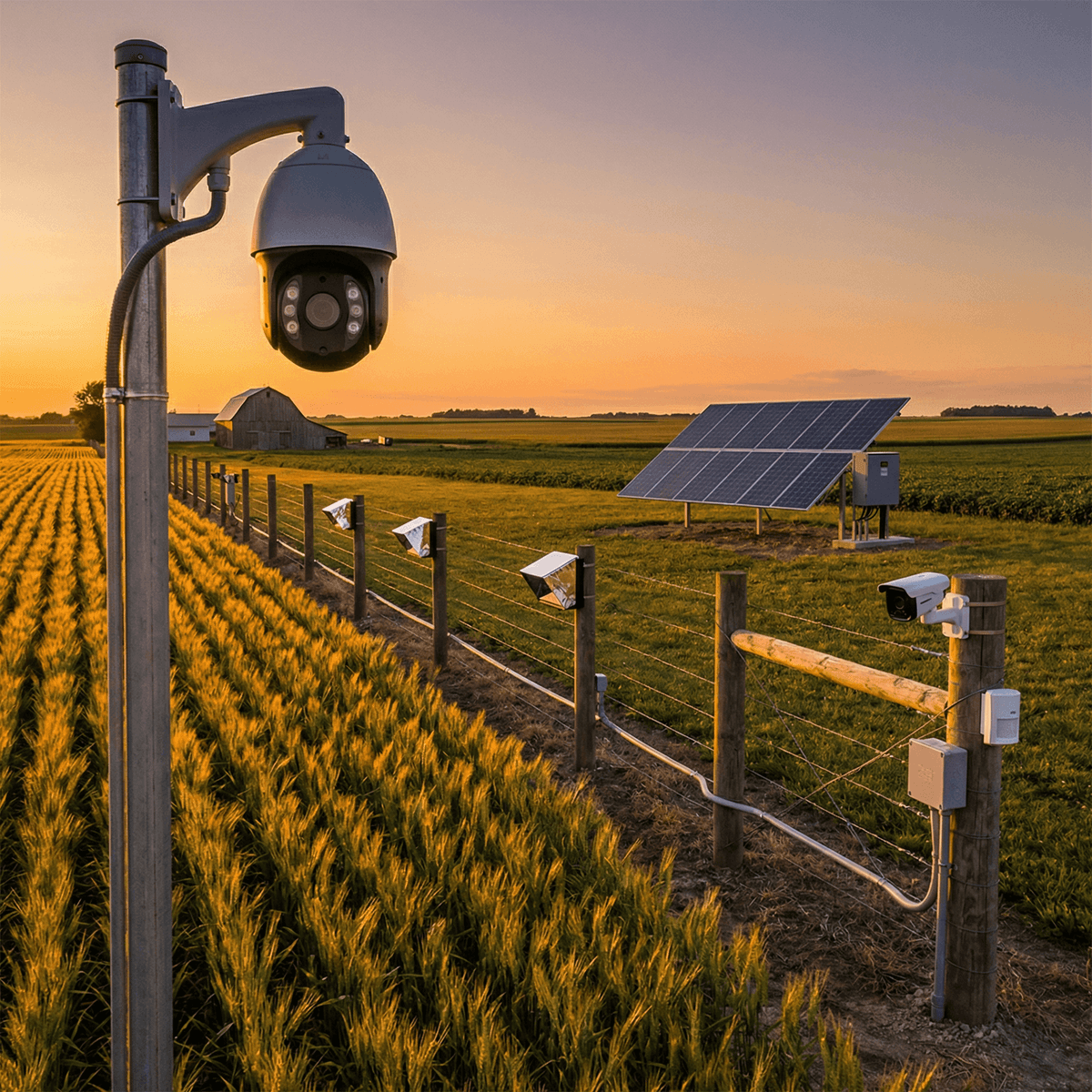
Solar-powered security systems work best when designers balance 24/7 load, 72-hour battery autonomy, and 15-20% PV oversizing instead of selecting cameras and panels separately.
For remote checkpoints, utility yards, farms, telecom compounds, and border perimeters, the design problem is rarely the camera alone. The real issue is matching detection quality to available energy. A thermal camera, 32-zone alarm panel, 16 cameras, wireless backhaul, and local lighting can push daily consumption well above a small standalone solar kit if the system is not engineered as one load profile.
SOLAR TODO typically advises buyers to start with the operational requirement first: detection, recognition, or identification at a defined distance such as 100 m, 300 m, or 800 m. That requirement determines thermal lens selection, visible-light support cameras, analytics processing, recorder size, and network bandwidth. Only after that should the PV array, battery bank, and controller be sized.
According to NREL (2024), PV performance modeling accuracy improves when irradiance, temperature, orientation, and system losses are explicitly included rather than assumed as fixed nominal values. According to IEA PVPS (2024), off-grid and hybrid solar applications continue to expand where diesel logistics and unstable grids raise lifecycle cost. Those two points matter because a security outage of even 4-8 hours can leave a perimeter blind during the highest-risk period.
The International Energy Agency states, "Solar PV is today one of the cheapest sources of electricity in many regions." For security projects, that statement is useful only when converted into site-level design rules: stable DC supply, battery reserve, and monitored charging performance. SOLAR TODO uses that approach when discussing remote security packages and expansion planning.
Thermal Imaging Selection and Detection Architecture
Thermal imaging selection should be based on target size, required range, and scene conditions, with 384×288 and 640×512 sensors covering most 150-1,000 m perimeter tasks.
Thermal cameras detect heat contrast, so they remain useful in darkness, haze, and low-visible-light scenes where standard HD cameras lose detail. For security design, the buyer should define whether the task is detection, recognition, or identification. Detection may only require awareness that a human or vehicle is present, while identification usually needs much higher pixel density and often a visible PTZ camera paired with thermal.
A practical specification workflow starts with four variables: sensor resolution, lens focal length, mounting height, and target distance. A 384×288 thermal unit with a shorter lens may be enough for 150-300 m perimeter coverage around a gate or fence line. A 640×512 unit with a longer lens is more suitable when the site needs earlier warning at 500-1,000 m, especially for border strips, open yards, or desert corridors.
Thermal vs visible vs detector layering
Layered detection reduces false alarms and lowers operator fatigue when 3 sensing methods confirm the same event within a programmed time window.
Thermal imaging should not replace all other devices. It should be layered with visible cameras, PIR detectors, dual-technology detectors, beam sensors, and access contacts. This is especially important where hot surfaces, moving vegetation, dust, animals, or reflected sunlight can create nuisance events. A typical architecture may use thermal for long-range cueing, visible PTZ for verification, and perimeter beams or dual-tech detectors for alarm confirmation.
According to IEC 62676 guidance for video surveillance system considerations, image quality and scene suitability must match the surveillance objective rather than generic camera counts. According to EN 50131 framework principles, intrusion detection performance depends on detector placement, environmental class, and alarm logic, not just the number of zones. That is why a 16-camera design can outperform a 32-camera design if the coverage geometry is correct.
Thermal imaging power and bandwidth impact
Thermal cameras usually consume about 8-25 W each, and that difference materially changes battery sizing when a site runs 4-16 cameras continuously.
Procurement teams often focus on thermal range but ignore power draw. A fixed thermal camera may run at 8-15 W, while a thermal PTZ or dual-sensor unit can exceed 20-40 W depending on heater use, zoom motor activity, and onboard analytics. Over 24 hours, an extra 10 W per camera adds 240 Wh daily. Across 8 cameras, that is 1.92 kWh per day, which can require several additional PV modules and a larger battery bank.
Bandwidth and storage also matter. Thermal streams usually compress efficiently, but dual-sensor cameras, 4K visible channels, and 30-day retention can drive recorder and radio requirements upward. SOLAR TODO generally recommends calculating storage by bitrate, frame rate, retention days, and event policy rather than by channel count alone.
Solar Charging Efficiency Standards and Off-Grid Power Sizing
Solar charging efficiency depends on controller topology, battery chemistry, and site losses, and MPPT controllers at 97-99% peak efficiency usually outperform PWM in variable irradiance conditions.
The off-grid energy model should begin with daily watt-hours, then add conversion losses, battery reserve, seasonal derating, and future expansion. For a security system with 16 fixed cameras at 10 W each, 1 NVR at 40 W, 32 detectors and panel electronics at 35 W combined, communications at 25 W, and auxiliaries at 40 W, the continuous load is about 300 W. Over 24 hours, that equals 7.2 kWh per day before controller and inverter losses.
If the design target is 72 hours of autonomy, usable stored energy should exceed 21.6 kWh. With lithium batteries at 80-90% usable depth of discharge, the installed battery may need roughly 24-27 kWh. With lead-acid at 50% practical depth of discharge, the installed capacity could double. That is one reason lithium chemistry is often preferred in remote security despite higher initial cost.
PV array sizing method
A conservative PV design often multiplies daily load by 1.15-1.20 and then divides by site-specific peak sun hours to maintain charging reliability in winter months.
Using the 7.2 kWh daily example, adding 20% system margin gives 8.64 kWh. If the site has 5.0 peak sun hours, the array requirement is about 1.73 kW before further local derating for dust, cable loss, module temperature, and aging. In harsher climates, designers may round that to 2.0-2.4 kW to preserve battery recovery after cloudy periods.
According to NREL (2024), temperature, soiling, mismatch, and wiring losses materially affect delivered PV output and should be included in performance estimates. According to IRENA (2024), solar project economics improve when lifecycle fuel and maintenance costs are compared against diesel-dependent alternatives, especially in remote applications. For security sites, the avoided cost is not just fuel; it is also avoided surveillance downtime.
Standards that matter in charging and system safety
Security power systems should reference IEC 62509, IEC 62109, IEC 61427, and battery safety guidance alongside IEC 62676 and EN 50131 to avoid treating power and security as separate scopes.
IEC 62509 covers battery charge controllers for PV systems. IEC 62109 addresses safety of power converters used in photovoltaic systems. IEC 61427 addresses secondary cells and batteries for renewable energy storage applications. When AC interfaces or grid backup are included, IEEE 1547 may also become relevant for interconnection behavior. For alarm transmission, UL 681 and NFPA 72 remain important references for installation and signaling practice.
The U.S. Department of Energy notes that battery-backed systems require correct charge control, thermal management, and maintenance planning to achieve expected service life. In practical terms, that means enclosure ventilation, battery low-temperature charging limits, surge protection, and remote telemetry for state of charge, PV input, and load current. SOLAR TODO recommends exposing those values on the monitoring dashboard so maintenance teams can act before a blackout occurs.
Applications, Comparison, and Selection Guide
The best solar-powered security design matches site risk tier, sensor range, and daily energy budget, with medium sites often landing in the 16-camera and 32-zone class.
A remote border gate, fuel depot, agricultural perimeter, telecom shelter, or municipal yard does not need the same architecture. A checkpoint may prioritize thermal early warning and lane control. A gas station chain may prioritize cloud visibility, retail evidence quality, and hazardous-area alarm segmentation. A government compound may need 64 cameras, 128 zones, and multi-partition control with full-service monitoring.
SOLAR TODO offers reference configurations that help buyers benchmark scope. The Border Checkpoint 32-Zone Off-Grid package supports 32 security zones, 16 cameras, 32 intrusion detectors, a 32-channel NVR, and a 64-zone hybrid panel with spare expansion capacity. The Gas Station Chain 32-Zone Cloud package supports 16 HD IP cameras, 32 primary detector points, 30 days of 4K retention, and 4G plus Ethernet plus WiFi communications. The Government Building 128-Zone Maximum package scales to 128 zones and 64 cameras for larger campuses.
Comparison table for selection
A comparison table helps procurement teams align thermal range, power demand, and site class before requesting a quotation.
| Design factor | Small remote site | Medium perimeter site | Large critical site |
|---|---|---|---|
| Typical cameras | 4-8 | 12-16 | 32-64 |
| Thermal cameras | 1-2 fixed | 2-4 fixed/PTZ | 4-12 fixed/PTZ |
| Alarm zones | 8-16 | 32 | 64-128 |
| Daily load estimate | 1.5-3.5 kWh | 5-9 kWh | 15-40 kWh |
| Battery autonomy target | 48-72 h | 72 h | 72-96 h |
| PV oversizing margin | 15% | 15-20% | 20% |
| Communications | 4G or radio | 4G + radio/Ethernet | Fiber + 4G backup |
| Typical use case | Pump house, gate | Border post, depot | Government campus |
EPC Investment Analysis and Pricing Structure
Security EPC pricing should be evaluated across FOB supply, CIF delivered, and turnkey EPC because remote-site logistics and commissioning can change total investment by 15-30%.
For B2B buyers, EPC means Engineering, Procurement, and Construction. In security projects, turnkey EPC typically includes system design review, equipment supply, mounting structures, power subsystem integration, installation, commissioning, testing, and operator handover. Depending on scope, it may also include trenching, poles, cabinets, networking, and training.
A three-tier commercial structure is standard:
- FOB Supply: equipment ex-works or port basis, suitable for buyers with local installers.
- CIF Delivered: equipment plus freight and insurance to destination port, useful where import logistics are outsourced.
- EPC Turnkey: full delivery, installation, commissioning, and acceptance testing.
Based on the provided product data, the Border Checkpoint 32-Zone Off-Grid package is available as equipment-only, delivered cargo, or turnkey EPC at USD 7,100-9,200. The Government Building 128-Zone Maximum package is available with professional installation and commissioning under an EPC turnkey range of USD 36,300-46,600. Actual pricing changes with thermal camera count, battery chemistry, autonomy target, pole works, and communications scope.
Volume guidance for planning:
- 50+ units or repeated site packages: about 5% discount
- 100+ units: about 10% discount
- 250+ units: about 15% discount
Payment terms commonly used:
- 30% T/T deposit and 70% against B/L
- 100% L/C at sight
Financing may be available for projects above USD 1,000,000. For quotation support, buyers can contact [email protected] or reach SOLAR TODO through its project sales channel. Sample deployment scenario (illustrative): replacing a diesel-powered 300 W average security load can avoid thousands of liters of fuel use over a multi-year period, often bringing payback into a 3-6 year range depending on fuel transport cost, maintenance frequency, and site irradiance.
FAQ
The FAQ below answers 10 common procurement and engineering questions using concise ranges such as 72-hour autonomy, 15-20% PV margin, and 384×288 to 640×512 thermal selection.
Q: What is the main design rule for a solar-powered security system? A: The main rule is to size the detection architecture and the power system together. Start with the 24-hour load in watt-hours, then add at least 72 hours of battery autonomy and 15-20% PV margin for losses, weather, and future expansion.
Q: How do I choose between a 384×288 and 640×512 thermal camera? A: Choose by required detection distance and task. A 384×288 camera is often enough for 150-300 m perimeter awareness, while 640×512 is better for longer-range detection or stronger analytics performance at 500 m and beyond.
Q: Why is thermal imaging useful in solar-powered security systems? A: Thermal imaging works in 0 lux conditions and detects heat contrast rather than visible light. That allows earlier intrusion awareness at night and can reduce the need for high-power floodlighting, which helps the off-grid energy budget.
Q: How much battery autonomy should a remote security site have? A: A practical target is 72 hours for remote sites with unstable weather or difficult maintenance access. Critical sites may extend to 96 hours, especially where resupply delays, winter irradiance, or communications dependence make outages unacceptable.
Q: What solar charge controller standard should buyers check? A: Buyers should review IEC 62509 for PV charge controller performance and IEC 62109 for converter safety. In practice, MPPT controllers with 97-99% peak efficiency are usually preferred because they recover more energy during variable irradiance conditions.
Q: How do I reduce false alarms in perimeter surveillance? A: Use layered detection instead of relying on one device type. Combining thermal cameras, visible verification, beam sensors, and dual-tech detectors within a 2- or 3-event logic window can materially reduce nuisance alarms from animals, wind, and thermal clutter.
Q: What standards apply to video and intrusion parts of the system? A: IEC 62676 is widely referenced for video surveillance systems, while EN 50131 is commonly used for intrusion and hold-up system design logic. UL 681 and NFPA 72 are also relevant where installation practice, signaling, or supervisory interfaces are required.
Q: How should I estimate PV array size for a security load? A: First calculate daily load in kWh, then add 15-20% for losses and divide by local peak sun hours. For example, an 8.6 kWh adjusted daily requirement at 5.0 sun hours needs about 1.7 kW minimum before site-specific derating.
Q: What is included in turnkey EPC for security systems? A: Turnkey EPC usually includes engineering review, equipment supply, solar subsystem integration, installation, testing, commissioning, and handover. It may also include poles, cabinets, trenching, networking, and operator training depending on the contract scope.
Q: What are the typical pricing and payment terms? A: Pricing is usually quoted as FOB Supply, CIF Delivered, or EPC Turnkey. The provided reference ranges are USD 7,100-9,200 for the Border Checkpoint 32-Zone Off-Grid package and USD 36,300-46,600 for the Government Building 128-Zone Maximum package, with 30% T/T plus 70% against B/L or 100% L/C at sight.
References
The references below cite 8 recognized organizations and standards relevant to thermal imaging selection, PV charging efficiency, battery-backed security design, and alarm/video compliance.
- NREL (2024): PVWatts and PV performance modeling guidance for estimating solar production, losses, and site-specific system output.
- IEA PVPS (2024): Trends in Photovoltaic Applications 2024, including market deployment context for PV systems and off-grid use cases.
- IRENA (2024): Renewable Power Generation Costs, covering solar cost competitiveness and lifecycle economics versus conventional supply.
- IEC 62676 (2024 reference set): Video surveillance systems for use in security applications, including system design and performance considerations.
- EN 50131 (2024 reference set): Intrusion and hold-up alarm systems framework for detector classes, environmental suitability, and alarm logic.
- UL 681 (2023): Installation and classification practices for burglary and holdup alarm systems.
- NFPA 72 (2022): National Fire Alarm and Signaling Code, relevant where supervisory signaling and integrated notification paths are required.
- IEC 62509 (2010, current reference use): Battery charge controllers for photovoltaic systems — performance and function guidance.
Conclusion
Solar-powered security systems deliver reliable 24/7 protection when thermal range, 72-hour battery autonomy, and 15-20% PV oversizing are designed as one system rather than separate purchases.
For most remote B2B sites, the best result comes from layered detection, MPPT-based charging, and standards-based design under IEC 62676, EN 50131, and UL 681. SOLAR TODO can support buyers who need equipment supply, delivered cargo, or turnkey EPC with scalable architectures from 32-zone off-grid sites to 128-zone critical facilities.
About SOLARTODO
SOLARTODO is a global integrated solution provider specializing in solar power generation systems, energy-storage products, smart street-lighting and solar street-lighting, intelligent security & IoT linkage systems, power transmission towers, telecom communication towers, and smart-agriculture solutions for worldwide B2B customers.
Further Reading
About the Author

SOLARTODO Editorial Team
Solar Energy & Infrastructure Expert Team
SOLAR TODO is a professional supplier of solar energy, energy storage, smart lighting, smart agriculture, security systems, communication towers, and power tower equipment.
Our technical team has over 15 years of experience in renewable energy and infrastructure, providing high-quality products and solutions to B2B customers worldwide.
Expertise: PV system design, energy storage optimization, smart lighting integration, smart agriculture monitoring, security system integration, communication and power tower supply.
Cite This Article
SOLARTODO Editorial Team. (2026). Solar-Powered Security Systems System Design: thermal…. SOLARTODO. Retrieved from https://solartodo.com/knowledge/solar-powered-security-systems-system-design-thermal-imaging-selection-and-solar-charging-efficiency-standards
@article{solartodo_solar_powered_security_systems_system_design_thermal_imaging_selection_and_solar_charging_efficiency_standards,
  title = {Solar-Powered Security Systems System Design: thermal…},
  author = {SOLARTODO Editorial Team},
  journal = {SOLARTODO Knowledge Base},
  year = {2026},
  url = {https://solartodo.com/knowledge/solar-powered-security-systems-system-design-thermal-imaging-selection-and-solar-charging-efficiency-standards},
  note = {Accessed: 2026-10-19}
}
Published: July 12, 2026 | Available at: https://solartodo.com/knowledge/solar-powered-security-systems-system-design-thermal-imaging-selection-and-solar-charging-efficiency-standards
Subscribe to Our Newsletter
Get the latest solar energy news and insights delivered to your inbox.
View All Articles