Solar-Powered Security Systems ROI Analysis: insurance…

SOLARTODO Editorial Team
Solar Energy & Infrastructure Expert Team
Watch the video
TL;DR
For critical infrastructure, solar-powered security systems improve ROI by keeping cameras and alarms online during outages, reducing diesel use by 60-90%, and strengthening insurance negotiations with better evidence and uptime records. Medium sites often start at 32 zones and 16 cameras, while larger compounds may need 128 zones and 64 cameras. Buyers should model insurance savings together with avoided losses, lower guard cost, and EPC scope.
Solar-powered security systems can cut diesel backup use by 60-90%, support 24/7 monitoring across 32-128 zones, and improve insurability for critical infrastructure by lowering outage-related exposure, false alarms, and incident losses when systems follow IEC 62676 and EN 50131 practices.
Summary
Solar-powered security systems can cut diesel backup use by 60-90%, support 24/7 monitoring across 32-128 zones, and improve insurability for critical infrastructure by lowering outage-related exposure, false alarms, and incident losses when systems follow IEC 62676 and EN 50131 practices.
Key Takeaways
- Quantify current loss exposure by tracking 12 months of theft, outage, and guard-call incidents before sizing a 32-zone, 64-zone, or 128-zone security and surveillance system.
- Replace diesel-heavy backup designs with solar-plus-battery architectures that reduce generator runtime by 60-90% and stabilize 24/7 camera, detector, and alarm uptime.
- Specify layered detection with at least 16 cameras and 32 detector points for medium sites, because insurers value verified alarms more than single-sensor intrusion alerts.
- Use standards-based designs aligned with IEC 62676, EN 50131, UL 681, and NFPA 72 to improve underwriting confidence and reduce compliance gaps during tender review.
- Model ROI with 3 cost lines—loss reduction, guard efficiency, and energy savings—and test payback under 3 scenarios over 5 years before procurement approval.
- Negotiate insurance terms using evidence packages that include 30 days of video retention, alarm logs, maintenance records, and uptime reports above 99% target availability.
- Compare FOB Supply, CIF Delivered, and EPC Turnkey pricing, and apply volume discounts of 5% at 50+, 10% at 100+, and 15% at 250+ project units.
- Plan maintenance every 6-12 months for batteries, detectors, communications, and cleaning so the system keeps evidentiary video quality and alarm integrity during year 1 to year 10.
Why solar-powered security systems improve ROI for critical infrastructure
Solar-powered security systems improve ROI when they keep surveillance online during grid failure, reduce diesel use by 60-90%, and give insurers better evidence quality through 24/7 monitoring, 16-64 cameras, and standards-based alarm records.
Critical infrastructure operators do not buy security and surveillance systems only to detect intrusion. They buy continuity. A border checkpoint, fuel station portfolio, substation, water site, telecom compound, or government facility can lose far more from 2 hours of blind time than from the hardware cost itself. When cameras, detectors, and communications fail during an outage, the site shifts from monitored to exposed immediately.
A solar-powered architecture changes that risk profile because generation and storage are local. Instead of depending on unstable utility supply or long generator runtime, the site can maintain core loads such as NVR, hybrid alarm panel, routers, detectors, and selected cameras for 12-48 hours depending on battery sizing. For insurers, that matters because continuity reduces the probability of undetected intrusion, delayed response, and disputed claims.
According to the International Energy Agency, "Solar PV is set to become the largest renewable power source by 2029." That statement matters for security buyers because the same cost decline and deployment maturity that support utility PV also support off-grid and hybrid security loads. According to IRENA (2024), renewable power costs remain competitive with fossil alternatives in many markets, which supports lower operating expenditure for remote security systems.
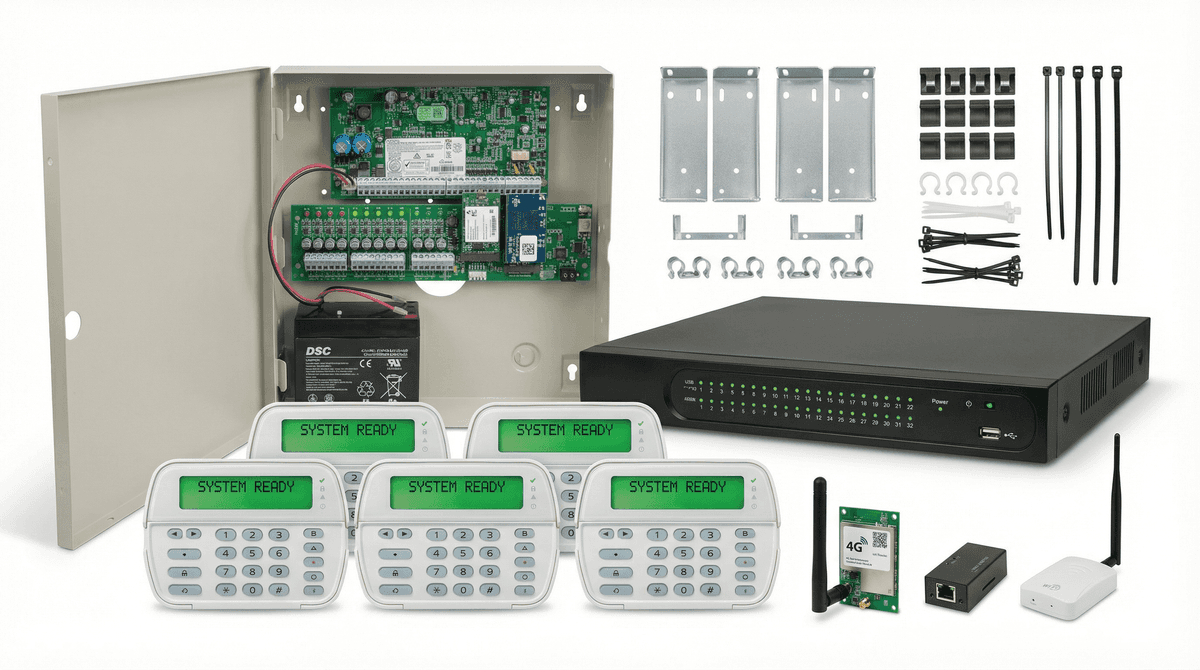
SOLAR TODO applies this logic across remote and grid-weak projects where security continuity is part of the asset-protection budget, not a standalone electronics purchase. For example, the Border Checkpoint 32-Zone Off-Grid package supports 16 cameras, 32 intrusion detectors, a 32-channel NVR, and a 64-zone hybrid alarm panel for medium-security sites where grid power is unstable or unavailable.
How insurance premium reduction is evaluated
Insurance premium reduction is usually tied to lower expected loss frequency, lower claim severity, and better evidence retention, with underwriters often reviewing 12-36 months of incident data and the site’s protection standards.
Insurers rarely publish a universal percentage discount for every security upgrade because infrastructure classes differ. A gas station chain, border checkpoint, and government archive do not present the same fire load, theft profile, occupancy pattern, or geopolitical exposure. What underwriters do assess consistently is whether the site has verified intrusion detection, dependable power continuity, tamper-resistant recording, and documented maintenance.
For critical infrastructure, the strongest insurance argument is not “we installed cameras.” It is “we reduced unmonitored hours, improved alarm verification, and preserved evidence.” A system with 16 HD IP cameras, 32 primary detector points, and 30 days of video retention gives a stronger underwriting case than a motion-only CCTV setup with no retention policy. The underwriting conversation shifts from hardware count to measurable risk control.
Main insurance variables that affect ROI
A practical ROI model should include at least 5 variables:
- Annual insurance premium before upgrade
- Historical annual loss value from theft, vandalism, outage, or false dispatch
- Security operating cost, including diesel, guards, and maintenance
- Expected reduction in claim frequency after verified monitoring starts
- Residual risk during grid failure or communications outage
According to NFPA 72, alarm signaling reliability and supervisory functions are central to dependable event transmission. According to UL 681, installation practices and classification affect burglary-system credibility. Those frameworks matter because insurers and brokers often ask whether a system follows recognized installation and signaling practices before granting favorable terms.
The International Electrotechnical Commission states in IEC 62676 that video surveillance systems should be designed around operational requirements, image usability, and recording performance. That is directly relevant to claims handling. A blurry image from an underpowered camera may detect movement, but it may not support identification, prosecution, or settlement.
Where premium reduction usually comes from
Premium reduction usually comes from four measurable improvements:
- Fewer successful incidents because perimeter and access points are monitored 24/7
- Lower claim severity because alarms trigger earlier and response starts faster
- Better claim resolution because 30-day video retention preserves evidence
- Lower business interruption exposure because solar backup keeps the system online during outages
Sample deployment scenario (illustrative): a medium checkpoint pays USD 48,000 per year in combined property and operational-risk insurance. After installing a 32-zone off-grid security and surveillance system, documenting 99% target monitoring uptime, and reducing diesel dependency, the broker may negotiate a premium adjustment plus lower deductible on selected theft-related cover. The exact result depends on insurer policy wording, local loss history, and compliance evidence.
SOLAR TODO advises buyers to treat insurance reduction as one ROI component, not the whole business case. In many projects, avoided incident loss and reduced guard intervention create more value than the premium change alone.
Technical design factors that drive financial return
The highest ROI comes from matching power autonomy, detection layers, and communications redundancy to the site’s real threat map, typically across 1 primary perimeter, 2-4 access lanes, and 16-128 alarm zones.
A security system that saves energy but misses incidents is a poor investment. Likewise, a high-spec camera network with weak power backup will not satisfy critical infrastructure requirements. The financial return depends on system architecture, not just component count.
For medium off-grid sites, the Border Checkpoint 32-Zone Off-Grid configuration is a useful benchmark. It includes 12 HD fixed IP cameras, 4 PTZ cameras, 8 perimeter beam sets, 16 PIR detectors, 16 dual-technology detectors, a 32-channel NVR, and a 64-zone hybrid alarm panel configured for 32 active zones. That mix supports visual verification plus layered intrusion logic.
For grid-powered portfolios, the Gas Station Chain 32-Zone Cloud package shows how cloud-connected monitoring improves central oversight. It includes 16 HD IP cameras, 32 protected zones, 8 gas detectors, 4G + Ethernet + WiFi communications, and 30 days of 4K video retention. In insurance terms, this improves event documentation across 5 to 500 sites under one dashboard.
Power architecture and uptime economics
Security loads are modest compared with industrial process loads, but uptime is non-negotiable. A site may only need a few kilowatts for cameras, NVR, networking, detectors, lighting at critical points, and control panels. Yet if those loads fail, the site becomes blind. Solar-plus-battery systems are therefore evaluated on autonomy hours, recharge time, and communications resilience.
According to NREL (2024), solar resource modeling can predict PV production with strong planning accuracy when site inputs are correct. That allows engineers to size PV and battery capacity around worst-month irradiance, not annual averages alone. For insurers and finance teams, this is important because autonomy claims should be based on modeled energy balance, not brochure assumptions.
A typical ROI-focused design review should test:
- Critical load in watts for cameras, NVR, panel, router, and wireless links
- Battery autonomy target, often 12-24 hours minimum for essential loads
- PV recharge window under seasonal irradiance conditions
- Generator integration strategy if autonomy must exceed 24-48 hours
- Communications redundancy using 4G, Ethernet, and radio paths
Detection quality, false alarms, and claim outcomes
False alarms erode ROI because they waste guard time, increase dispatch cost, and reduce operator trust. The Government Building 128-Zone Maximum description notes that layered AI video analytics can reduce nuisance alarms by up to 90% versus motion-only legacy CCTV, consistent with current manufacturer and integrator benchmarks. Even if a buyer does not need 128 zones, the principle applies at smaller scale: verified alarms are worth more than raw alarm volume.
A 32-zone site should separate perimeter, lane, office, utility, and stockroom logic into distinct partitions. That supports faster triage and clearer incident reports. If a detector trips in a wind-prone area, dual-technology devices reduce nuisance activations compared with PIR-only devices. If a PTZ camera verifies a lane intrusion within seconds, the operator can classify the event before dispatching guards or police.
According to EN 50131, intrusion and hold-up systems should be designed around security grades, environmental classes, and signaling performance. Buyers should align detector selection with the actual environment, especially in dusty, hot, or wind-exposed sites where single-technology devices can underperform.
EPC Investment Analysis and Pricing Structure
A complete EPC business case should compare equipment cost, logistics cost, installation cost, and 3 return streams—insurance improvement, loss reduction, and operating savings—over a 3- to 7-year horizon.
For B2B procurement, pricing must be structured in a way that finance, engineering, and operations can all review. Security buyers often receive a hardware quote but not a lifecycle model. That creates approval delays. A better approach is to separate supply scope from delivery scope and turnkey scope.
What EPC turnkey delivery includes
EPC means Engineering, Procurement, and Construction. For a solar-powered security and surveillance system, turnkey delivery usually includes:
- Site survey and load assessment
- PV, battery, mounting, and cabling design
- Camera, detector, panel, NVR, and network architecture
- Civil and electrical installation
- Testing, commissioning, and operator training
- Handover documents, as-built drawings, and maintenance plan
For reference, SOLAR TODO lists the Border Checkpoint 32-Zone Off-Grid turnkey EPC range at USD 7,100-9,200. Larger systems such as the Government Building 128-Zone Maximum are listed with EPC turnkey ranges of USD 36,300-46,600, depending on scope and site conditions.
Three-tier pricing explanation
The three common commercial structures are:
| Pricing Model | What It Includes | Best For | Cost Impact |
|---|---|---|---|
| FOB Supply | Equipment only at port of origin | Experienced local EPCs | Lowest upfront price |
| CIF Delivered | Equipment plus freight and insurance to destination port | Importers managing local installation | Mid-level landed cost |
| EPC Turnkey | Design, supply, installation, testing, and commissioning | Owners needing one accountable contractor | Highest upfront, lowest coordination burden |
Volume pricing guidance for framework orders should be explicit:
- 50+ units: 5% discount
- 100+ units: 10% discount
- 250+ units: 15% discount
Payment terms should also be clear for procurement teams:
- 30% T/T + 70% against B/L
- Or 100% L/C at sight
- Financing available for large projects above USD 1,000K
- Commercial contact: [email protected]
ROI and payback logic
A simple 5-year ROI model should include annual savings and avoided losses. Sample deployment scenario (illustrative):
| ROI Variable | Annual Value (USD) | Notes |
|---|---|---|
| Diesel and backup power reduction | 6,000 | Based on lower generator runtime |
| Reduced guard overtime and dispatch | 8,500 | Fewer false alarms, faster verification |
| Avoided theft and vandalism loss | 14,000 | Based on historical incident average |
| Insurance premium improvement | 4,000 | Subject to underwriter approval |
| Maintenance cost | -3,500 | Cleaning, battery checks, detector service |
| Net annual benefit | 29,000 | Before tax and financing effects |
If turnkey CAPEX is USD 42,000, simple payback is about 1.45 years in this illustrative case. If the same site only realizes USD 16,000 annual benefit, payback extends to about 2.6 years. This is why procurement teams should request best-case, base-case, and conservative-case models before award.
According to BloombergNEF (2024), bankability and supplier quality remain central to infrastructure procurement. That matters because low-cost components with weak support can erase savings through downtime, warranty disputes, and poor evidence quality.
SOLAR TODO supports inquiry-led procurement rather than online checkout because B2B ROI depends on site load, autonomy target, insurer requirements, and installation conditions. For project discussions, buyers can review View all Security & Surveillance System products or Configure your system online.
Use cases and selection guide for critical infrastructure buyers
The right system size depends on site footprint, risk zoning, and outage tolerance, with 32-zone packages fitting medium checkpoints and fuel stations while 128-zone architectures fit multi-wing government compounds.
Critical infrastructure buyers should choose by operational risk, not by camera count alone. A border site with 1 gate, 2 to 4 lanes, and 1 perimeter strip needs different logic than a government facility with 4 to 12 floors and 2 security perimeters. Insurance reviewers will also look at occupancy, public access, hazardous materials, and response time.
Recommended fit by site type
| Site Type | Typical Recommended Architecture | Why It Matters for ROI |
|---|---|---|
| Border checkpoint | 32-zone off-grid, 16 cameras, 32 detectors | Keeps monitoring active where grid is weak |
| Gas station chain | 32-zone cloud, 16 cameras, 30-day retention | Standardizes evidence and central oversight |
| Government building | 128-zone, 64 cameras, 128 detector points | Supports partitions, public access, and archives |
| Remote telecom or utility site | Off-grid hybrid with verified alarms | Cuts diesel visits and outage-related blind time |
Selection checklist for procurement teams
- Confirm whether the insurer requires 30 days, 60 days, or longer video retention.
- Verify compliance intent with IEC 62676, EN 50131, UL 681, and NFPA 72.
- Ask for autonomy calculations in hours, not only battery amp-hour figures.
- Separate essential loads from non-essential loads to protect 24/7 monitoring.
- Require maintenance scope for batteries, detectors, and communications every 6-12 months.
- Request event-report samples showing alarm, video, and operator log correlation.
According to IEA (2024), electrification and digital infrastructure are increasing across industrial and public assets. That trend increases the value of dependable site security because more assets are remotely supervised and fewer sites maintain large on-site teams. In practical terms, better monitoring continuity can reduce both direct loss and operational delay.
FAQ
A solar-powered security system can improve ROI through lower diesel use, stronger uptime, and better underwriting evidence, but buyers should verify 12-36 months of incident data before claiming premium savings.
Q: What is a solar-powered security system for critical infrastructure? A: It is a security and surveillance system that uses solar PV and battery storage to keep cameras, detectors, alarms, and communications running during grid outages. Typical configurations protect 32 to 128 zones and support 16 to 64 cameras. The main value is continuity, especially at remote or grid-weak sites.
Q: How does this type of system reduce insurance premiums? A: It can support premium reduction by lowering unmonitored hours, improving alarm verification, and preserving video evidence for claims. Insurers usually review loss history, maintenance records, and system design quality rather than granting a fixed discount automatically. Better terms may include lower premiums, lower deductibles, or broader theft-related coverage.
Q: What ROI factors should procurement managers calculate first? A: Start with 5 items: annual premium, annual incident loss, guard and dispatch cost, diesel or backup power cost, and maintenance cost. Then model expected improvements over 3 to 5 years. This gives a clearer business case than looking at equipment CAPEX alone.
Q: How much autonomy should an off-grid security system provide? A: For critical loads, many buyers target 12 to 24 hours minimum battery autonomy, with generator support if outages can exceed 24 to 48 hours. The exact number depends on camera count, NVR load, communications equipment, and local irradiance. Autonomy should be based on load calculations, not generic battery labels.
Q: Why do insurers care about video retention and alarm logs? A: They care because claims are easier to validate when the operator can produce time-stamped footage, detector history, and response records. A system with 30 days of retention and synchronized logs provides stronger evidence than a live-view-only setup. That can reduce disputes and improve recovery outcomes.
Q: Are solar-powered systems only useful for remote border or utility sites? A: No. They are also useful at grid-powered sites that still face outages, unstable voltage, or high backup fuel cost. Gas stations, logistics yards, substations, and public compounds can all benefit. The value comes from maintaining 24/7 monitoring when utility power is interrupted.
Q: What standards should buyers request in tenders? A: Buyers should ask for design alignment with IEC 62676 for video surveillance, EN 50131 for intrusion systems, UL 681 for installation practices, and NFPA 72 where signaling and supervisory functions apply. These standards help structure technical review and improve insurer confidence. They also reduce ambiguity during acceptance testing.
Q: How do solar-powered systems compare with generator-only backup? A: Generator-only backup can support long outages, but it adds fuel logistics, noise, maintenance, and startup risk. Solar-plus-battery systems reduce generator runtime significantly and keep electronics online instantly during short outages. In many projects, the best design is hybrid: solar and battery first, generator as extended backup.
Q: What maintenance is required to protect ROI over time? A: Maintenance usually includes PV cleaning, battery health checks, detector testing, firmware updates, communication-path verification, and retention checks every 6 to 12 months. Critical sites should also review alarm reports and false-alarm rates monthly. Poor maintenance can erase insurance and loss-reduction benefits quickly.
Q: What does EPC turnkey include, and when is it worth paying for? A: EPC turnkey usually includes engineering, equipment procurement, installation, commissioning, training, and handover documents. It is worth paying for when the owner wants one accountable contractor and faster deployment across multiple sites. This model often reduces coordination risk even if upfront cost is higher than equipment-only supply.
Q: What are the usual commercial terms for B2B orders? A: Common terms are 30% T/T plus 70% against B/L, or 100% L/C at sight. Volume discounts often start at 5% for 50+ units, 10% for 100+, and 15% for 250+. Financing may be available for projects above USD 1,000K through offline quotation and project review.
Q: How should buyers engage SOLAR TODO for a project assessment? A: Buyers should prepare site load data, risk zones, desired autonomy hours, retention period, and insurer requirements before inquiry. SOLAR TODO can then propose equipment-only, delivered, or EPC scope based on the project. For direct commercial contact, use [email protected] or call +6585559114.
References
According to NREL (2024), solar resource and PV performance modeling support bankable energy-yield estimates when site inputs and system assumptions are properly defined.
- NREL (2024): PVWatts Calculator methodology and solar resource modeling used for PV production estimation and system sizing.
- IEC 62676 (2024): Video surveillance systems for use in security applications, covering operational requirements and performance.
- EN 50131 (2024): Intrusion and hold-up systems framework covering grades, environmental classes, and system requirements.
- UL 681 (2023): Installation and classification practices for burglary and holdup alarm systems.
- NFPA 72 (2022): National Fire Alarm and Signaling Code, including signaling reliability and supervisory concepts relevant to integrated security systems.
- IEA (2024): Energy market and electrification outlooks supporting the growth of distributed power and digitally monitored infrastructure.
- IRENA (2024): Renewable Power Generation Costs report showing continued competitiveness of solar generation versus fossil alternatives.
- BloombergNEF (2024): Bankability and supplier-quality market intelligence used by infrastructure buyers during procurement review.
Conclusion
Solar-powered security systems can deliver 1.5- to 3-year payback when they combine 24/7 uptime, 30-day evidence retention, and lower diesel and incident costs, while also strengthening insurance negotiations for critical infrastructure.
For buyers comparing 32-zone to 128-zone architectures, the bottom line is simple: choose the system that keeps essential security loads online during outages, documents incidents clearly, and fits insurer requirements. SOLAR TODO should be evaluated on total lifecycle value, not hardware price alone.
About SOLARTODO
SOLARTODO is a global integrated solution provider specializing in solar power generation systems, energy-storage products, smart street-lighting and solar street-lighting, intelligent security & IoT linkage systems, power transmission towers, telecom communication towers, and smart-agriculture solutions for worldwide B2B customers.
About the Author

SOLARTODO Editorial Team
Solar Energy & Infrastructure Expert Team
SOLAR TODO is a professional supplier of solar energy, energy storage, smart lighting, smart agriculture, security systems, communication towers, and power tower equipment.
Our technical team has over 15 years of experience in renewable energy and infrastructure, providing high-quality products and solutions to B2B customers worldwide.
Expertise: PV system design, energy storage optimization, smart lighting integration, smart agriculture monitoring, security system integration, communication and power tower supply.
Cite This Article
SOLARTODO Editorial Team. (2026). Solar-Powered Security Systems ROI Analysis: insurance…. SOLARTODO. Retrieved from https://solartodo.com/knowledge/solar-powered-security-systems-roi-analysis-insurance-premium-reduction-for-critical-infrastructure
@article{solartodo_solar_powered_security_systems_roi_analysis_insurance_premium_reduction_for_critical_infrastructure,
  title = {Solar-Powered Security Systems ROI Analysis: insurance…},
  author = {SOLARTODO Editorial Team},
  journal = {SOLARTODO Knowledge Base},
  year = {2026},
  url = {https://solartodo.com/knowledge/solar-powered-security-systems-roi-analysis-insurance-premium-reduction-for-critical-infrastructure},
  note = {Accessed: 2026-10-20}
}
Published: July 5, 2026 | Available at: https://solartodo.com/knowledge/solar-powered-security-systems-roi-analysis-insurance-premium-reduction-for-critical-infrastructure
Subscribe to Our Newsletter
Get the latest solar energy news and insights delivered to your inbox.
View All Articles