solar powered cold chain refrigeration for rural clinics |…

Cinn Song
Founder & Chief Solutions Architect
TL;DR
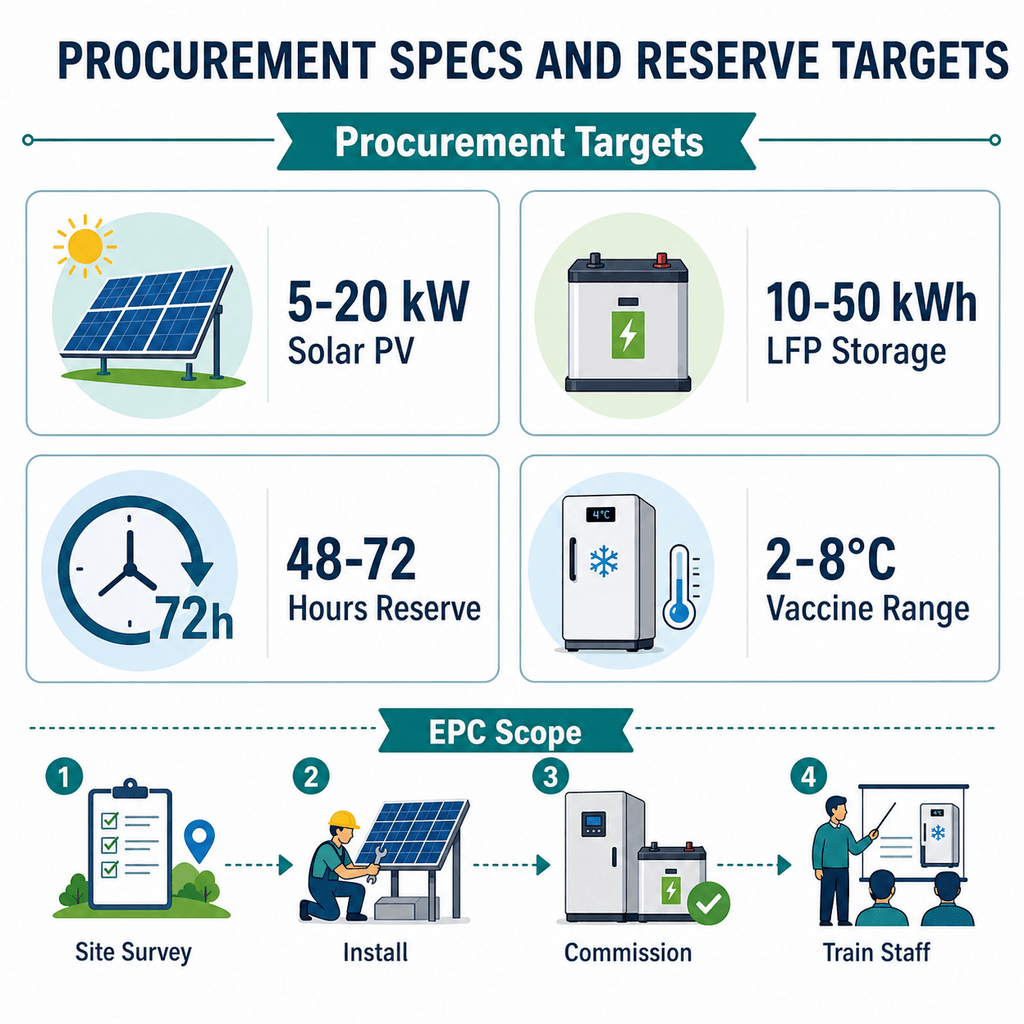
Solar powered cold chain refrigeration helps rural clinics keep vaccines at 2-8°C despite weak grids and fuel shortages. A practical clinic system uses 5-20kW PV, 10-50kWh LFP storage, medical-grade refrigeration, and 48-72 hours of reserve. Buyers should compare FOB, CIF, and EPC turnkey pricing while verifying IEC standards, WHO cold chain requirements, monitoring, warranty, and maintenance scope.
Solar powered cold chain refrigeration for rural clinics keeps vaccines at 2-8°C using 5-20kW PV, 10-50kWh LFP storage, and 48-72 hours of reserve, reducing diesel dependence while supporting WHO-compliant vaccine storage.
Summary
Solar powered cold chain refrigeration for rural clinics keeps vaccines at 2-8°C using 5-20kW PV, 10-50kWh LFP storage, and 48-72 hours of reserve, reducing diesel dependence while supporting WHO-compliant vaccine storage.
Key Takeaways
Rural clinic cold chain programs perform best when procurement teams define 2-8°C storage, 48-72 hours of reserve, and EPC delivery scope upfront.
- Specify a 2-8°C vaccine chamber with 30-day temperature logging before approving any rural clinic cold chain purchase.
- Size PV at 5-20kW and LFP storage at 10-50kWh to support refrigeration, lighting, IT, and emergency loads.
- Design for 48-72 hours of battery autonomy where grid outages or cloudy periods routinely exceed 1 day.
- Compare solar direct-drive, hybrid PV-battery, and diesel-backed refrigeration using 10-year fuel, maintenance, and outage costs.
- Verify IEC 61215, IEC 61730, IEC 62109, and IEEE 1547 compliance for modules, inverters, storage, and interconnection.
- Use NREL PVWatts or equivalent irradiance data to model annual PV yield within a 17-22% capacity factor range.
- Reduce diesel exposure by pairing 22.5-24.5% TOPCon modules with LFP batteries rated for daily cycling.
- Request FOB, CIF, and EPC turnkey quotations for 50+ clinic programs to unlock 5-15% volume pricing.
Solar Powered Cold Chain Refrigeration for Rural Clinics
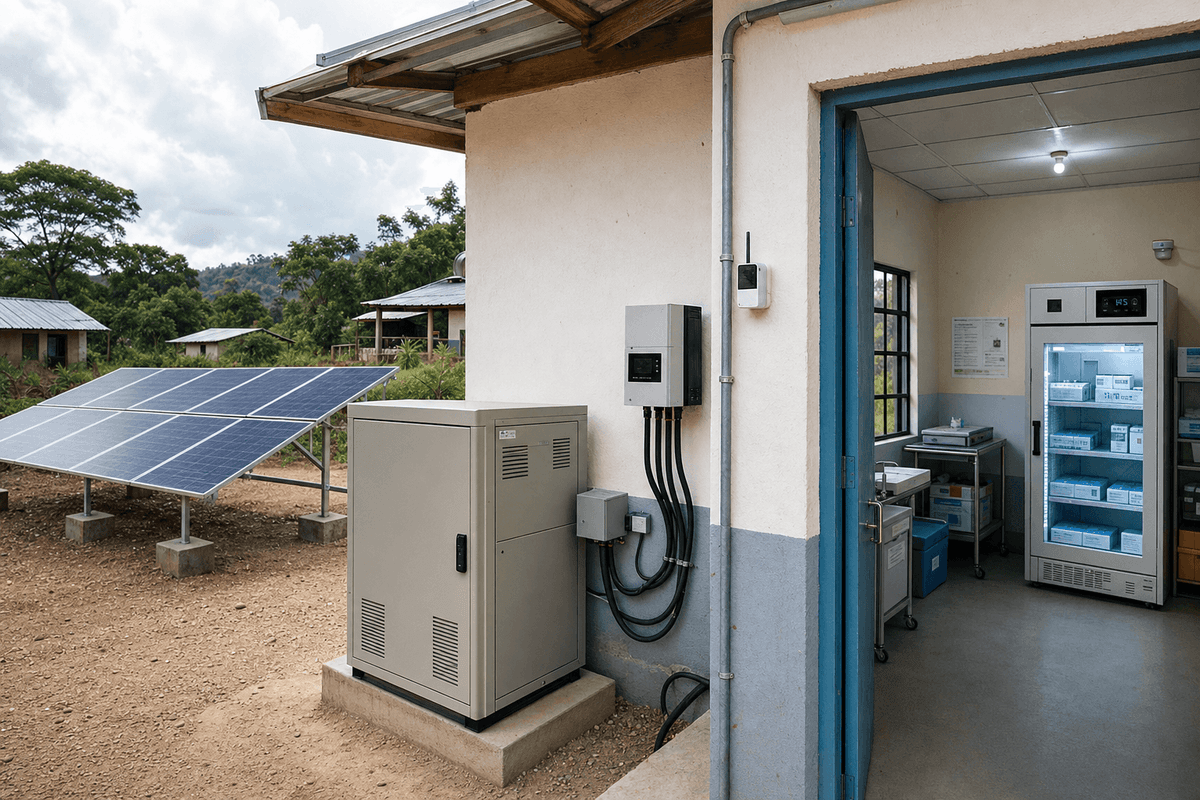
Solar powered cold chain refrigeration keeps rural clinic vaccines at 2-8°C with 5-20kW PV arrays and 10-50kWh storage when grid power is weak.
For health ministries, NGOs, EPC contractors, and medical infrastructure buyers, the problem is not simply buying a refrigerator. The real requirement is protecting biological products through unreliable power, high ambient temperatures, poor road access, and limited maintenance staff.
According to WHO guidance for immunization practice, most routine vaccines must remain between 2°C and 8°C, while freeze-sensitive vaccines can lose potency below 0°C. The CDC states, 'Vaccines must be stored properly', a short requirement that becomes difficult when clinics receive only a few hours of grid power per day.
A clinic-scale solar cold chain system converts daytime solar resource into stable cooling and stored energy. In rural Latin America, Africa, the Middle East, and Southeast Asia, it can combine N-type TOPCon PV modules, LFP batteries, medical refrigeration, remote monitoring, and backup input. SOLARTODO positions these systems as B2B infrastructure packages for inquiry-based quotation, not as an online marketplace.
According to IRENA (2025), 91% of new renewable power projects commissioned in 2024 were more cost-effective than fossil fuel alternatives. The IEA states, 'solar PV is now the cheapest source of electricity in history', especially where financing is available and solar resources are strong.
Technical Architecture and Performance Requirements
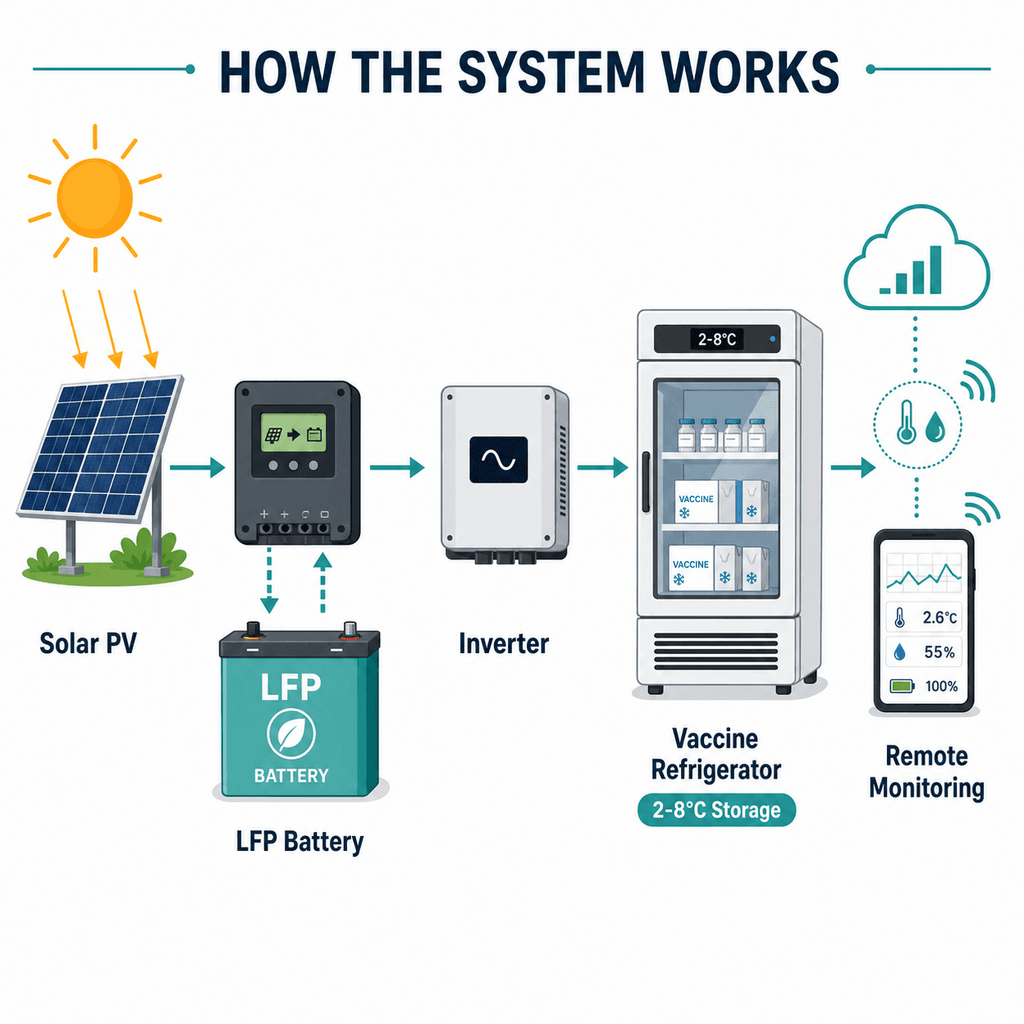
A clinic cold chain system should combine 22.5-24.5% TOPCon modules, LFP storage, and medical refrigeration sized from measured daily kWh demand.
The architecture starts with a load audit covering refrigerator wattage, compressor duty cycle, freezer or ice-pack needs, lights, fans, IT loads, security, and any diagnostic equipment. A dedicated vaccine refrigerator may use modest energy, but full clinic resilience often justifies a larger hybrid PV system.
A practical rural clinic configuration usually includes:
- 5-20kW PV array using mono TOPCon modules with 22.5-24.5% efficiency
- 10-50kWh LFP battery storage for night operation and cloudy-day reserve
- Medical-grade refrigerator or WHO PQS-aligned solar direct-drive unit
- Hybrid inverter or charge controller with compressor surge capacity
- Temperature logger with alarms, 30-day records, and remote monitoring
- DC and AC protection, earthing, lightning protection, and lockable enclosures
- Optional grid or generator input for emergency charging
SOLARTODO's 20kW+50kWh Residential Solar+Storage platform is relevant for larger rural clinics because it generates approximately 30-36MWh per year under many sunbelt conditions. For medium clinics, the same design logic can be scaled down while retaining predictable PV yield, LFP storage, protected circuits, and cold chain monitoring.
According to NREL PVWatts methodology, project teams should model yield using local irradiation, array tilt, system losses, and temperature assumptions. For many sunbelt sites, well-designed fixed-tilt PV systems target a 17-22% capacity factor, but shading, dust, and high module temperature can reduce production.
Applications and Rural Clinic Use Cases
Solar refrigeration is most valuable where clinics need 24/7 vaccine protection, 48-72 hours of reserve, and lower diesel logistics risk.
Rural clinics use solar powered cold chain systems in three common models. The smallest is a dedicated vaccine refrigerator with solar direct-drive cooling. The next is a clinic microgrid that powers refrigeration plus lights, fans, communications, and IT. The most resilient model integrates PV, LFP storage, grid input, generator backup, and remote monitoring.
For a vaccination outreach clinic, the main value is service continuity. If a refrigerator fails during a multi-day outage, the loss includes damaged vaccines, wasted transport, repeated staff time, and missed appointments. If the clinic also stores insulin, samples, or temperature-sensitive medicines, stable cooling has higher clinical value.
For a rural health post, buyers can specify a 5kW PV array with 10-15kWh of LFP storage for vaccine refrigeration and essential lighting. For a larger clinic with refrigeration, IT, water pumping, fans, and security, 10-20kW PV with 30-50kWh storage is more realistic. SOLARTODO can configure these packages around site load data and local installation constraints.
Comparison and Selection Guide
Procurement teams should compare at least 3 system types across autonomy, maintenance, load coverage, and 10-year total cost before procurement award.
| Option | Typical PV and storage | Best fit | Strength | Limitation |
|---|---|---|---|---|
| Solar direct-drive refrigerator | 0.5-2kW PV, thermal storage | Dedicated vaccine storage | Simple operation and low battery dependence | Limited support for other clinic loads |
| Hybrid PV-battery clinic system | 5-20kW PV, 10-50kWh LFP | Refrigeration plus clinic power | Supports 24/7 cold chain and essential services | Requires battery sizing and monitoring |
| Grid plus solar backup | 3-10kW PV, 5-20kWh LFP | Weak-grid clinics | Reduces outages and grid purchases | Still exposed to long cloudy periods if undersized |
| Diesel generator only | 2-10kVA generator, no PV | Emergency fallback | Familiar and dispatchable | Fuel logistics, noise, maintenance, emissions |
Selection should begin with vaccine volume and temperature risk, then move to energy design. Under-sizing is expensive because one outage can damage inventory and disrupt immunization schedules. Over-sizing also has a cost, so design should use local irradiation data, measured loads, and defined autonomy targets.
SOLARTODO recommends that B2B buyers compare purchase price, delivered cost, installation scope, training, spare parts, monitoring, warranty response, and financing options. A low-cost refrigerator without verified power autonomy is not equivalent to a clinic-ready cold chain system.
Key procurement checks include:
- Confirm 2-8°C vaccine storage performance under local ambient temperature
- Require 48-72 hours of reserve for weak-grid or off-grid clinics
- Model PV production using NREL PVWatts or equivalent local solar data
- Specify IEC 61215 and IEC 61730 certified PV modules
- Require IEC 62109 inverter safety and appropriate surge protection
- Include commissioning tests for temperature, battery autonomy, and alarms
EPC Investment Analysis and Pricing Structure
EPC turnkey delivery bundles engineering, procurement, construction, commissioning, and training for clinic programs from 50 units to USD 1,000K+ projects.
For rural clinic cold chain programs, EPC means Engineering, Procurement, and Construction. Engineering includes load assessment, PV and battery sizing, single-line diagrams, mounting design, protection design, and cold chain acceptance criteria. Procurement includes PV modules, batteries, inverters, refrigerators, monitoring devices, cables, mounting, distribution boards, and spare parts. Construction includes installation, testing, commissioning, documentation, and user training.
SOLARTODO normally structures B2B quotations in three commercial tiers:
| Pricing tier | What it includes | Buyer responsibility | Typical use |
|---|---|---|---|
| FOB Supply | Equipment supplied at export port | Freight, import, local installation | EPCs with their own logistics team |
| CIF Delivered | Equipment plus international freight and insurance | Import clearance and installation | Government or NGO programs needing delivered cost |
| EPC Turnkey | Design, supply, installation, commissioning, and training | Site access and approvals | Multi-clinic deployments requiring single-point delivery |
Volume pricing is reviewed after the bill of materials is fixed. As guidance, SOLARTODO can review 50+ clinic kits for a 5% discount, 100+ clinic kits for a 10% discount, and 250+ clinic kits for a 15% discount, subject to final configuration, shipping route, and project schedule.
ROI analysis should compare the solar cold chain system against diesel-only generation, grid-only refrigeration with vaccine losses, and portable ice-box logistics. Payback depends on avoided diesel fuel, reduced emergency transport, fewer temperature excursions, and continuous immunization services. In many weak-grid markets, a 5-20kW PV system can reduce delivered energy cost by 30-70% over the project life.
Standard payment terms are 30% T/T deposit plus 70% against B/L, or 100% L/C at sight for approved buyers. Project financing may be available for large projects above USD 1,000K. For technical quotation, procurement teams can contact SOLARTODO at [email protected] or +6585559114 with site count, vaccine volume, load list, autonomy requirement, delivery country, and preferred Incoterms.
FAQ
Solar powered cold chain FAQ answers should define 2-8°C storage, 48-72 hours of autonomy, and EPC scope in concise buyer language.
Q: What is solar powered cold chain refrigeration for rural clinics? A: Solar powered cold chain refrigeration uses PV modules, power electronics, batteries or thermal storage, and medical-grade refrigerators to hold vaccines at 2-8°C. For rural clinics, the system is usually sized around the vaccine load plus essential facility loads, so immunization services can continue through grid outages, fuel shortages, and road disruptions.
Q: How much PV capacity does a rural clinic vaccine refrigerator need? A: A single vaccine refrigerator may need only 0.5-2kW of dedicated PV, but clinics often specify 5-20kW to support refrigeration, lights, computers, fans, and communications. The correct size depends on compressor power, ambient temperature, door openings, solar resource, and whether the clinic wants 48-72 hours of autonomy.
Q: What temperature range must vaccine cold chain equipment maintain? A: Most routine vaccines must be stored at 2-8°C, with freeze-sensitive products protected from temperatures below 0°C. Procurement specifications should require continuous temperature monitoring, alarm outputs, and documented holdover performance. Clinics storing ultra-cold products need separate equipment because standard solar vaccine refrigerators are not designed for -60°C to -90°C storage.
Q: Should clinics choose solar direct-drive or battery-based refrigeration? A: Solar direct-drive is efficient for dedicated vaccine storage because it can use thermal storage and reduce battery maintenance. Battery-based hybrid systems are better when the same PV plant must also power lighting, IT, water pumps, security, or evening loads. Many rural clinic programs combine direct-drive refrigeration with 10-50kWh LFP storage for broader resilience.
Q: How long should the system operate without sun? A: A rural clinic cold chain design should normally target 48-72 hours of reserve without strong sunlight. Sites with long rainy seasons, unreliable access roads, or high-value vaccine inventory may require 4-5 days of autonomy. Reserve sizing should be based on measured load, worst-month irradiation, and the clinic's acceptable outage risk.
Q: How much does an EPC turnkey cold chain solar project cost? A: Cost depends on PV size, refrigeration volume, battery capacity, civil works, and logistics. Small clinic packages are often quoted as FOB supply, CIF delivered, or EPC turnkey so buyers can compare equipment-only cost against installed project cost. SOLARTODO provides offline quotations after reviewing load data, site access, and required warranty terms.
Q: What maintenance is required after installation? A: Maintenance includes cleaning PV modules every 1-3 months in dusty areas, checking cable terminations, testing alarms, reviewing temperature logs, and inspecting batteries and ventilation. A trained technician should complete preventive maintenance at least twice per year. Remote monitoring reduces site visits by identifying abnormal compressor runtime, battery faults, and temperature excursions early.
Q: What standards should procurement teams require? A: Procurement teams should require IEC 61215 and IEC 61730 for PV modules, IEC 62109 for inverter safety, and IEEE 1547 where grid interconnection applies. Vaccine refrigeration should reference WHO PQS specifications and require 2-8°C performance evidence. Battery systems should include LFP chemistry documentation, BMS protections, and transport compliance.
Q: How does solar refrigeration compare with diesel generation? A: Solar refrigeration replaces recurring diesel fuel logistics with upfront PV and storage capital. Diesel can support emergency backup, but it exposes clinics to fuel theft, transport delays, noise, emissions, and engine maintenance. Over 10 years, a properly sized solar hybrid system usually has lower operating risk where outages and fuel delivery failures are common.
Q: Can SOLARTODO support multi-country rural clinic programs? A: SOLARTODO can support multi-country programs with B2B system design, export documentation, FOB or CIF delivery, and EPC partner coordination. For programs above 50 clinic kits, standardized BOMs improve spare-parts planning and reduce training cost. Large projects above USD 1,000K can also be reviewed for project financing availability.
Q: What warranty structure should buyers request? A: Buyers should request separate warranties for PV modules, inverters, batteries, refrigeration equipment, and EPC workmanship. A practical specification includes 25+ year PV mechanical service life, inverter warranty terms of at least 5 years, battery cycle-life documentation, and 12-24 months of installation workmanship coverage. Temperature performance guarantees should be tied to commissioning tests.
Q: When is a 20kW plus 50kWh clinic system justified? A: A 20kW plus 50kWh system is justified when the clinic needs vaccine refrigeration plus evening lighting, laboratory equipment, IT, communications, and several hours of backup. SOLARTODO's 20kW+50kWh TOPCon LFP platform can produce about 30-36MWh per year, making it suitable for larger rural clinics with 3-phase loads.
References
The reference set combines 8 authoritative sources covering 2-8°C vaccine storage, PV yield modeling, safety standards, and solar cost benchmarks.
- [WHO] (2015): Immunization in Practice, a practical guide for health staff, explains vaccine cold chain handling and 2-8°C storage practice for routine immunization.
- [WHO PQS] (2024): Performance, Quality and Safety specifications for vaccine refrigerators and freezers, including solar direct-drive equipment categories.
- [CDC] (2025): Vaccine Storage and Handling Toolkit, provides operational guidance for vaccine storage units, temperature monitoring, and handling responsibilities.
- [NREL] (2024): PVWatts Calculator methodology and solar resource data support annual PV yield estimation using irradiation, tilt, losses, and temperature assumptions.
- [IRENA] (2025): Renewable Power Generation Costs in 2024 reports global renewable cost trends and the competitiveness of new solar PV against fossil alternatives.
- [IEC 61215-1] (2021): Terrestrial photovoltaic modules design qualification and type approval requirements for crystalline silicon PV module durability.
- [IEC 61730-1] (2023): Photovoltaic module safety qualification requirements for construction, electrical safety, and fire-related risk reduction.
- [IEEE 1547] (2018): Standard for interconnection and interoperability of distributed energy resources with electric power systems interfaces.
Conclusion
Solar powered cold chain refrigeration gives rural clinics 2-8°C vaccine protection with 5-20kW PV, 10-50kWh storage, and lower diesel dependence.
The bottom line is direct: rural clinics should treat cold chain refrigeration as critical infrastructure, not as a stand-alone appliance. For programs above 50 clinics, SOLARTODO recommends standardized PV-battery-refrigeration packages with verified autonomy, IEC-compliant components, remote monitoring, and EPC pricing that compares FOB Supply, CIF Delivered, and EPC Turnkey delivery on the same technical basis.
About SOLARTODO
SOLARTODO is a global integrated solution provider specializing in solar power generation systems, energy-storage products, smart street-lighting and solar street-lighting, intelligent security & IoT linkage systems, power transmission towers, telecom communication towers, and smart-agriculture solutions for worldwide B2B customers.
About the Author

Cinn Song
Founder & Chief Solutions Architect
Cinn Song founded SOLARTODO LIMITED and leads its smart-city infrastructure engineering — from solar, storage and integrated smart poles to the company's push into physical-AI city edge nodes: pole-mounted edge computing, vertical LLMs for smart cities, drone-based O&M with autonomous battery swapping, robotic maintenance, and high-speed counter-UAS interception. Since 2010, he has directed turnkey EPC + BOT delivery across 50+ countries, including telecom monopole supply for national grid operators, off-grid solar street-lighting for African municipalities, and integrated smart-pole programs for Gulf smart cities.
Cite This Article
Cinn Song. (2026). solar powered cold chain refrigeration for rural clinics |…. SOLARTODO. Retrieved from https://solartodo.com/knowledge/solar-powered-cold-chain-refrigeration-for-rural-clinics
@article{solartodo_solar_powered_cold_chain_refrigeration_for_rural_clinics,
  title = {solar powered cold chain refrigeration for rural clinics |…},
  author = {Cinn Song},
  journal = {SOLARTODO Knowledge Base},
  year = {2026},
  url = {https://solartodo.com/knowledge/solar-powered-cold-chain-refrigeration-for-rural-clinics},
  note = {Accessed: 2026-09-19}
}
Published: June 16, 2026 | Available at: https://solartodo.com/knowledge/solar-powered-cold-chain-refrigeration-for-rural-clinics
Subscribe to Our Newsletter
Get the latest solar energy news and insights delivered to your inbox.
View All Articles