Solar-Powered access control for 24/7 Operation | SOLARTODO

Cinn Song
Founder & Chief Solutions Architect
Watch the video
TL;DR
Solar-powered access control is the best fit for remote gates, warehouses, telecom compounds, and utility sites where grid power is costly or unreliable. A typical industrial node uses 800W-2kW of PV, 5-10kWh LFP storage, and 48-72 hours of backup, with UL 294 or IEC 60839-aligned access equipment and EPC options for 50+ node projects.
Solar-powered access control keeps gates, doors, and readers online 24/7 using 800W-2kW PV arrays, 5-10kWh LFP batteries, and 48-72 hours of backup for warehouses, depots, telecom sites, and remote infrastructure.
Summary
Solar-powered access control keeps gates, doors, and readers online 24/7 using 800W-2kW PV arrays, 5-10kWh LFP batteries, and 48-72 hours of backup for warehouses, depots, telecom sites, and remote infrastructure.
Key Takeaways
Solar-powered access control improves 24/7 perimeter uptime by combining 48-72 hours of storage, multi-factor entry control, and solar hybrid charging.
- Size battery autonomy for 48-72 hours using 5-10kWh LFP storage per gate cluster or multi-door controller.
- Specify 800W-2kW solar arrays for remote access points with readers, locks, controllers, cameras, and 4G routers.
- Require UL 294 or IEC 60839-11-1 aligned access equipment for audit logging, credential control, and physical security reliability.
- Integrate 4G/LTE failover and encrypted event reporting to maintain 24/7 monitoring when Ethernet or grid power fails.
- Compare FOB, CIF, and EPC turnkey pricing before procurement because logistics, civil works, and commissioning can add 20-45%.
- Reduce generator runtime by 60-90% at remote gates by replacing diesel-only access power with PV plus LFP storage.
- Plan preventive maintenance every 6-12 months, including battery health checks, panel cleaning, lock testing, and firmware review.
- Use SOLARTODO project engineering for 50+ access points to standardize cabinets, spares, monitoring, and warranty support.
Why 24/7 Access Control Needs Solar Hybrid Power
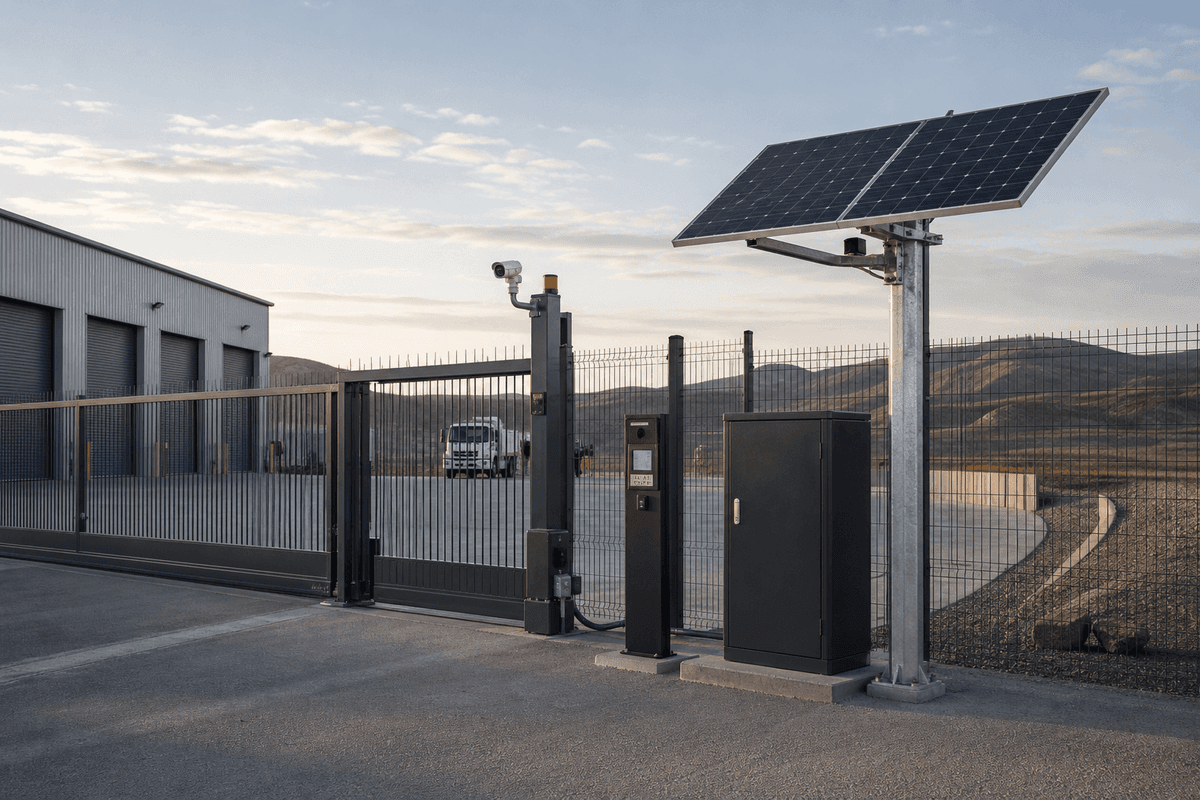
Solar-powered access control protects critical entry points for 24 hours per day by pairing 800W-2kW PV generation with 5-10kWh LFP battery backup.
For B2B sites, access control is not only a convenience system. It is a production continuity layer. A gate failure can stop trucks, expose a warehouse yard, delay shift changes, or leave a telecom compound dependent on manual guards. The risk is highest where utility power is unstable, trenching new AC cable is expensive, or the protected asset is outside the main building envelope.
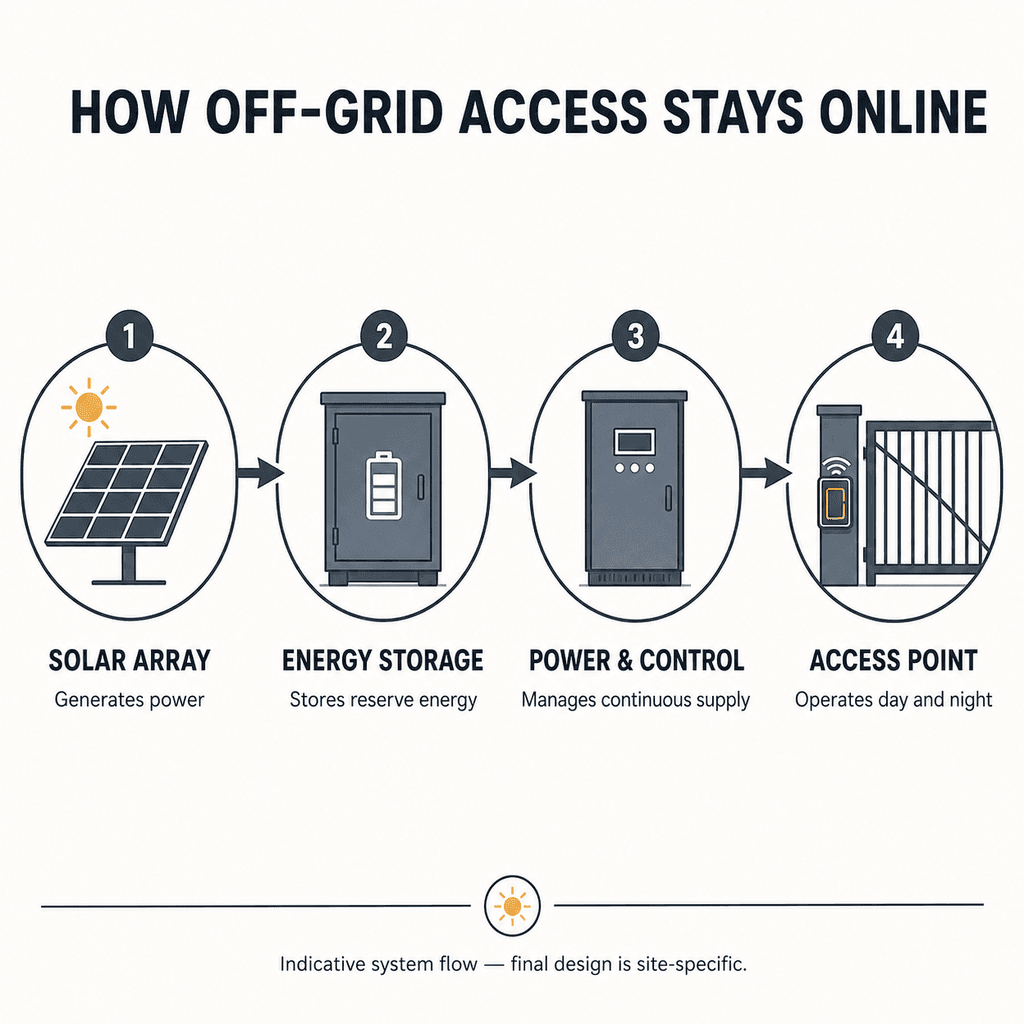
A solar-powered access control system typically includes solar modules, MPPT charging, LFP batteries, a DC or AC power distribution cabinet, access controller, RFID or biometric readers, electric locks or gate relays, request-to-exit devices, and a 4G/LTE or Ethernet communications path. For higher-risk locations, SOLARTODO adds CCTV verification, sirens, strobes, and intrusion sensors so that access events and alarm events share the same power and monitoring backbone.
According to IRENA (2025), utility-scale solar PV reached a global weighted-average LCOE of USD 0.043/kWh in 2024, while battery storage costs fell 93% from 2010 to 2024. Those two cost movements matter for security buyers because remote access points often consume modest continuous loads but face high grid-extension and outage costs.
The International Renewable Energy Agency states, "Renewables remained the most cost-competitive option" in 2024. For access control, the practical implication is simple: a small hybrid power plant can now be treated as part of the security bill of materials, not as a separate infrastructure project.
Technical Architecture for Solar-Powered Access Control
A reliable solar access-control node uses a 48V DC architecture, 99.9% controller availability targets, and 4G/LTE backup for every critical gate.
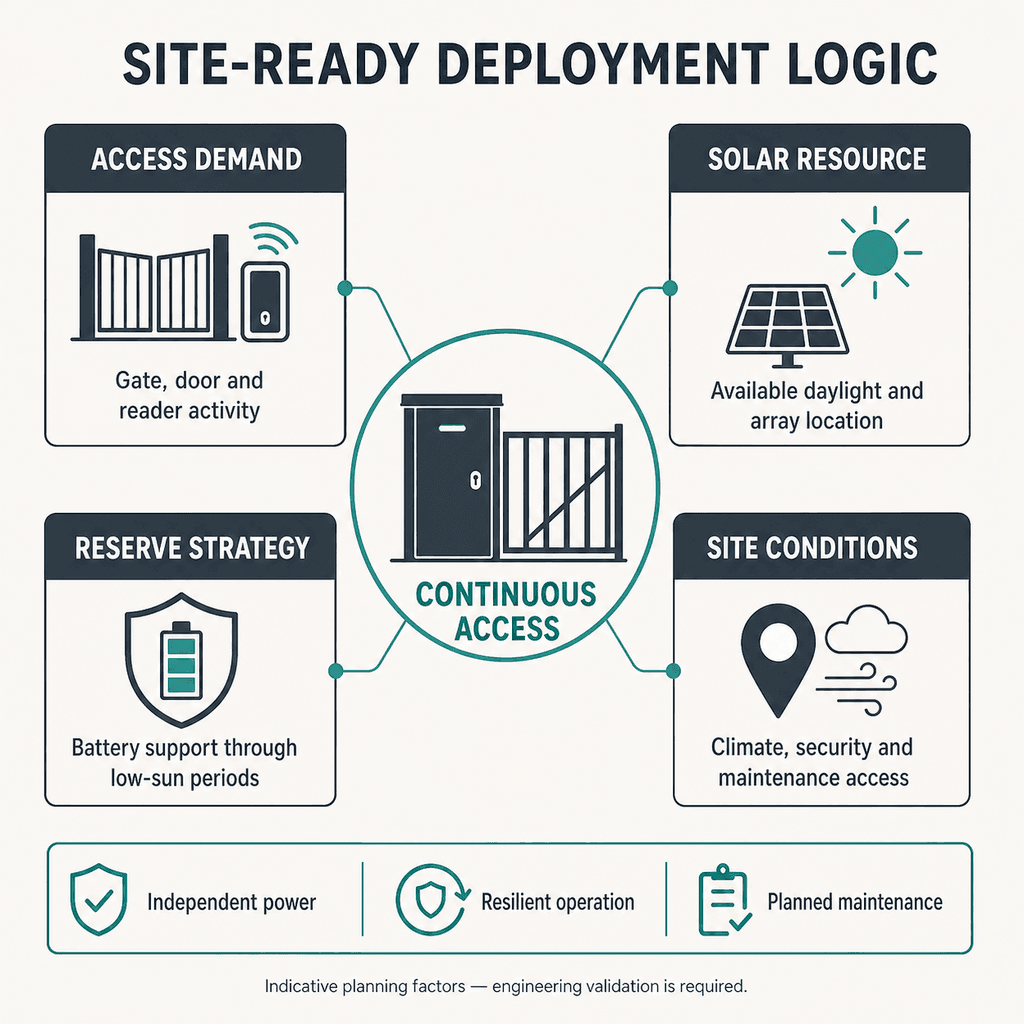
The best architecture starts with load profiling. A single pedestrian door with a controller, reader, lock, exit button, and router may average 20-60W. A vehicle gate with loop detector, access reader, intercom, gate operator relays, camera, IR illuminator, and communications equipment may average 80-250W, with short motor or lock surge events. Procurement teams should request both average watts and peak watts, because battery sizing depends on average load while inverter and breaker sizing depend on peak load.
A typical SOLARTODO configuration for an industrial access point uses:
- 800W-1.2kW monocrystalline solar array for one gate or two pedestrian doors.
- 2kW solar array for access control plus CCTV, perimeter beams, siren, and router.
- 5kWh LFP battery for 48-hour autonomy in moderate loads.
- 10kWh LFP battery for 72-hour autonomy or multi-device security loads.
- MPPT charge controller sized at 125% of expected solar charging current.
- IP65 or IP66 outdoor cabinet with surge protection, fuses, breakers, and ventilation.
- 4G/LTE router with Ethernet primary where available and local Wi-Fi for maintenance.
Access control logic should remain local even when cloud software is used. If the network drops, authorized credentials must still open approved doors, denied credentials must remain denied, and logs should buffer locally until the link returns. This fail-operational design is essential for ports, logistics yards, telecom compounds, mines, farms, substations, and industrial parks.
According to IEC 60839-11-1 (2013), electronic access control systems cover physical entry control and include requirements for logging, identification, and control information. In practice, this means buyers should not evaluate only the reader type. They should check event logs, tamper signals, controller memory, credential rules, and integration with alarms.
UL Solutions states, "Access control systems are foundational to facility security." For B2B buyers, that foundation must include power continuity, not only card readers and software dashboards.
Applications and Operational Benefits
Solar access-control systems deliver the strongest ROI at remote gates, unmanned yards, logistics parks, and sites where trenching costs exceed USD 8,000-25,000.
Remote vehicle gates are the most common use case. Running new AC cable across a yard, road, or perimeter fence can require trenching, permits, conduit, protection works, and downtime. A solar cabinet near the gate can reduce civil work, shorten deployment, and keep the access point independent from local utility failures.
Warehouses and logistics centers use solar access control to keep truck gates, employee turnstiles, and emergency entry points running during outages. When paired with a 24-zone hybrid alarm panel and cameras, the same energy system can support intrusion sensors and video verification. SOLARTODO warehouse security packages can use 2kW solar arrays and 10kWh LFP batteries to support up to 72 hours of critical security operation.
Telecom and utility sites need access records even when no guard is present. A solar-powered access node can log contractor entry, restrict time windows, trigger camera snapshots, and alert remote supervisors when a cabinet is forced open. For critical infrastructure, the access controller should be placed inside a locked enclosure with tamper detection, DC surge protection, and local backup memory.
Agricultural estates, mining sites, construction camps, and water facilities use solar access control because perimeter assets may be far from the main electrical room. These sites often need weather-resistant cabinets, anti-corrosion hardware, and simple maintenance routines that local teams can execute without specialist tools.
According to NREL PVWatts documentation, solar output estimates use long-term weather and solar-resource data to model expected generation variability. For procurement managers, this supports a practical requirement: ask suppliers to size each access point using site irradiance, load profile, autonomy target, and seasonal worst-case assumptions rather than one generic panel size.
Specification and Selection Guide
A bankable specification compares access-control security level, solar autonomy, communications, and installation scope across at least 3 procurement options.
Procurement should start with a site survey and a written performance requirement. Define how many openings must be controlled, how many events per day are expected, whether the gate motor itself needs solar backup, and whether the system must integrate with CCTV, alarm panels, visitor management, or ERP workflows.
| Requirement | Basic Solar Door | Industrial Gate Node | High-Security Hybrid Node |
|---|---|---|---|
| Typical access points | 1-2 doors | 1 vehicle gate + 1 door | 2-4 gates or zones |
| Solar array | 300-600W | 800W-1.2kW | 1.5-2kW |
| Battery storage | 1-3kWh LFP | 5kWh LFP | 10kWh LFP |
| Backup autonomy | 24-36 hours | 48 hours | 72 hours |
| Communications | 4G or Ethernet | Ethernet + 4G | Ethernet + 4G + local diagnostics |
| Security devices | Reader, lock, controller | Reader, gate relay, camera | Access, CCTV, siren, beams, alarm panel |
| Best use case | Small remote door | Warehouse or depot gate | Critical warehouse, telecom, utility site |
The access-control layer should match recognized standards. IEC 60839-11-1 is relevant for electronic access control functionality and test methods. UL 294 is especially important for North American projects because it defines performance levels for access control system units, including security performance from Level I to Level IV. IEC 62676 is relevant when video verification is integrated with the access point.
Cybersecurity and communications should be specified directly. Require encrypted controller communication, role-based administrator accounts, unique device passwords, firmware update procedures, and event log retention. For sites with enterprise security operations centers, request API or ONVIF-compatible integration where applicable.
IEEE 1547-2018 applies when distributed energy resources interconnect with utility systems. If the access-control power package is off-grid only, the interconnection scope may be simpler. If it is grid-hybrid, the inverter, protection settings, commissioning tests, and anti-islanding behavior should follow local utility requirements.
EPC Investment Analysis and Pricing Structure
EPC turnkey delivery bundles engineering, procurement, construction, commissioning, and warranty support for 50-250+ solar access-control nodes across multi-site projects.
SOLARTODO is a B2B manufacturer and exporter, not an online marketplace. The commercial process is inquiry, engineering review, offline quotation, and project delivery planning. For large infrastructure buyers in Latin America, the Middle East, Africa, Southeast Asia, and Europe, the most important pricing question is not the unit reader price. It is which delivery boundary the buyer wants.
FOB Supply covers factory supply at the port of loading. It is suitable when the buyer controls freight, customs, installation, and local commissioning. CIF Delivered adds international freight and insurance to the destination port, reducing logistics uncertainty for importers. EPC Turnkey includes engineering, procurement, construction, installation supervision, commissioning, documentation, and training, making it the preferred model for multi-site deployments or customers without an experienced local security integrator.
| Pricing Tier | What It Includes | Typical Buyer Responsibility | Best Fit |
|---|---|---|---|
| FOB Supply | Equipment, factory QA, export packing | Freight, customs, installation, commissioning | Experienced distributors and EPCs |
| CIF Delivered | FOB scope + sea freight + insurance | Customs, inland transport, civil works | Importers needing logistics support |
| EPC Turnkey | Design, supply, installation, commissioning, training | Site access, permits, approvals | Owners needing one accountable package |
Volume pricing should be negotiated at the project level. As guidance, 50+ access nodes may qualify for a 5% discount, 100+ nodes for 10%, and 250+ nodes for 15%, subject to configuration, destination, certification scope, and installation requirements. Standard payment terms are 30% T/T deposit plus 70% against bill of lading, or 100% L/C at sight. Financing is available for large projects above USD 1,000K after credit and project review. For commercial quotations, contact [email protected].
ROI depends on avoided trenching, reduced generator fuel, lower outage risk, and reduced manual guarding. A remote gate that avoids USD 12,000 in trenching and USD 2,000 per year in generator fuel can pay back a USD 9,000-18,000 solar access package in roughly 3-6 years. Where downtime blocks truck movement or leaves inventory exposed, payback can be faster because the avoided operational loss is larger than the electricity saving.
FAQ
Solar-powered access control is best specified by autonomy hours, access-point count, security standard, and total installed cost instead of reader price alone.
Q: What is solar-powered access control? A: Solar-powered access control uses photovoltaic modules and battery storage to run gates, doors, readers, controllers, locks, and communications equipment 24/7. A typical industrial node uses 800W-2kW of solar and 5-10kWh of LFP storage, depending on load and autonomy requirements.
Q: How long can a solar access-control system operate without sun? A: Industrial systems are commonly sized for 48-72 hours of autonomy without meaningful solar charging. The exact runtime depends on average load, battery capacity, weather, battery temperature, and whether cameras, sirens, gate operators, or routers are powered from the same cabinet.
Q: What access points are suitable for solar power? A: Remote gates, warehouse truck entrances, pedestrian turnstiles, telecom compounds, utility substations, farms, and construction camps are strong candidates. Solar is most attractive when grid extension is expensive, outage risk is high, or trenching across roads and yards would delay operations.
Q: How much does a solar-powered access-control system cost? A: Small solar door systems may be quoted as equipment packages, while industrial gate nodes often require project pricing. Buyers should compare FOB Supply, CIF Delivered, and EPC Turnkey scopes because freight, batteries, cabinets, civil works, commissioning, and monitoring can materially change total cost.
Q: What does EPC turnkey delivery include? A: EPC turnkey delivery includes engineering, procurement, construction, installation supervision, commissioning, documentation, and training. For 50+ nodes, SOLARTODO can standardize solar cabinets, access controllers, spare parts, and monitoring workflows so procurement teams manage one integrated project package.
Q: Which standards should procurement teams request? A: Request access-control equipment aligned with IEC 60839-11-1 or UL 294, battery systems aligned with UL 1973 where applicable, and video systems aligned with IEC 62676 if CCTV is included. Grid-hybrid inverter interconnection should follow IEEE 1547-2018 and local utility rules.
Q: Can the system integrate with CCTV and alarms? A: Yes, solar access-control cabinets can power cameras, alarm inputs, sirens, strobes, perimeter beams, and 4G routers. For warehouses, SOLARTODO can integrate access events with AI video verification and intrusion detection, creating a single power-resilient security layer.
Q: What maintenance is required? A: Plan maintenance every 6-12 months for panel cleaning, battery health checks, firmware review, lock operation tests, cable inspection, and event-log verification. Dusty, coastal, desert, or industrial sites may need more frequent cleaning and corrosion checks to preserve solar yield and enclosure reliability.
Q: Does solar access control work during grid outages? A: Yes, if the system is designed with sufficient battery autonomy and local controller logic. During outages, approved credentials should continue working, denied credentials should remain blocked, and stored access logs should upload automatically when Ethernet or 4G service returns.
Q: How should batteries be sized for 24/7 operation? A: Battery sizing starts with average load in watts multiplied by required autonomy hours, then adds efficiency and aging margins. For example, a 100W average load over 72 hours requires 7.2kWh before reserve margins, so a 10kWh LFP battery is typically appropriate.
Q: Is financing available for large projects? A: Financing may be available for SOLARTODO projects above USD 1,000K after review of project scope, buyer profile, destination market, and payment structure. Standard alternatives remain 30% T/T plus 70% against B/L or 100% L/C at sight.
Q: Why choose solar instead of diesel generator backup? A: Solar plus LFP storage reduces fuel logistics, noise, emissions, and routine generator servicing. For remote access points, it can cut generator runtime by 60-90% while providing quieter 24/7 security power for controllers, readers, cameras, routers, and alarms.
References
- IRENA (2025): Renewable Power Generation Costs in 2024; reports USD 0.043/kWh global solar PV LCOE and 93% battery storage cost decline since 2010. https://www.irena.org/Publications/2025/Jun/Renewable-Power-Generation-Costs-in-2024 — https://www.irena.org/Data/View-data-by-topic/Capacity-and-Generation
- NREL PVWatts (2024): PVWatts methodology uses long-term solar resource and weather data to estimate photovoltaic generation and interannual variability. https://pvwatts.nrel.gov/version_6.php — https://www.nrel.gov/research/data-tools.html
- IEC 60839-11-1 (2013): Electronic access control systems standard defining functionality, performance requirements, logging, identification, and control information. https://webstore.iec.ch/en/publication/3662 — https://webstore.iec.ch/
- UL 294 (2023): Access Control System Units framework for safety, performance, reliability, and Levels I-IV security performance. https://www.ul.com/services/access-control-system-testing-and-certification — https://www.ul.com/
- UL 1973 (2022): Batteries for stationary and motive auxiliary power applications, including PV, wind, UPS, and stationary storage systems. https://webstore.ansi.org/standards/ul/ansiul19732022 — https://www.ul.com/
- IEEE 1547-2018 (2018): Interconnection and interoperability standard for distributed energy resources connected to electric power systems. https://standards.ieee.org/ieee/1547/5915/ — https://standards.ieee.org/ieee/1547/7382/
- IEC 62676-1-1 (2013): Video surveillance systems standard specifying minimum system requirements for security applications. https://webstore.iec.ch/en/publication/7347 — https://webstore.iec.ch/
- IEC 62676-6 (2026): Intelligent video analytics standard covering performance testing and grading for real-time video analysis systems. https://webstore.iec.ch/en/publication/59704 — https://webstore.iec.ch/ The 8 references below support solar cost, battery safety, access-control performance, video security, and DER interconnection requirements for B2B specifications.
- IRENA (2025): Renewable Power Generation Costs in 2024; reports USD 0.043/kWh global solar PV LCOE and 93% battery storage cost decline since 2010.
- NREL PVWatts (2024): PVWatts methodology uses long-term solar resource and weather data to estimate photovoltaic generation and interannual variability.
- IEC 60839-11-1 (2013): Electronic access control systems standard defining functionality, performance requirements, logging, identification, and control information.
- UL 294 (2023): Access Control System Units framework for safety, performance, reliability, and Levels I-IV security performance.
- UL 1973 (2022): Batteries for stationary and motive auxiliary power applications, including PV, wind, UPS, and stationary storage systems.
- IEEE 1547-2018 (2018): Interconnection and interoperability standard for distributed energy resources connected to electric power systems.
- IEC 62676-1-1 (2013): Video surveillance systems standard specifying minimum system requirements for security applications.
- IEC 62676-6 (2026): Intelligent video analytics standard covering performance testing and grading for real-time video analysis systems.
Conclusion
Solar-powered access control is a practical 24/7 security investment when each node is sized for 48-72 hours of autonomy and verified against recognized standards.
Bottom line: for warehouses, logistics parks, telecom sites, and remote infrastructure, SOLARTODO solar-powered access control combines 800W-2kW PV, 5-10kWh LFP storage, and EPC delivery options to reduce outage risk and avoid costly grid extension. For 50+ access points, standardize the cabinet, battery, controller, communications, and maintenance model before issuing a final purchase order.
About SOLARTODO
SOLARTODO is a global integrated solution provider specializing in solar power generation systems, energy-storage products, smart street-lighting and solar street-lighting, intelligent security & IoT linkage systems, power transmission towers, telecom communication towers, and smart-agriculture solutions for worldwide B2B customers.
About the Author

Cinn Song
Founder & Chief Solutions Architect
Cinn Song founded SOLARTODO LIMITED and leads its smart-city infrastructure engineering — from solar, storage and integrated smart poles to the company's push into physical-AI city edge nodes: pole-mounted edge computing, vertical LLMs for smart cities, drone-based O&M with autonomous battery swapping, robotic maintenance, and high-speed counter-UAS interception. Since 2010, he has directed turnkey EPC + BOT delivery across 50+ countries, including telecom monopole supply for national grid operators, off-grid solar street-lighting for African municipalities, and integrated smart-pole programs for Gulf smart cities.
Cite This Article
Cinn Song. (2026). Solar-Powered access control for 24/7 Operation | SOLARTODO. SOLARTODO. Retrieved from https://solartodo.com/knowledge/solar-powered-access-control-for-247-operation
@article{solartodo_solar_powered_access_control_for_247_operation,
  title = {Solar-Powered access control for 24/7 Operation | SOLARTODO},
  author = {Cinn Song},
  journal = {SOLARTODO Knowledge Base},
  year = {2026},
  url = {https://solartodo.com/knowledge/solar-powered-access-control-for-247-operation},
  note = {Accessed: 2026-10-19}
}
Published: August 21, 2026 | Available at: https://solartodo.com/knowledge/solar-powered-access-control-for-247-operation
Subscribe to Our Newsletter
Get the latest solar energy news and insights delivered to your inbox.
View All Articles