Solar-Hybrid Smart Streetlights: Grid Plus PV Power…

Cinn Song
Founder & Chief Solutions Architect
Watch the video
TL;DR
Solar-hybrid smart streetlights use grid power, 200-400W PV, and 5-15kWh LFP batteries to keep 160W LED lighting and smart-city devices running with higher reliability than off-grid-only designs. For 50-250+ pole projects, compare FOB, CIF, and EPC turnkey pricing, validate IEEE/IEC standards, and model site-specific PV yield before procurement.
Solar-hybrid smart streetlights combine grid input, 200-400W PV, 5-15kWh LFP storage, and 160W LED loads to cut outages, reduce trenching dependence, and support 7-11kW EV-ready smart-city poles.
Summary
Solar-hybrid smart streetlights combine grid input, 200-400W PV, 5-15kWh LFP storage, and 160W LED loads to cut outages, reduce trenching dependence, and support 7-11kW EV-ready smart-city poles.
Key Takeaways
Grid plus PV streetlights use 2 power sources and 1 controller architecture to prioritize lighting uptime, battery health, and predictable municipal maintenance.
- Specify 200-400W monocrystalline PV and 5-15kWh LFP storage to support cameras, sensors, lighting, and emergency standby for 2-8 hours.
- Design grid-plus-PV controls with 3 operating modes: PV priority, grid backup, and battery-protected emergency lighting.
- Compare 160W LED fixtures against 250W HPS alternatives to reduce lighting energy use by roughly 36-45% per pole.
- Validate interconnection against IEEE 1547-2018 and IEC 62124 when PV, battery, and grid circuits operate as one hybrid system.
- Use 30m, 32m, or 35m pole spacing to plan boulevard lighting layouts before confirming optics, road class, and illuminance targets.
- Budget procurement around 3 commercial tiers: FOB supply, CIF delivered, and EPC turnkey installation with 50+, 100+, and 250+ volume discounts.
- Prioritize LFP batteries with 5, 10, or 15kWh capacity where grid outages, telecom loads, or public-safety devices require overnight resilience.
- Request site-specific PV yield modeling with NREL PVWatts-style inputs to estimate annual generation within a practical engineering range.
Why Grid Plus PV Architecture Matters
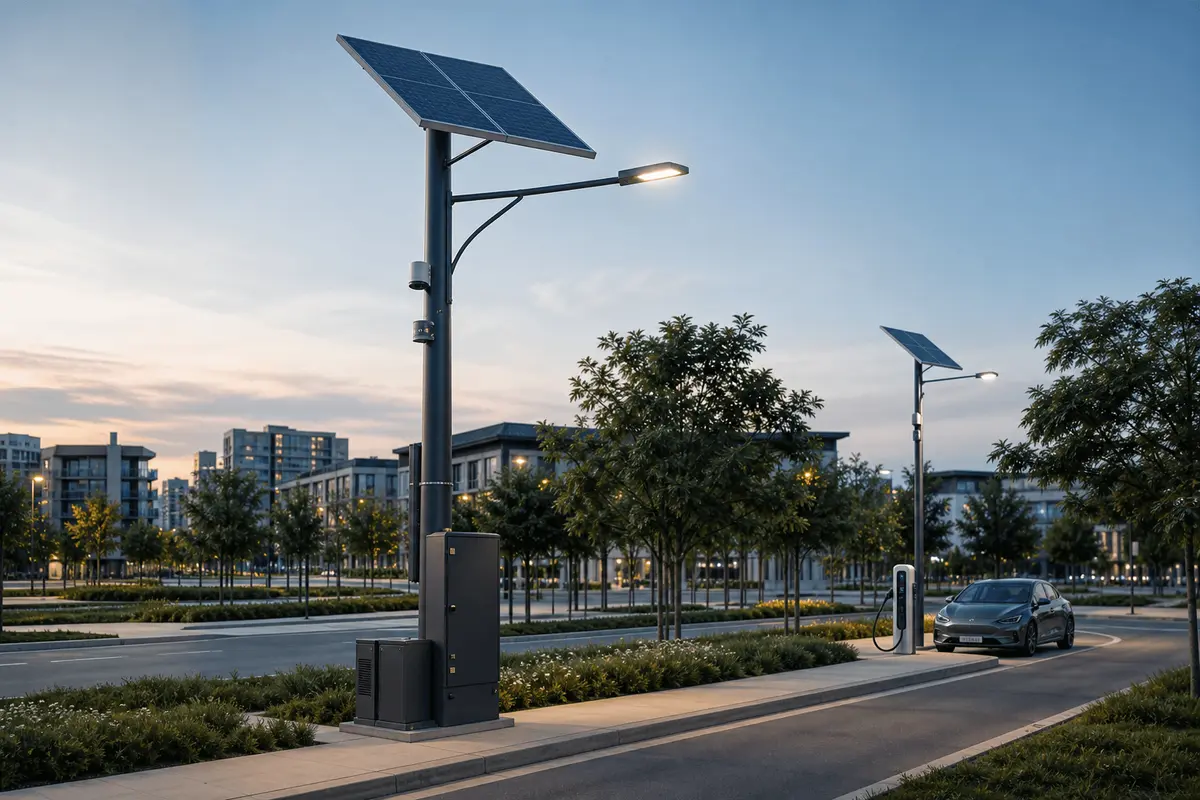
Grid plus PV smart streetlights solve the core 2026 infrastructure problem: cities need 24/7 lighting, surveillance, communications, and EV-ready power without relying on a single utility feed.
A solar-hybrid smart streetlight is not simply a solar lamp connected to a grid wire. It is a managed power node that combines photovoltaic generation, utility power, battery storage, LED lighting, and smart-city auxiliary loads under one control strategy. For B2B buyers, the advantage is operational: grid power covers long cloudy periods, PV reduces import energy, and the battery keeps critical services alive during short outages.
SOLARTODO positions this architecture for municipal boulevards, industrial parks, ports, campuses, highways, and smart-city corridors in Latin America, the Middle East, Africa, Southeast Asia, and Europe. These markets often face a mix of rising electricity tariffs, unreliable distribution feeders, limited maintenance teams, and growing demand for public safety devices. The hybrid architecture addresses those constraints with a more predictable operating model than pure off-grid lighting.
According to IRENA (2025), solar PV accounted for 452.1GW of renewable capacity additions in 2024, or about 77.8% of the global renewable additions reported for that year. That matters for streetlighting because PV modules, controllers, and battery supply chains are now mature enough for infrastructure-scale procurement. IRENA states, 'Solar photovoltaic power has become increasingly competitive,' which supports the shift from decorative pilot projects to repeatable public works packages.
According to IEA (2024), solar PV is expected to lead renewable capacity growth toward 2030, with renewables contributing most new power capacity in many scenarios. The IEA states, 'Solar PV alone accounts for over half of this expansion,' describing the central role of PV in new electricity infrastructure. For smart poles, this supports a practical design choice: use the grid for certainty, but use PV wherever the pole surface and project economics allow.
Technical Power Architecture
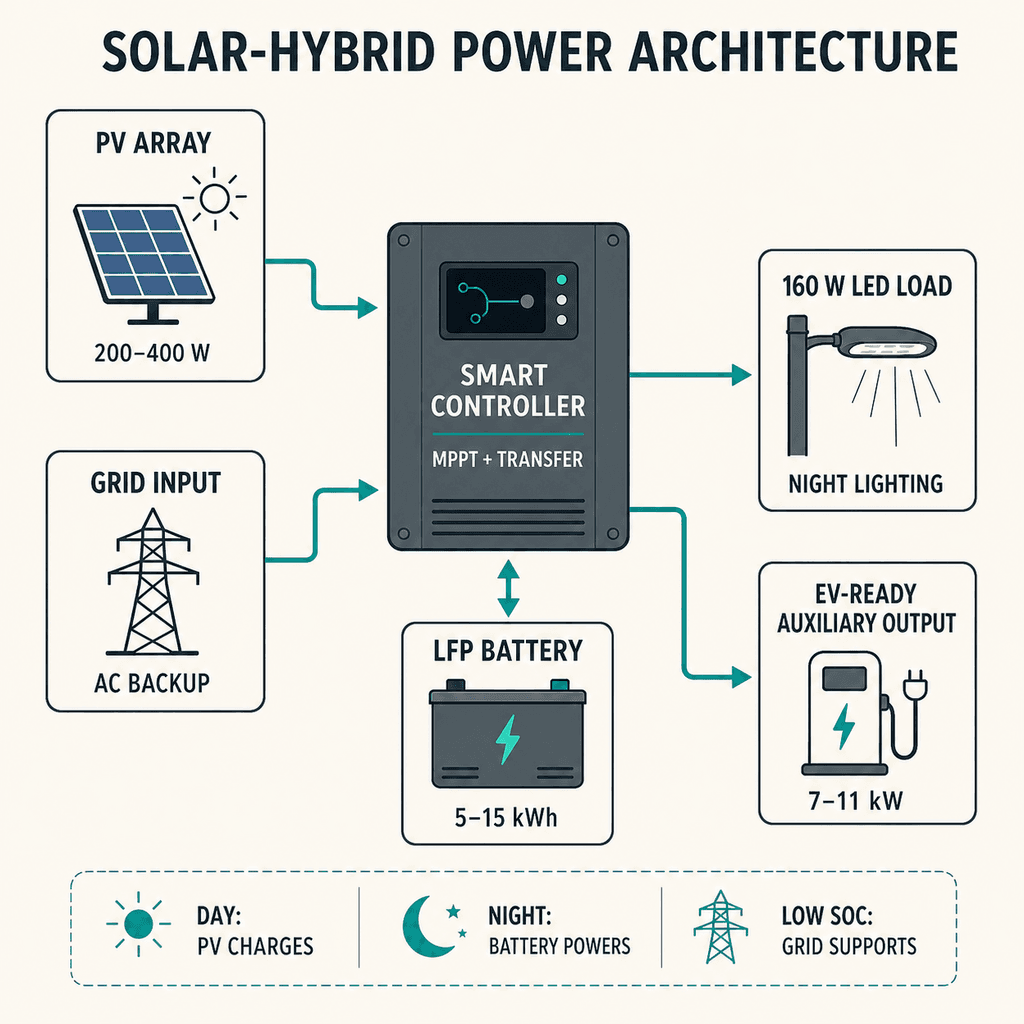
A grid-plus-PV smart streetlight normally uses 5 major electrical blocks: PV array, MPPT controller, LFP battery, grid charger/inverter, and protected DC load bus.
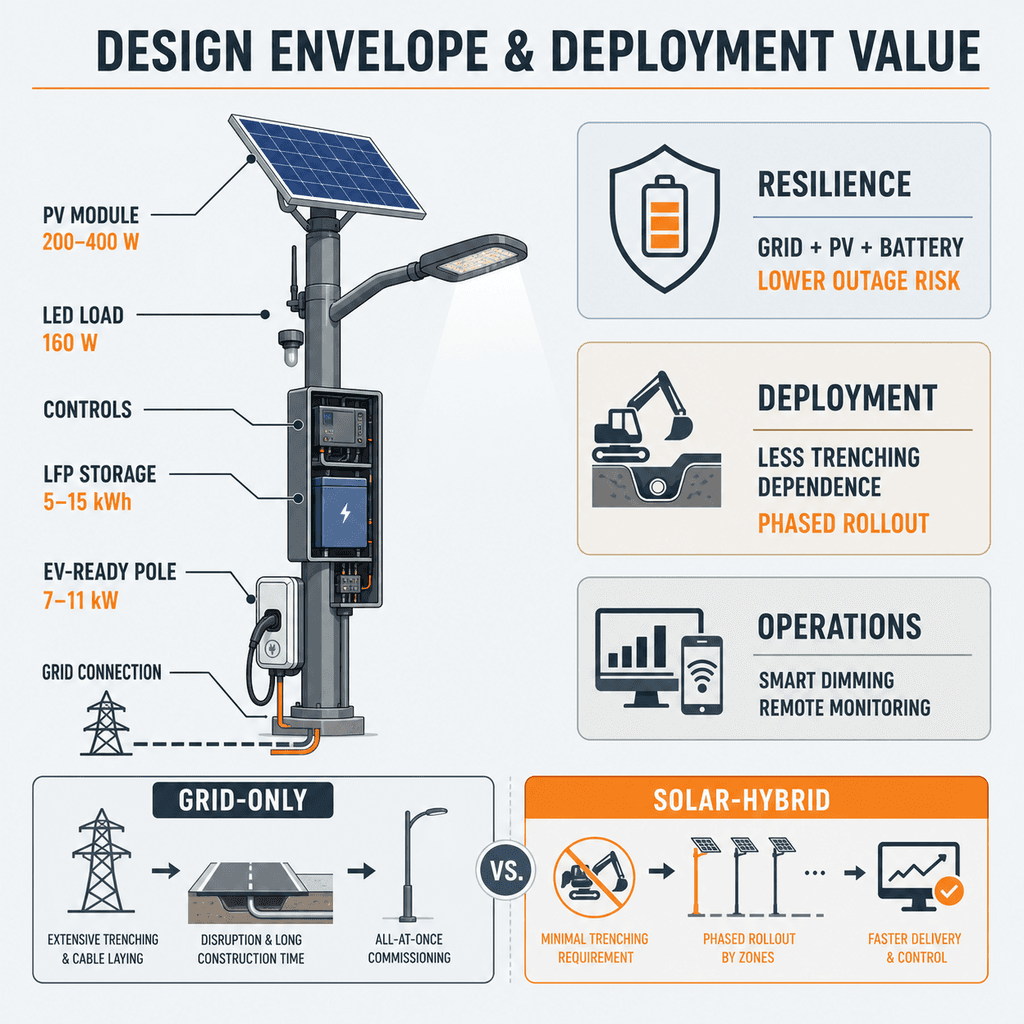
The typical SOLARTODO hybrid boulevard configuration uses 2 monocrystalline solar panels rated at 100W, 150W, or 200W each, giving 200W, 300W, or 400W installed PV capacity. The smart pole can include a 160W LED luminaire, PTZ camera, environmental sensor, WiFi 6 or 5G communications, IP audio column, emergency call unit, LED display, and optional 7kW or 11kW Type 2 AC EV charger. In the 12m wind-solar hybrid pole, the battery is usually 5kWh, 10kWh, or 15kWh LFP storage inside the base.
The controller should implement source prioritization rather than uncontrolled parallel supply. During daylight, PV charges the LFP battery and serves low-voltage DC loads where the controller allows. At night, the battery supports LED lighting and low-power smart devices until a defined state-of-charge threshold. If battery reserve drops below the engineering limit, the grid charger maintains the lighting schedule and protects battery cycle life.
Operating Modes
A bankable hybrid design should define at least 3 modes. Normal mode uses PV first, battery second, and grid support only when needed. Grid-assist mode keeps the battery above the reserve threshold during rainy periods or high auxiliary load. Emergency mode preserves a reduced lighting profile, camera, communications, and emergency call availability for 2-8 hours depending on battery size and site load.
NREL PVWatts methodology is useful for early-stage energy estimation because it converts local irradiance, array tilt, system losses, and DC capacity into expected annual AC production. For a 400W pole-mounted PV array, a favorable site may generate several hundred kWh per year, but output still depends on shading, soiling, tilt, and the local solar resource. Procurement teams should request site-specific energy tables rather than using a single global yield assumption.
Battery sizing should start from the night load, not from the panel nameplate. A 160W luminaire running 12 hours consumes 1.92kWh before dimming strategies and driver losses. Adaptive dimming, camera duty cycle, sensor power, communications standby, and emergency reserve all change the final storage requirement. LFP chemistry is commonly preferred because public infrastructure benefits from thermal stability, long cycle life, and predictable maintenance planning.
EPC Investment Analysis and Pricing Structure
EPC delivery for 50-250+ hybrid smart poles should define scope, logistics, civil works, commissioning, discounts, payment terms, and payback assumptions before quotation.
For SOLARTODO, EPC means Engineering, Procurement, and Construction support around a real project package, not an online cart checkout. Engineering includes pole schedule, power architecture, load table, foundation assumptions, cable routing, lighting layout inputs, and grid interconnection review. Procurement includes smart poles, PV modules, LFP batteries, controllers, luminaires, cameras, communication devices, and optional EV charging hardware. Construction support can include installation guidance, commissioning checklists, and project documentation for local contractors or turnkey partners.
The commercial structure normally uses 3 tiers. FOB Supply covers manufacturing and export-ready goods at the port of origin; the buyer manages freight, import, and installation. CIF Delivered includes ocean freight and insurance to the destination port, which helps procurement teams compare landed costs. EPC Turnkey adds project engineering, site coordination, installation scope, commissioning support, and local compliance documentation where SOLARTODO or its partner network can support the project.
Volume pricing should be discussed early because pole count affects steel fabrication, controller procurement, packaging, and freight utilization. As guidance, projects above 50 units can target about 5% discount, projects above 100 units can target about 10%, and projects above 250 units can target about 15%, subject to configuration, delivery market, and payment schedule. Payment terms are typically 30% T/T deposit plus 70% against B/L, or 100% L/C at sight for qualified orders.
ROI depends on the baseline. Replacing a 250W HPS lamp with a 160W LED fixture saves about 90W during operation; at 12 hours per night and $0.15/kWh, that is roughly $59 per pole per year from lighting energy alone. The hybrid case can add value through reduced outage penalties, lower generator use, fewer standalone cabinets, shorter exposed cable runs, and lower maintenance visits. For large projects above $1,000K, project financing may be available; contact [email protected] for financing review and quotation routing.
| Commercial tier | Buyer scope | SOLARTODO scope | Best fit |
|---|---|---|---|
| FOB Supply | Freight, import, installation | Factory supply, packing, export documents | Experienced importers and EPCs |
| CIF Delivered | Import, inland transport, installation | Factory supply plus sea freight and insurance | Municipal buyers comparing landed cost |
| EPC Turnkey | Site access, approvals, owner acceptance | Engineering, supply, installation coordination, commissioning | 50-250+ pole smart-city corridors |
Specification and Selection Guide
A procurement-ready hybrid smart streetlight specification should compare height, PV capacity, battery size, lighting output, grid interface, and smart-device load in one table.
The correct architecture is selected by load profile. A simple urban road may need an 8m all-in-one 60W solar streetlight with 120Wp PV and 500Wh battery for fast deployment. A boulevard, port, or smart-city corridor may need a 12m hybrid pole with 160W LED lighting, 200-400W PV, 5-15kWh LFP battery, surveillance, sensors, and communications. Where EV charging is included, the charger load must be treated separately from the lighting and public-safety reserve.
IEC 60598 remains relevant for luminaire safety and construction, while IEC 62722 supports LED luminaire performance expectations. IEC 62124 is useful for photovoltaic standalone system qualification, especially where the pole must operate through defined autonomy periods. IEEE 1547-2018 becomes important when distributed energy resources interact with electric power systems, and UL 1741 is commonly referenced for inverter and interconnection equipment in North American projects.
According to IRENA (2025), 91% of new renewable power projects commissioned in 2024 were more cost-effective than fossil-fuel alternatives. That does not mean every smart pole should be off-grid. It means PV is now economically credible enough to be integrated into grid-connected public infrastructure, especially where energy tariffs, outage costs, and trenching constraints are material.
| Selection factor | 8m all-in-one solar streetlight | 12m grid-plus-PV smart pole | 12m wind-solar hybrid smart pole |
|---|---|---|---|
| Typical LED load | 60W | 120-160W | 160W |
| PV capacity | 120Wp | 200-400W | 200-400W plus VAWT |
| Battery capacity | 500Wh class | 5-15kWh LFP | 5-15kWh LFP |
| Grid connection | Optional or none | Yes, backup and charging | Yes, hybrid resilience |
| Smart devices | Basic controller, sensor | Camera, sensor, WiFi/5G, audio, display | 11-in-1 smart-city package |
| Pole spacing | Project-specific | 30m, 32m, or 35m | 30m, 32m, or 35m |
| Best use case | Residential roads and parks | Boulevards, campuses, ports | Coastal boulevards and high-visibility corridors |
For structural selection, buyers should also specify wind rating, coating, corrosion class, foundation assumptions, anchor cage details, and service access. SOLARTODO smart poles use steel pole structures with hot-dip corrosion protection and architectural coating options. In coastal regions, structural review should include local gust factors, salt exposure, fatigue assumptions, and combined equipment loading from PV, cameras, displays, and communication devices.
Deployment, Maintenance, and Risk Control
Successful hybrid streetlight projects reduce lifecycle risk by documenting 4 items early: load schedule, grid rules, foundation design, and remote maintenance workflow.
Installation planning should begin with a single-line diagram and a per-pole load table. The load table should separate mandatory loads, such as lighting and emergency call units, from discretionary loads, such as LED displays or WiFi hotspots. This prevents the battery from being sized around a vague smart-city concept and gives engineers a measurable basis for autonomy calculations.
Maintenance teams should be able to inspect battery state of charge, PV charging status, grid input, controller alarms, and luminaire operation remotely. A practical preventive maintenance interval is 12-18 months for visual inspection, fastener checks, waterproofing review, electrical terminals, lens condition, and cabinet seals. Sites with dust, salt spray, heavy pollen, or vandalism risk may need shorter inspection cycles.
Cybersecurity and network planning also matter because smart streetlights can become distributed endpoints for cameras, public WiFi, audio systems, and emergency communications. Procurement documents should specify role-based access, encrypted remote access, firmware update process, log retention, and SIM or fiber ownership. For municipalities, these requirements are often as important as lumens per watt.
SOLARTODO is not an online marketplace; the buying process is inquiry, engineering confirmation, offline quotation, and project financing review where applicable. Buyers should prepare pole count, road width, spacing target, grid availability, outage history, desired smart functions, battery autonomy target, and destination port. For direct project consultation, contact +6585559114 or [email protected].
FAQ
Hybrid smart streetlight FAQs should answer 10 procurement questions covering architecture, cost, standards, installation, battery life, EV charging, and warranty assumptions.
Q: What is a solar-hybrid smart streetlight with grid plus PV architecture? A: A solar-hybrid smart streetlight combines utility grid input, photovoltaic generation, battery storage, and controlled LED lighting in one managed system. The grid provides reliability during long cloudy periods, while 200-400W PV and 5-15kWh LFP storage reduce grid dependence and keep critical smart-city loads operating during short outages.
Q: How is grid-plus-PV different from a fully off-grid solar streetlight? A: A fully off-grid light depends on solar generation and battery storage only, so autonomy must cover worst-case weather. A grid-plus-PV light uses PV to reduce energy import but keeps grid backup for reliability. This is better for 160W luminaires, cameras, communications, and public-safety devices requiring predictable uptime.
Q: What battery size is suitable for hybrid smart streetlights? A: Battery size should be based on night load, dimming schedule, outage target, and auxiliary devices. SOLARTODO smart-pole configurations commonly use 5kWh, 10kWh, or 15kWh LFP batteries. A 160W LED running 12 hours consumes about 1.92kWh before dimming, so cameras and communications must be added separately.
Q: Can the same pole support EV charging and streetlighting? A: Yes, but EV charging must be electrically separated from the lighting reserve. SOLARTODO hybrid boulevard poles can integrate a 7kW or 11kW Type 2 AC charger in a welded base. The charger is usually treated as an opportunistic or grid-supported load, not as a guaranteed battery-backed lighting load.
Q: What standards should engineers check before procurement? A: Engineers should check IEC 60598 for luminaire safety, IEC 62722 for LED performance, IEC 62124 for PV standalone behavior, and IEEE 1547-2018 for distributed energy interconnection. North American projects may also require UL 1741 for inverter-related equipment and local utility approval before grid connection.
Q: How much energy can a hybrid smart streetlight save? A: Savings depend on the baseline fixture, tariff, dimming profile, and PV yield. Replacing a 250W HPS fixture with a 160W LED cuts lighting wattage by about 36%. At 12 operating hours and $0.15/kWh, the lighting reduction alone is roughly $59 per pole per year.
Q: What does EPC turnkey delivery include for smart streetlight projects? A: EPC turnkey delivery includes engineering, procurement, construction coordination, installation support, commissioning, and documentation. For SOLARTODO projects, this may cover pole schedules, power design, foundation assumptions, device configuration, logistics, and acceptance checklists. Pricing is normally compared against FOB Supply and CIF Delivered tiers before final contract scope.
Q: What payment terms and volume discounts are typical? A: Typical payment terms are 30% T/T deposit plus 70% against bill of lading, or 100% L/C at sight for qualified buyers. Volume guidance is about 5% discount for 50+ units, 10% for 100+ units, and 15% for 250+ units, subject to configuration and destination.
Q: How often should hybrid smart streetlights be maintained? A: A practical maintenance interval is every 12-18 months for electrical, structural, and optical inspection. Teams should check battery status, controller logs, PV charging, grid input, waterproof seals, fasteners, lens clarity, and communication uptime. Harsh coastal, dusty, or vandalism-prone sites may require shorter inspection cycles.
Q: When should a city choose wind-solar hybrid poles instead of PV-only poles? A: Wind-solar hybrid poles are best where local wind resources are credible and the project needs high-visibility resilience. SOLARTODO's 12m hybrid pole can use 300-500W vertical-axis wind turbine options plus 200-400W PV. PV-only grid-hybrid poles are usually simpler where wind is turbulent, obstructed, or difficult to permit.
References
These 8 references cover PV yield modeling, distributed energy interconnection, luminaire safety, battery safety, module qualification, and renewable cost trends for hybrid streetlights.
- NREL (2024): PVWatts Calculator methodology and solar resource modeling for estimating photovoltaic energy production across project locations.
- IRENA (2025): Renewable Power Generation Costs in 2024, reporting solar PV competitiveness and 2024 renewable cost trends.
- IEA (2024): Renewables 2024 market analysis covering solar PV growth, renewable capacity expansion, and grid integration needs.
- IEEE 1547-2018 (2018): Standard for interconnection and interoperability of distributed energy resources with electric power systems.
- IEC 60598-1 (2024): General requirements and tests for luminaires used in roadway and outdoor lighting applications.
- IEC 62124 (2004): Photovoltaic standalone system design verification guidance relevant to autonomous and hybrid PV lighting systems.
- IEC 62619 (2022): Safety requirements for secondary lithium cells and batteries used in industrial applications, including LFP storage.
- UL 1741 (2021): Standard for inverters, converters, controllers, and interconnection system equipment for distributed energy resources.
Conclusion
Grid-plus-PV smart streetlights are best specified as 2-source power systems with 200-400W PV, 5-15kWh LFP storage, and documented grid backup logic.
The bottom line: SOLARTODO solar-hybrid smart streetlights give EPCs and municipalities a practical architecture for resilient lighting, surveillance, communications, and EV-ready corridors, especially for 50-250+ pole projects where standardized design, financing review, and lifecycle maintenance matter as much as first cost.
About SOLARTODO
SOLARTODO is a global integrated solution provider specializing in solar power generation systems, energy-storage products, smart street-lighting and solar street-lighting, intelligent security & IoT linkage systems, power transmission towers, telecom communication towers, and smart-agriculture solutions for worldwide B2B customers.
About the Author

Cinn Song
Founder & Chief Solutions Architect
Cinn Song founded SOLARTODO LIMITED and leads its smart-city infrastructure engineering — from solar, storage and integrated smart poles to the company's push into physical-AI city edge nodes: pole-mounted edge computing, vertical LLMs for smart cities, drone-based O&M with autonomous battery swapping, robotic maintenance, and high-speed counter-UAS interception. Since 2010, he has directed turnkey EPC + BOT delivery across 50+ countries, including telecom monopole supply for national grid operators, off-grid solar street-lighting for African municipalities, and integrated smart-pole programs for Gulf smart cities.
Cite This Article
Cinn Song. (2026). Solar-Hybrid Smart Streetlights: Grid Plus PV Power…. SOLARTODO. Retrieved from https://solartodo.com/knowledge/solar-hybrid-smart-streetlights-grid-plus-pv-power-architecture
@article{solartodo_solar_hybrid_smart_streetlights_grid_plus_pv_power_architecture,
  title = {Solar-Hybrid Smart Streetlights: Grid Plus PV Power…},
  author = {Cinn Song},
  journal = {SOLARTODO Knowledge Base},
  year = {2026},
  url = {https://solartodo.com/knowledge/solar-hybrid-smart-streetlights-grid-plus-pv-power-architecture},
  note = {Accessed: 2026-10-19}
}
Published: July 14, 2026 | Available at: https://solartodo.com/knowledge/solar-hybrid-smart-streetlights-grid-plus-pv-power-architecture
Subscribe to Our Newsletter
Get the latest solar energy news and insights delivered to your inbox.
View All Articles