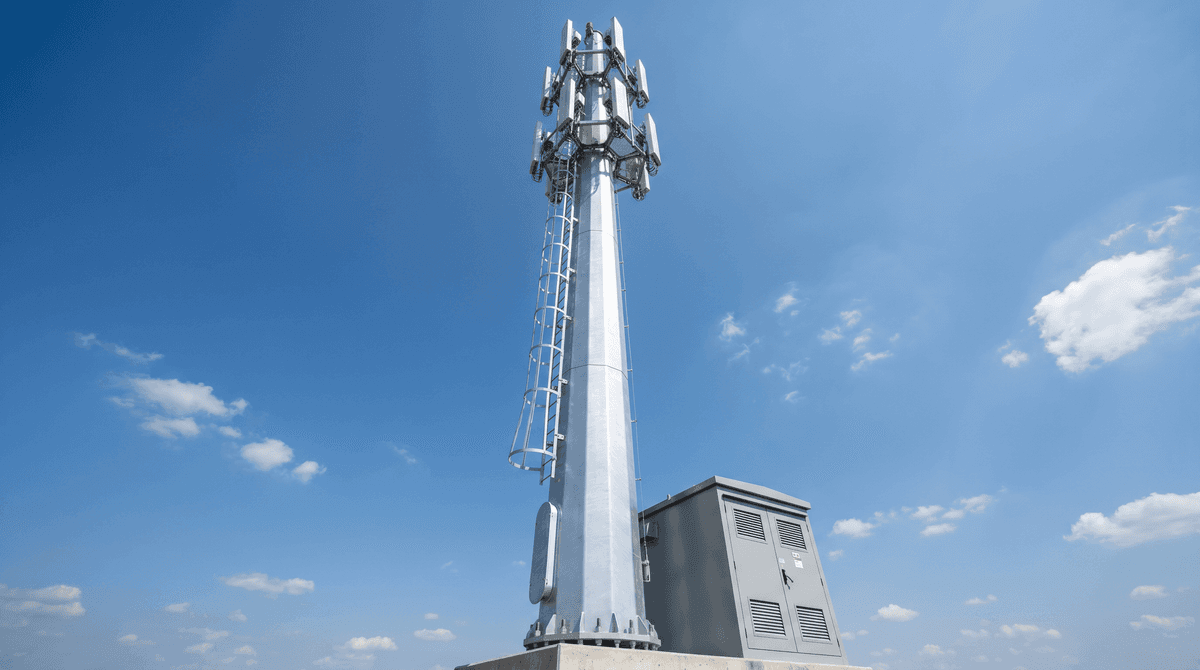
Sofia Telecom Tower Market Analysis: 35m Steel Monopole Configuration Guide for Urban Macro Coverage
Summary
Sofia’s dense urban footprint, mountain-influenced wind exposure, and ongoing 4G/5G capacity pressure support a typical 15-unit macro rollout using 35m steel monopole Telecom Tower structures. A recommended configuration uses Q345 hot-dip galvanized steel, Wind Class 4 at 70 m/s, and 18t per tower with CKD shipping that cuts logistics volume by 60-70%.
Key Takeaways
A Sofia macro-cell Telecom Tower program would typically favor the 35-45m size class, matching peri-urban and high-coverage urban edge use with 2-3 platforms and support for 6-9 panel antennas plus 1-2 microwave links.
- Sofia Municipality reports a population of about 1.28 million residents, which increases demand for higher-capacity macro telecom sites across dense districts and transport corridors.
- According to the National Statistical Institute of Bulgaria, Sofia City Province remains the country’s largest urban concentration, making 35m monopoles a practical height for wide-area macro coverage without moving into oversized rural 45-55m classes.
- A typical 15-unit deployment in Sofia would use 35m tapered steel monopoles, each at approximately 18t based on the engineering rule of ~500 kg/m × 35m.
- The recommended structure uses hot-dip galvanized Q345 steel, Wind Class 4, and 70 m/s design wind speed under TIA-222-H, which is conservative for exposed ridge, boulevard, and open-corridor sites.
- The specified antenna package of 9 panel antennas + 1 microwave dish + 6 RRUs fits a high-capacity regional macro profile and remains aligned with the 35-45m telecom tower application band.
- Concrete pad foundations are suitable where Sofia urban and suburban plots provide stable bearing conditions and where excavation depth can be managed around utilities and paved access roads.
- CKD shipping reduces transport volume by 60-70%, which matters for imported steel sections moving through Black Sea and overland routes into western Bulgaria.
- A normal manufacturing window for this tower class is 30-45 days, followed by civil works, erection, antenna mounting, grounding, and acceptance testing to TIA-222-H / GB/T 50233.
Market Context for Sofia
Sofia combines a population of roughly 1.28 million with the country’s highest business density, making macro telecom infrastructure a capacity issue rather than only a coverage issue. According to Sofia Municipality (2023), the municipality covers about 492 km², which creates mixed deployment conditions across dense central districts, residential expansion zones, ring-road corridors, and foothill areas. For Telecom Tower planning, that means one pole type rarely fits every site, but the 35m macro monopole is a strong fit for broad urban-suburban coverage.
According to the National Statistical Institute of Bulgaria (2024), Sofia City Province remains the largest concentration of population and economic activity in Bulgaria. That concentration matters because mobile traffic scales with commuting, office density, retail clusters, and transport interchanges, not only resident count. A 35m monopole is often the practical middle ground where rooftop options are constrained, while 45m+ structures may face more visual, zoning, and foundation constraints inside the municipal boundary.
Climate and terrain also shape tower selection in Sofia. The city sits at approximately 550 m elevation in the Sofia Valley and is influenced by nearby Vitosha Mountain, which can increase localized wind effects along open boulevards, ridge-adjacent sites, and transport corridors. According to TIA (2022), tower wind design must account for site-specific exposure, topographic effects, and appurtenance loading; for that reason, a conservative Wind Class 4 at 70 m/s is a defensible recommendation for a macro tower procurement specification in Sofia when planners want one standard across mixed exposure categories.
Network modernization is another driver. According to the European Commission DESI reports and national broadband policy documents, Bulgaria continues to expand very high-capacity connectivity and 5G service availability. Macro sites in capital-city environments increasingly need to carry multiple sectors, RRUs, and microwave backhaul, especially where fiber is delayed or where redundant transmission is required. That profile aligns better with a steel monopole carrying 9 panels, 1 microwave dish, and 6 RRUs than with a lighter rural single-tier arrangement.
Authority guidance also supports durable steel infrastructure. The ITU states, "Infrastructure sharing, site optimization and appropriate tower design are critical to cost-effective broadband expansion." The World Bank notes that digital infrastructure quality directly affects urban productivity and service access in middle-income European markets. For Sofia, the practical reading is clear: fewer, higher-capacity macro poles at 35m can be more efficient than many undersized infill structures when land access and permitting are limited.
Recommended Technical Configuration
For Sofia’s urban macro coverage needs, a typical 15-unit deployment would use 35m hot-dip galvanized steel monopoles with 9 panel antennas, 1 microwave dish, and 6 RRUs per site.
The correct engineering band is the 35-45m size class from the product table. That class is defined for highway/peri-urban applications with 2-3 platforms, 6-9 panels, and 1-2 microwave links, with a structural mass of 22-30t as a broad class envelope. However, this project-specific configuration is fixed at 35m and approximately 18t per tower, which remains consistent with the explicit product engineering rule of ~500 kg/m × height and is the controlling value for procurement.
A typical Sofia rollout of this profile would consist of approximately 15 units of tapered round or octagonal steel monopole Telecom Tower structures. Each tower would be fabricated in flanged bolt-on sections for transport and site assembly, using Q345 steel with hot-dip galvanizing for a 30-year design life in a low-corrosion environment. SOLAR TODO should present this as a macro-cell recommendation, not as a rooftop infill pole, because the loading package is too high for the 15-25m class.
The specified antenna package is heavier than a basic suburban 4G site and lighter than the most congested dense-urban hotspot profile. With 9 panel antennas + 1 microwave + 6 RRUs, the tower is configured for regional macro coverage and transmission resilience. In Sofia, that is relevant for ring-road sectors, residential edge districts, logistics zones, and transport approaches where line-of-sight and broad azimuth coverage matter more than decorative concealment.
Foundation selection is set here as a concrete pad foundation, which is reasonable for many Sofia plots with accessible excavation and moderate tower height at 35m. Final geotechnical verification still matters because urban utility congestion, groundwater variability, and fill conditions can change footing dimensions. According to GB/T 50233 and TIA-222-H, foundation design must be verified against actual soil bearing capacity, overturning moment, and anchor-bolt reactions before fabrication release.
For logistics, SOLAR TODO’s CKD shipment model reduces shipping volume by 60-70%, which can materially lower freight complexity for sectional steel poles. That matters for imported steel structures entering Bulgaria through multimodal routes. It also helps where site access in Sofia is constrained by boulevard traffic, crane staging limits, and short municipal work windows.
Technical Specifications
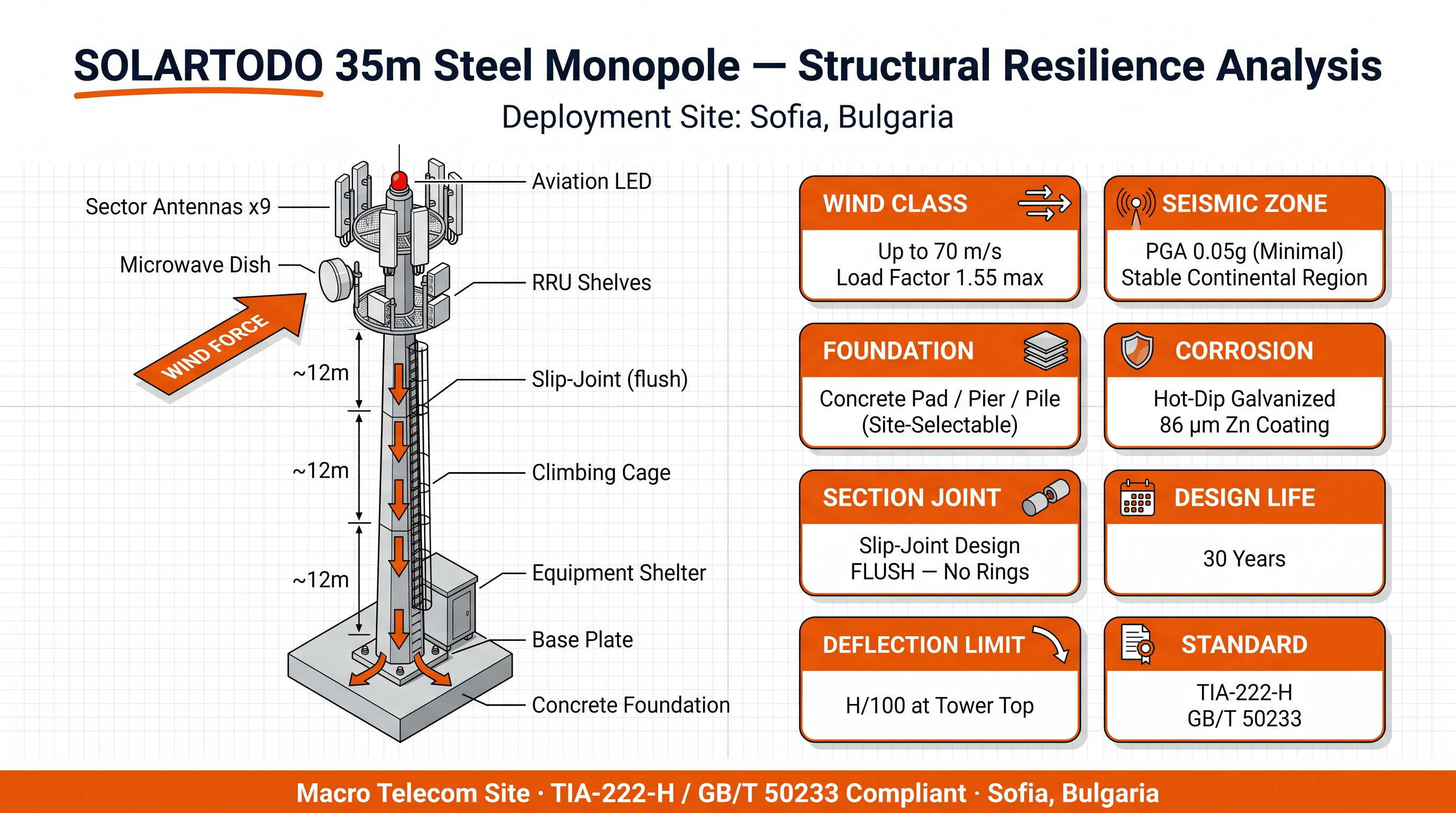
The recommended Sofia specification is a 35m regional macro Telecom Tower in Q345 galvanized steel, rated to 70 m/s wind and configured for 9 panels, 1 microwave dish, and 6 RRUs.
- Product type: Steel monopole Telecom Tower, tapered round or octagonal tube
- Recommended quantity: Approximately 15 units for a macro-coverage package of this scale
- Tower height: 35m
- Size class match: 35-45m | highway/peri-urban | 2-3 platforms | 6-9 panels + 1-2 microwave
- Tower weight: Approximately 18t per tower based on ~500 kg/m × 35m engineering rule
- Steel grade: Q345 structural steel
- Surface treatment: Hot-dip galvanized
- Design wind class: Class 4
- Design wind speed: 70 m/s
- Wind load factor: 1.55
- Corrosion zone: Low
- Antenna load: 9× panel antennas + 1× microwave dish + 6× RRU
- Platforms: 2 antenna platforms
- Foundation type: Concrete pad foundation
- Section connection: Flanged bolt-on sectional design
- Access system: Climbing ladder + safety cage
- Cable management: Integrated cable tray
- Aviation marking: Aircraft warning light
- Lightning protection: Lightning rod + grounding system
- Pole class: Regional macro / high-coverage tower
- Design life: 30 years
- Shipping mode: CKD, with 60-70% logistics volume reduction
- Production lead time: 30-45 days
- Applicable standards: TIA-222-H / GB/T 50233
According to TIA (2022), tower design must include wind effects on the pole shaft, mounts, feed lines, antennas, and ancillary appurtenances. According to the galvanizing guidance used across steel infrastructure supply chains, hot-dip zinc coating remains a standard corrosion-control approach where a 20-30 year service objective is required. SOLAR TODO should keep the specification sheet tightly aligned to these values to avoid mismatches during consultant review.
Implementation Approach
A Sofia Telecom Tower rollout of 15 macro monopoles would typically proceed in 5 stages over roughly 3-6 months, depending on permitting, geotechnical checks, and utility access windows.
Stage 1 is site screening and structural definition. This usually includes cadastral review, zoning checks, line-of-sight assessment, utility conflict mapping, and wind exposure classification for each site. For a 35m monopole with 70 m/s design wind, planners should confirm crane access, setback constraints, and whether microwave azimuths have clear paths across Sofia’s built environment.
Stage 2 is geotechnical verification and foundation detailing. Even though the recommended base is a concrete pad foundation, actual footing diameter, depth, reinforcement, and anchor-bolt cage geometry depend on soil bearing values and overturning loads. In a city with mixed fill and utility corridors, one unsuitable plot can delay a whole batch if borehole work is not completed before steel release.
Stage 3 is fabrication and logistics. The pole sections are fabricated from Q345 steel, galvanized, drilled, flanged, and packed in CKD form. With a 30-45 day production cycle, procurement teams can sequence foundations first and then deliver steel to match crane availability. SOLAR TODO can support this phase by standardizing accessory kits across all 15 units, reducing site variation during erection.
Stage 4 is civil works and tower erection. Concrete pad foundations are cast, cured, and surveyed before anchor checks. The monopole sections are then lifted and bolted in sequence, followed by ladder, cable tray, safety cage, grounding, lightning rod, and aircraft warning light installation. Antenna platforms, panels, RRUs, and the 1 microwave dish are mounted after plumb verification.
Stage 5 is commissioning and acceptance. This includes torque verification, verticality checks, grounding resistance testing, cable routing inspection, and antenna alignment. According to GB/T 50233, erection quality and acceptance procedures should be documented in a structured handover file. For macro telecom sites, operators also typically require sweep tests, backhaul validation, and as-built drawings before traffic cutover.
Expected Performance & ROI
A 35m macro Telecom Tower in Sofia would typically improve sector reach and equipment loading capacity more efficiently than multiple shorter infill poles, especially where each site must support 9 panels and 6 RRUs.
The main performance benefit is structural headroom for modern radio loading. A 35m monopole with 2 platforms and a 9-panel configuration supports tri-sector macro service with additional capacity layers, while the 1 microwave dish provides backhaul resilience where fiber is not yet the only transmission path. According to the ITU (2023), well-planned passive infrastructure reduces network expansion cost by improving site utilization and lowering duplication of civil works.
Lifecycle economics are usually stronger when a single pole can carry both current and near-term equipment loads. A 30-year design life spreads foundation, steel, logistics, and permitting costs across several radio refresh cycles, while galvanizing reduces repainting and corrosion intervention compared with less protected steel systems. According to NREL (2023), lifecycle cost analysis in infrastructure procurement should prioritize total ownership cost rather than first-cost only, especially when service life exceeds 20 years.
Maintenance demand is moderate. Typical inspections occur every 6-12 months, with torque, coating, grounding, and obstruction-light checks forming the core routine. A monopole also uses a smaller footprint than many lattice alternatives, which can lower land-use friction in urban and suburban Sofia. For operators, the ROI case often improves when one macro tower reduces the need for two or three lower-capacity sites in nearby corridors.
Payback varies by tenancy, lease structure, and traffic monetization, so a single universal number would be misleading. In practical terms, a 15-unit macro package tends to perform best where each tower can host multi-band radio equipment from day one and preserve reserve loading for future amendments. SOLAR TODO should therefore quote ROI as a function of tenancy ratio, civil reuse, and backhaul strategy rather than as a fixed headline figure.
Results and Impact
For Sofia, the main impact of a 15-unit 35m monopole program would be broader macro coverage, higher radio loading capacity, and lower long-term site fragmentation across dense urban corridors.
The configuration is technically suited to areas where rooftop rights are difficult, where boulevard setbacks allow ground-based poles, and where operators need both coverage and capacity. Compared with shorter 25-30m poles, the 35m class generally offers better clutter clearance over tree lines, mid-rise blocks, and transport infrastructure. Compared with 45m+ rural towers, it is easier to permit and integrate into a metropolitan environment.
This is also a logistics-efficient format. CKD shipment cuts transport volume by 60-70%, while flanged sections simplify staged delivery into constrained plots. For procurement teams comparing options, the Sofia fit is not about maximum height; it is about matching a 35m, 18t, Wind Class 4 monopole to a city that needs macro performance without overbuilding the structure.
The European Commission states, "5G and high-capacity networks are strategic infrastructure for economic and social activity." In Sofia, that statement translates into a practical tower decision: use a monopole class that carries heavy antenna loads, fits urban land constraints, and remains maintainable for 30 years.
Comparison Table
A Sofia buyer comparing tower options should generally select the 35m macro monopole when antenna loading reaches 9 panels and microwave backhaul is required.
| Configuration Option | Height | Typical Load Profile | Approx. Weight | Best Fit in Sofia | Main Limitation |
|---|---|---|---|---|---|
| Urban infill monopole | 25m | 3-6 panel antennas | 12-15t | Tight plots, localized fill-in coverage | Limited for 9 panels + microwave |
| Suburban macro monopole | 30m | 6 panels + 1 microwave + 3 RRU | 15t | Residential districts, moderate loading | Less future reserve than 35m option |
| Recommended macro monopole | 35m | 9 panels + 1 microwave + 6 RRU | 18t | Urban edge, ring road, logistics, transport corridors | Requires careful crane and foundation planning |
| High rural coverage monopole | 45m | 9-12 panels, wider-area coverage | 22-30t+ | Open outskirts, long-distance coverage | More visual and permitting pressure in city areas |
Pricing & Quotation
SOLAR TODO offers three pricing tiers for this product line: FOB Supply (equipment ex-works China), CIF Delivered (including ocean freight and insurance), and EPC Turnkey (fully installed, commissioned, with 1-year warranty). Volume discounts are available for large-scale deployments. Configure your system online for an instant estimate, or request a custom quotation from our engineering team at [email protected].
For Sofia buyers, quotation accuracy depends on 4 variables more than any others: geotechnical class, final antenna loading, transport route, and municipal work constraints. SOLAR TODO should therefore quote the 35m / 18t / Wind Class 4 baseline first, then adjust for site-specific foundation and accessory requirements. Buyers can also review the product page for the Telecom Tower and use the contact us channel for engineering review.
Frequently Asked Questions
A Sofia telecom buyer usually needs answers on 35m height, 70 m/s wind rating, 30-year service life, installation sequence, and quotation scope before issuing a monopole RFQ.
Q1: Why is 35m the recommended Telecom Tower height for Sofia?
A 35m height fits the product’s 35-45m macro class and balances coverage with urban permitting practicality. In Sofia, it is high enough to clear many mid-rise obstructions and tree lines while avoiding the larger visual and foundation burden of 45m+ rural towers. It also matches the specified load of 9 panels + 1 microwave + 6 RRUs.
Q2: Is Wind Class 4 at 70 m/s excessive for Sofia?
It is conservative, but not unreasonable for a city affected by open corridors, foothill exposure, and mixed topography near Vitosha. A 70 m/s design under TIA-222-H gives additional reserve where one standardized tower design is preferred across multiple sites. Final structural verification should still use local exposure and topographic data.
Q3: What foundation is suitable for this tower type?
The specified option is a concrete pad foundation, which is common for 35m monopoles where soil bearing is adequate and excavation access is available. Final pad dimensions depend on geotechnical data, overturning moment, and anchor reactions. Urban utility conflicts in Sofia can change footing geometry even when tower height stays fixed.
Q4: How long would procurement and installation usually take?
Production is typically 30-45 days for the steel structure itself. Total project duration is often 3-6 months when permitting, soil investigation, foundation curing, erection, antenna installation, and acceptance testing are included. Schedule risk usually comes from municipal access windows and delayed geotechnical approvals rather than steel fabrication.
Q5: How does a monopole compare with a lattice telecom tower?
A monopole uses a smaller footprint and is often easier to place in dense urban or suburban plots. For Sofia, that can reduce land-use friction and improve visual acceptance. A lattice tower may offer different loading economics at larger heights, but this product line is specifically a steel monopole, not a lattice structure.
Q6: What maintenance interval is typical over a 30-year design life?
Most operators inspect passive tower assets every 6-12 months. Routine checks include bolt torque, galvanizing condition, grounding resistance, aircraft warning light function, ladder safety, and cable tray condition. After severe wind events, an additional visual and alignment inspection is recommended before returning the site to normal maintenance intervals.
Q7: What affects ROI or payback for a Sofia tower project?
The biggest factors are tenancy ratio, land lease terms, civil reuse, and whether microwave or fiber backhaul is already available. A 30-year design life usually improves total ownership economics because the same passive structure can support several radio upgrade cycles. ROI should be modeled per site cluster, not as one fixed citywide number.
Q8: Does SOLAR TODO provide EPC as well as equipment supply?
Yes. SOLAR TODO structures quotations around FOB Supply, CIF Delivered, and EPC Turnkey scopes. That allows buyers in Bulgaria to compare equipment-only procurement against delivered steel or full installation responsibility. The correct scope depends on whether the buyer already has local civil contractors, crane access, and telecom rigging teams.
Q9: What warranty terms are typically available?
The pricing section specifies EPC Turnkey supply with a 1-year warranty. Buyers should also request detailed warranty language for galvanizing, fabrication tolerances, and accessory components such as warning lights. For long-life steel assets, warranty review should be paired with inspection and maintenance obligations in the contract documents.
Q10: Can this tower support future 5G equipment additions?
The specified loading of 9 panels + 6 RRUs already places the tower in a high-capacity macro category, which is favorable for future amendments. However, exact spare capacity depends on mount arrangement, wind sail area, cable count, and final antenna model weights. Reserve loading should be checked during structural analysis before adding new equipment.
References
- Sofia Municipality (2023): Municipal profile and urban data; Sofia population of about 1.28 million and municipal area of roughly 492 km².
- National Statistical Institute of Bulgaria (2024): Regional demographic and economic statistics confirming Sofia City Province as Bulgaria’s largest urban concentration.
- TIA (2022): TIA-222-H, Structural Standard for Antenna Supporting Structures, Antennas and Small Wind Turbine Support Structures.
- GB/T (2014): GB/T 50233, standard covering erection and acceptance requirements for transmission and steel structure works used in related infrastructure practice.
- ITU (2023): Guidance on digital infrastructure and broadband deployment economics, including the importance of efficient passive infrastructure and site optimization.
- European Commission (2024): Digital connectivity and 5G policy updates under DESI and Gigabit infrastructure objectives relevant to Bulgaria.
- NREL (2023): Lifecycle cost analysis guidance for infrastructure procurement, emphasizing total cost of ownership over multi-decade service life.
Equipment Deployed
- 15 × 35m tapered steel monopole Telecom Tower, approximately 18t per tower
- Hot-dip galvanized Q345 steel pole sections with flanged bolt-on connection
- Wind Class 4 structural design rated to 70 m/s with 1.55 wind factor
- Antenna loading set for 9 × panel antennas + 1 × microwave dish + 6 × RRUs
- Concrete pad foundation for each tower
- 2 × antenna platforms per tower
- Climbing ladder with safety cage
- Integrated cable tray system
- Aircraft warning light
- Grounding system and lightning rod
- 30-year design life configuration
- CKD shipping format with 60-70% volume reduction