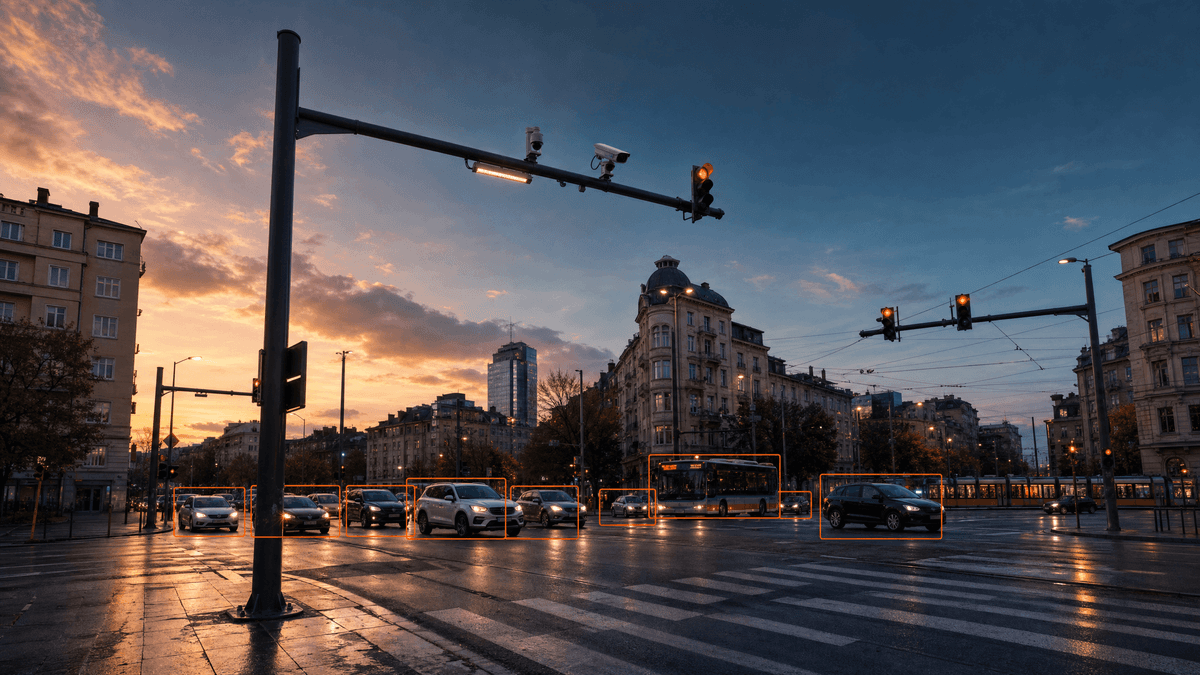
Sofia Smart Traffic System Market Analysis: 24-Intersection 10m Configuration Guide
Summary
Sofia’s urban mobility profile supports a typical 24-intersection Smart Traffic System plan using 10m hot-dip galvanized poles, 5G/fiber backhaul, and AI edge processing with <50ms response. With 1.28 million residents and a 492 km² municipal area, corridor-level adaptive control is a practical fit for high-traffic junctions.
Key Takeaways
- A typical Sofia deployment of this scale would cover approximately 24 intersections using 10m L-arm steel poles in dark grey hot-dip galvanized finish.
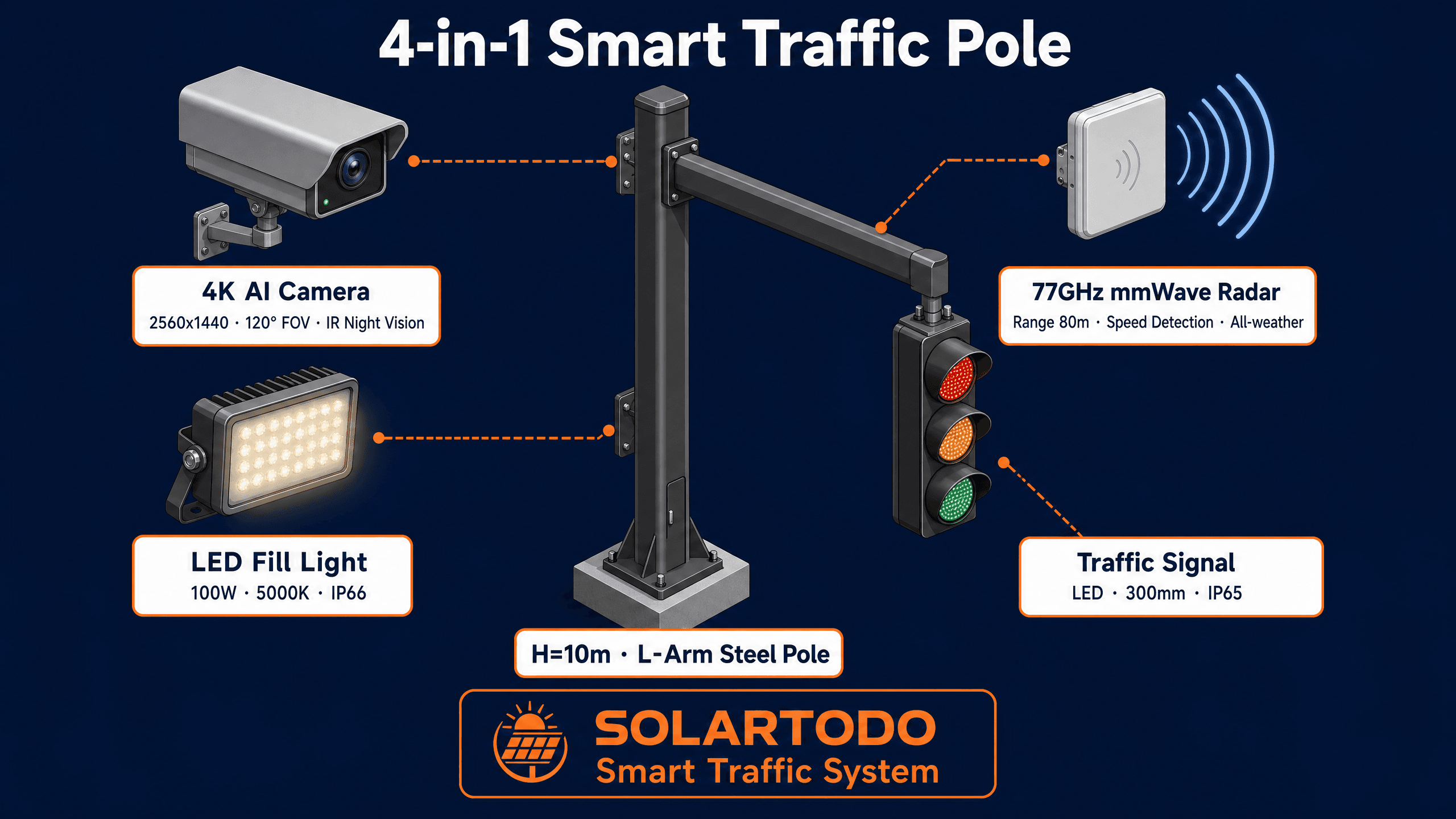
- Each pole combines 4 modules in 1 unit: 4K AI camera, 77GHz mmWave radar, LED fill light, and LED signal head.
- The specified edge stack uses NVIDIA Jetson and supports <50ms response time with claimed 98% detection accuracy across camera analytics.
- A junction of this class would usually require 4-12 poles per intersection, while the referenced city-scale configuration is framed around 24 intersections with 10m pole height.
- Backhaul in Sofia should typically use 5G/fiber to a central TrafficGPT platform, enabling natural-language traffic queries and cross-corridor signal analysis.
- The recommended cooperation model is BOT (zero upfront), which can reduce municipal capex pressure while spreading cost over a multi-year service term.
- The system should be specified to NTCIP and GB 25280, with local civil and electrical works aligned to Bulgarian and EU procurement and safety rules.
- Based on adaptive signal benchmarks cited by public agencies, corridor travel time improvements of roughly 10%-25% and incident response gains of 20%-40% are a realistic planning range, subject to junction geometry and enforcement policy.
Market Context for Sofia
Sofia’s road network and commuter density make AI-based junction control technically relevant at a 24-intersection scale, especially where mixed traffic, tram interfaces, and pedestrian demand create variable cycle timing every 60-120 seconds.
Sofia is Bulgaria’s capital and largest municipality. According to the National Statistical Institute of Bulgaria (2024), the Sofia Capital Municipality population is about 1.28 million, while the municipality covers roughly 492 km². That concentration matters because adaptive control systems perform best where signalized intersections carry recurring peak-hour surges rather than isolated rural traffic. In Sofia, those surges are concentrated on radial boulevards, ring-road connectors, and multimodal corridors with buses, trams, private cars, and pedestrians competing for green time.
According to Sofia Municipality’s urban planning documents and mobility strategies, congestion management, public transport priority, and safer pedestrian movement remain central transport objectives. A Smart Traffic System is therefore not just a surveillance layer. It is a junction-control asset that can support pedestrian detection, vehicle classification, queue estimation, and incident auto-alerts within a single 10m roadside structure. For a city with dense intersections spaced at a few hundred meters on major corridors, combining sensing and signaling on one pole reduces roadside clutter and simplifies maintenance access.
Climate and environmental conditions also matter for pole and sensor selection. According to Climate-Data.org and the Bulgarian National Institute of Meteorology and Hydrology, Sofia has cold winters, summer heat, and seasonal fog or precipitation, with annual temperatures generally ranging from below 0°C in winter periods to above 30°C in summer peaks. That profile supports the use of hot-dip galvanized steel and a 10m mounting height, which gives better sightlines over parked vehicles, buses, and turning lanes than a 6m urban accessory pole. The dark grey finish is also consistent with municipal streetscape requirements in many European capitals.
Telecom availability supports the proposed communications stack. According to the European Commission’s Digital Economy and Society reporting and ITU broadband assessments, Bulgaria has broad urban fiber availability and mature 4G/5G market coverage in major cities. For Sofia, that means a practical architecture is fiber where ducts exist and 5G where rapid rollout is needed, with both paths feeding a central TrafficGPT platform. This hybrid backhaul model is important because adaptive control loses value if video and radar events cannot reach the control layer within low-latency thresholds.
Public safety is another driver. The European Commission states, "Road safety is a shared responsibility" and urban junctions remain a major risk area for vulnerable road users. The OECD/ITF has also noted in multiple urban mobility studies that data-led signal control and safer intersection design are among the most cost-effective city interventions when pedestrian exposure is high. In Sofia, where tram crossings, school zones, and multilane boulevards intersect, a system that detects pedestrians and flags incidents in real time is a practical infrastructure upgrade rather than an optional digital layer.
SOLAR TODO’s Smart Traffic System fits this context because the product combines 4 sensing/signaling functions on one L-arm pole and connects them through edge AI and central software. For municipal buyers, that matters less as a branding point and more as an integration point: one foundation, one pole, one power drop, and one backhaul path can replace several separate roadside devices. For Sofia’s dense urban corridors, that usually lowers civil complexity compared with piecemeal equipment additions.
Recommended Technical Configuration
For Sofia’s arterial intersections, a typical 24-intersection configuration would use 10m L-arm galvanized poles with 4-in-1 sensing and signaling, because 10m height gives better lane coverage, pedestrian visibility, and signal mounting clearance than 6m or 8m variants.
Based on the provided project-specific configuration, the recommended city profile is a 24-intersection deployment using 10m L-arm steel poles in dark grey hot-dip galvanized finish. This is the correct size class for Sofia because major urban intersections often include 3-5 approach lanes, tram or bus interfaces, and heavy pedestrian crossings. A 10m pole improves camera angle, radar field of view, and signal head placement compared with a shorter 6m or 8m variant, especially where buses or delivery vehicles can block line-of-sight.
A typical deployment of this scale would consist of approximately 24 signalized intersections, with each intersection using a set of 4-12 poles depending on approach count, auxiliary turn lanes, pedestrian islands, and median geometry. The product specification supplied for this guide is fixed at 10m rather than an auto-rotated 6m/8m/10m selection, and that is appropriate for Sofia’s larger boulevard junctions. Highway gantries are not the target here; this is an urban intersection configuration.
The recommended functional stack is the exact 4-in-1 assembly specified by SOLAR TODO: 4K AI camera, 77GHz mmWave radar, LED fill light, and LED signal head on each pole. Edge processing is handled by NVIDIA Jetson, allowing local object detection and event filtering before transmission to the central platform. This matters because sending every raw frame upstream would increase bandwidth cost and reduce response speed. Keeping first-pass analytics at the edge supports the stated <50ms response target for local detection events.
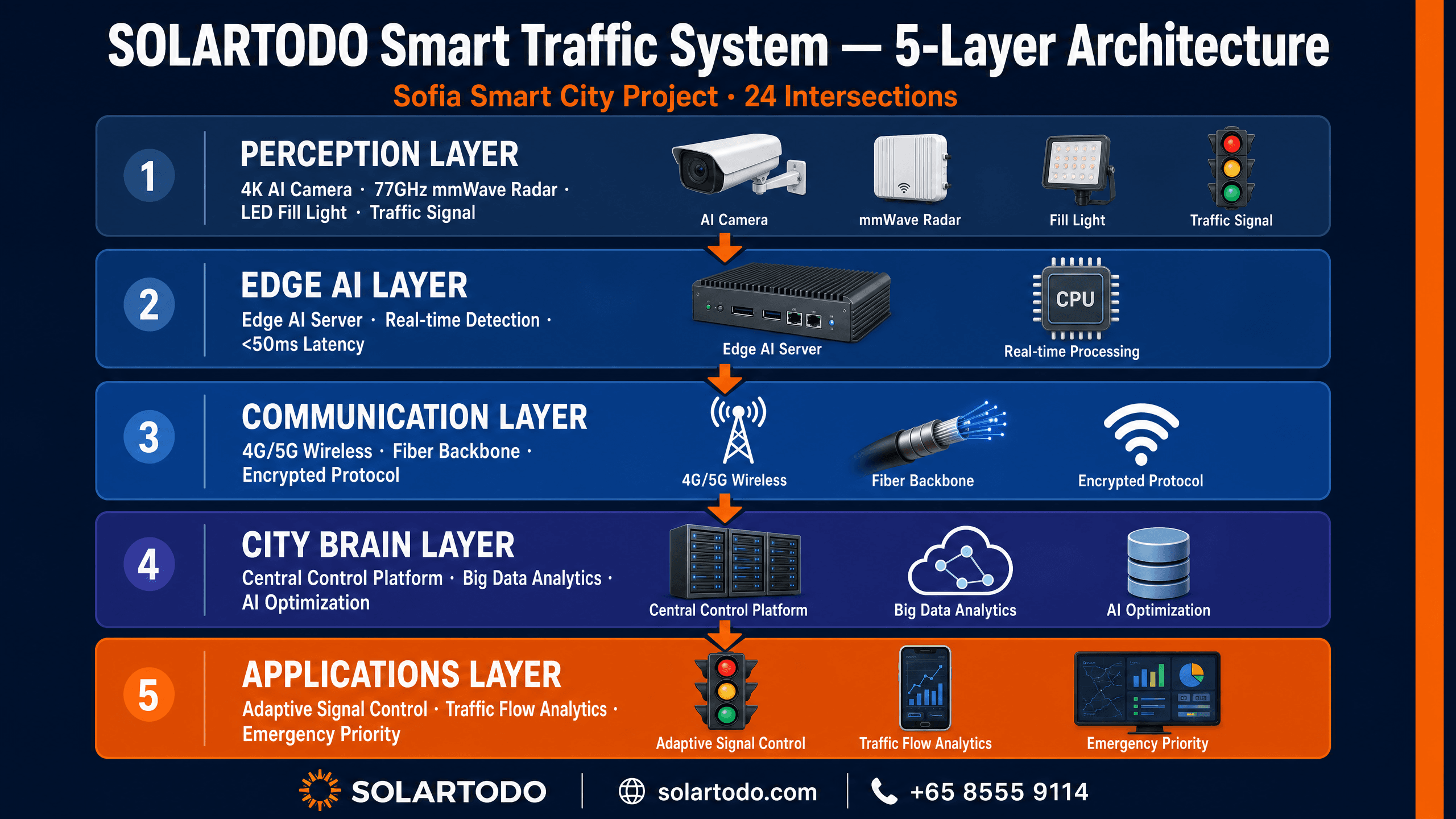
The software workflow should follow the provided 5-layer architecture: Perception → Edge AI → Communication (5G/fiber) → City Brain (TrafficGPT) → Applications. In practice, that means the camera and radar generate raw observations, Jetson performs edge inference, then the system sends relevant metadata and control instructions through 5G or fiber to a central dashboard. TrafficGPT can then support natural-language queries such as corridor congestion checks, incident lookups, and pedestrian phase performance summaries. For a city traffic center, this reduces the need to manually search separate video and signal systems.
The recommended operational features for Sofia are the exact ones specified: pedestrian detection, adaptive signal optimization, and incident auto-alert. These three functions match the city’s likely priorities better than a basic video-only package. Pedestrian detection helps on wide crossings and school routes. Adaptive optimization helps with directional peaks that change by time of day. Incident auto-alert helps traffic operators identify stopped vehicles, wrong-way movements, or lane blockages before queues spread across adjacent intersections.
From a commercial perspective, the recommended model is BOT (zero upfront). For municipalities facing capex constraints, BOT can be easier to approve than a large one-time EPC contract, especially when the deployment starts with 24 intersections and then scales corridor by corridor. SOLAR TODO can therefore be positioned not as a claimed past installer in Sofia, but as a supplier whose Smart Traffic System aligns with this financing structure and infrastructure profile. Buyers that prefer direct ownership can still request a custom quotation or review the product page at /smart-traffic.
Technical Specifications
The specified Sofia configuration uses 10m dark-grey hot-dip galvanized L-arm poles with 4K AI video, 77GHz radar, NVIDIA Jetson edge computing, and NTCIP/GB 25280 compliance for 24 intersections.
- Deployment profile: approximately 24 intersections
- Pole type: L-arm steel pole
- Pole height: 10m
- Pole finish: dark grey, hot-dip galvanized steel
- Intersection sizing rule: typically 4-12 poles per intersection, depending on approach count and auxiliary coverage
- Integrated modules per pole: 4-in-1
- 4K AI camera
- 77GHz mmWave radar
- LED fill light
- LED signal head
- AI performance: camera analytics with 98% accuracy and <50ms response
- Detection scope: 45+ detection types in the broader product platform; Sofia configuration prioritizes pedestrian detection and incident recognition
- Edge computing platform: NVIDIA Jetson
- Core features for this configuration:
- Pedestrian detection
- Adaptive signal optimization
- Incident auto-alert
- Communications: 5G/fiber backhaul
- Central software layer: TrafficGPT with natural-language query support
- Architecture: Perception → Edge AI → Communication → City Brain → Applications
- Cooperation model: BOT (zero upfront)
- Applicable standards: NTCIP, GB 25280
- Urban fit: suitable for major Sofia intersections with multi-lane approaches, tram conflict points, and high pedestrian volumes
According to NTCIP guidance, interoperable traffic devices should use standardized communications objects and controller interfaces to reduce lock-in and simplify central management. According to IEEE smart city transport discussions (2023), combining radar and video improves detection reliability in low-visibility conditions because radar remains effective in rain, fog, and partial occlusion where optical systems alone can underperform.
Implementation Approach
A 24-intersection Sofia rollout would typically proceed in 4 phases over roughly 6-12 months, starting with junction audit and communications survey before foundation works, pole erection, integration, and signal optimization tuning.
Phase 1 is the corridor survey and design stage. A municipal team or EPC contractor would usually audit 24 intersections for lane geometry, mast-arm clearance, pedestrian crossing length, cabinet location, fiber availability, and power supply routing. This stage normally takes 4-8 weeks depending on permit procedures. At this point, each intersection is classified by approach count and whether it needs 4, 6, 8, or up to 12 poles. Existing signal controller compatibility with NTCIP should also be checked before procurement.
Phase 2 is procurement and factory integration. The 10m poles, camera/radar assemblies, Jetson edge units, LED signal heads, and communication devices are configured as matched equipment sets. For imported systems, buyers often choose containerized shipping or CKD/SKD packaging depending on local assembly preference. Typical lead times for a 24-intersection package can range from 8-16 weeks, depending on signal head specification, network hardware, and local customs clearance. SOLAR TODO should be asked to align pole flange details and mounting interfaces with local civil drawings before shipment.
Phase 3 is civil and electrical work. Foundations are cast first, then poles are erected, powered, and connected to cabinets or edge enclosures. In dense urban streets, a practical installation rhythm is 1-3 intersections per week, subject to lane closure windows and utility conflicts. Fiber splicing, 5G router setup, and controller integration follow. Because the system combines 4 functions in 1 pole, the number of separate roadside cabinets and brackets can be lower than in a fragmented procurement model.
Phase 4 is commissioning and optimization. This stage includes camera calibration, radar zone mapping, pedestrian detection tuning, and adaptive timing validation across peak periods. Operators should test at least AM peak, midday, PM peak, and weekend conditions over 2-4 weeks before final acceptance. According to FHWA adaptive signal guidance, benefits are strongest when timing plans are reviewed after live data is collected rather than frozen at pre-installation assumptions.
For Sofia, a phased rollout by corridor is usually safer than citywide simultaneous activation. Start with 6-8 intersections on a congested boulevard, validate queue detection and pedestrian calls, then expand to the remaining 16-18 intersections. This reduces operational risk and gives the traffic center time to train staff on TrafficGPT queries and event workflows. Municipal buyers can contact us to map these phases to local procurement rules.
Expected Performance & ROI
For Sofia corridors with recurring congestion, a 24-intersection AI traffic package would typically target 10%-25% travel-time reduction, 20%-40% faster incident awareness, and a 5-8 year payback depending on labor savings, delay costs, and collision reduction.
According to the U.S. Federal Highway Administration (FHWA), adaptive signal control can improve travel times by more than 10% in many corridors, with some deployments reporting larger benefits where demand fluctuates strongly by time of day. According to the World Bank (2023) and OECD transport studies, urban congestion imposes measurable productivity and fuel costs, so even modest delay reductions can justify digital traffic upgrades when applied across dozens of intersections rather than a single junction.
For Sofia, a realistic planning range is a 10%-25% reduction in corridor travel time and a 5%-15% reduction in average stopped delay where existing timing plans are static. Incident auto-alerts can shorten awareness time by 20%-40% because operators receive machine-generated flags instead of relying only on patrol reports or public calls. Pedestrian detection can also reduce missed crossing demand and improve compliance at wide crossings, though the exact safety benefit depends on enforcement and crossing design.
The ROI case should be built from four measurable categories:
- Delay cost reduction across commuters and freight vehicles
- Operator efficiency gains from automated event detection
- Maintenance savings from consolidated roadside hardware
- Safety value from faster incident response and improved pedestrian phase handling
According to IEA (2023), digitalization in energy and transport systems improves asset utilization when data is acted on in real time. That principle applies here: the value is not the camera alone, but the closed loop between detection, edge AI, and signal timing. A BOT structure can improve adoption because the municipality does not need full upfront capex on day 1. In practice, payback for a 24-intersection package often falls in the 5-8 year range when delay savings are monetized conservatively and hardware life is modeled over 10-15 years.
The maintenance model should assume routine inspection every 3-6 months, camera cleaning based on seasonal dust and precipitation, annual firmware review, and replacement planning for signal modules within standard LED service intervals. Because the poles are hot-dip galvanized steel, the structural life is usually longer than the electronics refresh cycle. That separation is important for lifecycle budgeting: civil assets may remain in place for well over 15 years, while edge compute or sensors may be upgraded earlier.
Results and Impact
For Sofia, the main impact of a 24-intersection Smart Traffic System would be better signal responsiveness, clearer pedestrian priority logic, and faster operator visibility across high-demand corridors using one integrated roadside platform.
This is not a claimed past deployment result. It is the expected operational impact of matching the specified 10m 4-in-1 pole configuration to Sofia’s intersection profile. In practical terms, the city gains a denser stream of machine-readable traffic data at each junction. That data can support queue-based phase extension, pedestrian call validation, and incident alerts without installing separate poles for each subsystem. For municipal engineering teams, that means fewer roadside assets to inspect and fewer integration points to troubleshoot.
The second impact is organizational. Traffic centers often struggle because data sits in separate video, controller, and incident systems. A TrafficGPT layer changes the workflow by allowing natural-language queries over a centralized event stream. According to ITU (2022), interoperable digital platforms are essential for smart city operations because isolated devices do not produce full value. SOLAR TODO’s architecture aligns with that requirement by connecting edge sensing to a central application layer rather than leaving devices as standalone field hardware.
Comparison Table
A 10m 4-in-1 pole configuration is the strongest fit for Sofia’s major intersections because it consolidates 4 functions, supports <50ms edge response, and reduces roadside clutter compared with separate-device layouts.
| Configuration Option | Pole Height | Integrated Devices | Edge AI | Backhaul | Best Use in Sofia | Main Limitation |
|---|---|---|---|---|---|---|
| Basic signal pole + separate CCTV | 6-8m | Signal + standalone camera | Limited or none | Fiber only in many cases | Small intersections with low variability | More brackets, more cabinets, weaker all-weather detection |
| Video-only smart junction | 8m | 4K camera + signal | Yes | 5G/fiber | Medium urban junctions | Lower reliability in fog, rain, or occlusion than radar + video |
| Recommended SOLAR TODO Smart Traffic System | 10m | 4K AI camera + 77GHz radar + LED fill light + LED signal | NVIDIA Jetson | 5G/fiber | Major Sofia arterials, tram corridors, pedestrian-heavy intersections | Requires stronger integration planning at controller level |
| Highway gantry smart traffic setup | 10-12m+ gantry form | Multi-lane sensors and signs | Yes | Fiber preferred | Ring road or expressway segments | Not suitable for standard urban junction geometry |
Pricing & Quotation
SOLAR TODO offers three pricing tiers for this product line: FOB Supply (equipment ex-works China), CIF Delivered (including ocean freight and insurance), and EPC Turnkey (fully installed, commissioned, with 1-year warranty). Volume discounts are available for large-scale deployments. Configure your system online for an instant estimate, or request a custom quotation from our engineering team at [email protected].
Frequently Asked Questions
A Sofia Smart Traffic System purchase usually raises 10 practical questions covering pole height, communications, installation time, ROI, maintenance, pricing, and standards compliance for a 24-intersection rollout.
Q1: Why is a 10m pole recommended for Sofia instead of 6m or 8m?
A 10m pole is better suited to Sofia’s larger boulevard intersections, where buses, parked vehicles, and multiple turn lanes can block lower-mounted sensors. The extra height improves camera angle, radar coverage, and LED signal visibility. For a 24-intersection urban package, 10m is a practical choice where pedestrian crossings and multi-lane approaches must be monitored from one structure.
Q2: What exactly is included in the 4-in-1 Smart Traffic System?
Each pole combines four field components: a 4K AI camera, a 77GHz mmWave radar, an LED fill light, and an LED signal head. The Sofia configuration also includes NVIDIA Jetson edge computing, 5G/fiber backhaul, and TrafficGPT central software access. The key operational functions are pedestrian detection, adaptive signal optimization, and incident auto-alert.
Q3: How many poles would a 24-intersection deployment typically require?
The product line usually uses 4-12 poles per intersection depending on geometry, lane count, medians, and auxiliary turn channels. For 24 intersections, total pole count can therefore vary widely. Final quantity should be based on a junction survey, controller layout, and sightline analysis rather than a fixed citywide average. Sofia’s larger arterials will usually sit toward the middle or upper end of that range.
Q4: How long would installation take for a project of this size?
A typical 24-intersection rollout takes about 6-12 months including survey, design, procurement, civil work, installation, and commissioning. Factory lead time alone can be 8-16 weeks depending on signaling and communications options. Field installation often proceeds at 1-3 intersections per week, subject to permits, lane closures, utility conflicts, and controller integration complexity.
Q5: What kind of ROI or payback is realistic?
For planning purposes, municipalities often model a 5-8 year payback if the system reduces delay, improves incident response, and lowers field maintenance complexity. Public adaptive signal benchmarks commonly show 10%-25% corridor travel-time improvement. Actual ROI depends on traffic volume, labor costs, existing controller condition, and whether benefits such as collision reduction are included in the financial model.
Q6: How does radar plus camera compare with camera-only systems?
Radar and video together usually provide more stable detection than camera-only systems in fog, rain, glare, or partial occlusion. The 77GHz radar helps maintain speed and presence detection even when optical visibility drops. Camera-only systems can still work well, but mixed sensing is generally preferred at complex Sofia intersections where weather and heavy vehicles can obstruct views.
Q7: What maintenance should the city expect after commissioning?
A practical maintenance plan includes visual inspection every 3-6 months, lens cleaning based on season, annual firmware and cybersecurity review, and periodic calibration checks for radar and video zones. Hot-dip galvanized poles usually outlast the electronics. Municipal buyers should budget separately for structural life, signal module replacement, and future AI hardware upgrades over a 10-15 year horizon.
Q8: Is the system compatible with existing traffic control infrastructure?
Compatibility depends on the existing controller and central management software, but NTCIP support improves the chances of integration. Before procurement, the city should verify cabinet interfaces, power availability, detector input mapping, and communications protocols. In many cases, the Smart Traffic System can coexist with existing signal controllers while adding edge detection and central analytics on top.
Q9: What is the difference between BOT and EPC for this product?
BOT spreads cost through a service-style commercial structure and can reduce upfront municipal capex to near zero at project start. EPC is a direct purchase and installation model where the buyer owns the assets after acceptance. For Sofia, BOT can be attractive if the city wants to start with 24 intersections and expand later without a large initial capital outlay.
Q10: Does EPC Turnkey pricing include warranty and commissioning?
Yes. In SOLAR TODO’s stated pricing structure, EPC Turnkey includes full installation, commissioning, and a 1-year warranty. Buyers should still confirm what is covered in detail, such as civil works, communications devices, software access term, spare parts, and response times. Those items can materially affect total cost of ownership over the first 3-5 years.
References
- National Statistical Institute of Bulgaria (2024): Population statistics for Sofia Capital Municipality, approximately 1.28 million residents.
- Sofia Municipality (2023): Municipal planning and mobility strategy documents covering transport modernization, congestion management, and pedestrian safety priorities.
- European Commission (2024): Digital Economy and Society and road safety policy materials relevant to urban broadband availability and safer city mobility.
- U.S. Federal Highway Administration (FHWA) (2023): Adaptive Signal Control Technologies guidance indicating travel-time and delay improvements on signalized corridors.
- ITU (2022): Smart sustainable cities framework and interoperability guidance for digital urban infrastructure platforms.
- IEEE (2023): Intelligent transportation and sensor-fusion discussions supporting combined radar and video detection for urban traffic monitoring.
- IEA (2023): Digitalization and system efficiency analysis showing the value of real-time data in transport and infrastructure operations.
According to FHWA (2023), adaptive signal systems can improve arterial performance when timing responds to live demand rather than fixed plans. ITU states, "Interoperability is a key enabler of smart sustainable cities," which is directly relevant for NTCIP-based traffic systems. The European Commission states, "Road safety is a shared responsibility," reinforcing the case for pedestrian-aware intersection technology in Sofia.
Equipment Deployed
- 24-intersection Smart Traffic System configuration
- 10m L-arm steel pole, dark grey, hot-dip galvanized
- 4K AI camera with 98% detection accuracy and <50ms response
- 77GHz mmWave radar
- LED fill light
- LED signal head
- NVIDIA Jetson edge AI computing platform
- 5G/fiber backhaul connection
- TrafficGPT central platform with natural-language queries
- Pedestrian detection module
- Adaptive signal optimization function
- Incident auto-alert function
- NTCIP-compliant communications interface
- GB 25280-compliant signal hardware framework
- BOT cooperation model (zero upfront)