Summary
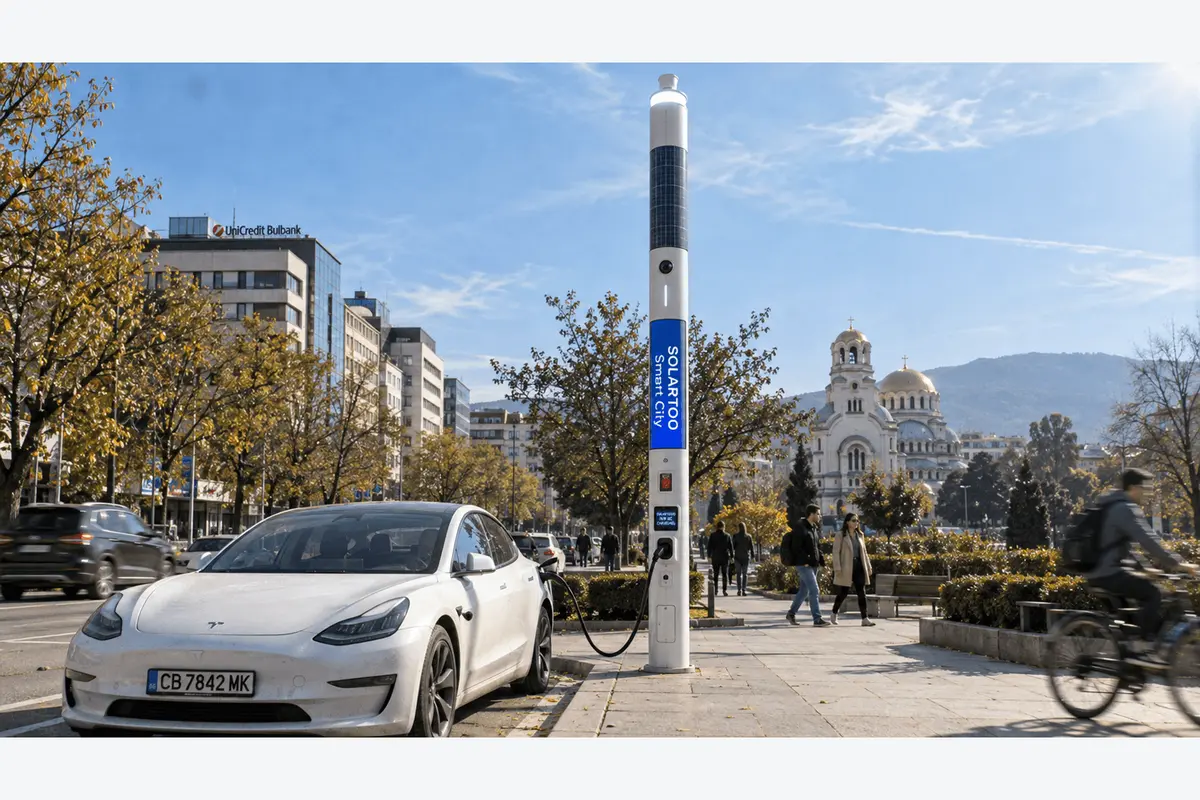
Sofia’s winter climate and constrained kerbs favor a grid-connected Smart Streetlight concept: approximately 111 seamless 11m poles at 28m spacing, with flush charging and sensing. Photometric and feeder studies must confirm suitability.
Key Takeaways
A typical 111-unit Sofia concept would combine 11m cylindrical poles, 60W lighting, and embedded charging, subject to street-specific photometric, structural, electrical, and accessibility verification.
- Approximately 111 units at 28m spacing represent 110 intervals, or 3.08km along a single uninterrupted row.
- Each pole remains Ø315mm from top to bottom, with 5mm steel walls and no widened charging base.
- The integrated 60W, 9,000lm, 4000K ring requires road-lighting calculations at the proposed 11m mounting height.
- Each embedded 7kW charger includes Type 2 and Type 1 outlets; simultaneous output requires confirmation.
- The 1,800Wh LFP battery supports auxiliary resilience; it cannot sustain 7kW vehicle charging for long periods.
- The 4MP camera, 8-parameter sensor, and internal 5G NR n78 antenna require separate acceptance tests.
- A 2,200mm × approximately 170mm flush display shows only the prescribed SOLARTODO Smart City text.
Market Context for Sofia: Basin Winters Meet Constrained Kerbs
Sofia’s approximately 550m valley elevation and continental winter conditions make drainage, cold-weather charging controls, and maintainable flush equipment central to an 11m Smart Streetlight specification.
According to Bulgaria’s National Statistical Institute (2026 release), Sofia Capital Municipality has 1,303,813 residents in its published population table. According to the same source (2026), 1,240,528 residents occupy urban settlements within that municipality; this is not the population of Sofia city alone. The distinction matters when choosing corridors: a metropolitan population does not establish demand for identical equipment across every street. NSI population table.
According to Sofia Municipality (2021), the Sofia valley averages 550m elevation and extends approximately 75km along its principal axis. Sofia Municipality states, “warm summer and cold winter,” and describes seasonal snow cover and a spring–summer precipitation maximum. This inland basin setting calls for freeze–thaw protection, water management, and temperature-controlled battery charging rather than a coastal salt-air design assumption. Sofia SECAP 2021–2030.
According to ERM Zapad (2025), its distribution-equipment specification identifies 230/400V nominal networks at 50Hz. That is the relevant supply context for lighting and AC charging; an upstream medium-voltage network does not determine streetlight height. Sofia Municipality, the distribution operator, road authorities, and heritage reviewers would each have distinct approval roles. ERM Zapad technical specification.
The strongest market fit is a selected urban corridor combining lighting renewal, legal charging bays, and a requirement to limit pavement furniture. Historic central streets require particular attention to underground services, heritage constraints, and crane access for an 11m monolithic pole. A constant-diameter body reduces equipment protrusions, but charging cables still need a route outside the pedestrian clearway.
Recommended Technical Configuration
A typical 111-unit deployment of this scale would use 11m seamless Ø315mm poles, preserving a constant cylindrical envelope while integrating lighting, charging, sensing, and communications.
The specified configuration belongs to the urban street class within the product family’s 6–12m range. Its 28m spacing corresponds to approximately 35.7 poles per kilometre along one row, consistent with the stated 30–50-pole planning range. Junctions, staggered layouts, crossings, and double-sided roads change quantities and coverage; 3.08km is interval arithmetic, not a surveyed route.
Select the cylindrical variant where streetscape integration and consolidated equipment justify its additional engineering requirements. The embedded ring has no luminaire arm, and all functional modules remain flush with the cylinder skin. The specified 60W ring supersedes the family’s generic 80–150W lighting range for this concept; it must still demonstrate adequate road illumination.
Charging should use a permanently available supply with managed demand, rather than relying on a lighting circuit that may switch off during daylight. According to the European Parliament and Council (2023), AFIR defines high-power charging as output above 22kW, placing 7kW below that threshold. Type 2 is the relevant European AC interoperability interface; the additional Type 1 outlet does not replace it. Consult the applicable consolidated requirements before procurement. AFIR regulation and amendments.
Technical Specifications
The proposed Sofia configuration specifies approximately 111 identical 11m poles, each integrating a 60W ring luminaire and 7kW charger inside a Ø315mm cylindrical body.
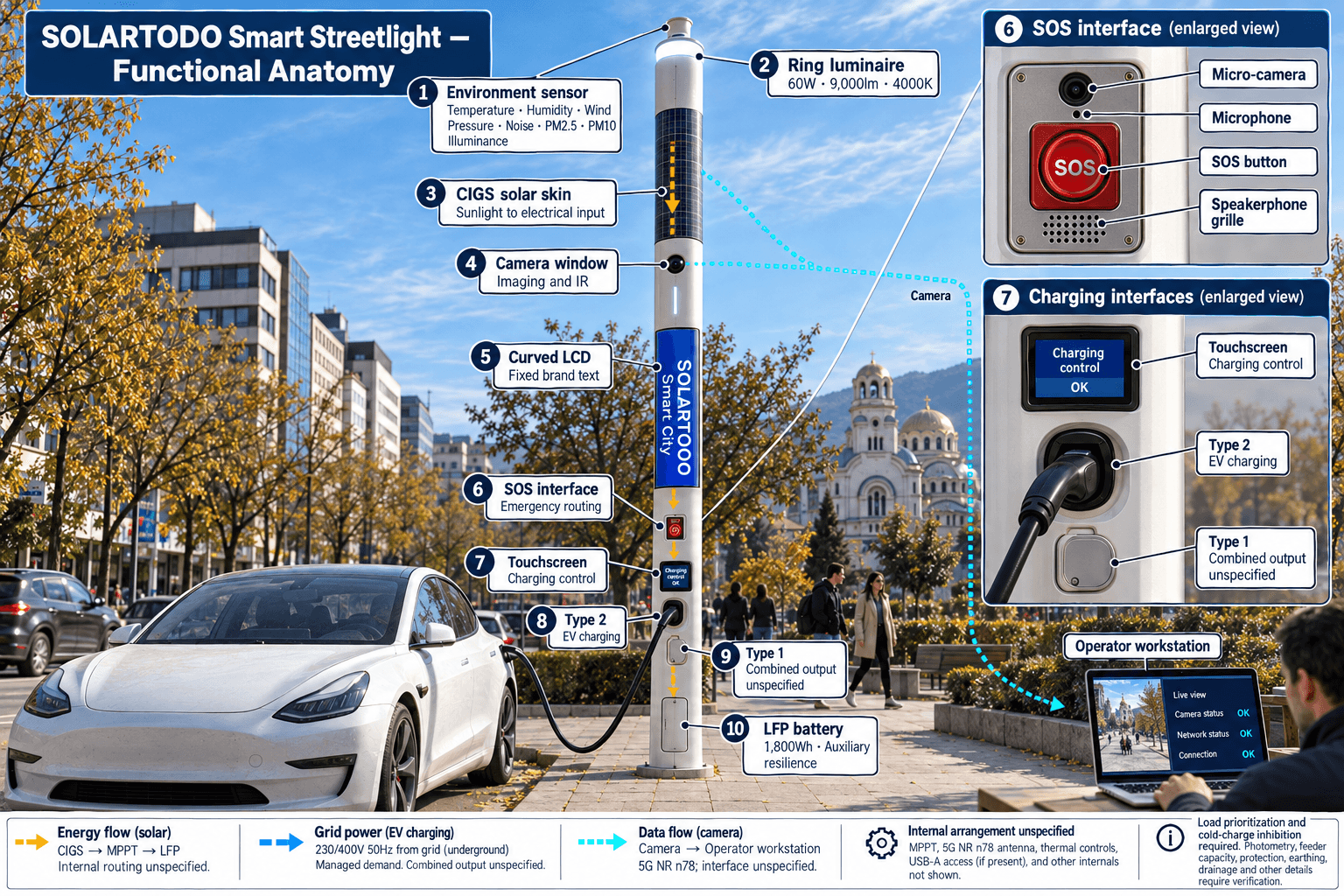
- Structure: seamless, monolithic steel cylinder; 11m height; constant Ø315mm diameter; 5mm wall; hot-dip galvanizing; matte white RAL9003 finish. No widened base, separate bollard, external boxes, side arms, or luminaire outriggers.
- Lighting: embedded Ø315mm top ring-light band; 360° glow; 60W; 9,000lm; 4000K. The specified efficacy is 150lm/W; roadway distribution remains subject to photometry.
- Solar skin: approximately 316W CIGS flexible thin-film cells wrapped 360° around the 6.5–10.3m mid-section. Dark blue-black semi-transparent film is laminated flush, without rigid panels, brackets, or tilt.
- Storage: 1,800Wh LFP battery inside the pole base with MPPT; require documented cold-charge inhibition, thermal controls, and load prioritization.
- Environment: dome-top, flush 8-parameter sensor measuring temperature, humidity, wind, pressure, noise, PM2.5, PM10, and illuminance.
- Camera: flush turret behind a Ø10cm dark anti-vandal glass window; 4MP imaging and specified 30m infrared range; no protruding dome.
- Communications: embedded 5G NR n78 equipment and internal antenna; demonstrate RF performance through the integrated enclosure and operator compatibility.
- Emergency interface: flush 12 × 12cm SOS panel incorporating micro-camera, microphone, and speakerphone grille. No external speaker column or public-address audio module.
- Charging: fully embedded 7kW dual-outlet hardware with Type 2 and Type 1 flush flip-caps; 5m coiled Type 2 cable; flush touchscreen at 1.5m. Confirm cable stowage and combined outlet rating.
- Display and USB: vertical curved LCD, 2,200mm tall × approximately 170mm wide, following the Ø315mm cylinder’s curvature; flush front-face portrait inset. Content is strictly SOLARTODO uppercase above Smart City title case, stacked vertically in white sans-serif on deep blue, without imagery, video, or advertisements. Two flush USB-A outlets complete the configuration.
- Standards: supplied design references IEC 60598 and GB/T 37024; require applicable Bulgarian/European conformity evidence and tender-specific structural, electrical, and lighting verification.
IEC states, “Luminaires for road and street lighting,” in the title of IEC 60598-2-3. According to IEC (2002, amended 2011), that part addresses particular luminaire requirements; citing it does not establish whole-pole certification or road-lighting performance. Require relevant test reports, adopted BDS EN requirements, and engineering calculations for this precise assembly. IEC publication.
Implementation Approach
An illustrative 111-unit Sofia programme should progress through surveys, prototype acceptance, controlled shipping, foundations, erection, and commissioning, with approximately 28–44 weeks reserved for planning.
Survey and procurement gates
Allow an illustrative 4–6 weeks for utility detection, lighting measurements, geotechnical sampling, charging-demand assessment, and accessibility review. Prepare the tender around measurable outcomes, including road-lighting performance, repair access, data ownership, and charging availability. According to the European Commission’s Joint Research Centre (2019), road-lighting procurement criteria address energy consumption, light pollution, and durability. JRC procurement report.
Manufacturing and delivery
Use a planning allowance of 12–18 weeks for detailed engineering, approvals, prototype testing, and production, followed by 6–10 weeks for freight and inland delivery. These are illustrative allowances, not verified supplier lead times. Preserve the seamless 11m cylinder during transport; a knock-down shipment may separate service modules, but must not introduce segmented pole joints. The logistics plan should address long-load handling and delivery from a nominated seaport or intermodal terminal to inland Sofia.
Installation and acceptance
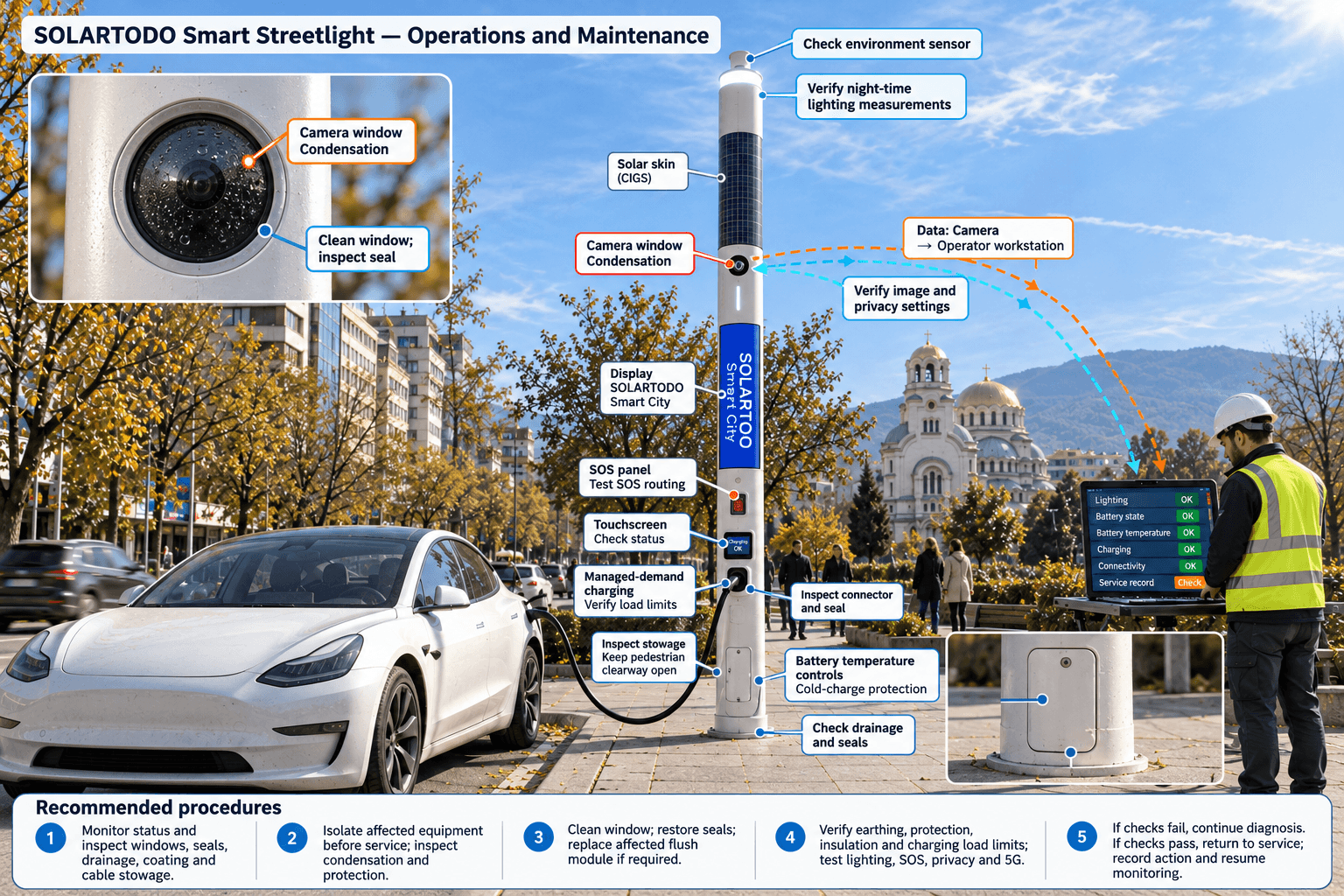
Allow an illustrative 6–10 weeks for civil works, erection, wiring, and commissioning, with permitted overlap between phases. Foundation dimensions must follow site soil and loading calculations; 5mm wall thickness alone does not establish structural adequacy around service openings. Verify earthing, protective devices, insulation, charging load limits, drainage, and battery temperature controls before energization. Night-time measurements, camera privacy settings, SOS routing, and RF tests should precede acceptance.
Expected Performance & ROI
Approximately 111 luminaires rated at 60W would draw 6.66kW together, while charging demand could reach 777kW under an explicitly assumed 7kW-per-pole aggregate limit.
At an assumed 4,000 annual lighting hours, the rings would consume 26,640kWh before dimming and conversion losses. An illustrative 100W-per-position baseline would consume 44,400kWh, producing a calculated 17,760kWh annual lighting reduction, or 40%. These are scenario calculations, not a measured Sofia baseline or an industry savings guarantee. Cameras, displays, communications, charging, and battery losses require separate metering.
The 777kW charging scenario excludes auxiliary loads and assumes 7kW total per pole, rather than 7kW at each outlet. Demand management and phase balancing should follow the operator’s approved connection capacity. At 230V, a nominal 7kW single-phase load draws approximately 30.4A before detailed equipment allowances. Neither outlet count nor a lighting feeder’s existing fuse establishes usable charging capacity.
The 1,800Wh battery provides a theoretical 30 hours at 60W alone, before discharge limits, cold conditions, losses, and auxiliary consumption. At 7kW, the same nominal energy represents only approximately 15.4 minutes before those deductions. No annual CIGS yield or autonomous-operation claim is justified without location-specific shading, orientation, and electrical modelling.
Calculate simple payback as incremental installed investment divided by annual net benefit. Net benefit should combine verified lighting savings, avoided maintenance, and net charging contribution, less connectivity, software, inspections, and component replacement allowances. Exclude advertising revenue because the prescribed screen carries fixed brand text only. A defensible payback period requires baseline bills, tendered scope, and charging utilization; none is supplied here.
Comparison Table
For Sofia, the 11m flush configuration should be compared with conventional lighting and modular smart poles using verified road performance, serviceability, and charging integration criteria.
| Criterion | Conventional LED pole | Modular smart pole | Specified SOLARTODO cylinder |
|---|---|---|---|
| Height | Site-selected | Family range 6–12m | 11m |
| Envelope | Pole plus luminaire arrangement | Octagonal body with accessories | Constant Ø315mm; 5mm wall |
| Light output | Tender-specific | Generic family 80–150W | Embedded 60W, 9,000lm ring |
| EV provision | Separate equipment if required | Configuration-dependent | Flush 7kW, Type 2 + Type 1 |
| Sensors | Usually separate | Modular selection | Flush 8-parameter pod |
| Camera | Optional external mounting | Configuration-dependent | Flush 4MP; IR 30m |
| Storage | Not assumed | Configuration-dependent | Internal 1,800Wh LFP |
| Main decision | Lighting performance | Modular flexibility | Integrated streetscape and service access |
Pricing & Quotation
A quotation for approximately 111 poles should distinguish equipment, inland logistics, civil works, grid connection, commissioning, and service obligations without assuming a uniform installation scope.
SOLARTODO offers three pricing tiers for this product line: FOB Supply (equipment ex-works China), CIF Delivered (including ocean freight and insurance), and EPC Turnkey (fully installed, commissioned, with 1-year warranty). Volume discounts are available for large-scale deployments. Configure your system online for an instant estimate, or request a custom quotation from our engineering team at [email protected].
For contract accuracy, FOB and EXW must be distinguished explicitly, and CIF must name a destination seaport; inland Sofia delivery needs its own scope. Review the Smart Streetlight product family alongside a site-specific bill of quantities. No monetary prices are stated in this guide.
Frequently Asked Questions
These 10 procurement questions clarify the proposed 11m Sofia configuration, including lighting suitability, charging limits, installation, maintenance, commercial scope, and the evidence needed for investment approval.
Q1: Is a 60W ring sufficient for an 11m Sofia streetlight?
The specified ring delivers 9,000lm at 4000K, but wattage and lumen output do not establish roadway suitability. Obtain photometric files and calculate the applicable lighting class, uniformity, glare, and spill light at 28m spacing. Confirm the design through night-time measurements before accepting this configuration for a particular Sofia street.
Q2: Does the cylinder include a separate charging cabinet?
No. The specified pole remains Ø315mm from top to bottom, with charging hardware embedded inside the cylinder. Two flush flip-caps cover the Type 2 and Type 1 interfaces, and the touchscreen sits at 1.5m. The 5m coiled Type 2 cable still needs secure stowage and an accessible route to a designated parking bay.
Q3: Can both outlets deliver 7kW simultaneously?
The supplied description identifies a 7kW dual-outlet charger but does not establish independent 7kW output at both interfaces. This guide therefore uses 7kW total per pole solely as a planning assumption. Request the combined rating, simultaneous-operation logic, protective arrangement, and load-management specification before approving feeder capacity or charging-service commitments.
Q4: What deployment timeline should an EPC contractor plan?
An illustrative programme is approximately 28–44 weeks across survey, engineering, production, transport, civil works, and commissioning, with some activities overlapping. This is a planning scenario rather than a supplier commitment. Sofia street permissions, utility conflicts, heritage review, grid connection, and prototype acceptance can change the critical path substantially.
Q5: What ROI or payback period is credible?
No fixed payback period is credible without an installed scope, measured baseline, operating costs, and utilization forecast. The illustrative lighting calculation yields 17,760kWh annual savings against 111 assumed 100W positions operating for 4,000 hours. That calculation excludes auxiliary electricity and charging demand, which must be included in the investment model.
Q6: How should maintenance address Sofia’s winter conditions?
Specify pre-winter inspection of drainage, seals, cable stowage, camera windows, and battery temperature controls. The 1,800Wh LFP battery requires manufacturer-defined cold-charge protection. Maintenance procedures should also cover salt splash from treated roads, condensation, coating damage, and safe replacement of flush modules without altering the constant Ø315mm exterior envelope.
Q7: How does this compare with a standard smart pole?
The specified 11m cylinder integrates its ring light, camera, display, charging interfaces, and communications without side arms or external cabinets. A standard 6–12m octagonal smart pole offers modular accessory arrangements instead. Selection should depend on photometric performance, streetscape requirements, repair access, structural verification, and the complexity of maintaining embedded equipment.
Q8: What should an EPC quotation include?
For approximately 111 poles, request itemized equipment, transport, inland delivery, foundations, trenching, cabling, protection, grid connection, testing, and commissioning scope. Identify exclusions for traffic management, utility diversion, heritage requirements, connectivity, and software services. The named Incoterm and delivery location must be explicit, with FOB and EXW distinguished correctly in the contract.
Q9: What warranty applies to this concept?
The stated EPC Turnkey offer includes a 1-year warranty. The contract should define its start date, covered components, labour, access equipment, response times, exclusions, and replacement procedures. Battery, display, charger, coating, and software obligations should be listed separately; no longer equipment warranty or battery-life guarantee is established by the supplied configuration.
Q10: What installation checks are required before acceptance?
Verify foundations, anchorage, structural openings, earthing, electrical protection, and the approved 230/400V supply arrangement. Test the 7kW charger under managed demand, followed by lighting measurements, SOS routing, camera privacy settings, and 5G connectivity. Record module access and cable-stowage checks so the flush design remains maintainable and does not obstruct pedestrian movement.
References
These 7 public references establish Sofia’s demographic and climate context, Bulgarian distribution characteristics, and relevant European procurement, charging, and luminaire requirements for this proposed configuration.
- National Statistical Institute of Bulgaria (2026): Population by districts, municipalities, place of residence and sex; Sofia Capital Municipality and urban-settlement totals. Population table.
- Sofia Municipality (2021): Sustainable Energy and Climate Action Plan 2021–2030; valley elevation, geography, seasonal climate, and municipal planning context. SECAP.
- ERM Zapad (2025): Distribution-equipment technical specification identifying nominal 230/400V, 50Hz network characteristics. Technical specification.
- European Parliament and Council (2023, subsequently amended): Regulation (EU) 2023/1804; alternative-fuels infrastructure definitions and charging interoperability. EUR-Lex.
- International Electrotechnical Commission (2002; Amendment 1, 2011): IEC 60598-2-3, particular requirements for road and street lighting luminaires. IEC catalogue.
- European Commission (2018): EU Green Public Procurement Criteria for Road Lighting and Traffic Signals. Criteria document.
- European Commission Joint Research Centre (2019): Revision of EU green public procurement criteria for street lighting and traffic signals; energy consumption, light pollution, and durability. Publications Office report.
Equipment Deployed
- Approximately 111 proposed poles: 11m monolithic seamless steel cylinders, constant Ø315mm, 5mm wall, hot-dip galvanized, matte white RAL9003; no widened bases, external boxes, side arms, or outriggers
- Per pole: embedded Ø315mm top LED ring band, 60W, 9000lm, 4000K, 360° glow
- Per pole: approximately 316W CIGS flexible solar film wrapped 360° flush around the 6.5–10.3m section; no rigid panels or brackets
- Per pole: internal 1800Wh LFP battery with MPPT
- Per pole: flush dome-top sensor measuring temperature, humidity, wind, pressure, noise, PM2.5, PM10, and illuminance
- Per pole: flush 4MP turret camera behind Ø10cm dark anti-vandal glass, specified IR range 30m
- Per pole: embedded 5G NR n78 equipment with internal antenna
- Per pole: flush 12×12cm SOS panel with micro-camera, microphone, and speakerphone grille; no public-address module or external speaker column
- Per pole: fully embedded 7kW dual-outlet charger, Type 2 + Type 1 flush flip-caps, 5m coiled Type 2 cable, touchscreen at 1.5m; combined outlet rating to be confirmed
- Per pole: flush portrait curved LCD, 2200mm tall × approximately 170mm wide, conforming to the Ø315mm cylinder; white SOLARTODO above Smart City on deep blue, without imagery, video, or ads
- Per pole: two flush USB-A outlets
- Planning spacing: 28m; supplied standards references: IEC 60598 and GB/T 37024; European conformity and site-specific engineering verification required