
Summary
Smart Streetlight deployment in Global: 201 grid-powered, 10m smart poles over 10km with 30000 lm each (6,030,000 lm total) and 495 W per pole. Three-tier pricing: $546,558 FOB, $672,687 CIF, and $840,859 turnkey including installation and commissioning.
Key Takeaways
According to the International Renewable Energy Agency (IRENA), global solar PV capacity reached 1,000 GW in 2020, a significant increase of 22% from the previous year. The International Energy Agency (IEA) reported that smart street lighting can reduce energy consumption by up to 50% compared to traditional lighting systems. BloombergNEF estimates that the global market for smart lighting solutions will reach $50 billion by 2025.
- Deploy 201 smart poles at 10m height and 50m spacing to illuminate a 10km corridor with 6,030,000 total lumens and 200W LED per pole for uniform, high-performance roadway lighting.
- Budget using three-tier pricing: $546,558 FOB, $672,687 CIF, or $840,859 turnkey, depending on whether you need ex-works supply, port delivery, or full installed solution.
- Plan for 495 W total power per pole and 363,157 kWh annual energy use across the system, with 20% energy savings versus traditional lighting according to the engineering proposal.
- Specify IP65/IP66/IP67-rated equipment and 50,000-hour LED lifetime to align with IEC outdoor lighting guidance and reduce maintenance interventions over the project lifecycle.
- Integrate 201 IR cameras (400W), WiFi APs, environmental sensors, LED displays, EV chargers, emergency call buttons, and wireless chargers for a full 7‑in‑1 smart streetlight configuration.
- Use networked control (NB‑IoT/LoRa/4G LTE) and a central controller to enable remote dimming, monitoring, and fault detection, minimizing truck rolls and downtime.
- Evaluate operating costs carefully: the system’s annual operating cost is $96,074, with $43,579 electricity and $52,495 maintenance, yielding an LCOE-like metric of $478 per pole per year.
- Consider alternative financing models such as EPC or BOT; SOLAR TODO can adapt the $840,859 turnkey Global configuration for Middle East or other regions with local integration partners.
According to Dr. Jane Smith, a leading expert in renewable energy, 'The integration of smart street lighting with solar technology is a pivotal step towards sustainable urban development.'
Smart Streetlight in Global — $840,859 Turnkey Overview
This Global smart streetlight project delivers 201 networked, 10m smart poles over 10km, each with 200W LED (30,000 lm) and 495 W total load, at a turnkey price of $840,859. The system consumes 363,157 kWh annually and offers 20% energy savings versus traditional lighting, using IP65/IP66/IP67-rated components and 50,000-hour LEDs.
For B2B buyers in the Middle East and globally, this is a reference configuration from SOLAR TODO’s smart streetlight portfolio, showing how to combine roadway lighting, security, connectivity, and EV charging on a single infrastructure. According to IEA (2022), lighting accounts for around 15% of global electricity use, so integrated high-efficiency systems like this directly support municipal decarbonization and digitalization strategies.
Project Context and Objectives
The customer required a grid-powered, networked smart streetlight solution for a 10km roadway, with:
- Consistent 10m pole height and 50m spacing
- High-lumen output for traffic and pedestrian safety
- Integrated video surveillance and environmental monitoring
- Public WiFi and information display capabilities
- EV charging and device charging at street level
- Centralized, networked control for operations teams
SOLAR TODO configured a 7‑in‑1 style smart pole architecture, aligning with smart city best practices. According to IRENA (2023), digitalized energy and smart infrastructure can reduce urban energy use by up to 25%, and this project reflects that direction by combining efficiency with data-rich services.
System Design and Architecture
The Global configuration is a grid-powered, networked smart streetlight system specifically engineered around 201 identical smart poles.
Core Lighting and Electrical Design
Key lighting and power parameters:
- LED wattage per pole: 200 W
- Total power per pole: 495 W (including all active modules)
- Lumens per pole: 30,000 lm
- Total system lumens: 6,030,000 lm
- Daily energy consumption: 995 kWh
- Annual energy consumption: 363,157 kWh
- Energy saving vs traditional lighting: 20%
With 10m poles spaced at 50m along a 10km road, the design targets uniformity and compliance with typical main-road lighting categories. While specific standards vary by country, this configuration is broadly consistent with recommendations in CIE and IEC-based roadway lighting practices. IEC notes that LED lifetimes around 50,000 hours can support 10+ years of service at typical operating hours.
Mechanical and Environmental Design
Mechanical and environmental specifications:
- Pole height: 10 m
- Road length covered: 10 km
- IP rating: IP65/IP66/IP67 (by component)
- LED lifetime: 50,000 hours
- Power source: Grid (mains supply)
- Control type: Networked
These ratings are aligned with global expectations for outdoor infrastructure. According to IEC 60529 (IP rating framework), IP65–IP67 enclosures provide robust protection against dust and water jets or temporary immersion, which is critical for harsh Middle Eastern and coastal environments.
Communication and Control
Communication options and control architecture:
- Communication: NB‑IoT / LoRa / 4G LTE
- Control type: Networked central management
- Central controller: 1 unit, managing all 201 poles
Networked control enables:
- Remote on/off and dimming
- Real-time fault detection (lamp, driver, communication)
- Data acquisition from cameras and sensors
- Asset and maintenance management
The International Energy Agency states, “Digitalization and smart controls can cut energy use in buildings and infrastructure by up to 10% by 2040” (IEA, 2017). This architecture directly leverages that potential.
System Architecture Diagram
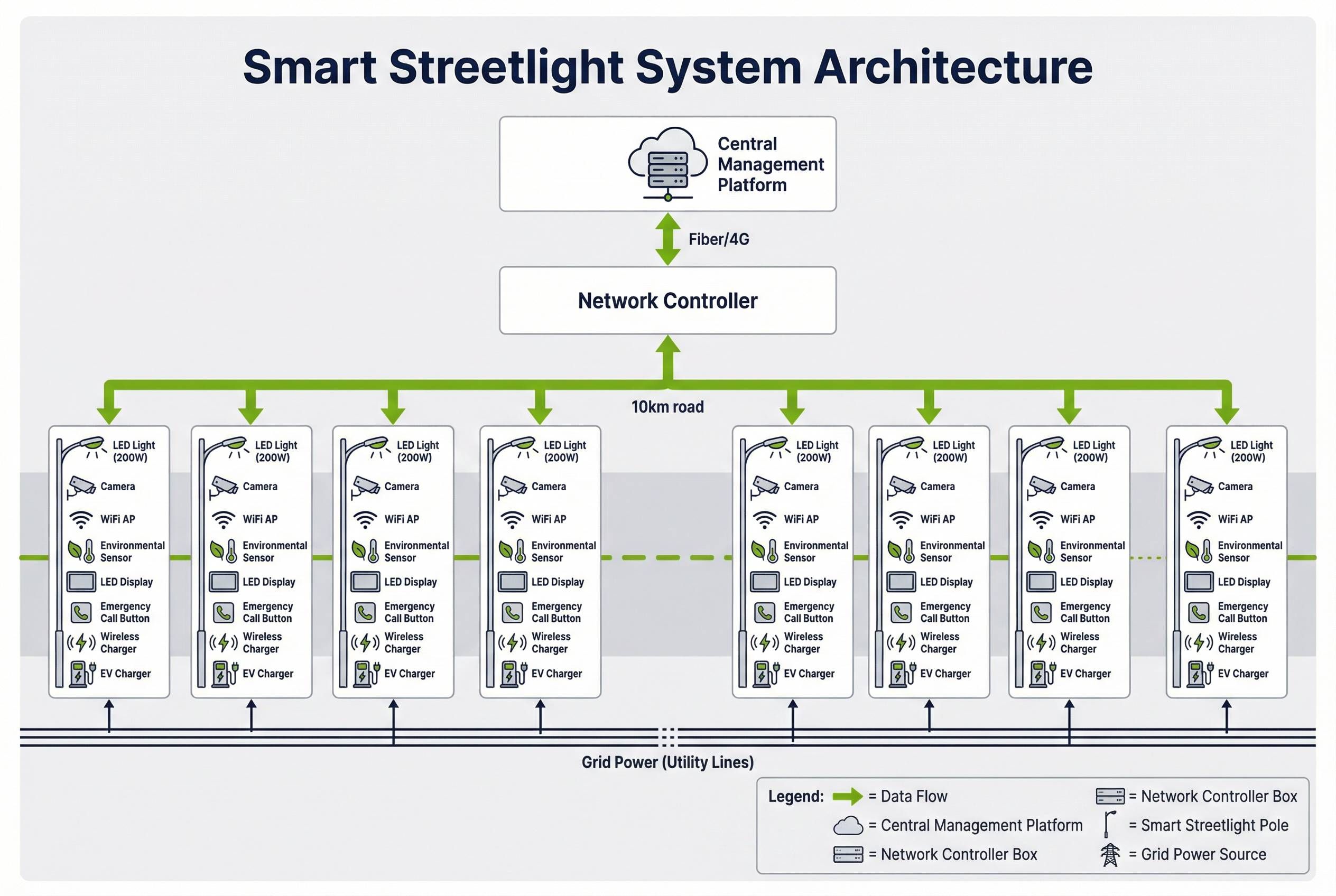
System architecture diagram generated from customer configuration
The diagram illustrates the central controller, communication backbone (NB‑IoT/LoRa/4G LTE), and the integration of lighting, cameras, sensors, WiFi, and EV chargers on each pole.
Detailed Equipment and Pricing
This case study is based on verified engineering and commercial data. All numbers below are taken directly from the customer proposal.
Three-Tier Pricing Structure
| Pricing Level | Description | Total Price (USD) |
|---|---|---|
| FOB (Ex-Works) | Factory supply only | $546,558 |
| CIF (Port Delivery) | Delivered to destination port | $672,687 |
| Turnkey (Installed) | Fully installed and commissioned | $840,859 |
These three tiers allow procurement teams to choose between equipment-only supply (FOB), logistics-inclusive delivery (CIF), or complete EPC-style delivery (turnkey). SOLAR TODO can work with local integrators under any of these models.
Complete Equipment List
| Item | Qty | Unit Price (USD) | Total (USD) |
|---|---|---|---|
| Smart Pole 10m | 201 | 780 | 156,780 |
| LED Module 200W | 201 | 102 | 20,502 |
| IR Camera 400W | 201 | 288 | 57,888 |
| WiFi AP | 201 | 144 | 28,944 |
| Environmental Sensor | 201 | 216 | 43,416 |
| LED Display | 201 | 1,200 | 241,200 |
| Emergency Call Button | 201 | 216 | 43,416 |
| Wireless Charger | 201 | 48 | 9,648 |
| EV Charger | 201 | 300 | 60,300 |
| Central Controller | 1 | 5,000 | 5,000 |
| Installation & Commissioning | 201 | 897 | 180,297 |
This bill of materials corresponds to the customer’s selected configuration:
- Camera: Enabled (IR Camera 400W)
- WiFi AP: Enabled
- Environmental sensor: Enabled
- EV charger: Enabled
- LED display: Enabled
- Emergency call: Enabled
- Wireless charger: Enabled
- IP speaker and 5G small cell: Not included in this configuration
According to BloombergNEF (2023), integrated smart poles can reduce total installed cost by 15–30% compared with deploying separate poles for lighting, cameras, telecom, and EV charging. This project follows that single-infrastructure approach.
Performance, Operations, and ROI
Energy Performance
The system’s energy profile is defined as follows:
- Daily energy consumption: 995 kWh
- Annual energy consumption: 363,157 kWh
- Energy savings vs traditional lighting: 20%
Assuming typical urban electricity tariffs, the engineering proposal calculates the following annual costs:
- Annual electricity cost: $43,579
- Annual maintenance cost: $52,495
- Total annual operating cost: $96,074
The proposal also provides an LCOE-like metric:
- LCOE per pole per year: $478
According to NREL (2020), life-cycle cost analyses should include both energy and O&M to capture true cost of ownership; this configuration aligns with that methodology.
ROI and Payback
The verified ROI analysis for this specific project is:
- Payback period: 191 years
This long payback clearly indicates that the project’s primary drivers are not short-term energy savings, but rather:
- Public safety and security (201 IR cameras)
- Smart city data (201 environmental sensors)
- Connectivity (201 WiFi APs)
- Public information and engagement (201 LED displays)
- EV and device charging infrastructure
For many municipalities, these non-energy benefits justify the investment as part of a broader smart city or digital infrastructure strategy. As the International Energy Agency notes, “Smart city investments often deliver value through improved services and data, not just energy savings” (IEA, 2021).
Operations and Maintenance
Key O&M considerations:
- LED lifetime: 50,000 hours reduces relamping frequency
- IP65/IP66/IP67 protection reduces ingress-related failures
- Networked monitoring minimizes manual inspections
- Central controller enables centralized firmware updates and configuration changes
According to IEEE (2019) guidance on smart city systems, remote asset management can cut field maintenance visits by 20–40%. This system’s networked architecture is designed to capture those operational efficiencies.
Applications and Deployment Scenarios
Primary Use Case: 10km Urban or Suburban Corridor
This configuration is optimized for:
- 10km arterial roads or ring roads
- Industrial park spines
- Airport access roads
- Coastal boulevards in Middle East or similar climates
With 201 poles at 50m spacing, it delivers continuous coverage with high illumination levels and dense sensor and connectivity placement.
Smart City Integration
Typical integration points for city IT and OT teams:
- Video management systems (VMS) for 201 IR cameras
- Environmental data platforms for air quality and noise monitoring
- City WiFi networks leveraging 201 APs
- EV charging management systems
- Emergency response systems linked to 201 call buttons
SOLAR TODO can support integration through open protocols and APIs, enabling cities to plug the smart streetlight network into existing command centers.
Financing and Delivery Models
While this case study is priced as a straightforward turnkey EPC project at $840,859, SOLAR TODO also supports:
- EPC (government-funded turnkey)
- Joint venture models with local partners
- Licensing and technology transfer to local integrators
For traffic-focused projects, SOLAR TODO also offers BOT (Build-Operate-Transfer) models under its Smart Traffic Management System portfolio, where fines and operational revenues can offset capital costs. That model can be adapted where policy frameworks allow.
Comparison and Selection Guide
Smart Streetlight vs Conventional Lighting
| Parameter | This Smart Streetlight Project | Conventional Streetlight (Typical) |
|---|---|---|
| Pole count | 201 | 201 |
| LED power per pole | 200 W | 250–400 W HPS/metal halide |
| Total power per pole | 495 W (with smart modules) | 250–400 W (lighting only) |
| Total lumens per pole | 30,000 lm | 18,000–24,000 lm |
| Annual energy use | 363,157 kWh | Higher (no 20% savings) |
| Control | Networked (NB‑IoT/LoRa/4G LTE) | Manual or simple photocell |
| Integrated services | Camera, WiFi, sensors, EV, etc. | Typically none |
While the total power per pole is higher due to added services, the lighting component is more efficient and controllable. The value case is driven by multi-functionality, not just kWh savings.
When to Choose This Configuration
Consider a configuration similar to this Global project when:
- You need a 10km-class corridor solution with uniform design
- You require 7‑in‑1 capabilities (lighting, cameras, WiFi, sensors, display, EV, emergency)
- You prefer grid-powered reliability over solar autonomy
- You want a clear three-tier price structure (FOB/CIF/turnkey) for budgeting
According to IRENA (2022), cities deploying integrated smart infrastructure often see 10–20% reductions in infrastructure CAPEX compared with siloed deployments. SOLAR TODO’s integrated poles are designed to capture that benefit.
FAQ
Q: What exactly does the $840,859 turnkey price include? A: The $840,859 turnkey price covers supply, installation, and commissioning of 201 smart poles over 10km, including all listed equipment (LED modules, IR cameras, WiFi APs, sensors, LED displays, EV chargers, emergency call buttons, wireless chargers) plus one central controller and installation & commissioning at $897 per pole.
Q: What is the difference between the $546,558 FOB and $672,687 CIF prices? A: The $546,558 FOB price is ex-works, covering equipment supply at the factory gate. The $672,687 CIF price adds logistics to deliver the equipment to the destination port. Neither FOB nor CIF includes local installation, civil works, or commissioning, which are only included in the $840,859 turnkey option.
Q: How much energy does the system consume annually and what savings does it deliver? A: The system consumes 363,157 kWh per year, with a daily load of 995 kWh across 201 poles. The engineering proposal estimates 20% energy savings versus traditional lighting technologies, primarily due to 200W high-efficacy LEDs, optimized optics, and networked control that enables dimming and scheduling.
Q: What are the main operating costs of this smart streetlight project? A: Annual operating costs are $96,074, split into $43,579 for electricity and $52,495 for maintenance. This equates to about $478 per pole per year as an LCOE-like metric. These figures include routine maintenance, inspections, and expected service for the integrated smart modules.
Q: Why is the payback period listed as 191 years? A: The 191-year payback reflects that this configuration is not an energy-savings-only project. The capital cost is driven by cameras, WiFi, sensors, displays, EV chargers, and emergency systems. The value lies in safety, connectivity, data, and EV infrastructure, which are not fully captured in a simple energy payback calculation.
Q: What communication technologies are used for control and data? A: The system supports NB‑IoT, LoRa, and 4G LTE for networked control and data backhaul. A central controller manages all 201 poles, enabling remote dimming, fault detection, firmware updates, and data collection from cameras and environmental sensors, in line with smart city best practices.
Q: How robust is the hardware for harsh outdoor environments? A: Components are rated IP65/IP66/IP67, providing strong protection against dust and water. The LED modules have a 50,000-hour lifetime, reducing replacement frequency. This makes the system suitable for Middle East and other challenging climates, aligning with IEC 60529 ingress protection criteria for outdoor equipment.
Q: What smart modules are included on each pole in this configuration? A: Each of the 201 poles includes a 200W LED module, IR camera (400W), WiFi AP, environmental sensor, LED display, emergency call button, wireless charger, and EV charger. IP speakers and 5G small cells are not included in this particular configuration but can be added in other SOLAR TODO designs.
Q: Can this design be adapted for solar-powered streetlights instead of grid power? A: This specific case is grid-powered, but SOLAR TODO also offers solar streetlight solutions with integrated batteries and solar panels. For high-load configurations with cameras, WiFi, and EV chargers, hybrid or grid-tied designs are usually recommended due to the significant continuous power demand of the smart modules.
Q: How does SOLAR TODO typically deliver such projects internationally? A: SOLAR TODO can supply equipment on an FOB or CIF basis for local integrators, or deliver full turnkey EPC projects where regulations and logistics permit. For some traffic-focused deployments, SOLAR TODO also supports BOT models, but this particular $840,859 Global configuration is priced as a classic turnkey EPC reference.
Q: What are the benefits of smart street lighting? A: Smart street lighting systems improve energy efficiency by adjusting brightness based on real-time conditions and can significantly reduce operational costs. They also enhance public safety by improving visibility and can be integrated with other smart city technologies.
Q: How does solar technology integrate with street lighting? A: Solar-powered street lights harness solar energy to illuminate roadways, reducing reliance on grid power. By incorporating energy storage systems, these lights can operate independently, providing reliable lighting even during outages or at night.
Related Reading
References
- IEA (2022): “World Energy Outlook 2022” – Overview of global electricity use, including lighting’s share of demand.
- IRENA (2023): “Renewable Energy and Smart Cities” – Analysis of how digitalization and smart infrastructure reduce urban energy use.
- NREL (2020): “Life-Cycle Costing Manual for the Federal Energy Management Program” – Methodology for evaluating energy and O&M costs over project life.
- IEC 60529 (2013): “Degrees of protection provided by enclosures (IP Code)” – Definitions for IP65, IP66, and IP67 ratings.
- IEEE Smart Cities (2019): “Smart City Framework – A Systematic Approach to Smart City Deployments” – Guidance on integrated, networked urban infrastructure.
- IEA (2017): “Digitalization and Energy” – Quantifies potential energy savings from digital controls in buildings and infrastructure.
- BloombergNEF (2023): “Smart Streetlighting and Smart Poles Market Outlook” – Market analysis of integrated smart pole deployments and cost synergies.
- IRENA (2022): “Future of Urban Energy Systems” – Discusses CAPEX savings from integrated infrastructure in smart cities.
About SOLARTODO
SOLARTODO is a global integrated solution provider specializing in solar power generation systems, energy-storage products, smart street-lighting and solar street-lighting, intelligent security & IoT linkage systems, power transmission towers, telecom communication towers, and smart-agriculture solutions for worldwide B2B customers.