Smart Streetlight Data Analytics: Turning Streetlights…

Cinn Song
Founder & Chief Solutions Architect
Watch the video
TL;DR
Smart streetlight data analytics turns ordinary lighting assets into distributed city sensor nodes. By combining 100W-200W LED lighting, 4MP video, WiFi 6, environmental sensors, and solar or hybrid storage, cities can reduce energy use by 50-70%, lower maintenance by 20-40%, and collect actionable data for traffic, safety, energy, and asset operations.
Smart streetlight data analytics turns 7m-12m poles into city sensor nodes with LED lighting, 4MP video, WiFi 6, and solar storage, cutting energy use by 50-70% while improving maintenance response.
Summary
Smart streetlight data analytics turns 7m-12m poles into city sensor nodes by combining LED lighting, cameras, WiFi 6, solar storage, and dashboards to cut energy use by 50-70% while improving response time.
Key Takeaways
Smart streetlight analytics programs should start with 3-5 priority datasets, 1 cybersecurity standard, and a 12-month operating baseline.
- Map 1 sensor node every 28-35m to capture lane-level lighting, traffic, video, and environmental data without adding separate roadside cabinets.
- Specify 100W-200W LED luminaires, 4MP-8MP cameras, WiFi 6/5G backhaul, and IP66 housings for outdoor smart streetlight analytics.
- Connect solar generation of 256W-400W and 3,000Wh-15kWh LFP storage where grid access, resilience, or trenching cost is a constraint.
- Compare conventional poles with smart poles to reduce 3-8 separate devices into 1 integrated asset and simplify procurement, permitting, and maintenance.
- Build ROI models using 50-70% LED energy savings, 20-40% maintenance reduction, and monetizable data services such as parking or EV charging.
- Require IEC 60598, IEC 62722, IEEE 802.11ax, ISO/IEC 27001, and UL 9540A-aligned documentation before approving city-scale deployment.
- Pilot 20-50 poles for 90-180 days before scaling to 250+ units, using uptime, lux, alert accuracy, and network latency as acceptance metrics.
- Negotiate 5%, 10%, and 15% volume discounts at 50+, 100+, and 250+ units to lower EPC total cost of ownership.
Smart Streetlights as City Sensor Infrastructure
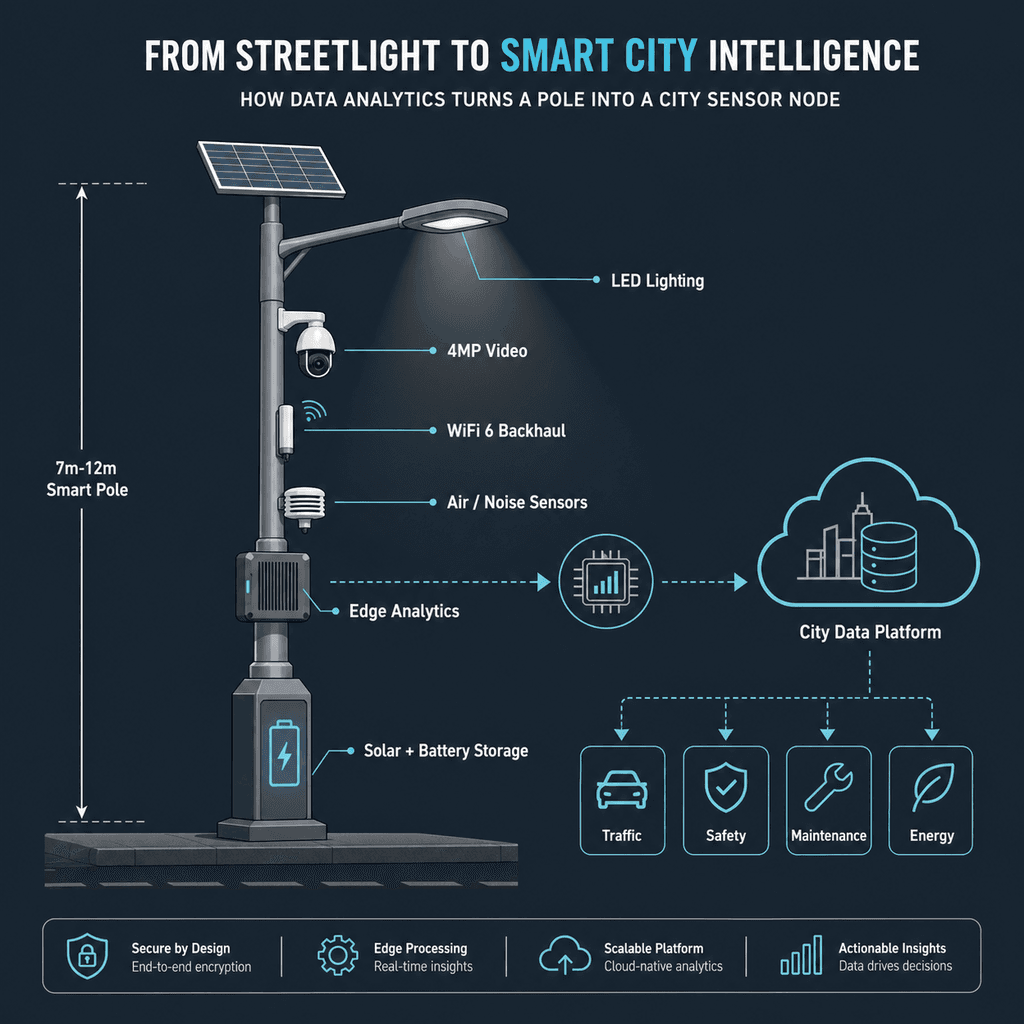
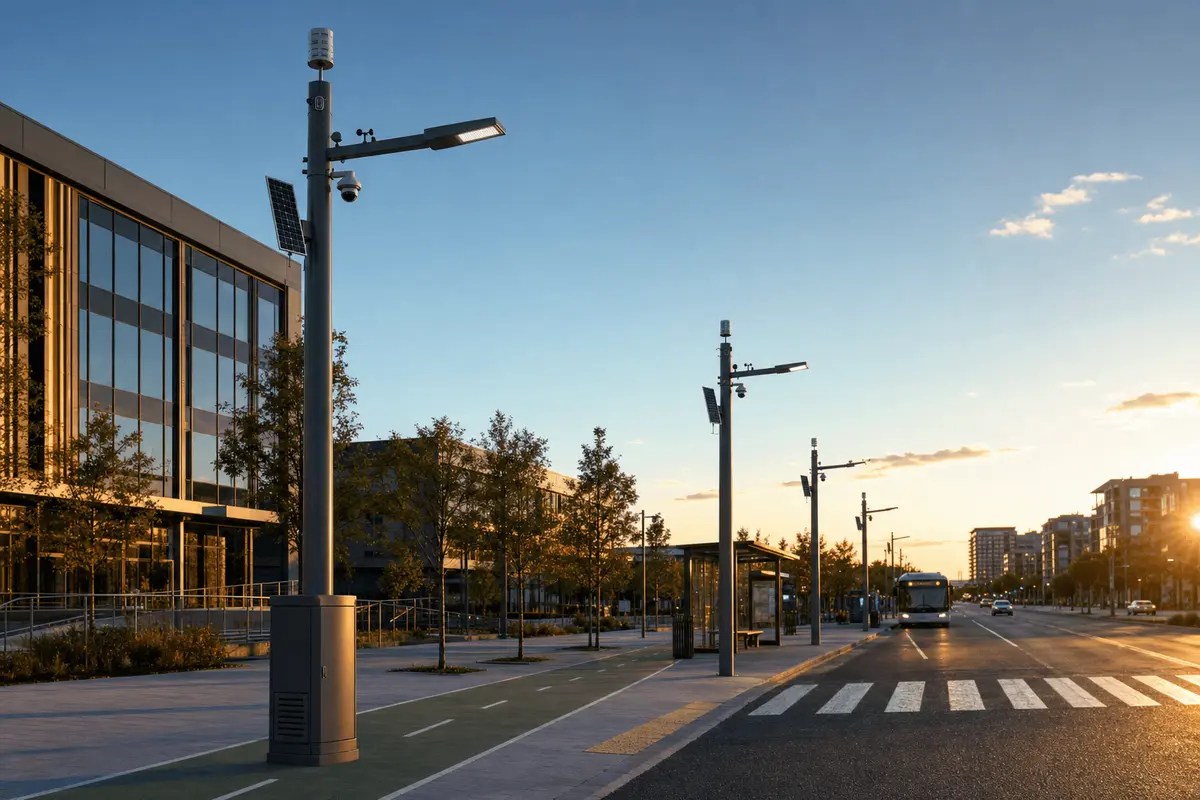
Smart streetlight analytics converts a 7m-12m lighting pole into a city sensor node that can collect 4MP video, air-quality, traffic, WiFi, and energy data.
For procurement managers and city engineers, the main shift is that streetlights are no longer passive electrical loads. They become distributed edge infrastructure located exactly where cities need data: roads, intersections, tunnels, checkpoints, parking zones, logistics parks, ports, and public corridors. A smart streetlight can observe traffic flow, detect equipment faults, measure environmental conditions, support emergency communication, and report energy performance from the same vertical asset.
According to the International Energy Agency (2024), lighting remains one of the largest electricity end uses, and LED conversion is a core efficiency pathway for public infrastructure. The U.S. Department of Energy states, "LEDs use at least 75% less energy," which explains why municipalities often use lighting modernization as the entry point for smart city upgrades. Once LED savings are captured, the same pole can host communications, safety, and analytics layers.
SOLARTODO positions smart streetlight analytics as a B2B infrastructure system rather than a consumer IoT product. The company manufactures and exports solar energy, energy storage, smart streetlights, telecom towers, power towers, smart traffic, security systems, and smart agriculture monitoring equipment for Latin America, the Middle East, Africa, Southeast Asia, and Europe. Projects follow an inquiry, offline quotation, technical configuration, and optional project financing process.
For city buyers, the highest-value analytics use cases usually fall into 5 categories:
- Energy analytics: power draw, solar yield, battery state of charge, dimming schedules, and fault alerts.
- Mobility analytics: vehicle count, speed trends, congestion, incident detection, and lane occupancy.
- Safety analytics: perimeter visibility, emergency calls, camera alerts, and public-address events.
- Environmental analytics: temperature, humidity, PM2.5, noise, rainfall, and localized microclimate patterns.
- Asset analytics: luminaire health, controller uptime, network latency, enclosure temperature, and maintenance tickets.
Technical Deep Dive: Data Architecture and Sensor Stack
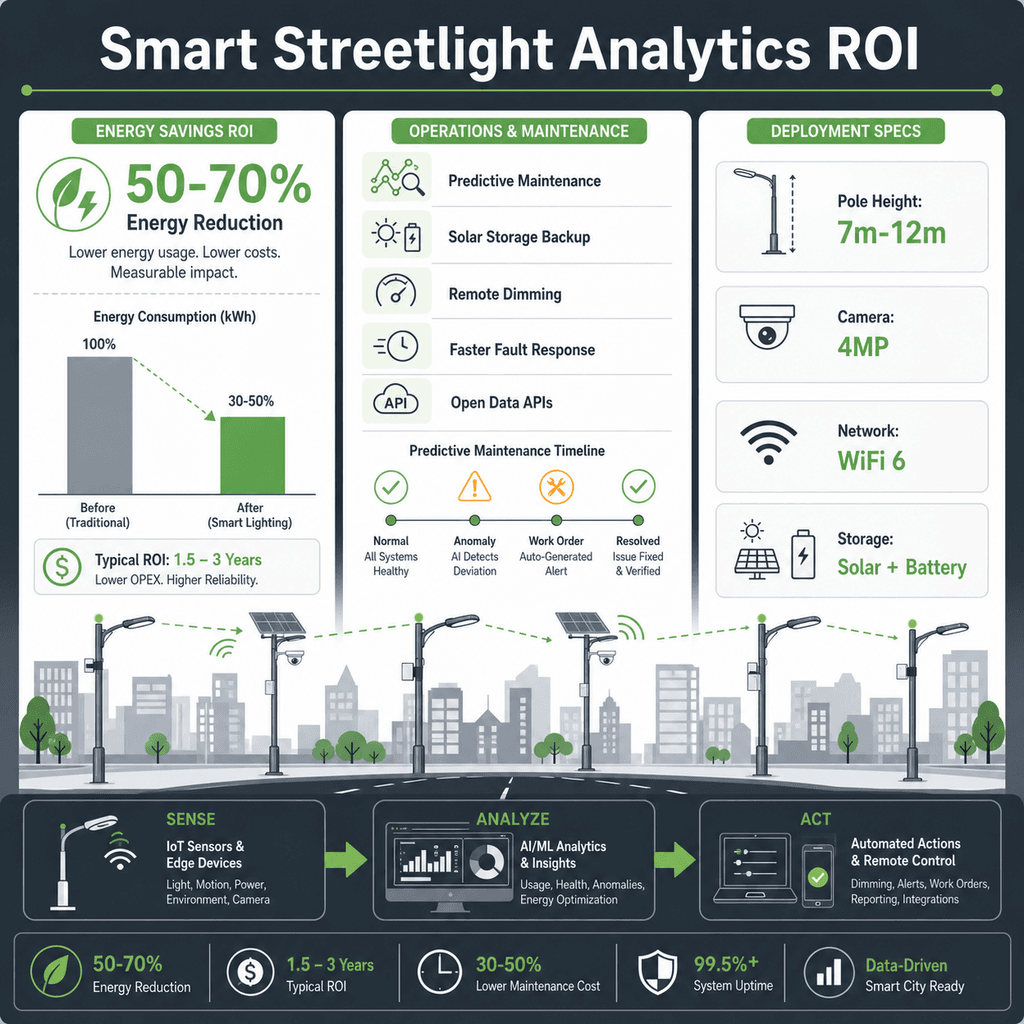
A practical smart streetlight analytics stack needs 4 layers: sensors, edge control, secure communications, and a dashboard that converts raw signals into decisions.
The physical pole is the foundation. SOLARTODO smart streetlight variants include 7m cylindrical CIGS smart poles, 10m tunnel entrance smart poles, and 12m wind-solar hybrid smart poles. The 7m Ø400 Cylindrical CIGS Smart Pole integrates 100W LED lighting, 15,000 lm output, about 256W CIGS solar generation, 3,000Wh LFP storage, 7kW AC charging, 4MP IR video, and WiFi 6 connectivity in 1 monolithic steel column.
The 10m Tunnel Entrance Smart Pole is optimized for threshold lighting and traffic awareness. It combines a 200W LED luminaire, AI camera, environmental sensor, and LED display, with a design target of 300 lux and IP66 ingress protection. For tunnel entrances where daylight can exceed 5,000-20,000 lux and interior luminance may fall below 100-300 lux, analytics can validate whether lighting transitions remain within engineering targets.
The 12m Wind-Solar Hybrid Smart Pole supports boulevard and mixed-energy applications. It can integrate a 160W LED luminaire, 400W-500W vertical-axis wind turbine, 2 monocrystalline solar panels, 5kWh-15kWh LFP storage, PTZ camera, environmental sensor, WiFi 6/5G communications, and 7kW or 11kW Type 2 AC EV charging. This makes it suitable for highways, campuses, waterfronts, business parks, and EV-enabled streets.
Data Pipeline
The data pipeline should be designed before procurement, because sensor density affects bandwidth, storage, privacy, and operating cost. A 4MP camera generates far more data than a PM2.5 sensor, while a dimming controller may send only periodic status packets. Engineers should define sampling frequency, retention rules, event triggers, and edge processing requirements before ordering hardware.
A resilient architecture usually includes:
- Local controller for LED dimming, battery protection, and sensor polling.
- Edge AI module for camera-based events such as stopped vehicles or intrusion detection.
- Communications layer using WiFi 6, 4G/5G, fiber, LoRaWAN, or Ethernet depending on site conditions.
- Cloud or municipal platform for dashboards, alerts, APIs, and historical analytics.
- Cybersecurity controls including device certificates, encrypted transport, role-based access, and audit logs.
According to IEEE 802.11ax-2021, WiFi 6 improves dense wireless environments through features such as OFDMA and multi-user scheduling. That matters for smart streetlights because intersections, transit stops, and commercial districts can contain many connected devices within a small area. For B2B buyers, the specification question is not only peak speed but whether the network can maintain stable uptime under crowd, weather, and electromagnetic interference conditions.
Applications and Operational Analytics
Cities can prioritize 6 high-value analytics workflows before adding advanced AI, because lighting, faults, traffic, safety, energy, and maintenance deliver measurable returns.
The first use case is adaptive lighting. Instead of running every luminaire at 100% output all night, the city can dim lights during low-traffic periods and raise output when cameras, radar, or schedules indicate activity. This reduces electricity use while maintaining visibility for pedestrians, vehicles, and security personnel. According to the U.S. Department of Energy (2024), LED lighting can deliver major savings compared with legacy technologies, and connected controls add further operational efficiency.
The second use case is asset fault detection. A conventional maintenance model waits for complaints or periodic patrols. A smart pole reports driver failure, battery alarms, abnormal power draw, communication loss, enclosure overheating, and solar charging anomalies. For projects with 250+ poles, automated fault grouping can reduce truck rolls by directing technicians to clusters of failures instead of isolated manual inspections.
The third use case is transport analytics. At intersections, checkpoint lanes, tunnel entrances, and logistics parks, smart poles can collect vehicle count, queue length, congestion trends, and incident alerts. The objective is not to replace a full traffic management center; it is to create low-friction data coverage at road segments where installing a new mast, cabinet, camera pole, and power supply would be expensive.
The fourth use case is security and emergency response. Border crossings and controlled logistics parks often need lighting, video, audio, emergency call, WiFi, and local power at every lane node. SOLARTODO's 7m Ø400 Cylindrical CIGS Smart Pole supports this type of compact deployment by integrating 10 functions into 1 steel column with no external cabinets or widened bases.
The fifth use case is environmental monitoring. Sensor payloads can measure heat islands, rainfall, humidity, particulate matter, noise, and localized weather. This helps cities compare neighborhoods, identify pollution exposure near freight corridors, and plan targeted interventions. The World Bank has reported that cities generate more than 80% of global GDP, which makes reliable urban infrastructure data economically significant, not just operationally useful.
The sixth use case is distributed energy analytics. Solar-powered and hybrid poles can track photovoltaic generation, battery state of charge, wind contribution, EV charging sessions, and grid backup events. According to IRENA (2025), 91% of new renewable power projects commissioned in 2024 were more cost-effective than fossil fuel alternatives. That trend strengthens the case for solar and hybrid smart poles where trenching, diesel backup, or weak grids increase lifetime cost.
EPC Investment Analysis and Pricing Structure
EPC smart streetlight procurement should compare FOB supply, CIF delivery, and turnkey installation across 50+, 100+, and 250+ unit volumes.
An EPC delivery model covers Engineering, Procurement, and Construction. For smart streetlights, engineering includes pole layout, lighting simulation, foundation design, solar and battery sizing, communications planning, cybersecurity requirements, and dashboard integration. Procurement includes poles, luminaires, controllers, batteries, solar modules, cameras, sensors, chargers, cables, anchors, and documentation. Construction includes civil works, installation, commissioning, network testing, training, and handover files.
SOLARTODO is not an online marketplace. B2B buyers send project requirements, drawings, target quantities, and destination details, then receive an offline technical and commercial quotation. For large deployments, SOLARTODO can support project financing, especially for projects above USD 1,000K. Commercial inquiries should be sent to [email protected] or +6585559114.
Pricing should be evaluated in 3 tiers:
| Pricing tier | What it includes | Best-fit buyer | Commercial note |
|---|---|---|---|
| FOB Supply | Factory supply, export packing, and handover at port of loading | Importers, distributors, EPC firms with local logistics | Lowest unit price, buyer controls freight and installation |
| CIF Delivered | FOB supply plus ocean freight and insurance to destination port | Government contractors and developers needing delivered cost clarity | Easier landed-cost budgeting before customs and inland transport |
| EPC Turnkey | Engineering, supply, logistics, installation, commissioning, and training | Municipalities, industrial parks, ports, and border agencies | Highest scope, lowest coordination burden, best for complex sites |
Volume pricing should be built into the procurement model. As planning guidance, 50+ units may qualify for about 5% discount, 100+ units for about 10%, and 250+ units for about 15%, depending on configuration, steel price, battery size, electronics package, destination, and installation scope. Buyers should request separate pricing for poles, smart devices, energy storage, communications, software, spare parts, and installation.
ROI depends on the baseline. Against conventional streetlights, buyers can model 50-70% electricity savings from LED conversion and smart dimming, plus 20-40% maintenance savings from remote monitoring and longer service intervals. Against multi-asset roadside deployments, integrated poles can reduce the need for separate CCTV poles, communications cabinets, EV charger pedestals, speaker columns, and sensor masts.
Payment terms are typically 30% T/T deposit plus 70% against bill of lading, or 100% irrevocable L/C at sight for qualified projects. For public-sector tenders, buyers should confirm warranty terms, spare-parts commitments, commissioning responsibilities, software licensing, data ownership, and service-level expectations before contract award.
Comparison and Selection Guide
Buyers should compare smart streetlights by function count, power architecture, data payload, installation complexity, and 25-year infrastructure suitability.
The best selection process starts with the operating environment. A tunnel entrance does not need the same pole as a boulevard EV charging corridor, and a border checkpoint has different requirements from a residential street. Engineers should define pole height, wind resistance, lighting target, camera coverage, data backhaul, grid availability, solar exposure, cybersecurity rules, and maintenance access before selecting the platform.
| Configuration | Height | Core analytics payload | Energy system | Best use case | Typical value driver |
|---|---|---|---|---|---|
| 7m Ø400 Cylindrical CIGS Smart Pole | 7m | 4MP IR video, WiFi 6, emergency and security functions | About 256W CIGS solar, 3,000Wh LFP | Border checkpoints and controlled lanes | 10-in-1 compact security infrastructure |
| 10m Tunnel Entrance Smart Pole | 10m | AI camera, environmental sensor, LED display | Grid-connected lighting platform | Tunnel entrances and threshold zones | 200W LED, 300 lux target, IP66 protection |
| 12m Wind-Solar Hybrid Smart Pole | 12m | PTZ camera, environmental sensor, communications, EV charging data | 400W-500W VAWT, solar panels, 5kWh-15kWh LFP | Boulevards, campuses, smart corridors | Hybrid generation plus 7kW or 11kW charging |
| Conventional LED pole | 6m-12m | Limited or no data collection | Grid only | Basic roadway lighting | Lowest upfront cost, limited analytics value |
Selection should also include standards review. IEC 60598 supports luminaire safety evaluation, IEC 62722 addresses LED luminaire performance, IEEE 802.11ax covers WiFi 6 networking, ISO/IEC 27001 supports information security management, and UL 9540A is relevant when evaluating lithium-ion battery thermal runaway risk. These references do not replace local code, but they give procurement teams a defensible framework for technical compliance.
The International Electrotechnical Commission states, "International Standards help ensure safety, reliability and interoperability." For smart streetlight analytics, interoperability is critical because buyers may need to connect lighting controllers, cameras, chargers, environmental sensors, and dashboards from different suppliers over a 10-25 year asset life.
FAQ
Smart streetlight analytics projects should answer at least 10 procurement questions on data, cost, installation, maintenance, standards, privacy, and ROI.
Q: What is smart streetlight data analytics? A: Smart streetlight data analytics is the use of connected poles to collect, process, and visualize city data from lighting controllers, cameras, environmental sensors, energy systems, and communications devices. A single 7m-12m pole can support lighting, safety, mobility, and asset-management analytics when it includes secure connectivity and dashboard integration.
Q: How do smart streetlights turn into city sensors? A: Smart streetlights become city sensors by adding cameras, environmental modules, power meters, wireless radios, and edge controllers to the lighting pole. The pole collects data at road level, processes urgent events locally, and sends structured records to a city dashboard for trend analysis, maintenance planning, and operational response.
Q: What data can a smart streetlight collect? A: A smart streetlight can collect luminaire status, power consumption, solar generation, battery charge, camera events, vehicle counts, pedestrian presence, air quality, temperature, humidity, noise, and network uptime. The exact dataset depends on sensor selection, privacy rules, sampling frequency, and whether the project uses edge AI or cloud analytics.
Q: How much energy can smart streetlight analytics save? A: Smart streetlight analytics can support 50-70% energy savings when LED luminaires, dimming schedules, occupancy triggers, and fault detection replace legacy always-on lighting. Savings vary by baseline technology, tariff, dimming policy, road safety requirements, and whether solar or hybrid power offsets part of the grid load.
Q: What is included in EPC turnkey delivery for smart streetlights? A: EPC turnkey delivery includes engineering, procurement, installation, commissioning, testing, training, and handover documentation. For smart streetlights, that normally covers pole layout, lighting design, foundations, wiring, communications, sensors, dashboard setup, cybersecurity configuration, and acceptance testing for 50+ or 100+ pole deployments.
Q: How should buyers compare FOB, CIF, and EPC pricing? A: FOB pricing covers factory supply and export handover, CIF adds freight and insurance to the destination port, and EPC turnkey includes installation and commissioning. Buyers should compare all 3 tiers using the same pole specification, battery size, sensor package, software scope, warranty terms, and delivery schedule.
Q: What volume discounts are realistic for B2B smart streetlight projects? A: Planning guidance is 5% discount for 50+ units, 10% for 100+ units, and 15% for 250+ units, subject to configuration and destination. Battery capacity, steel thickness, camera type, EV charger rating, software scope, and installation complexity can change the final quotation.
Q: What standards matter for smart streetlight analytics? A: Important standards include IEC 60598 for luminaire safety, IEC 62722 for LED performance, IEEE 802.11ax-2021 for WiFi 6 communications, ISO/IEC 27001 for information security management, and UL 9540A for battery thermal runaway evaluation. Local electrical, road, and privacy regulations must also be checked.
Q: How long should a pilot project run before citywide deployment? A: A smart streetlight pilot should usually run 90-180 days across 20-50 poles, covering normal traffic, weather, network, and maintenance conditions. The pilot should measure uptime, lux levels, data accuracy, alert quality, cybersecurity logs, maintenance tickets, and user acceptance before scaling to 250+ units.
Q: How is privacy handled with camera-enabled smart streetlights? A: Privacy is handled through data minimization, edge processing, restricted access, encryption, retention limits, and clear governance policies. Cities can configure analytics to count vehicles or detect events without storing unnecessary personal data. Procurement documents should define who owns data, who accesses it, and how long it is retained.
Q: What maintenance is required for smart streetlight sensor systems? A: Maintenance includes luminaire inspection, sensor cleaning, camera alignment, battery checks, firmware updates, network diagnostics, and enclosure sealing verification. Remote monitoring reduces manual inspections by flagging faults early, but field service is still needed for damaged poles, degraded batteries, failed drivers, or dirty optical surfaces.
Q: When should a buyer choose SOLARTODO for smart streetlight analytics? A: Buyers should consider SOLARTODO when they need B2B smart streetlight manufacturing, export support, solar or hybrid energy options, and project-based configuration rather than online cart purchasing. SOLARTODO is especially relevant for Latin America, the Middle East, Africa, Southeast Asia, and Europe where financing and offline quotation support are useful.
Conclusion
Smart streetlight data analytics is most valuable when 1 pole replaces multiple roadside assets while delivering measurable energy, safety, mobility, and maintenance data.
The bottom line: for corridors, checkpoints, tunnels, campuses, and industrial zones above 50 poles, SOLARTODO smart streetlights can combine 100W-200W LED lighting, 4MP video, WiFi 6, solar storage, and EPC support into a scalable city sensor platform. Buyers should pilot 20-50 units, verify standards compliance, and then negotiate 100+ or 250+ unit pricing for the best total cost of ownership.
References
The most relevant references for smart streetlight analytics span 8 authorities covering lighting, communications, batteries, cybersecurity, solar economics, and urban infrastructure.
- International Energy Agency (2024): Energy efficiency and lighting analysis describing LED lighting as a major pathway for reducing electricity demand and emissions.
- U.S. Department of Energy (2024): LED lighting guidance stating that LEDs use at least 75% less energy and last up to 25 times longer than incandescent lighting.
- IEC 60598-1 (2024): Luminaires general requirements and tests for electrical safety, construction, thermal performance, and ingress-related design considerations.
- IEC 62722-2-1 (2023): Particular LED luminaire performance requirements covering rated output, efficiency, lifetime, and test conditions.
- IEEE 802.11ax-2021 (2021): Wireless LAN standard for WiFi 6 operation, dense-device performance, OFDMA, and high-efficiency wireless networking.
- ISO/IEC 27001 (2022): Information security management system standard relevant to connected infrastructure, device access control, audit trails, and data governance.
- UL 9540A (2019): Test method for evaluating thermal runaway fire propagation in battery energy storage systems, relevant to LFP storage integration.
- IRENA (2025): Renewable Power Generation Costs in 2024, reporting that 91% of new renewable power projects commissioned in 2024 were more cost-effective than fossil fuel alternatives.
About SOLARTODO
SOLARTODO is a global integrated solution provider specializing in solar power generation systems, energy-storage products, smart street-lighting and solar street-lighting, intelligent security & IoT linkage systems, power transmission towers, telecom communication towers, and smart-agriculture solutions for worldwide B2B customers.
About the Author

Cinn Song
Founder & Chief Solutions Architect
Cinn Song founded SOLARTODO LIMITED and leads its smart-city infrastructure engineering — from solar, storage and integrated smart poles to the company's push into physical-AI city edge nodes: pole-mounted edge computing, vertical LLMs for smart cities, drone-based O&M with autonomous battery swapping, robotic maintenance, and high-speed counter-UAS interception. Since 2010, he has directed turnkey EPC + BOT delivery across 50+ countries, including telecom monopole supply for national grid operators, off-grid solar street-lighting for African municipalities, and integrated smart-pole programs for Gulf smart cities.
Cite This Article
Cinn Song. (2026). Smart Streetlight Data Analytics: Turning Streetlights…. SOLARTODO. Retrieved from https://solartodo.com/knowledge/smart-streetlight-data-analytics-turning-streetlights-into-city-sensors
@article{solartodo_smart_streetlight_data_analytics_turning_streetlights_into_city_sensors,
  title = {Smart Streetlight Data Analytics: Turning Streetlights…},
  author = {Cinn Song},
  journal = {SOLARTODO Knowledge Base},
  year = {2026},
  url = {https://solartodo.com/knowledge/smart-streetlight-data-analytics-turning-streetlights-into-city-sensors},
  note = {Accessed: 2026-09-04}
}
Published: July 4, 2026 | Available at: https://solartodo.com/knowledge/smart-streetlight-data-analytics-turning-streetlights-into-city-sensors
Subscribe to Our Newsletter
Get the latest solar energy news and insights delivered to your inbox.
View All Articles