Smart Streetlight Connectivity: LoRaWAN vs NB-IoT vs 4G

Cinn Song
Founder & Chief Solutions Architect
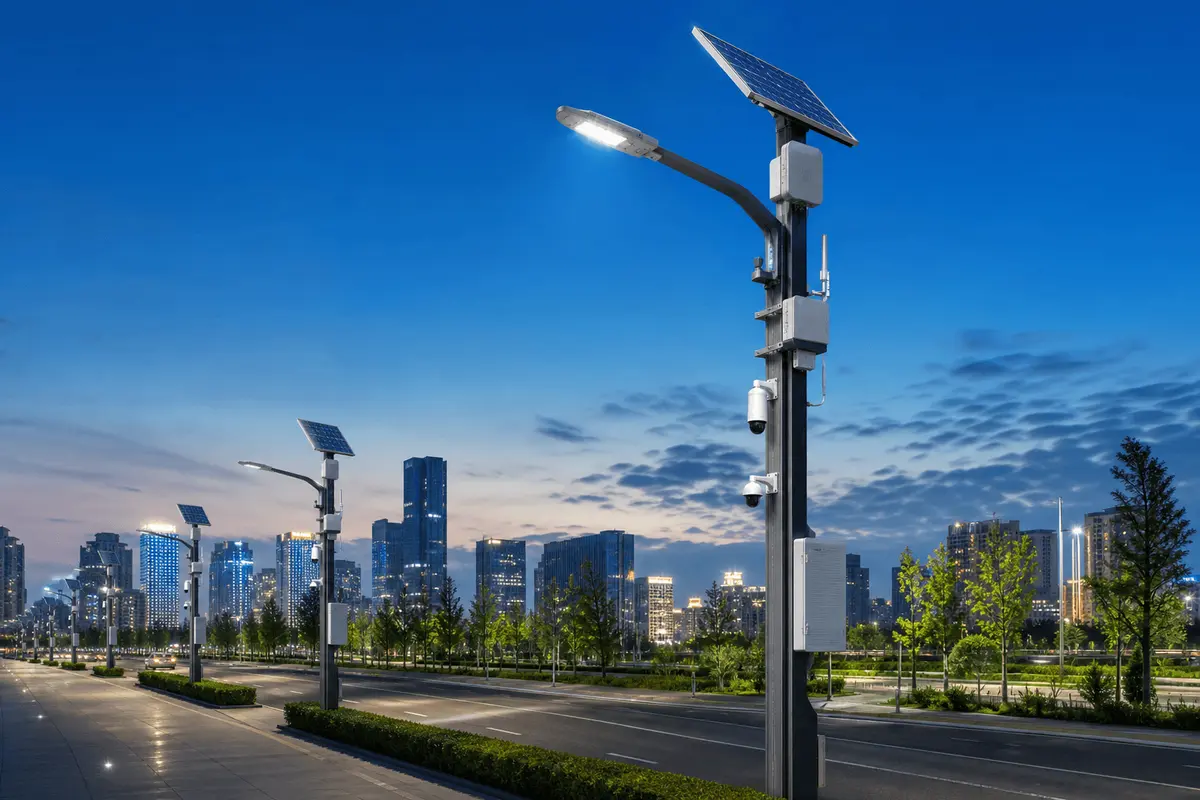
Watch the video
TL;DR
Choose smart streetlight connectivity by data load, not by trend. LoRaWAN is best for low-cost private telemetry below 50 kbps, NB-IoT is best for licensed carrier LPWAN control, and 4G is required for Mbps-class workloads such as 4MP video, WiFi 6, emergency audio, and 7kW or 11kW EV charging.
Smart streetlight connectivity choices usually narrow to LoRaWAN, NB-IoT, and 4G: LoRaWAN fits 1-5 kbps telemetry, NB-IoT supports licensed LPWAN control, and 4G handles 4MP video, WiFi 6 backhaul, and emergency audio.
Summary
Smart streetlight connectivity choices usually narrow to LoRaWAN, NB-IoT, and 4G: LoRaWAN fits 1-5 kbps telemetry, NB-IoT supports licensed LPWAN control, and 4G handles 4MP video, WiFi 6 backhaul, and emergency audio.
Key Takeaways
- Map 3 traffic classes per pole: lighting telemetry below 5 kbps, firmware or signage data at 50-250 kbps, and video backhaul above 2 Mbps.
- Select LoRaWAN for private networks covering 50-500 poles where small packets, low recurring fees, and local gateway control matter most.
- Use NB-IoT for 500-5,000 dispersed poles when licensed cellular coverage, SIM management, and carrier-grade security outweigh bandwidth limits.
- Reserve 4G for smart poles with 4MP cameras, WiFi 6 access points, emergency call units, or 7kW AC EV charging payment terminals.
- Design hybrid networks with LoRaWAN or NB-IoT for 90% of telemetry and 4G for the 10% of nodes carrying video or public services.
- Budget connectivity at USD 0.20-1.50 per LoRaWAN pole-month, USD 0.50-3.00 for NB-IoT SIMs, and USD 5-25 for 4G data plans.
- Require IEC 60598, IEC 62368-1, IEEE 802.15.4, and 3GPP-aligned documentation before approving smart streetlight communications hardware.
- Plan lifecycle support for at least 10 years, including remote firmware updates, SIM replacement policy, gateway redundancy, and cybersecurity logging.
Smart Streetlight Connectivity Decision Framework
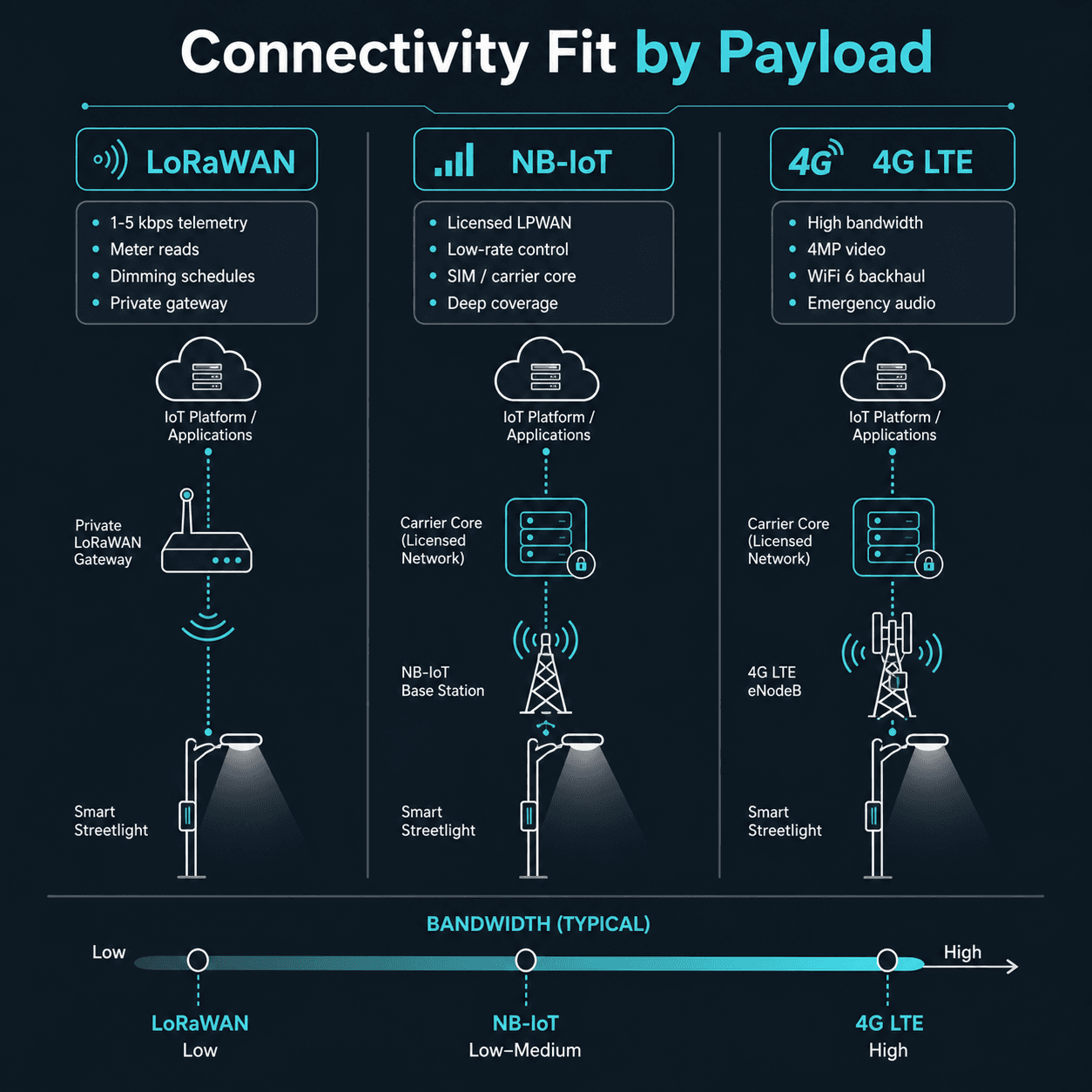
Smart streetlight networks should use LoRaWAN for low-data telemetry, NB-IoT for licensed wide-area control, and 4G for video or broadband loads above 2 Mbps.
Connectivity is no longer a minor accessory in smart streetlight procurement. It determines whether a pole can report dimming status, battery state of charge, environmental readings, camera events, EV charging transactions, and emergency audio without field visits. For B2B buyers, the practical decision is not which radio is theoretically best, but which network matches the pole's data profile, ownership model, and service-level risk.
A SOLARTODO smart streetlight project may include simple solar lighting poles, 10-in-1 multifunction poles, border checkpoint poles, tunnel entrance poles, and wind-solar hybrid boulevard systems. These do not all need the same communications architecture. A 7m Ø400 Cylindrical CIGS Smart Pole at a border checkpoint may need 4MP IR video and WiFi 6, while a distributed solar streetlight fleet may only need hourly battery and lamp status.
According to the LoRa Alliance specification history, LoRaWAN 1.0.4 was published in 2020 and defines Class A, Class B, and Class C device behavior for low-power wide-area networks. According to 3GPP Release 13, NB-IoT was introduced as a cellular LPWAN standard using narrow 180-200 kHz channels. According to 3GPP LTE user equipment categories, 4G LTE Cat 1 and higher categories support far greater throughput than LPWAN options, making them better suited to video and broadband backhaul.
The International Energy Agency states, "Digitalisation is transforming the energy sector." For smart streetlights, that transformation is visible at the pole level: LED drivers, solar charge controllers, LFP batteries, cameras, sensors, EV chargers, and command platforms must exchange reliable data. Connectivity architecture therefore becomes part of the engineering bill of materials, not just an IT subscription.
Technical Deep Dive: LoRaWAN vs NB-IoT vs 4G
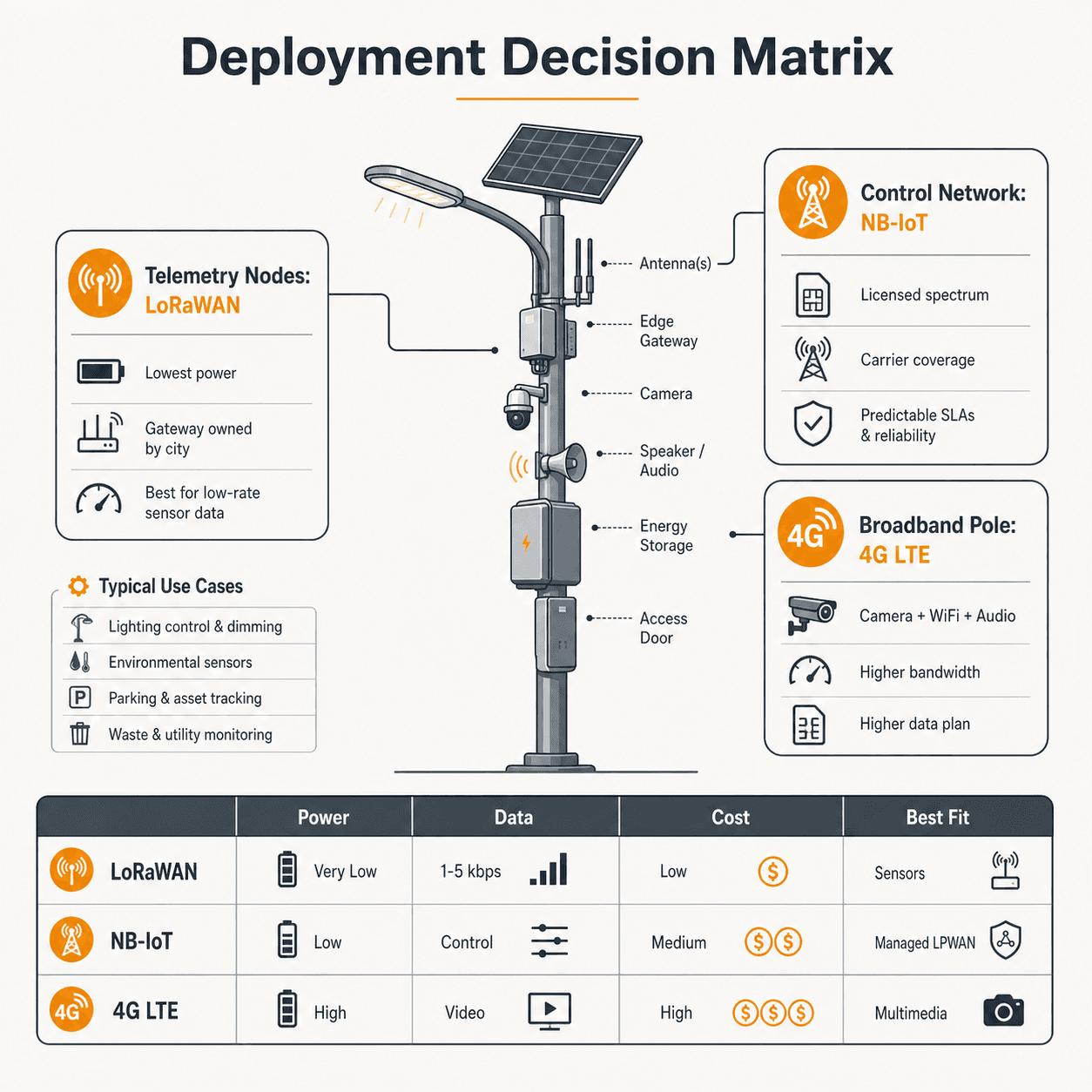
LoRaWAN typically serves small packets below 50 kbps, NB-IoT serves carrier LPWAN telemetry around 20-250 kbps, and 4G serves megabit applications.
LoRaWAN for private, low-power telemetry
LoRaWAN is strongest when the buyer wants a private network with low operating cost and small payloads. It uses unlicensed sub-GHz bands such as EU868, US915, AS923, and AU915, subject to regional duty-cycle or dwell-time rules. In streetlighting, common payloads include lamp on/off status, dimming level, battery voltage, solar charge current, door-open alarms, and fault codes.
A single gateway can often support hundreds of poles in open terrain, although real range depends on antenna height, urban obstruction, interference, and local regulation. LoRaWAN is not appropriate for continuous CCTV video, large firmware images, or low-latency voice. It is appropriate for periodic telemetry every 5-60 minutes and event-driven alarms that tolerate seconds of network delay.
IEEE 802.15.4 is not LoRaWAN, but its description as a standard for "Low-Rate Wireless Networks" is a useful engineering reminder: low-power IoT networks should be treated as control and sensing infrastructure, not broadband infrastructure. Procurement teams should specify payload size, reporting interval, acknowledgement policy, and gateway redundancy before choosing devices.
NB-IoT for carrier-managed LPWAN deployments
NB-IoT fits projects where poles are spread across wide regions and the owner prefers mobile operator coverage instead of deploying gateways. It runs in licensed spectrum, supports cellular authentication, and is managed through SIM or eSIM provisioning. For municipalities, utilities, industrial parks, and transport authorities, that can reduce private network maintenance.
NB-IoT is still a low-throughput technology. It is suitable for meter-like telemetry, lighting control, cabinet alarms, and basic sensor data, but it is not intended for high-resolution camera streaming. Latency can be higher than 4G LTE, especially in deep coverage modes, so emergency audio and real-time video analytics should use 4G or fiber.
According to 3GPP Release 13 documentation, NB-IoT was designed for massive machine-type communications, extended coverage, low device complexity, and long battery life. That makes it attractive for solar streetlights with autonomous LFP storage, where the communications module should not materially reduce battery autonomy during cloudy periods.
4G for video, WiFi, EV charging, and public services
4G LTE is the practical default for smart poles that carry broadband services. A 4MP IR camera, WiFi 6 hotspot, emergency call unit, environmental data hub, and 7kW AC charger can produce traffic that exceeds LPWAN capacity by orders of magnitude. In those cases, 4G provides the bandwidth and lower latency required for operational monitoring.
The tradeoff is cost and power consumption. 4G modules, antennas, SIM plans, and data management add recurring expenditure, and the modem consumes more energy than an LPWAN radio. For solar-powered poles, that may require larger LFP batteries or stricter wake/sleep rules. For SOLARTODO platforms with 3,000Wh to 15kWh storage, the electrical impact is manageable when designed during system sizing.
4G is also more exposed to cybersecurity and data governance requirements because it may carry video, personal data, payment data, or public WiFi traffic. Buyers should require VPN tunneling, device certificates, APN control, firewall rules, role-based access, and clear data retention policies.
Applications by Smart Streetlight Use Case
A 10-in-1 smart pole usually needs 2 network layers: LPWAN for controls and 4G for camera, WiFi, EV charging, or emergency services.
For basic solar streetlights, LoRaWAN or NB-IoT is normally enough. The pole reports LED driver status, battery state of charge, PV charging behavior, and tamper alarms. If a project includes 500 poles over a campus, logistics park, or municipality, LoRaWAN can minimize monthly fees when the owner can host gateways. If the same 500 poles are dispersed across highways or rural roads, NB-IoT may reduce deployment complexity.
For SOLARTODO's 10m Tunnel Entrance Smart Pole, connectivity must support lighting control, an AI camera, environmental sensor data, and LED display updates. The 200W LED module and 300 lux entrance-zone target make reliability more important than low subscription cost alone. A practical design is 4G for camera and display updates, with local controller logic maintaining lighting behavior if the network is unavailable.
For the 7m Ø400 Cylindrical CIGS Smart Pole used at border checkpoints, the communications requirement is heavier. The pole combines 100W LED lighting, about 256W CIGS solar generation, 3,000Wh LFP storage, 4MP IR video, WiFi 6, emergency response features, and lane-node operation every 28m. In that environment, 4G or private LTE is usually required for surveillance and incident workflows, while LPWAN can still handle energy telemetry.
For the 12m Wind-Solar Hybrid Smart Pole with VAWT, monocrystalline solar panels, 5-15kWh LFP storage, and 7kW or 11kW Type 2 AC EV charging, 4G is the preferred baseline. Payment authorization, charger diagnostics, load logs, firmware updates, and user support require more bandwidth and lower latency than LoRaWAN or NB-IoT can provide.
According to IRENA (2025), renewable power generation costs continued to fall across solar and wind technologies, strengthening the case for distributed clean infrastructure. According to the IEA (2023), electricity grids require more investment and digital control as distributed assets increase. Smart streetlights sit at that intersection: they are public infrastructure assets, energy devices, and communications nodes.
EPC Investment Analysis and Pricing Structure
EPC pricing should separate FOB supply, CIF delivery, and turnkey installation because connectivity can shift 10-year operating cost by 15-40%.
A SOLARTODO EPC delivery model covers Engineering, Procurement, and Construction support for smart streetlight projects. Engineering includes pole configuration, solar and battery sizing, lighting simulation inputs, network architecture, device list, drawings, and integration assumptions. Procurement includes pole fabrication, luminaires, batteries, solar modules or CIGS wraps, controllers, communications modules, cameras, gateways, and spare parts. Construction support can include installation guidance, commissioning files, remote platform setup, and project documentation for local contractors.
Three pricing tiers help procurement teams compare offers cleanly:
| Pricing tier | What it includes | Connectivity responsibility | Best fit |
|---|---|---|---|
| FOB Supply | Factory supply at port of origin | Buyer manages SIMs, gateways, and platform integration | Experienced importers and EPC contractors |
| CIF Delivered | Product delivered to destination port | Buyer manages local installation and subscriptions | Public tenders with local civil works teams |
| EPC Turnkey | Engineering, supply, delivery, installation support, commissioning package | Jointly specified network, platform, and acceptance testing | Multi-site smart city or infrastructure projects |
Volume pricing should be modeled early. As guidance, 50+ units can support a 5% discount, 100+ units can support a 10% discount, and 250+ units can support a 15% discount, depending on configuration and delivery scope. LoRaWAN gateway cost becomes more efficient as pole count rises, while NB-IoT and 4G costs scale more directly with SIM count.
ROI depends on the baseline. Against conventional streetlights with separate CCTV poles, signage cabinets, EV charging pedestals, and network devices, integrated smart poles can reduce civil works, trenching, cabinet count, and maintenance visits. For projects with 100 poles, avoiding even 2 maintenance visits per pole per year can materially improve payback, especially in remote industrial, border, port, and highway environments.
Payment terms are typically 30% T/T deposit plus 70% against bill of lading, or 100% L/C at sight for approved projects. Financing is available for large projects above USD 1,000K, subject to project review, buyer profile, country risk, and bank documentation. For formal quotations, contact SOLARTODO at [email protected] or +6585559114.
Comparison and Selection Guide
Most smart streetlight projects should standardize on 1 primary radio and add 4G only where video, WiFi, or EV charging requires it.
| Criterion | LoRaWAN | NB-IoT | 4G LTE |
|---|---|---|---|
| Typical role | Private LPWAN telemetry | Carrier LPWAN telemetry | Broadband services |
| Typical data profile | Small packets, 1-60 minute intervals | Small packets, periodic or event-based | Continuous or burst traffic |
| Indicative throughput | About 0.3-50 kbps by region and settings | About 20-250 kbps for NB1 use cases | Mbps-class, category-dependent |
| Spectrum | Unlicensed regional sub-GHz | Licensed cellular | Licensed cellular |
| Infrastructure | Buyer or operator gateways | Mobile operator network | Mobile operator network |
| Best pole functions | Dimming, alarms, battery data | Dimming, alarms, dispersed telemetry | 4MP video, WiFi 6, EV charging, voice |
| Main cost driver | Gateway deployment and maintenance | SIM plan and operator coverage | SIM data plan and power budget |
| Main limitation | Duty cycle, payload size, no video | Bandwidth and latency limits | Higher power and recurring cost |
The selection process should begin with a device matrix, not a radio preference. List every pole function, its data volume, reporting interval, latency requirement, and failure behavior. A dimming command can tolerate seconds of latency if the local controller has schedules. A checkpoint camera alarm may require immediate transmission. An EV charger needs reliable session records and payment connectivity.
For SOLARTODO smart streetlight procurement, the most robust approach is often a hybrid architecture. Use LoRaWAN or NB-IoT for lighting, battery, and sensor telemetry across the fleet. Use 4G only on nodes with cameras, WiFi, EV charging, emergency phones, or LED displays. This avoids paying broadband subscription fees on every pole while preserving performance for high-value nodes.
Cybersecurity should be evaluated at the same time. Require unique credentials per pole, encrypted transport, remote firmware update controls, event logs, and access separation between lighting operations, video users, and payment systems. IEC 62443 principles are relevant when smart poles connect operational technology, public networks, and cloud platforms.
FAQ
Smart streetlight connectivity FAQs should cover 10 procurement issues: bandwidth, cost, coverage, security, installation, maintenance, EPC scope, and lifecycle risk.
Q: What is the best connectivity option for smart streetlights? A: The best option depends on pole functions and data volume. LoRaWAN is usually best for private low-data telemetry, NB-IoT is best for carrier-managed dispersed lighting control, and 4G is best for video, WiFi, EV charging, and emergency audio. Many B2B projects use LPWAN for 90% of poles and 4G for high-bandwidth nodes.
Q: When should a project choose LoRaWAN for smart streetlights? A: Choose LoRaWAN when the project has clustered poles, small payloads, and a buyer willing to deploy gateways. It works well for dimming status, battery voltage, solar charging data, and fault alarms at 5-60 minute intervals. It is not suitable for continuous camera feeds, large files, or voice services.
Q: When is NB-IoT better than LoRaWAN? A: NB-IoT is better when poles are geographically dispersed and public cellular coverage is already reliable. It avoids private gateway deployment and uses licensed spectrum with mobile operator authentication. The tradeoff is recurring SIM cost, operator dependency, and limited bandwidth compared with 4G LTE.
Q: Why do smart poles with cameras usually need 4G? A: Smart poles with 4MP cameras usually need 4G because video traffic is measured in Mbps, not small LPWAN packets. 4G also supports faster event upload, remote diagnostics, WiFi backhaul, emergency calling, and charger data. LoRaWAN and NB-IoT can still support secondary lighting telemetry on the same pole.
Q: How much does connectivity cost per smart streetlight? A: Indicative connectivity cost ranges from USD 0.20-1.50 per pole-month for LoRaWAN after gateway investment, USD 0.50-3.00 for NB-IoT SIMs, and USD 5-25 for 4G data plans. Actual pricing depends on country, data allowance, operator contracts, gateway density, cybersecurity requirements, and platform scope.
Q: What does EPC turnkey delivery include for connectivity? A: EPC turnkey delivery can include network design, communications module selection, gateway placement, SIM strategy, platform setup, commissioning documents, and acceptance testing. SOLARTODO can quote FOB Supply, CIF Delivered, or EPC Turnkey structures. Payment terms are typically 30% T/T plus 70% against B/L, or 100% L/C at sight.
Q: How should engineers size bandwidth for a smart streetlight network? A: Engineers should list each device, payload size, reporting interval, and latency target before choosing a radio. Lighting control and battery telemetry may need less than 5 kbps per pole, while video and WiFi require Mbps-class links. Firmware updates, signage media, and charger logs should be included in the bandwidth model.
Q: What standards matter for smart streetlight connectivity procurement? A: Relevant standards include LoRaWAN 1.0.4 or 1.1 for LPWAN behavior, 3GPP Release 13 and later for NB-IoT, LTE specifications for 4G modules, IEC 60598 for luminaires, IEC 62368-1 for ICT equipment safety, and IEC 62443 principles for industrial cybersecurity. Buyers should request certificates and test reports.
Q: Can one smart pole use LoRaWAN and 4G together? A: Yes, a smart pole can use LoRaWAN and 4G together when functions have different data needs. LoRaWAN can report lighting, battery, and tamper events, while 4G carries camera, WiFi, EV charging, or emergency audio traffic. This hybrid design reduces recurring broadband cost across the wider fleet.
Q: What maintenance is required for smart streetlight communications? A: Communications maintenance includes SIM audits, antenna inspection, gateway uptime checks, firmware updates, password rotation, log review, and platform health monitoring. For LoRaWAN, gateway placement and backhaul reliability are critical. For NB-IoT and 4G, operator coverage, data plans, and module lifecycle support should be reviewed annually.
Q: How does connectivity affect solar streetlight battery autonomy? A: Connectivity affects autonomy because radios consume power, especially 4G modules during transmission. LoRaWAN and NB-IoT are usually low enough for small telemetry loads, while 4G cameras and WiFi require larger batteries or duty cycling. SOLARTODO sizes LFP storage, solar generation, and communication loads together during engineering.
Q: What warranty and lifecycle questions should buyers ask? A: Buyers should ask for module warranty, antenna warranty, gateway support life, SIM replacement policy, firmware update period, and spare-part availability for 10 years. They should also define who owns the platform data and who responds to network faults. These terms affect lifecycle cost as much as pole hardware.
References
Authoritative smart streetlight connectivity specifications span at least 8 sources, including LoRa Alliance, 3GPP, IEC, IEEE, IEA, and IRENA.
- LoRa Alliance (2020): LoRaWAN Specification 1.0.4, defining MAC behavior, device classes, activation, and network architecture for low-power wide-area IoT systems.
- 3GPP (2016): Release 13 NB-IoT specifications, introducing cellular LPWAN capabilities for massive machine-type communications using narrowband LTE technology.
- 3GPP (2017): Release 14 LTE enhancements, including NB-IoT evolution and higher-performance cellular IoT categories for broader industrial use cases.
- IEEE 802.15.4 (2020): Standard for Low-Rate Wireless Networks, relevant to low-power IoT design principles and constrained-device communications planning.
- IEC 60598-1 (2020): Luminaires general requirements and tests, used for safety evaluation of LED streetlight equipment integrated into smart pole systems.
- IEC 62368-1 (2023): Audio/video, information and communication technology equipment safety requirements for connected devices inside smart infrastructure.
- IEC 62443 (2018-2024): Industrial automation and control system cybersecurity standards, relevant to smart pole platforms connected to operational networks.
- IEA (2023): Electricity Grids and Secure Energy Transitions, describing the need for grid investment, digitalisation, and flexible infrastructure as distributed energy expands.
Conclusion
Smart streetlight connectivity should be selected by data load: LoRaWAN below 50 kbps, NB-IoT for licensed telemetry, and 4G for Mbps-class services.
The bottom line: SOLARTODO smart streetlight projects should use LPWAN for routine lighting and energy telemetry, then add 4G only for camera, WiFi, EV charging, emergency audio, or LED display workloads. For fleets above 100 poles, this hybrid strategy can reduce recurring connectivity cost while preserving operational performance for high-value smart infrastructure nodes.
About SOLARTODO
SOLARTODO is a global integrated solution provider specializing in solar power generation systems, energy-storage products, smart street-lighting and solar street-lighting, intelligent security & IoT linkage systems, power transmission towers, telecom communication towers, and smart-agriculture solutions for worldwide B2B customers.
About the Author

Cinn Song
Founder & Chief Solutions Architect
Cinn Song founded SOLARTODO LIMITED and leads its smart-city infrastructure engineering — from solar, storage and integrated smart poles to the company's push into physical-AI city edge nodes: pole-mounted edge computing, vertical LLMs for smart cities, drone-based O&M with autonomous battery swapping, robotic maintenance, and high-speed counter-UAS interception. Since 2010, he has directed turnkey EPC + BOT delivery across 50+ countries, including telecom monopole supply for national grid operators, off-grid solar street-lighting for African municipalities, and integrated smart-pole programs for Gulf smart cities.
Cite This Article
Cinn Song. (2026). Smart Streetlight Connectivity: LoRaWAN vs NB-IoT vs 4G. SOLARTODO. Retrieved from https://solartodo.com/knowledge/smart-streetlight-connectivity-lorawan-vs-nb-iot-vs-4g
@article{solartodo_smart_streetlight_connectivity_lorawan_vs_nb_iot_vs_4g,
  title = {Smart Streetlight Connectivity: LoRaWAN vs NB-IoT vs 4G},
  author = {Cinn Song},
  journal = {SOLARTODO Knowledge Base},
  year = {2026},
  url = {https://solartodo.com/knowledge/smart-streetlight-connectivity-lorawan-vs-nb-iot-vs-4g},
  note = {Accessed: 2026-10-19}
}
Published: July 8, 2026 | Available at: https://solartodo.com/knowledge/smart-streetlight-connectivity-lorawan-vs-nb-iot-vs-4g
Subscribe to Our Newsletter
Get the latest solar energy news and insights delivered to your inbox.
View All Articles