Smart Streetlight 5G Small Cell Integration: Deployment…

Cinn Song
Founder & Chief Solutions Architect
Watch the video
TL;DR
Smart streetlight 5G small cell integration is a practical way to combine lighting, telecom, fiber, power, cameras, WiFi, and sensors in one 6-10 m pole. For B2B projects, specify 35 m/s wind design, separate AC/DC/fiber/grounding paths, IEC and IEEE compliance, and EPC pricing. SOLARTODO projects can reduce duplicate foundations by 50% and scale from 50-pole pilots to 250+ pole rollouts.
Smart streetlight 5G small cell integration combines 6-10 m steel poles, 120 W LED lighting, fiber backhaul, and 35 m/s wind design to reduce duplicate foundations, accelerate densification, and support 50-200 m urban coverage zones.
Summary
Smart streetlight 5G small cell integration combines 6-10 m steel poles, 120 W LED lighting, fiber backhaul, and 35 m/s wind design to reduce duplicate foundations, accelerate densification, and support 50-200 m urban coverage zones.
Key Takeaways
This deployment guide gives procurement and engineering teams 8 numbered actions for 6-10 m smart streetlight 5G small cell projects.
- Validate 35 m/s or higher wind loading before procurement, including antenna area, luminaire offset, cable weight, and local exposure category.
- Reserve the upper 1.5 m of a 6 m pole for RF equipment to protect 50-200 m micro-cell coverage and antenna clearance.
- Specify separate internal cable paths for AC power, DC radio power, fiber, and grounding to reduce 4 common interference and maintenance risks.
- Use hot-dip galvanized Q235 or Q355 steel with ISO 1461 or ASTM A123 coating control for 25-30 year corrosion resistance.
- Compare FOB, CIF, and EPC turnkey pricing because a 6 m combo pole can range from about $65 FOB to $350-$600 installed.
- Model ROI from 50% fewer foundations, 30% less trench coordination, 60-70% LED energy savings, and potential telecom lease revenue.
- Require IEC 60598, IEC 62305, IEEE Std 81, and TIA-222-H or EN 1993-3-1 documentation before batch production.
- Plan phased rollout in 50, 100, or 250+ pole lots to unlock 5%, 10%, and 15% volume pricing during municipal or campus deployment.
Smart Streetlight 5G Small Cell Deployment Context
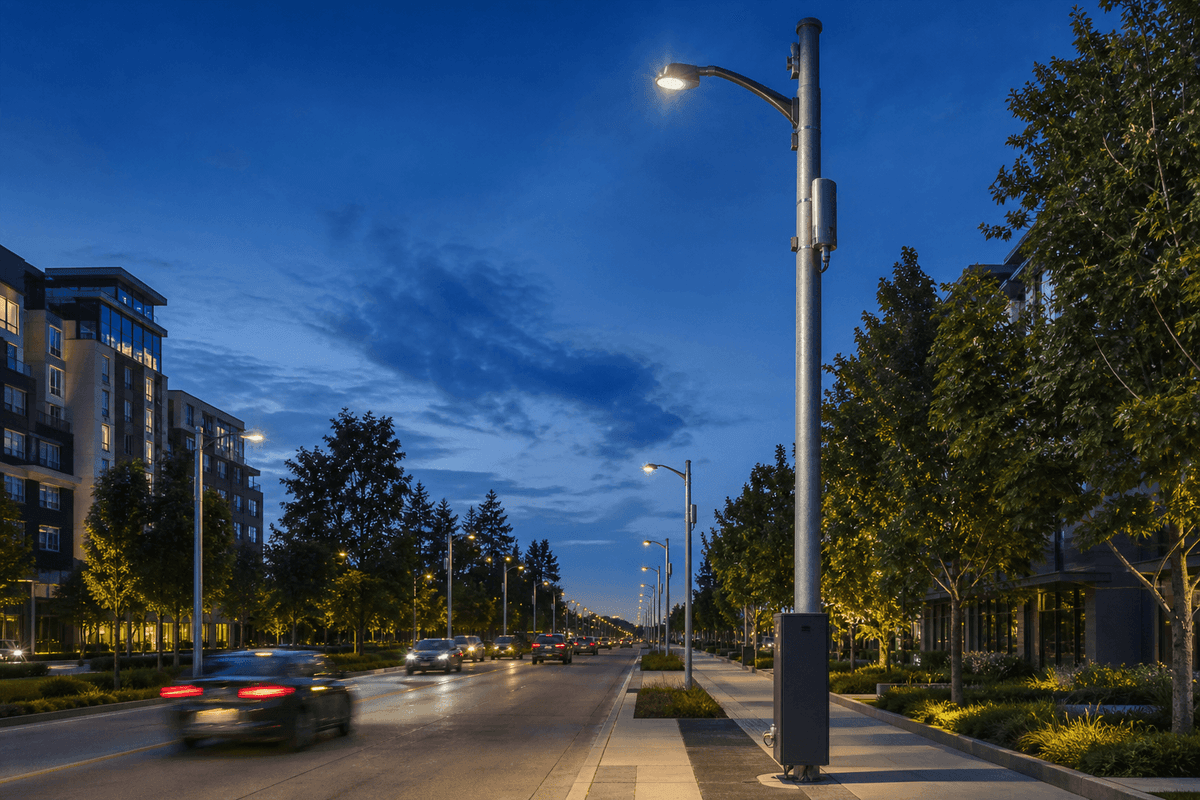
Smart streetlight 5G integration works best when 6-10 m poles combine lighting, RF, power, fiber, and sensors in one engineered asset.
For B2B buyers, the core decision is not whether a pole can hold a radio; it is whether the total site can meet structural, electrical, telecom, permitting, and maintenance requirements for 25-30 years. A 5G small cell often serves a short 50-200 m radius, so dense urban networks need many repeatable sites rather than a few tall towers. Streetlight infrastructure is attractive because it already follows road geometry, power access, and municipal right-of-way logic.
SOLARTODO positions smart streetlight 5G small cell integration as a practical infrastructure consolidation strategy for cities, industrial parks, ports, campuses, highways, and energy sites. A 6 m micro-cell streetlight combo pole can support 1 antenna, 1 LED luminaire, a 35 m/s design wind speed, and a nominal 120 kg pole weight. A 10 m integrated smart pole can support more advanced packages such as 120 W LED lighting, 4K AI cameras, WiFi 6, environmental sensors, and fiber-connected 5G equipment.
According to IEA (2024), electricity demand from connected infrastructure must be managed with efficient digital systems, not added as unmanaged load. The International Energy Agency states, "Efficiency is the first fuel," which is especially relevant when lighting, telecom, cameras, and sensors share one power point. According to GSMA (2025), 5G network expansion depends on dense site deployment, making existing street furniture a strategic asset for mobile operators and municipalities.
The business case is strongest where separate lighting poles, CCTV poles, WiFi poles, and telecom monopoles would otherwise create duplicated foundations and street clutter. A shared pole can reduce street-level asset count by 50% and civil-work locations from 2 foundations to 1. For procurement teams, that reduction often matters as much as hardware price because permitting, trenching, lane closure, and inspection costs drive real project budgets.
Technical Architecture and Engineering Requirements
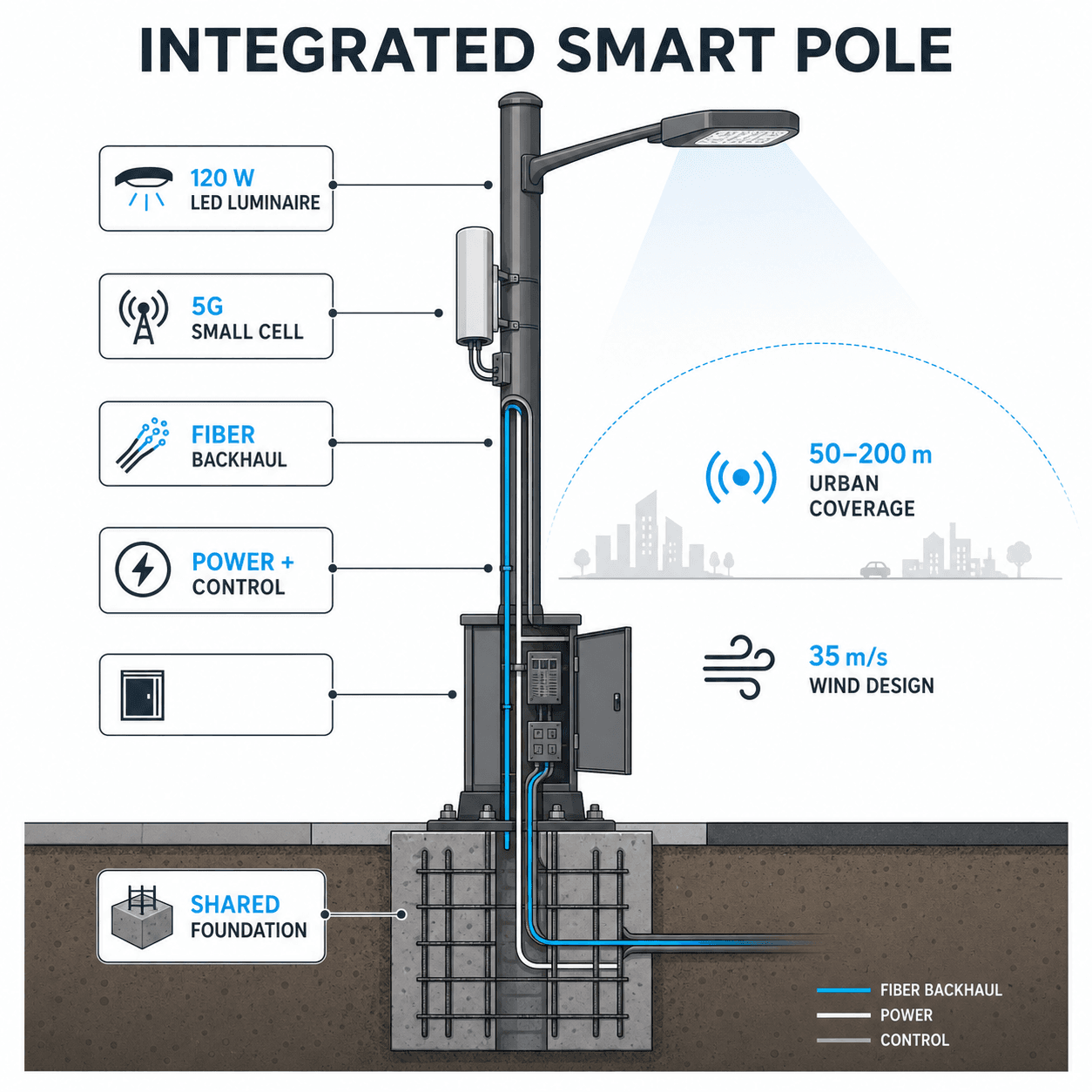
A reliable 5G smart streetlight pole uses 5 engineered layers: steel structure, RF zone, lighting arm, electrical network, and foundation interface.
The structural layer starts with the pole body. SOLARTODO typically specifies octagonal steel shafts using Q235 or Q355 steel, with hot-dip galvanizing or marine-grade coating for corrosion protection. For inland urban deployments, 35 m/s wind speed equals 126 km/h and can be adequate after site-specific verification. For coastal, typhoon, desert, or high-altitude areas, the design should be recalculated using local wind maps, gust factors, antenna projected area, and foundation soil data.
The RF layer requires the cleanest possible mounting zone. On a 6 m pole, reserve the upper 1.5 m for the antenna, small-cell radio, GPS puck, concealment shroud, and future alignment access. On a 10 m pole, additional height can improve line-of-sight and equipment separation, but it increases overturning moment and may trigger stricter permitting. The antenna bracket should document vertical load, lateral load, wind area, azimuth adjustment, and cable bend radius.
The lighting layer should not be treated as an accessory. A 120 W LED luminaire at 170 lm/W can deliver about 20,400 lumens while using far less power than legacy high-pressure sodium lighting. According to IEA (2024), LED lighting is one of the most mature efficiency measures for electricity demand reduction. For roadway, pathway, perimeter, or campus lighting, luminaire safety and photometric files should align with IEC 60598 and local lighting classifications.
The electrical layer is where many smart pole projects fail in operation. A single shaft may contain AC lighting power, DC radio power, fiber, Ethernet, grounding conductors, surge protection, controller wiring, and camera cables. SOLARTODO recommends separate labeling and cable routing for at least 4 cable types: AC, DC, fiber, and grounding. IEEE Std 81 grounding measurement practices help verify earth resistance, while IEC 62305 supports lightning protection design.
The foundation layer must be finalized after equipment selection, not before. A small 2 kg sensor rarely drives foundation size, but a 12 kg radio with offset mounting can materially increase overturning moment. Engineering drawings should include base plate dimensions, anchor bolt grade, embedment depth, concrete class, cable entry, grounding point, and inspection access. For batch orders above 100 poles, pre-approval of the anchor-bolt template prevents expensive civil rework.
Integration Checklist for Procurement Teams
Procurement teams should issue 12 technical inputs before quotation to avoid price gaps, redesign, and field variation.
- Confirm pole height: 6 m for micro-cell streets, 9-10 m for broader corridors, or project-specific height.
- Confirm antenna count: 1 antenna for basic micro-cell use, or more only after structural recalculation.
- Confirm design wind speed: 35 m/s minimum for many inland sites, higher for coastal and cyclone zones.
- Confirm lighting load: 60 W, 90 W, 120 W, or other luminaire wattage with photometric file.
- Confirm telecom backhaul: fiber, microwave, or hybrid architecture.
- Confirm power source: grid, solar hybrid, battery backup, or dedicated utility feed.
- Confirm corrosion class: standard galvanized, marine-grade coating, or custom paint system.
- Confirm sensors: CCTV, WiFi 6, PM2.5, PM10, humidity, noise, emergency call, or gateway cabinet.
EPC Investment Analysis and Pricing Structure
EPC turnkey delivery prices the complete pole site, while FOB and CIF pricing cover narrower supply and delivery scopes.
EPC means Engineering, Procurement, and Construction. For smart streetlight 5G integration, EPC turnkey delivery normally includes structural design, shop drawings, pole fabrication, galvanizing, luminaire procurement, cable routing, controller integration, foundation works, installation, testing, and commissioning. Telecom operator equipment, SIM/core services, spectrum, and network optimization are usually separate unless the contract explicitly includes them.
SOLARTODO uses three commercial layers so buyers can compare like-for-like pricing. FOB supply is the factory-gate pole or hardware package price before international freight, import duty, local civil works, and installation. CIF delivered includes sea freight and insurance to the destination port, but excludes customs clearance, inland transport, and construction. EPC turnkey includes the installed and commissioned site, making it the correct basis for municipal budgeting and project finance.
| Pricing Layer | Typical Scope | 6 m Reference Range | Best For |
|---|---|---|---|
| FOB Supply | Pole body, bracket, basic hardware | From about $65 per pole | Distributors and EPCs with local installation teams |
| CIF Delivered | FOB scope plus sea freight and insurance | Project-specific by port and volume | Importers comparing landed cost |
| EPC Turnkey | Engineering, foundation, installation, testing | About $350-$600 per installed 6 m pole | Municipal, campus, industrial, and utility buyers |
| 10 m Integrated Smart Pole | 5G, LED, camera, WiFi, sensors, fiber-ready design | About $35,000-$48,000 depending on modules | Advanced smart-city corridors and telecom lease models |
Volume pricing should be negotiated early because manufacturing efficiency improves with repeatable drawings and batch galvanizing. As guidance, SOLARTODO can structure 5% discounting for 50+ units, 10% for 100+ units, and 15% for 250+ units, subject to steel price, configuration, and delivery schedule. Payment terms are typically 30% T/T deposit plus 70% against bill of lading, or 100% irrevocable L/C at sight for qualified projects.
ROI depends on avoided civil works, energy savings, and potential telecom revenue. A combo pole can reduce foundation count by 50% versus separate lighting and telecom assets. A smart LED retrofit can reduce lighting energy use by 60-70% compared with older HPS lamps, depending on dimming schedules and tariff structure. In some markets, leasing the 5G attachment point to a telecom operator can shorten payback to 5-7 years for advanced smart poles.
For large projects above $1,000K, SOLARTODO can discuss project financing, staged delivery, and procurement packaging. Buyers should request a project-specific quote rather than treating published ranges as final pricing. Send technical drawings, site wind speed, antenna data sheets, luminaire requirements, destination port, and installation scope to [email protected] for a formal quotation.
Deployment Best Practices and Use Cases
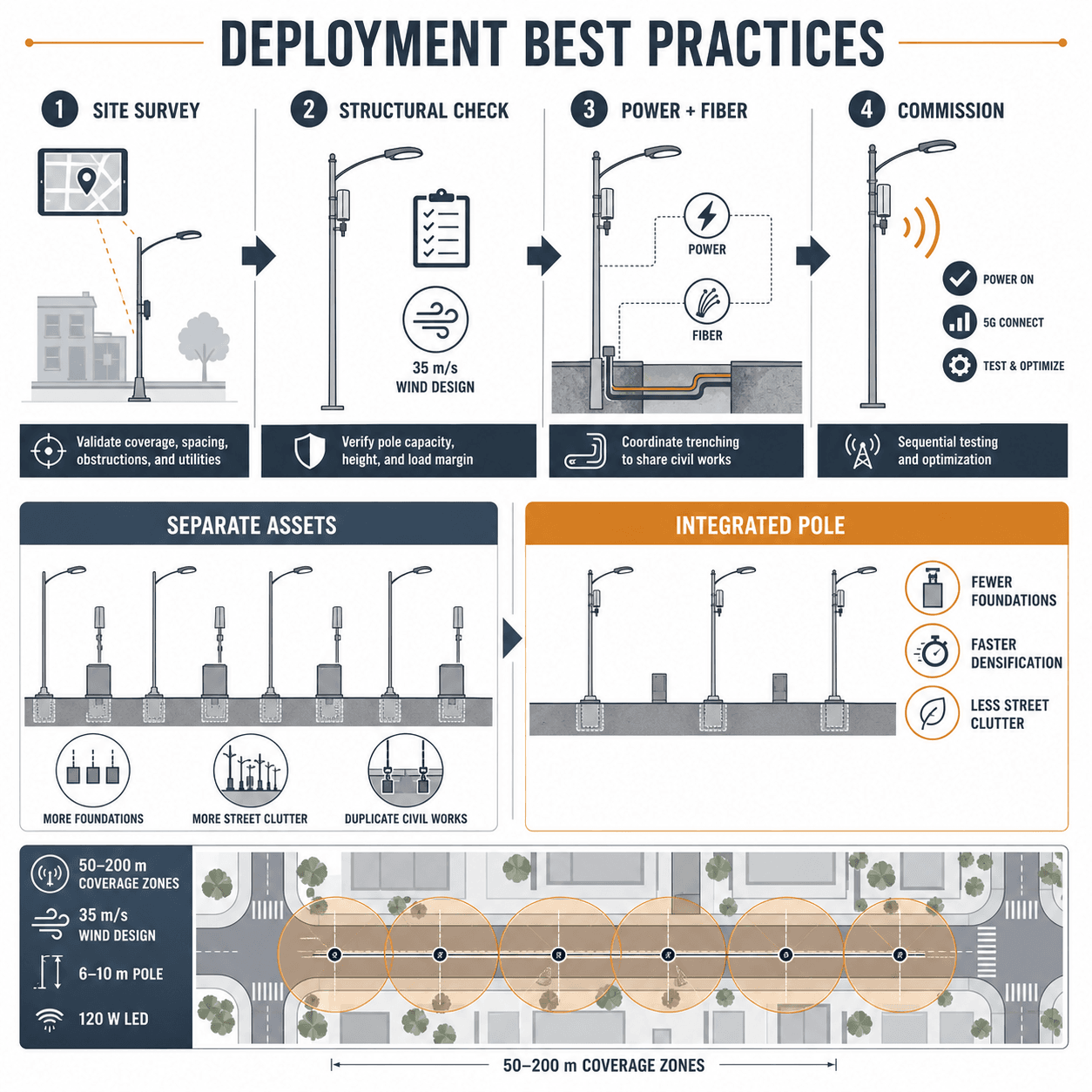
The best deployments start with radio planning, then lock structural design, civil works, power, fiber, and maintenance access.
A practical deployment sequence begins with RF planning. Engineers should map the 50-200 m small-cell coverage target, identify shadowing from buildings or trees, and confirm whether each pole needs sub-6 GHz, mmWave, WiFi 6, CCTV, or environmental monitoring. The radio plan should define azimuth, tilt, height, power, backhaul, and handover requirements before the pole drawing is frozen.
Civil engineering comes next. Each location should be checked for underground utilities, drainage, sidewalk clearance, road safety setbacks, ADA or local accessibility rules, and service vehicle access. Foundation drawings should be standardized where possible, but not blindly copied across weak soil, coastal fill, bridge decks, or high-wind corridors. According to NREL (2024), distributed infrastructure resilience improves when performance data and site conditions are incorporated into planning.
Electrical integration should include surge protection, grounding, metering, isolation, and safe maintenance switching. IEC states, "Protection against lightning shall be based on a risk assessment," a concise principle that fits smart poles carrying multiple electronic systems. A pole supporting 5G radio, camera, WiFi, and lighting should not depend on undocumented field wiring, because one failed surge event can take down several public services simultaneously.
Use cases vary by buyer type. Municipal buyers often prioritize lighting efficiency, traffic monitoring, public WiFi, and low visual impact. Telecom operators prioritize site density, fiber availability, power reliability, and fast permitting. Industrial parks prioritize perimeter security, private 5G, low-voltage integration, and predictable maintenance. Solar farms and utility sites prioritize lighting, surveillance, private communications, and remote monitoring along service roads.
A typical MENA-region infrastructure project may deploy 24 combo poles along a 1.8 km service road. By combining one light point and one radio point per pole, the project can reduce foundations from 48 to 24 and shorten trench coordination by about 30%. For a larger smart-city corridor, 100+ poles allow repeatable manufacturing, standardized anchor cages, and stronger procurement leverage.
Comparison and Selection Guide
Choose 6 m poles for dense micro-cells, 10 m poles for integrated smart-city nodes, and separate towers only when coverage or load requires height.
| Option | Typical Height | Main Function | Advantages | Limitations |
|---|---|---|---|---|
| 6 m Micro Cell Streetlight Combo Pole | 6 m | 1 antenna plus 1 LED light | Low visual impact, 35 m/s design, compact foundation | Shorter coverage radius and limited equipment load |
| 10 m 5G Integrated Smart Streetlight Pole | 10 m | 5G, LED, CCTV, WiFi, sensors | Multi-service platform with 120 W LED and fiber backhaul | Higher cost and stricter structural review |
| Conventional Streetlight plus Separate Telecom Pole | 6-15 m | Split lighting and telecom assets | Clear ownership separation | 2 foundations, more permits, more street clutter |
| Dedicated Telecom Monopole | 15 m+ | Broader telecom coverage | Higher elevation and load capacity | Higher permitting burden and weaker streetscape fit |
For procurement, the best option is usually the lowest total lifecycle cost, not the lowest pole price. A separate telecom pole can be technically clean but may create more civil work, more land-use approvals, and more maintenance visits. A 6 m combo pole is cost-effective for dense micro-cell networks, while a 10 m integrated smart pole is better when the buyer needs CCTV, WiFi 6, environmental sensors, and smart-city data in one asset.
SOLARTODO recommends a pilot-first deployment model. Start with 5-10 representative sites, validate RF coverage, grounding, lighting uniformity, thermal performance, maintenance access, and public acceptance, then scale to 50+ units. This reduces redesign risk before batch production and gives procurement teams real evidence for warranty, spare parts, and training requirements.
FAQ
Smart streetlight 5G integration projects usually require 8 procurement decisions covering height, wind, power, fiber, coating, installation, warranty, and ROI.
Q: What is smart streetlight 5G small cell integration? A: Smart streetlight 5G small cell integration combines a lighting pole, LED luminaire, telecom antenna, radio equipment, power, fiber, and optional sensors in one engineered asset. A typical 6 m configuration supports 1 antenna and 1 LED light, while a 10 m smart pole can add CCTV, WiFi 6, and environmental monitoring.
Q: How high should a 5G smart streetlight pole be? A: Most micro-cell streetlight projects use 6 m poles for dense 50-200 m coverage zones, especially sidewalks, campuses, and industrial roads. A 10 m pole is better when the project needs wider clearance, stronger multi-service integration, or additional modules such as 4K cameras, WiFi 6 access points, and sensors.
Q: What wind speed should procurement specify? A: A 35 m/s design wind speed equals 126 km/h and is common for many inland urban deployments after structural verification. Coastal, typhoon, desert, and high-altitude sites may need higher design values, plus checks for antenna projected area, luminaire offset, gust response, anchor bolts, and foundation reaction.
Q: How much does a 6 m smart streetlight 5G pole cost? A: A basic 6 m pole may start around $65 FOB for the pole body, while EPC turnkey installation often ranges from $350-$600 per installed pole. Final pricing depends on steel weight, coating, antenna bracket, lighting, fiber, foundation, local labor, import duties, and whether commissioning is included.
Q: What does EPC turnkey delivery include for smart poles? A: EPC turnkey delivery usually includes engineering, procurement, construction, foundation works, pole installation, cable routing, luminaire installation, grounding, testing, and commissioning. It may not include telecom operator radios, spectrum services, SIM/core network integration, or long-term O&M unless those items are written into the contract.
Q: Which standards should a 5G smart pole follow? A: Structural design should reference TIA-222-H, EN 1993-3-1, or the governing national code. Lighting should align with IEC 60598, galvanizing with ISO 1461 or ASTM A123, lightning protection with IEC 62305, and grounding verification with IEEE Std 81 where those standards apply.
Q: How does a combo pole reduce project cost? A: A combo pole can reduce asset count by 50% by replacing separate lighting and telecom poles with one shared structure. It can also reduce foundation locations from 2 to 1, shorten trench coordination by about 30% in suitable layouts, and lower long-term maintenance visits.
Q: What maintenance is required after installation? A: Maintenance should include annual inspection of bolts, coating damage, grounding resistance, cable glands, surge protection, luminaire output, and radio mounting alignment. For harsh coastal or industrial environments, inspection intervals may shorten to 6 months, especially where salt, dust, vibration, or high humidity accelerates corrosion.
Q: Can a smart streetlight pole support cameras and WiFi? A: Yes, a properly engineered pole can support CCTV cameras, WiFi 6 access points, environmental sensors, gateways, and emergency call buttons. Each added device must be checked for weight, wind area, power draw, cable separation, electromagnetic clearance, and maintenance height before production approval.
Q: What payment terms and financing are available? A: Standard payment terms are typically 30% T/T deposit plus 70% against bill of lading, or 100% L/C at sight for qualified buyers. For large projects above $1,000K, SOLARTODO can discuss financing, staged delivery, and project packaging based on destination, buyer profile, and contract scope.
References
Smart streetlight 5G projects should cite at least 7 authority sources covering structural design, lighting safety, galvanizing, grounding, lightning, energy, and resilience.
- TIA-222-H (2017): Structural standard for antenna-supporting structures, including wind, ice, appurtenance, and loading considerations.
- IEC 60598-1 (2024): Luminaire safety standard covering general requirements and tests for lighting equipment.
- IEC 62305 (2010): Lightning protection standard used for risk assessment and protection design of structures and electronic systems.
- IEEE Std 81 (2012): Guide for measuring earth resistivity, ground impedance, and earth surface potentials of grounding systems.
- ISO 1461 (2022): Hot-dip galvanized coating standard for fabricated iron and steel articles.
- ASTM A123/A123M (2024): Standard specification for zinc hot-dip galvanized coatings on iron and steel products.
- IEA (2024): Energy efficiency and digital infrastructure analysis supporting lower electricity demand through efficient connected systems.
- NREL (2024): Distributed energy and resilience research emphasizing performance data, site conditions, and infrastructure reliability.
Conclusion
Smart streetlight 5G integration is strongest when 6-10 m poles are engineered as telecom, lighting, power, and civil assets from day one.
The bottom line: SOLARTODO smart streetlight 5G small cell integration can reduce duplicate foundations by 50%, support 35 m/s wind-rated micro-cell deployments, and scale from 50-pole pilots to 250+ pole municipal or industrial programs. For B2B buyers, the right procurement path is a site-specific EPC quotation with verified wind, RF, power, fiber, coating, and maintenance requirements before mass production.
About SOLARTODO
SOLARTODO is a global integrated solution provider specializing in solar power generation systems, energy-storage products, smart street-lighting and solar street-lighting, intelligent security & IoT linkage systems, power transmission towers, telecom communication towers, and smart-agriculture solutions for worldwide B2B customers.
About the Author

Cinn Song
Founder & Chief Solutions Architect
Cinn Song founded SOLARTODO LIMITED and leads its smart-city infrastructure engineering — from solar, storage and integrated smart poles to the company's push into physical-AI city edge nodes: pole-mounted edge computing, vertical LLMs for smart cities, drone-based O&M with autonomous battery swapping, robotic maintenance, and high-speed counter-UAS interception. Since 2010, he has directed turnkey EPC + BOT delivery across 50+ countries, including telecom monopole supply for national grid operators, off-grid solar street-lighting for African municipalities, and integrated smart-pole programs for Gulf smart cities.
Cite This Article
Cinn Song. (2026). Smart Streetlight 5G Small Cell Integration: Deployment…. SOLARTODO. Retrieved from https://solartodo.com/knowledge/smart-streetlight-5g-small-cell-integration-deployment-best-practices
@article{solartodo_smart_streetlight_5g_small_cell_integration_deployment_best_practices,
  title = {Smart Streetlight 5G Small Cell Integration: Deployment…},
  author = {Cinn Song},
  journal = {SOLARTODO Knowledge Base},
  year = {2026},
  url = {https://solartodo.com/knowledge/smart-streetlight-5g-small-cell-integration-deployment-best-practices},
  note = {Accessed: 2026-10-19}
}
Published: July 11, 2026 | Available at: https://solartodo.com/knowledge/smart-streetlight-5g-small-cell-integration-deployment-best-practices
Subscribe to Our Newsletter
Get the latest solar energy news and insights delivered to your inbox.
View All Articles