Smart Pole Digital Signage and Public Wi-Fi:…

Cinn Song
Founder & Chief Solutions Architect
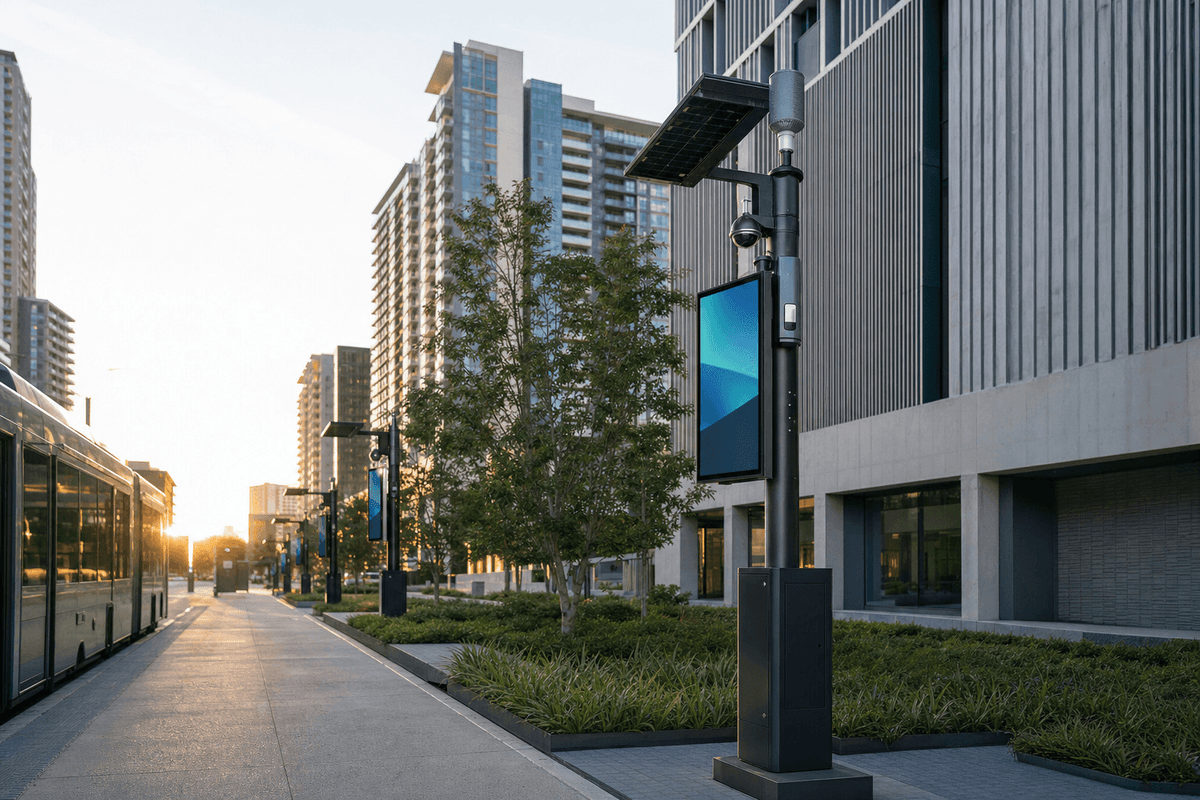
TL;DR
Smart pole digital signage and public Wi-Fi can turn lighting corridors into revenue infrastructure when media rights, Wi-Fi service rules, and EPC scope are defined upfront. A 50+ node deployment with 43-55in displays, Wi-Fi 6, and 3-15kWh storage can target USD 850-3,600 annual benefit per pole and 3.8-7.2 year payback.
Smart poles with 43-55in digital signage, Wi-Fi 6, and 5-15kWh LFP storage turn a 50-node corridor into an advertising, connectivity, and public-service network, with typical EPC payback of 3.8-7.2 years.
Summary
Smart poles with 43-55in digital signage, Wi-Fi 6, and 5-15kWh LFP storage turn a 50-node corridor into an advertising, connectivity, and public-service network, with typical EPC payback of 3.8-7.2 years.
Key Takeaways
Use 50-node smart pole corridors to combine 43-55in displays, Wi-Fi 6 access, solar-LFP storage, and measurable ad revenue in one procurement package.
- Convert 50+ lighting poles into revenue nodes by bundling 43-55in digital signage, public Wi-Fi, surveillance, and remote content management.
- Specify 2,500-5,000 nit outdoor displays with IP65 or IP66 enclosures for readable advertising in high-sun, high-dust corridors.
- Deploy Wi-Fi 6 access points with 50-150 concurrent-user planning capacity per pole and segmented VLANs for public, operator, and device traffic.
- Size hybrid power around 3-15kWh LFP storage, ~256W CIGS solar or 400-500W wind plus solar, depending on display duty cycle.
- Compare FOB, CIF, and EPC turnkey offers because civil works, backhaul, foundations, and commissioning can add 25-60% above delivered equipment cost.
- Model ROI with USD 850-3,600 annual benefit per pole from ads, sponsorship, Wi-Fi services, energy savings, and avoided separate cabinets.
- Require IEC 60598, IEC 60529, IEEE 802.11ax, and UL 48 alignment before accepting 7m, 10m, or 12m smart pole configurations.
- Apply SOLARTODO volume guidance early: 50+ units receive 5%, 100+ receive 10%, and 250+ receive 15% planning discounts.
Why Digital Signage and Public Wi-Fi Belong on Smart Poles
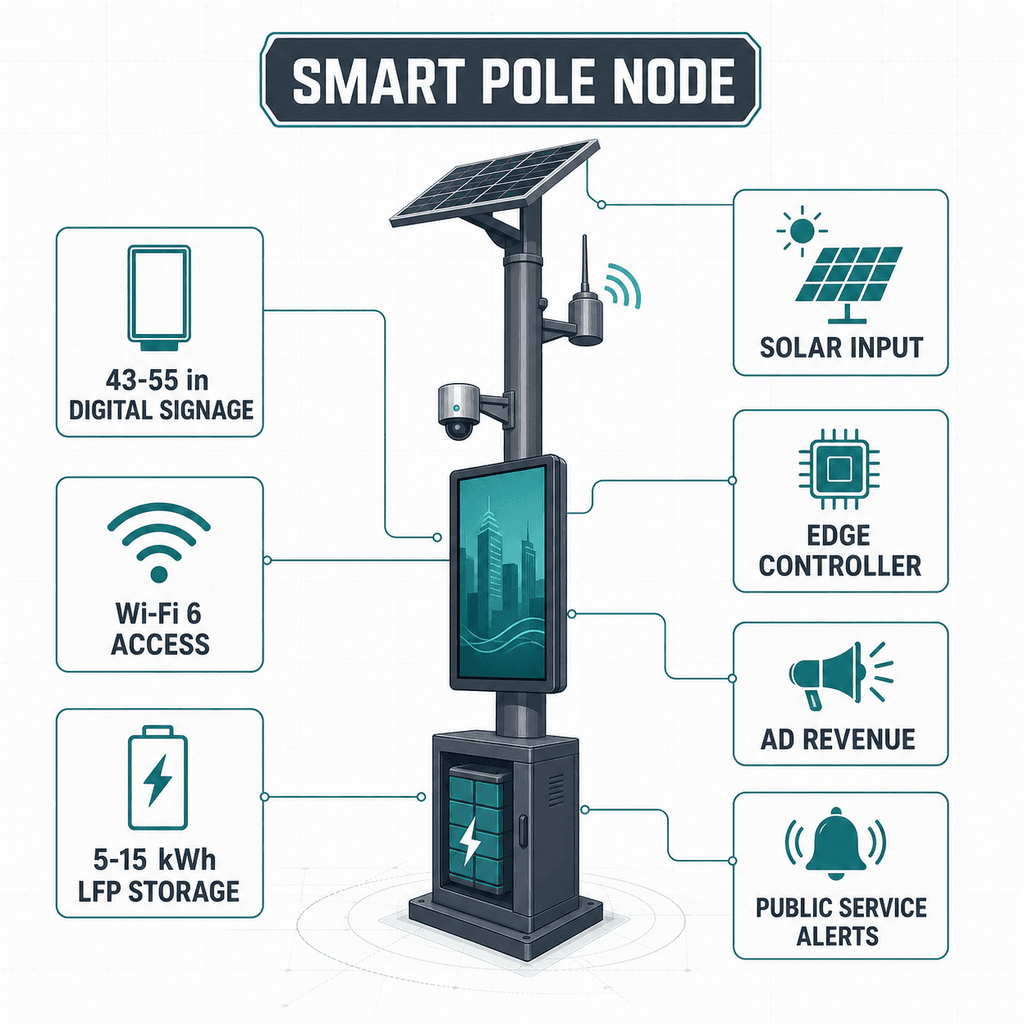
A smart pole becomes revenue-generating infrastructure when 1 lighting asset hosts a 43-55in screen, Wi-Fi 6 access point, camera, and solar-LFP power. For city, port, campus, and boulevard owners, this converts a recurring lighting cost into a managed communications and media asset.
According to IEA (2026), global electricity demand is forecast to grow 3.6% annually from 2026 to 2030, after 4.4% growth in 2024 and 3% growth in 2025. IEA Executive Director Fatih Birol states, "we're now moving at speed into the Age of Electricity." New public infrastructure should therefore reduce grid burden, support electrified services, and create budget offsets.
According to IRENA (2024), renewables accounted for 86% of global capacity additions in 2023, adding 473GW, with solar contributing 345.5GW. Solar-LFP smart poles match this direction because they distribute generation and storage at the load point. SOLARTODO designs these systems for Latin America, the Middle East, Africa, Southeast Asia, and Europe, where infrastructure often needs lighting, connectivity, and security together.
Technical Architecture for Revenue Nodes
A revenue-ready smart pole needs 4 synchronized layers at 7-12m mounting height: certified structure, high-brightness display, managed Wi-Fi, and resilient solar-grid-battery power.
The structural layer carries the commercial risk because it determines whether display, antenna, camera, and battery loads are safe for local wind zones. The SOLARTODO 7m Ø400 Cylindrical CIGS Smart Pole uses a 400mm steel cylinder, 5mm wall thickness, hot-dip galvanizing, and flush-integrated CIGS cells for compact lane-node projects. The 12m wind-solar hybrid pole uses a 160W LED, 400-500W vertical-axis wind generation, 2 monocrystalline panels, and 5-15kWh LFP storage for boulevards.
The signage layer should be specified as outdoor media equipment. A practical configuration uses a 43-55in screen, 2,500-5,000 nit brightness, automatic dimming, thermal control, tamper alarms, and a cloud content management system. Where traffic safety is critical, animation rules and nighttime brightness curves should be approved before commissioning.
The communications layer should separate public Wi-Fi from operator traffic. Wi-Fi 6, based on IEEE 802.11ax-2021, supports high-efficiency WLAN operation for dense environments, while Wi-Fi 6E can use 6GHz spectrum only where local regulation allows. Tenders should define 50-150 concurrent users per pole, captive portal rules, backhaul, WPA3 security, and VLAN separation for cameras, displays, chargers, and maintenance.
Power and Standards Basis
According to IRENA (2024), battery storage project costs dropped 89% between 2010 and 2023, and solar PV LCOE was 56% lower than fossil alternatives in 2023. These trends support hybrid solar-LFP designs for signage and Wi-Fi loads, but energy balance must still be modeled by site.
According to NREL PVWatts V8 documentation, PV estimates use inputs such as system capacity, module type, tilt, azimuth, losses, weather data, and inverter efficiency. For smart poles, the key question is whether stored energy covers night advertising, Wi-Fi backhaul, camera operation, and emergency lighting through cloudy periods.
For acceptance, buyers should map each subsystem to a standard. Lighting should reference IEC 60598 and IEC 62722. Enclosures should reference IEC 60529. Displays should align with UL 48 or local electric sign rules. Batteries should use IEC 62619 or equivalent industrial lithium safety requirements.
EPC Investment Analysis and Pricing Structure
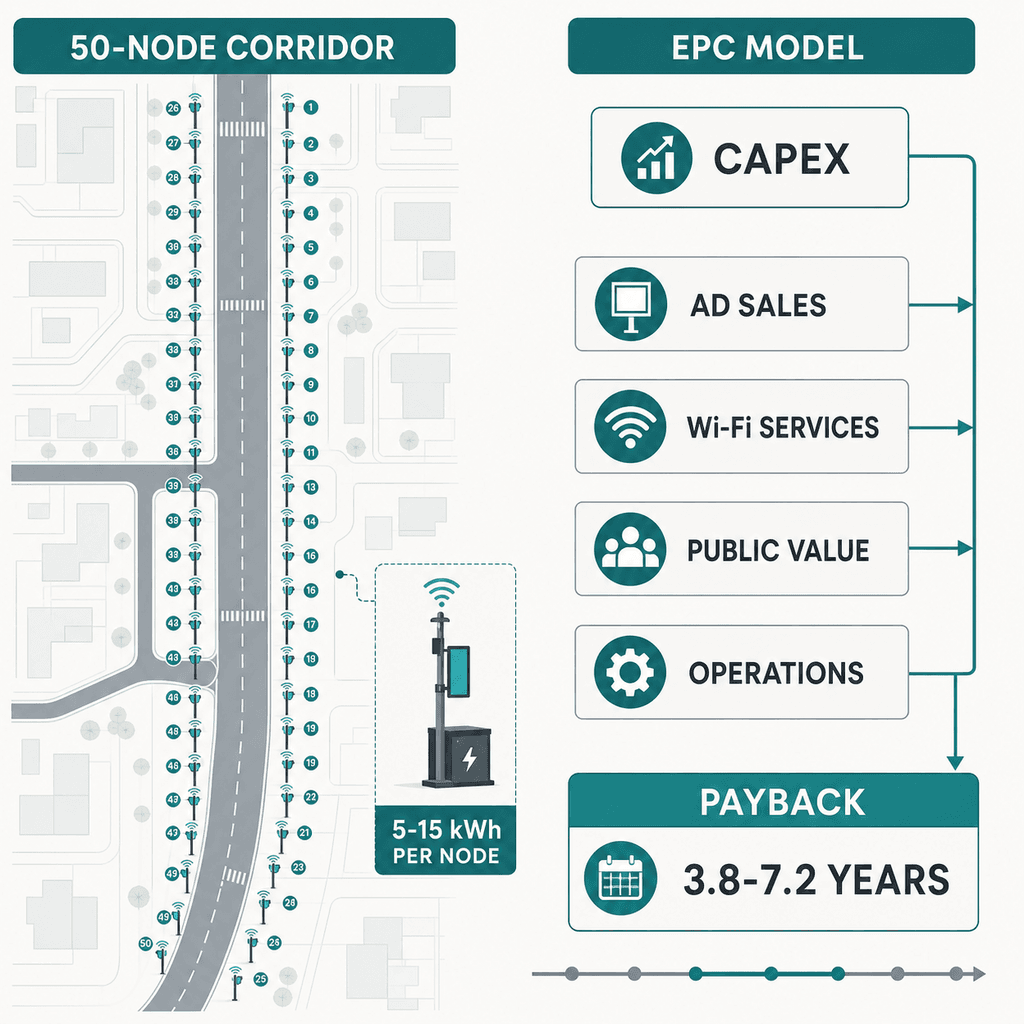
For 50+ smart pole projects, EPC turnkey pricing should separate FOB supply, CIF delivery, and site works to protect ROI and warranty risk.
EPC means Engineering, Procurement, and Construction. For smart pole signage projects, turnkey EPC should include site survey, structural verification, lighting and RF layout, solar estimate, display brightness plan, CMS setup, factory integration, shipping documents, foundations, cabling, installation, commissioning, training, and maintenance handover. Missing scope usually becomes buyer risk.
SOLARTODO is not an online marketplace; the process is inquiry, technical clarification, offline quotation, and project delivery. Export buyers should request a bill of materials by pole type, civil works allowance, factory acceptance testing plan, and commissioning schedule.
| Pricing tier | What it includes | Planning use | Best-fit buyer |
|---|---|---|---|
| FOB Supply | Pole, LED, display, Wi-Fi AP, controller, solar or wind kit, LFP battery, factory test | Equipment baseline before freight and duties | Local EPCs and city contractors |
| CIF Delivered | FOB scope plus sea freight and insurance to destination port | Roughly 8-18% logistics allowance | Government import programs and distributors |
| EPC Turnkey | CIF scope plus engineering, foundations, cabling, installation, commissioning, and training | Roughly 25-60% site-work allowance | Municipalities, ports, campuses, developers |
Volume pricing should be evaluated at corridor scale. As planning guidance, SOLARTODO can apply 5% discount for 50+ units, 10% for 100+ units, and 15% for 250+ units, subject to final configuration. Standard payment terms are 30% T/T + 70% against B/L, or 100% L/C at sight. Financing is available for large projects above USD 1,000K; contact [email protected] for review.
ROI should compare the integrated pole with separate light poles, display kiosks, Wi-Fi cabinets, surveillance poles, and electrical cabinets. Integrated welded-base or monolithic designs can reduce footprint by about 30-40% in suitable layouts. A realistic model counts ad revenue, sponsorship, Wi-Fi revenue, energy savings, avoided O&M, CMS fees, backhaul, and cleaning cost.
Applications, Revenue Models, and ROI
The strongest deployments place 1 monetized pole every 25-35m across 50+ nodes on corridors where pedestrians, vehicles, and advertisers repeat daily.
Smart boulevards and retail corridors are the direct fit because media value rises with repeat traffic. A 12m SOLARTODO hybrid boulevard pole can combine 160W LED lighting, 400-500W wind generation, 2 solar panels, Wi-Fi 6/5G communications, optional 7kW or 11kW AC charging, and a 55in display. The same node can show paid ads, public alerts, air-quality messages, and wayfinding.
Border checkpoints, customs lanes, logistics parks, and police inspection corridors need a different model. The 7m Ø400 CIGS smart pole is stronger when compact diameter, flush integration, surveillance, emergency response, and Wi-Fi coverage matter more than large billboard revenue. Its 100W LED, 15,000 lm lighting, ~256W CIGS generation, 3,000Wh storage, 4MP IR video, and Wi-Fi 6 connectivity support 28m lane spacing.
Transit approaches, tunnel entrances, and airport access roads prioritize safety messaging. The SOLARTODO 10m Tunnel Entrance Smart Pole uses 200W LED lighting at about 34,000 lumens, an AI camera, environmental sensor, and LED display in a 4-in-1 system. ROI comes from avoided cabinets, faster incident communication, and lower maintenance complexity.
According to IEA (2026), more than 2,500GW of projects are stalled in grid connection queues worldwide, and annual grid investment must rise about 50% from today's USD 400 billion by 2030. That grid pressure supports local hybrid power for signage, Wi-Fi, cameras, and edge devices.
For a 100-pole corridor, a conservative model might assume USD 1,800 annual net advertising income, USD 250 Wi-Fi sponsorship value, and USD 200 avoided energy or maintenance cost per pole. That equals USD 225,000 annual benefit. If incremental EPC cost for signage and Wi-Fi is USD 1.08 million, simple payback is about 4.8 years.
Comparison and Selection Guide
Select the pole configuration by revenue density, not height alone: 7m checkpoint nodes, 10m traffic nodes, and 12m hybrid boulevards serve different payback cases.
| Configuration | Best site | Core specifications | Signage and Wi-Fi role | Revenue logic |
|---|---|---|---|---|
| 7m Ø400 CIGS smart pole | Border checkpoints, customs lanes, security corridors | 100W LED, 15,000 lm, ~256W CIGS, 3kWh LFP, 4MP IR camera, Wi-Fi 6 | Compact display or lane messaging plus public or staff Wi-Fi | Operational savings, sponsored messages, security integration |
| 10m tunnel entrance smart pole | Tunnel thresholds, traffic approaches, road safety zones | 200W LED, ~34,000 lm, AI camera, environmental sensor, LED display, IP66 | Safety messages, alerts, and monitored connectivity | Avoided cabinets, faster incident response, EPC cost control |
| 12m wind-solar hybrid smart pole | Boulevards, campuses, resorts, ports, mixed-use districts | 160W LED, 400-500W VAWT, 2 solar panels, 5-15kWh LFP, optional 7kW/11kW AC charger | 43-55in display, Wi-Fi 6/5G, EV user engagement | Highest ad, sponsorship, charging, and connectivity value |
Selection should start with ownership of media rights. Procurement documents should define ad-share formula, prohibited content, emergency override rights, uptime, and proof-of-play reporting.
Backhaul and maintenance are the second decision set. Fiber is preferred for dense media networks, while 4G/5G backhaul supports phased corridors or remote roads. Buyers should require spare parts, display cleaning intervals, firmware updates, battery state-of-health monitoring, remote alarms, service-level reporting, and a clear warranty claim process.
FAQ
Procurement teams should validate 10 issues before award: revenue rights, Wi-Fi capacity, display power, EPC scope, standards, warranty, maintenance, and financing.
Q: What makes smart pole digital signage revenue-generating? A: Smart pole signage becomes revenue-generating when the owner can sell scheduled screen inventory, sponsorship slots, or public-service media across a managed network. A 43-55in outdoor display with proof-of-play reporting lets advertisers verify delivery. The strongest projects bundle 50+ poles so media sales are large enough to justify CMS, cleaning, backhaul, and sales operations.
Q: How does public Wi-Fi create income for a smart pole project? A: Public Wi-Fi can create income through sponsored captive portals, venue branding, premium access, analytics services, and bundled advertising packages. It should not be treated as an online marketplace. SOLARTODO supplies the infrastructure through inquiry and offline quotation, while the asset owner or media operator manages user terms, consent, pricing, and local telecom compliance.
Q: What display size and brightness should B2B buyers specify? A: Most outdoor smart pole projects should specify 43-55in displays with 2,500-5,000 nit brightness, automatic dimming, IP65 or IP66 protection, and vandal-resistant glass. Very bright environments, such as Middle East boulevards or tropical ports, need higher thermal margins. Traffic authorities may restrict animation speed, color changes, or nighttime brightness.
Q: How many users can one public Wi-Fi smart pole support? A: A practical planning range is 50-150 concurrent users per Wi-Fi 6 access point, depending on bandwidth policy, antenna design, and backhaul. The tender should define target Mbps per user, session duration, and coverage radius. Backhaul often becomes the bottleneck before the access point hardware does, especially with video-heavy users.
Q: What power system is required for digital signage and Wi-Fi? A: The power system depends on screen size, brightness schedule, Wi-Fi duty cycle, camera load, and local solar resource. Small checkpoint nodes may use ~256W CIGS generation and 3kWh LFP storage, while boulevard systems may use wind-solar hybrid generation with 5-15kWh storage. Grid backup is recommended for high-uptime advertising networks.
Q: How should EPC pricing, payment terms, and warranty be evaluated? A: EPC pricing should separate FOB supply, CIF delivery, and turnkey site works so buyers can see equipment, logistics, and civil-cost exposure. SOLARTODO payment terms can be 30% T/T + 70% against B/L, or 100% L/C at sight. Warranty review should cover pole structure, LED luminaire, display, battery, controller, and installation workmanship separately.
Q: When should a project choose a 7m, 10m, or 12m smart pole? A: Choose 7m poles for compact security nodes, customs lanes, and pedestrian checkpoints where 28m spacing and clean integration matter. Choose 10m poles for traffic and tunnel approaches needing stronger lighting and safety messages. Choose 12m hybrid poles for boulevards and campuses where advertising, Wi-Fi, EV charging, and solar-wind generation can share one structure.
Q: What maintenance does a smart signage pole need? A: Maintenance should include monthly remote health checks, quarterly visual inspection, display cleaning, firmware updates, thermal filter inspection, and annual electrical testing. Batteries should be monitored for state of health, temperature, and cycle count. In dusty, coastal, or high-pollen locations, cleaning intervals may shorten to 30-60 days to protect screen readability.
Q: How do privacy and cybersecurity requirements affect public Wi-Fi design? A: Privacy and cybersecurity requirements determine login flow, data retention, network segmentation, and vendor access. Public Wi-Fi should use consent-based portals, WPA3 where supported, VLAN separation, encrypted management, and limited log retention. Camera, display CMS, EV charger, and maintenance access should never share the same unrestricted public network segment.
Q: What ROI should municipalities or developers expect? A: A realistic smart pole digital signage ROI is often 3.8-7.2 years for 50+ node corridors, but it depends on media demand and EPC scope. Strong sites can produce USD 850-3,600 annual benefit per pole from advertising, sponsorship, energy savings, and avoided separate infrastructure. Low-traffic corridors should prioritize safety and connectivity value over ad revenue.
References
Use these 8 references to verify electricity growth, renewable cost trends, PV modeling, wireless standards, and outdoor electrical safety requirements for 2026 smart pole tenders.
- IEA (2026): Electricity 2026 forecasts 3.6% annual global demand growth for 2026-2030, renewables rising about 1,000TWh annually, and major grid-flexibility requirements.
- IEA (2024): World Energy Outlook 2024 press release explains the Age of Electricity, electricity demand growth, and the need for grids and storage.
- IRENA (2024): Renewable Power Generation Costs in 2023 reports solar PV LCOE 56% below fossil alternatives and battery storage cost declines of 89% since 2010.
- IRENA (2024): Renewable Capacity Statistics 2024 reports 473GW of renewable additions in 2023, equal to 86% of new power capacity.
- NREL (2026): PVWatts V8 documentation defines solar performance inputs, updated TMY weather data, module types, losses, and annual AC energy estimation.
- IEEE (2021): IEEE 802.11ax-2021 defines High Efficiency WLAN operation used for Wi-Fi 6 access planning in dense public environments.
- IEC (2020): IEC 60598-1 and IEC 62722 guidance support luminaire safety and LED performance verification for outdoor smart streetlight systems.
- UL and IEC (2022): UL 48 supports electric sign safety review, while IEC 60529 supports IP ingress-protection classification for outdoor enclosures.
Conclusion
Smart pole digital signage and public Wi-Fi can justify 50+ node corridors when EPC pricing, ad rights, and power design are modeled together.
Bottom line: SOLARTODO smart pole infrastructure is most bankable when a 7m, 10m, or 12m pole is selected by use case, paired with Wi-Fi 6, 43-55in signage, and 3-15kWh storage, then procured under a clear FOB, CIF, or EPC turnkey scope.
About SOLARTODO
SOLARTODO is a global integrated solution provider specializing in solar power generation systems, energy-storage products, smart street-lighting and solar street-lighting, intelligent security & IoT linkage systems, power transmission towers, telecom communication towers, and smart-agriculture solutions for worldwide B2B customers.
About the Author

Cinn Song
Founder & Chief Solutions Architect
Cinn Song founded SOLARTODO LIMITED and leads its smart-city infrastructure engineering — from solar, storage and integrated smart poles to the company's push into physical-AI city edge nodes: pole-mounted edge computing, vertical LLMs for smart cities, drone-based O&M with autonomous battery swapping, robotic maintenance, and high-speed counter-UAS interception. Since 2010, he has directed turnkey EPC + BOT delivery across 50+ countries, including telecom monopole supply for national grid operators, off-grid solar street-lighting for African municipalities, and integrated smart-pole programs for Gulf smart cities.
Cite This Article
Cinn Song. (2026). Smart Pole Digital Signage and Public Wi-Fi:…. SOLARTODO. Retrieved from https://solartodo.com/knowledge/smart-pole-digital-signage-and-public-wi-fi-revenue-generating-infrastructure
@article{solartodo_smart_pole_digital_signage_and_public_wi_fi_revenue_generating_infrastructure,
  title = {Smart Pole Digital Signage and Public Wi-Fi:…},
  author = {Cinn Song},
  journal = {SOLARTODO Knowledge Base},
  year = {2026},
  url = {https://solartodo.com/knowledge/smart-pole-digital-signage-and-public-wi-fi-revenue-generating-infrastructure},
  note = {Accessed: 2026-09-19}
}
Published: June 25, 2026 | Available at: https://solartodo.com/knowledge/smart-pole-digital-signage-and-public-wi-fi-revenue-generating-infrastructure
Subscribe to Our Newsletter
Get the latest solar energy news and insights delivered to your inbox.
View All Articles