تحديات المناخ الحار على أداء smart city في الخليج

Cinn Song
Founder & Chief Solutions Architect
Watch the video
TL;DR
Gulf smart city projects fail when hot-climate risk is treated as a normal outdoor condition. Specify 50°C+ thermal resilience, IP66/IP67 protection, 85 µm galvanizing, 150 W LED lighting, and 35 m spacing. SOLARTODO’s 10m 5-in-1 pole costs about $12,000-$16,000 installed, with EPC financing available above $1,000K.
Gulf smart city poles must handle 50°C heat, 60°C+ heat-index events, and 150 km/h wind while maintaining LED, camera, sensor, and WiFi uptime. SOLARTODO specifies IP66/IP67 enclosures, 85 µm galvanizing, and EPC pricing from $12,000-$16,000 per 10m pole.
Summary
Gulf smart city poles must handle 50°C heat, 60°C+ heat-index events, and 150 km/h wind while maintaining LED, camera, sensor, and WiFi uptime. SOLARTODO specifies IP66/IP67 enclosures, 85 µm galvanizing, and EPC pricing from $12,000-$16,000 per 10m pole.
Key Takeaways
Use a 10m smart pole specification with 150 W LED lighting, 4K AI PTZ surveillance, 8 environmental sensors, WiFi 6, and public-address capability for Gulf corridors.
- Specify electronics rated to at least 60°C ambient operation and model enclosure temperature rise before approving any 10m smart city deployment.
- Select IP66 luminaires, IP67 cameras, and IP65 sensor enclosures to reduce dust, humidity, and salt-air failures in coastal Gulf cities.
- Require hot-dip galvanized Q345B steel with 85 µm zinc coating and >150 km/h wind resistance for road, port, and seafront installations.
- Plan 35 m pole spacing for 10m corridors, using about 29 poles per 1 km to balance lighting uniformity, camera coverage, and WiFi density.
- Compare FOB, CIF, and EPC turnkey pricing before procurement; SOLARTODO’s 10m 5-in-1 pole is typically $12,000-$16,000 per unit supply and install.
- Apply volume discounts of 5% at 50+ units, 10% at 100+ units, and 15% at 250+ units to improve municipal CAPEX planning.
- Budget preventive maintenance every 6 months in dusty or coastal zones, with sensor calibration and thermal inspection included.
- Finance large projects above $1,000K when phased smart lighting, surveillance, and environmental monitoring must be deployed across multiple districts.
Hot Climate Risk for Gulf Smart City Infrastructure
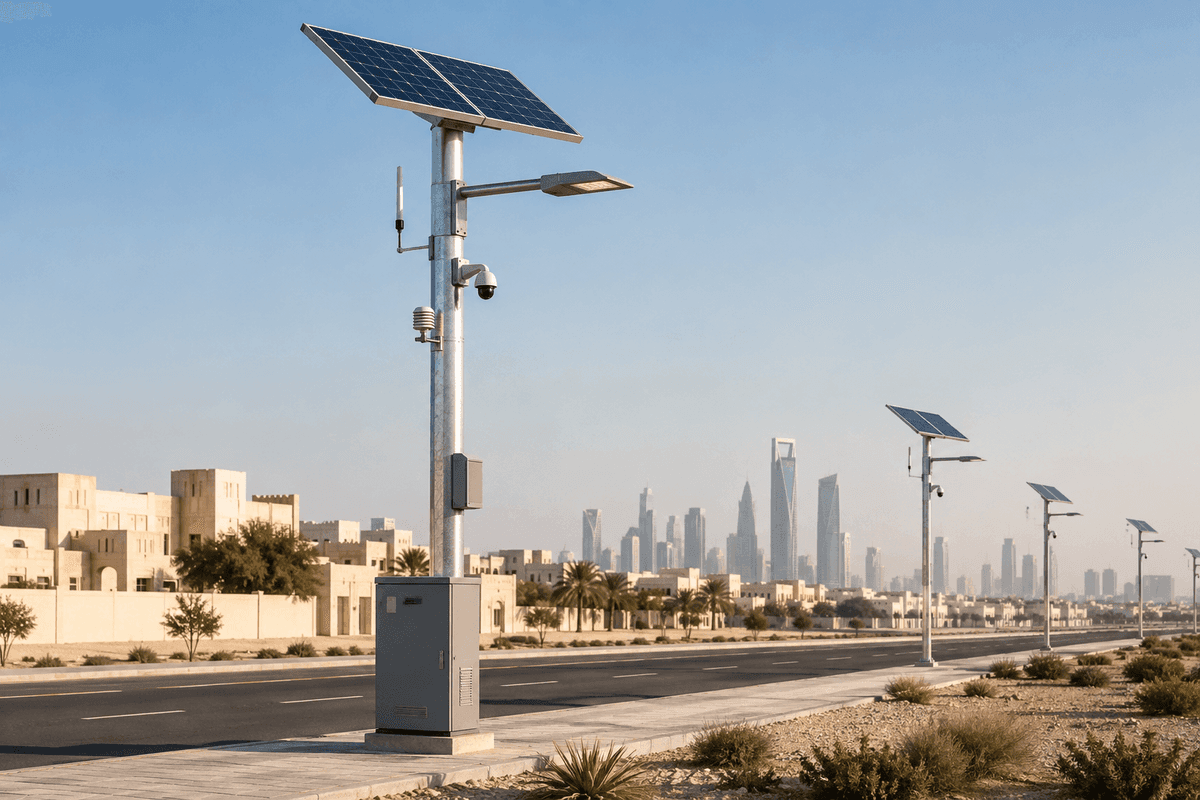
Gulf smart city poles must be engineered for 50°C ambient heat, 60°C+ perceived heat, and dust-loaded outdoor operation without derating critical lighting, surveillance, sensor, or network functions.
The Gulf climate creates a different engineering problem from temperate smart city deployments. High daytime temperatures, hot nights, airborne dust, high UV exposure, and coastal salinity all raise the failure risk of power supplies, LED drivers, camera motors, batteries, connectors, seals, and sensor membranes. Procurement teams should treat thermal performance as a primary technical requirement, not as a secondary environmental note.
According to WMO (2025), the Arab region had its hottest year on record in 2024, with temperatures 1.08°C above the 1991-2020 average and several countries exceeding 50°C. WMO Secretary-General Celeste Saulo states, "Temperatures are rising at twice the global average," which makes Gulf smart infrastructure a long-life climate adaptation investment rather than a simple lighting upgrade.
According to NOAA Climate.gov (2024), parts of the Persian Gulf recorded heat-index conditions above 60°C in July 2024, including a reported 62°C heat index in Dubai and near 69°C in Asaluyeh. These values matter because a sealed pole cabinet exposed to solar radiation can run hotter than ambient air, especially when it contains a PDU, gateway, PoE switches, cellular backhaul, and edge AI hardware.
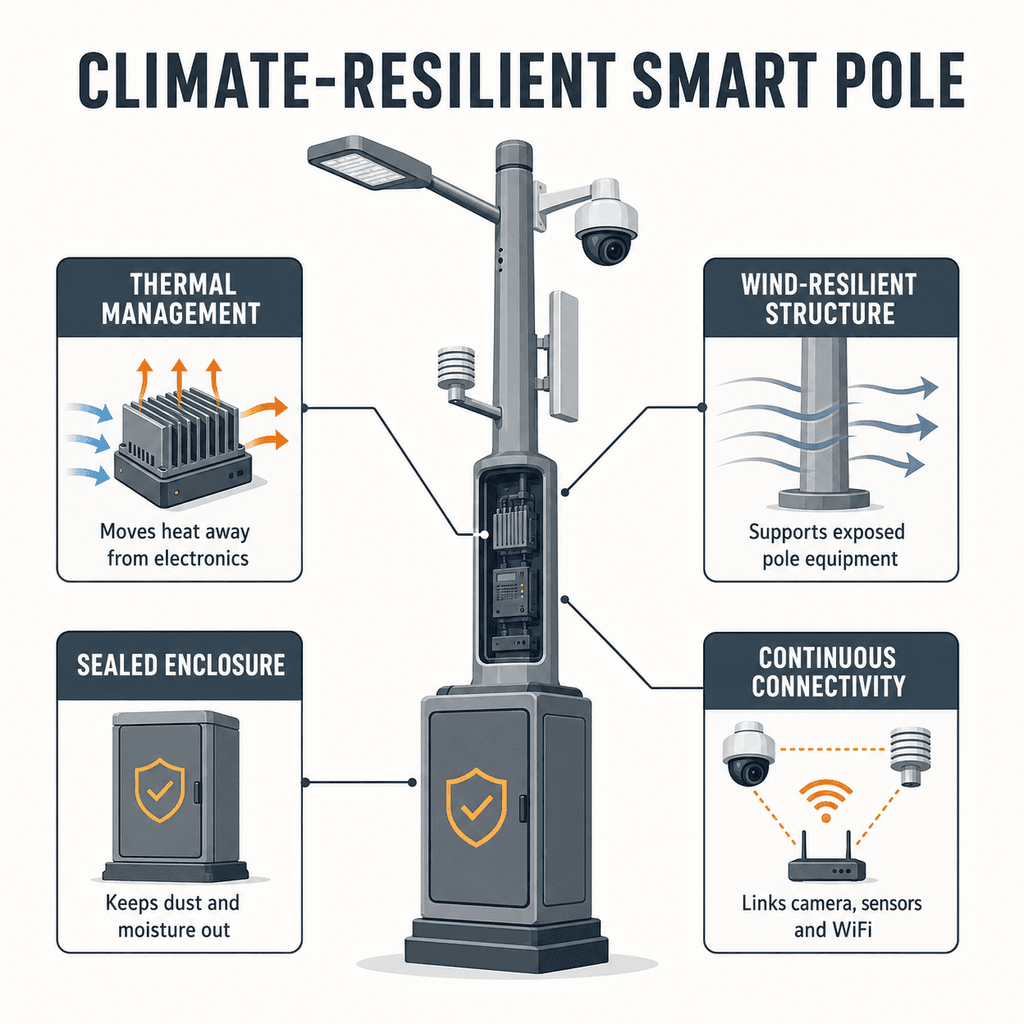
For B2B buyers, the main risk is not one dramatic failure. The larger cost comes from cumulative degradation: LED lumen depreciation accelerates, electrolytic capacitors age faster, camera PTZ mechanisms work under thermal stress, air-quality sensors drift, and routers throttle under sustained enclosure heat. A Gulf-ready smart pole should therefore include component derating, heat-sink sizing, surge protection, internal cable routing, and clear maintenance access.
Technical Design Requirements for Gulf-Ready Smart Poles
A Gulf-ready 10m smart pole should combine 150 W LED lighting, IP66/IP67 protection, 85 µm galvanizing, and edge processing rated for continuous high-temperature service.
SOLARTODO’s 10m Smart City 5-in-1 Standard integrates LED street illumination, 4K AI PTZ surveillance, environmental monitoring, WiFi 6 connectivity, and public-address emergency alerts on one galvanized steel pole. For Gulf markets, this consolidation reduces duplicated foundations, cabinets, cabling, and permitting, but it also concentrates thermal and electrical load into one infrastructure point. That is why procurement specifications must define the operating envelope clearly.
The recommended mechanical baseline is Q345B structural steel, 4 mm wall thickness, hot-dip galvanization with a minimum 85 µm zinc coating, and a >150 km/h wind resistance rating. The 10m pole uses internal cable management and an IP66 access door for the smart PDU, communication gateway, and wiring terminations. This matters in Gulf deployments because dust ingress, salt corrosion, and unauthorized access can reduce uptime as much as heat.
The LED module should deliver 150 W output at 170 lm/W, producing about 25,500 lm with Type III optics for two-lane urban roads. At 10 m mounting height and 35 m pole spacing, the design target is about 25-30 lux average maintained illuminance with Uo >= 0.40 for road-class applications. IEC states that IEC 60598-1:2024 covers luminaires up to 1,000 V and includes general safety requirements, while IEC 62722-1:2022 addresses luminaire performance and environmental requirements.
The surveillance module should use 4K resolution, 20x optical zoom, 360° pan, 50 m IR night vision, and onboard AI inference. Gulf buyers should confirm thermal ratings for the camera housing, IR illuminator, motor assembly, and NPU, not just the sensor resolution. IEC 62676-6:2026 is especially relevant because it covers performance testing and grading for real-time intelligent video analysis systems under operating stress levels.
Environmental monitoring should include PM2.5, PM10, O3, NO2, noise, temperature, humidity, and wind speed where city planners need hyperlocal climate and air-quality data. Sensor placement must avoid exhaust plumes, reflected wall heat, and luminaire heat sinks. For LoRaWAN, cellular, and WiFi 6 systems, antenna isolation and cabinet ventilation are practical design points that protect data quality and service continuity.
EPC Investment Analysis and Pricing Structure
EPC turnkey delivery for Gulf smart city poles should define $12,000-$16,000 unit economics, 50+ unit discounts, and 6-9 year payback assumptions before tender award.
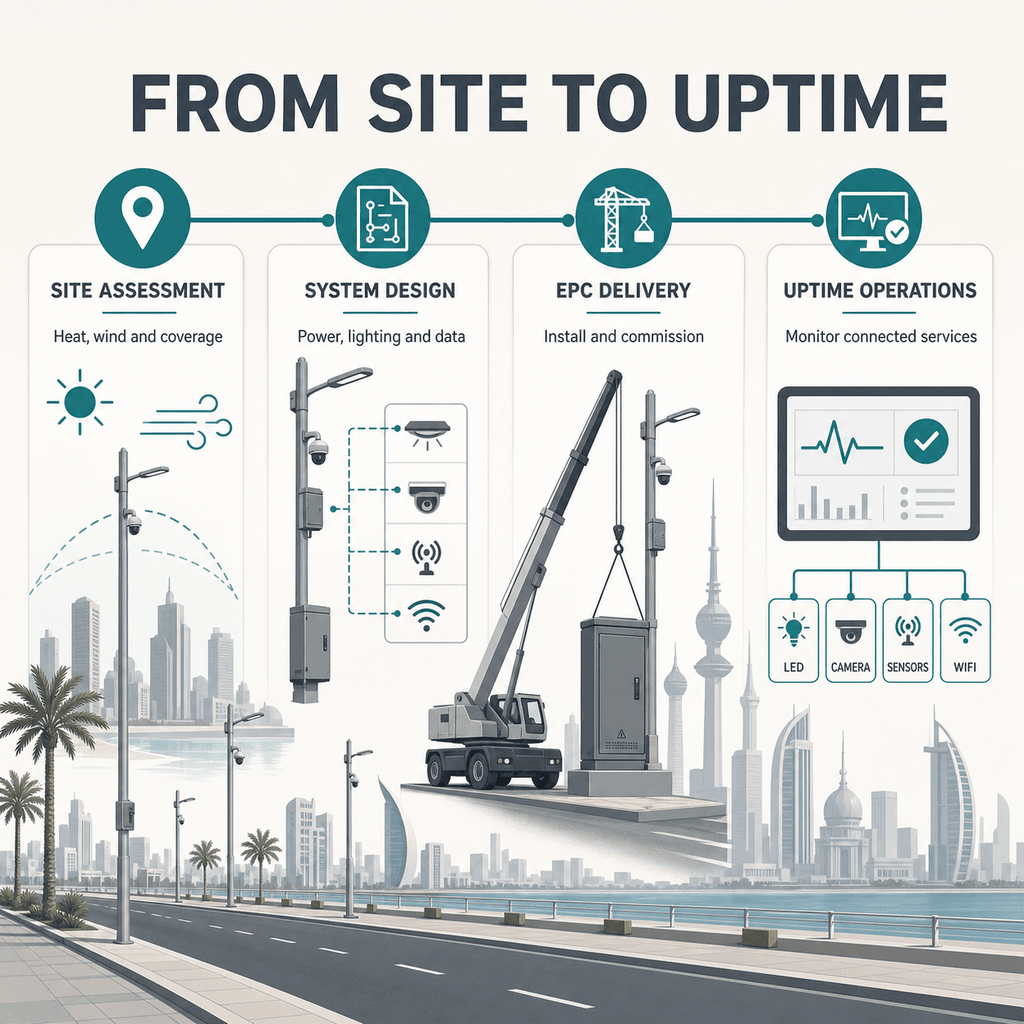
EPC means Engineering, Procurement, and Construction. For a SOLARTODO smart pole project, EPC turnkey delivery typically includes site survey, lighting layout, wind-load coordination, pole foundation design support, module procurement, logistics, installation, commissioning, platform integration, testing, handover documents, and maintenance training. Buyers should separate EPC scope from product supply so bids can be compared fairly.
Three commercial structures are common. FOB Supply covers factory supply at the export port and is best when the buyer controls freight, customs, and installation. CIF Delivered adds international freight and insurance to the destination port, improving landed-cost visibility. EPC Turnkey covers delivered equipment, local installation coordination, commissioning, and handover, making it the preferred structure for municipalities, developers, campuses, ports, and industrial zones.
| Pricing Tier | What It Includes | Best For | Buyer Risk |
|---|---|---|---|
| FOB Supply | Smart pole equipment at export port | Experienced importers | Freight, customs, installation |
| CIF Delivered | Equipment, international freight, insurance | Regional distributors | Local civil works and commissioning |
| EPC Turnkey | Engineering, supply, install, commissioning | Municipal and campus projects | Requires clear site scope |
SOLARTODO’s 10m Smart City 5-in-1 Standard is typically priced at $12,000-$16,000 per unit on a supply-and-install basis, depending on module configuration, foundation conditions, software requirements, and local installation cost. Volume guidance is 5% discount for 50+ units, 10% for 100+ units, and 15% for 250+ units. Standard payment terms are 30% T/T deposit plus 70% against bill of lading, or 100% L/C at sight.
ROI depends on what the pole replaces. A 5-in-1 system can replace separate streetlights, CCTV poles, environmental stations, WiFi access points, and PA speaker infrastructure. Civil works savings are commonly estimated at 40-60% compared with five separate deployments, while LED lighting can reduce energy consumption by more than 60% versus legacy high-pressure sodium systems. A practical Gulf payback model is usually 6-9 years when energy savings, avoided duplicate foundations, lower maintenance truck rolls, and public-safety value are included.
According to IRENA (2025), renewable capacity additions reached 582 GW in 2024, and 91% of newly commissioned utility-scale renewable projects produced electricity below the cheapest new fossil alternative. The same report places global solar PV LCOE at $0.043/kWh and utility-scale battery storage installed cost at $192/kWh in 2024. This supports solar-assisted smart city infrastructure where grid tariffs, diesel backup, or remote site power are constraints. Financing is available for large projects above $1,000K; procurement teams can contact [email protected] for project structuring.
Comparison and Selection Guide
A Gulf smart pole tender should compare temperature rating, ingress protection, corrosion resistance, lighting output, data functions, and EPC scope across at least 5 measurable categories.
Decision-makers should avoid evaluating smart city poles only by the number of modules. A low-cost multi-function pole can still fail commercially if the camera throttles at high temperature, the sensor data drifts, the cabinet lacks service access, or the software cannot integrate with existing city platforms. The right selection method is to compare environmental survivability first, then functional performance, then lifecycle cost.
| Selection Factor | Gulf-Ready Requirement | SOLARTODO 10m 5-in-1 Standard | Why It Matters |
|---|---|---|---|
| Pole height | 8-10 m by road type | 10 m | Supports road lighting and 80 m camera radius |
| Lighting | 150 W, 170 lm/W, Type III optics | 25,500 lm | Maintains 25-30 lux at 35 m spacing |
| Camera | 4K, 20x zoom, 50 m IR | 8 MP PTZ with edge AI | Reduces bandwidth by up to 70% |
| Enclosure protection | IP65-IP67 by module | IP66 luminaire, IP67 camera | Protects against dust and water ingress |
| Structure | >150 km/h wind resistance | Q345B, 4 mm steel, 85 µm zinc | Supports coastal and open-road resilience |
| Connectivity | WiFi 6, 4G/5G, LoRaWAN | 500+ users per pole | Enables public access and IoT data |
| Deployment density | 25-40 m spacing | 35 m recommended | About 29 poles per 1 km corridor |
According to the World Bank (2025), urban heat islands can raise city temperatures by up to 10°C, and urban poor exposed to dangerous heat could rise by 700% by 2050. World Bank guidance states, "Extreme urban heat is one of the deadliest and most costly urban risks," which is directly relevant for Gulf master planning, worker safety, and infrastructure continuity.
For campuses and parks, SOLARTODO’s 8m Campus/Park Environmental Smart Streetlight may be more appropriate than a 10m corridor pole. It uses an 80 W LED luminaire, 4K AI camera, environmental sensors, WiFi 6, and USB charging ports. For urban roads, ports, logistics zones, and commercial districts, the 10m 5-in-1 Standard provides stronger mounting height, broader surveillance coverage, and better corridor spacing economics.
Operations, Maintenance, and Data Reliability
Gulf smart city operations should schedule 6-month inspections, sensor calibration, thermal checks, and firmware control to protect 25-year pole assets.
Operations planning should begin before installation. Gulf dust can reduce optical clarity, block ventilation paths, and affect particulate readings. Coastal humidity and salt mist can attack fasteners and exposed connectors. High UV exposure can embrittle plastics and cable jackets. A professional maintenance plan should define inspection intervals, cleaning methods, spare-part levels, firmware policies, cybersecurity responsibilities, and service-level targets.
For lighting, maintenance should track lumen output, driver temperature, surge protection status, and DALI-2 control response. For cameras, teams should verify IR performance, PTZ accuracy, AI event accuracy, and enclosure seals. For air-quality sensors, calibration logs are essential because bad data can mislead city dashboards and public-health reporting. For WiFi and LoRaWAN, packet loss, backhaul latency, and device load should be reviewed monthly in high-traffic districts.
According to IEA (2023), space cooling energy consumption is set to more than double by 2050 without action, and cooling already represented 9% of final electricity consumption in 2022. The International Energy Agency states, "Cooling is the fastest growing use of energy in buildings," and that pressure affects smart city infrastructure because peak cooling demand can coincide with streetlighting startup, surveillance loads, and public WiFi usage.
NLR/NREL PVWatts V8 documentation is relevant when smart poles include solar-assisted or hybrid power options because the model uses updated weather data and thermal effects assumptions. In simple terms, PV modules lose output as cell temperature rises above the 25°C reference condition. Gulf designs should therefore consider module temperature coefficient, ventilation, tilt, soiling loss, and cleaning access when adding PV and battery storage to poles.
FAQ
Smart city buyers in the Gulf should evaluate 10-12 practical questions covering heat, cost, installation, maintenance, standards, and EPC delivery before issuing tenders.
Q: What is the main hot-climate challenge for smart city poles in the Gulf? A: The main challenge is sustained thermal stress above 45-50°C, often combined with dust, humidity, and salt air. These conditions accelerate LED driver aging, camera throttling, seal degradation, and sensor drift. Gulf tenders should require high-temperature component ratings, IP65-IP67 protection, thermal modeling, and defined maintenance intervals.
Q: How does extreme heat affect LED streetlight performance? A: Extreme heat raises LED junction temperature, which can reduce luminous output and shorten driver life. A Gulf-ready 150 W luminaire should use efficient heat sinking, quality drivers, and IEC 60598 and IEC 62722 performance documentation. At 170 lm/W, thermal management is still essential to maintain 25-30 lux over time.
Q: Why are IP ratings important for Gulf smart city projects? A: IP ratings define protection against dust and water ingress, both critical in Gulf road, port, and coastal environments. A practical specification is IP66 for luminaires, IP67 for cameras, and IP65 for environmental sensors. These ratings help reduce faults caused by sandstorms, pressure washing, humidity, and cabinet contamination.
Q: What does EPC turnkey delivery include for SOLARTODO smart poles? A: EPC turnkey delivery includes engineering support, procurement, logistics, installation coordination, commissioning, system testing, and handover documentation. For SOLARTODO smart poles, it can also include lighting layout, foundation coordination, IoT platform integration, and training. EPC is best for municipalities and campuses needing accountable delivery rather than equipment-only supply.
Q: How much does a 10m SOLARTODO 5-in-1 smart pole cost? A: A 10m SOLARTODO Smart City 5-in-1 Standard pole typically costs $12,000-$16,000 per unit on a supply-and-install basis. Final price depends on camera analytics, sensor package, software integration, freight, foundation conditions, and local labor. Volume discounts are 5% at 50+ units, 10% at 100+, and 15% at 250+.
Q: What payment and financing terms are available for large projects? A: Standard payment terms are 30% T/T deposit plus 70% against bill of lading, or 100% L/C at sight. Financing is available for large projects above $1,000K, subject to project review and buyer profile. EPC buyers should request a phased payment schedule tied to shipment, installation, and commissioning milestones.
Q: How often should Gulf smart poles be maintained? A: Gulf smart poles should receive preventive maintenance every 6 months in dusty, coastal, or high-traffic locations. The visit should include luminaire cleaning, camera lens inspection, enclosure seal checks, surge protector review, sensor calibration, and communication diagnostics. Annual structural checks should confirm anchor bolts, corrosion condition, and pole alignment.
Q: Which standards should procurement teams reference? A: Procurement teams should reference IEC 60598 for luminaire safety, IEC 62722 for luminaire performance, IEC 62676 for video surveillance, EN 40 for lighting columns, and ISO 12944 or ISO 1461 for corrosion protection. These standards create measurable acceptance criteria for safety, performance, structure, and durability in outdoor Gulf conditions.
Q: How many 10m smart poles are needed for a 1 km corridor? A: At 35 m recommended spacing, a 1 km corridor needs about 29 smart poles. Final quantity depends on road width, lighting class, camera sightlines, WiFi coverage targets, intersections, and existing infrastructure. Engineering teams should validate spacing using photometric simulation, surveillance coverage maps, and network planning.
Q: When should buyers choose an 8m campus pole instead of a 10m road pole? A: Choose an 8m campus pole for parks, universities, pedestrian zones, and corporate campuses where lower mounting height and 80 W lighting are sufficient. Choose the 10m 5-in-1 Standard for roads, commercial districts, ports, and wide corridors requiring 150 W lighting, longer camera reach, and 35 m spacing.
Conclusion
Gulf smart city projects should specify 50°C heat resilience, IP65-IP67 protection, and EPC pricing clarity before procuring 10m integrated poles.
The bottom line: SOLARTODO’s 10m Smart City 5-in-1 Standard is a practical Gulf infrastructure platform when buyers require 150 W LED lighting, 4K AI surveillance, 8-channel environmental sensing, WiFi 6, and >150 km/h structural wind resistance. For projects above 50 units, use volume pricing and EPC scope control to reduce lifecycle risk.
References
- IEC 60598-1 (2024): Luminaires - Part 1: General requirements and tests for luminaire safety up to 1,000 V. https://webstore.iec.ch/en/publication/66620 — https://webstore.iec.ch/
- IEC 62722-1 (2022): Luminaire performance - Part 1: General performance and environmental requirements for luminaires. https://webstore.iec.ch/en/publication/68003 — https://webstore.iec.ch/
- IEC 62676-6 (2026): Video surveillance systems standard covering performance testing and grading of real-time intelligent video analytics devices. https://webstore.iec.ch/en/publication/59704 — https://webstore.iec.ch/
- IRENA Renewable Power Generation Costs in 2024 (2025): Reports 582 GW renewable capacity additions, 91% least-cost renewable projects, and $0.043/kWh global solar PV LCOE. https://www.irena.org/Digital-Report/Renewable-Power-Generation-Costs-in-2024 — https://www.irena.org/Data/View-data-by-topic/Capacity-and-Generation
- IEA Space Cooling (2023): Shows space cooling energy consumption could more than double by 2050 without action and represented 9% of final electricity consumption in 2022. https://www.iea.org/reports/space-cooling-2 — https://www.iea.org/reports/world-energy-outlook-2024 These 8 references support Gulf smart pole specifications across heat risk, lighting safety, video analytics, renewable economics, and urban resilience.
- WMO (2025): State of the Climate in the Arab Region reporting 2024 as the hottest Arab-region year on record, with temperatures 1.08°C above the 1991-2020 average. https://wmo.int/news/media-centre/temperature-increase-accelerating-arab-region-escalating-impacts
- NOAA Climate.gov (2024): July 2024 global climate summary noting Persian Gulf heat-index values above 60°C and Dubai reaching about 62°C. https://www.climate.gov/news-features/understanding-climate/global-climate-summary-july-2024
- IEC 60598-1 (2024): Luminaires - Part 1, general safety requirements and tests for luminaires operating up to 1,000 V. https://webstore.iec.ch/en/publication/66620
- IEC 62722-1 (2022): Luminaire performance - Part 1, general performance and environmental requirements for luminaires. https://webstore.iec.ch/en/publication/68003
- IEC 62676-6 (2026): Video surveillance systems, performance testing and grading of real-time intelligent video content analysis devices and systems. https://webstore.iec.ch/en/publication/59704
- IRENA (2025): Renewable Power Generation Costs in 2024, reporting 582 GW renewable additions and global solar PV LCOE of $0.043/kWh. https://www.irena.org/Digital-Report/Renewable-Power-Generation-Costs-in-2024
- IEA (2023): Space Cooling analysis showing cooling energy consumption could more than double by 2050 without action. https://www.iea.org/reports/space-cooling-2
- World Bank (2025): Handbook on Urban Heat Management in the Global South, highlighting urban heat islands up to 10°C and dangerous heat exposure risks. https://www.worldbank.org/en/topic/urbandevelopment/publication/handbook-on-urban-heat-management-in-the-global-south
About SOLARTODO
SOLARTODO is a global integrated solution provider specializing in solar power generation systems, energy-storage products, smart street-lighting and solar street-lighting, intelligent security & IoT linkage systems, power transmission towers, telecom communication towers, and smart-agriculture solutions for worldwide B2B customers.
About the Author

Cinn Song
Founder & Chief Solutions Architect
Cinn Song founded SOLARTODO LIMITED and leads its smart-city infrastructure engineering — from solar, storage and integrated smart poles to the company's push into physical-AI city edge nodes: pole-mounted edge computing, vertical LLMs for smart cities, drone-based O&M with autonomous battery swapping, robotic maintenance, and high-speed counter-UAS interception. Since 2010, he has directed turnkey EPC + BOT delivery across 50+ countries, including telecom monopole supply for national grid operators, off-grid solar street-lighting for African municipalities, and integrated smart-pole programs for Gulf smart cities.
Cite This Article
Cinn Song. (2026). تحديات المناخ الحار على أداء smart city في الخليج. SOLARTODO. Retrieved from https://solartodo.com/knowledge/smart-city
@article{solartodo_smart_city,
  title = {تحديات المناخ الحار على أداء smart city في الخليج},
  author = {Cinn Song},
  journal = {SOLARTODO Knowledge Base},
  year = {2026},
  url = {https://solartodo.com/knowledge/smart-city},
  note = {Accessed: 2026-10-19}
}
Published: September 3, 2026 | Available at: https://solartodo.com/knowledge/smart-city
Subscribe to Our Newsletter
Get the latest solar energy news and insights delivered to your inbox.
View All Articles