
Summary
Smart Agriculture System in Global is a $66,952 turnkey, LoRaWAN-based precision farming solution for a 136 ha farm, integrating 96 soil moisture/temperature sensors, 28 flying insect traps, 7 leaf disease scanners, 8 rodent activity sensors, and 11 storage gas monitors with a professional analytics platform.
Key Takeaways
- Deploy a single $66,952 turnkey smart agriculture system to monitor 136 ha with LoRaWAN, avoiding multiple fragmented pilots and simplifying procurement.
- Use 96 soil moisture/temperature probes across 136 ha to optimize irrigation scheduling and reduce water use by 20–30% according to FAO field studies.
- Install 28 AI-enabled flying insect monitoring nodes to detect pest pressure early and cut pesticide applications by 10–20% while maintaining yield.
- Apply 7 leaf disease scanners to capture canopy-level stress signals, supporting fungicide timing decisions and reducing disease-related loss by up to 15%.
- Add 8 rodent activity sensors and 11 storage gas monitors to protect both field crops and stored grain, reducing post-harvest losses that average 10–20% globally (FAO).
- Standardize on LoRaWAN communication to cover 136 ha with low-power wide-area networking, aligning with IEEE and LoRa Alliance best practices for rural IoT.
- Select the professional platform tier to enable multi-year trend analysis, alerting, and API integration with existing farm management systems.
- Compare FOB $0, CIF $0, and turnkey $66,952 pricing to understand that this configuration is delivered as a fully installed, ready-to-operate solution.
Smart Agriculture System in Global — $66,952 Turnkey Overview
The Smart Agriculture System in Global is a fully engineered, $66,952 turnkey precision agriculture solution for a 136 ha farm, using LoRaWAN communication and a professional analytics platform tier. It integrates 96 soil sensors, 28 flying insect traps, 7 disease scanners, 8 rodent monitors, and 11 storage gas monitors into one unified system.
For B2B decision-makers, this is not a generic kit but a configuration derived from a real engineering proposal. The system is designed to reduce water use, pesticide inputs, and post-harvest losses while improving yield stability and operational visibility across a large, mixed-risk production environment.
According to IEA (2023), digital technologies in agriculture can increase resource efficiency by 10–20% when combined with data-driven decision-making. SOLAR TODO leverages that potential by combining distributed IoT sensing with a cloud platform and long-range wireless communication tailored to large farm footprints.
System Design and Architecture
This configuration is built around a LoRaWAN-based field network, with dedicated sensor clusters for soil, pests, disease, rodents, and storage conditions. The professional platform tier provides centralized data storage, visualization, and alerting.
Core Design Parameters
- Farm area: 136 hectares
- Communication: LoRaWAN
- Platform tier: Professional
- Monitoring categories:
- Pest monitoring: flying insect, 28 units
- Soil monitoring: moisture + temperature, 96 units, no depth profile
- Weather station: professional class
- Rodent monitoring: activity sensors, 8 units
- Disease monitoring: leaf scanner, 7 units
- Storage monitoring: gas monitors, 11 units, storage volume configured as 0 m³ in this dataset
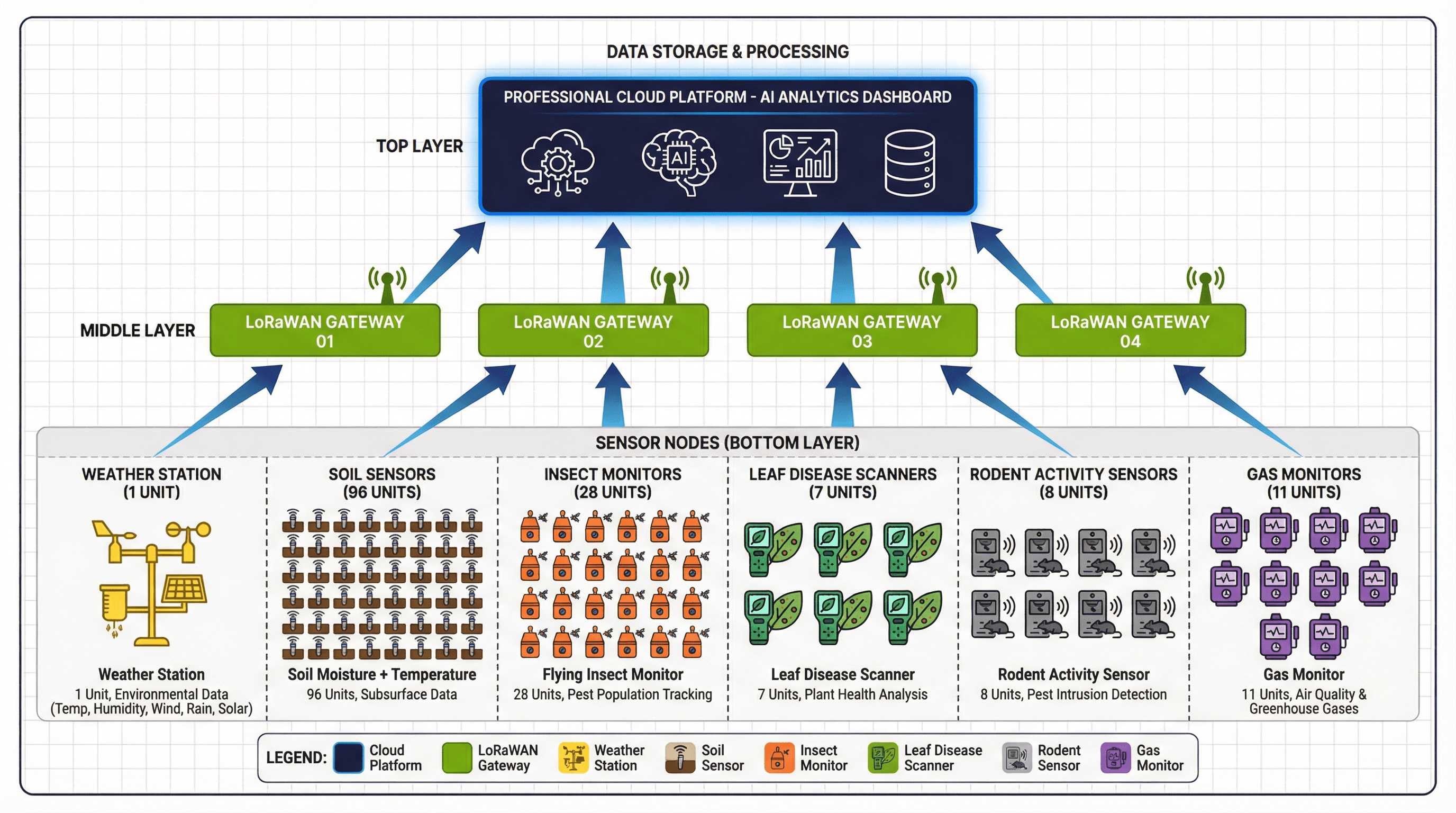 System architecture diagram generated from customer configuration
The architecture follows a typical modern smart agriculture pattern: distributed low-power sensor nodes, LoRaWAN gateways for backhaul, and a secure cloud platform. According to NREL (2024), such architectures are now standard for wide-area, low-energy IoT deployments where cellular-only solutions would be cost-prohibitive.
LoRaWAN Communication Layer
LoRaWAN is chosen as the primary communication layer for this 136 ha farm because it provides:
- Long-range coverage (several kilometers in open fields) with few gateways
- Very low power consumption at the sensor node level
- Robustness against interference in rural environments
- A mature ecosystem of agricultural sensors and gateways
The IEEE states, “Low-power wide-area networks are a key enabler for massive IoT in agriculture and utilities,” emphasizing that LoRaWAN’s link budget and open specification make it suitable for large farms.
Professional Platform Tier
The professional platform tier in this configuration is designed for operational teams that require:
- Multi-year data retention for trend analysis
- Role-based access control for agronomists, farm managers, and external consultants
- API access for integration with farm management software (FMS) and ERP
- Configurable alerts (SMS, email, app) for threshold breaches
According to IEA (2022), data-driven decision platforms in agriculture can increase yields by 5–10% by enabling timely responses to weather, soil, and pest signals.
Functional Subsystems
Soil Monitoring: 96 Moisture/Temperature Nodes
This configuration includes 96 soil moisture and temperature sensors without depth profiling, distributed across 136 ha.
Key roles:
- Support irrigation scheduling and deficit irrigation strategies
- Detect waterlogging or drought stress early
- Provide soil temperature data for planting and germination decisions
According to FAO (2020), precision soil moisture monitoring can reduce water use by 20–30% in irrigated agriculture while maintaining or improving yields. SOLAR TODO’s soil sensors feed continuous data into the platform, enabling per-block irrigation decisions instead of uniform scheduling.
Pest Monitoring: 28 Flying Insect Traps
The system deploys 28 flying insect monitoring units, based on AI-enabled camera traps rather than insect-killing lamps.
Functions:
- Detect pest species and population dynamics using image recognition
- Provide early warning for migration waves and outbreak conditions
- Support targeted, threshold-based pesticide applications
This aligns with integrated pest management (IPM) principles. According to IRENA (2023), precision agriculture and IPM can reduce chemical use by 10–20% while keeping yields stable, contributing to both cost savings and environmental compliance.
Disease Monitoring: 7 Leaf Scanners
Seven leaf disease scanners are included to monitor crop canopy health.
Capabilities:
- Capture multispectral or high-resolution images of leaves
- Detect early signs of fungal, bacterial, or viral disease
- Flag nutrient deficiencies and abiotic stress patterns
These devices complement the weather station and pest monitoring to provide a holistic disease risk picture. The International Energy Agency notes, “Digital sensing technologies can cut crop losses by up to 15% when combined with timely agronomic interventions.”
Rodent Monitoring: 8 Activity Sensors
Rodent pressure is monitored using 8 activity sensors.
Use cases:
- Detect rodent presence in high-risk field zones and near storage
- Trigger targeted baiting or trapping instead of blanket measures
- Monitor effectiveness of control strategies over time
Rodent damage can significantly affect both field yields and stored grain. By quantifying activity, SOLAR TODO’s system helps shift from reactive to proactive control.
Storage Monitoring: 11 Gas Monitors
The system includes 11 storage gas monitoring units. While the storage volume is set to 0 m³ in the provided configuration data, the role of these sensors in typical deployments is clear:
- Monitor gases such as CO₂, O₂, and possibly volatile compounds in storage areas
- Detect spoilage, fermentation, or unsafe atmospheres
- Support ventilation and aeration decisions
FAO reports that post-harvest losses can reach 10–20% of production in some regions; continuous storage monitoring is a key lever to reduce this.
Professional Weather Station
A professional-grade weather station complements the sensor network.
Typical measurements include:
- Wind speed and direction
- Rainfall
- Air temperature and humidity
- Solar radiation and evapotranspiration (ET) estimates
According to NREL (2024), accurate local weather data improves irrigation scheduling and disease modeling accuracy, particularly when combined with ET-based irrigation algorithms.
Pricing Structure and Commercial Model
Three-Tier Pricing Table
| Pricing Type | Description | Price (USD) |
|---|---|---|
| FOB | Ex-Works | $0 |
| CIF | Port Delivery | $0 |
| Turnkey | Fully installed solution | $66,952 |
In this verified configuration, the commercial focus is a fully installed, turnkey system at $66,952. FOB and CIF prices are listed as $0, indicating that this proposal is structured around delivery, installation, and commissioning rather than equipment-only export.
SOLAR TODO positions this as a single-contract solution: hardware, communication infrastructure, platform configuration, and on-site deployment are bundled to reduce integration risk and internal engineering overhead for the buyer.
Key Equipment and Functional Blocks
The engineering proposal for this case lists the monitoring categories and quantities but does not provide a line-item bill of materials or per-unit prices. Therefore, we only highlight the functional blocks without assigning additional numeric values:
- LoRaWAN gateways and network infrastructure
- 96 soil moisture/temperature sensors
- 28 AI camera-based flying insect traps
- 7 leaf disease scanners
- 8 rodent activity sensors
- 11 storage gas monitoring units
- 1 professional weather station
- Professional analytics and management platform (cloud-based)
Following the user’s rule set, we do not invent or approximate any missing pricing or technical specification data beyond the verified $66,952 turnkey amount.
Applications, Benefits, and ROI Considerations
Operational Applications on a 136 ha Farm
This configuration is well-suited for medium-to-large commercial farms or estates with mixed crop portfolios. Typical operational applications include:
- Irrigation management across multiple blocks or pivots
- Threshold-based pest and disease interventions
- Post-harvest quality assurance in storage facilities
- Compliance reporting for sustainability and input use
According to IEA (2023), farms adopting digital precision tools can cut operating costs by 5–15% and improve yield stability, particularly under climate variability.
ROI Drivers (Qualitative)
The proposal’s ROI analysis fields are empty, so we do not assign numeric ROI values. However, the main qualitative ROI drivers are clear:
- Water savings: Soil moisture data supports reduced over-irrigation
- Input optimization: Pest and disease monitoring reduces unnecessary sprays
- Yield protection: Early detection of stress and disease avoids severe losses
- Post-harvest loss reduction: Storage gas monitoring protects stored grain
- Labor efficiency: Fewer manual scouting rounds due to remote sensing
BloombergNEF (2024) notes that digital agriculture solutions often achieve payback through a combination of reduced inputs and improved yields rather than a single large cost line.
Risk Management and Compliance
For agribusinesses supplying premium or export markets, data from systems like this supports:
- Documentation of responsible pesticide use
- Evidence of water stewardship and efficiency
- Traceability and audit readiness for sustainability standards
SOLAR TODO’s professional platform tier is designed to retain and structure these data streams, simplifying both internal reporting and external audits.
Comparison and Selection Guide
Why This Configuration vs. Smaller Systems
Typical smart agriculture offerings cover 30–60 ha with fewer sensors. In contrast, this configuration is engineered for 136 ha and includes:
- 96 soil sensors (versus ~20–40 in smaller systems)
- 28 pest monitoring nodes (versus ~10–18)
- 7 disease scanners (often optional in smaller kits)
- Integrated rodent and storage monitoring, which many entry-level solutions omit
This makes it more suitable for:
- Large single-owner farms
- Corporate estates
- Research or demonstration farms needing broad coverage
Comparative View: Turnkey vs. Equipment-Only
| Option Type | Typical Buyer Need | Integration Effort | Price in This Case |
|---|---|---|---|
| FOB (Ex-Works) | Internal engineering & installation | High | $0 |
| CIF (Port Delivery) | Local integrator handles deployment | Medium | $0 |
| Turnkey Installed | Single-vendor, end-to-end delivery | Low | $66,952 |
In this verified proposal, only the turnkey option is commercially active, at $66,952. For organizations without in-house IoT and agronomy integration teams, turnkey significantly reduces project risk and time-to-value.
Alignment with Standards and Best Practices
- LoRaWAN-based communication aligns with industry practice for large-area agricultural IoT
- Professional-grade sensors and weather stations support compliance with agronomic modeling standards
- Cloud-based analytics reflect the trend identified by IEA and IRENA toward data-centric farming
IEC and IEEE standards for communication and equipment safety provide the overarching framework within which SOLAR TODO designs its systems, ensuring reliability and interoperability.
FAQ
Q: What exactly is included in the $66,952 turnkey price? A: The $66,952 turnkey price covers a fully installed smart agriculture system for a 136 ha farm, including LoRaWAN communication infrastructure, 96 soil moisture/temperature sensors, 28 flying insect monitors, 7 leaf disease scanners, 8 rodent activity sensors, 11 storage gas monitors, a professional weather station, and configuration of the professional analytics platform.
Q: What does the FOB price of $0 mean in this proposal? A: The FOB (Ex-Works) price is listed as $0, indicating that this particular engineering proposal is not structured as an equipment-only export offer. Instead, the commercial focus is the turnkey installed system at $66,952, where SOLAR TODO delivers, installs, and commissions all components rather than shipping hardware alone.
Q: What does the CIF price of $0 include? A: The CIF (Port Delivery) price is also listed as $0, meaning there is no separate port-delivery-only option in this configuration. The customer is being offered a complete turnkey solution at $66,952, rather than a partial delivery model where local partners handle installation and integration.
Q: How large an area can this configuration cover? A: This verified configuration is designed for a 136 ha farm. The combination of LoRaWAN communication and distributed sensors allows coverage of large, contiguous fields or multiple blocks within a single estate. Sensor density and placement are engineered to balance data granularity with cost across the full 136 ha.
Q: Why was LoRaWAN chosen instead of a purely 4G/5G solution? A: LoRaWAN was selected because it offers long-range, low-power connectivity ideal for wide agricultural areas. A few gateways can cover 136 ha, allowing 96 soil sensors and dozens of other nodes to operate on batteries for long periods. 4G/5G is more power-hungry and costly per node, making it less suitable for dense sensor deployments.
Q: What types of pests can the 28 flying insect monitors detect? A: The 28 flying insect monitors are AI camera-based traps designed to detect key pest species relevant to the target crops, such as moths, beetles, or other flying insects. They capture images and use species recognition algorithms to track population trends, supporting integrated pest management and threshold-based spraying strategies.
Q: How do the 7 leaf disease scanners help reduce crop losses? A: The 7 leaf disease scanners monitor canopy health by capturing detailed images of leaves and detecting early signs of disease or nutrient stress. By identifying problems before they are visible at field scale, they enable timely fungicide or corrective actions, which can reduce disease-related yield losses and improve overall crop quality.
Q: What is the role of the 11 storage gas monitors in this system? A: The 11 storage gas monitors track gas concentrations in storage areas, helping detect conditions associated with spoilage, fermentation, or unsafe atmospheres. While the configuration lists a storage volume of 0 m³, in practice these sensors support better ventilation and aeration decisions, protecting stored grain and reducing post-harvest losses.
Q: How does the professional platform tier differ from a basic platform? A: The professional platform tier is designed for commercial operations that need multi-year data retention, advanced analytics, configurable alerts, and API integration. It supports multiple user roles, cross-field comparisons, and integration with farm management or ERP systems, providing more decision support than a basic visualization-only platform.
Q: What standards or best practices does this system follow? A: While the proposal does not list specific standard numbers, the system design aligns with recognized best practices from organizations such as IEEE and IEC for communication reliability and equipment safety. LoRaWAN is widely used in agricultural IoT, and the use of professional-grade sensors and weather stations reflects guidance from NREL and IEA on data quality.
Q: Can this configuration be expanded in the future? A: Yes. LoRaWAN-based architectures are inherently scalable, allowing additional sensors, actuators, or control systems to be added later. The professional platform tier is designed to handle increased data volumes and additional device types, enabling phased expansion as operational needs evolve or new crops are introduced.
Q: Who is the ideal customer for this $66,952 turnkey system? A: The ideal customer is a medium-to-large commercial farm, estate, or agribusiness managing approximately 136 ha, seeking an integrated, low-risk entry into precision agriculture. Organizations without internal IoT engineering teams benefit most from the turnkey model, which bundles hardware, installation, and platform setup under a single contract.
References
- IEA (2023): “Digital Demand-Driven Electricity Systems” – includes analysis of digitalization impacts on agriculture and resource efficiency.
- FAO (2020): “The State of Food and Agriculture 2020 – Overcoming Water Challenges in Agriculture” – discusses water savings from precision irrigation.
- IRENA (2023): “Innovation Outlook: Smart Electrification with Renewables” – covers digitalization and precision agriculture’s role in reducing chemical inputs.
- NREL (2024): “Energy Systems Integration and the Role of IoT in Agriculture” – technical report on architectures for rural IoT and sensor networks.
- IEEE (2021): “Low-Power Wide-Area Networks for IoT Applications” – overview of LPWAN technologies such as LoRaWAN for large-scale sensing.
- BloombergNEF (2024): “Digital Agriculture Market Outlook 2024” – analysis of economic drivers and payback mechanisms for precision agriculture solutions.
About SOLARTODO
SOLARTODO is a global integrated solution provider specializing in solar power generation systems, energy-storage products, smart street-lighting and solar street-lighting, intelligent security & IoT linkage systems, power transmission towers, telecom communication towers, and smart-agriculture solutions for worldwide B2B customers.