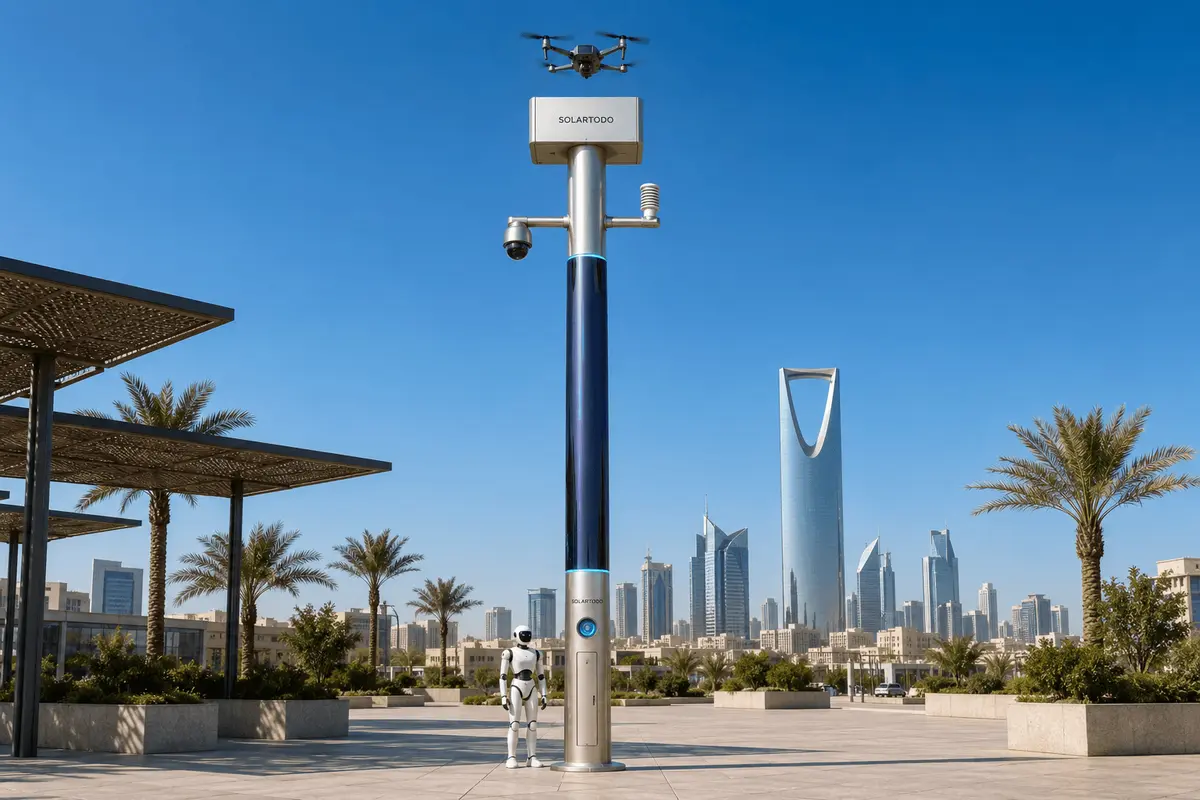
A City AI Pole is a non-lighting physical-AI edge node that hosts energy, sensing, compute, drone and ground-robot operations on one off-grid pole. In this Singapore deployment, SOLARTODO Sentinel Sky Hub supports holiday traffic-incident response for a power utility by processing data locally and coordinating authorized field actions from a common operating picture.
Holiday Traffic Risk in a Compact Mountain-Edge City
Singapore is dense, vertical and logistics-sensitive, but it also has a mountain-edge operating pattern around Bukit Timah, Mandai, central catchment roads, elevated expressway approaches and utility corridors that cross hilly green edges. During major holiday periods, traffic incidents near these corridors can slow emergency access, delay utility crews and create uncertainty about whether roadside cabinets, substations, underground access points or temporary event power assets are still reachable.
For a power utility, the problem is not only congestion. It is night-response availability. A collision, stalled vehicle, fallen object or crowd spillover near a utility corridor can trigger field questions across traffic management, security, customer operations, event command and utility maintenance. Existing fixed cameras may not cover the exact angle. A crew may need time to reach the site. A drone operator may not be positioned nearby. A ground check may be needed before a technician enters a dark, wet or congested roadside area.
This case study frames an illustrative temporary-event deployment of SOLARTODO Sentinel Sky Hub nodes for Singapore holiday operations. The objective is to improve the availability of field intelligence and response resources during night traffic incidents, subject to final engineering confirmation, site permissions, airspace approvals and local operational rules. The node is a pure smart pole with no lighting system. It is not a streetlight replacement and does not require grid, city or site power.
Cross-Department Operating Model
The proposed deployment is organized around a cross-department command view rather than a product dashboard. The power utility remains the operational stakeholder because it owns the resilience requirement: keep access, inspection and incident awareness available when holiday movement is at its highest. Traffic operations use the same event feed to understand obstruction and queue risk. Security teams use perimeter and intrusion cues around utility assets. Event operations see whether temporary staging, shuttle movement or crowd flow is creating a utility exposure. Maintenance teams receive dispatch-grade summaries instead of raw sensor feeds.
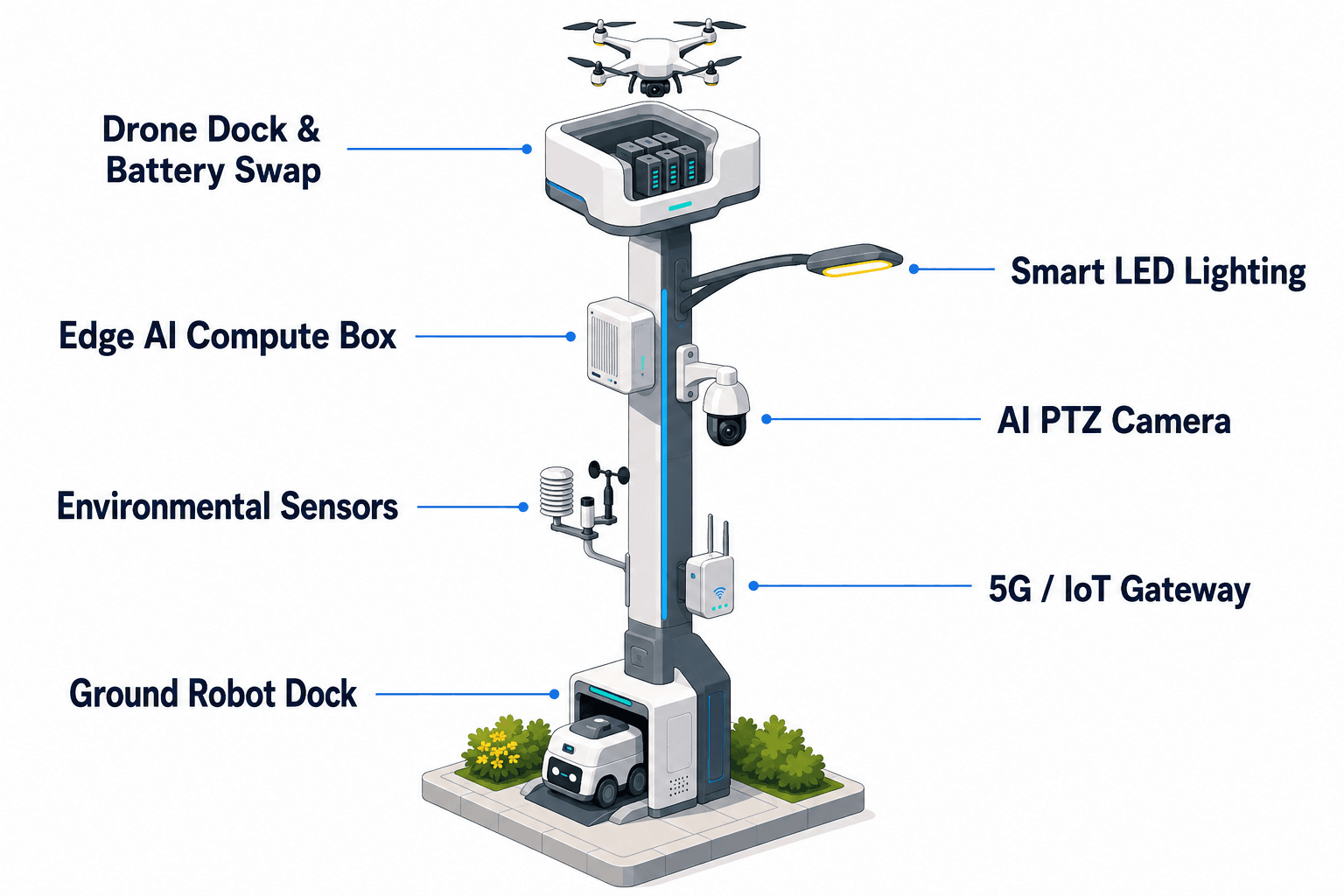
Sky Hub supports this by running OTATODO at the pole. The node fuses PTZ camera perception, environmental readings, drone mission state, battery magazine state, ground-robot charging state and energy budget into a common operating picture. The loop is sensing, authorized assessment and response, edge-compute scheduling, then field operations and maintenance. Human authorization remains explicit for regulated or safety-sensitive actions.
Raw video and sensor data stay on the pole and are processed locally. The command view receives de-identified event and status metadata, such as incident class, location reference, queue direction, crowd-density band, drone readiness, ground-robot battery state and recommended next action. This PDPL/LGPD-oriented design reduces unnecessary data movement while still giving multiple departments a shared operational picture.
Drone-Led Incident Visibility
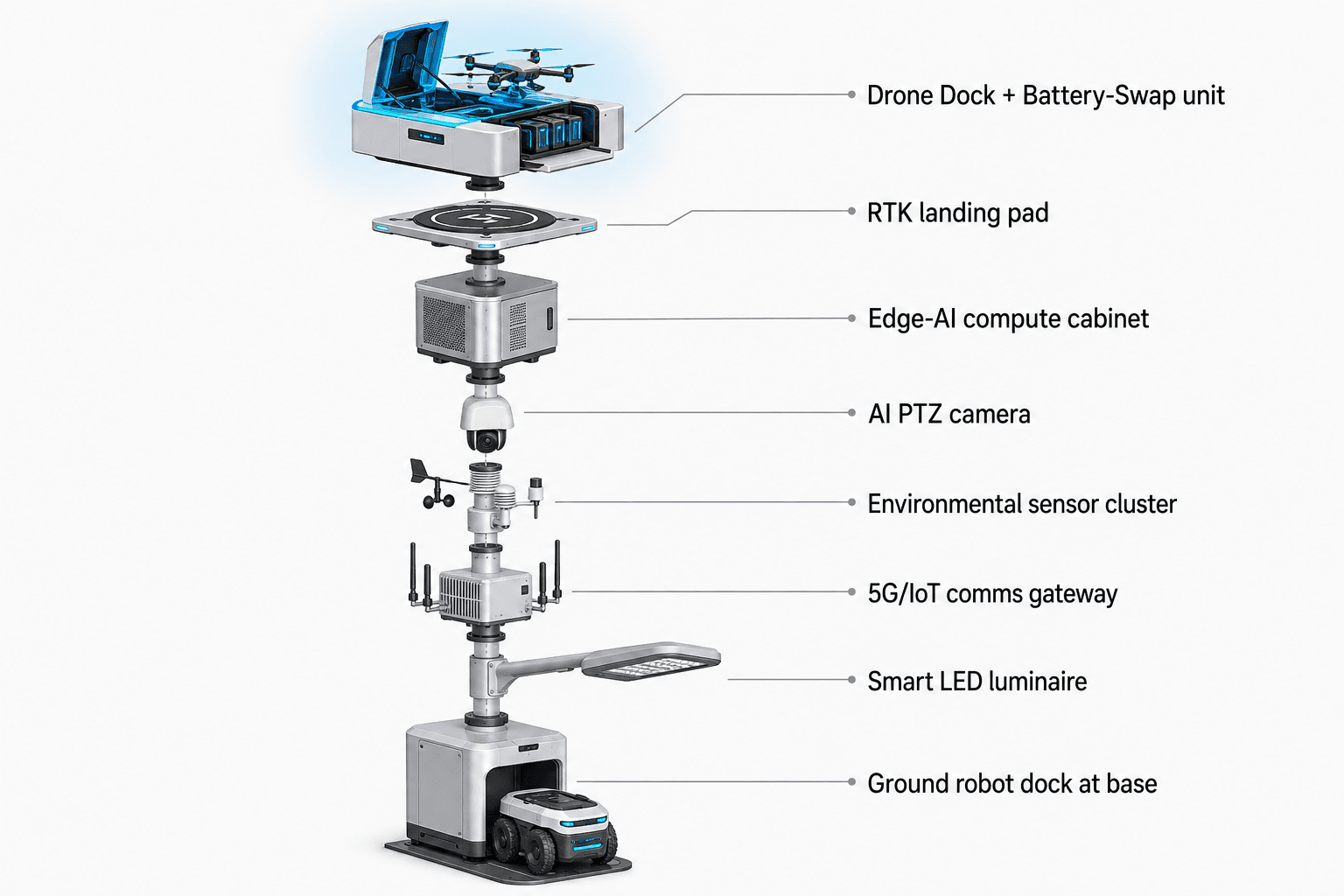
The primary operational topic is drone response. When the on-pole PTZ camera flags an unusual traffic stop, obstruction, crowd compression or perimeter approach, OTATODO scores the event locally and checks the mission queue, battery state and weather conditions. If the incident warrants aerial verification, the node can launch its friendly drone for a short regional patrol, inspection pass, return, battery exchange and redeployment cycle.
The automated battery hot-swap magazine is important for night-response availability. A landed drone receives a charged pack through a rear-service exchange sequence, then can relaunch for another sortie if the duty cycle and authorization state allow it. Multiple bays support several consecutive sorties without requiring an operator to stand at the pole during the holiday response window. This is especially relevant in Singapore, where rapid situational awareness can matter more than long-distance flight.
The drone operations manager handles route planning, charge and swap state, task queueing, fleet health and mission logs. It does not turn the node into an autonomous enforcement system. For Counter-UAS coordination, the pole may detect and track an unauthorized drone through its own sensors and optional partner-sensor inputs. Radar is not built into the pole. Any mitigation is non-kinetic and human-authorized only, such as commanding the friendly drone for close-approach deterrence or soft aerial net-capture where lawful and approved. There is no shoot-down, jamming, denial or autonomous attack.
Ground Robot as the Night-Response Module
The module focus for this Singapore configuration is the ground robot. A drone can establish overhead context quickly, but a ground robot can inspect the roadside surface, base cabinet, utility access point, temporary cable route or pole base from close range. At night, that can reduce blind dispatches and help the utility decide whether to send a crew immediately, hold for traffic control, or ask another department for support first.
The robot operates from the Sky Hub base area and returns for wireless charging. Its roles include autonomous patrol, alarm response, inspection, air-ground coordination and confirmation of whether a traffic incident is creating a utility hazard. For example, after a holiday-night collision near a temporary event corridor, the drone can confirm queue length and scene geometry while the robot checks whether the pole base, nearby cabinet, cable guard or access hatch has been affected. The PTZ camera continues anonymous vehicle count, crowd-density estimation, intrusion and perimeter awareness.
Edge AI compute on a Jetson-class module schedules these tasks on the pole. It prioritizes inference, drone launch readiness, robot charging, metadata generation and energy conservation. The deployment avoids face recognition and licence-plate recognition as active capabilities. Its value is operational availability: keeping inspection, aerial view, local perception and cross-department status available even when crews are delayed, network quality changes or night visibility is poor.
Availability and Energy Planning
The proposed KPI framing is availability, not claimed incident reduction. The buyer should evaluate whether the temporary-event node increases the percentage of holiday-night incident windows where the utility has a usable local picture, a ready drone sortie, a chargeable ground robot and a complete event record. Planning metrics should be recomputed against each site, holiday schedule, airspace constraint, traffic control plan and maintenance roster.
Sky Hub is designed as a fully off-grid micro-station. It uses battery storage plus approximately 15 square meters of 360-degree wrapped flexible CIGS thin-film solar replenishment over a vertical cylindrical body about 8 meters tall and 0.6 meters wide. The wrap may carry roughly 2.4 to 2.7 kWp nameplate. In realistic clear-sky use, a vertical cylinder collects direct sun mainly on its sun-facing projection, not across the whole wrap at once. In a high-irradiance region, this supports roughly 0.8 to 1.1 kW DC peak and about 6 to 9 kWh per day, with peaks typically mid-morning or mid-afternoon rather than noon.
For Singapore, final yield must be confirmed by solar study, shading review and monsoon-season duty-cycle modeling. The solar layer is supplemental replenishment, not an unlimited pure-solar claim. High-power drone and robot tasks are buffered by 5 to 20 kWh-class storage and scheduled by operational priority. The availability case is therefore practical: keep a battery-backed, locally intelligent, off-grid edge node ready during the temporary holiday period without depending on nearby grid, city or site power.
System Configuration
| Parameter | Configuration |
|---|---|
| Pole form | Sky Hub pure smart pole, non-lighting, fully off-grid cylindrical physical-AI edge node |
| Energy system | ~15 m² wrapped flexible CIGS replenishment, 5-20 kWh-class battery storage, duty-cycle scheduling |
| Edge AI compute | Jetson-class on-pole inference cabinet with local workload scheduling and metadata export controls |
| Drone operations | Autonomous launch, patrol, inspection, return, multi-bay battery hot-swap and mission logging |
| Ground robot module | Service or humanoid robot patrol, incident inspection, air-ground coordination and wireless charging at pole base |
| Sensing package | AI PTZ for anonymous vehicle count, crowd density, intrusion and perimeter awareness plus nine environmental sensors |
| Command integration | Common operating picture for utility, traffic, security, event and maintenance teams with human authorization gates |
How It Works
- On-pole PTZ and environmental sensors flag a night traffic anomaly near a utility corridor.
- Edge AI classifies the event locally and assigns a confidence and utility-impact score.
- The common operating picture asks the authorized operator to approve drone verification or ground-robot inspection.
- The drone captures incident geometry while the robot checks the pole base, cabinet or access route from ground level.
- OTATODO records mission state, battery state, operator decision, event metadata and maintenance follow-up without exporting raw video.
Planning Assumptions (Indicative)
Illustrative planning inputs a buyer can recompute — target metrics, not achieved results. Subject to final engineering confirmation.
| Metric | Planning assumption | Indicative value |
|---|---|---|
| Night-response availability | temporary-event node keeps local sensing, drone readiness and robot charging available during defined holiday response windows | target 90-95% operational window availability |
| Aerial verification | drone sortie replaces manual first-look checks for selected traffic-incident alerts where approvals and weather permit | ~10-20 verification sorties per holiday week planned |
| Ground inspection labor | ground robot performs close-range utility corridor checks before dispatching a human crew into congested night conditions | ~8-12 initial inspections per holiday week automated |
| Data minimization | raw video and sensor streams are processed locally, with command systems receiving only de-identified event and status metadata | target 100% local raw-data retention by policy |
| Energy reserve | battery-backed scheduling limits high-power drone and robot tasks during poor solar replenishment periods | target 1-2 nights of critical response reserve |
Deployed Equipment
- SOLARTODO Sentinel Sky Hub pure smart pole body with no lighting system
- Wrapped flexible CIGS thin-film solar replenishment layer
- 5-20 kWh-class battery storage and power management cabinet
- AI PTZ sensing module
- Nine-sensor environmental monitoring package
- Drone launch, landing and multi-bay battery hot-swap module
- Ground robot wireless charging interface at pole base
- OTATODO edge OS common-operating-picture gateway
Frequently Asked Questions
Is Sky Hub a smart streetlight for Singapore roads?
No. Sky Hub is a pure smart pole and includes no lighting system, lamp head or street-lighting function. In this proposed Singapore use case it is positioned as a physical-AI edge node for temporary-event traffic-incident response, utility asset awareness, drone operations and ground-robot coordination, not as a lighting asset.
Does the node need power from the city grid or an event site?
No. The configuration is designed as fully off-grid, using on-pole CIGS solar replenishment and battery storage. The solar wrap is a supplemental replenishment layer, not an unlimited self-sufficiency claim. Drone and robot activity must be scheduled against battery reserve, weather, shading and duty-cycle limits confirmed during site engineering.
What data leaves the pole during operations?
By default, raw video and sensor data stay on the pole and are processed locally by the edge AI system. The cross-department command view receives de-identified event and status metadata, such as incident category, readiness state, mission log references and maintenance actions. This is a PDPL/LGPD-oriented design approach, not a certification claim.
How does the ground robot help a power utility during a holiday traffic incident?
The ground robot provides close-range inspection when crews may be delayed by night congestion or safety controls. It can patrol near the pole base, utility cabinet, temporary cable route or access point, then return for wireless charging. Its role is to improve field visibility before dispatch, not to replace authorized utility technicians.
How are drone operations controlled without an operator on site?
OTATODO manages route planning, task queueing, health state, return sequencing and the battery hot-swap state machine at the pole. Human authorization remains part of safety-sensitive actions. The intended value is local readiness during holiday-night response windows, where a remote command team needs rapid aerial verification without stationing personnel at every point.
Does the Counter-UAS function attack unauthorized drones?
No. Counter-UAS coordination is non-lethal and human-authorized only. The pole may detect and track an unauthorized drone, including through optional partner-sensor inputs, then coordinate an approved friendly-drone response such as close-approach deterrence or soft aerial net-capture where lawful. It does not jam, shoot down or autonomously attack targets.
What should the buyer measure during evaluation?
The core KPI should be availability: whether the node keeps sensing, drone readiness, robot charging, energy reserve, mission records and command metadata available during the agreed holiday-night operating window. The case should not be judged on invented coverage or detection-rate claims; each metric needs local baselining and final engineering confirmation.
Explore Further
- City AI Pole / smart streetlight product line
- More smart-city deployment cases
- Talk to our engineering team
Planning a similar physical-AI deployment for streets, campuses or public spaces? Request an engineering consultation