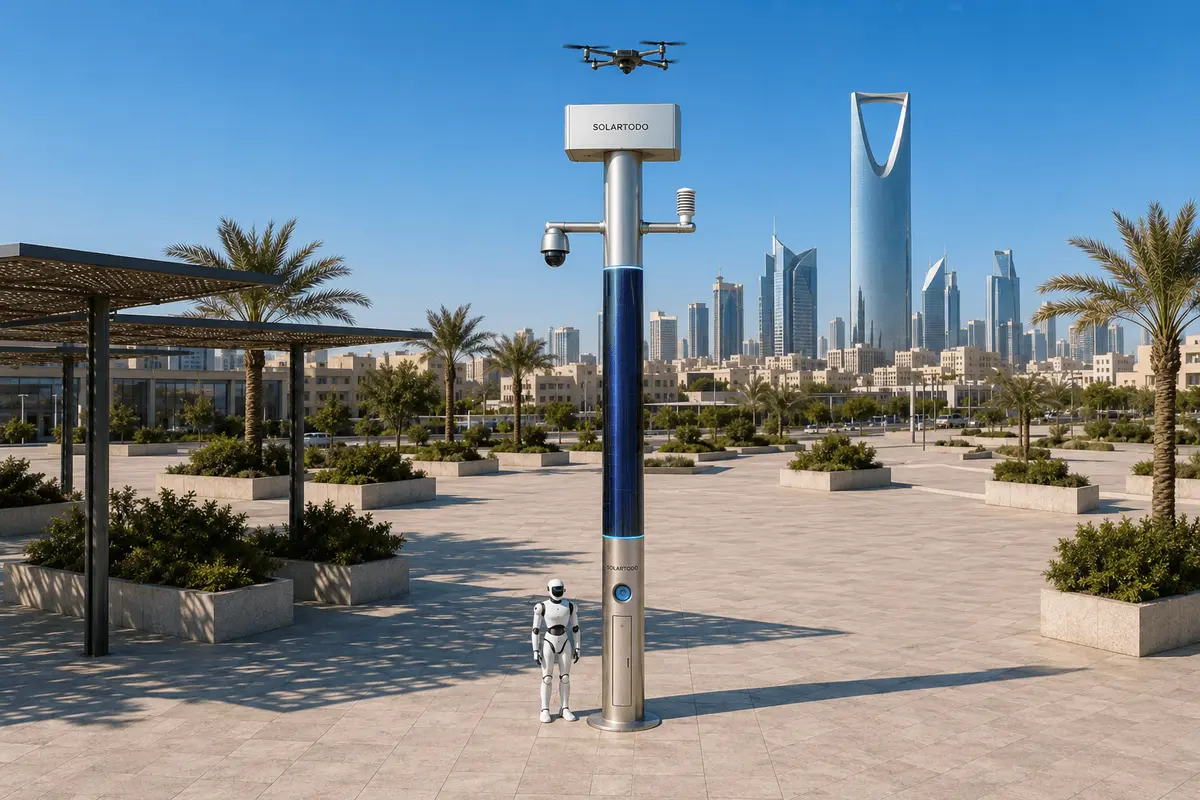
A City AI Pole is a non-lighting, off-grid physical-AI edge node that combines local compute, sensing, battery-backed solar replenishment, drone operations, robot support, and incident coordination. In this São Paulo port-corridor configuration, SOLARTODO Sentinel Sky Hub keeps campus-perimeter patrol, assessment, response authorization, and field records operating locally during network disruption.
1. Incident Context: A Port Corridor Under Sports-Event Pressure
The operating setting is a São Paulo logistics and port-adjacent campus corridor serving warehouses, customs support yards, emergency access lanes, and perimeter gates. During a major sports-event week, the city absorbs unusual passenger movement, road closures, temporary vendor activity, and higher demand on public communications networks. For emergency-management teams, the problem is not only crowd density in the city center. It is the secondary pressure placed on transport corridors that must keep port-related cargo, service contractors, security patrols, and emergency vehicles moving while cellular links become less predictable.
This case study is written as an incident-review style proposed configuration, subject to final engineering confirmation. The assumed incident begins with a partial network outage across the campus perimeter. Cameras, handheld radios, and central dashboards remain useful where connected, but field teams lose reliable access to continuous remote video and live tasking. Manual patrols can still walk or drive the fence line, yet they take time, expose staff to avoidable night work, and create gaps between observation, decision, and response record.
The emergency-management stakeholder therefore frames the deployment as a labor-replacement and continuity problem: keep routine perimeter inspection, first-look anomaly assessment, and incident evidence logs running even when the backhaul is degraded. The objective is not to build a lighting project or a generic surveillance upgrade. The objective is to place physical-AI edge nodes along a corridor so each node can sense locally, compute locally, coordinate a ground robot or friendly drone, and send only de-identified event or status metadata when a link is available.
2. Corridor Deployment: Non-Lighting Physical-AI Nodes Along the Campus Perimeter
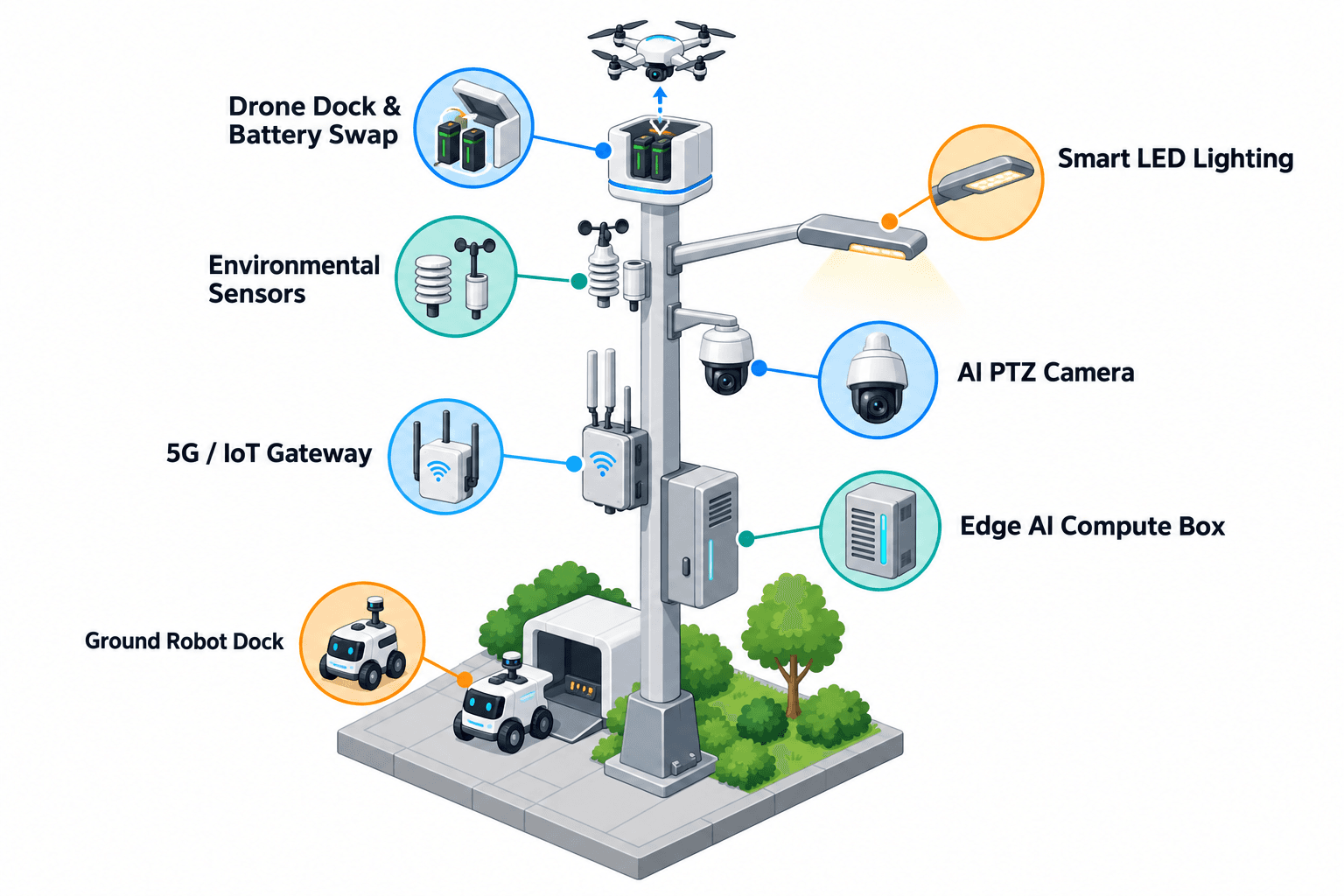
The proposed deployment uses SOLARTODO Sentinel Sky Hub as the pole-form shape of a city-ai-pole system. Each Sky Hub is a pure smart pole with no lighting system. It hosts sensing, edge compute, energy storage, drone operations, robot charging coordination, and local mission management. It is fully off-grid, using battery storage plus 360-degree wrapped flexible CIGS thin-film solar replenishment on the pole body. The solar layer is treated honestly as replenishment, not as unlimited self-sufficiency.
For planning, the pole body carries about 15 square meters of vertical wrapped CIGS surface over an approximately 8 meter tall, 0.6 meter wide cylindrical body, equal to roughly 2.4 to 2.7 kWp nameplate. Because a vertical cylinder collects direct sun mainly on its sun-facing projection, not across the full wrap at once, realistic clear-sky output in a high-irradiance region is roughly 0.8 to 1.1 kW DC peak and about 6 to 9 kWh per day. São Paulo engineering would need local irradiance, shading, salt exposure, wind, and seasonal duty-cycle confirmation. High-power drone and robot activity is buffered by 5 to 20 kWh-class storage and scheduled by operating policy.
The corridor pattern places nodes at decision points rather than at every meter of fence: gate approaches, blind turns, container-stack edges, service-road crossings, and emergency assembly zones. Each node maintains a local common-operating-picture view for its segment. If the network drops, the pole continues local inference, event scoring, task queueing, mission logs, drone swap sequencing, and robot return-to-base charging logic. When communications recover, the node forwards de-identified summaries and status records, not raw continuous video or raw sensor streams.
3. What the Edge Node Does During the Network-Outage Incident
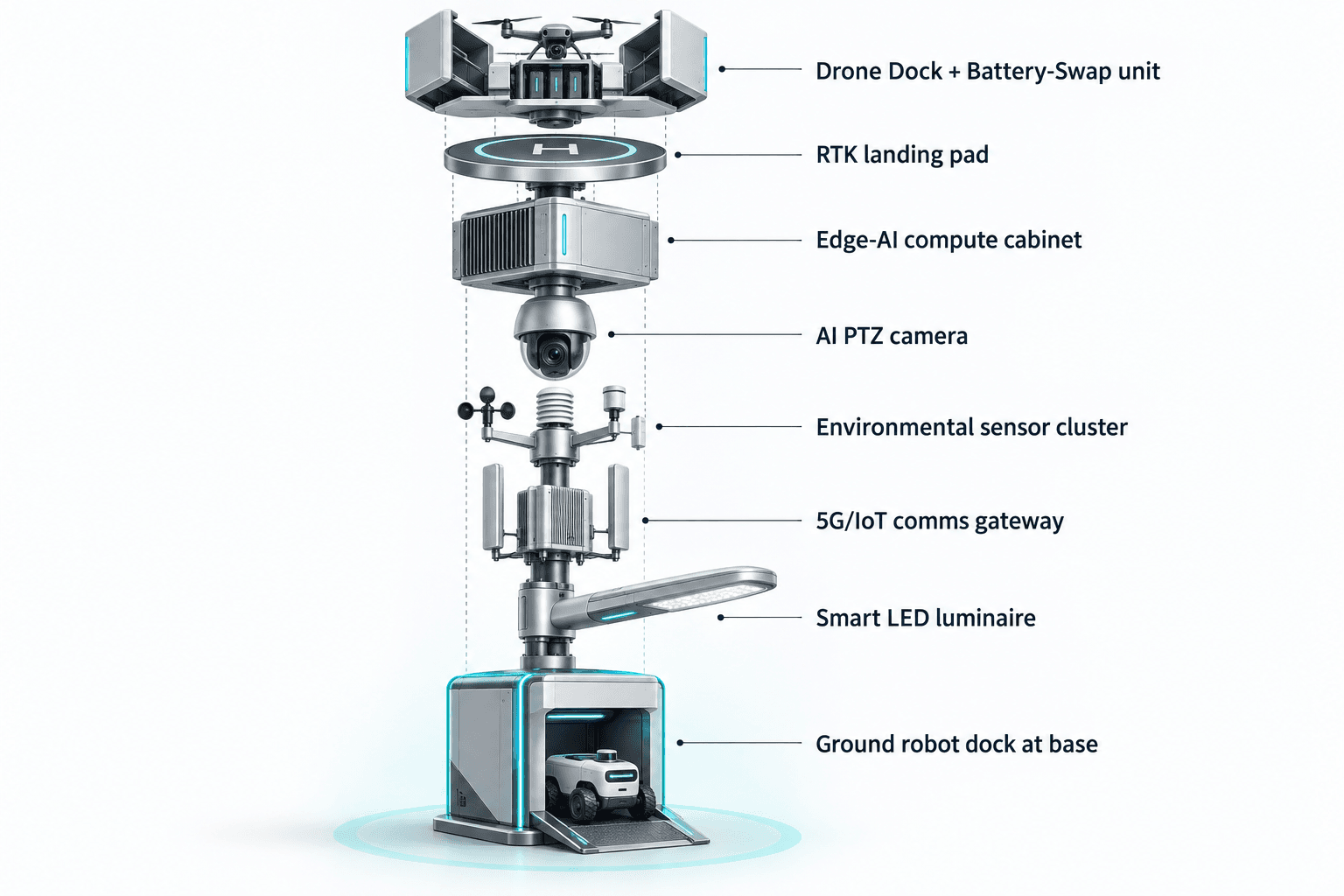
The incident-review sequence starts with the on-pole PTZ camera detecting an unusual after-hours perimeter movement near a service gate. Local perception classifies the event as intrusion or perimeter awareness, while also checking anonymous vehicle count, crowd density, noise, illuminance, wind, temperature, humidity, pressure, PM10, and PM2.5 context. Face recognition and licence-plate recognition are not part of this active deployed capability statement.
Because the central network is degraded, the edge-compute module becomes the operating center for the corridor segment. A Jetson-class edge module, Orin- or Thor-class in capability, schedules inference, robot dispatch, drone readiness, storage budget, and mission priority on the pole. Raw video and sensor data stay on the pole for local processing. Only de-identified event and status metadata may leave the pole under policy. This PDPL/LGPD-oriented architecture reduces the need to move sensitive material during a chaotic city event, while preserving the audit trail needed by emergency managers.
The operations loop follows the principle of sensing, authorized assessment and response, edge-compute scheduling, then field operations and maintenance. The COP command view shows the scored anomaly, local weather and visibility, battery state, drone magazine state, robot charging state, and available response options. A human operator authorizes the next action. The node can then send a ground service robot to inspect the gate line, ask a friendly drone to launch for a short regional patrol, or hold position while a human patrol is routed to the nearest safe access point.
If an unauthorized drone is detected by pole sensing or by an optional partner-sensor input, the pole can track it and coordinate the node's own friendly drone for a non-kinetic response, such as soft aerial net-capture or close-approach deterrence, only with human authorization. Radar is not built into the pole. The response is not a shoot-down, not jamming, and not an autonomous attack.
4. Robot-Centered Emergency Management: Replacing Routine Patrol Labor, Not Human Authority
The primary KPI framing for this São Paulo configuration is labor replacement in repetitive inspection and first-response observation. A ground robot handles perimeter sweeps, alarm follow-up, visible-condition checks, and return-to-pole wireless charging. It does not replace the emergency manager's authority. It replaces slow, repeated, low-information movement by human staff across a noisy and congested corridor.
During the outage, the robot can leave the pole base, patrol a pre-authorized segment, inspect a gate cabinet, confirm whether a barrier is open, and stream local findings back to the pole over the local link. The edge node fuses those findings with camera, environmental, and drone state. If the robot sees an obstruction, the COP shows a de-identified event card and maintenance task. If the robot confirms no physical breach, the operator can downgrade the event without sending a full manual patrol team.
Drone operations complement the robot where height, speed, or a wider sightline matter. The Sky Hub supports launch, regional patrol, inspection, return, and task redeployment for autonomous sorties without an operator standing at the pole. A multi-bay battery magazine performs automated rear-service battery exchange for a landed drone, enabling several consecutive sorties when storage and duty-cycle policy allow. Drone operations management handles route planning, charge or swap state, task queues, fleet health, and mission logs.
This structure moves the KPI discussion from headcount claims to planning inputs. The buyer can model how many manual night patrols per week may be replaced by robot patrols, how many first-look checks shift from vehicles to edge-coordinated drone sorties, and how many operator minutes are preserved because the incident record is created on-pole. These are target evaluation metrics, not achieved results.
5. Review Outcome: A Practical Configuration for Continuity, Privacy, and Field Discipline
For an emergency-management buyer, the proposed value is continuity under degraded connectivity. Sky Hub gives the port-campus corridor an off-grid physical node that can keep sensing, computing, robotic patrol, drone tasking, and incident records active without depending on city, grid, or site power. The configuration is strongest where a normal control room cannot be assumed to have perfect bandwidth during a sports-event surge.
The incident-review lesson is that the edge node should not be treated as a product datasheet. It is a field discipline point. It creates a local decision cell along the perimeter, keeps raw data local, enforces human-in-the-loop response, and converts repetitive patrol labor into scheduled robot and drone work. The emergency manager still decides, authorizes, and escalates. The pole supplies local perception, battery-backed autonomy, and an auditable event package.
Final engineering would confirm corridor spacing, mounting foundations, wind loading, solar yield, storage capacity, communication failover, robot route geometry, drone operating rules, local aviation and public-safety approvals, and LGPD-oriented data-handling policy. The case remains intentionally conservative: no named customer, no invented deployment quantity, no claimed coverage area, no detection-rate claim, no certification claim, and no achieved savings claim. It is a proposed São Paulo configuration for evaluating how physical-AI edge-node poles can keep a port-campus perimeter operational when the network is the first thing to fail.
System Configuration
| Parameter | Configuration |
|---|---|
| Pole category | City-ai-pole / physical-AI urban edge node; non-lighting pure smart pole with no lighting system |
| Energy system | Fully off-grid battery-backed micro-station with 360-degree wrapped flexible CIGS thin-film replenishment; approximately 5 to 20 kWh-class storage subject to duty-cycle design |
| Edge AI compute | Jetson-class on-pole inference and workload scheduler, Orin- or Thor-class capability, processing raw video and sensor data locally |
| Camera and sensing | AI PTZ for anonymous vehicle count, crowd density, intrusion, and perimeter awareness; nine environmental inputs including wind, weather, noise, particles, and illuminance |
| Drone operations | Autonomous launch, patrol, inspection, return, task redeployment, mission logging, and multi-bay rear-service battery hot-swap magazine |
| Ground robot operations | Humanoid or service robot patrol, alarm response, inspection, air-ground coordination, and wireless charging at pole base |
| C-UAS coordination | Detection and tracking with human-authorized non-kinetic friendly-drone coordination; optional partner-sensor input only, no built-in radar |
How It Works
- On-pole camera and environmental sensors flag an anomaly along the campus-perimeter corridor.
- Edge AI classifies the event, scores urgency, and keeps raw video and sensor data local.
- The COP presents robot, drone, energy, and communications state for human authorization.
- The authorized response dispatches a ground robot, launches a friendly drone, or routes a human patrol.
- The pole records mission logs and exports only de-identified event/status metadata when policy and connectivity allow.
Planning Assumptions (Indicative)
Illustrative planning inputs a buyer can recompute — target metrics, not achieved results. Subject to final engineering confirmation.
| Metric | Planning assumption | Indicative value |
|---|---|---|
| Inspection labor | Robot patrol replaces routine manual perimeter walks on selected night and event-shift windows | ~10 to 20 patrols/week targeted for automation |
| First-look response | Drone or robot verifies low-to-medium priority alarms before dispatching a vehicle patrol | ~50% of first-look checks targeted for remote field confirmation |
| Operator continuity | On-pole COP and local logs remain available during partial network outage | ~4 to 8 hours of degraded-link operation modeled per incident exercise |
| Drone sortie continuity | Battery magazine enables sequential short inspections when storage and weather policy permit | ~3 to 6 consecutive short sorties used as a planning input |
| Manual report preparation | Event metadata and mission logs are generated locally for later supervisor review | ~20 to 40 minutes/report targeted for reduction |
Deployed Equipment
- SOLARTODO Sentinel Sky Hub non-lighting physical-AI edge-node pole
- Battery-backed off-grid energy cabinet with wrapped flexible CIGS replenishment
- On-pole Jetson-class edge-compute module and local storage
- AI PTZ camera and environmental monitoring package
- Autonomous drone bay with multi-bay rear-service battery hot-swap magazine
- Ground robot wireless charging interface at pole base
- COP command-view software running OTATODO edge operations logic
Frequently Asked Questions
Is Sky Hub a smart streetlight or lighting upgrade for São Paulo streets?
No. In this configuration, Sky Hub is a pure non-lighting smart pole and physical-AI edge node. It is not a lighting product and does not include a lighting system. The deployment purpose is emergency-management continuity for a port-campus perimeter corridor, with sensing, edge compute, drone operations, robot support, and off-grid energy.
How does the system keep operating during a network outage?
The pole processes video and sensor inputs locally, schedules workloads on the edge-compute module, maintains robot and drone task queues, and records mission logs on-pole. If the backhaul is degraded, the local common-operating-picture still supports authorized response decisions. When connectivity returns, only de-identified event and status metadata are exported under policy.
Does the wrapped solar surface make the pole energy-unlimited?
No. The wrapped CIGS layer is a replenishment layer for a battery-backed off-grid micro-station, not a promise of unlimited pure-solar operation. The vertical cylindrical surface has realistic collection limits, so high-power drone and robot tasks must be buffered by storage and scheduled by duty cycle, weather, mission priority, and final engineering confirmation.
What role does the ground robot play in the incident-review scenario?
The robot replaces repetitive first-look inspection tasks rather than replacing human authority. It can patrol a pre-authorized perimeter segment, inspect a gate or obstruction, coordinate with the pole and drone, and return to the pole base for wireless charging. Emergency managers still authorize escalation, response posture, and any regulated action.
What counter-UAS capability is included?
The pole can detect and track an unauthorized drone through its own sensing or optional partner-sensor input, then coordinate a friendly drone for non-kinetic actions such as soft aerial net-capture or close-approach deterrence. Any mitigation is human-authorized. The system does not perform shoot-downs, jamming, denial, hard-kill action, or autonomous attack.
How should a buyer evaluate ROI without claimed achieved results?
The right evaluation is a planning model, not a fabricated success claim. A São Paulo buyer can compare current manual patrol frequency, outage response time, first-look alarm workload, report preparation effort, and robot/drone duty cycles against target automation assumptions. Final results depend on corridor geometry, operating rules, staffing model, and engineering validation.
Explore Further
- City AI Pole / smart streetlight product line
- More smart-city deployment cases
- Talk to our engineering team
Planning a similar physical-AI deployment for streets, campuses or public spaces? Request an engineering consultation