rooftop solar system for commercial buildings | SOLARTODO

Cinn Song
Founder & Chief Solutions Architect
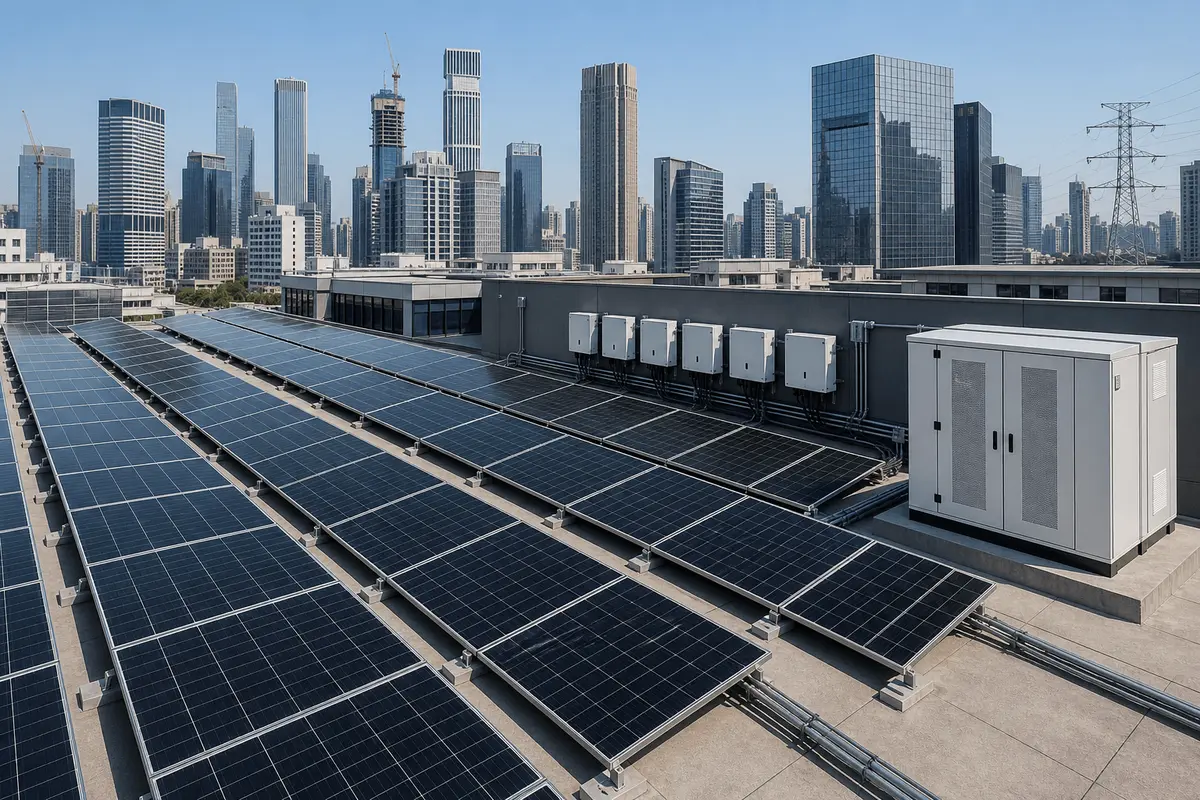
Watch the video
TL;DR
A commercial rooftop solar system turns unused roof area into a 100kW-500kW energy asset that can generate about 150-190MWh per 100kW annually. With 22.5%-24.5% TOPCon modules, optional 200kWh LFP storage, and EPC turnkey delivery, many buildings can reduce grid purchases, manage peak demand, and target 5-8 year payback.
Commercial rooftop solar systems use 100kW-500kW PV arrays, 22.5%-24.5% TOPCon modules, and optional 200kWh LFP storage to cut peak demand, improve resilience, and target 5-8 year payback.
Summary
Commercial rooftop solar systems use 100kW-500kW PV arrays, 22.5%-24.5% TOPCon modules, and optional 200kWh LFP storage to cut peak demand, improve resilience, and target 5-8 year payback.
Key Takeaways
Commercial rooftops above 1,000 m2 can host 100kW-200kW PV systems that generate 150-380MWh annually in strong solar markets.
- Assess 12 months of interval load data before sizing a 100kW-500kW rooftop solar system for peak shaving and self-consumption.
- Select 22.5%-24.5% N-type TOPCon modules where roof area, structural loading, and long-term output degradation below 0.4% per year matter.
- Pair 100kW PV with 200kWh LFP storage when evening load shifting, backup power, or demand-charge reduction is worth the added capex.
- Compare FOB, CIF, and EPC turnkey pricing because a 100kW + 200kWh commercial system typically falls within USD 79,200-101,200 EPC budget range.
- Model ROI over 25 years using local tariffs, 150-190MWh annual yield per 100kW, and a target payback period of 5-8 years.
- Specify IEC 61215, IEC 61730, UL 9540, IEEE 1547, CE, TUV, ISO 9001, and ISO 14001 compliance for bankable procurement.
- Apply volume discounts of 5% at 50+ units, 10% at 100+ units, and 15% at 250+ units during framework purchasing.
- Use SOLARTODO configurator support to validate roof layout, inverter ratio, battery capacity, and financing for projects above USD 1,000K.
Commercial Rooftop Solar System Overview
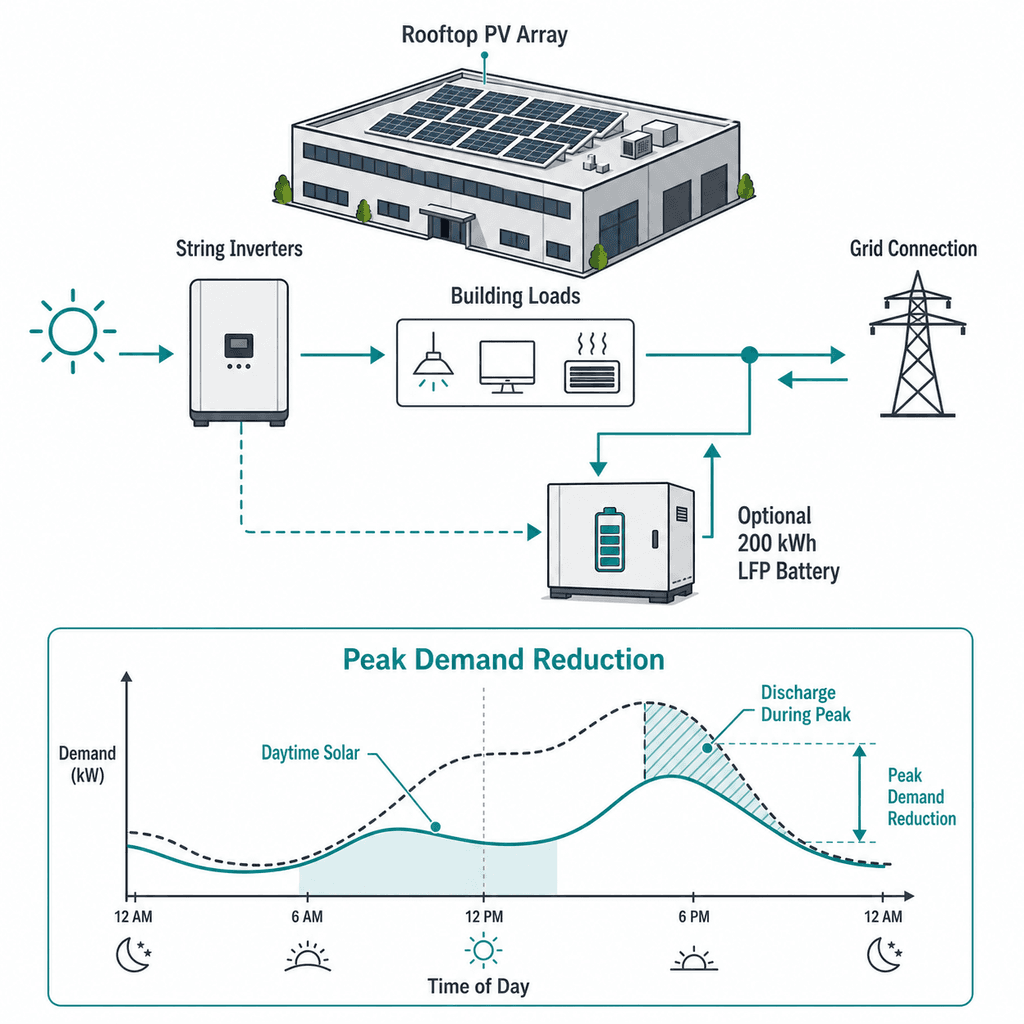
A commercial rooftop solar system converts unused roof area into a 100kW-500kW power asset that can offset 20%-60% of building electricity demand.
For procurement managers, the core business case is not simply green electricity. It is a controlled energy cost, a lower exposure to tariff escalation, and a measurable reduction in peak-grid dependency. A typical 100kW rooftop PV plant with high-efficiency TOPCon modules can produce about 150-190MWh per year in sunbelt locations, depending on irradiance, temperature, shading, soiling, and grid availability.
For engineers, the system architecture is familiar: PV modules, mounting structures, DC cabling, string or hybrid inverters, AC protection, monitoring, and utility interconnection. For facilities with evening demand or unstable grids, LFP battery storage adds load shifting, backup power, and demand-charge control. SOLARTODO typically positions this as an inquiry-led B2B project rather than an online marketplace purchase, with offline quotation, design coordination, and project financing available for qualified large projects.
According to IRENA (2025), renewable capacity additions reached 582GW in 2024, with solar PV contributing 452.1GW. This matters for commercial buyers because solar PV is now a globally mature supply chain, not a niche technology. IRENA also reported that 91% of new renewable power projects commissioned in 2024 were more cost-effective than fossil fuel alternatives.
The International Energy Agency states, 'Solar PV is the cheapest source of new electricity generation in most countries.' For commercial buildings, that statement becomes actionable only when the rooftop is structurally suitable, the interconnection is feasible, and daytime load is high enough to absorb generation.
Technical Design and System Components
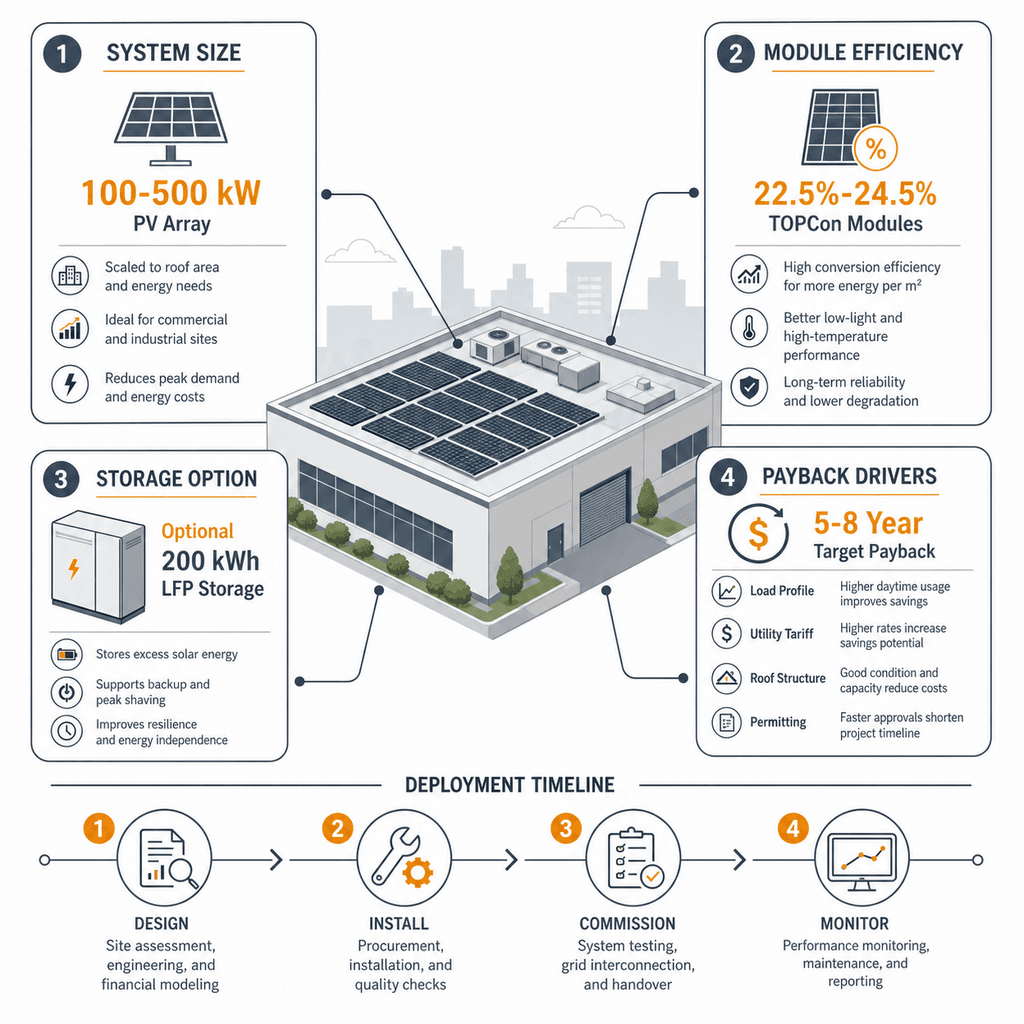
A well-designed commercial rooftop solar system combines 22.5%-24.5% PV modules, 97%+ inverter efficiency, and roof-specific structural engineering.
The PV array is the visible part of the system, but the financial result depends on the full electrical and mechanical package. SOLARTODO rooftop configurations commonly use N-type TOPCon mono modules with 210mm wafers because they provide high power density, low first-year degradation below 1.0%, and annual degradation typically below 0.4%. A 100kW rooftop system generally requires about 500-550 m2 of usable area when access paths, setbacks, tilt spacing, and maintenance zones are included.
Core Components
The core system should be specified as a coordinated package, not as isolated hardware line items.
- PV modules: 22.5%-24.5% efficiency N-type TOPCon panels, typically 700W+ class depending on module format.
- Mounting system: aluminum or galvanized steel structures designed for local wind load, roof type, and waterproofing constraints.
- Inverter platform: string, central, or hybrid inverter with 97%+ conversion efficiency and appropriate DC-to-AC ratio.
- Protection devices: DC isolators, surge protection, AC breakers, grounding, monitoring, and fire-safety disconnects.
- Battery option: LFP storage, often 200kWh for a 100kW commercial hybrid package requiring peak shaving or backup.
- Monitoring: real-time energy yield, inverter alarms, performance ratio, state of charge, and fault reporting.
According to NREL PVWatts methodology, PV energy output depends on solar resource, array tilt, azimuth, losses, and inverter assumptions. For B2B feasibility, that means a generic production number is only a screening value; procurement should request site-specific yield modeling before capex approval.
IEC 61215 and IEC 61730 are essential procurement filters. IEC 61215 addresses design qualification and type approval for PV modules, while IEC 61730 addresses module safety construction and testing. For battery-backed systems, UL 9540 and UL 9540A evidence should be reviewed where required by local code, insurer, or authority having jurisdiction.
NREL states, 'PVWatts estimates the energy production of grid-connected photovoltaic systems.' That simple purpose is valuable for early-stage comparison, but final engineering should include roof obstructions, local wind code, cable losses, thermal behavior, and utility export rules.
Applications, ROI, and Building Use Cases
Commercial rooftop solar delivers the strongest ROI where daytime loads exceed 60% of annual PV output and tariffs penalize peak demand.
The best-fit buildings are factories, logistics warehouses, shopping centers, cold-storage facilities, hospitals, schools, hotels, and office campuses with large unobstructed roofs. Industrial rooftops are especially attractive because production loads often align with solar generation hours. In markets with high diesel backup costs, solar-plus-storage can also reduce generator runtime and stabilize sensitive equipment.
A 100kW rooftop PV system generating 150-190MWh per year can offset a meaningful share of commercial daytime consumption. If grid electricity costs USD 0.12/kWh, annual energy savings may reach roughly USD 18,000-22,800 before demand-charge benefits, tax incentives, or carbon value. In higher-tariff markets at USD 0.18/kWh, the same production can be worth USD 27,000-34,200 per year.
Adding 200kWh of LFP storage changes the use case. Instead of exporting excess noon energy at a low rate, the building can shift stored energy into evening loads or discharge during peak demand windows. This is particularly useful where tariffs include 15-minute or 30-minute demand charges, where grid outages interrupt production, or where export approval is limited.
According to IEA PVPS (2024), distributed PV continues to expand as commercial users seek electricity-cost control and decarbonization. According to BloombergNEF (2024), Tier 1 module assessment focuses on bankability and project-finance acceptance, which is relevant for buyers seeking lender confidence rather than only the lowest module price.
For SOLARTODO buyers, the practical workflow is inquiry, preliminary load and roof assessment, technical sizing, offline quotation, financing review if applicable, and EPC execution. This approach is better suited to B2B projects than cart-style purchasing because roof loading, grid rules, battery safety, and payment instruments must be checked before commitment.
EPC Investment Analysis and Pricing Structure
A 100kW + 200kWh rooftop solar-plus-storage project typically uses FOB, CIF, or EPC turnkey pricing with 5%-15% volume discounts.
EPC means Engineering, Procurement, and Construction. For a commercial rooftop solar system, EPC turnkey delivery normally includes site survey, structural review coordination, electrical design, equipment procurement, logistics, mounting installation, inverter commissioning, grid interconnection support, monitoring setup, and handover documentation. It may also include training, warranty files, as-built drawings, and performance acceptance testing.
| Pricing tier | What it includes | Best fit | Buyer responsibility |
|---|---|---|---|
| FOB Supply | Factory-side equipment supply, export packing, and basic technical documents | Buyers with their own freight forwarder and local installer | International freight, import clearance, local installation |
| CIF Delivered | Equipment, sea freight, and insurance to destination port | Importers and EPC firms needing landed equipment cost control | Port clearance, inland transport, installation, permits |
| EPC Turnkey | Design, procurement, logistics coordination, installation, commissioning, and handover | Commercial owners seeking single-project accountability | Site access, approvals, utility coordination, payment milestones |
For budgeting, SOLARTODO product data indicates a 100kW + 200kWh hybrid TOPCon LFP commercial system can sit within an EPC turnkey budget of USD 79,200-101,200, subject to destination, roof type, local labor, permitting, switchgear, and battery enclosure requirements. FOB supply is usually lower because it excludes freight, import handling, and local construction. CIF delivered adds shipping cost visibility but still leaves on-site works with the buyer or local EPC partner.
Volume pricing should be negotiated early for multi-site rollouts. A practical procurement guide is 5% discount for 50+ units, 10% for 100+ units, and 15% for 250+ units, subject to bill of materials standardization, shipment schedule, and payment security. This is most relevant for retail chains, telecom facilities, logistics portfolios, and industrial groups with repeatable roof designs.
Payment terms are typically 30% T/T deposit and 70% against bill of lading, or 100% L/C at sight for qualified buyers and banks. Financing is available for large projects above USD 1,000K, especially where the buyer can provide site data, audited financials, project pipeline, and local legal documentation. For commercial inquiries, contact [email protected] or +6585559114.
ROI should compare solar against the building's avoided grid tariff, not only against module cost. In many commercial cases, 5-8 year payback is achievable where annual yield reaches 150-190MWh per 100kW and electricity tariffs are high enough. Batteries improve ROI when they reduce peak charges, avoid outage losses, or increase self-consumption from low-value exported energy.
Comparison and Selection Guide
Commercial buyers should compare rooftop PV, rooftop PV plus storage, and diesel backup using 25-year cost, resilience, and operational risk.
A specification table helps procurement teams align technical performance with purchasing risk. The lowest capex option is not always the best lifecycle option, especially when the site faces outages, time-of-use tariffs, or roof-space constraints.
| Option | Typical size | Main benefit | Limitation | Best use case |
|---|---|---|---|---|
| Rooftop PV only | 100kW-500kW | Lowest capex and direct daytime savings | Limited evening use without export value | Warehouses, offices, retail, factories with daytime load |
| Rooftop PV + 200kWh LFP | 100kW PV + 200kWh storage | Peak shaving, backup, and higher self-consumption | Higher upfront cost and battery compliance review | Manufacturing, cold storage, clinics, telecom hubs |
| Diesel backup only | 100kVA-500kVA | Dispatchable emergency power | Fuel cost, emissions, maintenance, noise | Emergency-only sites with low outage frequency |
| Grid-only supply | Existing service | No project capex | Tariff escalation and outage exposure | Low-tariff sites with limited roof area |
Selection should begin with roof strength, waterproofing condition, available area, shading, and electrical room capacity. A roof near replacement should be upgraded before PV installation because removing and reinstalling modules later adds avoidable cost. For metal roofs, clamp-based mounting can reduce penetrations; for concrete roofs, ballast or anchored systems depend on wind uplift and structural margins.
Procurement should request datasheets, warranty terms, degradation curves, inverter certifications, battery safety documentation, monitoring scope, and spare-parts plan. Engineers should verify the single-line diagram, protection coordination, grounding, fire setbacks, and interconnection requirement under IEEE 1547 or equivalent local grid rules. Project managers should align shipping lead time, crane access, work-at-height safety, shutdown windows, and commissioning criteria.
SOLARTODO supports commercial rooftop projects across Latin America, the Middle East, Africa, Southeast Asia, and Europe. The strongest projects usually combine repeatable engineering, bankable components, clear payment terms, and a measured ROI model based on site data rather than generic assumptions.
FAQ
Commercial rooftop solar FAQ answers should cover 10 procurement, engineering, cost, installation, maintenance, and warranty questions in 40-80 words each.
Q: What is a rooftop solar system for commercial buildings? A: A commercial rooftop solar system is a grid-connected PV plant installed on a business roof to generate electricity for on-site use. Typical projects range from 100kW to 500kW, using modules, mounting, inverters, protection devices, and monitoring. The goal is to reduce grid purchases, stabilize energy cost, and use otherwise idle roof area.
Q: How much roof area is needed for a 100kW commercial solar system? A: A 100kW rooftop solar system usually needs about 500-550 m2 of usable roof area with modern high-efficiency TOPCon modules. The exact area depends on module wattage, tilt, access paths, shading, setbacks, and local fire-code spacing. Structural capacity and roof condition should be verified before procurement.
Q: How much electricity can a 100kW rooftop solar system generate? A: A 100kW commercial rooftop PV system can generate about 150-190MWh per year in many sunbelt locations. Output varies with irradiance, temperature, module orientation, soiling, shading, and downtime. Buyers should use NREL PVWatts-style modeling or detailed simulation before approving final ROI assumptions.
Q: What is the typical payback period for commercial rooftop solar? A: Commercial rooftop solar commonly targets a 5-8 year payback where electricity tariffs are moderate to high and daytime self-consumption is strong. Payback improves when the system offsets peak demand charges or diesel generator use. It becomes longer when tariffs are low, roof work is complex, or export rates are limited.
Q: Should a commercial building add battery storage to rooftop solar? A: Battery storage is worthwhile when the building needs peak shaving, evening load shifting, backup power, or higher solar self-consumption. A 100kW PV system paired with 200kWh LFP storage is a common hybrid benchmark. If the building consumes most solar energy during the day, PV-only may deliver better first-cost economics.
Q: What does EPC turnkey delivery include for rooftop solar? A: EPC turnkey delivery includes engineering, procurement, construction, commissioning, and project handover. For rooftop solar, that usually covers layout design, structural coordination, equipment supply, installation, electrical works, monitoring setup, and acceptance testing. Buyers should confirm whether permits, utility studies, civil works, and grid fees are included.
Q: How are FOB, CIF, and EPC turnkey prices different? A: FOB pricing covers factory-side equipment supply and export preparation, while CIF adds freight and insurance to the destination port. EPC turnkey pricing includes design, installation, commissioning, and handover, so it is the most complete budget view. SOLARTODO also supports volume pricing of 5%-15% for qualified multi-site purchases.
Q: What certifications should commercial rooftop solar equipment have? A: PV modules should meet IEC 61215 for design qualification and IEC 61730 for safety qualification. Grid-connected equipment should align with IEEE 1547 or local interconnection rules, while battery systems may require UL 9540 and UL 9540A evidence. CE, TUV, UL, ISO 9001, and ISO 14001 documentation also supports procurement due diligence.
Q: How long does installation take for a commercial rooftop solar project? A: A 100kW-500kW rooftop solar project often takes several weeks on site after design approval, equipment delivery, permits, and grid coordination are complete. The actual schedule depends on roof access, safety restrictions, shutdown windows, weather, and utility inspection timing. Multi-site programs should standardize designs to reduce delivery risk.
Q: What maintenance does a commercial rooftop solar system require? A: Maintenance includes visual inspections, module cleaning where soiling is high, inverter checks, torque checks, thermal scanning, alarm review, and performance-ratio monitoring. Many commercial sites schedule preventive maintenance every 6-12 months. Inverters may need service or replacement during a 25-year PV asset life, depending on model and operating conditions.
Q: Can rooftop solar reduce diesel generator use? A: Rooftop solar can reduce diesel runtime when paired with controls and, often, battery storage. PV alone offsets daytime grid or generator consumption, while storage helps during clouds, peak periods, or evening loads. For critical sites, engineers should design the system around generator synchronization, load priority, and battery reserve settings.
Q: How does SOLARTODO quote commercial rooftop solar projects? A: SOLARTODO uses an inquiry-to-offline-quotation model rather than marketplace checkout. Buyers provide load data, roof details, location, target scope, and preferred pricing basis such as FOB, CIF, or EPC turnkey. For large projects above USD 1,000K, financing review may be available after technical and commercial qualification.
Conclusion
A commercial rooftop solar system above 100kW can deliver 150-190MWh per year, 5-8 year payback, and stronger energy resilience when properly engineered.
The bottom line: for commercial buildings with strong daytime load and usable roof area, SOLARTODO rooftop solar systems using 22.5%-24.5% TOPCon modules and optional 200kWh LFP storage provide a practical route to lower energy cost, peak-demand control, and 25-year asset value.
References
The 7 references below support PV cost, system modeling, module safety, interconnection, and battery compliance for commercial rooftop solar procurement.
- IRENA (2025): Renewable Power Generation Costs in 2024 and Renewable Capacity Statistics 2025, including 582GW renewable additions and solar PV's 452.1GW contribution.
- IEA PVPS (2024): Trends in Photovoltaic Applications 2024, documenting global PV deployment, distributed generation growth, and commercial solar market trends.
- NREL (2024): PVWatts Calculator methodology for estimating grid-connected photovoltaic energy production using solar resource, array geometry, losses, and inverter assumptions.
- IEC 61215-1:2021 (2021): Terrestrial photovoltaic module design qualification and type approval requirements for crystalline silicon PV modules.
- IEC 61730-1:2023 (2023): Photovoltaic module safety qualification requirements for construction, testing, and electrical safety evaluation.
- IEEE 1547-2018 (2018): Standard for interconnection and interoperability of distributed energy resources with electric power system interfaces.
- UL 9540 (2023): Safety standard for energy storage systems and equipment, relevant to commercial LFP battery-backed solar projects.
- BloombergNEF (2024): Tier 1 PV module manufacturer methodology for bankability assessment and project-finance procurement screening.
About SOLARTODO
SOLARTODO is a global integrated solution provider specializing in solar power generation systems, energy-storage products, smart street-lighting and solar street-lighting, intelligent security & IoT linkage systems, power transmission towers, telecom communication towers, and smart-agriculture solutions for worldwide B2B customers.
About the Author

Cinn Song
Founder & Chief Solutions Architect
Cinn Song founded SOLARTODO LIMITED and leads its smart-city infrastructure engineering — from solar, storage and integrated smart poles to the company's push into physical-AI city edge nodes: pole-mounted edge computing, vertical LLMs for smart cities, drone-based O&M with autonomous battery swapping, robotic maintenance, and high-speed counter-UAS interception. Since 2010, he has directed turnkey EPC + BOT delivery across 50+ countries, including telecom monopole supply for national grid operators, off-grid solar street-lighting for African municipalities, and integrated smart-pole programs for Gulf smart cities.
Cite This Article
Cinn Song. (2026). rooftop solar system for commercial buildings | SOLARTODO. SOLARTODO. Retrieved from https://solartodo.com/knowledge/rooftop-solar-system-for-commercial-buildings-2
@article{solartodo_rooftop_solar_system_for_commercial_buildings_2,
  title = {rooftop solar system for commercial buildings | SOLARTODO},
  author = {Cinn Song},
  journal = {SOLARTODO Knowledge Base},
  year = {2026},
  url = {https://solartodo.com/knowledge/rooftop-solar-system-for-commercial-buildings-2},
  note = {Accessed: 2026-10-19}
}
Published: July 7, 2026 | Available at: https://solartodo.com/knowledge/rooftop-solar-system-for-commercial-buildings-2
Subscribe to Our Newsletter
Get the latest solar energy news and insights delivered to your inbox.
View All Articles