Rio de Janeiro Solar PV System Market Analysis: 2.2MW Industrial Rooftop Configuration Guide
Summary
Rio de Janeiro’s 6.21M-person municipality, 13.8/34.5kV distribution context, and 1,460-2,010 kWh/m² solar resource support a recommended 2.2MW industrial rooftop Solar PV System producing ~3.73GWh/year.
Key Takeaways
This section summarizes 7 engineering and market points for a 2.2MW Rio de Janeiro industrial rooftop Solar PV System.
- A recommended system would use approximately 3,605 TOPCon panels rated 600W each, forming about 2.163MWdc for a nominal 2.2MW class design.
- With a 1.15 DC/AC ratio, the inverter block would be approximately 1.88MWac using central inverter architecture for the 500kW-5MW C&I class.
- Annual yield is estimated at ~3,734,311 kWh using 5.5 kWh/m²/day irradiance and ~14% total system losses.
- Rio de Janeiro has 6,211,223 residents and 5,174.60 people/km², according to IBGE 2022 municipal census data.
- Light’s medium-voltage standards list 13.8kV and 34.5kV as nominal supply classes, supporting LV-to-MV interconnection review.
- CO2 reduction is estimated at ~1,568 tons/year, equivalent to approximately 70,560 trees, using the project-specific emissions assumption.
- The system should align with IEC 61215 and IEC 61730 module qualification, plus ANEEL’s 75kW-to-3MW non-dispatchable minigeneration framework.
Market Context for Rio de Janeiro
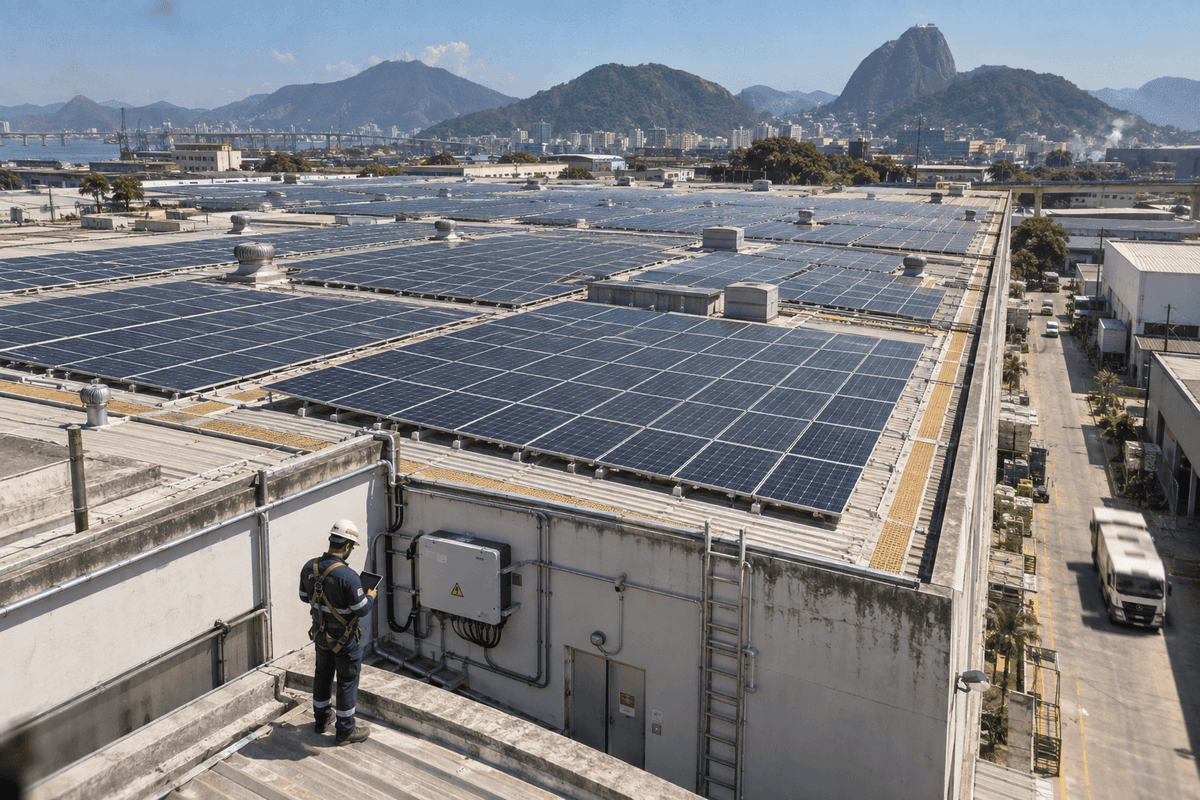
Rio de Janeiro’s dense urban load, coastal climate, and medium-voltage distribution framework make 2MW-class rooftop PV technically relevant for factories, logistics centers, and large commercial roofs.
Rio de Janeiro is a high-density demand center rather than a low-load rural solar market. According to IBGE (2022), the municipality recorded 6,211,223 residents and a density of 5,174.60 people/km² across about 1,200.329 km². For B2B buyers, that density matters because industrial rooftops can generate close to load, reduce daytime import from the grid, and avoid the land-use constraints common in coastal urban regions.
Solar resource is also commercially meaningful. According to the Government of Rio de Janeiro energy booklet (2024), the state’s solar irradiation potential varies from 1,460 to 2,010 kWh/m². For a site-level engineering estimate at coordinates -22.91, -43.17, the project-specific irradiance input of 5.5 kWh/m²/day is consistent with a strong fixed-tilt PV opportunity when roof orientation, structural capacity, soiling, and shading are controlled.
Grid interconnection needs early attention. According to Light (2023), the standardized medium-voltage nominal supply classes in its Rio de Janeiro documentation are 13.8kV and 34.5kV. A 2.2MW industrial rooftop Solar PV System would therefore be treated as a C&I-scale generator requiring protection coordination, metering, transformer review, and utility access approval rather than a simple residential net-metering installation.
Brazil’s distributed generation framework is mature but specific. According to ANEEL (2026), microgeneration is up to 75kW, while minigeneration is above 75kW and up to 3MW for non-dispatchable sources under the applicable framework. ANEEL states, “A rede funciona como uma bateria,” describing how surplus distributed generation can be injected and later compensated through the grid under SCEE rules.
Recommended Technical Configuration
A typical 2.2MW Rio de Janeiro industrial rooftop deployment would require a 500kW-5MW C&I architecture with multiple inverter inputs and LV-to-MV step-up interconnection.
Based on SOLARTODO’s Solar PV System architecture rules, this project belongs in the 500kW-5MW C&I / industrial class. That means a recommended configuration is not a residential single-string design and not a 50MW utility substation design. It should use multiple array sections, central inverter conversion, AC collection, and a step-up transformer for connection review at the facility’s available LV/MV interface.
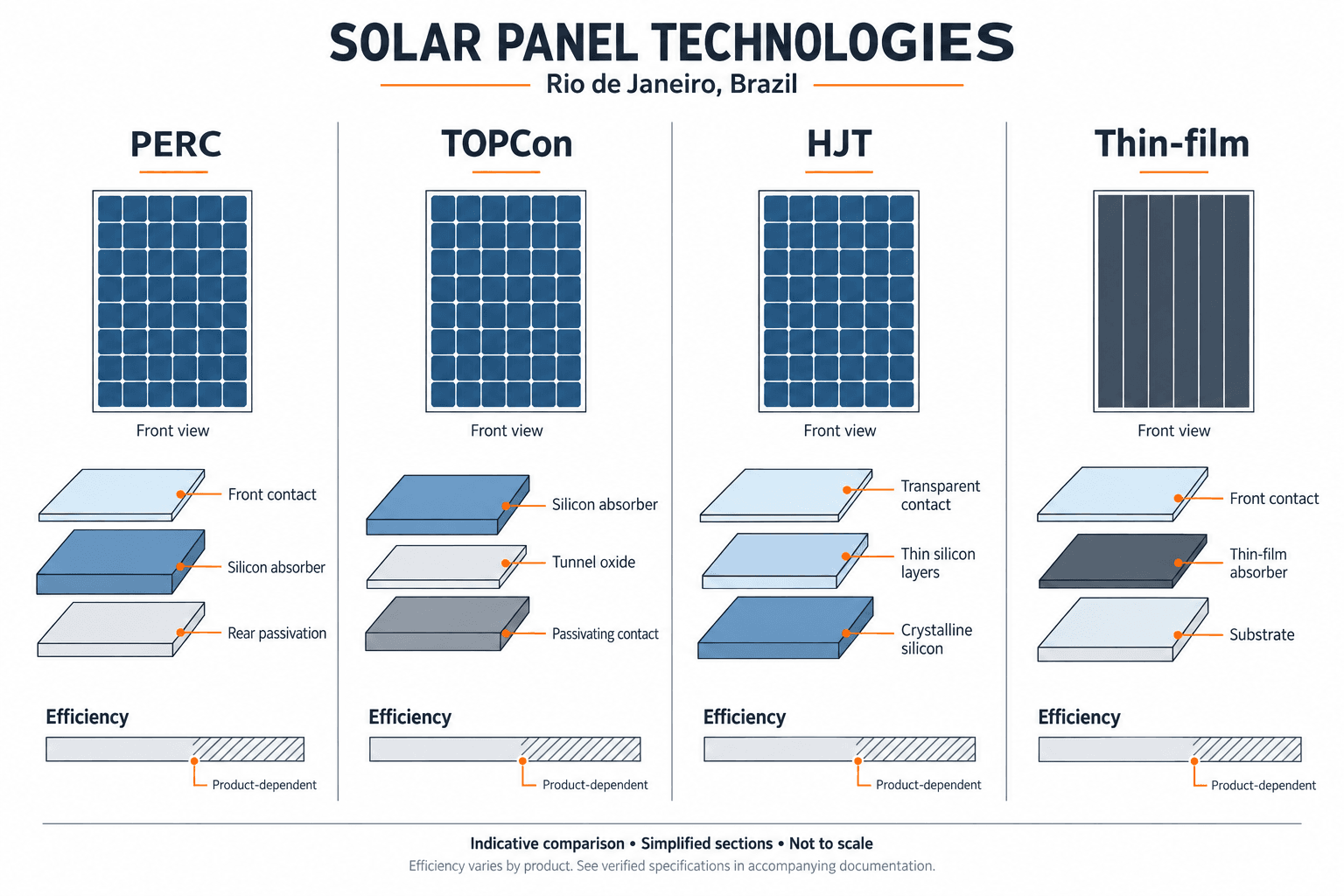
A typical configuration of this scale would consist of approximately 3,605 TOPCon photovoltaic modules rated at 600W each. The DC nameplate is approximately 2.163MWdc, rounded commercially as a 2.2MW industrial rooftop Solar PV System. With a DC/AC ratio of 1.15, the inverter AC block would be approximately 1.88MWac, allowing the array to sustain stronger inverter loading during typical irradiance windows while accepting limited clipping during peak conditions.
The roof layout should use fixed-tilt aluminum racking at 20 degrees. In Rio de Janeiro, this tilt supports annual yield while keeping wind loads, row spacing, and roof access practical for industrial buildings. SOLARTODO would recommend structural verification before final string layout, especially for coastal wind exposure, waterproofing penetrations, and maintenance walkways.
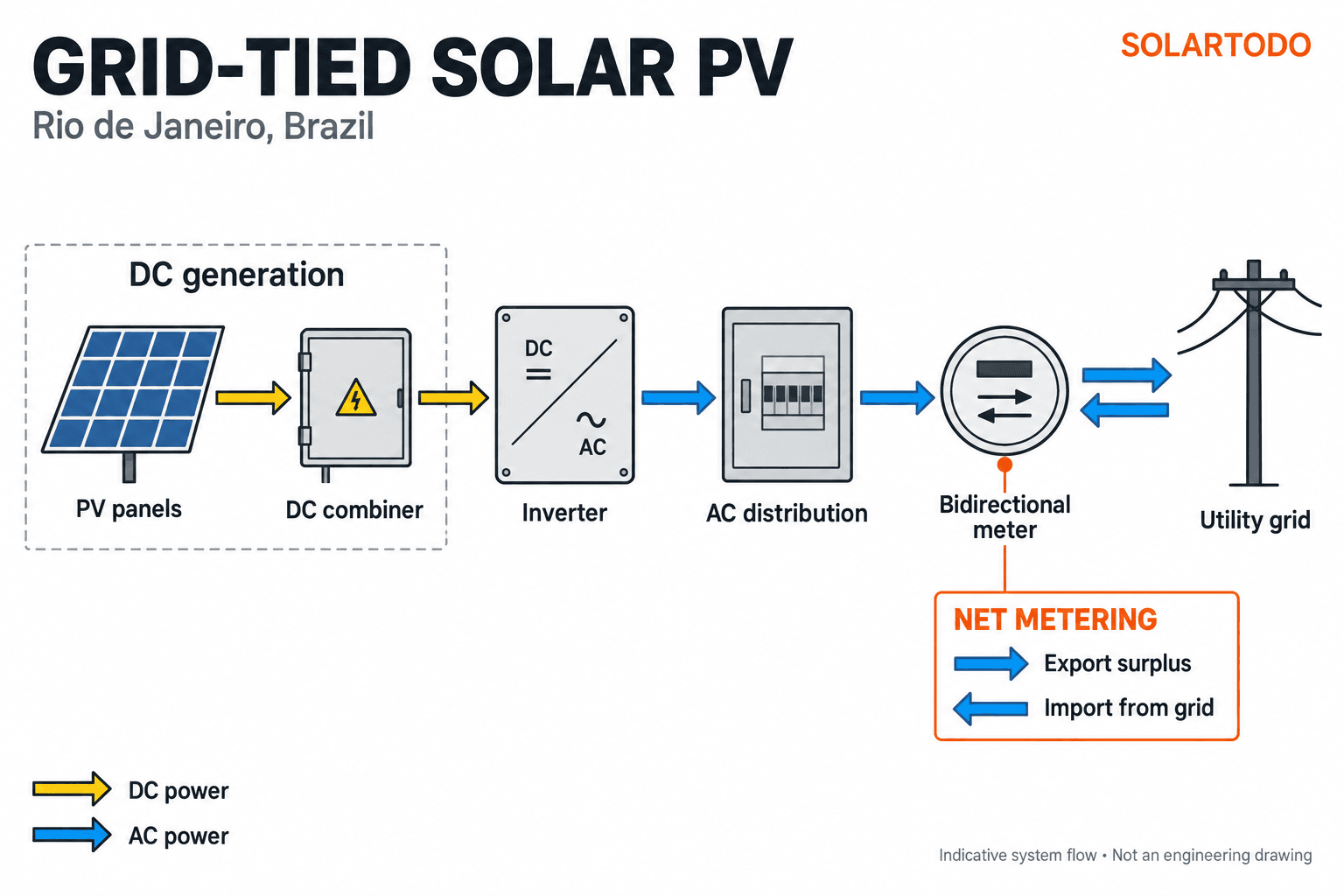
The electrical design should include DC combiners, monitored strings, central inverter AC output, AC distribution, protection relays, bi-directional metering, and transformer integration. The connection path should be coordinated with Light’s 13.8kV or 34.5kV medium-voltage requirements when the existing facility transformer cannot absorb the generation capacity safely.
Technical Specifications
The recommended 2.2MW system uses 3,605 TOPCon modules, 20-degree fixed tilt, 1.15 DC/AC ratio, and IEC-qualified module construction.
- Product line: SOLARTODO Solar PV System for industrial rooftop generation.
- Recommended scale class: 500kW-5MW C&I / industrial rooftop PV.
- PV array: approximately 3,605 TOPCon panels, 600W per module.
- Nominal project class: 2.2MW; calculated DC capacity: approximately 2.163MWdc.
- Module efficiency: 25% TOPCon cell/module specification as provided for this configuration.
- Array mounting: fixed tilt aluminum racks, 20-degree tilt angle.
- Inverter architecture: central inverter, 98% CEC efficiency, 5-year inverter warranty.
- DC/AC ratio: 1.15, implying approximately 1.88MWac inverter capacity.
- System losses: approximately 14%, including soiling 2%, shading 3%, mismatch 2%, wiring 3%, and availability 3%.
- Irradiance assumption: 5.5 kWh/m²/day for annual production modeling.
- Annual yield: approximately 3,734,311 kWh/year.
- Degradation: 0.4% per year for the TOPCon panels.
- Lifetime: 30 years, with 25-year panel warranty and 5-year inverter warranty.
- Standards: IEC 61215 for design qualification and IEC 61730 for PV module safety qualification.
According to NREL (2014), PVWatts uses a default total system loss of 14%, which closely matches the loss stack specified for this Rio de Janeiro configuration. IEC states, “safe electrical and mechanical operation,” when describing IEC 61730-1 requirements for PV module construction; this is the relevant safety lens for procurement qualification. For project documentation, SOLARTODO should also include single-line diagrams, array layout, protection settings, grounding design, and local utility interconnection forms.
Implementation Approach
A typical Rio de Janeiro 2.2MW rooftop PV project would move through 6 phases from feasibility and utility access review to commissioning and monitoring.
The first phase is technical feasibility. Engineers should verify roof load capacity, waterproofing conditions, fire access lanes, panel orientation, shading from HVAC units or parapets, and transformer headroom. This stage should also confirm whether the facility connection is low voltage with onsite transformation or already served through a medium-voltage interface.
The second phase is detailed engineering. A typical package includes module layout, string sizing, DC combiner allocation, inverter positioning, AC distribution, grounding, lightning protection, cable tray routing, monitoring architecture, and interconnection protection. According to ANEEL (2023), PRODIST Module 3 governs technical requirements for distribution-system connection, so utility-facing design review should begin before equipment shipment.
The third phase is procurement and logistics. SOLARTODO can specify TOPCon panels, aluminum tilt racks, central inverter equipment, DC combiner boxes, AC distribution gear, meters, monitoring devices, and transformer-interface components. For Brazil, CKD or containerized equipment planning should include port clearance, inland transport windows, roof crane access, and spare-module allocation.
The fourth phase is installation. Work typically proceeds by roof preparation, racking layout, module mounting, DC stringing, combiner installation, inverter placement, AC cabling, protection panel integration, and transformer tie-in. Because Rio de Janeiro has coastal humidity and salt-air exposure in many districts, connector sealing, cable UV rating, aluminum compatibility, and anti-corrosion fasteners should be specified clearly.
The fifth phase is testing and commissioning. Electrical checks should include insulation resistance, polarity, open-circuit voltage, inverter startup, protection relay behavior, metering verification, emergency shutdown, and monitoring data validation. The final handover should include as-built drawings, warranty files, operating procedures, maintenance schedule, and grid approval documentation.
Expected Performance & ROI
This 2.2MW configuration is expected to produce approximately 3.73GWh/year and reduce about 1,568 tons of CO2 annually under the stated assumptions.
The project-specific annual yield is approximately 3,734,311 kWh. Against the calculated 2.163MWdc array, that equals roughly 1,727 kWh/kWp/year, a strong output level for an industrial rooftop PV system using 5.5 kWh/m²/day irradiance. On the AC side, the implied capacity factor is about 22.7% when referenced to approximately 1.88MWac inverter capacity.
According to IEA (2025), solar PV increased by about 480 TWh globally in 2024, the largest increase of any electricity source. IEA states, “Solar PV led the way,” which reflects why industrial buyers increasingly evaluate rooftop solar as a mainstream energy asset rather than an experimental sustainability add-on.
Payback depends on local tariff structure, demand charges, taxes, financing, import duties, and whether generation is self-consumed or credited through Brazil’s compensation rules. For Rio de Janeiro C&I buyers, the most important ROI driver is usually daytime self-consumption ratio: a facility that consumes most output during operating hours normally captures stronger savings than one exporting a larger share. SOLARTODO’s recommendation is to model at least 12 months of interval load data before finalizing inverter capacity and export limits.
According to IRENA (2025), the global weighted average LCOE for utility-scale solar PV in 2024 was USD 0.043/kWh. That benchmark is not a Brazil-specific EPC price and should not be used as a direct quotation; however, it supports the broader economic logic that PV is now a bankable generation technology. For procurement decisions, lifecycle value should include degradation at 0.4%/year, inverter replacement planning after warranty, cleaning costs, insurance, and monitoring response time.
Results and Impact
A properly engineered 2.2MW Rio de Janeiro rooftop system would target 30-year generation, measurable CO2 reduction, and reduced exposure to daytime grid energy costs.
The expected impact is operational rather than anecdotal. A typical 2.2MW industrial rooftop Solar PV System in Rio de Janeiro would convert unused roof area into a long-life power asset, producing approximately 3.73GWh in year one before degradation. Over 30 years, output would decline gradually at the specified 0.4% per year, so long-term financial modeling should use degraded annual yield rather than a flat generation number.
The environmental impact is also quantifiable. Based on the project-specific factor, annual CO2 reduction is approximately 1,568 tons, or about 70,560 trees equivalent. That figure should be treated as a planning estimate and adjusted if the buyer uses a different grid emissions factor, ESG reporting protocol, or carbon-accounting boundary.
Comparison Table
This table compares 4 Solar PV System size classes and explains why Rio de Janeiro’s 2.2MW rooftop recommendation fits the C&I industrial category.
| Capacity class | Typical application | Recommended architecture | Rio de Janeiro fit | Notes |
|---|---|---|---|---|
| 3-15kW | Residential rooftop | Single string + 5kW residential inverter | Not suitable | Too small for industrial loads |
| 15-100kW | Small commercial | 2-4 strings + 1-2 string inverters | Limited fit | Useful for shops or small warehouses |
| 100-500kW | Mid commercial | Multi-string + central or string inverter + LV/MV transformer | Partial fit | Suitable for medium factory roofs |
| 500kW-5MW | C&I / industrial | Multiple inverters or central inverter + LV-to-10/35kV step-up transformer | Best fit | Matches the 2.2MW SOLARTODO recommendation |
| 5-50MW | Utility small | Inverters + 35kV step-up + grid substation | Not rooftop fit | Requires open land or dedicated utility site |
| 50MW+ | Utility large | Central inverters + 110/220kV interconnection | Not applicable | Over-scaled for an industrial roof |
Pricing & Quotation
SOLARTODO provides 3 quotation paths for Rio de Janeiro buyers: FOB equipment supply, CIF delivery, and EPC Turnkey with installation and commissioning.
SOLARTODO offers three pricing tiers for this product line: FOB Supply (equipment ex-works China), CIF Delivered (including ocean freight and insurance), and EPC Turnkey (fully installed, commissioned, with 1-year warranty). Volume discounts are available for large-scale deployments. Configure your system online for an instant estimate, or request a custom quotation from our engineering team at [email protected].
For product details, buyers can review the SOLARTODO Solar PV System page before submitting load data, roof drawings, and utility bills through contact us. Final pricing should be based on bill-of-materials validation, Brazilian import route, roof reinforcement scope, MV interconnection requirements, and monitoring expectations. No price should be inferred from this guide because engineering scope changes can materially affect the final offer.
Frequently Asked Questions
These 10 FAQs answer the main technical, installation, warranty, ROI, maintenance, and pricing questions for a 2.2MW Rio rooftop PV system.
Q1: What is the recommended Solar PV System size for an industrial rooftop in Rio de Janeiro? A typical recommendation is a 2.2MW-class industrial rooftop system using approximately 3,605 TOPCon modules rated 600W each. The calculated DC size is about 2.163MWdc, paired with roughly 1.88MWac inverter capacity at a 1.15 DC/AC ratio. Final sizing should be checked against 12 months of load data and roof constraints.
Q2: Why does this configuration use a central inverter instead of residential string inverters? A 2.2MW industrial rooftop falls into the 500kW-5MW C&I class, where central inverter architecture can simplify AC collection, monitoring, and grid protection. Residential 5kW string inverters would be operationally fragmented at this scale. The specified central inverter has 98% CEC efficiency and a 5-year inverter warranty.
Q3: How much electricity would the Rio de Janeiro system generate annually? Under the project-specific assumptions, annual generation is approximately 3,734,311 kWh. That estimate uses 5.5 kWh/m²/day irradiance, 20-degree fixed tilt, 25% TOPCon module efficiency, and about 14% total system losses. Actual output depends on roof azimuth, shading, cleaning frequency, inverter uptime, and curtailment limits.
Q4: What installation timeline is typical for a 2.2MW industrial rooftop PV project? A typical timeline can range from several months to longer when utility access studies or roof reinforcement are required. Feasibility, structural review, and utility application should start first, followed by detailed engineering, procurement, shipping, installation, testing, and commissioning. The longest schedule risks are usually interconnection approval, transformer availability, and roof access logistics.
Q5: What payback period should a buyer expect in Rio de Janeiro? Payback cannot be stated without tariffs, tax treatment, financing cost, self-consumption ratio, and EPC scope. For C&I users, the strongest economics usually occur when daytime facility load absorbs most PV output. SOLARTODO should model ROI with 12 months of bills, interval demand data, expected annual yield, degradation at 0.4%/year, and inverter maintenance assumptions.
Q6: What maintenance does a 2.2MW rooftop Solar PV System require? Maintenance typically includes module cleaning, thermal inspections, inverter checks, combiner inspection, torque checks, monitoring review, vegetation or debris control, and protection testing. In Rio de Janeiro’s coastal environment, corrosion checks and connector sealing deserve special attention. The assumed loss stack includes 2% soiling and 3% availability, so maintenance directly affects yield.
Q7: How does this system compare with a ground-mount solar plant? A rooftop system uses existing industrial roof area and can sit close to daytime load, reducing land acquisition needs. A ground-mount project may offer easier orientation, access, and expansion, but it requires suitable land and permitting. For dense Rio de Janeiro industrial districts, rooftop PV is often the more practical first option.
Q8: Which warranties apply to the recommended configuration? The specified configuration includes a 25-year panel warranty and a 5-year inverter warranty. The TOPCon panels are modeled with 0.4% annual degradation and a 30-year lifetime assumption. Buyers should separate product warranty, workmanship warranty, monitoring support, and inverter service terms in the final contract documentation.
Q9: Does the system need bi-directional metering and utility approval? Yes. A 2.2MW distributed generation project requires utility coordination, protection review, and metering that distinguishes imported and exported active energy. ANEEL’s framework and PRODIST Module 3 shape the access process. In Rio de Janeiro, Light’s 13.8kV and 34.5kV medium-voltage standards may influence transformer and protection design.
Q10: Does SOLARTODO publish EPC pricing for this Rio de Janeiro configuration? No fixed price is provided in this guide because roof structure, import route, transformer scope, cable distance, grid approval, and installation conditions vary by site. SOLARTODO offers FOB Supply, CIF Delivered, and EPC Turnkey quotation paths. Buyers should use the configurator or request a custom engineering quote with bills, drawings, and load data.
References
This guide relies on 7 public and technical references covering Rio demographics, solar resource, distributed generation rules, grid voltage, PV losses, costs, and IEC standards.
- IBGE (2022): Rio de Janeiro municipality recorded 6,211,223 residents, 5,174.60 people/km² density, and 1,200.329 km² area in census/municipal data.
- Government of Rio de Janeiro / SEENEMAR (2024): State solar irradiation potential varies from 1,460 to 2,010 kWh/m², supporting PV market screening.
- Light (2023): RECON-MT documentation lists 13.8kV and 34.5kV as standardized nominal medium-voltage supply classes in the Rio de Janeiro concession context.
- ANEEL (2026): Micro and minigeneration rules define microgeneration up to 75kW and non-dispatchable minigeneration above 75kW up to 3MW under current distributed generation rules.
- NREL (2014): PVWatts Version 5 documentation uses 14% default total system losses for PV energy estimates.
- IEA (2025): Global Energy Review 2025 reports solar PV generation increased by about 480 TWh in 2024, the largest increase among electricity sources.
- IRENA (2025): Renewable Power Generation Costs in 2024 reports global weighted-average utility-scale solar PV LCOE of USD 0.043/kWh.
- IEC (2023): IEC 61730-1:2023 specifies photovoltaic module safety construction requirements; IEC 61215 covers PV module design qualification and type approval.
Equipment Deployed
- 3,605× TOPCon photovoltaic panels, 600W each, 25% efficiency, 0.4%/yr degradation
- Central inverter block, approximately 1.88MWac, 98% CEC efficiency, 5-year warranty
- Fixed-tilt aluminum rooftop racking, 20° tilt angle
- DC combiner boxes with string monitoring and protection
- AC distribution panel and protection interface
- LV-to-MV transformer integration for 13.8kV or 34.5kV interconnection review
- Bi-directional net metering and monitoring system
- IEC 61215 and IEC 61730 compliant module package