Retrofitting Existing Streetlights to Smart Poles: A…

Cinn Song
Founder & Chief Solutions Architect
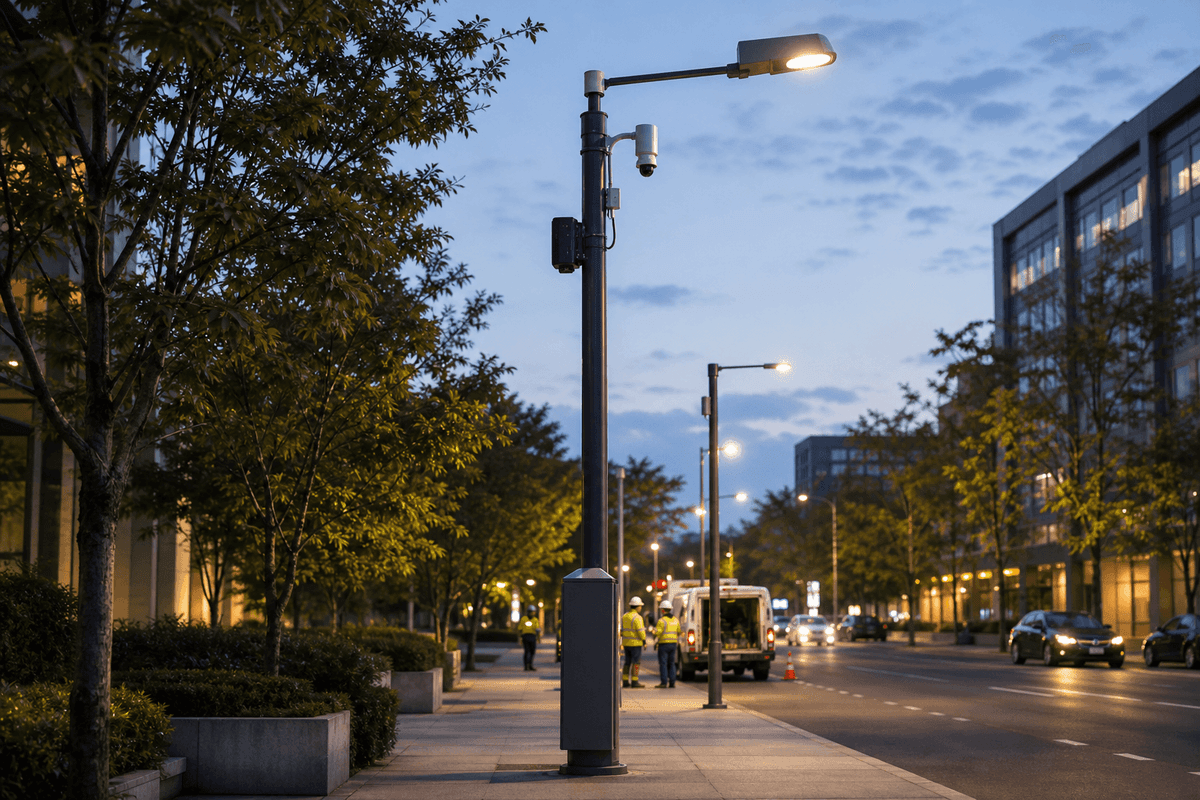
Watch the video
TL;DR
Retrofitting existing streetlights into smart poles is practical when the pole, foundation, power supply, and communications can support added modules. Start with LED and controls for 40-60% energy savings, validate a 50-pole pilot, then scale to 100 or 250+ units with SOLARTODO EPC pricing across FOB, CIF, or turnkey delivery.
Retrofitting streetlights to smart poles upgrades existing 6m-12m assets with LED, sensors, cameras, WiFi, and controls, cutting energy 40-60%, reducing separate hardware by up to 66%, and scaling from 50-pole pilots to 250+ EPC rollouts.
Summary
Retrofitting streetlights to smart poles upgrades existing 6m-12m assets with LED, sensors, cameras, WiFi, and controls, typically cutting lighting energy 40-60%, reducing separate roadside hardware by up to 66%, and phasing deployment from 50-pole pilots to 250+ EPC rollouts.
Key Takeaways
- Audit 100% of existing 6m-12m poles for foundation, wind load, corrosion, feeder capacity, and cabinet space before adding smart modules.
- Prioritize LED conversion at 120-170 lm/W to reduce streetlighting energy use by 40-60% versus legacy HPS or metal-halide fixtures.
- Segment retrofits into 50-pole pilots, 100-pole district packages, and 250+ network rollouts to control technical and procurement risk.
- Select IP66 outdoor enclosures and -40°C to +55°C electronics for bridges, coastal corridors, industrial parks, and high-temperature markets.
- Consolidate 3 assets into 1 smart pole by combining lighting, CCTV, and environmental sensing, reducing visible hardware count by about 66%.
- Specify 4G/5G, LoRaWAN, Ethernet, or hybrid backhaul with 99% target device availability before adding cameras or edge AI.
- Model EPC pricing across FOB supply, CIF delivered, and turnkey installation, using 5%, 10%, and 15% volume discounts at 50, 100, and 250+ units.
- Plan maintenance around 6-12 month inspection intervals, replaceable modules, surge protection, and remote diagnostics to protect 10-25 year assets.
Why Retrofit Existing Streetlights Into Smart Poles
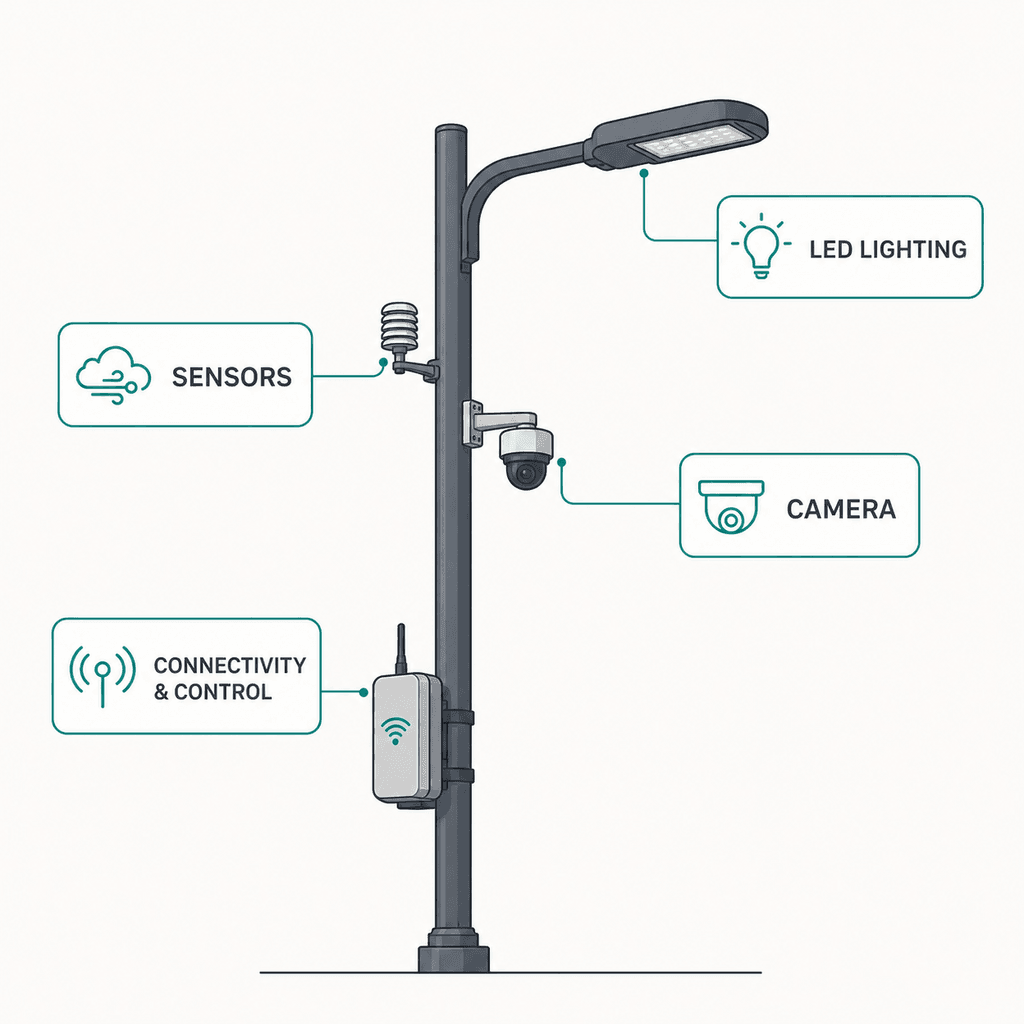
Retrofitting existing streetlights into smart poles is usually faster than rebuilding corridors because 50-70% of civil work may already exist. Municipalities, utilities, campuses, ports, and EPC contractors can reuse pole locations, power routes, and lighting rights-of-way while adding digital services in controlled phases.
The main procurement problem is not whether smart poles are useful; it is whether the old asset can safely carry new loads. A conventional light pole may have been designed only for one luminaire, while a smart-pole retrofit may add a camera, 4G/5G gateway, environmental sensor, public-address speaker, WiFi 6 access point, or small edge-computing cabinet. For B2B buyers, the migration roadmap should begin with structural verification, electrical capacity checks, and network design before any module list is finalized.
According to the IEA (2026), lighting in buildings and outdoor applications represented about 8% of global electricity demand in 2024, equal to around 2,200 TWh. The IEA also states, "LEDs have become one of the biggest energy efficiency success stories of recent years." That matters for retrofit economics because smart controls, dimming schedules, and LED luminaires can create immediate operating savings before advanced data services are monetized.
SOLARTODO positions smart streetlight retrofits as B2B infrastructure projects, not online product purchases. A typical migration starts with inquiry, site data collection, engineering review, offline quotation, and optional project financing. For Latin America, the Middle East, Africa, Southeast Asia, and Europe, the practical objective is to convert existing roadside lighting into multi-function infrastructure while keeping traffic disruption, trenching, and future maintenance under control.
Technical Migration Roadmap
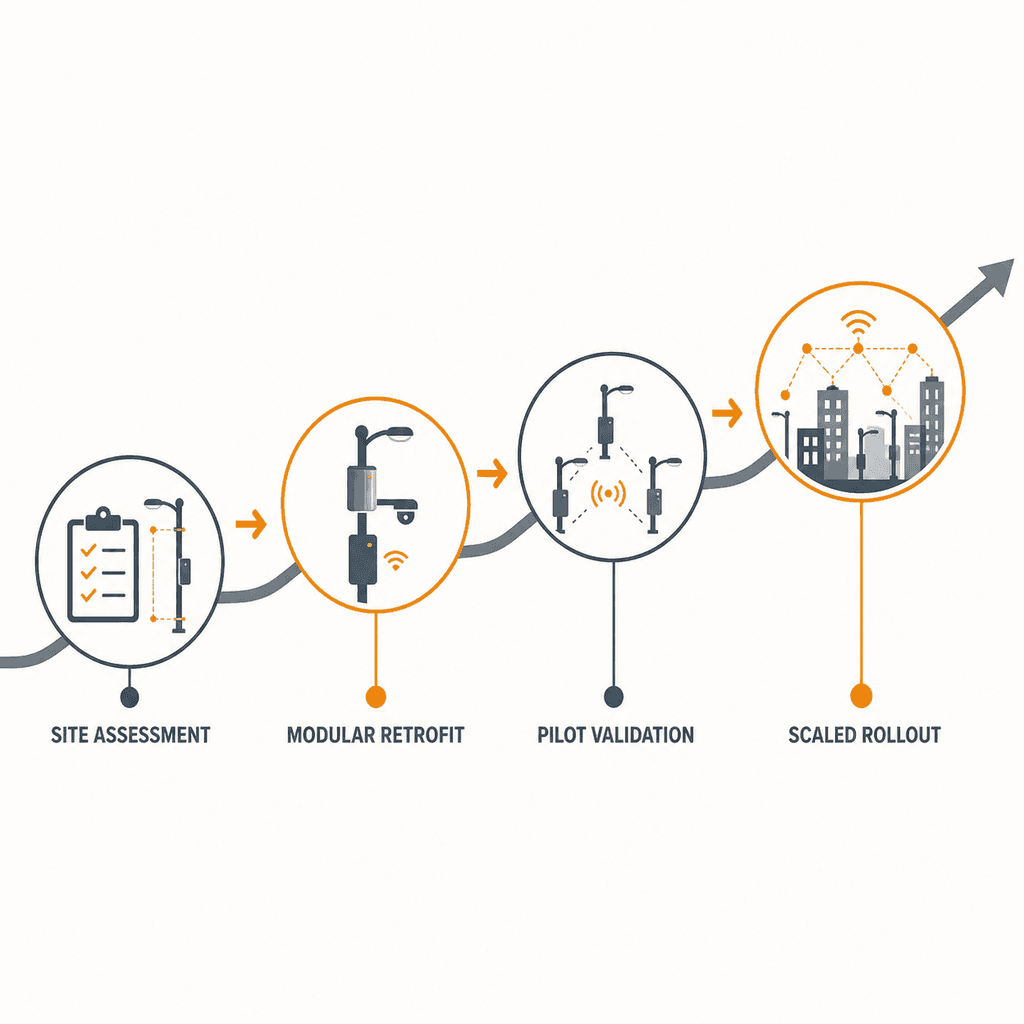
A reliable retrofit roadmap uses 5 stages: asset audit, engineering design, pilot installation, network integration, and scaled EPC deployment. Each stage should produce measurable acceptance evidence, including pole inspection records, photometric calculations, electrical load schedules, communication tests, and maintenance documentation.
Stage 1: Asset Audit
The audit should cover pole height, shaft geometry, foundation condition, feeder voltage, grounding, luminaire arm type, corrosion state, and local wind zone. Existing 6m-12m poles may support basic LED and controller upgrades, but heavier payloads such as PTZ cameras, LED displays, drone docks, or EV charging cabinets often require reinforcement or replacement. Bridge and coastal locations need additional attention because wind exposure and chloride corrosion can shorten service life if coating systems are not upgraded.
For each pole, classify the retrofit decision into 3 categories:
- Reuse: suitable for LED, controller, and lightweight sensor modules.
- Reinforce: suitable after bracket, foundation, grounding, or cabinet upgrades.
- Replace: required where structural reserve, corrosion condition, or feeder capacity is insufficient.
Stage 2: Engineering Design
Engineering design converts the audit into a bill of materials and installation method. SOLARTODO retrofit packages commonly align with 3-in-1 configurations such as LED lighting, 4K PTZ surveillance, and environmental sensing, or larger 10-in-1 smart streetlight platforms where power, structure, and budget allow. For bridge corridors, SOLARTODO product data shows a 10m smart streetlight option with 150W LED output at 170 lm/W, about 25,500 lumens, IP66 enclosure class, 180 km/h wind resistance, and -40°C to +55°C operating range.
According to the U.S. Department of Energy (2024), streetlight dimming performance depends on consistent driver behavior, including 0-10V controls and ANSI C137.1-2022 alignment. DOE states, "The key to making an informed and cost-effective choice" is accurate performance, cost, and reliability data. In procurement terms, that means buyers should request photometric files, surge protection ratings, driver control curves, warranty terms, and communication protocols before issuing a purchase order.
Stage 3: Pilot Deployment
A 50-pole pilot is large enough to expose installation issues but small enough to correct before district-wide procurement. The pilot should include at least 2 road types, 2 communication conditions, and 1 maintenance drill. Acceptance should measure lux level, camera view, sensor reporting, controller uptime, power draw, cabinet temperature, waterproofing, and fault escalation time.
Stage 4: Integration and Scale
After the pilot, the project can move to 100-pole or 250+ packages. At this stage, the most important technical questions are platform interoperability, cybersecurity, spare-parts logistics, and data ownership. IEEE 802.11, LoRaWAN, 4G/5G, Ethernet, OCPP, ONVIF, MQTT, and API integrations may all be relevant depending on the module stack. For public-sector and utility buyers, the smartest roadmap is modular: install the lighting and controller layer first, then add cameras, sensors, edge AI, EV charging, or drone support where business value is proven.
Applications and Use Cases
Smart-pole retrofits deliver the strongest value where existing lighting corridors already have 4,000-4,380 annual operating hours. Typical use cases include urban arterials, bridges, ports, logistics parks, campuses, border facilities, mining roads, industrial estates, and tourism districts that need lighting plus digital monitoring.
For city roads, the first benefit is energy reduction. Replacing 250W-400W HID luminaires with 120W-180W LED fixtures can reduce power use by roughly 40-60%, especially when dimming profiles are allowed during low-traffic hours. DOE (2019) reported that adaptive street and residential lighting can reduce energy consumption by more than 50% through maintained lighting levels and dimming. This makes LED-and-controls retrofits the preferred first phase even when the long-term goal is a full smart-city platform.
For bridges and coastal viaducts, the business case is broader than energy. A 10m pole with 150W roadway lighting, 4K PTZ surveillance, and environmental sensing can replace separate lighting, CCTV, and sensor masts. In SOLARTODO bridge configurations, that can reduce visible roadside hardware by about 66% and lower cable interface points by 2-4 terminations per location. The resulting maintenance plan treats the location as 1 coordinated asset rather than 3 unrelated systems.
For campuses, ports, and logistics parks, smart-pole retrofits can support security and operational workflows. A 12m SOLARTODO smart streetlamp platform can combine 2×80W luminaires, 22kW AC EV charging, WiFi 6, 4MP video, 8-275 TOPS edge AI, and optional drone-dock capability. Those modules should not be added everywhere. They should be assigned to gates, loading zones, perimeter roads, emergency response points, and high-value asset areas where measurable operational value exists.
Comparison and Selection Guide
A retrofit decision should compare 4 paths: lamp-only LED replacement, networked LED control, 3-in-1 smart-pole retrofit, and full replacement. The right choice depends on structural reserve, power availability, communication coverage, data needs, and the buyer’s target payback period.
| Migration path | Typical scope | Best fit | Benefits | Main limitation |
|---|---|---|---|---|
| LED lamp or luminaire replacement | 80W-180W LED | Old HPS roads with stable poles | 40-60% energy reduction | Limited data capability |
| Networked lighting control | LED + controller + gateway | District lighting management | Remote dimming and fault alerts | Requires platform integration |
| 3-in-1 smart-pole retrofit | LED + CCTV + sensor | Bridges, industrial roads, city corridors | Up to 66% hardware consolidation | Needs structural verification |
| Full smart pole replacement | 6m-15m new pole | EV charging, displays, drone dock, dense modules | Highest module capacity | Highest civil cost |
| Specification item | Recommended retrofit baseline | Engineering note |
|---|---|---|
| Pole height | 6m-12m existing, 15m for special roads | Match road width and camera sightline |
| Luminaire efficacy | 120-170 lm/W | DOE FEMP exterior guidance uses high LER thresholds |
| Enclosure rating | IP66 for electronics | Critical for rain, dust, and coastal corridors |
| Operating temperature | -40°C to +55°C | Suitable for desert and cold-region projects |
| Communication | 4G/5G, LoRaWAN, Ethernet, or hybrid | Select by bandwidth and coverage |
| Camera option | 4MP-4K PTZ, 20x zoom where needed | Avoid over-specifying low-risk roads |
| Maintenance interval | 6-12 months | Combine visual, electrical, and network checks |
According to IRENA (2025), battery storage costs declined 93% from 2010 to 2024, reaching USD 192/kWh. That trend matters because smart-pole projects increasingly add LiFePO4 backup for controllers, cameras, emergency communications, and controlled shutdown. Backup storage should be sized for critical electronics first, not for full-night luminaire operation unless the project is designed as a solar or off-grid streetlight system.
EPC Investment Analysis and Pricing Structure
A smart-pole EPC package should price engineering, procurement, construction, commissioning, and handover separately from optional digital services. This gives procurement teams a clear view of hardware cost, freight exposure, civil works, installation labor, software integration, maintenance, and financing assumptions.
EPC turnkey delivery normally includes site survey, pole audit, structural review, module configuration, lighting design, procurement, factory acceptance testing, international logistics, installation supervision or full construction, commissioning, training, and as-built documentation. For retrofit projects, SOLARTODO recommends separating unavoidable civil works from optional smart modules so that decision-makers can approve the minimum viable upgrade first and expand later.
Three pricing tiers are useful for budget control:
| Pricing tier | What it includes | Buyer responsibility | Typical use |
|---|---|---|---|
| FOB Supply | Factory-tested poles, luminaires, controllers, sensors, and accessories | Freight, customs, installation, local permits | Experienced EPC buyer with local crews |
| CIF Delivered | FOB scope plus international freight and insurance to destination port | Inland logistics, installation, permits | Importers and regional integrators |
| EPC Turnkey | Engineering, procurement, delivery, installation, commissioning, and handover | Site access, permits, utility coordination | Municipalities, utilities, campuses, large owners |
Volume pricing should be modeled transparently. A 50+ unit package can support a 5% hardware discount, a 100+ unit package can support a 10% discount, and a 250+ unit rollout can support a 15% discount depending on module mix, steel specification, freight route, and payment risk. Payment terms are typically 30% T/T deposit plus 70% against bill of lading, or 100% irrevocable L/C at sight for qualified projects.
ROI depends on the baseline. If a corridor replaces 250W HPS fixtures with 150W LED smart luminaires and operates 4,200 hours per year, each pole can save about 420 kWh annually before dimming. At USD 0.15/kWh, that is USD 63 per pole per year from wattage reduction alone; adaptive dimming, maintenance dispatch reduction, avoided standalone CCTV masts, and fewer trenching interfaces can improve payback materially. For conventional-to-smart retrofits, simple payback often ranges from 4-8 years when energy, maintenance, and avoided separate infrastructure are included.
Project financing is available for large SOLARTODO projects above USD 1,000K, subject to buyer profile, country risk, bankability, and contract structure. For quotation, send pole count, location, road type, existing pole photos, voltage, module requirements, and delivery term request to [email protected]. SOLARTODO can then prepare an offline quotation rather than marketplace-style checkout pricing.
FAQ
These 10 FAQ answers cover technical, cost, installation, warranty, and maintenance issues for 50-250+ pole retrofit programs. They are written for procurement managers, engineers, EPC contractors, and project owners comparing smart streetlight migration paths.
Q: What is a smart-pole retrofit for existing streetlights? A: A smart-pole retrofit upgrades an existing streetlight with LED lighting, controls, sensors, cameras, connectivity, or other modules while reusing part of the installed asset. The scope may be as simple as LED plus a controller or as complex as a 3-in-1 pole with surveillance and environmental sensing.
Q: When should an existing streetlight be reused instead of replaced? A: Reuse is appropriate when the pole, foundation, grounding, and feeder capacity can support the added load with a reasonable safety margin. If corrosion, wind rating, base plate condition, or cable capacity is uncertain, the pole should be reinforced or replaced before adding cameras, displays, EV charging, or heavy cabinets.
Q: How much energy can a streetlight retrofit save? A: LED retrofits commonly reduce lighting energy use by 40-60% compared with older HPS or metal-halide fixtures. Additional adaptive dimming can improve savings where traffic, safety rules, and local lighting standards allow lower output during low-use hours. Actual savings depend on wattage, operating hours, tariff, and dimming schedule.
Q: What does EPC turnkey pricing include for smart-pole retrofits? A: EPC turnkey pricing includes engineering, procurement, construction, installation, commissioning, training, and project handover. It usually covers site survey, structural review, module selection, logistics, installation labor, testing, and documentation. SOLARTODO also supports FOB supply and CIF delivered pricing when buyers have local EPC teams.
Q: What payment terms are typical for SOLARTODO retrofit projects? A: Standard payment terms are 30% T/T deposit and 70% against bill of lading, or 100% irrevocable L/C at sight for qualified buyers. Large projects above USD 1,000K may qualify for financing review, depending on country risk, buyer profile, contract structure, and required delivery scope.
Q: Which smart modules should be installed first? A: Install LED luminaires, surge protection, and networked lighting controllers first because they create measurable energy and maintenance value. Add CCTV, environmental sensors, WiFi, edge AI, EV charging, or drone modules after the pilot confirms structural capacity, communication reliability, operational need, and budget approval.
Q: How long should a pilot deployment run before full rollout? A: A pilot should run for at least 60-90 days and include different road types, communication conditions, and maintenance scenarios. The buyer should verify lighting levels, controller uptime, camera views, water ingress resistance, alarm routing, data accuracy, and installer feedback before approving a 100-pole or 250+ rollout.
Q: What standards matter for smart streetlight retrofit procurement? A: Key references include IEC 60598 for luminaire safety, IEC 62722 for luminaire performance, IEEE 802.11 for WiFi connectivity, ANSI C137.1 for 0-10V dimming interfaces, and UL 1598 for luminaire safety in relevant markets. Local road-lighting and electrical codes still govern final acceptance.
Q: How often do smart poles need maintenance? A: Most smart poles should be inspected every 6-12 months, with more frequent checks in coastal, desert, bridge, or high-pollution sites. Maintenance should include lens cleaning, fastener inspection, grounding and surge protection checks, firmware review, network health testing, and replacement of failed sensors or communication modules.
Q: Can existing poles support CCTV and environmental sensors? A: Some existing poles can support CCTV and environmental sensors, but only after structural review. A lightweight sensor and fixed camera may be acceptable on many 8m-10m poles, while PTZ cameras, displays, or multiple brackets can change wind load and vibration behavior enough to require reinforcement or replacement.
Conclusion
A phased smart-pole retrofit can convert 50-250+ existing streetlights into energy-saving, data-ready infrastructure with 40-60% lighting energy reduction. The bottom line: start with audit and LED controls, validate a 50-pole pilot, then scale SOLARTODO EPC deployment where structural capacity, communications, and ROI are proven.
For B2B decision-makers, the best migration roadmap is conservative and modular. Reuse assets where the engineering case is strong, replace weak poles before adding expensive modules, and keep EPC pricing transparent across FOB supply, CIF delivered, and turnkey delivery.
References
These 8 references support lighting efficiency, smart controls, safety standards, and renewable infrastructure investment assumptions used in this roadmap. They should be checked against local electrical, road-lighting, telecom, and procurement rules before final specification.
- [IEA] (2026): The next wave of LED lighting: smarter, circular and more efficient; reports lighting at about 8% of 2024 global electricity demand, around 2,200 TWh. https://www.iea.org/commentaries/the-next-wave-of-led-lighting-smarter-circular-and-more-efficient
- [U.S. Department of Energy] (2019): Adaptive Lighting for Streets and Residential Areas; notes adaptive systems can reduce energy consumption by more than 50% through dimming and maintained lighting levels. https://www.energy.gov/cmei/ssl/articles/adaptive-lighting-streets-and-residential-areas
- [U.S. Department of Energy] (2024): The Energy and Operational Impacts of Using 0-10V Control for LED Streetlights; evaluates 23 LED streetlights and ANSI C137.1-2022 dimming consistency. https://www.energy.gov/cmei/ssl/articles/energy-and-operational-impacts-using-0-10v-control-led-streetlights
- [IRENA] (2025): Renewable Power Generation Costs in 2024; reports USD 0.043/kWh utility-scale solar PV LCOE and 93% battery storage cost decline from 2010 to 2024. https://www.irena.org/Publications/2025/Jun/Renewable-Power-Generation-Costs-in-2024
- [IEC 60598] (2024): Luminaires standard series covering general safety and construction requirements for luminaires, relevant to streetlight retrofit fixture procurement and testing.
- [IEC 62722] (2023): Luminaire performance standard series for LED luminaire performance, useful for validating output, efficacy, and performance claims in retrofit specifications.
- [IEEE 802.11] (2020): Wireless LAN standard family supporting WiFi connectivity used in smart-pole access points, maintenance tablets, and local commissioning workflows.
- [UL 1598] (2021): Luminaires safety standard used in North American markets for evaluating fixed lighting equipment, construction, electrical safety, and installation suitability.
About SOLARTODO
SOLARTODO is a global integrated solution provider specializing in solar power generation systems, energy-storage products, smart street-lighting and solar street-lighting, intelligent security & IoT linkage systems, power transmission towers, telecom communication towers, and smart-agriculture solutions for worldwide B2B customers.
About the Author

Cinn Song
Founder & Chief Solutions Architect
Cinn Song founded SOLARTODO LIMITED and leads its smart-city infrastructure engineering — from solar, storage and integrated smart poles to the company's push into physical-AI city edge nodes: pole-mounted edge computing, vertical LLMs for smart cities, drone-based O&M with autonomous battery swapping, robotic maintenance, and high-speed counter-UAS interception. Since 2010, he has directed turnkey EPC + BOT delivery across 50+ countries, including telecom monopole supply for national grid operators, off-grid solar street-lighting for African municipalities, and integrated smart-pole programs for Gulf smart cities.
Cite This Article
Cinn Song. (2026). Retrofitting Existing Streetlights to Smart Poles: A…. SOLARTODO. Retrieved from https://solartodo.com/knowledge/retrofitting-existing-streetlights-to-smart-poles-a-migration-roadmap
@article{solartodo_retrofitting_existing_streetlights_to_smart_poles_a_migration_roadmap,
  title = {Retrofitting Existing Streetlights to Smart Poles: A…},
  author = {Cinn Song},
  journal = {SOLARTODO Knowledge Base},
  year = {2026},
  url = {https://solartodo.com/knowledge/retrofitting-existing-streetlights-to-smart-poles-a-migration-roadmap},
  note = {Accessed: 2026-10-19}
}
Published: August 9, 2026 | Available at: https://solartodo.com/knowledge/retrofitting-existing-streetlights-to-smart-poles-a-migration-roadmap
Subscribe to Our Newsletter
Get the latest solar energy news and insights delivered to your inbox.
View All Articles