Summary
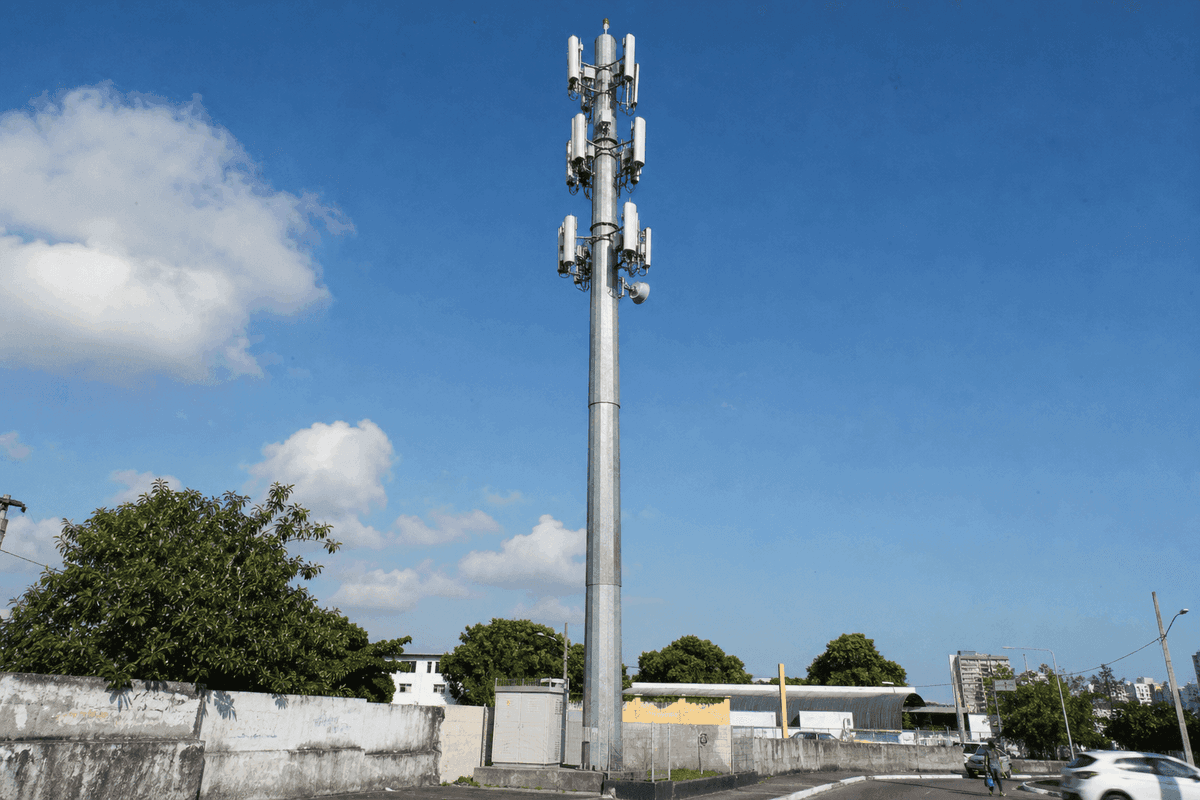
Recife’s 1.49 million residents, 219 km² area, and 3.5 GHz 5G clearance support a 28-unit SOLARTODO 30 m galvanized Q345 monopole plan for coastal 4G/5G macro coverage.
Key Takeaways
Recife needs 30 m coastal macro towers because density, corrosion, wind exposure, and 5G mid-band coverage all affect tower sizing and procurement risk.
- Recife has 1,488,920 residents in about 219 km², so the density is near 6,800 people/km² and favors compact macro sites.
- The recommended SOLARTODO baseline is 28 units of 30 m tapered steel monopoles for regional 4G/5G coverage.
- Each tower should be estimated at about 15 t, using the telecom rule of 500 kg/m for a 30 m Q345 steel monopole.
- The antenna load should support 9 panel antennas, 1 microwave dish, and 6 RRUs on 2 antenna platforms.
- Wind design should use Class 3 at 60 m/s with a 1.35 factor because Recife is a humid Atlantic coastal city.
- CKD shipping can reduce transport volume by 60-70%, improving container utilization for a 28-tower program.
- Production planning should allow 30-45 days before ocean freight, foundation curing, erection, and acceptance testing.
- The target structural design life is 30 years with annual inspection of bolts, galvanizing, grounding, and safety accessories.
Recife Market Context
Recife’s 1.49 million-person coastal market needs compact 30 m macro towers that can carry multi-operator antennas without consuming large urban plots.
According to IBGE (2022), Recife recorded 1,488,920 residents within roughly 219 km². That produces a density profile near 6,800 people/km², which is high enough to require layered mobile infrastructure rather than sparse rural-style towers. Dense districts such as Boa Viagem, Recife Antigo, Santo Amaro, and Casa Forte need capacity, while residential corridors and bridges need continuity.
According to IBGE (2022), the Recife Metropolitan Region had about 3.73 million residents. This matters because mobile demand is not limited to the municipal boundary; commuters from Olinda, Jaboatão dos Guararapes, Paulista, and Camaragibe increase daytime load on roads, hospitals, universities, port zones, and commercial districts. A tower plan should therefore support both city-center capacity and wider regional coverage.
According to Anatel (2022), Recife was cleared for 3.5 GHz 5G activation on 5 September 2022. Mid-band 5G improves capacity but normally needs denser site planning than low-band LTE. A 30 m macro layer helps operators maintain coverage, sector geometry, and microwave backhaul resilience across mixed dense-urban and peri-urban districts.
According to IEA (2023), data transmission networks consumed about 260-340 TWh of electricity globally in 2022. That statistic reinforces why telecom infrastructure procurement should evaluate not only steel cost, but also power access, maintenance access, and long-life reliability. For Recife, SOLARTODO should treat tower durability and site revisit reduction as commercial requirements.
Recommended SOLARTODO Configuration
The recommended Recife configuration is 28 SOLARTODO 30 m galvanized Q345 steel monopoles, each rated for 9 panels and 60 m/s wind.
SOLARTODO should recommend a tapered round or octagonal steel monopole rather than a lattice tower, FRP pole, or joint-use utility structure. A 30 m monopole fits the 25-35 m suburban and residential macro class. It provides enough height for regional coverage while keeping the footprint smaller than lattice structures in constrained urban plots.
Each tower should use hot-dip galvanized Q345 steel, flanged bolt-on sections, and CKD packing. The planning weight should remain about 15 t per tower, calculated from 500 kg/m × 30 m. This avoids an under-specified structure while staying within realistic telecom monopole practice rather than heavy power-transmission tower assumptions.
The recommended loading is 9 panel antennas, 1 microwave dish, and 6 RRUs per tower. This is appropriate for 4G densification, 5G overlay, and microwave backhaul. Final drawings must still confirm wind area, antenna elevations, dish diameter, RRU placement, feeder routing, and platform geometry.
According to IEC (2010), IEC 62305 defines 4 lightning protection levels for risk-based lightning protection design. For Recife, that supports making grounding, lightning rods, bonding continuity, and surge protection baseline requirements. Coastal humidity and frequent storms make lightning and corrosion controls part of the core specification, not optional accessories.
Technical Specifications
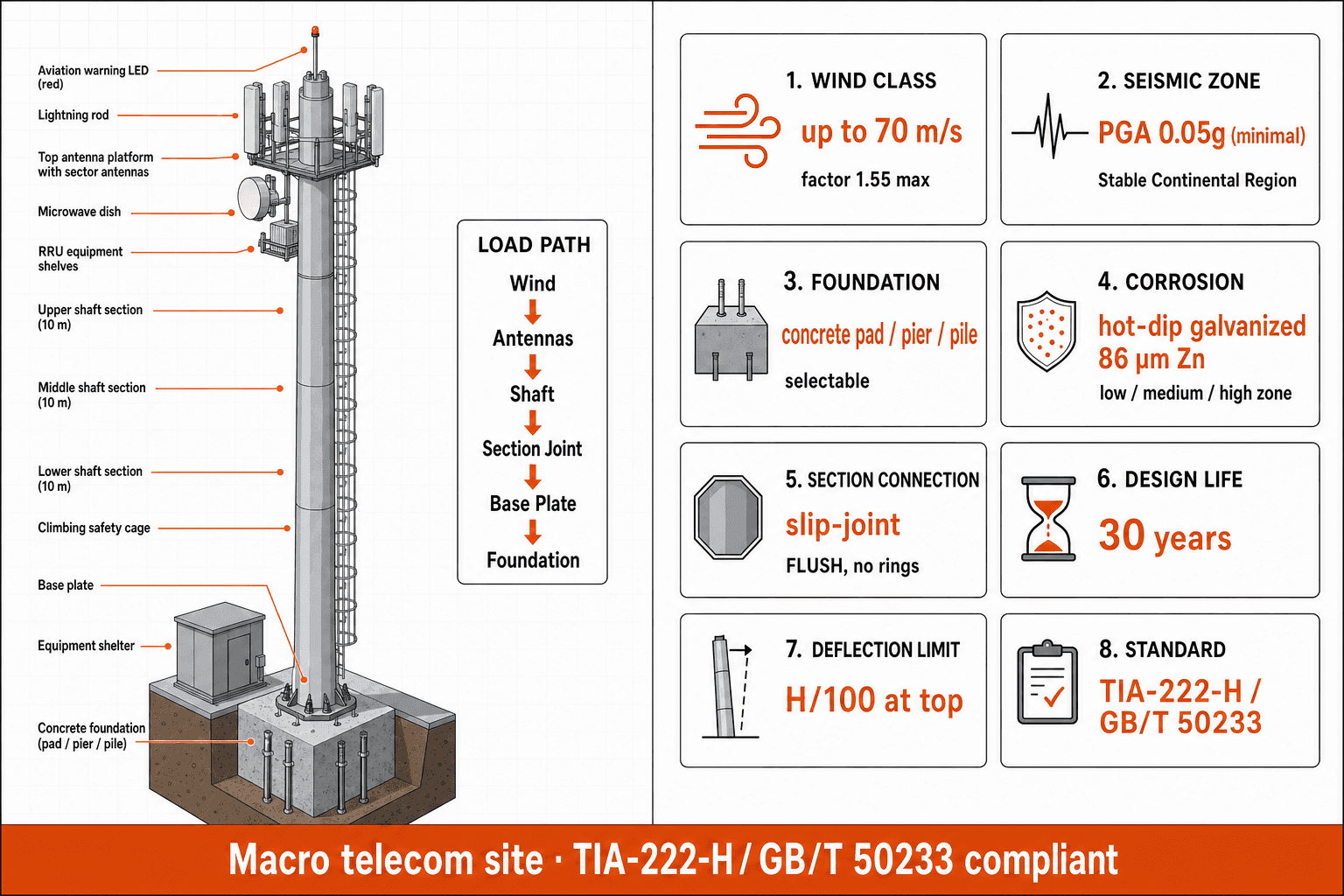
A Recife-ready tower package should combine 30 m height, 15 t steel mass, 2 platforms, drilled piers, and high-corrosion galvanizing.
| Parameter | Recommended Recife Specification |
|---|---|
| Product | SOLARTODO Telecom Tower |
| Tower form | Tapered steel monopole, round or octagonal |
| Quantity basis | Approximately 28 units |
| Height | 30 m |
| Steel grade | Hot-dip galvanized Q345 steel |
| Estimated weight | About 15 t/tower, 500 kg/m |
| Antenna load | 9 panel antennas + 1 microwave dish + 6 RRUs |
| Platforms | 2 antenna platforms |
| Wind design | Class 3, 60 m/s, factor 1.35 |
| Corrosion exposure | High corrosion coastal zone |
| Foundation | Concrete drilled pier foundation |
| Design life | 30 years |
| Shipping format | CKD, 60-70% volume reduction |
| Production time | Typically 30-45 days before shipment |
According to TIA (2022), TIA-222-H defines minimum loading criteria for antenna-supporting structures. For Recife, that means tower verification should include wind, appurtenance, serviceability, foundation reactions, antenna loading, and construction tolerance checks. The 60 m/s wind basis with a 1.35 factor is a conservative starting point for coastal exposure.
According to IEEE (2023), electrical and communications infrastructure should be evaluated for grounding, bonding, safety clearance, and maintainability across the asset life cycle. For a telecom tower, those principles translate into accessible cable trays, safe climbing systems, verified grounding resistance, labeled circuits, and maintainable warning lights. Procurement should require inspection records instead of relying only on factory declarations.
Comparison Table
A 30 m monopole is the best fit because Recife requires compact footprint, 5G antenna capacity, corrosion resistance, and fast CKD logistics.
| Option | Typical Use | Recife Fit | Main Limitation |
|---|---|---|---|
| 30 m galvanized steel monopole | Urban and suburban macro 4G/5G | High | Requires engineered drilled pier foundation |
| Lattice tower | Rural high-load or large compound sites | Medium | Larger footprint and more visual impact |
| FRP pole | Lightweight low-load sites | Low | Limited heavy antenna and microwave loading |
| Rooftop-only network | Dense infill capacity | Medium | Depends on landlord access and roof structure |
| Joint-use utility pole | Utility-led corridors | Low | Limited telecom loading, height, and control |
The monopole option gives the best balance of footprint, structural capacity, procurement repeatability, and urban appearance. Lattice towers can carry heavier loads, but they are harder to place in tight Recife plots. Rooftops and small cells remain useful, but they should complement the macro layer rather than replace it.
According to NREL (2024), bankable energy modeling depends on hourly resource and load assumptions rather than annual averages alone. The same planning logic applies to telecom: tower quantity should not be based only on population. Operators should validate traffic peaks, terrain, clutter, lease availability, power access, and microwave paths before finalizing the 28-site layout.
Implementation Plan
A 28-site Recife rollout should sequence surveys, drilled piers, 30-45 day fabrication, CKD delivery, erection, grounding, and acceptance testing.
The first step is site validation. Each candidate location should be checked for soil bearing capacity, flood exposure, road access, setback rules, zoning constraints, crane access, and antenna azimuth requirements. The engineering package should include geotechnical input before foundation drawings are released.
The second step is factory production and inspection. SOLARTODO should confirm Q345 steel certificates, galvanizing thickness, flange alignment, bolt grades, platform details, ladder safety, aircraft warning lights, cable tray routing, grounding lugs, and packing lists. CKD packaging should be matched to container loading and Recife port handling constraints.
The third step is civil works and erection. Drilled concrete piers should be completed before tower arrival where schedule compression is required. After curing, crews should erect sections, torque bolts, install platforms, connect grounding, mount safety systems, and complete verticality checks.
The final step is telecom integration and acceptance. Carriers or integrators should install antennas, RRUs, microwave equipment, feeders, and power systems. Acceptance should include bolt torque records, grounding resistance, warning-light operation, antenna alignment, as-built drawings, and photo documentation.
Pricing and Procurement
Pricing should be quoted as FOB, CIF, or EPC because freight, soil conditions, access limits, and installation scope can change total cost by site.
SOLARTODO should present three quotation models. FOB Supply covers tower equipment ex-works or port in China. CIF Delivered adds ocean freight and insurance to the agreed destination. EPC Turnkey includes installed and commissioned towers with civil works, erection, grounding, and a 1-year warranty when local execution is included.
According to BloombergNEF (2024), global energy-transition investment reached about USD 1.8 trillion in 2023. That scale of infrastructure investment has increased buyer scrutiny of lifecycle cost, delivery risk, and bankable documentation. Telecom tower buyers should therefore compare quotations by specification, not only by steel price per ton.
According to IRENA (2024), global renewable power capacity reached about 3,870 GW by the end of 2023. For telecom operators, this supports more hybrid site-power options, but it does not remove the need for grid-quality grounding, battery backup planning, and maintainable tower access. Pricing should separate tower steel, accessories, foundations, logistics, and installation.
Frequently Asked Questions
These 10 FAQ answers cover price, specifications, logistics, warranty, installation, comparison, standards, maintenance, and Recife-specific engineering decisions.
Q1: What tower type is recommended for Recife?
The recommended tower is a 30 m tapered galvanized steel monopole from SOLARTODO. It should use Q345 steel, flanged sectional construction, 2 antenna platforms, and drilled concrete pier foundations. This format fits Recife because it reduces urban footprint while supporting 9 panel antennas, 1 microwave dish, and 6 RRUs for regional 4G/5G macro coverage.
Q2: How many towers are recommended?
The planning baseline is approximately 28 units of 30 m monopole towers. This is not a final radio-frequency design or a completed deployment claim. The number should be validated against traffic maps, carrier targets, rooftop availability, zoning, terrain clutter, microwave paths, and site acquisition feasibility across Recife and nearby metropolitan demand corridors.
Q3: What is the expected tower weight?
Each 30 m telecom monopole should be planned at about 15 t, using the engineering rule of 500 kg/m. A lower estimate may understate steel, flange, and wind-load requirements. A much higher estimate may indicate that the design is drifting toward heavy transmission-tower assumptions instead of a practical urban telecom monopole.
Q4: What wind and corrosion specification should be used?
The Recife baseline should use Wind Class 3 at 60 m/s with a 1.35 factor, plus high-corrosion hot-dip galvanizing. Recife’s Atlantic exposure, humidity, and seasonal storms make corrosion protection and lateral-load design critical. Bolted joints, platforms, ladder systems, grounding points, and cable trays should all be inspected for coating quality.
Q5: How much does a SOLARTODO Telecom Tower cost?
SOLARTODO should quote the project under FOB Supply, CIF Delivered, or EPC Turnkey. Final pricing depends on steel weight, galvanizing, accessories, freight route, container loading, soil report, foundation depth, crane access, installation labor, and carrier loading. Buyers should request a line-item quotation rather than comparing only price per ton.
Q6: How long does production and delivery take?
Standard production typically requires 30-45 days before shipment, assuming drawings, steel grade, antenna load, galvanizing, and accessories are approved. Ocean freight, customs clearance, local inland transport, foundation curing, and erection are separate schedule items. CKD packing can reduce shipping volume by 60-70%, which helps large 28-unit programs.
Q7: What foundation is recommended?
A drilled concrete pier foundation is the recommended baseline for Recife’s 30 m monopole sites. It provides controlled overturning resistance while using less surface area than broad shallow pads. Final foundation design must follow the geotechnical report, groundwater conditions, soil bearing capacity, flood risk, local code, and tower reaction loads.
Q8: What warranty and design life should buyers expect?
The structural design life target should be 30 years when the tower is installed and maintained correctly. EPC Turnkey projects can include a 1-year warranty for installed works, subject to contract scope. Warranty terms should clearly separate steel fabrication, galvanizing, accessories, civil works, installation workmanship, and third-party telecom equipment.
Q9: Why choose a monopole instead of a lattice tower?
A monopole is better for Recife when urban footprint, appearance, installation speed, and site acquisition are important. Lattice towers can carry heavier loads, but they need larger compounds and create greater visual impact. For a 30 m, 9-panel, 1-dish telecom load, a properly engineered galvanized monopole is the cleaner baseline.
Q10: What maintenance is required after installation?
Annual maintenance should check galvanizing damage, bolt torque, flange condition, platform safety, ladder integrity, cable tray condition, warning-light operation, grounding resistance, lightning protection, and foundation cracking. Coastal Recife sites should also receive corrosion-focused inspections after severe storms. Maintenance records help preserve the 30-year design-life target and reduce emergency site revisits.
References
These 10 sources support Recife population, 5G readiness, telecom loading, lightning protection, energy demand, infrastructure cost, and renewable-power context.
- IBGE (2022): Recife municipality census population, 1,488,920 residents, and municipal area of about 219 km².
- IBGE (2022): Recife Metropolitan Region population context, approximately 3.73 million residents.
- Anatel (2022): Recife clearance for 3.5 GHz 5G activation on 5 September 2022.
- IEA (2023): Data transmission networks used about 260-340 TWh of electricity globally in 2022.
- IEC (2010): IEC 62305 lightning protection framework with 4 lightning protection levels.
- TIA (2022): TIA-222-H structural standard for antenna-supporting structures and appurtenance loading.
- IEEE (2023): Electrical infrastructure guidance for grounding, bonding, safety, and maintainability practices.
- NREL (2024): PVWatts and resource-modeling guidance using hourly assumptions for energy planning.
- IRENA (2024): Global renewable power capacity reached about 3,870 GW by the end of 2023.
- BloombergNEF (2024): Global energy-transition investment reached about USD 1.8 trillion in 2023.
Equipment Deployed
- Approximately 28 units × 30m tapered steel monopole Telecom Tower, regional macro / high-coverage class
- Hot-dip galvanized Q345 steel monopole, round or octagonal tapered tube, flanged bolt-on sectional design
- Approximate tower weight: 15t per tower, based on 500kg/m × 30m engineering rule
- Wind class 3: 60 m/s design wind speed with 1.35 factor per TIA-222-H framing
- High-corrosion coastal protection with hot-dip galvanizing for Recife’s Atlantic environment
- Antenna load package: 9× panel antennas + 1× microwave dish + 6× RRU
- Concrete pier / drilled pier foundation suited to 30m macro tower profile and site soil confirmation
- Accessories: climbing ladder, cable tray, aircraft warning light, grounding system, lightning rod, 2 antenna platforms, and safety cage
- CKD shipping configuration with 60-70% transport volume reduction
- Production lead time: 30-45 days; design life: 30 years; standards: TIA-222-H / GB/T 50233