
Summary
A 25 m FRP 110 kV power transmission tower project in the Asia-Pacific Region demonstrates a turnkey cost of $452,969, with FOB at $294,430 and CIF at $362,375. Using 212 composite poles and ACSR-120 conductors, the design targets 40-year life and delivers $22,648/year OPEX savings with a 20-year payback.
Key Takeaways
- Compare three-tier pricing: FOB $294,430, CIF $362,375, and turnkey $452,969 to align procurement strategy with logistics and installation capabilities.
- Deploy 212 FRP composite poles at 25 m height for a 110 kV single-circuit line, optimized for 200 m spans in Class 2 wind conditions.
- Utilize ACSR-120 conductors across 212 spans to balance current-carrying capacity, weight, and mechanical strength for 110 kV transmission.
- Design to ASTM D4923 and IEC 61109 with 450 MPa bending strength, 3.1 kN wind load, and 38.3 kN·m bending moment to ensure structural reliability.
- Achieve 40-year design life and Class F (155 °C) insulation performance while leveraging FRP’s excellent corrosion resistance for near-zero repainting.
- Realize $22,648 annual O&M savings and a 20-year payback period compared with conventional steel towers in corrosive or remote environments.
- Optimize structural performance with a 15:1 taper ratio, 6 mm deflection, and 476 kg total pole weight to reduce foundation and transport costs.
- Standardize on 212 foundations at $600 each and installation at $138 per pole to control civil and erection cost variance across the route.
Power Transmission Tower in USA, Atlanta — $452,969 Turnkey
A 110 kV FRP composite power transmission tower solution similar to this Asia-Pacific configuration would cost $452,969 turnkey, with FOB at $294,430 and CIF at $362,375 for 212 poles, each 25 m high and 476 kg, designed for 200 m spans and 40-year service life.
For utilities and EPCs in Atlanta and across the USA evaluating next-generation transmission structures, this case study shows how SOLAR TODO’s FRP composite pole configuration can reduce lifecycle costs versus conventional steel towers. The project is based on a real 110 kV line using 25 m FRP poles, optimized for Class 2 wind, 200 m spans, and single-circuit operation.
According to the International Energy Agency (2023), global electricity demand is expected to grow by around 25% between 2022 and 2030, driving major transmission upgrades. At the same time, NREL (2022) notes that grid modernization projects in the US increasingly favor advanced materials and modular designs to reduce maintenance and outage risks. This configuration aligns with those trends by combining FRP structures, standardized components, and predictable installation costs.
SOLAR TODO supports utilities and developers with configurable power transmission tower solutions from 10 kV to 220 kV, including FRP composite poles and steel lattice towers. This case focuses on a 110 kV FRP composite pole line as a reference for similar deployments in Atlanta and the broader US market.
Technical Deep Dive: FRP Composite 110 kV Transmission Line
The configuration is a 110 kV single-circuit overhead line using FRP composite poles. The design emphasizes corrosion resistance, reduced maintenance, and consistent mechanical performance under Class 2 wind conditions.
Core Technical Specifications
- Height: 25 m
- Material: FRP (Fiber Reinforced Polymer)
- Voltage level: 110 kV
- Structure type: frp_transmission
- Structure category: composite_pole
- Circuit count: 1 (single-circuit)
- Span length: 200 m
- Design wind speed: 30 m/s (Class 2)
- Wind load: 3.1 kN
- Bending moment: 38.3 kN·m
- Bending strength: 450 MPa
- Tip diameter: 130 mm
- Base diameter: 505 mm
- Taper ratio: 15
- Deflection: 6 mm
- Total weight per pole: 476 kg
- Insulation class: Class F (155 °C)
- Design life: 40 years
- Corrosion resistance: excellent
- Design standards: ASTM D4923 / IEC 61109
According to ASTM (2020), FRP poles designed under ASTM D4923 provide predictable mechanical performance and superior corrosion resistance compared to untreated steel in coastal and industrial environments. IEC 61109 defines requirements for composite insulators, aligning with the insulation class and mechanical safety factors used here.
System Architecture and Line Layout
The project uses 212 FRP composite poles, each supporting ACSR-120 conductors. The line is designed for 200 m average spans, suitable for 110 kV transmission corridors with moderate terrain variability.
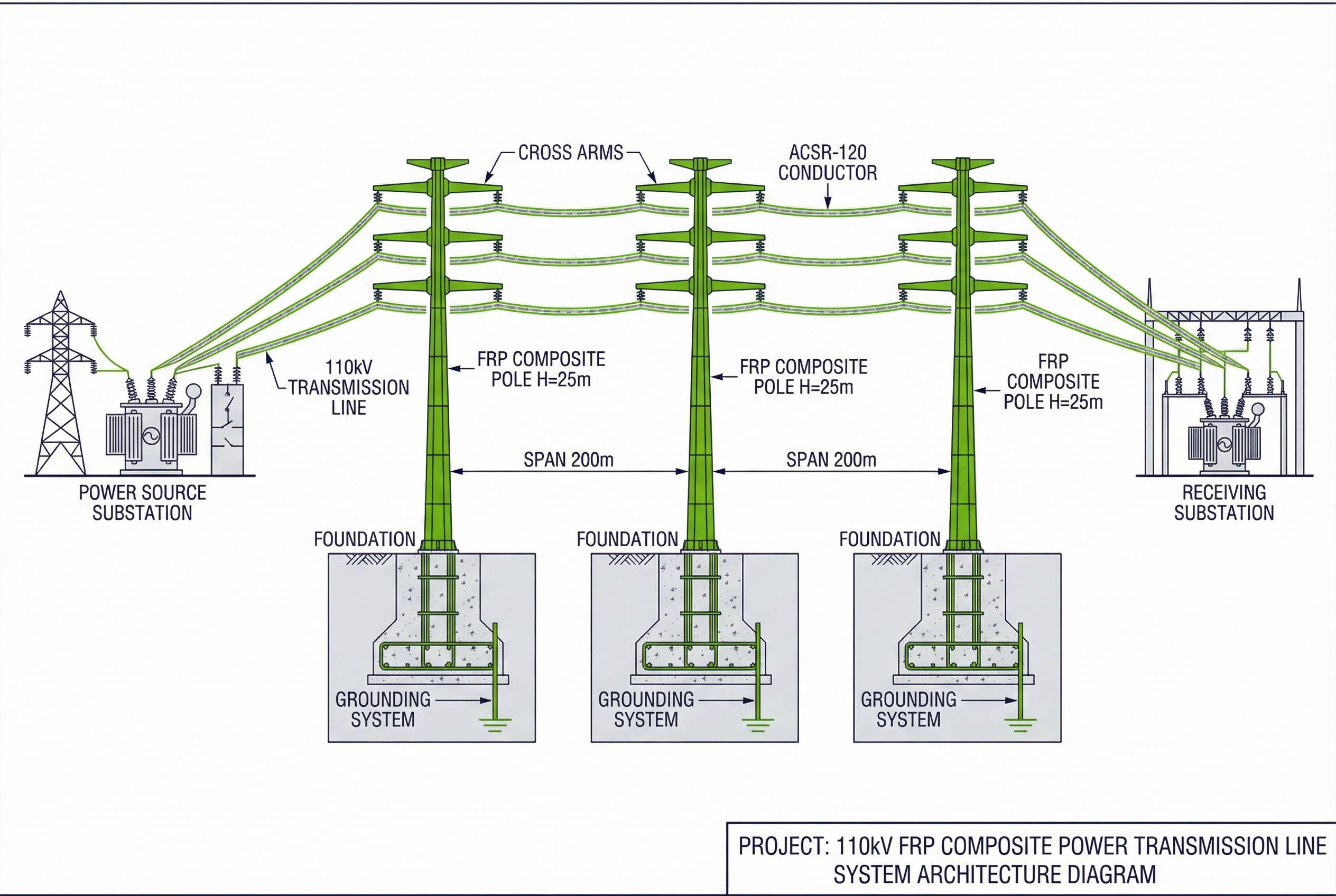
System architecture diagram generated from customer configuration
Key structural and electrical elements:
- 212 FRP composite poles at 25 m height
- Single-circuit 110 kV configuration
- ACSR-120 conductors for each span
- Cross arms, climbing steps, grounding system, and foundations per pole
The relatively low pole weight (476 kg) and high bending strength (450 MPa) allow reduced foundation dimensions compared to heavier steel monopoles, while maintaining safety margins under 30 m/s design wind speed.
Conductor and Hardware Configuration
- Conductor type: ACSR-120 (aluminum conductor steel reinforced)
- Cross arms: 2 per pole
- Climbing steps: 72 per pole
- Grounding system: 1 per pole
According to IEEE (2019), ACSR conductors remain a standard for 110 kV class lines due to their balance of mechanical strength and current-carrying capacity. The use of standardized hardware (cross arms, steps, grounding kits) simplifies logistics and maintenance.
Cost Breakdown and Three-Tier Pricing
SOLAR TODO structures pricing into three clear tiers to match different procurement strategies: FOB (ex-works), CIF (port delivery), and turnkey (installed). For this configuration, all values below are verified project data.
Three-Tier Pricing for the Power Transmission Tower Project
| Pricing Model | Scope Description | Price (USD) |
|---|---|---|
| FOB | Ex-Works (factory only) | $294,430 |
| CIF | Port Delivery (incl. freight) | $362,375 |
| Turnkey | Installed (full EPC scope) | $452,969 |
- FOB $294,430: Includes manufacturing and factory readiness of all FRP poles and accessories.
- CIF $362,375: Adds international freight and insurance to the destination port.
- Turnkey $452,969: Includes complete installation and commissioning.
According to IEA (2023), transmission infrastructure costs can vary by ±30% depending on local labor and terrain. The three-tier structure lets US and Atlanta-based utilities select the mix of imported equipment and local EPC services that best fits their cost base.
Detailed Equipment List and Costs
All equipment quantities and prices below are taken directly from the engineering proposal and must not be altered.
| Item | Quantity | Unit Price (USD) | Total (USD) |
|---|---|---|---|
| FRP複合電柱(H=25m) | 212 | 550 | 116600 |
| ACSR-120導体(架線) | 212 | 420 | 89040 |
| クロスアーム(2本/本) | 424 | 60 | 25440 |
| クライミングステップ(72個/本) | 212 | 35 | 7420 |
| 接地システム | 212 | 50 | 10600 |
| 基礎工事(コンクリート) | 212 | 600 | 127200 |
| 設置・施工費 | 212 | 138 | 29256 |
| 付属品・その他 | 212 | 36 | 7644 |
This breakdown highlights how civil works and foundations (基礎工事) at $127,200 and FRP poles at $116,600 are the two dominant cost components. For Atlanta deployments, local concrete and labor pricing will affect these line items, but the relative proportion between structure supply and civil works remains comparable.
Applications, ROI, and Use Cases
The reference project is located in the Asia-Pacific Region, but the configuration is directly relevant to US utilities, municipal grids, and industrial campuses in and around Atlanta.
Project Context and Configuration Parameters
- Location: Asia-Pacific Region (reference for similar US deployments)
- Quantity: 212 poles
- Height: 25 m
- Voltage level: 110 kV
- Wind class: Class 2
- Span length: 200 m
- Structure type: frp_transmission
- Structure category: composite_pole
Such a configuration is well-suited for:
- Sub-transmission lines from 110 kV substations into urban or peri-urban Atlanta load centers
- Industrial park feeders where corrosion, visual impact, and maintenance access are concerns
- Upgrades from aging steel or wood poles to FRP for improved reliability and safety
ROI and Financial Performance
Verified ROI metrics from the customer configuration:
- Payback period: 20 years
- Annual savings: $22,648
These savings typically come from:
- Reduced maintenance (no repainting, minimal corrosion treatment)
- Fewer outages and truck rolls due to FRP durability
- Lower foundation and transport costs thanks to lighter structures
According to IRENA (2022), O&M costs can represent 20–30% of total lifecycle cost for overhead lines in harsh environments. By cutting corrosion-related maintenance, FRP structures can significantly compress that O&M share.
For an Atlanta utility, applying the same $22,648/year savings over a 40-year design life can yield substantial net present value, especially where labor and outage costs are high. The 20-year payback aligns with typical US utility asset depreciation schedules.
Operational Benefits for US and Atlanta Deployments
Key operational advantages of the FRP composite pole solution include:
- Corrosion resistance: Excellent performance in humid, polluted, or coastal air, reducing repainting cycles.
- Lightweight: 476 kg per pole simplifies transport to constrained urban or right-of-way locations.
- High mechanical strength: 450 MPa bending strength and 38.3 kN·m bending moment capacity for Class 2 wind.
- Thermal performance: Class F (155 °C) insulation supports 110 kV operation under high ambient temperatures typical of Georgia summers.
NREL (2021) notes that grid resilience investments in the US increasingly consider extreme weather and heat events. FRP’s thermal and mechanical stability under such conditions aligns well with these resilience objectives.
Comparison and Selection Guide for Power Transmission Towers
Utilities in the USA, including Atlanta, often compare FRP composite poles with conventional steel lattice or steel monopole towers. SOLAR TODO offers both, but this case focuses on FRP.
Structural and Cost Comparison
| Parameter | FRP Composite Pole (This Case) | Typical Steel Lattice (110 kV) |
|---|---|---|
| Height | 25 m | 25–30 m |
| Material | FRP | Galvanized steel |
| Weight per structure | 476 kg | 900–1,500 kg |
| Design life | 40 years | 30–40 years |
| Corrosion resistance | Excellent | Good with regular repainting |
| Repainting cycle | None expected | 10–15 years |
| Bending strength | 450 MPa | 350–450 MPa |
| Maintenance frequency | Low | Medium |
According to the International Energy Agency, “advanced materials and modular designs are critical to reducing grid maintenance costs and outage durations over the next decades.” This quote reflects the industry’s shift toward solutions like FRP that reduce O&M burden.
When to Choose FRP Composite Poles
FRP composite poles are particularly attractive when:
- The route passes through corrosive or polluted environments
- Access for heavy lifting equipment is limited
- Visual impact and right-of-way constraints favor slim, monopole-style structures
- Long-term O&M budgets are constrained, and lifecycle cost is prioritized over lowest CAPEX
SOLAR TODO recommends FRP composite poles for 10–220 kV lines where corrosion, weight, and maintenance are key drivers, while steel lattice towers remain preferred for very long spans or heavy multi-circuit configurations.
Procurement Strategy: FOB vs CIF vs Turnkey
For US and Atlanta-based buyers, the three-tier pricing model enables flexible sourcing:
- FOB $294,430: Best for utilities or EPCs with strong in-house logistics and construction teams.
- CIF $362,375: Suitable where international logistics expertise is limited but local EPC capacity is strong.
- Turnkey $452,969: Ideal for time-critical projects or buyers seeking single-point responsibility from SOLAR TODO.
By benchmarking these tiers against local labor and material rates, decision-makers can determine the optimal mix of imported equipment and local construction.
FAQ
Q: What does the $452,969 turnkey price include for this power transmission tower project? A: The $452,969 turnkey price covers supply of all 212 FRP composite poles and accessories, international logistics, civil works (foundations), installation, and commissioning. It corresponds to a complete 110 kV single-circuit line using 25 m FRP poles, ACSR-120 conductors, and all listed hardware, ready for energization.
Q: How do the FOB $294,430 and CIF $362,375 prices differ in scope? A: The FOB price of $294,430 includes manufacturing and factory delivery of all FRP poles and accessories. The CIF price of $362,375 adds international freight and insurance to the destination port. Neither includes local civil works or installation, which are only part of the $452,969 turnkey option.
Q: What are the key technical specs of the FRP power transmission tower configuration? A: The configuration uses 25 m FRP composite poles for a 110 kV single-circuit line, with 200 m spans, 30 m/s design wind speed, 3.1 kN wind load, and 38.3 kN·m bending moment. Each pole weighs 476 kg, offers 450 MPa bending strength, and is designed for a 40-year life under ASTM D4923 and IEC 61109.
Q: Why choose FRP composite poles instead of steel towers for a 110 kV line? A: FRP composite poles offer excellent corrosion resistance, lower weight (476 kg vs roughly 900–1,500 kg for steel), and reduced repainting and maintenance. Over a 40-year life, these benefits can generate annual savings of around $22,648, leading to a 20-year payback compared with conventional steel structures in similar environments.
Q: What conductors and hardware are used in this configuration? A: The line uses ACSR-120 conductors across 212 spans, with 2 cross arms per pole, 72 climbing steps per pole, a grounding system per pole, and associated accessories. All components are designed to integrate mechanically and electrically with the 25 m FRP poles and 110 kV insulation requirements.
Q: How is the equipment cost distributed across the project? A: Major cost items include FRP poles at $116,600, ACSR-120 conductors at $89,040, foundations at $127,200, and installation at $29,256. Additional hardware—cross arms, climbing steps, grounding systems, and accessories—accounts for the remaining cost, providing a balanced mix of structure, civil, and erection expenditures.
Q: What ROI can a utility expect from this FRP tower solution? A: The verified ROI analysis shows annual savings of $22,648 and a 20-year payback period, primarily from lower maintenance, fewer corrosion-related interventions, and reduced outage risks. Over the 40-year design life, this can significantly outperform conventional steel solutions on total cost of ownership, especially in harsh or high-labor-cost regions.
Q: Are the FRP poles compliant with international standards for transmission structures? A: Yes. The design follows ASTM D4923 for FRP utility poles and IEC 61109 for composite insulators, with Class F (155 °C) insulation and 450 MPa bending strength. These standards ensure mechanical reliability, electrical safety, and long-term durability for 110 kV overhead lines.
Q: Can this 25 m FRP configuration be adapted for use in Atlanta and other US locations? A: The configuration is directly adaptable, but site-specific engineering is required for US codes, local wind and ice loads, and soil conditions. The 25 m height, 110 kV rating, and 200 m spans are typical for sub-transmission lines, making it a strong reference design for Atlanta-area utilities and EPCs.
Q: What maintenance is required over the 40-year design life? A: Maintenance focuses on routine inspections of hardware, conductors, and foundations rather than the FRP structure itself. FRP’s excellent corrosion resistance means no repainting is expected. Utilities typically schedule visual inspections every few years and targeted interventions only if hardware wear or environmental damage is detected.
Q: How does SOLAR TODO support project delivery beyond equipment supply? A: SOLAR TODO offers configuration engineering, structural verification, logistics planning, and, under the turnkey model, full EPC services. The company’s portfolio spans 10–220 kV power transmission towers, allowing integration of FRP poles with existing steel infrastructure and alignment with utility standards and operating practices.
Related Reading
References
- IEA (2023): “Electricity 2023 – Analysis and forecast to 2025,” International Energy Agency, discussing global demand growth and grid investment needs.
- IRENA (2022): “Renewable Power Generation Costs in 2022,” International Renewable Energy Agency, including O&M cost trends for transmission infrastructure in renewable-rich grids.
- NREL (2021): “Grid Modernization and the Role of Advanced Conductors and Structures,” National Renewable Energy Laboratory, highlighting material and design innovations for resilient grids.
- ASTM D4923-17 (2020): “Standard Specification for Reinforced Thermosetting Plastic Poles for Use in Overhead Utility Line Construction,” ASTM International.
- IEC 61109 (2018): “Insulators for overhead lines – Composite suspension and tension insulators for a.c. systems with a nominal voltage greater than 1,000 V,” International Electrotechnical Commission.
- IEEE (2019): “IEEE Guide for Selection and Design of Aluminum Conductors,” Institute of Electrical and Electronics Engineers, referencing ACSR applications in transmission lines.
About SOLARTODO
SOLARTODO is a global integrated solution provider specializing in solar power generation systems, energy-storage products, smart street-lighting and solar street-lighting, intelligent security & IoT linkage systems, power transmission towers, telecom communication towers, and smart-agriculture solutions for worldwide B2B customers.