Power Transmission Tower Argentina $31,894 Turnkey

SOLAR TODO
Solar Energy & Infrastructure Expert Team

Verified SOLAR TODO case for Argentina, Buenos Aires: a 20 m, 35kV dead-end Power Transmission Tower priced at $20,731 FOB, $25,515 CIF, and $31,894 turnkey. The proposal includes a 400 m span, 2 circuits, 9.1-year payback, and $3,500 annual savings.
Summary
This case study reviews a verified SOLAR TODO Power Transmission Tower configuration for Argentina, Buenos Aires: 1 unit, 20 m height, 35kV dead-end steel tower. Pricing is fixed at $20,731 FOB, $25,515 CIF, and $31,894 turnkey, with 9.1-year payback and $3,500 annual savings.
Key Takeaways
- Select the verified 20 m, 35kV dead-end steel tower when a project requires 1 structure for a 400 m span and 2 circuits.
- Compare the three commercial scopes carefully: $20,731 FOB, $25,515 CIF, and $31,894 turnkey represent different delivery responsibilities.
- Confirm structural loading against the proposal values of 14.1 kN wind load, 168.7 kN·m bending moment, and 60 mm deflection.
- Specify the included accessories upfront: 1 climbing ladder and 1 grounding system are already part of this tower solution.
- Budget for the full installed package using the verified turnkey price of $31,894, including installation and technical supervision.
- Use the proposal-based foundation data during civil review: concrete foundation with Ø4000 mm base diameter and class 2 wind design at 30 m/s.
- Evaluate project economics using the verified ROI inputs of $3,500 annual savings and 9.1 years payback.
- Reference IEC 60826 / GB 50545 and the 50-year design life when aligning procurement, engineering, and compliance discussions.
Project Overview
A verified SOLAR TODO Power Transmission Tower for Buenos Aires is configured as a 20 m, 35kV dead-end steel tower with a 400 m span, 2 circuits, and a fixed turnkey price of $31,894. The same proposal also confirms $20,731 FOB, $25,515 CIF, 14.1 kN wind load, and a 50-year design life.
This is not a generic pricing article. It is a solution case study based on a verified engineering proposal for 1 Power Transmission Tower under the project location listed as International / Por confirmar, prepared for an Argentina, Buenos Aires use case. For B2B buyers, the value lies in the exact commercial scope, complete equipment list, and proposal-level technical parameters that can be used for procurement screening, engineering review, and budget approval.
SOLAR TODO positions this configuration as a practical medium-voltage line structure for projects that need a dead-end steel tower rather than a lighter distribution pole or a larger high-voltage lattice tower. The verified design uses galvanized steel, supports 35kV service, and includes both a climbing ladder and grounding system. Because the numbers are proposal-based, decision-makers can use them as a reference point for internal comparison without re-estimating the package.
According to IEC (2019), IEC 60826 provides the basis for design criteria of overhead transmission lines, including loading and reliability concepts relevant to structures such as dead-end towers. IEEE states in IEEE 524 (2016) that transmission line construction quality directly affects long-term mechanical and electrical performance. For buyers, that means early alignment between tower design, foundation scope, conductor selection, and installation method is essential.
The International Energy Agency states, "Electricity networks are the backbone of secure and reliable power systems." IRENA notes that grid investment is indispensable for integrating new generation and improving energy access. Those statements matter here because a single correctly specified Power Transmission Tower can be a critical enabling asset in a broader distribution or sub-transmission expansion plan.
System Design and Technical Configuration
The verified system is a steel tower category structure configured as a dead-end Power Transmission Tower. It is designed for 35kV service, 20 m height, and a 400 m span using ACSR-70 conductor. The proposal specifies class 2 wind conditions, a design wind speed of 30 m/s, wind load of 14.1 kN, bending moment of 168.7 kN·m, and maximum deflection of 60 mm.
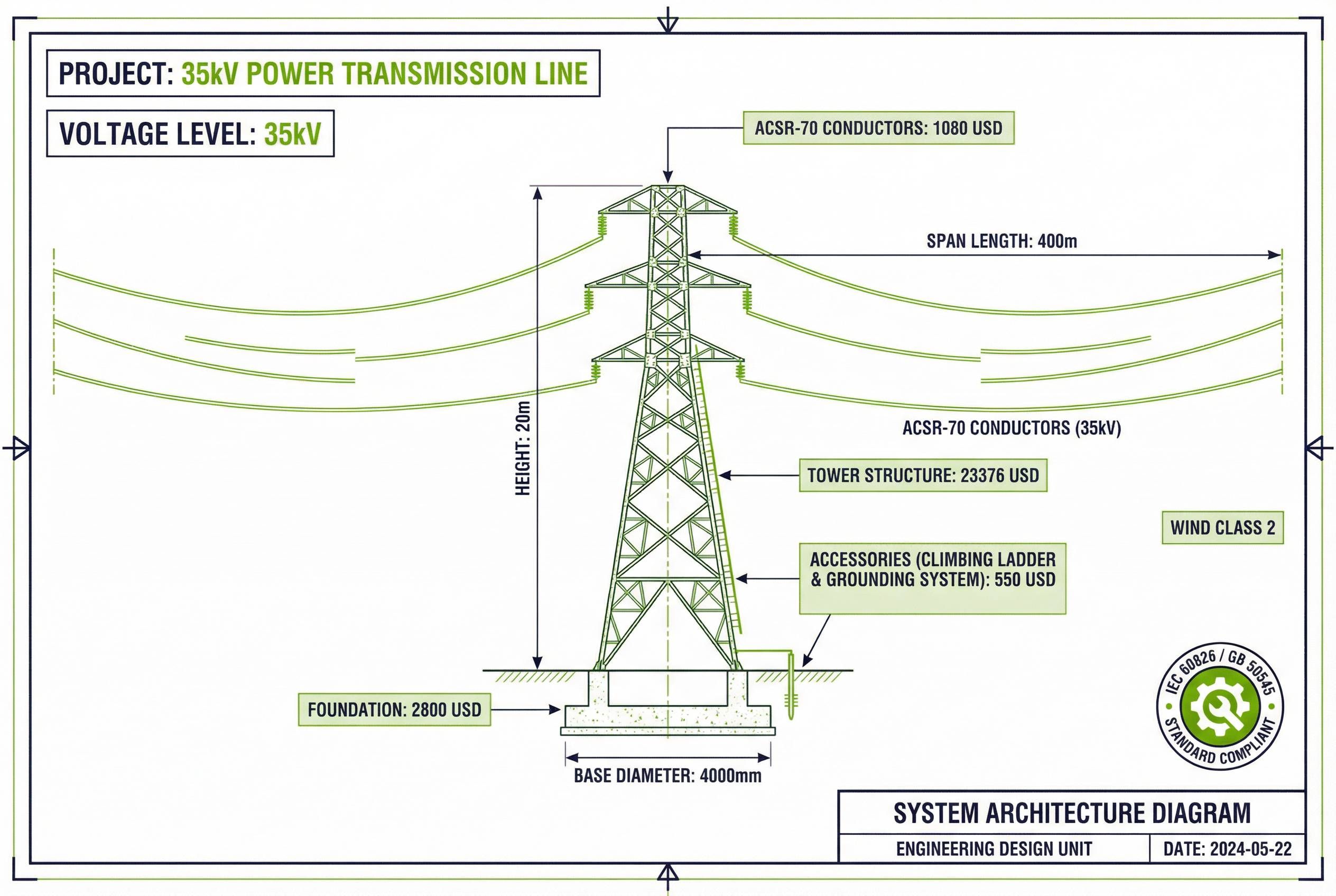 System architecture diagram generated from customer configuration
Verified technical specifications
| Parameter | Verified value |
|---|---|
| Product | Power Transmission Tower |
| Quantity | 1 |
| Height | 20 m |
| Voltage level | 35kV |
| Structure type | dead_end |
| Structure category | steel_tower |
| Material | STEEL |
| Wind class | class_2 |
| Design wind speed | 30 m/s |
| Wind load | 14.1 kN |
| Bending moment | 168.7 kN·m |
| Deflection | 60 mm |
| Span length | 400 m |
| Circuit count | 2 |
| Total weight | 30000 kg |
| Base diameter | 4000 mm |
| Tip diameter | 1667 mm |
| Taper ratio | 117 |
| Conductor type | ACSR_70 |
| Design standard | IEC 60826 / GB 50545 |
| Design life | 50 years |
| Included accessories | Climbing Ladder, Grounding System |
| Location | International / Por confirmar |
For engineering teams, the most important aspect is that the structural and electrical parameters are internally consistent as a dead-end configuration. Dead-end towers carry higher longitudinal and mechanical loads than simple suspension structures because they terminate or redirect conductor tension. That is why the proposal includes explicit values for bending moment, wind load, and deflection, plus a dedicated concrete foundation.
The 30000 kg total weight and Ø4000 mm foundation base indicate a substantial civil and erection scope relative to smaller distribution structures. The tip diameter of 1667 mm and taper ratio of 117 further define the geometry relevant to fabrication, transport, and installation planning. Procurement managers should note that these values affect crane selection, transport packaging, and foundation execution sequencing even when the commercial award is made on a turnkey basis.
According to IEC (2019), loading assumptions for overhead lines must consider wind, conductor tension, and reliability requirements. ASTM states in ASTM A123/A123M (2023) that zinc coating on iron and steel products is a standard corrosion-protection method for galvanized structures, which supports the use of galvanized steel in long-life outdoor tower applications. For a Buenos Aires-area project, corrosion protection, grounding continuity, and foundation quality remain basic risk-control items regardless of final microclimate conditions.
Pricing Structure and Equipment Scope
This SOLAR TODO case includes verified three-tier pricing. These values must be read as separate commercial scopes rather than interchangeable estimates. For B2B evaluation, the distinction between ex-works supply, port delivery, and full installation is often more important than the tower price alone.
Three-tier pricing comparison
| Commercial scope | Verified price |
|---|---|
| FOB Price (Ex-Works) | $20,731 |
| CIF Price (Port Delivery) | $25,515 |
| Turnkey Price (Installed) | $31,894 |
The FOB price of $20,731 is the ex-works supply benchmark for the configured Power Transmission Tower package. The CIF price of $25,515 adds port-delivery scope. The turnkey price of $31,894 is the installed solution benchmark and is the most relevant figure for project owners comparing total delivered value rather than component-only pricing.
Complete equipment list from the engineering proposal
| Item | Qty | Unit Price | Total |
|---|---|---|---|
| Torre de Transmisión — Estructura Principal (Acero Galvanizado, H=20m, Dead-End, 35kV) | 1 | 23376 | 23376 |
| Conductor ACSR-70 (Aluminium Conductor Steel Reinforced, 70mm², vano 400m) | 1 | 1080 | 1080 |
| Escalera de Acceso (Climbing Ladder) | 1 | 275 | 275 |
| Sistema de Puesta a Tierra (Grounding System) | 1 | 275 | 275 |
| Fundación de Concreto (base Ø4000mm, carga viento 14.1kN) | 1 | 2800 | 2800 |
| Instalación y Montaje (mano de obra especializada + supervisión técnica) | 1 | 4088 | 4088 |
This itemization is useful for scope clarification. The principal tower structure is the largest cost element, followed by the concrete foundation and installation/mounting package. The inclusion of conductor, ladder, and grounding system shows that this is not merely a bare steel structure quotation; it is a defined solution package suitable for project-level budgeting.
According to NREL (2024), structured cost breakdowns improve bankability and project comparison because they separate equipment, logistics, and installation assumptions. IEEE states in IEEE 80 (2013) that grounding design is fundamental to personnel safety and fault-current management in substations and associated power infrastructure. In practical terms, the grounding line item should not be treated as optional during procurement review.
Performance, ROI, and Use Case Fit
The verified ROI analysis gives this Power Transmission Tower package a payback period of 9.1 years and annual savings of $3,500. For B2B stakeholders, these are the key financial indicators supplied with the proposal and should be used exactly as stated. They provide a direct basis for internal CAPEX justification, especially where line reinforcement or new connection infrastructure supports productive loads.
Verified ROI metrics
| Financial metric | Verified value |
|---|---|
| Annual savings | $3,500 |
| Payback period | 9.1 years |
A 9.1-year payback is generally evaluated in the context of infrastructure life, not short-cycle equipment replacement. Here, the design life is 50 years, which means the asset is intended to operate far beyond the simple payback period if installation quality and maintenance practices are adequate. That long asset life is one reason transmission and distribution support structures are often approved on total lifecycle value rather than on lowest initial supply price.
This configuration fits projects that need a medium-voltage dead-end structure at 35kV with a 400 m span and 2-circuit arrangement. Typical use cases include line terminations, angle or tension points in industrial power distribution, utility extension projects, and network reinforcement where mechanical loads exceed what a lighter pole solution can comfortably handle. Because the proposal is for 1 unit, it is especially relevant to bottleneck removal, line segment upgrades, or site-specific interconnection works.
According to IEA (2023), grid expansion and modernization are essential to support electrification and reliable power delivery. IRENA (2023) reports that transmission and distribution infrastructure remains a major enabler of renewable energy integration and system resilience. Those macro findings support the business case logic behind localized investments such as this SOLAR TODO Power Transmission Tower, even when the project itself is only a single-structure deployment.
The International Energy Agency states, "Grids need to expand and strengthen to meet climate goals and support energy security." That quote is directly relevant for procurement teams weighing whether a line-support investment should be deferred. In many industrial and utility contexts, relatively modest structure CAPEX can unlock larger operational benefits by enabling connection reliability, reducing outage exposure, or supporting new load growth.
Procurement and Selection Guidance
For buyers comparing tower options, the main question is not whether this is the cheapest structure available, but whether it is the correct structure for the verified duty. A 20 m, 35kV dead-end steel tower with 14.1 kN wind load and 168.7 kN·m bending moment should be compared against structures designed for similar mechanical and electrical conditions. Comparing it to a lighter distribution pole or a higher-voltage lattice tower would distort the decision.
Commercial scope comparison for decision-makers
| Decision factor | FOB $20,731 | CIF $25,515 | Turnkey $31,894 |
|---|---|---|---|
| Tower supply basis | Included | Included | Included |
| Port delivery | Buyer-managed | Included | Included as part of installed delivery scope |
| Installation and mounting | Buyer-managed | Buyer-managed | Included |
| Technical supervision | Buyer-managed | Buyer-managed | Included |
| Best for | Experienced EPC or local installer | Importing buyer with local erection team | Owner seeking one installed package |
The turnkey option is usually the clearest benchmark for project owners because it reduces interface risk between supply, civil works, and erection. The verified equipment list already includes installation and mounting with specialized labor plus technical supervision, which is often where schedule slippage and claims arise if scope is fragmented. For many B2B buyers, paying the turnkey price of $31,894 can simplify accountability.
What to validate before purchase
- Confirm the project requires a dead-end structure rather than a suspension structure.
- Verify the 35kV voltage level and 400 m span match the line design basis.
- Check that local soil and geotechnical conditions are compatible with the specified Ø4000 mm concrete foundation concept.
- Review conductor compatibility for ACSR-70 and 2-circuit arrangement.
- Align logistics planning with the 30000 kg total weight and galvanized steel structure handling requirements.
- Confirm grounding, access ladder, and installation supervision are included in the final commercial scope.
SOLAR TODO should be evaluated here as a solution provider offering a defined engineering package, not just fabricated steel. That distinction matters because the proposal combines structure, conductor, grounding, foundation, and installation into one coherent scope. For organizations operating in Argentina or planning Buenos Aires-area infrastructure, that can shorten technical clarification cycles and improve budget certainty.
FAQ
Q: What is included in the $31,894 turnkey price? A: The verified turnkey price of $31,894 is the installed commercial scope for this Power Transmission Tower case. The proposal equipment list includes the main galvanized steel tower, ACSR-70 conductor, climbing ladder, grounding system, concrete foundation, and installation and mounting with specialized labor plus technical supervision.
Q: What does the $20,731 FOB price cover? A: The verified FOB price of $20,731 is the ex-works commercial benchmark for the configured tower package. It is best understood as the supply-side price level before port-delivery and installed-scope additions, so buyers should review logistics, civil works, and erection responsibilities separately.
Q: What is the difference between FOB, CIF, and turnkey in this case? A: FOB is the ex-works supply basis at $20,731, CIF is port delivery at $25,515, and turnkey is the installed solution at $31,894. The difference is not tower specification but responsibility allocation across logistics, delivery, installation, and supervision.
Q: What are the core technical specifications of this tower? A: This verified configuration is a 20 m, 35kV dead-end steel tower for a 400 m span and 2 circuits. It is designed to class 2 wind conditions at 30 m/s, with 14.1 kN wind load, 168.7 kN·m bending moment, 60 mm deflection, and a 50-year design life.
Q: Why is a dead-end structure used instead of a simpler pole? A: A dead-end structure is used when the line must terminate, redirect, or resist higher conductor tension than a simple suspension support. In this case, the verified design values and 35kV, 400 m span duty indicate a mechanically more demanding application suited to a steel tower configuration.
Q: Is the foundation included in the verified proposal? A: Yes, the equipment list includes a concrete foundation line item with base Ø4000 mm and wind load reference of 14.1 kN. Its verified unit price and total are both 2800, making foundation scope part of the defined proposal rather than an assumed external cost.
Q: What accessories are included with the tower? A: The verified accessories included are 1 climbing ladder and 1 grounding system. These are also listed separately in the equipment table, each with a unit price and total of 275, which helps procurement teams confirm safety and earthing scope during review.
Q: What is the expected return on investment for this project? A: The verified ROI analysis shows annual savings of $3,500 and a payback period of 9.1 years. For infrastructure with a 50-year design life, that indicates the asset is intended to deliver value over a much longer operating period than the initial capital recovery window.
Q: Which standards are referenced for the tower design? A: The proposal specifies IEC 60826 / GB 50545 as the design standard basis. For buyers and engineers, that is important because it links the structure to recognized overhead line design methodology rather than an unspecified internal design approach.
Q: How heavy is the tower system and why does that matter? A: The verified total weight is 30000 kg. This matters because transport planning, lifting equipment selection, foundation execution, and site installation sequencing all depend on actual structure mass, especially for international delivery and turnkey erection coordination.
Q: Is this case study specific to Buenos Aires, Argentina? A: The article is written for a Buenos Aires, Argentina market context, while the verified project location in the proposal is stated as International / Por confirmar. That means the technical and commercial data are fixed, but final site confirmation and local execution details still require project-specific validation.
Q: Who should choose the turnkey option instead of FOB or CIF? A: The turnkey option is usually best for project owners who want one accountable scope for supply, installation, and technical supervision. Buyers with strong local EPC capability may prefer FOB or CIF, but turnkey often reduces interface risk and simplifies schedule management.
References
- IEC (2019): IEC 60826, Design criteria of overhead transmission lines, covering loading and reliability concepts for line structures.
- IEEE (2016): IEEE 524, Guide to the Installation of Overhead Transmission Line Conductors, supporting construction and installation best practice.
- IEEE (2013): IEEE 80, Guide for Safety in AC Substation Grounding, relevant to grounding system design and personnel safety.
- ASTM (2023): ASTM A123/A123M, Standard specification for zinc coating by hot-dip galvanizing on iron and steel products.
- IEA (2023): Electricity Grids and Secure Energy Transitions, explaining why grid expansion and strengthening are essential to reliable power systems.
- IRENA (2023): World Energy Transitions Outlook, emphasizing the role of transmission and distribution infrastructure in energy system transformation.
- NREL (2024): Energy systems cost and project analysis methodologies used as reference for structured infrastructure cost evaluation.
- UL (2022): Grounding and bonding safety guidance relevant to electrical infrastructure risk reduction and installation practice.
Conclusion
For Argentina, Buenos Aires applications requiring a verified medium-voltage dead-end structure, this SOLAR TODO Power Transmission Tower delivers a fixed commercial benchmark of $31,894 turnkey for a 20 m, 35kV, 2-circuit configuration. Bottom line: if your project matches the 400 m span, 14.1 kN wind load, and 50-year design basis, this proposal provides a clear procurement-ready reference with defined ROI and full equipment scope.
About SOLARTODO
SOLARTODO is a global integrated solution provider specializing in solar power generation systems, energy-storage products, smart street-lighting and solar street-lighting, intelligent security & IoT linkage systems, power transmission towers, telecom communication towers, and smart-agriculture solutions for worldwide B2B customers.
About the Author

SOLAR TODO
Solar Energy & Infrastructure Expert Team
SOLAR TODO is a professional supplier of solar energy, energy storage, smart lighting, smart agriculture, security systems, communication towers, and power tower equipment.
Our technical team has over 15 years of experience in renewable energy and infrastructure, providing high-quality products and solutions to B2B customers worldwide.
Expertise: PV system design, energy storage optimization, smart lighting integration, smart agriculture monitoring, security system integration, communication and power tower supply.
Cite This Article
SOLAR TODO. (2026). Power Transmission Tower Argentina $31,894 Turnkey. SOLAR TODO. Retrieved from https://solartodo.com/knowledge/power-transmission-tower-in-argentina-buenos-aires-31894-turnkey
@article{solartodo_power_transmission_tower_in_argentina_buenos_aires_31894_turnkey,
  title = {Power Transmission Tower Argentina $31,894 Turnkey},
  author = {SOLAR TODO},
  journal = {SOLAR TODO Knowledge Base},
  year = {2026},
  url = {https://solartodo.com/knowledge/power-transmission-tower-in-argentina-buenos-aires-31894-turnkey},
  note = {Accessed: 2026-03-31}
}
Published: March 30, 2026 | Available at: https://solartodo.com/knowledge/power-transmission-tower-in-argentina-buenos-aires-31894-turnkey
Subscribe to Our Newsletter
Get the latest solar energy news and insights delivered to your inbox.
View All Articles