Perimeter Security System Cost Analysis 2026: Solar Hybrid…

SOLARTODO Editorial Team
Solar Energy & Infrastructure Expert Team
Watch the video
TL;DR
For remote perimeter security sites in the Middle East and Africa, solar hybrid systems usually beat traditional diesel-backed designs on 5-year cost. Although upfront CAPEX is often 8-22% higher, fuel savings of 40-75% and lower maintenance typically reduce total ownership cost by 18-34%, with payback commonly achieved in 2.8-5.6 years.
Perimeter security in Middle East and Africa remote sites now shows a clear cost split: solar hybrid systems cut fuel use by 40-75%, lower 5-year OPEX by 18-34%, and typically recover the premium in 2.8-5.6 years versus diesel-dependent traditional designs.
Summary
Perimeter security in Middle East and Africa remote sites now shows a clear cost split: solar hybrid systems cut fuel use by 40-75%, lower 5-year OPEX by 18-34%, and typically recover the premium in 2.8-5.6 years versus diesel-dependent traditional designs.
Key Takeaways
- Compare 5-year total cost, not only CAPEX: solar hybrid perimeter systems in MEA often cost 8-22% more upfront but reduce fuel and maintenance spend by 18-34% over 5 years.
- Prioritize solar hybrid power where grid uptime is below 95% or diesel runtime exceeds 8 hours/day, because generator servicing and fuel logistics quickly raise annual OPEX by $6,000-$28,000 per site.
- Size remote perimeter systems with at least 20-30% power margin; a 16-camera, 32-detector checkpoint package typically needs about 3.8-5.6 kWh/day before autonomy reserve.
- Use layered detection with 16 cameras, 32 intrusion detectors, and a 32-channel NVR to reduce blind spots and improve event verification within 10-30 seconds.
- Check standards early: EN 50131, IEC 62676, UL 681, and NFPA 72 alignment reduces redesign risk and supports procurement approval for public and industrial projects.
- Model ROI by subregion: Gulf and North African sites with high irradiance of roughly 2,000-2,300 kWh/m2/year usually reach payback 0.6-1.2 years faster than lower-sun coastal sites.
- Negotiate volume pricing on portfolios: 50+ systems can target 5% discount, 100+ systems 10%, and 250+ systems 15%, which materially changes TCO for border, oil and gas, and utility projects.
- Select EPC delivery for multi-site rollouts above $1,000K, because integrated engineering, procurement, installation, and commissioning can cut deployment delays by 15-25% versus fragmented contracting.
Market Context and Cost Drivers
Perimeter security cost in Middle East and Africa is driven by power reliability, fuel logistics, and site remoteness, with off-grid or weak-grid locations seeing 5-year operating costs rise 20-40% above urban grid-connected sites.
For 2026 buyers, the main question is not whether cameras or detectors are affordable; it is whether the power architecture can support 24/7 uptime at a predictable cost. A medium remote site with 12-16 cameras, 24-32 detectors, networking, recording, and lighting can consume 3.5-6.5 kWh/day, and that energy profile directly affects diesel runtime, battery sizing, and maintenance intervals.
According to IEA (2024), Africa still has some of the world’s weakest electricity access and reliability metrics, while diesel backup remains common across telecom, border, mining, and oil field operations. According to IRENA (2024), solar PV and battery systems continue to reduce delivered energy cost in remote applications, especially where diesel fuel must be transported more than 100-300 km.
The Middle East has a different profile. Grid access is stronger in Gulf urban corridors, but remote security sites for pipelines, substations, logistics yards, and border control still face high ambient temperatures of 40-50°C and long feeder distances. Those conditions increase enclosure cooling loads, shorten battery life if thermal design is weak, and raise field service cost per visit by 10-25%.
Why 2026 pricing looks different from 2021-2025
From 2021 to 2024, battery prices fell materially, while diesel price volatility remained high in several African and Middle Eastern markets. According to BloombergNEF (2024), lithium-ion battery pack prices reached about $115/kWh in 2024, down from about $139/kWh in 2023 and far below 2021 levels. That shift narrows the CAPEX gap between solar hybrid and traditional diesel-backed designs.
At the same time, security system requirements increased. A 2026 perimeter package often includes 4 MP to 8 MP IP cameras, AI-enabled analytics, 30-day retention, 4G failover, and 32-128 alarm zones. Compared with a 2021 analog or low-resolution CCTV package, storage demand can be 2-4 times higher, and average continuous power draw can rise by 15-35%.
Regional cost indicators in Middle East and Africa
The table below summarizes broad 2026 planning benchmarks for B2B budgeting. Actual pricing depends on duty, inland transport, detector density, and civil works.
| Region | Typical solar resource | Grid reliability profile | Diesel logistics burden | Solar hybrid cost advantage window |
|---|---|---|---|---|
| Gulf Cooperation Council | 2,100-2,300 kWh/m2/year | High in cities, variable remote | Moderate | Strong for remote border, pipeline, utility sites after 3-5 years |
| North Africa | 2,000-2,250 kWh/m2/year | Medium to high | Moderate | Strong for desert checkpoints and utility perimeters |
| Sub-Saharan Africa | 1,800-2,200 kWh/m2/year | Medium to low in many areas | High | Very strong where diesel haul distance exceeds 100 km |
| East Africa | 1,900-2,100 kWh/m2/year | Medium | High in remote corridors | Strong for telecom, border, wildlife, and logistics perimeters |
| Southern Africa | 1,900-2,200 kWh/m2/year | Medium, with outage risk in some markets | Moderate to high | Strong where load shedding drives backup runtime |
Solar Hybrid vs Traditional System Architecture
Solar hybrid perimeter security systems usually combine PV, battery storage, and backup generation to cut diesel runtime by 40-75%, while traditional systems rely on grid plus generator or generator-only operation for 24/7 continuity.
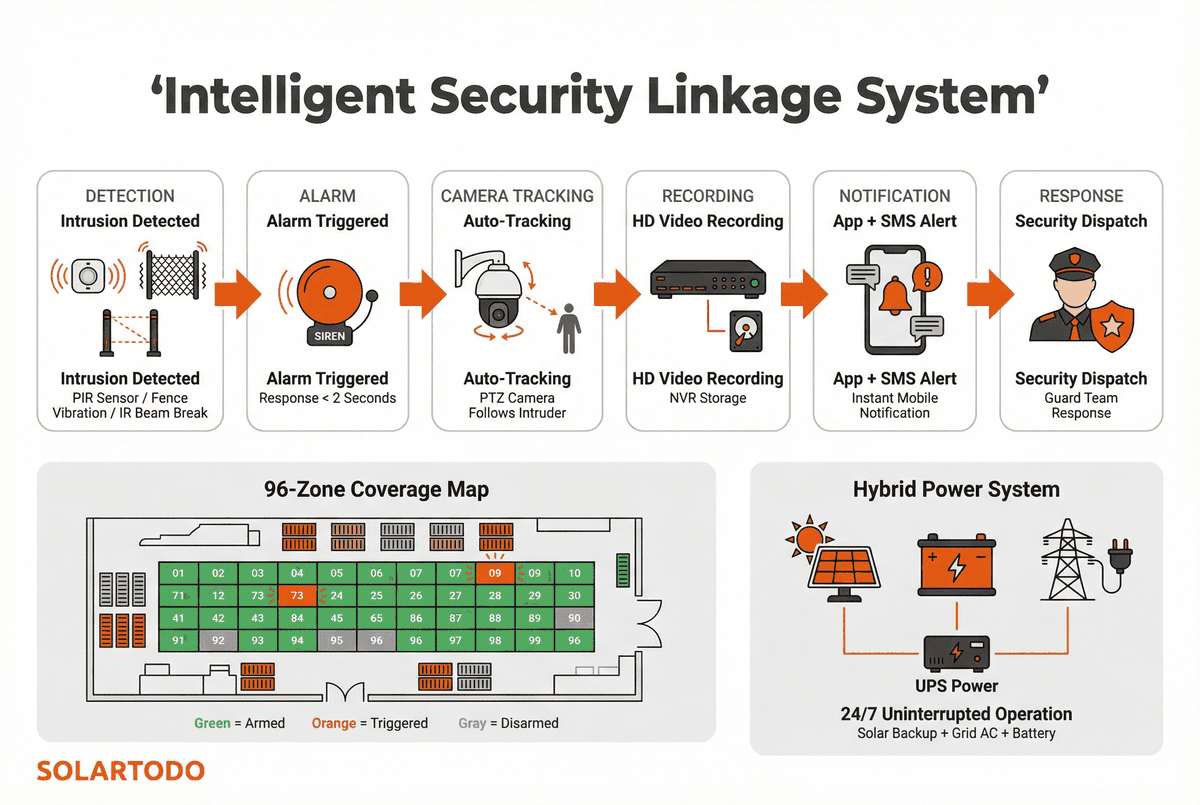
For this comparison, a practical reference is a medium remote perimeter package similar to the SOLAR TODO Border Checkpoint 32-Zone Off-Grid configuration: 16 cameras, 32 detectors, a 32-channel NVR, and a 64-zone hybrid alarm panel configured for 32 active zones. This type of package suits 1 primary gate, 2-4 vehicle lanes, 1 inspection building, and 1 perimeter strip.
A traditional architecture in MEA usually has 1 AC distribution board, 1 UPS, 1 diesel generator, and sometimes unstable grid input. The system can work, but fuel dependency is high. If the average electrical load is 180-230 W continuous, daily energy demand is about 4.3-5.5 kWh. With generator efficiency losses and partial-load operation, delivered energy cost becomes expensive.
A solar hybrid architecture adds PV modules, MPPT charge control, lithium battery storage, DC protection, and generator auto-start for low battery events. In a 5.0 kWh/day design, a site may use about 2.5-3.5 kWp PV and 10-15 kWh battery storage depending on autonomy target, seasonal irradiance, and acceptable generator runtime. In high-sun areas, generator use can drop to emergency-only operation for much of the year.
Reference system comparison
The table below uses a medium-security remote site benchmark for 2026 procurement analysis.
| Parameter | Solar hybrid perimeter system | Traditional grid + generator / generator-only |
|---|---|---|
| Cameras | 16 IP cameras | 16 IP cameras |
| Detectors | 32 intrusion detectors | 32 intrusion detectors |
| Recording | 32-channel NVR, 30 days typical | 32-channel NVR, 30 days typical |
| Daily energy demand | 4.3-5.5 kWh/day | 4.3-5.5 kWh/day |
| Power source | 2.5-3.5 kWp PV + 10-15 kWh battery + backup genset | Grid/UPS + genset or genset-only |
| Fuel dependency | Low to medium | High |
| Annual service visits | 2-4 planned visits | 4-8 planned visits |
| Noise and emissions | Low | High |
| Best fit | Remote, weak-grid, desert, border | Urban grid sites or low-runtime backup use |
According to NREL (2024), solar-plus-storage economics improve when diesel displacement is high and load is relatively constant. Perimeter security is exactly that type of load: cameras, networking, and alarm panels run 24 hours per day, 365 days per year, which improves solar hybrid utilization compared with intermittent loads.
2026 Cost Analysis by Middle East and Africa Region
In 2026, medium remote perimeter systems in MEA typically budget at $7,100-$9,200 for equipment-only off-grid packages, while full installed project costs can rise to $11,500-$19,500 depending on civil works, communications, and power architecture.
The most important distinction is total cost of ownership. Traditional systems often appear cheaper at tender stage because the generator, UPS, and basic wiring are familiar line items. However, once fuel, oil changes, battery replacements, and emergency callouts are included, 5-year cost can exceed the solar hybrid alternative in many remote sites.
Five-year cost benchmark by subregion
The following table models a medium remote site with 16 cameras and 32 detectors. It assumes 24/7 operation, 5.0 kWh/day average energy demand, and moderate site hardening. Values are planning ranges, not fixed quotations.
| Subregion | Traditional initial cost | Solar hybrid initial cost | 5-year traditional TCO | 5-year solar hybrid TCO | Typical payback of solar hybrid |
|---|---|---|---|---|---|
| Gulf remote sites | $10,500-$15,000 | $13,000-$18,000 | $22,000-$31,000 | $18,000-$25,000 | 3.2-5.0 years |
| North Africa desert sites | $10,000-$14,500 | $12,500-$17,500 | $21,000-$30,000 | $17,000-$24,000 | 2.8-4.6 years |
| West/Central Africa remote sites | $11,000-$16,500 | $13,500-$19,000 | $26,000-$39,000 | $18,500-$27,500 | 2.9-4.4 years |
| East Africa border/logistics sites | $10,800-$15,500 | $13,000-$18,500 | $24,000-$35,000 | $18,000-$26,500 | 3.0-4.8 years |
| Southern Africa outage-prone sites | $10,500-$15,000 | $12,800-$18,000 | $23,000-$33,000 | $18,000-$25,500 | 3.1-5.1 years |
The largest TCO gap appears in regions with expensive fuel delivery and frequent generator runtime. A diesel-backed site using 2.0-3.5 liters/day for security loads may consume 730-1,278 liters/year. At delivered fuel prices of $1.10-$1.80/liter, annual fuel spend alone reaches about $800-$2,300 before theft, transport losses, or idle running inefficiency.
Year-over-year trend analysis, 2021-2040
From 2021 to 2025, three trends changed perimeter security economics: battery prices declined, AI video loads increased, and diesel logistics remained volatile. According to BloombergNEF (2024), battery pack prices fell to around $115/kWh in 2024. According to IEA (2024), solar remains the fastest-growing power technology globally, which supports better component availability through 2026.
From 2026 to 2030, the likely direction is higher use of DC-coupled security loads, wider deployment of LiFePO4 batteries, and more edge analytics at camera level. That can reduce backhaul bandwidth by 20-40% but may increase camera power draw by 5-15 W per channel. Buyers should therefore evaluate both communications and power budgets together.
From 2030 to 2040, long-duration storage and lower-cost sodium-ion or alternative chemistries may reduce remote-site battery CAPEX further. The likely result is a broader shift away from generator-dominant security power systems, especially where carbon reporting, fuel theft, and maintenance access remain major cost drivers.
Technical Performance, Standards, and Use Cases
A compliant perimeter security design in 2026 should align with EN 50131, IEC 62676, UL 681, and NFPA 72 principles while maintaining 24/7 operation, 30-day retention, and at least 10-24 hours of backup autonomy based on risk class.
For B2B buyers, standards are not paperwork only. EN 50131 affects alarm grading and detector logic. IEC 62676 covers video surveillance system performance and interoperability. UL 681 is still widely referenced for installation practice, especially where insurers or public-sector buyers want recognized burglary system methods. NFPA 72 matters when supervisory signaling or fire interface is part of the project scope.
A medium site like the SOLAR TODO Border Checkpoint 32-Zone Off-Grid package typically includes 12 fixed HD IP cameras, 4 PTZ cameras, 8 perimeter beam sets, 16 PIR detectors, 16 dual-technology detectors, 1 32-channel NVR, and 1 64-zone hybrid panel with 32 spare zones. Those spare zones matter because expansions such as fence vibration loops, thermal relays, lane sensors, or panic buttons often appear after commissioning.
Application fit by sector
Different sectors in MEA have different cost priorities.
- Border checkpoints: uptime, remote power, and evidentiary video matter more than low initial CAPEX. A 16-camera and 32-detector layout is common for 1 gate area and 2-4 lanes.
- Oil and gas perimeters: hazardous area separation, long cable runs, and false alarm reduction matter. Dual-tech detectors and beam zoning reduce nuisance events in wind and heat shimmer conditions.
- Logistics yards: lighting, access control, and video retention often dominate. Grid may exist, but outage risk still justifies battery-backed hybrid power.
- Utilities and substations: cyber segmentation, relay integration, and perimeter zoning are key. Spare panel zones support future expansion without replacing the core controller.
Two authority statements are worth quoting. The International Energy Agency states, “Solar PV is expected to account for the largest share of capacity expansion to 2030.” The International Renewable Energy Agency states that renewables “improve energy security and reduce exposure to fossil-fuel price volatility,” which directly supports the solar hybrid perimeter security case in remote MEA sites.
EPC Investment Analysis and Pricing Structure
For perimeter security projects above 1 site or above $1,000K portfolio value, EPC delivery usually lowers lifecycle risk by combining engineering, procurement, installation, commissioning, and performance responsibility under one contract.
For security systems, EPC turnkey scope usually includes site survey, power-load calculation, detector and camera layout, bill of materials, mounting structures, cable schedule, communications design, installation, testing, commissioning, and operator training. In remote MEA projects, EPC scope may also include fence interface, pole foundations, small shelters, grounding, and generator synchronization.
Three-tier pricing model
The table below gives a practical 2026 pricing structure for B2B tenders.
| Delivery model | What is included | Typical price level vs equipment-only | Best use case |
|---|---|---|---|
| FOB Supply | Core equipment, factory test, packing | Baseline | Buyers with local integrator and customs control |
| CIF Delivered | Equipment + sea/air freight + insurance to destination port | +8-15% | Importers needing landed cargo visibility |
| EPC Turnkey | Supply, installation, commissioning, training, handover | +25-60% | Multi-site, public-sector, remote, or financed projects |
For volume procurement, practical guidance is:
- 50+ systems: target 5% discount
- 100+ systems: target 10% discount
- 250+ systems: target 15% discount
Typical payment terms are 30% T/T and 70% against B/L, or 100% L/C at sight. Financing may be available for large projects above $1,000K. For quotation support, EPC discussion, or portfolio analysis, buyers can contact [email protected] or call +6585559114.
ROI logic for solar hybrid security
A solar hybrid package may add $2,000-$4,000 to initial project cost on a medium remote site, but annual savings from lower fuel, fewer service trips, and longer UPS battery life can reach $900-$2,400. That produces simple payback of about 2.8-5.6 years in many MEA remote applications.
SOLAR TODO can support equipment supply, delivered cargo, or turnkey EPC depending on project scope. For buyers comparing 10, 50, or 100 remote sites, the correct method is portfolio TCO modeling, not single-site CAPEX comparison. That is where solar hybrid designs usually show the strongest financial case.
FAQ
A perimeter security system protects site boundaries using cameras, detectors, alarms, recording, and power backup, and in MEA remote sites the power design can change 5-year cost by 18-34%.
Q: What is the main cost difference between solar hybrid and traditional perimeter security systems in 2026? A: The main difference is operating cost. Solar hybrid systems usually cost 8-22% more upfront, but they reduce diesel fuel, generator servicing, and emergency callouts enough to lower 5-year TCO by about 18-34% on remote MEA sites.
Q: When does a solar hybrid perimeter system make more financial sense than a traditional system? A: Solar hybrid usually makes sense when grid uptime is below 95%, diesel runtime exceeds 8 hours/day, or fuel transport is difficult. In those conditions, payback often lands between 2.8 and 5.6 years, especially in North Africa, East Africa, and remote Gulf sites.
Q: How much power does a medium perimeter security site typically need? A: A medium site with 16 IP cameras, 32 detectors, networking, and recording often needs about 4.3-5.5 kWh/day. Continuous load is commonly around 180-230 W, but PTZ cameras, wireless links, and enclosure cooling can push the figure higher.
Q: What battery size is typical for a solar hybrid perimeter system? A: For a 5.0 kWh/day site, battery storage often falls in the 10-15 kWh range. The exact size depends on autonomy target, depth of discharge, local irradiance, and whether the project allows generator auto-start during low-sun periods.
Q: Are solar hybrid systems reliable enough for border checkpoints and critical infrastructure? A: Yes, if the design includes proper autonomy, surge protection, thermal management, and backup generation. A well-sized system with 2.5-3.5 kWp PV, 10-15 kWh battery, and generator fallback can support 24/7 operation for border, utility, and oil-field perimeters.
Q: Which standards should buyers request in tender documents? A: Buyers should reference EN 50131 for intrusion systems, IEC 62676 for video surveillance, UL 681 for installation practice, and NFPA 72 where signaling integration is required. These standards help align detector logic, recording quality, and commissioning requirements.
Q: What does EPC turnkey delivery include for perimeter security? A: EPC turnkey delivery usually includes engineering, procurement, installation, testing, commissioning, and training. For remote MEA sites, it may also include foundations, poles, grounding, solar power integration, communications setup, and final acceptance testing under one contract.
Q: How do FOB, CIF, and EPC pricing differ? A: FOB covers factory supply and packing. CIF adds freight and insurance to the destination port, usually increasing cost by about 8-15%. EPC turnkey includes installation and commissioning, often raising price by 25-60% versus equipment-only but reducing interface risk.
Q: What maintenance savings can solar hybrid systems deliver? A: Solar hybrid systems reduce generator runtime, which lowers oil changes, filter replacement, and unplanned service visits. On many remote sites, annual maintenance and fuel savings total about $900-$2,400, and the savings are higher where technician travel distances exceed 100 km.
Q: How should buyers compare vendors for a 10-site or 100-site rollout? A: Compare vendors on 5-year TCO, not only unit price. Check power architecture, spare alarm zones, storage retention, standards alignment, warranty terms, and service model. For 50+ units, ask for 5% discount; for 100+ units, 10% is a practical target.
References
- IEA (2024): World Energy Outlook 2024 and related market analysis on grid reliability, solar growth, and energy security trends.
- IRENA (2024): Renewable Power Generation Costs and renewable deployment data relevant to remote solar economics and fossil-fuel exposure.
- BloombergNEF (2024): Battery pack price survey showing average lithium-ion pack prices near $115/kWh in 2024.
- NREL (2024): Solar-plus-storage and distributed energy resource analysis methods relevant to remote-site power and lifecycle cost modeling.
- IEC 62676 (2025): Video surveillance systems for use in security applications, covering performance and interoperability.
- EN 50131 (2024): Intrusion and hold-up alarm systems framework used for detector zoning and alarm grading.
- UL 681 (2023): Installation and classification practices for burglary and holdup alarm systems.
- NFPA 72 (2025): National Fire Alarm and Signaling Code, relevant where supervisory signaling and integrated notification are required.
Conclusion
For remote perimeter security in Middle East and Africa, solar hybrid systems usually deliver the lowest 5-year cost, cutting fuel dependence by 40-75% and recovering their CAPEX premium in about 2.8-5.6 years.
The bottom line is simple: if your site runs 24/7, uses 16 cameras and 32 detectors, and depends on diesel or weak grid power, SOLAR TODO solar hybrid architecture is usually the stronger financial choice over traditional designs when evaluated on TCO, uptime, and service risk.
About SOLARTODO
SOLARTODO is a global integrated solution provider specializing in solar power generation systems, energy-storage products, smart street-lighting and solar street-lighting, intelligent security & IoT linkage systems, power transmission towers, telecom communication towers, and smart-agriculture solutions for worldwide B2B customers.
Further Reading
About the Author

SOLARTODO Editorial Team
Solar Energy & Infrastructure Expert Team
SOLAR TODO is a professional supplier of solar energy, energy storage, smart lighting, smart agriculture, security systems, communication towers, and power tower equipment.
Our technical team has over 15 years of experience in renewable energy and infrastructure, providing high-quality products and solutions to B2B customers worldwide.
Expertise: PV system design, energy storage optimization, smart lighting integration, smart agriculture monitoring, security system integration, communication and power tower supply.
Cite This Article
SOLARTODO Editorial Team. (2026). Perimeter Security System Cost Analysis 2026: Solar Hybrid…. SOLARTODO. Retrieved from https://solartodo.com/knowledge/perimeter-security-system-cost-analysis-2026-solar-hybrid-vs-traditional-by-middle-east-africa
@article{solartodo_perimeter_security_system_cost_analysis_2026_solar_hybrid_vs_traditional_by_middle_east_africa,
  title = {Perimeter Security System Cost Analysis 2026: Solar Hybrid…},
  author = {SOLARTODO Editorial Team},
  journal = {SOLARTODO Knowledge Base},
  year = {2026},
  url = {https://solartodo.com/knowledge/perimeter-security-system-cost-analysis-2026-solar-hybrid-vs-traditional-by-middle-east-africa},
  note = {Accessed: 2026-10-19}
}
Published: July 12, 2026 | Available at: https://solartodo.com/knowledge/perimeter-security-system-cost-analysis-2026-solar-hybrid-vs-traditional-by-middle-east-africa
Subscribe to Our Newsletter
Get the latest solar energy news and insights delivered to your inbox.
View All Articles