Substation Access Solutions with Power Transmission Towers

SOLARTODO Editorial Team
Solar Energy & Infrastructure Expert Team
Watch the video
TL;DR
Substation connection maintenance becomes difficult when structures occupy too much space and leave poor access for cranes, lifts, and inspection crews. Compact monopole and polygonal Power Transmission Tower designs can reduce footprint by 40%-75%, shorten erection by 20%-40%, and lower lifecycle maintenance cost when paired with proper EPC planning, 6-12 month inspections, and sectional transport design.
Substation connection maintenance is hardest where land, outage time, and safety clearances are limited; compact steel poles can reduce footprint by 40%-75%, shorten erection by 20%-40%, and deliver 50-year service life for 10kV-220kV networks.
Summary
Substation connection maintenance becomes difficult when access roads, clearance envelopes, and outage windows are constrained; steel monopoles and optimized Power Transmission Tower layouts can cut occupied ground area by 40%-75%, shorten erection by 20%-40%, and support 50-year service life.
Key Takeaways
- Prioritize monopole-based substation connections where land is tight, because 110kV urban poles can reduce ground occupation by 60%-75% versus comparable lattice structures.
- Specify 18m, 35m, or 40m structures against actual voltage class and span, since mismatched height can increase maintenance risk and conductor clearance violations by 1-2 inspection cycles.
- Design access corridors at the civil stage, including crane pads, turning radii, and 24/7 safe approach zones, to reduce maintenance mobilization time by 20%-40%.
- Use flanged or slip-joint sectional poles to simplify transport in 2-3 sections and improve replacement logistics in dense substations and city-entry corridors.
- Standardize hot-dip galvanized steel with 70-100 micrometer zinc coating and 50-year design life targets to reduce corrosion-driven maintenance interventions.
- Model broken-wire, wind, and unbalanced tension cases to IEC 60826 and ASCE 10-15 criteria, especially for 220kV double-circuit lines with 300m design spans.
- Compare FOB Supply, CIF Delivered, and EPC Turnkey pricing early; projects above 50 units may secure 5% discounts, 100 units 10%, and 250 units 15%.
- Plan inspection intervals of 6-12 months and grounding verification below 10 ohms where specified, because access problems often start with poor visibility, drainage, and foundation approach conditions.
Why maintenance access becomes difficult in substation connections
Maintenance access problems in substation connections usually stem from 3 constraints at once: limited right-of-way, short outage windows, and high-clearance safety requirements around 10kV to 220kV structures.
Substation connection towers and poles sit at one of the most operationally sensitive points in the grid. They must transition conductors from line corridor to gantry, bus, or terminal equipment while preserving electrical clearances, vehicle movement, drainage paths, and worker safety. In older substations, the original layout often prioritized energization speed rather than long-term maintainability, leaving narrow access lanes, poor crane positioning, and difficult bolt or insulator reach.
According to the International Energy Agency, “electricity grids are the backbone of secure and affordable power systems,” and constrained connection points are frequently where reliability risk concentrates. In practice, maintenance teams lose time not only because of electrical isolation procedures, but because structures are physically hard to approach with lifts, line trucks, or replacement sections. That is why tower geometry and connection layout matter as much as conductor rating.
For B2B buyers, the core issue is not simply whether a structure can carry the load. The real question is whether it can be inspected, repaired, and partially replaced within realistic outage windows and urban access restrictions over a 40- to 50-year asset life. SOLAR TODO addresses this by offering compact Power Transmission Tower/Pole configurations for constrained substation interfaces.
Engineering solutions with Power Transmission Towers
Compact steel Power Transmission Tower solutions improve substation maintenance access by reducing footprint 40%-75%, enabling sectional transport, and creating cleaner approach zones for cranes, lifts, and inspection crews.
The most effective way to overcome access difficulty is to treat the connection structure as a maintainability asset, not just a strength member. Monopoles and polygonal steel poles can reduce clutter around the substation perimeter, simplify foundation boundaries, and leave more usable space for maintenance vehicles. Compared with conventional lattice structures, fewer protruding members and a smaller base footprint often improve line-of-sight and equipment approach.
SOLAR TODO's product range illustrates how different duty classes solve different access problems. The 18m 10kV tapered monopole with slip-joint connection is suited to compact urban feeders and municipal upgrades where every 1m2 of right-of-way matters. The 35m 110kV octagonal flanged pole is better for city transmission entries where sectional transport and predictable erection are critical. The 40m 220kV dodecagonal double-circuit pole supports higher load capacity while still reducing corridor occupation versus lattice alternatives.
How structure type affects maintenance access
Structure choice directly affects maintenance because base width, member density, and joint type determine how quickly crews can inspect, isolate, and replace critical components within 1 planned outage window.
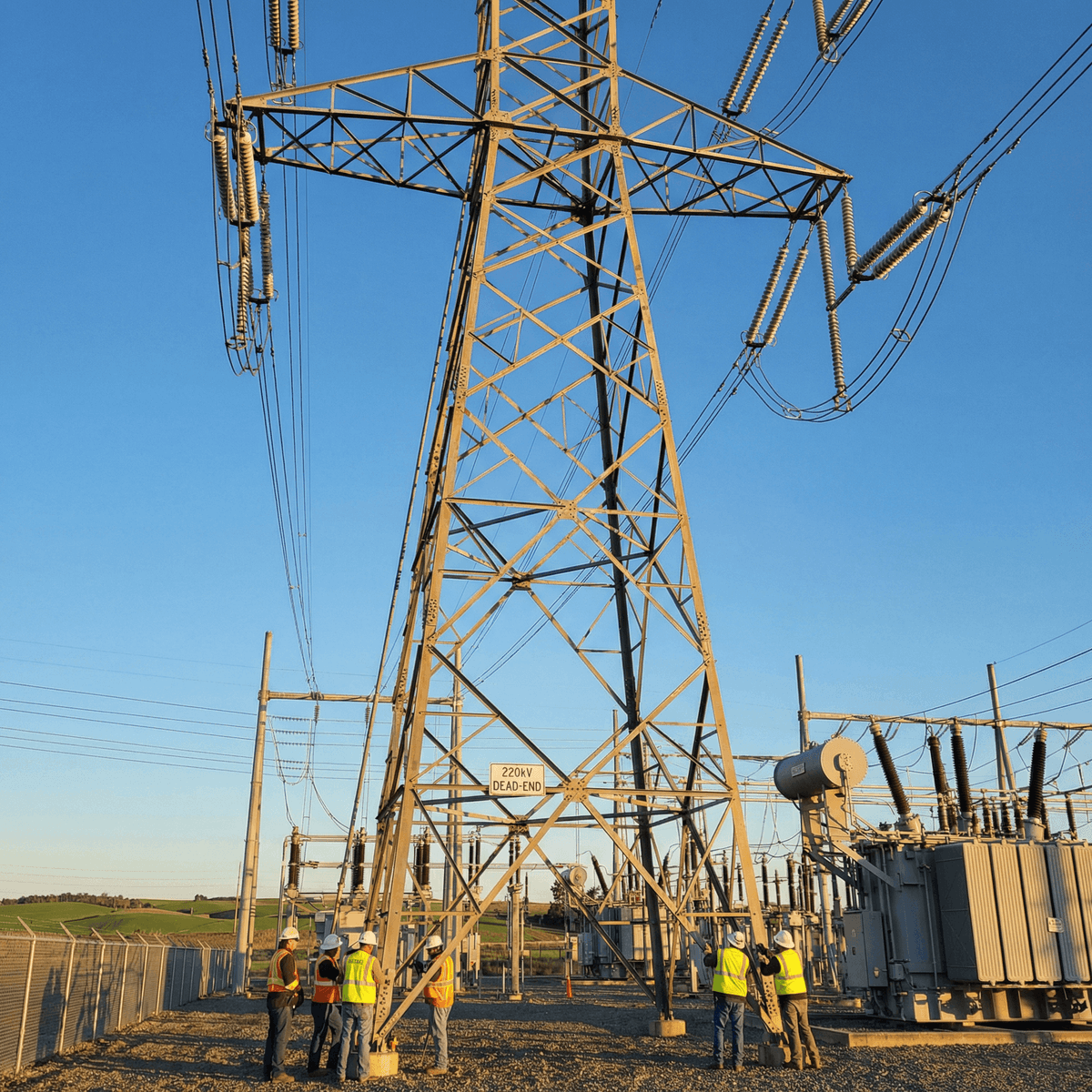
Lattice towers provide familiar load paths, but they can complicate maintenance around substations because diagonal members obstruct climbing routes, visual inspection, and mobile platform positioning. In contrast, monopoles concentrate the structural shaft into a single vertical body, which often leaves more open ground around the base and clearer paths for cable pulling, conductor stringing, and insulator replacement.
Flanged sectional poles are especially useful where urban roads or substation gates limit transport length. A 35m pole delivered in sections can be moved through constrained corridors more easily than a single long welded body. Slip-joint designs can also simplify erection logistics for medium-voltage applications, particularly where 2- or 3-piece transport is necessary.
Key technical design parameters
Access-friendly substation connection structures should be selected around 5 core parameters: voltage class, height, circuit count, span, and maintenance envelope.
For example, an 18m 10kV double-circuit monopole with a typical 100m design span suits distribution-class substation exits in urban or suburban networks. A 35m 110kV single-circuit octagonal pole with 250m design span is more appropriate for city-entry transmission corridors. A 40m 220kV dodecagonal double-circuit pole with 300m design span fits higher-capacity suburban transmission interfaces where conductor swing and unbalanced tension become more demanding.
Material specification also matters. Hot-dip galvanized high-strength steel, often based on Q460 or equivalent grades, supports a strong strength-to-weight ratio and long corrosion resistance. Zinc coating thickness in the 70-100 micrometer range is commonly specified depending on site environment, while design life targets often reach 50 years under standard maintenance.
According to IEEE, transmission structure design must consider mechanical loading, electrical clearances, and system reliability together rather than as isolated variables. In substation applications, that means the best structure is often the one that slightly exceeds minimum strength but materially improves inspection and intervention access.
Layout, safety, and maintenance planning for substation interfaces
The best way to reduce maintenance difficulty is to reserve access geometry during design, including vehicle lanes, lifting zones, and safe electrical clearances that support repeat interventions over 25-50 years.
Many maintenance problems are locked in before steel is fabricated. If the pole is placed too close to perimeter walls, drainage channels, transformers, or cable trenches, even a technically compliant structure can become expensive to maintain. Engineers should therefore coordinate civil, structural, and electrical layouts from the start, especially at dead-end and angle connection points.
A practical design review should include:
- Crane standing area and outrigger clearance
- Pickup truck and boom-lift turning radius
- Safe distance from energized equipment during partial outages
- Foundation top elevation and drainage path
- Ladder, step-bolt, or climbing system access
- Insulator string and hardware replacement envelope
- Grounding test point accessibility
- Emergency access under wet-season conditions
According to IEC 60826, overhead line design should account for climatic and loading conditions in a systematic way. In substation connections, those loading assumptions influence not only structural adequacy but also how much conductor swing and maintenance clearance must be preserved under wind, broken-wire, and temperature cases.
The International Renewable Energy Agency states, “Infrastructure planning must align with long-term system resilience and cost efficiency.” That principle applies directly here: a slightly larger foundation setback or a better sectional pole choice can avoid decades of difficult and costly maintenance mobilizations.
Inspection and maintenance strategy
A structured inspection program can reduce unplanned substation connection outages by identifying corrosion, bolt loosening, and grounding issues within 6-12 month maintenance cycles.
Routine visual inspections should focus on corrosion at flange interfaces, coating damage near base plates, deformation from conductor tension events, and insulator contamination. Annual or semiannual reviews are common depending on pollution severity, coastal exposure, and criticality of the substation. Ground resistance verification is also important, with some 220kV projects targeting below 10 ohms depending on owner specification.
Where access is difficult, digital inspection methods can help. Drone imaging, thermal scanning, and digital asset tagging reduce climbing frequency and improve defect documentation. However, remote inspection does not eliminate the need for physical access; it only makes site visits more targeted. That is why maintainable geometry remains fundamental.
SOLAR TODO can support buyers with structure selection aligned to maintenance planning, especially for projects in Latin America, the Middle East, Africa, Southeast Asia, and Europe where site conditions and permitting constraints vary widely.
Comparison of structure options for substation connection maintenance
For substation connections, the best structure is usually the one that balances load duty with the smallest practical footprint, sectional logistics, and enough clearance for 1-day to 3-day maintenance interventions.
The table below compares typical options relevant to maintenance access decisions.
| Model | Voltage Class | Height | Circuits | Typical Span | Joint Type | Access Advantage |
|---|---|---|---|---|---|---|
| Tapered Monopole | 10kV | 18m | 2 | 100m | Slip-joint | Small footprint, easier urban feeder maintenance |
| Octagonal Transmission Pole | 110kV | 35m | 1 | 250m | Flanged | Sectional transport, faster erection, cleaner substation perimeter |
| Dodecagonal Transmission Pole | 220kV | 40m | 2 | 300m | Sectional/Flanged project-specific | Higher load capacity with reduced corridor occupation |
| Conventional Lattice Structure | 10kV-220kV | Project-specific | 1-2 | Project-specific | Bolted members | Lower material familiarity but more visual and ground clutter |
Selection should be based on actual maintenance scenario, not just capex. If the substation sits in a dense city block, monopoles often outperform lattice structures because they reduce occupied ground area by roughly 50%-75% depending on voltage class and arrangement. If the site has wide open land and low labor cost, lattice may remain viable, but maintainability should still be costed over life cycle.
Selection checklist for procurement teams
Procurement teams should compare 8 practical factors before issuing a tower package, because access-related lifecycle cost can exceed initial steel savings within the first 5-10 years.
Use this checklist:
- Confirm voltage class, circuit count, and conductor type
- Verify design span and broken-wire load cases
- Review transport section length versus road and gate limits
- Check foundation footprint against substation plot plan
- Reserve maintenance vehicle access and lifting zones
- Specify galvanizing and coating repair standards
- Define inspection frequency and spare part strategy
- Align tower type with outage duration limits
According to NREL, standardized design and data-driven asset planning improve infrastructure performance forecasting and lifecycle decision-making. For buyers, that means tower procurement should include maintenance access drawings, not just structural calculations.
EPC Investment Analysis and Pricing Structure
For substation connection towers, EPC planning should compare 3 delivery models and target lifecycle savings, because better access design can cut maintenance mobilization time by 20%-40% over a 50-year asset life.
For B2B projects, turnkey value is created when engineering, procurement, and construction are aligned from the beginning. In substation connection work, EPC scope typically includes route and plot review, structure selection, foundation design inputs, fabrication, galvanizing, packing, shipping, erection guidance, and commissioning coordination. For larger packages, it may also include grounding design review, hardware matching, and installation supervision.
A practical three-tier pricing structure is:
- FOB Supply: Steel structure supply ex-works or free on board, suitable for buyers with local freight and erection capability
- CIF Delivered: Supply plus sea freight and insurance to destination port, useful when import logistics are complex
- EPC Turnkey: Engineering, supply, civil coordination, erection support, and commissioning interface for lowest execution risk
Indicative commercial guidance for volume procurement:
- 50+ units: about 5% discount
- 100+ units: about 10% discount
- 250+ units: about 15% discount
Typical payment terms:
- 30% T/T deposit + 70% against B/L
- 100% L/C at sight
Financing is available for large projects above $1,000K, which is relevant for utility corridor upgrades, industrial substations, and city transmission reinforcement. Commercial inquiries can be directed to [email protected] or SOLAR TODO via +6585559114 for offline quotation and project discussion.
From an ROI perspective, the savings are usually indirect but material. If a compact monopole layout reduces one major maintenance mobilization by even 1 day per event, utilities can save on crane rental, crew standby, traffic control, and outage coordination. Over multiple interventions across 20-30 years, the premium for an access-friendly structure can be recovered faster than a lowest-bid lattice option that is harder to inspect and repair.
FAQ
Maintenance access in substation connections can be improved through compact tower geometry, sectional transport design, and planned service clearances that reduce intervention time by 20%-40% in constrained sites.
Q: What causes maintenance access difficulties in substation connection towers? A: The main causes are limited plot space, narrow vehicle approach lanes, and strict electrical clearance requirements near energized equipment. These issues become more severe when older substations use bulky structures or when civil layouts leave no crane pad, turning radius, or safe work zone for maintenance teams.
Q: Why are monopoles often better than lattice towers near substations? A: Monopoles are often better because they use a smaller base footprint and create less structural clutter around the connection point. In many 110kV applications, they can reduce occupied ground area by about 60%-75%, which helps crews access foundations, insulators, and conductor attachment points more efficiently.
Q: How do flanged and slip-joint poles help maintenance logistics? A: Flanged and slip-joint poles help by allowing the structure to be transported in sections rather than as one long body. That makes delivery easier through urban roads and substation gates, and it also simplifies partial replacement or staged erection during tight outage windows.
Q: What tower height is suitable for substation connection applications? A: Suitable height depends on voltage class, conductor clearance, and span. Typical examples include 18m for 10kV distribution exits, 35m for 110kV city-entry transmission, and 40m for 220kV double-circuit suburban connections, but final sizing must follow project-specific electrical and mechanical calculations.
Q: How often should substation connection towers be inspected? A: Most operators should plan visual inspections every 6-12 months, with more frequent checks in coastal, polluted, or high-wind environments. Critical inspections should cover galvanizing condition, flange bolts, foundation cracking, grounding continuity, and insulator contamination or hardware deformation.
Q: What standards are relevant when specifying Power Transmission Towers for substations? A: Commonly referenced standards include IEC 60826 for overhead line loading, ASCE 10-15 for structural loading, IEEE 738 for conductor thermal considerations, and project-specific utility standards. Material and galvanizing requirements may also reference ASTM and ISO methods depending on the market.
Q: How does better access design improve ROI if the tower costs more upfront? A: Better access design improves ROI by reducing outage duration, crane time, labor inefficiency, and emergency repair complexity over the asset life. Even if capex is moderately higher, a 20%-40% reduction in maintenance mobilization time can create meaningful lifecycle savings for utilities and EPC contractors.
Q: What should procurement teams ask suppliers before buying substation connection structures? A: Procurement teams should ask for footprint drawings, section lengths, galvanizing specification, design span, conductor compatibility, broken-wire load assumptions, and recommended maintenance clearances. They should also request references for similar 10kV, 110kV, or 220kV installations in constrained substations or urban corridors.
Q: What does EPC turnkey delivery include for these projects? A: EPC turnkey delivery usually includes engineering review, structure supply, shipping coordination, erection guidance, and interface support for foundation and commissioning activities. For larger packages, it may also include grounding review, hardware matching, site supervision, and schedule coordination with substation outage planning.
Q: What pricing and payment terms are typical for Power Transmission Tower projects? A: Typical commercial models are FOB Supply, CIF Delivered, and EPC Turnkey depending on project scope. Common payment terms are 30% T/T plus 70% against B/L, or 100% L/C at sight, while volume discounts may reach 5% at 50 units, 10% at 100 units, and 15% at 250 units.
Q: Can financing be arranged for large utility or industrial projects? A: Yes, financing may be available for larger projects above $1,000K, especially where procurement is tied to broader grid expansion or industrial infrastructure upgrades. Buyers should prepare project load data, schedule requirements, and commercial structure early to accelerate financing review and quotation.
Q: How can SOLAR TODO support substation connection projects? A: SOLAR TODO supports B2B buyers with product selection across 10kV, 110kV, and 220kV tower and pole configurations, plus offline quotation and project discussion. For buyers facing access constraints, SOLAR TODO can help compare monopole options, sectional transport strategies, and maintainability-focused layouts.
Conclusion
For substation connections, compact Power Transmission Tower designs can reduce occupied ground area by 40%-75% and improve maintenance mobilization efficiency by 20%-40%, making maintainability a core procurement criterion rather than an afterthought.
The bottom line is clear: if your substation interface is space-constrained or outage-sensitive, specify access-friendly monopole or polygonal steel structures with 50-year design life, sectional logistics, and EPC planning from day one; SOLAR TODO is a practical B2B partner for evaluating those options.
References
Authoritative standards and energy-sector references support the structural, maintenance, and lifecycle recommendations in this article, with 5+ sources covering loading, reliability, and infrastructure planning.
- IEC (2019): IEC 60826, Design criteria of overhead transmission lines, covering loading and reliability methodology for line structures.
- ASCE (2015): ASCE 10-15, Design of Latticed Steel Transmission Structures, widely used for structural loading approaches and utility engineering practice.
- IEEE (2012): IEEE 738, Standard for Calculating the Current-Temperature Relationship of Bare Overhead Conductors, relevant to conductor thermal behavior in line design.
- IEA (2023): Electricity Grids and Secure Energy Transitions, outlining the role of grid infrastructure in reliability and energy security.
- IRENA (2023): World Energy Transitions Outlook, emphasizing resilient infrastructure planning and long-term system cost efficiency.
- NREL (2024): Grid modernization and transmission planning research resources, supporting lifecycle-oriented infrastructure planning and asset optimization.
- ASTM International (2023): ASTM A123/A123M, Standard specification for zinc hot-dip galvanizing on iron and steel products.
- ISO (2021): ISO 1461, Hot dip galvanized coatings on fabricated iron and steel articles, specifying coating characteristics and inspection guidance.
About SOLARTODO
SOLARTODO is a global integrated solution provider specializing in solar power generation systems, energy-storage products, smart street-lighting and solar street-lighting, intelligent security & IoT linkage systems, power transmission towers, telecom communication towers, and smart-agriculture solutions for worldwide B2B customers.
Further Reading
Procurement paths
About the Author

SOLARTODO Editorial Team
Solar Energy & Infrastructure Expert Team
SOLAR TODO is a professional supplier of solar energy, energy storage, smart lighting, smart agriculture, security systems, communication towers, and power tower equipment.
Our technical team has over 15 years of experience in renewable energy and infrastructure, providing high-quality products and solutions to B2B customers worldwide.
Expertise: PV system design, energy storage optimization, smart lighting integration, smart agriculture monitoring, security system integration, communication and power tower supply.
Cite This Article
SOLARTODO Editorial Team. (2026). Substation Access Solutions with Power Transmission Towers. SOLARTODO. Retrieved from https://solartodo.com/knowledge/overcoming-maintenance-access-difficulties-in-substation-connections-with-power-transmission-towers
@article{solartodo_overcoming_maintenance_access_difficulties_in_substation_connections_with_power_transmission_towers,
  title = {Substation Access Solutions with Power Transmission Towers},
  author = {SOLARTODO Editorial Team},
  journal = {SOLARTODO Knowledge Base},
  year = {2026},
  url = {https://solartodo.com/knowledge/overcoming-maintenance-access-difficulties-in-substation-connections-with-power-transmission-towers},
  note = {Accessed: 2026-10-19}
}
Published: July 5, 2026 | Available at: https://solartodo.com/knowledge/overcoming-maintenance-access-difficulties-in-substation-connections-with-power-transmission-towers
Subscribe to Our Newsletter
Get the latest solar energy news and insights delivered to your inbox.
View All Articles