Data Center Carbon Cuts with Commercial Solar PV

SOLAR TODO
Solar Energy & Infrastructure Expert Team
Watch the video
TL;DR
Commercial Solar PV Systems are a practical way for data centers to reduce carbon without risking uptime. Well-designed systems can cut Scope 2 emissions by 20-40%, generate about 1,200-1,800 kWh per installed kWp each year, and often pay back in 5-9 years. For best results, combine solar with strong interconnection design, energy management controls, and, where needed, battery storage.
Commercial Solar PV Systems help data centers cut Scope 2 emissions by 20-40%, offset daytime loads with 1,200-1,800 kWh/kWp/year generation, and often reach 5-9 year payback when power costs are $0.10-$0.18/kWh and land or carport space is available.
Summary
Commercial Solar PV Systems help data centers cut Scope 2 emissions by 20-40%, offset daytime loads with 1,200-1,800 kWh/kWp/year generation, and often reach 5-9 year payback when power costs are $0.10-$0.18/kWh and land or carport space is available.
Key Takeaways
- Quantify baseline emissions first by mapping IT, cooling, and auxiliary loads; many data centers can target 20-40% Scope 2 reduction with on-site Commercial Solar PV Systems.
- Size systems using real daytime demand and irradiance; a 50 kWp array typically generates 75-90 MWh/year, while 1 MWp can exceed 2,000 MWh/year in strong solar regions.
- Prioritize high-efficiency modules in space-constrained sites; N-type TOPCon and bifacial products in the 22-24.5% range improve output per square meter.
- Use carports, rooftops, and adjacent land together; parking can become productive energy infrastructure while preserving 20-30 vehicle bays under a 50 kW solar carport.
- Model ROI against tariff and PUE data; at $0.10-$0.18/kWh, annual savings can support typical payback periods of 5-9 years before escalation benefits.
- Integrate PV with UPS, BESS, and EMS platforms; pairing solar with storage can raise self-consumption and improve resilience during peak tariff periods.
- Specify bankable standards and interconnection compliance; require IEC 61215, IEC 61730, IEEE 1547, and relevant UL certifications for lower technical and procurement risk.
- Compare procurement routes carefully; FOB supply, CIF delivery, and EPC turnkey pricing differ materially in logistics scope, installation responsibility, and project risk allocation.
Why data centers are turning to Commercial Solar PV Systems
Commercial Solar PV Systems can reduce data center grid-related carbon emissions by 20-40% and deliver electricity at competitive lifecycle cost when matched to daytime cooling and IT support loads.
Data centers face a difficult decarbonization equation: demand is rising, uptime requirements are non-negotiable, and many operators must meet internal ESG targets or customer procurement mandates. Grid electricity remains the largest controllable source of operational carbon for most colocation, edge, and enterprise facilities. That makes on-site solar one of the few practical measures that can cut emissions without reducing computing capacity.
According to the International Energy Agency, "Solar PV has become the cheapest source of electricity in history in some markets," a point that matters directly to facilities with long operating hours and predictable daytime loads. According to IRENA (2024), utility-scale solar PV remains among the lowest-cost new-build power sources globally, while commercial behind-the-meter systems can hedge tariff volatility and improve long-term energy budgeting.
For data centers, the key issue is not whether solar can run the entire facility 24/7 on its own. The practical question is how much daytime energy and carbon can be displaced without compromising reliability. In most projects, Commercial Solar PV Systems work best as part of a hybrid architecture that includes utility supply, UPS, backup generation, and increasingly battery energy storage.
SOLAR TODO addresses this need with commercial-scale photovoltaic solutions suited to rooftops, carports, and adjacent land. For example, a 50kW Factory Solar Carport can generate roughly 75-90 MWh/year in 1,500-1,800 kWh/m2/year irradiation zones, while a 1MW Pastoral-Solar Ground Mount can reach about 2,050 MWh/year in high-resource sites. These figures make solar relevant not only for office loads around data centers, but also for cooling plants, administration buildings, security systems, and parts of core facility demand.
Technical fit: how Commercial Solar PV Systems support data center decarbonization
Commercial Solar PV Systems are technically effective for data centers when they are sized to daytime load, designed around 22-24.5% module efficiency, and integrated with power quality and interconnection requirements.
The technical case begins with load shape. Data centers operate continuously, but solar production peaks during the same daytime window when ambient temperatures increase chiller and CRAC energy consumption. Even if solar covers only a share of total demand, it can reduce imported grid electricity during expensive and carbon-intensive daytime periods.
According to NREL PVWatts methodology, fixed commercial arrays in many regions produce roughly 1,200-1,800 kWh per installed kWp annually depending on irradiance, tilt, losses, and temperature. That means a 500 kWp system may generate approximately 600-900 MWh/year, while a 1 MWp system in a strong solar zone can exceed 1,700-2,000 MWh/year. For operators reporting carbon KPIs, these are material numbers.
Suitable deployment formats for data centers
Commercial Solar PV Systems for data centers usually fit into three deployment formats: rooftop arrays, solar carports, and ground-mount systems, each with different yield, structural, and permitting implications.
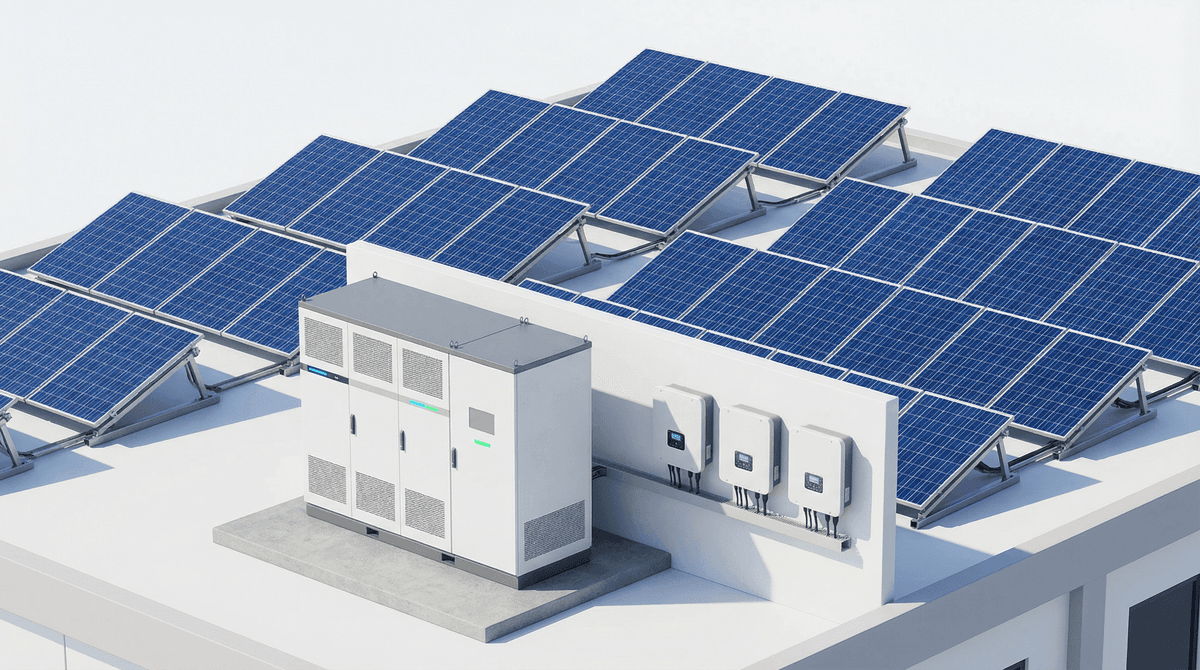
Rooftop systems suit administration buildings, warehouses, electrical annexes, and low-rise technical blocks where structural reserve and shading conditions are acceptable. Carports are attractive where parking is abundant but roof space is limited, because they add weather protection while generating electricity. Ground-mount systems are best for campus-style facilities with adjacent land and fewer space constraints.
SOLAR TODO's 50kW Factory Solar Carport is relevant for edge facilities, telecom-adjacent sites, and enterprise campuses that want to convert parking into generation capacity. Its N-type TOPCon modules with stated 24.5% efficiency support higher output per area, and the structure typically covers 320-420 m2 across 20-30 vehicle bays. For larger campuses, the 1MW Pastoral-Solar Ground Mount offers bifacial modules, single-axis tracking, and annual output around 2,050 MWh/year under suitable conditions.
Integration with UPS, BESS, and facility controls
Commercial Solar PV Systems deliver the best operational value when linked to energy management software, battery storage, and existing electrical architecture rather than treated as a standalone generation asset.
A data center cannot tolerate unstable voltage, poor harmonics, or uncontrolled export. Therefore, PV design must align with inverter controls, transformer settings, anti-islanding logic, and local grid-code requirements. IEEE 1547-2018 remains a key reference for distributed energy resource interconnection and interoperability, especially where export limitation or ride-through behavior is required.
Battery energy storage is not mandatory for every project, but it improves self-consumption and peak shaving. In facilities with time-of-use tariffs, storage can shift midday solar into late afternoon cooling peaks. It can also support resilience strategies for non-critical loads, though it should not be confused with the core UPS function that protects IT continuity.
The International Energy Agency states, "Rapid deployment of clean electricity is central to reducing emissions from digital infrastructure." In practical terms, that means pairing generation assets with controls that prioritize reliability, dispatch visibility, and measurable carbon reduction.
EPC Investment Analysis and Pricing Structure
Commercial Solar PV Systems for data centers typically achieve 5-9 year payback, and EPC turnkey delivery reduces execution risk by bundling engineering, procurement, construction, testing, and commissioning into one accountable scope.
For B2B buyers, project economics depend on system size, tariff level, available space, electrical complexity, and procurement route. A small 50 kWp carport project may primarily offset support-building and parking-area loads, while a 1 MWp campus system can materially reduce annual purchased electricity. At tariffs of $0.10-$0.18/kWh, annual savings can be substantial enough to support internal rate of return targets, especially in regions with strong solar resource.
EPC turnkey delivery usually includes:
- Site survey and feasibility study
- Structural and electrical engineering
- Module, inverter, mounting, cable, and protection equipment procurement
- Civil works and installation
- Grid interconnection documentation
- Testing, commissioning, and performance verification
- Basic O&M training and warranty documentation
Three-tier pricing structure for B2B procurement
Commercial Solar PV Systems are commonly quoted as FOB Supply, CIF Delivered, or EPC Turnkey, and each tier changes who carries logistics, installation, and performance responsibility.
| Pricing Tier | What is Included | Best For | Risk Allocation |
|---|---|---|---|
| FOB Supply | Modules, inverters, structures, BOS at port of origin | EPCs with local installation teams | Buyer manages freight, customs, installation |
| CIF Delivered | Equipment plus ocean freight and insurance to destination port | Importers and project developers | Buyer manages customs clearance and installation |
| EPC Turnkey | Full engineering, supply, installation, testing, commissioning | Data center owners seeking one-point accountability | Supplier/EPC manages execution and performance scope |
Indicative volume pricing guidance for repeat or portfolio buyers:
- 50+ units or equivalent package volume: about 5% discount
- 100+ units or equivalent package volume: about 10% discount
- 250+ units or equivalent package volume: about 15% discount
Typical commercial payment terms:
- 30% T/T deposit and 70% against B/L
- 100% L/C at sight
For large projects above $1,000K, financing may be available subject to project profile, jurisdiction, and credit review. For quotations, EPC scope clarification, and warranty terms, buyers can contact cinn@solartodo.com. SOLAR TODO follows an inquiry-to-offline-quotation model rather than online checkout, which is more suitable for engineered B2B projects.
ROI logic for data center operators
Commercial Solar PV Systems create value through electricity savings, carbon reduction, and tariff hedging, with the strongest cases usually found where daytime cooling loads are high and grid prices exceed $0.10/kWh.
A simplified example shows the economics. If a 1 MWp system produces 1,700 MWh/year and offsets electricity priced at $0.12/kWh, annual savings are about $204,000 before escalation. At $0.15/kWh, the same output yields roughly $255,000/year, improving payback and lifecycle return.
Carbon accounting also matters. Using a grid emissions factor of 0.60 tCO2/MWh, a 1,700 MWh/year system can avoid around 1,020 tons of CO2 annually. That reduction can support customer reporting, green lease commitments, and internal decarbonization milestones.
Deployment models, use cases, and selection guide
Commercial Solar PV Systems for data centers work best when matched to site form factor, with carports fitting constrained campuses, rooftops serving support buildings, and ground mounts delivering the largest annual MWh output.
Not every data center has enough roof area to make a large dent in total demand, which is why mixed-format deployment is often the most realistic strategy. A campus may combine rooftop PV on office and warehouse blocks, carports over staff parking, and ground-mount arrays on buffer land. This approach spreads generation across available surfaces while reducing single-point structural constraints.
Common use cases include:
- Enterprise data centers with owned campuses and adjacent land
- Colocation facilities seeking lower Scope 2 emissions for tenant reporting
- Edge data centers where parking can be converted into solar carports
- Telecom and digital infrastructure hubs combining PV with storage and smart controls
- New-build facilities that can design PV, switchgear, and BESS into the original master plan
Comparison of relevant SOLAR TODO solar PV options
Commercial Solar PV Systems should be selected by available area, annual energy target, and integration complexity rather than by module wattage alone.
| Solution | Nominal Size | Module Type | Efficiency | Typical Annual Generation | Typical Use Case |
|---|---|---|---|---|---|
| SOLAR TODO 50kW Factory Solar Carport | 50 kWp | N-type TOPCon mono | 24.5% | 75-90 MWh/year | Parking areas, edge sites, admin/support loads |
| SOLAR TODO 50kW Agricultural Greenhouse Rooftop | 50 kWp | Bifacial TOPCon or HJT | 22% | 72-85 MWh/year | Specialized rooftops with light-management constraints |
| SOLAR TODO 1MW Pastoral-Solar Ground Mount | 1,000 kWp | Bifacial with 1-axis tracker | 22% | About 2,050 MWh/year | Campus-scale sites with adjacent land |
For most data centers, the greenhouse-specific product is less directly relevant unless the operator has mixed-use agricultural or research infrastructure. The more practical comparison is between carport and ground-mount systems. Carports maximize dual use of developed land, while ground mounts usually deliver lower cost per installed watt and higher total annual output.
Selection criteria should include:
- Available roof, parking, or land area
- Structural loading and geotechnical conditions
- Interconnection limits and export policy
- Daytime load profile and cooling demand
- Carbon reporting methodology and target year
- Security, maintenance access, and cleaning conditions
SOLAR TODO can support these evaluations through project-based quotation and configuration review. For data center buyers, that matters because the right answer is rarely a standard package; it is a site-specific combination of generation, controls, and commercial structure.
FAQ
Commercial Solar PV Systems can answer most data center decarbonization needs when buyers assess load profile, interconnection, and ROI together rather than treating solar as a standalone sustainability add-on.
Q: How much can Commercial Solar PV Systems reduce a data center's carbon footprint? A: In many projects, on-site solar can reduce Scope 2 emissions by roughly 20-40%, depending on available area, local irradiance, and the grid emissions factor. The exact reduction depends on how much daytime electricity the system offsets and whether the facility adds storage to increase self-consumption.
Q: Can solar power run a data center 24/7 by itself? A: No, not reliably on its own, because solar generation is intermittent and stops at night. Data centers usually use solar as part of a hybrid system with utility supply, UPS, backup generation, and sometimes battery storage to maintain uptime while reducing daytime grid consumption.
Q: What size solar system is appropriate for a data center campus? A: The right size depends on daytime load, available space, and interconnection limits. As a rough guide, 50 kWp can generate about 75-90 MWh/year, while 1 MWp can produce around 1,700-2,050 MWh/year in strong solar regions, making both small and campus-scale projects viable.
Q: Why are solar carports relevant for data centers? A: Solar carports convert parking areas into productive energy assets without consuming new land. A 50 kW solar carport can cover about 20-30 vehicle bays and generate 75-90 MWh/year, which is useful for offsetting support-building loads, security systems, and part of daytime cooling demand.
Q: What technical standards should buyers require in procurement documents? A: Buyers should require recognized module and interconnection standards, including IEC 61215, IEC 61730, and IEEE 1547 where applicable. Depending on market and equipment scope, relevant UL standards, local grid codes, and fire or structural certifications should also be specified to reduce technical and compliance risk.
Q: How do batteries improve the value of Commercial Solar PV Systems in data centers? A: Batteries increase self-consumption by storing excess midday solar for later use, especially during late-afternoon cooling peaks or high tariff windows. They do not replace the core UPS architecture, but they can improve tariff management, support non-critical loads, and reduce curtailment where export is limited.
Q: What is the typical payback period for a data center solar project? A: Many commercial projects fall in the 5-9 year payback range, although results vary by tariff, irradiation, capex, and financing structure. Sites with electricity prices above $0.12/kWh and strong daytime load alignment usually see faster returns than facilities in low-tariff markets.
Q: What does EPC turnkey include for a Commercial Solar PV System? A: EPC turnkey typically includes engineering, equipment procurement, installation, testing, commissioning, and handover documentation. It is often the preferred route for data center owners because it reduces interface risk and creates one accountable party for project delivery and performance scope.
Q: How are FOB, CIF, and EPC quotes different? A: FOB supply covers equipment at the origin port, CIF adds freight and insurance to the destination port, and EPC turnkey includes full project delivery. The choice depends on whether the buyer has local construction capability, import experience, and appetite for execution risk.
Q: What payment terms are common for B2B solar procurement? A: Common terms include 30% T/T in advance and 70% against B/L, or 100% L/C at sight. For large projects above $1,000K, financing may be available subject to project review, and buyers should confirm milestone definitions, warranty scope, and commissioning conditions before contract award.
Q: How much maintenance do Commercial Solar PV Systems require at a data center? A: Maintenance is generally moderate and predictable, consisting of cleaning, thermal inspection, electrical checks, inverter monitoring, and periodic structural review. Dust, coastal corrosion, and local weather conditions influence service frequency, but most systems are far less maintenance-intensive than diesel-based generation assets.
Q: When is ground-mount better than rooftop or carport solar? A: Ground-mount is usually better when the site has adjacent land, higher annual MWh targets, and fewer structural constraints. It often offers lower installed cost per watt and easier maintenance access, while carports and rooftops are stronger choices where land is limited or dual-use infrastructure is preferred.
Related Reading
References
Commercial Solar PV Systems for data centers should be evaluated against recognized performance, safety, and market references, including at least 5 authoritative sources used in engineering and procurement decisions.
- NREL (2024): PVWatts Calculator methodology and solar resource modeling used to estimate annual PV generation by location, tilt, and system losses.
- IRENA (2024): Renewable Power Generation Costs report showing solar PV remains among the lowest-cost sources of new electricity in many markets.
- IEA (2024): Energy sector analysis and electricity transition reports highlighting the role of solar PV in reducing emissions from growing digital infrastructure loads.
- IEC 61215-1 (2021): Terrestrial photovoltaic modules - design qualification and type approval requirements for crystalline silicon modules.
- IEC 61730-1 (2023): Photovoltaic module safety qualification requirements for construction and testing.
- IEEE 1547-2018 (2018): Standard for interconnection and interoperability of distributed energy resources with electric power systems interfaces.
- UL 61730 (2023): North American harmonized PV module safety requirements aligned with international module safety frameworks.
- NREL (tracker studies, 2023-2024): Performance research showing single-axis tracking can improve annual energy harvest versus fixed-tilt systems under suitable conditions.
Conclusion
Commercial Solar PV Systems can cut data center Scope 2 emissions by 20-40% and often deliver 5-9 year payback, making them a practical decarbonization tool rather than a symbolic sustainability measure.
For operators with available roof, parking, or land area, SOLAR TODO can configure carport or ground-mount solutions from 50 kWp to 1 MWp+ that align with uptime requirements, carbon reporting, and B2B procurement structure. The bottom line is simple: if a data center has daytime load and space for PV, solar should be evaluated now as a bankable carbon and cost reduction asset.
About SOLARTODO
SOLARTODO is a global integrated solution provider specializing in solar power generation systems, energy-storage products, smart street-lighting and solar street-lighting, intelligent security & IoT linkage systems, power transmission towers, telecom communication towers, and smart-agriculture solutions for worldwide B2B customers.
About the Author

SOLAR TODO
Solar Energy & Infrastructure Expert Team
SOLAR TODO is a professional supplier of solar energy, energy storage, smart lighting, smart agriculture, security systems, communication towers, and power tower equipment.
Our technical team has over 15 years of experience in renewable energy and infrastructure, providing high-quality products and solutions to B2B customers worldwide.
Expertise: PV system design, energy storage optimization, smart lighting integration, smart agriculture monitoring, security system integration, communication and power tower supply.
Cite This Article
SOLAR TODO. (2026). Data Center Carbon Cuts with Commercial Solar PV. SOLAR TODO. Retrieved from https://solartodo.com/knowledge/overcoming-carbon-footprint-targets-in-data-centers-with-commercial-solar-pv-systems
@article{solartodo_overcoming_carbon_footprint_targets_in_data_centers_with_commercial_solar_pv_systems,
  title = {Data Center Carbon Cuts with Commercial Solar PV},
  author = {SOLAR TODO},
  journal = {SOLAR TODO Knowledge Base},
  year = {2026},
  url = {https://solartodo.com/knowledge/overcoming-carbon-footprint-targets-in-data-centers-with-commercial-solar-pv-systems},
  note = {Accessed: 2026-04-18}
}
Published: April 17, 2026 | Available at: https://solartodo.com/knowledge/overcoming-carbon-footprint-targets-in-data-centers-with-commercial-solar-pv-systems
Subscribe to Our Newsletter
Get the latest solar energy news and insights delivered to your inbox.
View All Articles