outdoor solar lighting for highway and road | SOLARTODO

Cinn Song
Founder & Chief Solutions Architect
Watch the video
TL;DR
Outdoor solar lighting for highways and roads is best specified as a split system with 8m-12m poles, 60W-120W LEDs, 3-5 days of autonomy, and wind-rated structures up to 150 km/h. For B2B projects, compare FOB, CIF, and EPC turnkey pricing, then size the system using local irradiance, road geometry, and maintenance access.
Outdoor solar lighting for highways and roads uses 100W LED fixtures, 800Wh LiFePO4 batteries, 150 km/h wind-rated poles, and 5-day autonomy to cut trenching, grid extension, and outage risk.
Summary
Outdoor solar lighting for highways and roads uses 100W LED fixtures, 800Wh LiFePO4 batteries, 150 km/h wind-rated poles, and 5-day autonomy to cut trenching, grid extension, and outage risk.
Key Takeaways
Use 100W LED split solar streetlights with 800Wh LiFePO4 storage for 10m highway poles where 5-day autonomy and 150 km/h wind resistance are required.
- Specify 10m split systems for 2-4 lane highways where independent PV orientation improves annual energy yield by 10-20% versus fixed all-in-one heads.
- Size battery storage at 4-5 nights of autonomy, using 800Wh LiFePO4 for a 100W fixture operating in dimming schedules over 12 hours.
- Require IEC 60598 luminaire compliance and IEC 62124 standalone PV design verification for public road projects above 50 poles.
- Compare FOB, CIF, and EPC turnkey pricing because civil works, foundations, transport, and commissioning can add 25-45% beyond fixture supply.
- Apply volume procurement tiers of 50+, 100+, and 250+ units to reduce unit cost by 5%, 10%, and 15% respectively.
- Use solar lighting where grid extension exceeds $20,000 per kilometer or where outages create safety risk on rural roads, bridges, and logistics corridors.
- Plan preventive maintenance every 12 months and battery replacement around year 6-8 depending on cycle depth, ambient temperature, and controller profile.
- Request SOLARTODO project sizing with pole spacing, irradiance, wind zone, and lighting class data before issuing a final bill of quantities.
Outdoor Solar Lighting for Highway and Road Projects
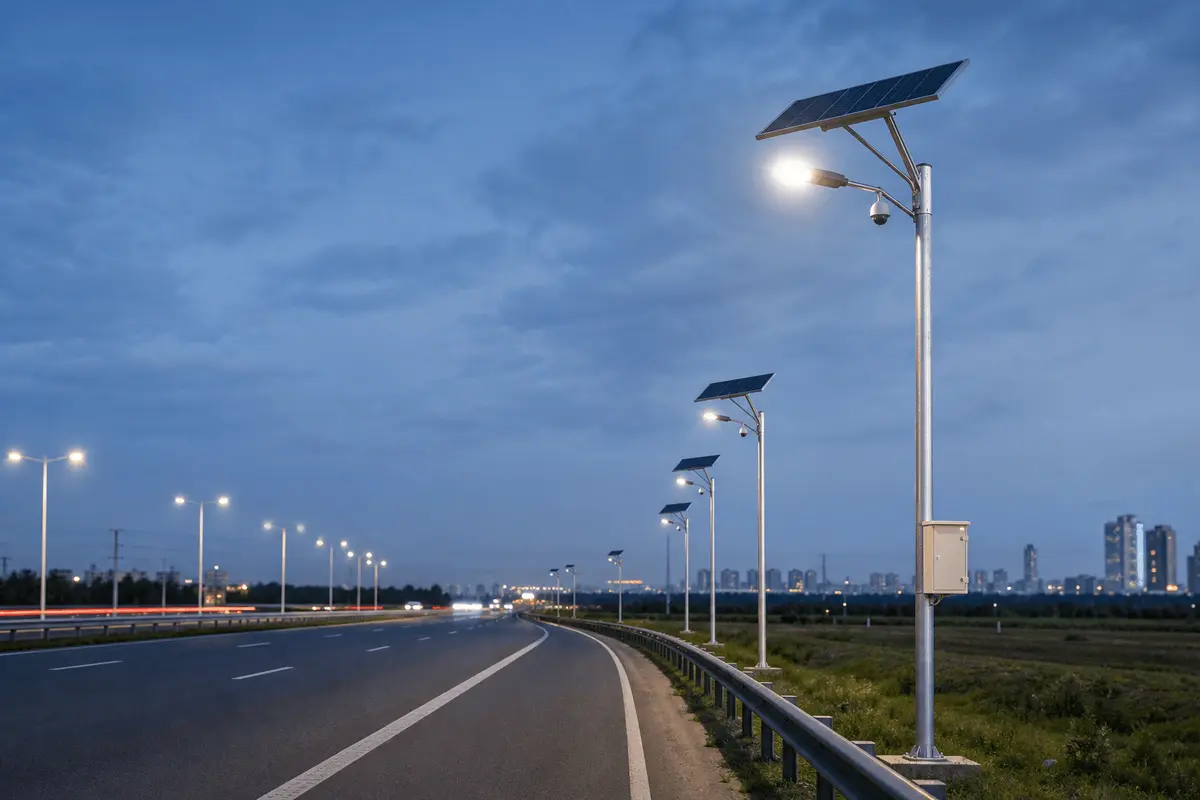
Outdoor solar highway lighting is most effective where 10m poles, 100W LEDs, 800Wh batteries, and 5-day autonomy replace expensive grid extension or unreliable utility power.
For B2B road owners, the core problem is not simply illumination; it is dependable visibility across long linear assets with uneven access to power. Highway corridors, arterial roads, port access roads, mining roads, border roads, and industrial estates often face high trenching costs, voltage-drop constraints, theft risk, and long outage recovery times. A distributed solar streetlight turns each pole into a standalone power system, so a single cable fault cannot darken an entire road section.
According to IRENA (2025), renewable power capacity additions reached about 582 GW in 2024, with solar PV representing roughly 452 GW. That scale matters for road lighting because PV modules, MPPT controllers, and LiFePO4 batteries now benefit from mature manufacturing, predictable supply, and improving lifecycle economics. IRENA Director-General Francesco La Camera states, 'renewables keep breaking their own expansion records,' which reflects why infrastructure buyers increasingly treat solar lighting as a standard option rather than a pilot technology.
SOLARTODO positions outdoor solar lighting as a project-engineered product, not a retail catalog item. The correct specification depends on mounting height, road width, target lighting class, wind speed, solar irradiation, rainy-day requirement, and installation method. For highway and road projects, SOLARTODO typically recommends split solar streetlights because the PV module can be tilted toward the best solar harvest while the LED luminaire is aimed for road uniformity.
Technical Deep Dive: System Architecture and Performance
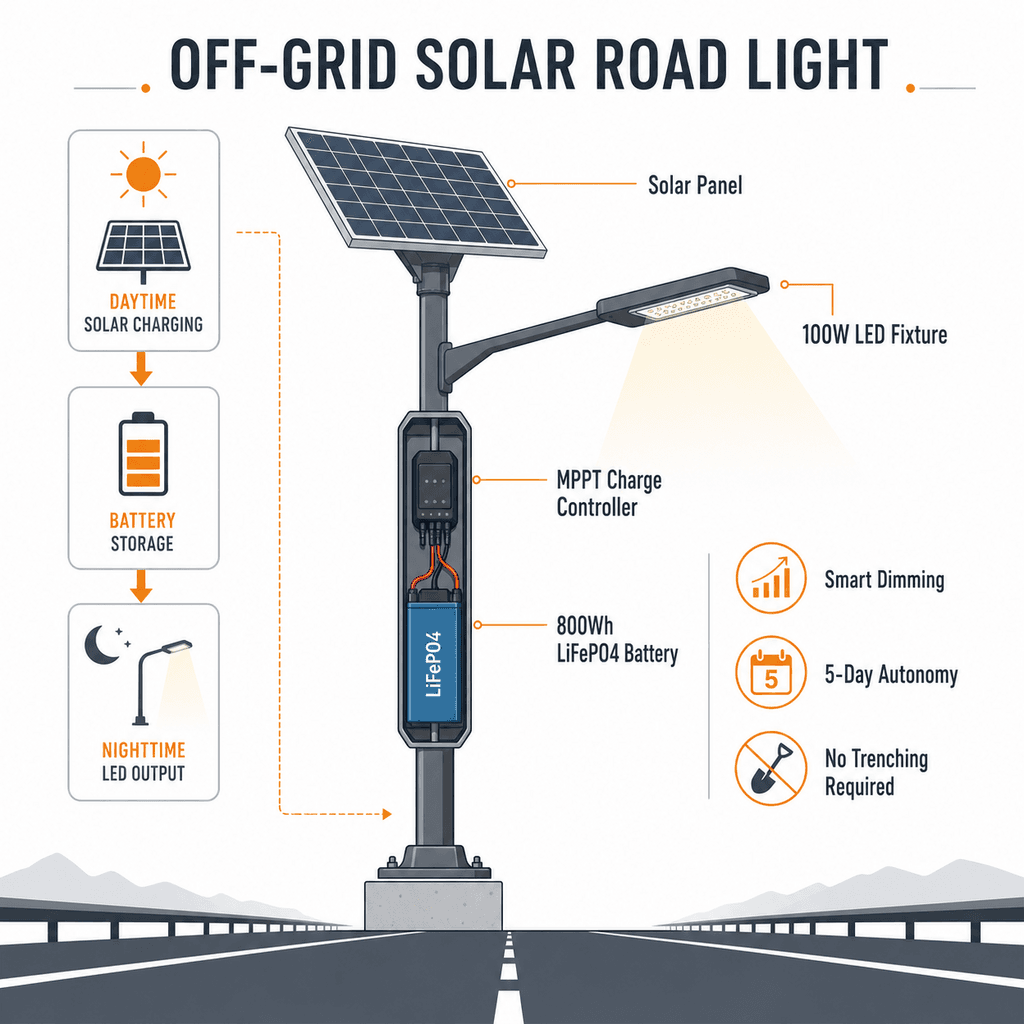
A highway-grade split solar streetlight combines a 100W LED luminaire, 800Wh LiFePO4 battery, MPPT controller, 10m galvanized pole, and independently mounted PV module.
The split architecture separates four engineering functions: power generation, energy storage, lighting, and structure. The solar module is sized for the local peak-sun-hour profile and mounted at an angle that favors annual energy yield. The luminaire is mounted and tilted for carriageway distribution, not for solar exposure. This matters on highways because good lighting design requires uniformity across lanes, shoulders, medians, and pedestrian conflict zones.
The battery and controller define service reliability. LiFePO4 chemistry is preferred for road lighting because it offers strong cycle life, thermal stability, and safer behavior than many older lithium chemistries. A properly configured MPPT controller improves solar harvest compared with simple PWM charging, especially in variable irradiance and higher-voltage module configurations. For a 100W LED fixture, an 800Wh battery provides a practical reserve when dimming schedules reduce average nightly load.
According to NREL PVWatts documentation, PV energy modeling depends on solar resource, array orientation, system losses, and operating temperature. Procurement teams should therefore avoid one-size-fits-all lighting schedules. A road in the Middle East with high irradiance and dust exposure requires a different cleaning and sizing assumption than a tropical coastal road with frequent cloud cover or an African highland corridor with high UV exposure and wind load.
The International Energy Agency states, 'Solar PV is the largest source of new renewable electricity.' For highway lighting buyers, this means solar components are no longer niche inputs; they are globally available infrastructure components. However, road lighting still needs project-specific engineering, especially for wind resistance, foundation design, corrosion protection, and optical distribution.
Core Specification Checklist
For highway and road lighting tenders, engineering teams should request these minimum data points:
- Pole height: 8m, 10m, or 12m depending on carriageway width and lighting class.
- LED power: 60W-120W for most road applications, with 100W common for 10m highway poles.
- Battery capacity: 600Wh-1,200Wh depending on autonomy target and dimming profile.
- Autonomy: 3-5 rainy days, with 5 days preferred for critical road safety corridors.
- Wind resistance: 120-150 km/h for exposed highway, coastal, and highland locations.
- Ingress protection: IP65 or higher for luminaires and control enclosures.
- Corrosion protection: hot-dip galvanized poles, with marine-grade coating where salt exposure is present.
- Standards: IEC 60598 for luminaire safety and IEC 62124 for standalone PV design verification.
Applications and Project Use Cases
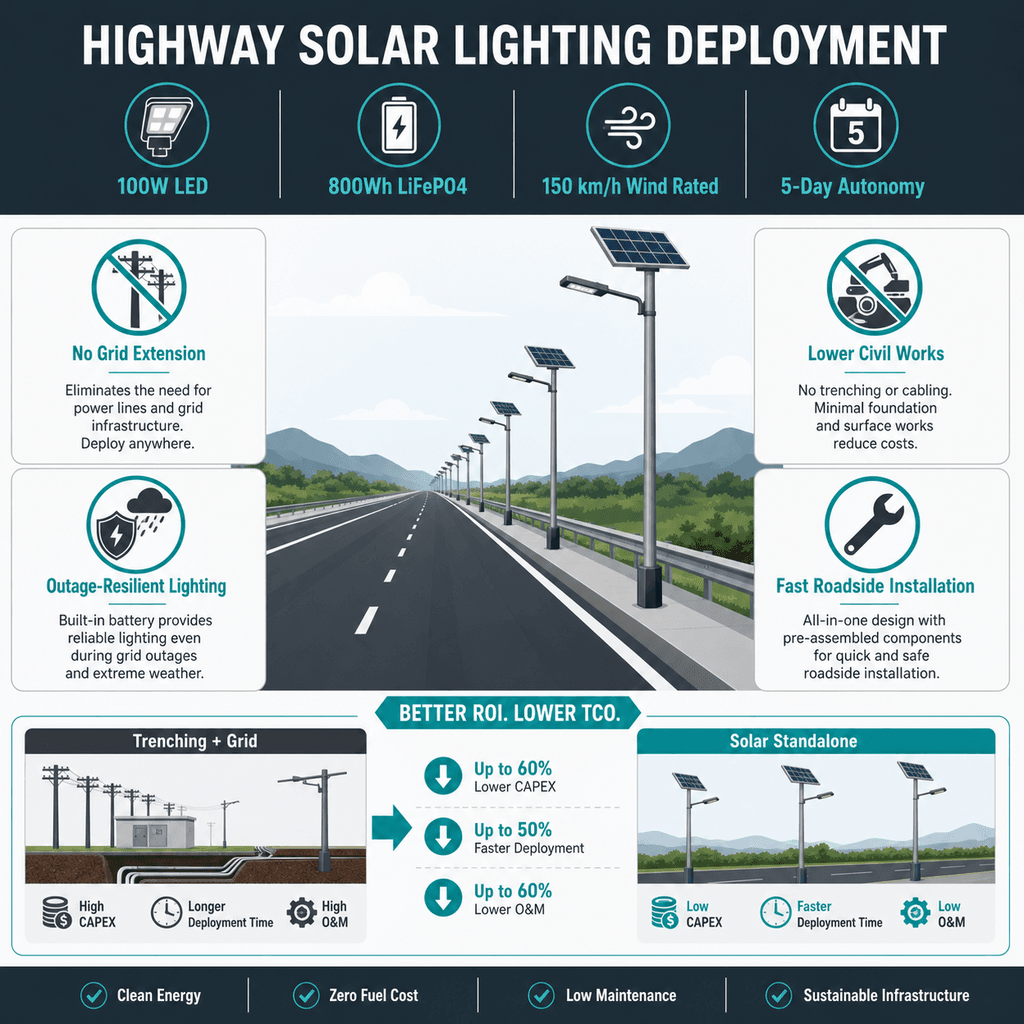
Solar road lighting delivers the highest value on corridors where grid connection costs exceed 20% of project budget or outage risk affects transport safety.
The strongest use cases are rural highways, feeder roads, bridges, toll plazas, logistics parks, industrial zones, mining access roads, airport perimeter roads, and temporary construction detours. In these locations, solar lighting reduces underground cabling, distribution cabinets, transformers, and utility coordination. Each pole operates independently, so maintenance teams can isolate failures without shutting down a complete feeder circuit.
For municipalities, the business case often combines avoided grid extension with lower operating cost. Conventional road lighting requires trenching, cable, breakers, metering, and monthly utility payments. Solar lighting shifts cost toward upfront equipment and installation, then reduces recurring energy exposure. According to IEA (2024), solar PV continued to dominate renewable capacity growth, which supports competitive procurement for modules and power electronics.
For EPC contractors, solar lighting also simplifies deployment in regions where utility permitting is slow. A road segment can be lit pole by pole as foundations cure and equipment arrives. SOLARTODO can support project packages for Latin America, the Middle East, Africa, Southeast Asia, and Europe, including quotation, technical configuration, export documentation, and financing discussion for large infrastructure programs.
Highway safety teams should still treat solar lighting as an engineered system, not a shortcut. Lighting class, pole spacing, glare control, uniformity ratio, and crash-zone placement must be evaluated. A 10m pole with a 100W LED may be suitable for one highway geometry but excessive for a narrow rural road. SOLARTODO project review should include road width, lane count, median layout, expected traffic speed, and desired dimming schedule.
EPC Investment Analysis and Pricing Structure
EPC turnkey solar lighting bundles engineering, procurement, civil works, installation, commissioning, and documentation, while volume orders above 250 units can reduce supply pricing by 15%.
A complete EPC delivery includes site survey, lighting layout, solar sizing, structural review, bill of quantities, export procurement, foundations, pole erection, fixture installation, controller configuration, testing, and handover documentation. For public agencies and private road operators, EPC reduces interface risk because one delivery chain coordinates equipment supply, civil construction, and performance commissioning.
SOLARTODO uses a B2B inquiry-to-quotation model rather than online checkout. Buyers can request budgetary pricing at three levels: FOB Supply for factory-gate export procurement, CIF Delivered for shipment to destination port, and EPC Turnkey for installed and commissioned road lighting. The right tier depends on whether the buyer already controls local civil works and installation resources.
| Pricing tier | What it includes | Best-fit buyer | Cost implication |
|---|---|---|---|
| FOB Supply | Solar light kits, poles, batteries, controllers, packaging, export documents | Importers, distributors, EPCs with local crews | Lowest quoted unit price, buyer handles freight and installation |
| CIF Delivered | FOB scope plus international freight and insurance to destination port | Government suppliers and regional contractors | Adds logistics cost but simplifies import planning |
| EPC Turnkey | Equipment, logistics, foundations, installation, testing, commissioning | Municipalities, road authorities, industrial owners | Highest upfront price, lowest coordination burden |
Volume pricing should be modeled early. Orders of 50+ units may qualify for about 5% discount, 100+ units for about 10%, and 250+ units for about 15%, subject to final specification and logistics. Standard payment terms are 30% T/T deposit plus 70% against bill of lading, or 100% L/C at sight. Project financing is available for large projects above $1,000K, with inquiries directed to [email protected].
ROI depends on avoided trenching, avoided grid extension, electricity tariff, maintenance access, and outage cost. For remote roads, avoiding even 1 km of utility extension can materially improve payback. Many projects target a 3-6 year payback when compared with conventional AC lighting that requires cable trenching, transformers, metering, and electricity payments. The ROI case is strongest when solar lighting replaces new grid infrastructure rather than only replacing existing grid-connected lamps.
Comparison and Selection Guide
A 10m split solar streetlight is preferred for highways, while 3.5m-6m compact solar lights fit pathways, campuses, and low-speed local roads.
The main selection question is not whether solar lighting works; it is which architecture fits the road class. All-in-one solar lights can be economical for small roads and pedestrian areas, but their integrated panel angle may compromise either solar harvest or light distribution. Split systems cost more upfront but give engineers better control over PV orientation, battery capacity, wind loading, and optical placement.
| Project condition | Recommended system | Typical pole height | Typical LED load | Key reason |
|---|---|---|---|---|
| Highway or arterial road | Split solar streetlight | 8m-12m | 80W-120W | Better road optics, larger PV and battery capacity |
| Rural feeder road | Split or semi-split solar light | 6m-9m | 40W-80W | Balances cost, autonomy, and installation speed |
| Industrial access road | Split high-wind model | 8m-10m | 60W-100W | Supports security visibility and 120-150 km/h wind zones |
| Park or campus pathway | Compact garden solar light | 3.5m-5m | 20W-40W | Lower glare and pedestrian-scale illumination |
| Temporary construction detour | Portable or modular solar light | 4m-8m | 30W-80W | Fast deployment without trenching |
For highway-grade procurement, the SOLARTODO 10m Highway Split 100W High-Wind Solar Streetlight is the relevant benchmark. It is designed around 150 km/h wind resistance, 800Wh LiFePO4 storage, and 5-day autonomy for critical road applications. For lower-speed environments, SOLARTODO also offers smaller pathway and garden formats, such as 3.5m systems with 20W LED loads and 150Wh LiFePO4 batteries.
Procurement teams should request a lighting simulation when road safety is regulated or politically visible. Specification sheets alone do not prove uniformity, glare control, or pole-spacing performance. A complete submittal should include photometric data, foundation assumptions, wind calculations, battery autonomy model, controller schedule, and warranty terms.
Conclusion
For highway projects above 50 poles, SOLARTODO split solar lighting with 100W LEDs, 800Wh LiFePO4 storage, and 150 km/h wind resistance provides the most resilient specification.
Outdoor solar lighting for highways and roads is now a bankable infrastructure option when it is sized by road geometry, solar resource, wind zone, and autonomy target. The bottom line: for critical road corridors, specify split solar streetlights with 3-5 days of autonomy, IEC-aligned components, and EPC pricing that separates supply, logistics, and installation risk.
SOLARTODO supports B2B buyers with engineered quotations, project financing discussion for large programs, and offline procurement support. For technical and commercial review, contact [email protected] or +6585559114 with road width, pole spacing target, location, quantity, and required delivery tier.
FAQ
Outdoor solar road lighting projects usually require 8-12m poles, 60W-120W LEDs, 3-5 autonomy days, and project-specific wind and lighting calculations.
Q: What is outdoor solar lighting for highway and road projects? A: Outdoor solar lighting for highways and roads is a standalone lighting system that combines a PV module, LED luminaire, battery, controller, and pole. For highway use, systems commonly use 8m-12m poles, 60W-120W LED fixtures, and 3-5 rainy-day autonomy to maintain visibility without grid power.
Q: Why use split solar streetlights instead of all-in-one lights on highways? A: Split solar streetlights are better for highways because the PV module and LED luminaire can be aimed independently. This improves solar harvest and road illumination at the same time. On 10m poles, split systems also support larger batteries, stronger brackets, and wind ratings up to 150 km/h.
Q: How much battery capacity is needed for a 100W road solar light? A: A 100W road solar light typically needs 600Wh-1,200Wh of LiFePO4 storage depending on dimming schedule and autonomy target. SOLARTODO's highway benchmark uses an 800Wh battery for 5-day autonomy under controlled lighting profiles. Final sizing should use local peak sun hours and rainy-season assumptions.
Q: What pole height is suitable for highway solar lighting? A: Highway solar lighting usually uses 8m, 10m, or 12m poles depending on road width, lane count, and required lighting class. A 10m pole with a 100W LED is common for arterial roads and highway shoulders. Narrow rural roads may use 6m-9m poles to control cost and glare.
Q: How does EPC turnkey pricing differ from FOB or CIF supply? A: FOB supply covers equipment and export documents, while CIF delivered adds freight and insurance to the destination port. EPC turnkey includes equipment, civil works, installation, commissioning, and handover. EPC pricing costs more upfront but reduces coordination risk for municipalities, road authorities, and industrial owners.
Q: What payment terms does SOLARTODO support for road lighting projects? A: SOLARTODO typically supports 30% T/T deposit with 70% against bill of lading, or 100% L/C at sight for qualified projects. Large projects above $1,000K may be eligible for financing discussion. Buyers should email [email protected] with quantity, destination, and technical requirements.
Q: What standards should buyers request for highway solar streetlights? A: Buyers should request IEC 60598 for luminaire safety, IEC 62124 for standalone PV system design verification, and relevant battery and ingress-protection documentation. For public roads, photometric files, wind-load assumptions, foundation drawings, and corrosion-protection specifications are also important. Standards reduce procurement ambiguity and improve tender comparability.
Q: How often do solar road lights need maintenance? A: Solar road lights should be inspected at least every 12 months, with cleaning frequency adjusted for dust, salt, pollen, or industrial pollution. Maintenance should check PV module soiling, bolt torque, luminaire seals, controller logs, and battery health. LiFePO4 batteries often require replacement after 6-8 years depending on heat and cycling.
Q: What is the typical ROI for solar highway lighting? A: ROI is strongest where solar lighting avoids new trenching, transformers, metering, and grid extension. Many projects target 3-6 year payback compared with new AC lighting, especially when utility extension exceeds $20,000 per kilometer. Final ROI depends on local labor, tariffs, road length, and maintenance access.
Q: Can solar lighting handle high-wind highway locations? A: Yes, but the pole, brackets, foundation, and PV mounting must be engineered for the wind zone. SOLARTODO's highway split model is rated for 150 km/h wind resistance. Buyers in coastal, desert, bridge, or highland locations should request structural calculations and site-specific foundation guidance before procurement.
Q: What information is needed for a SOLARTODO quotation? A: SOLARTODO needs project location, road width, lane count, pole height preference, target spacing, lighting hours, autonomy requirement, wind speed, quantity, and delivery tier. Photos or drawings improve accuracy. With these inputs, SOLARTODO can prepare an offline quotation for FOB, CIF, or EPC turnkey delivery.
References
Highway solar lighting specifications should cite at least 5 authoritative standards or institutions covering PV performance, luminaire safety, interconnection, and renewable cost trends.
- IRENA (2025): Renewable Capacity Statistics 2025, reporting about 582 GW of renewable additions in 2024 and solar PV as the dominant new capacity source.
- IRENA (2025): Renewable Power Generation Costs in 2024, documenting continued solar PV cost competitiveness against fossil-fuel generation in new power projects.
- IEA (2024): Renewables 2024, analyzing global renewable capacity growth and identifying solar PV as the leading source of new renewable electricity.
- NREL (2024): PVWatts Calculator documentation, explaining solar resource, array orientation, temperature, and system-loss inputs for PV energy estimation.
- IEC 60598-1 (2024): Luminaires, general requirements and tests for safety, construction, marking, and electrical performance.
- IEC 62124 (2004): Photovoltaic standalone systems design verification for off-grid PV system performance and reliability assessment.
- IEEE 1547-2018 (2018): Interconnection and interoperability standard for distributed energy resources connected to electric power systems.
- UL 8750 (2021): Safety requirements for LED equipment used in lighting products, relevant to LED drivers and luminaire components.
About SOLARTODO
SOLARTODO is a global integrated solution provider specializing in solar power generation systems, energy-storage products, smart street-lighting and solar street-lighting, intelligent security & IoT linkage systems, power transmission towers, telecom communication towers, and smart-agriculture solutions for worldwide B2B customers.
About the Author

Cinn Song
Founder & Chief Solutions Architect
Cinn Song founded SOLARTODO LIMITED and leads its smart-city infrastructure engineering — from solar, storage and integrated smart poles to the company's push into physical-AI city edge nodes: pole-mounted edge computing, vertical LLMs for smart cities, drone-based O&M with autonomous battery swapping, robotic maintenance, and high-speed counter-UAS interception. Since 2010, he has directed turnkey EPC + BOT delivery across 50+ countries, including telecom monopole supply for national grid operators, off-grid solar street-lighting for African municipalities, and integrated smart-pole programs for Gulf smart cities.
Cite This Article
Cinn Song. (2026). outdoor solar lighting for highway and road | SOLARTODO. SOLARTODO. Retrieved from https://solartodo.com/knowledge/outdoor-solar-lighting-for-highway-and-road-2
@article{solartodo_outdoor_solar_lighting_for_highway_and_road_2,
  title = {outdoor solar lighting for highway and road | SOLARTODO},
  author = {Cinn Song},
  journal = {SOLARTODO Knowledge Base},
  year = {2026},
  url = {https://solartodo.com/knowledge/outdoor-solar-lighting-for-highway-and-road-2},
  note = {Accessed: 2026-09-04}
}
Published: July 3, 2026 | Available at: https://solartodo.com/knowledge/outdoor-solar-lighting-for-highway-and-road-2
Subscribe to Our Newsletter
Get the latest solar energy news and insights delivered to your inbox.
View All Articles