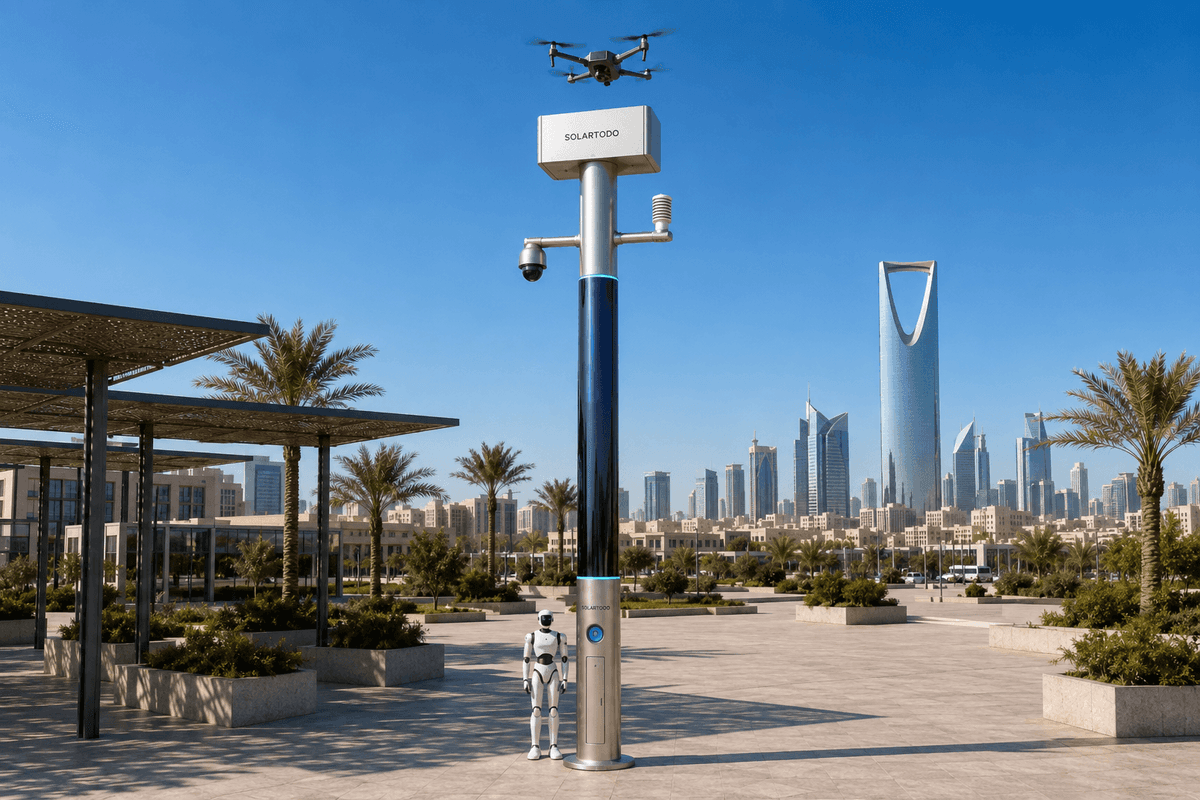
A City AI Pole is a non-lighting physical-AI edge node that combines off-grid energy, local sensing, edge compute, drone operations and ground robot support in one urban field station. In this Nairobi industrial-park configuration, SOLARTODO Sentinel Sky Hub forms a grid-mesh security layer for fire-response assessment while keeping raw video and sensor data on the pole.
1. Pilot Context: A Power-Utility Security Problem, Not a Street Asset
This pilot-report case study describes a proposed, illustrative configuration for a Nairobi power utility responsible for industrial-park substations, service depots, switching yards and perimeter corridors that sit near heavy logistics movement. During a major sports-event season, the security operating picture changes quickly: night traffic rises, temporary vendors and service vehicles cluster near arterial roads, response lanes become less predictable, and utility sites face a higher volume of alarms that may be smoke, dust, crowd spillover, unauthorized entry or equipment heat events.
The stakeholder need is not decorative urban hardware and not street lighting. The task is fire-response security at the edge of critical infrastructure. The proposed SOLARTODO Sentinel Sky Hub nodes are PURE smart poles with no lighting system. Each node is treated as an off-grid physical-AI micro-station: battery storage, 360-degree wrapped flexible CIGS thin-film solar replenishment, local compute, sensing, drone operations, ground robot support and a COP command view.
The selected city archetype is an industrial park because the value is concentrated in known assets rather than wide-area street coverage. Nairobi's industrial zones, utility yards and campus-like operating sites create a practical pattern: fixed nodes can be placed at gates, transformer yards, fuel-adjacent storage areas, warehouse edges and perimeter corners, then connected as a local grid-mesh for operational resilience. Grid-mesh here means the field nodes share status, events and mission state across a managed local network; it does not mean the poles require city or site electrical power.
The core pain point is drone endurance. In a fire-response security workflow, a drone may be needed for roofline inspection, smoke-source confirmation, perimeter sweep, access-route visibility and post-event reassessment. A single battery cycle can force short missions or operator trips to the site. Sky Hub addresses that operational constraint by placing drone charging and automated rear-service battery hot-swap at the pole, with mission scheduling governed by the node's energy budget and human authorization rules.
2. Proposed Grid-Mesh Deployment Pattern
The proposed layout uses a small grid-mesh of Sky Hub nodes across an industrial-park utility zone, positioned by risk rather than by road geometry. Candidate positions include the main service gate, a substation boundary, a transformer storage area, a vehicle dispatch edge and a rear perimeter line adjacent to logistics traffic. The configuration does not claim a fixed number of poles, coverage area or achieved detection rate; those values would be confirmed through site survey, obstacle mapping, radio planning, solar exposure review and the buyer's security concept of operations.
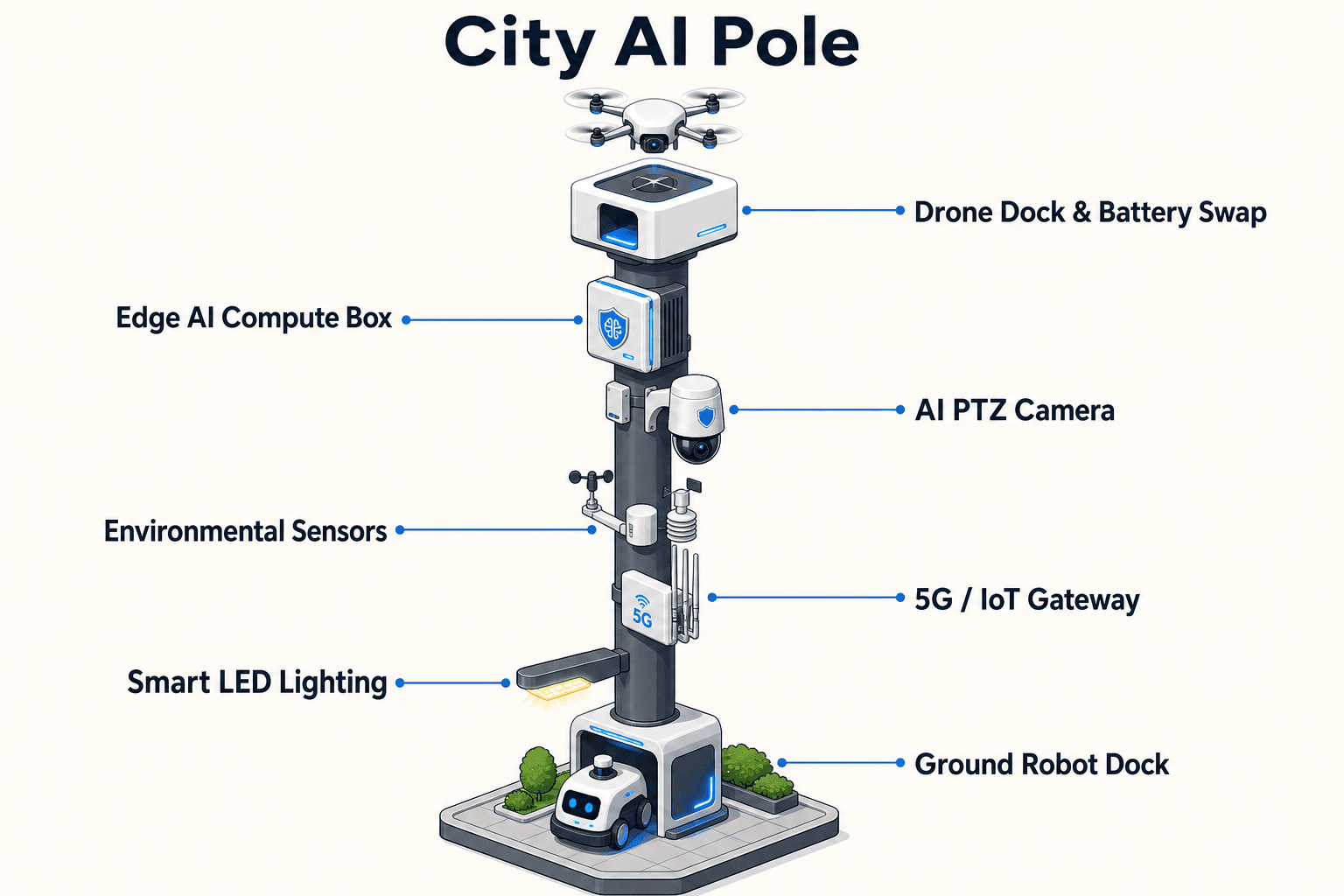
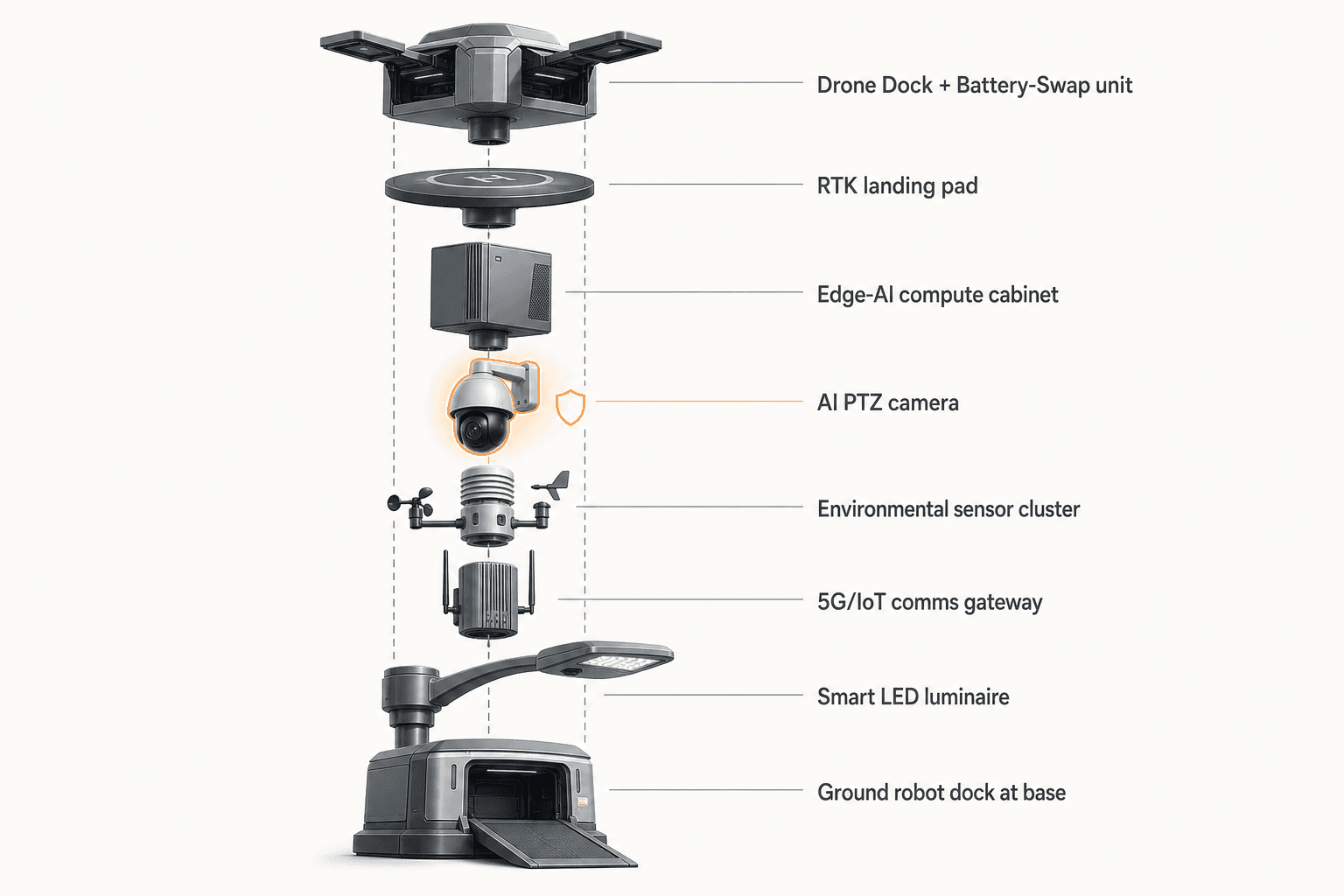
Each node hosts an AI PTZ camera for local perception, a nine-sensor environmental station, an on-pole edge inference cabinet, battery-backed DC power distribution, a drone operations bay with multi-bay battery magazine, and a robot charging interface at the base. Raw video and sensor data stay on the pole for local processing. The command view receives de-identified event and status metadata, such as smoke-confidence score, thermal-context tag if available from partner systems, wind direction, drone battery state, robot charge state, task queue status and operator decision history.
For the sports-event trigger, the pilot emphasis is false-alarm-rate discipline. Nairobi industrial areas can experience dust plumes, exhaust haze, cooking smoke near temporary activity, welding activity, parked vehicles and crowd movement that produce noisy signals. The goal is not to promise automatic fire detection accuracy. The goal is to create a repeatable evaluation method: compare single-sensor alarms against fused local assessment, require human-in-the-loop authorization for response actions, and record why an alert was escalated, watched, dismissed or converted into a drone/robot task.
The grid-mesh model also changes resilience. If one node has a low battery state after repeated drone sorties, OTATODO can schedule a neighboring node for observation, delay noncritical tasks, preserve essential sensing, or ask the operator to approve a lower-energy response. This is the module focus of the pilot: power is not treated as a static specification, but as the operating governor for safe, repeatable field autonomy.
3. Power Architecture and Drone-Endurance Logic
Sky Hub is specified as a fully off-grid system: no grid, city or site power dependency. The pole carries about 15 square meters of 360-degree wrapped flexible CIGS thin-film solar over a vertical cylindrical body roughly 8 meters tall and about 0.6 meters wide. Nameplate capacity is approximately 2.4-2.7 kWp. Because a vertical cylinder collects direct sun mainly on its sun-facing projection, not across the full wrap at once, the realistic clear-sky output in a high-irradiance region is roughly 0.8-1.1 kW DC peak, typically peaking in the mid-morning and mid-afternoon rather than at noon, with about 6-9 kWh/day in strong conditions.
For Nairobi, final power modeling would need site-specific irradiance, shading, wet-season assumptions, pole spacing, duty cycle, wind exposure, battery thermal envelope and security workload. The planning principle remains conservative: CIGS is a supplemental replenishment layer for a battery-backed micro-station, not a claim of unlimited pure-solar self-sufficiency. High-power drone and robot work is buffered by 5-20 kWh-class storage and scheduled by duty cycle.
The drone-endurance problem is addressed by three layers. First, a multi-bay battery magazine supports automated rear-service battery exchange after landing, so the aircraft receives a charged pack and can relaunch without an operator on site. Second, OTATODO manages the route plan, charge or swap state machine, task queue, fleet health and mission logs. Third, the energy scheduler assigns priorities: fire-response confirmation outranks routine patrol, perimeter verification outranks nonurgent inspection, and reserve thresholds protect sensing, communications and event recording.
In a fire-response example, the PTZ and environmental sensors may flag smoke-like haze, unusual crowd movement at a gate, rising noise, changing wind direction and a perimeter intrusion tag. The node does not stream raw video away for cloud review. It classifies locally, packages de-identified event metadata and presents a COP item for authorization. If the operator approves, the nearest energy-eligible Sky Hub launches a drone sortie to inspect the roofline or transformer-adjacent zone, then returns for automated battery exchange or charging. If ground access is needed, the service robot can patrol the base corridor, inspect a gate, coordinate with aerial view, and return to the pole base for wireless charging.
4. Fire-Response Operating Loop and False-Alarm KPI
The evaluation KPI is framed as false-alarm-rate, not as a claimed achieved result. The target is to reduce unnecessary dispatches and nuisance escalations by using local, multi-signal assessment before calling a field response. In an industrial park, a false fire alarm can pull security staff from perimeter posts, interrupt utility operations and create confusion during high-traffic event periods. A missed or delayed real escalation is also unacceptable, so the pilot should evaluate both false-alarm reduction and escalation discipline under human authorization.
The operating loop follows the Chinese concept of sensing, checking, responding, computing and maintenance coordination as one practical sequence: sensing, authorized assessment and response, edge-compute scheduling, and field operations and maintenance. In the COP command view, the operator sees event type, confidence band, location, related sensor context, wind direction, drone readiness, robot readiness, battery state, recommended action and audit trail. The interface should make it clear when the system is detecting, when it is recommending, and when a human has authorized an action.
For C-UAS coordination, the same boundary applies. If an unauthorized drone is detected and tracked by the pole or by an optional partner sensor input, the node may coordinate a friendly drone for soft aerial net-capture or close-approach deterrence only where permitted and only after human authorization. Radar is not built into the pole; it can be treated only as an optional partner-sensor input. The workflow never includes shoot-down, hard-kill, jamming, autonomous attack or weapons.
False-alarm-rate is measured as a buyer-recomputed planning metric: how many raw alerts become verified events, how many verified events need drone confirmation, how many drone confirmations lead to field dispatch, and how often the system correctly downgrades dust, exhaust, crowd movement or routine industrial activity. The pilot should define these thresholds before installation, then tune them through recorded event metadata and operator review, without exporting raw video from the poles.
5. Deployment Notes for Nairobi Buyers
For a Nairobi power-utility buyer, the most important planning work happens before procurement: site power is intentionally excluded, but civil foundations, solar exposure, wind loading, corrosion environment, drainage, radio paths, landing clearance, robot travel paths and security-room workflow must be confirmed. The industrial-park setting is suitable because the assets are bounded, the routes are repeatable, and the COP can be tied to existing security procedures without claiming citywide coverage.
Data handling should be described as designed for local processing and PDPL/LGPD-oriented architecture. For Kenya deployment, local legal review, data-protection impact assessment, retention policy and authority workflow would still be required. The technical posture is that raw video and sensor data stay on the pole, local inference generates event summaries, and only de-identified event or status metadata may leave the site under policy.
The pilot should be accepted or rejected against agreed planning targets rather than promotional claims. Example targets include lower false-alarm burden, fewer manual night patrols, better drone availability during sequential inspections, faster operator understanding of fire-response context, and clearer audit records for why a response was authorized. All values remain subject to final engineering confirmation, site survey and the buyer's operating rules.
System Configuration
| Parameter | Configuration |
|---|---|
| Pole form | SOLARTODO Sentinel Sky Hub cylindrical PURE smart pole, non-lighting, fully off-grid, approximately 8 m solar-wrapped body with battery-backed base systems |
| Energy system | 360-degree flexible CIGS thin-film wrap, approximately 15 m², ~2.4-2.7 kWp nameplate, 5-20 kWh-class storage, MPPT and duty-cycle scheduler |
| Edge AI compute | Jetson-class on-pole inference cabinet, Orin- or Thor-class compute tier, local event processing and workload scheduling under OTATODO |
| Security sensing | AI PTZ camera for anonymous vehicle count, crowd density, intrusion and perimeter awareness; raw video processed locally on the pole |
| Environmental monitoring | Wind speed, wind direction, temperature, humidity, atmospheric pressure, noise, PM10, PM2.5 and illuminance |
| Drone operations | Autonomous launch, patrol, inspection, return, rear-service battery hot-swap magazine, task queueing, fleet health and mission logs |
| Ground robot interface | Base-side wireless charging point for service or humanoid robot patrol, alarm response, inspection and air-ground coordination |
How It Works
- On-pole PTZ and environmental sensors flag smoke-like haze, intrusion context and wind direction near a utility asset.
- Edge AI classifies the event locally, scores confidence and separates dust, exhaust, crowd movement and possible fire-response triggers.
- The COP presents de-identified event metadata, battery state, drone readiness and recommended response for human authorization.
- After approval, the node launches a friendly drone for roofline or perimeter inspection and may coordinate a ground robot from the pole base.
- The drone returns for automated rear-service battery exchange, while OTATODO records mission state, operator decision and energy impact.
- Event summaries, false-alarm labels and maintenance notes are reviewed to tune thresholds without exporting raw video from the pole.
Planning Assumptions (Indicative)
Illustrative planning inputs a buyer can recompute — target metrics, not achieved results. Subject to final engineering confirmation.
| Metric | Planning assumption | Indicative value |
|---|---|---|
| False-alarm-rate | multi-signal local assessment reduces nuisance escalation before manual dispatch; target to be recomputed from event logs | ~20-40% fewer escalated nuisance alerts as a planning target |
| Drone availability | battery hot-swap magazine supports consecutive fire-response confirmation sorties without an operator on site | ~3-5 sequential short sorties per node before recharge planning review |
| Inspection labor | scheduled drone and robot patrols replace selected manual perimeter checks during high-traffic event periods | ~5-10 patrols/week automated per secured zone |
| Energy reserve | power scheduler preserves sensing, communications and event recording before noncritical drone or robot tasks | ~25-35% battery reserve threshold for priority operations |
| Event review workload | COP presents de-identified metadata, operator decisions and mission logs instead of raw continuous video review | ~10-20 prioritized incident records/day for review during event season |
Deployed Equipment
- SOLARTODO Sentinel Sky Hub off-grid physical-AI edge-node pole
- 360-degree flexible CIGS thin-film solar wrap with MPPT energy control
- Battery storage cabinet with BMS and DC distribution
- AI PTZ camera and local perception stack
- Nine-sensor environmental monitoring station
- Drone operations bay with multi-bay battery hot-swap magazine
- Ground robot wireless charging interface
- OTATODO COP command view and local event log
Frequently Asked Questions
Is SOLARTODO Sentinel Sky Hub a smart streetlight?
No. Sky Hub is a PURE smart pole and includes no lighting system, lamp head or street-lighting function. The Nairobi configuration is framed as a physical-AI urban edge node for industrial-park security, fire-response assessment, drone operations, robot support, local sensing and off-grid power management.
Does the pole depend on Nairobi grid power or utility site power?
No. The proposed node is designed as fully off-grid, using on-pole flexible CIGS solar replenishment and battery storage. The solar layer is supplemental rather than unlimited self-sufficiency: high-power drone and robot tasks are buffered by storage and scheduled by duty cycle, subject to final site energy modeling.
How does the system address drone endurance during fire-response work?
The Sky Hub configuration uses a multi-bay battery magazine for automated rear-service battery exchange after landing, allowing several consecutive short missions to be planned without an operator on site. OTATODO manages route planning, charge or swap state, task priority, fleet health and mission logs against the node's battery reserve.
What data leaves the pole in this proposed deployment?
Raw video and sensor data stay on the pole and are processed locally by the edge compute stack. The COP receives de-identified event and status metadata, such as event category, confidence band, sensor context, energy state and mission log references. Legal review and site policy would define retention and access rules.
Can the pole perform face recognition or licence-plate recognition?
Those are not stated as active deployed capabilities in this Nairobi case study. The security-sensing scope is anonymous vehicle count, crowd density, intrusion and perimeter awareness, with fire-response context from environmental data and local video inference. This keeps the pilot focused on operational security and privacy-oriented local processing.
How is Counter-UAS handled around a utility industrial park?
C-UAS is limited to non-lethal, human-authorized coordination. The pole may detect and track an unauthorized drone, including through optional partner-sensor input, and command a friendly drone for soft aerial net-capture or close-approach deterrence where lawful. It does not shoot down, jam or autonomously attack anything.
Explore Further
- City AI Pole / smart streetlight product line
- More smart-city deployment cases
- Talk to our engineering team
Planning a similar physical-AI deployment for streets, campuses or public spaces? Request an engineering consultation