Mumbai Smart Streetlight Market Analysis: 14m Drone-Dock Configuration Guide for Dense Urban Corridors
Summary
Mumbai’s 12.44 million residents, 2,200+ mm monsoon rainfall, and 35 m pole spacing make a 77-unit, 14 m SOLARTODO Smart Streetlight configuration suitable for lighting, EV charging, WiFi, camera analytics, and drone-ready monitoring.
Key Takeaways
For Mumbai, the strongest technical fit is a 77-unit, 14 m Smart Streetlight layout at 35 m spacing with 11 kW AC charging.
- A typical 77-unit corridor would cover approximately 2.7 km at 35 m spacing, using 14 m octagonal tapered steel poles.
- Each pole should use twin 1.5 m arms with 2 x 80 W SOLARTODO LEDs, delivering about 24,000 lumens at 150 lm/W and 4000K.
- The lower 2.2 m of the pole is the integrated 11 kW Type 2 EV charging cabinet, not a separate roadside charger.
- Mumbai’s monsoon exposure supports IP66 drone hangars, powder-coated RAL7021 steel, LiFePO4 backup, and bolted modules with no band clamps.
- A top drone dock rated for a sub-25 kg generic quadcopter supports 1000 W contact-pad charging and a 15-25 minute recharge cycle.
- A typical configuration uses WiFi 6 at 8.7 m, a 4 MP IR bullet camera, Jetson Orin edge AI, SOS linkage, and a P4 LED display.
- Recommended compliance references include IEC 60598 for luminaires, IEC 62196-2 for Type 2 AC charging, and GB/T 37024 for smart lighting systems.
Market Context for Mumbai
Mumbai’s dense 19.08, 72.88 coastal urban profile requires multi-function street assets that combine 24/7 lighting, communications, charging, and monitoring in one 14 m structure.
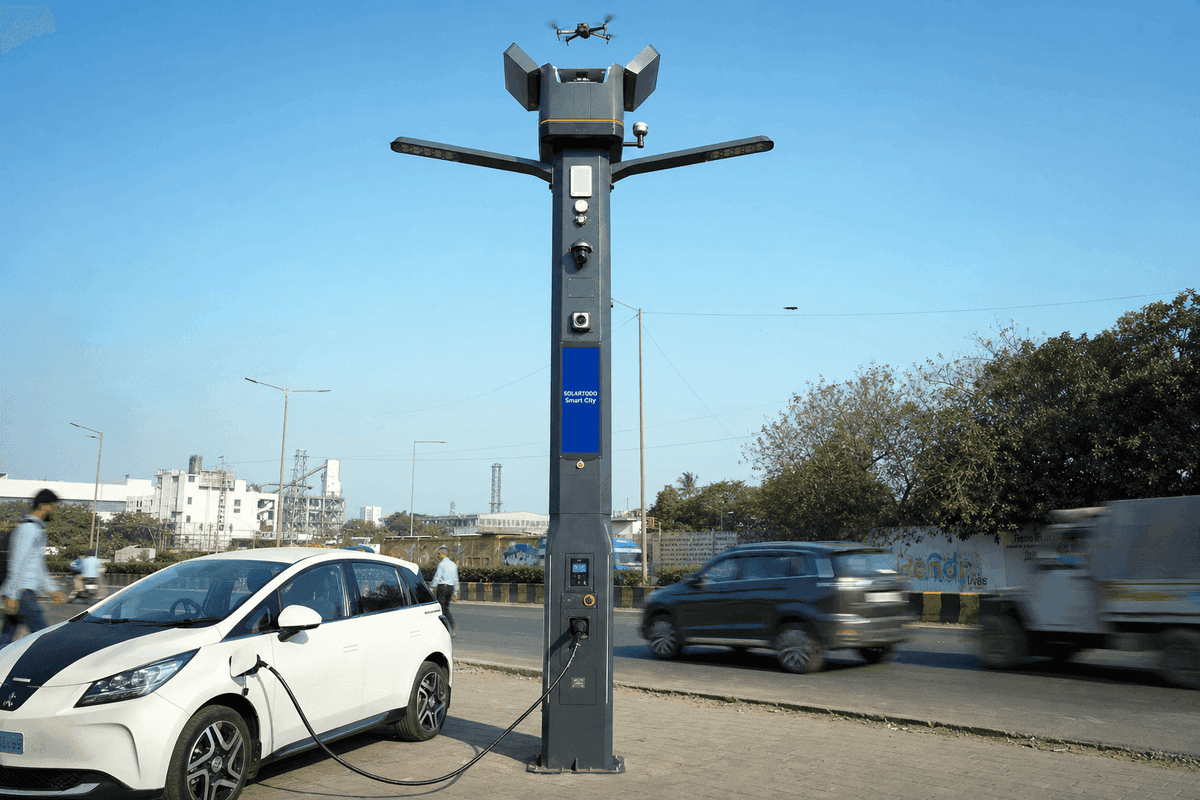
According to Census of India (2011), Greater Mumbai recorded 12,442,373 residents, making right-of-way efficiency a primary engineering constraint rather than a cosmetic design issue. A Smart Streetlight corridor in Mumbai therefore needs to reduce separate sidewalk objects: lamp pole, EV pedestal, camera post, WiFi fixture, display mast, and emergency point. SOLARTODO’s integrated pole-as-charger format is technically appropriate because the lower 2.2 m of the steel pole becomes the EV charging cabinet, leaving fewer standalone cabinets exposed to pedestrian flow and monsoon splash.
According to the Mumbai Climate Action Plan by MCGM and WRI India (2022), Mumbai targets net-zero greenhouse gas emissions by 2050 and identifies energy-efficient public lighting, air quality, and sustainable mobility as priority action areas. The same plan positions Mumbai as a high-risk coastal city facing extreme rainfall and flooding; that matters for enclosure sealing, cable gland design, surge protection, corrosion resistance, and foundation drainage. For this reason, a Mumbai specification should favor grid-powered AC 220/380V with LiFePO4 backup rather than a wind-solar hybrid pole, because the project-specific configuration requires no wind turbine and no solar panel.
According to India Meteorological Department climatological normals (1991-2020), Mumbai’s Santacruz station receives roughly 2,500 mm annual rainfall while Colaba receives roughly 2,200 mm. That rainfall profile supports IP66 weather-sealed drone hangars, stainless maintenance doors, powder coating, and socket-head bolting into pre-drilled threaded holes. ITU states, “A smart sustainable city is an innovative city that uses ICTs and other means,” which fits Mumbai corridors where lighting, public safety, WiFi, EV charging, and aerial inspection can share one managed asset.
According to Maharashtra’s EV Policy (2021), the state targeted 10% battery-electric share in new vehicle registrations by 2025 and 25% battery-electric public transport in six urban areas including Mumbai. IEA states, “Electric vehicles are the key technology to decarbonise road transport,” and the local implication is practical: dense street charging should be distributed where vehicles already dwell. A pole-integrated 11 kW AC charger is not a highway fast charger; it is a curbside, destination, fleet-support, and municipal-service charging node.
Recommended Technical Configuration
A typical Mumbai deployment of this scale would use approximately 77 SOLARTODO Smart Streetlight units, each 14 m tall and spaced at 35 m.
The recommended size class is the tall urban smart streetlamp class rather than a 6-8 m garden light, a highway traffic mast, or a bare drone tower. Mumbai’s arterial and mixed-use streets need a lighting height high enough for road illumination, camera sightlines, WiFi coverage, and a drone hangar, while still remaining within an urban street-pole envelope. The project-specific configuration is a 14 m octagonal tapered steel Smart Streetlight with drone dock, grid AC power, LiFePO4 backup, integrated EV charging, and no wind or solar generation.
A typical 77-unit deployment of this profile would consist of approximately 77 charcoal RAL7021 powder-coated steel poles, each tapering from a 45 cm base diameter to a 15 cm top diameter. At 35 m spacing, the lineal coverage is approximately 2,695 m before intersections, setbacks, utility conflicts, and turning radii are accounted for. SOLARTODO should be specified as a smart streetlamp first: the drone dock is an upgrade module on top, replacing the aviation-light cap, not a separate telecom lattice tower or a bare landing mast.
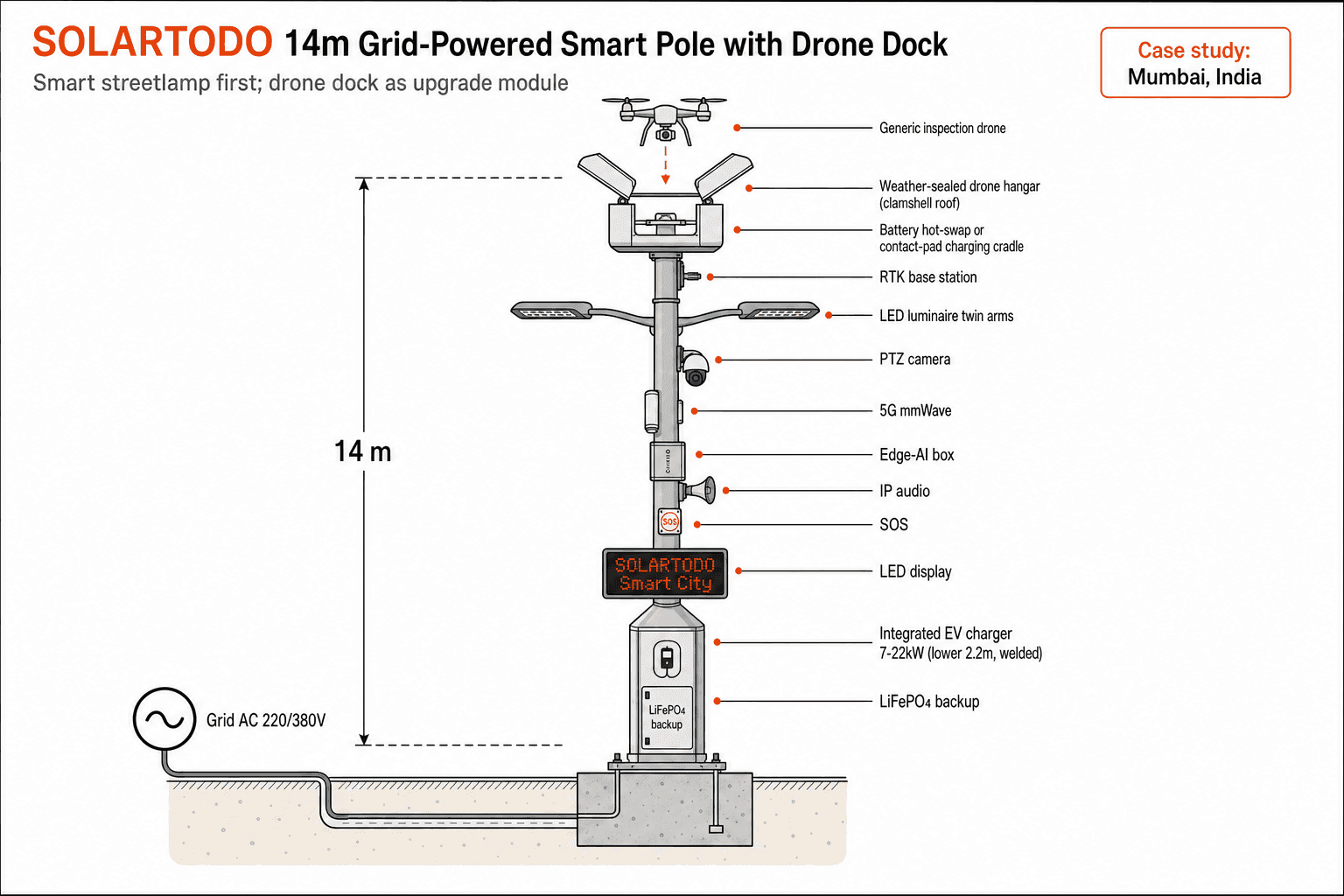
The correct electrical configuration is grid-powered AC 220/380V with local LiFePO4 backup. This aligns with a dense city where uninterrupted lighting, safety systems, WiFi, and emergency SOS must remain available even when drone operations are paused. For buyers comparing alternatives, the important distinction is that the EV charger is not mounted beside the pole; the lower 2.2 m of the pole is welded as one continuous steel structure with the charging cabinet.
Technical Specifications
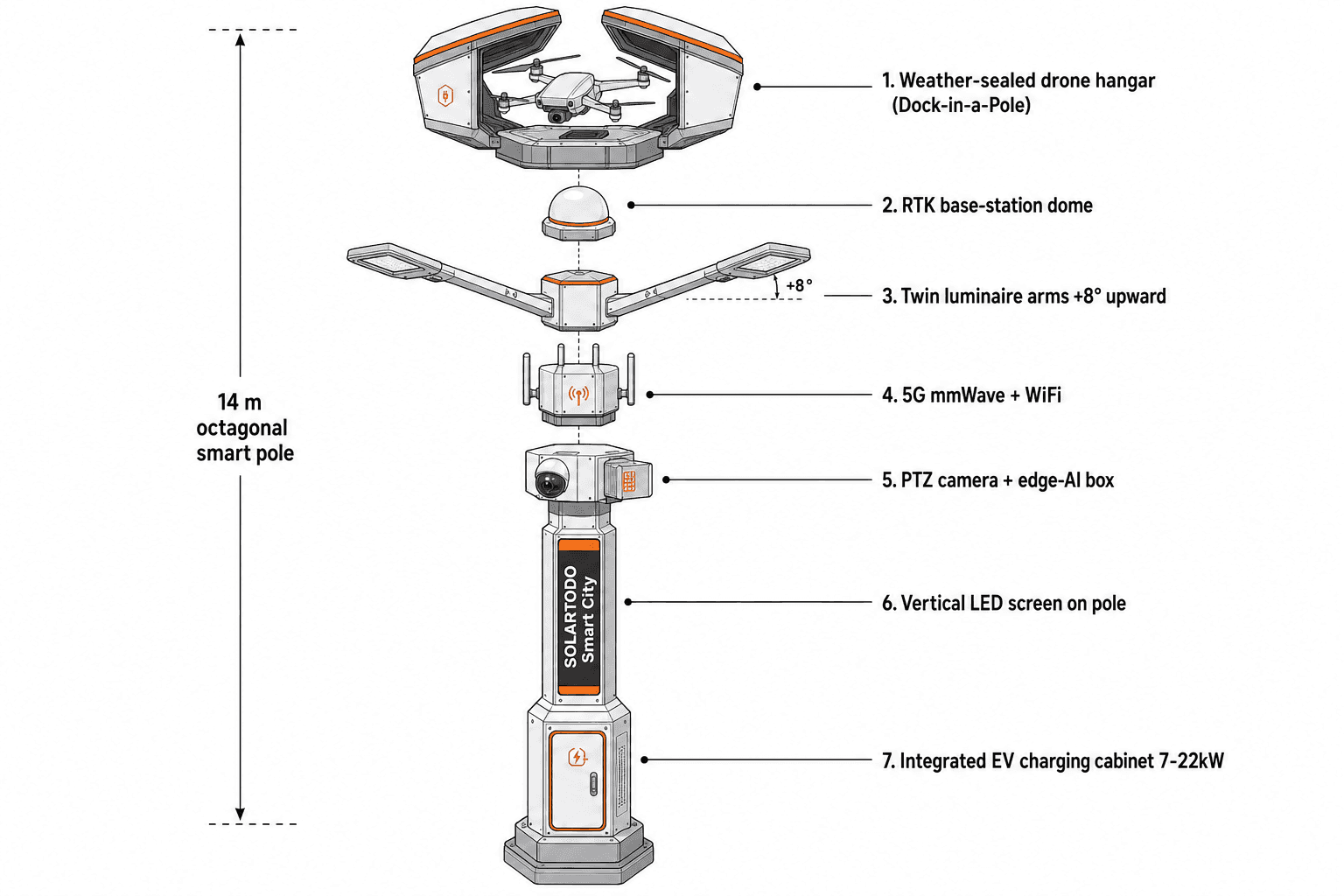
The Mumbai technical package should specify 14 m octagonal tapered steel, 2 x 80 W LED lighting, 11 kW Type 2 AC charging, and a 1200 x 1200 x 1100 mm drone hangar.
- Product line: SOLARTODO Smart Streetlight, project-specific drone-dock smart streetlamp variant.
- Pole structure: 14 m octagonal tapered steel, base diameter 45 cm, top diameter 15 cm, charcoal RAL7021 powder coat.
- Power system: AC 220/380V grid supply with LiFePO4 backup; no wind turbine and no solar panel.
- Integrated EV charging: lower 2.2 m of pole forms the welded cabinet, 11 kW single-gun AC charger, Type 2 connector, OCPP 1.6J, 5 m coiled Type 2 cable, 8-inch touchscreen, stainless maintenance door.
- Drone hangar: 1200 x 1200 x 1100 mm weather-sealed clamshell hangar, IP66 closed, matte-graphite housing, thin orange roof edge-line, internal cradle visible when open.
- Drone support: generic sub-25 kg quadcopter compatibility, 10 km flight radius, contact-pad auto-dock charging at 1000 W, typical 15-25 minute recharge cycle.
- Positioning: RTK base-station dome on a short stub-arm below hangar, 1 cm + 1 ppm positioning class.
- Lighting: twin symmetric 1.5 m arms with +8 degree upward tilt, 2 x 80 W SOLARTODO LED, 150 lm/W, 4000K.
- Vision and compute: 4 MP bullet camera with IR 50 m on 30 cm arm bracket, Jetson Orin edge AI box rated 8-275 TOPS.
- Environmental sensing: 4-parameter top sensor for temperature, humidity, wind speed, and noise.
- Emergency system: one-press SOS button with camera linkage.
- Display: P4 vertical LED screen, 960 x 1920 mm portrait, above 5500 cd/m2, content restricted to “SOLARTODO Smart City” in white sans-serif on deep blue.
- Communications: WiFi 6 AP, 802.11ax, 256 devices, 1.8 Gbps, flush-integrated on the flat pole face at 8.7 m with color-matched housing.
- Mounting method: all modules bolted into pre-drilled threaded holes using socket-head screws; no band clamps, no straps.
- Compatibility: DJI Dock 3, FlytBase, and open-protocol custom drones; visual representation should use a generic quadcopter with no brand logo.
- Standards: IEC 60598 for luminaires, GB/T 37024 for smart lighting systems, and IEC 62196-2 for Type 2 AC charging interfaces.
Implementation Approach
A Mumbai rollout of approximately 77 units would typically require 12-18 weeks after permits, assuming parallel foundation, fabrication, shipping, and commissioning workstreams.
The first phase is site verification: corridor survey, lighting simulation, buried-utility scan, cellular/WiFi propagation review, EV load assessment, and drone operating-zone risk screening. This phase typically takes 2-3 weeks for a 2-3 km urban corridor because Mumbai roads contain utilities, drainage structures, compound walls, trees, bus stops, and mixed pedestrian edges. The output should be a pole-by-pole schedule showing foundation location, supply point, earthing arrangement, camera field of view, WiFi overlap, display orientation, and drone clearance.
The second phase is engineering submittal and procurement. Drawings should confirm the welded pole-as-charger cabinet, 14 m pole taper, 35 m spacing assumptions, cable routing, surge protection, access door orientation, RTK dome placement, and drone hangar opening envelope. For CKD or semi-knocked-down logistics, factory acceptance should verify LED output, OCPP 1.6J communication, touchscreen operation, contact-pad charging, IP66 gasket compression, WiFi AP flush fit, and camera-SOS linkage before packing.
The third phase is civil and electrical installation. Foundations should be sequenced to maintain traffic access, and anchor bolt templates should be checked before concrete pour. Pole erection should use controlled lifting plans because the top hangar, twin luminaire arms, display, EV cabinet, and compute modules change the center of gravity compared with a standard lamp post. Commissioning should include insulation resistance, earthing continuity, EV charger test, OCPP backend connection, WiFi throughput sampling, camera analytics calibration, display brightness limits, drone docking trial, and emergency call verification.
Expected Performance & ROI
A 77-unit Mumbai configuration can provide about 12.3 kW of LED load, 847 kW of distributed AC charging capacity, and drone-ready monitoring across roughly 2.7 km.
Expected performance should be modeled by service category rather than by one invented project result. The lighting system uses 160 W per pole, or 12.32 kW across 77 poles. At 12 operating hours per night, lighting consumption would be about 147.8 kWh per night and 53,960 kWh per year before controls; dimming profiles can reduce this when traffic and safety rules permit.
ROI depends on the replacement baseline, municipal tariff, advertising utilization, EV charging utilization, maintenance contract, and drone service value. Compared with older 250 W high-pressure sodium fixtures plus ballast losses, a 160 W LED configuration can reduce lighting energy by roughly 40% before smart dimming. Payback is commonly evaluated over 4-7 years when energy savings are combined with display revenue, EV charging margin, telecom/WiFi service value, and reduced truck-rolls; without monetized services, a 6-10 year municipal asset view is more realistic.
According to IEC 62196-2 (2022), Type 2 AC interfaces are defined for dimensional compatibility of AC charging accessories, making the 11 kW single-gun charger a standards-aligned curbside option. According to GB/T 37024 (2018), smart lighting system architecture emphasizes intelligent control and management, which supports LoRaWAN/4G controllers and cloud monitoring for fault detection. For a buyer, the main ROI logic is asset consolidation: one foundation and one grid connection can host lighting, charging, display, WiFi, video, SOS, edge AI, and drone service.
Results and Impact
A properly specified 77-unit Smart Streetlight corridor would consolidate at least 6 roadside functions per pole while avoiding standalone EV pedestals and separate drone masts.
For Mumbai, the expected impact is not a claim of completed deployment; it is a measurable technical fit. The integrated design can reduce sidewalk clutter by combining LED lighting, 11 kW AC charging, WiFi 6, camera analytics, emergency SOS, LED display, environmental sensing, and drone docking into a single steel asset. This is valuable in dense wards where every additional cabinet or pole competes with pedestrians, drainage access, shopfronts, tree pits, and utility covers.
Operationally, a typical corridor could improve night visibility, enable distributed curbside charging, support municipal announcements, and provide aerial situational awareness within a 10 km flight radius where regulations and permissions allow. Maintenance teams would also gain a single asset register per location, simplifying inspection cycles and spare-part planning. SOLARTODO’s flush-mounted WiFi and bolted module approach is especially relevant in Mumbai because exposed straps, clamps, and mismatched external boxes age poorly in high-rainfall, high-salinity urban air.
Comparison Table
The recommended 14 m drone-dock Smart Streetlight differs from standard 6-12 m poles by adding 1000 W drone charging, 11 kW integrated EV charging, and edge AI.
| Option | Best Mumbai Use | Height / Form | Power | Key Modules | Fit Assessment |
|---|---|---|---|---|---|
| Standard SOLARTODO Smart Streetlight | Normal urban lighting and modular sensing | 6-12 m octagonal galvanized pole | Grid or configured supply | LED, camera, WiFi 6, SOS, display, optional EV | Good for secondary roads without drone operations |
| 12 m grid smart pole | Dense commercial curbside charging | 12 m tapered steel with lower 2.2 m charger | Grid AC | LED, integrated EV charger, smart controller | Strong where EV charging is primary |
| 14 m drone-dock Smart Streetlight | Mumbai arterial monitoring and multi-service corridors | 14 m octagonal tapered steel | AC 220/380V + LiFePO4 backup | 2 x 80 W LED, 11 kW EV, 1200 mm hangar, RTK, Jetson Orin, WiFi 6 | Recommended for this 77-unit technical profile |
| Cylindrical CIGS smart pole | Premium streetscape with flush embedded modules | Ø180/200/315/400 mm seamless cylinder | Solar wrap plus configured grid support | Flush EV, embedded modules, no arms | Premium aesthetic fit, but not aligned with this drone-dock specification |
Pricing & Quotation
SOLARTODO provides 3 quotation scopes for Mumbai buyers, but final EPC pricing depends on foundation, utility connection, permits, logistics, and commissioning requirements.
SOLARTODO offers three pricing tiers for this product line: FOB Supply (equipment ex-works China), CIF Delivered (including ocean freight and insurance), and EPC Turnkey (fully installed, commissioned, with 1-year warranty). Volume discounts are available for large-scale deployments. Configure your system online for an instant estimate, or request a custom quotation from our engineering team at [email protected].
For Mumbai procurement, the quotation package should separate pole fabrication, integrated EV charging equipment, drone dock hardware, LED display, communications, civil works, electrical works, software integration, and annual maintenance. Buyers should request a pole-by-pole bill of materials because coastal foundations, traffic management, trenching, utility approvals, and OCPP backend integration can vary strongly between wards. For technical scoping, contact us with corridor length, preferred spacing, EV load requirement, drone payload class, and installation constraints.
Frequently Asked Questions
Mumbai buyers evaluating a 77-unit Smart Streetlight corridor usually ask about technical fit, timeline, ROI, maintenance, pricing scope, warranty, and installation constraints.
Q1: Is this a drone tower or a Smart Streetlight? This configuration is a Smart Streetlight first. The 14 m octagonal tapered steel pole provides road lighting, EV charging, WiFi 6, camera analytics, SOS, display, environmental sensing, and cloud control. The drone dock is an upgrade module on top, replacing the aviation-light cap. It should not be specified as a bare drone landing tower or telecom lattice structure.
Q2: Why is 14 m appropriate for Mumbai streets? A 14 m pole supports better camera sightlines, drone hangar clearance, WiFi placement at 8.7 m, and twin 80 W luminaire coverage across wider urban corridors. It is taller than a garden light but still an urban street asset. The height also helps keep the 1200 x 1200 x 1100 mm drone hangar above common obstructions.
Q3: How long would a typical 77-unit deployment take? A typical 77-unit Mumbai deployment would take about 12-18 weeks after permits and utility approvals. Site survey usually takes 2-3 weeks, fabrication and testing 4-6 weeks, logistics and customs 3-5 weeks, and civil-electrical installation can proceed in parallel. Dense traffic corridors may extend the timeline.
Q4: What ROI should a buyer expect? ROI depends on the existing lighting baseline, tariff, charger utilization, display revenue, drone service value, and maintenance model. Against older 250 W sodium lighting, 160 W LED per pole can reduce lighting energy by roughly 40% before dimming. With monetized EV charging and display use, a 4-7 year payback can be modeled; otherwise 6-10 years is more realistic.
Q5: Does the pole include solar panels or wind turbines? No. The Mumbai project-specific configuration is grid-powered AC 220/380V with LiFePO4 backup. It has no wind turbine and no solar panel. This matters because the top position is occupied by a large IP66 drone hangar, and the mid-pole surfaces are assigned to camera, display, compute, WiFi, and other modules.
Q6: How is EV charging integrated into the pole? The lower 2.2 m of the pole is the EV charging cabinet, welded as one continuous steel structure rather than installed as a separate pillar. The charger is an 11 kW single-gun AC unit with Type 2 cable, OCPP 1.6J, 8-inch touchscreen, 5 m coiled cable, and stainless maintenance door.
Q7: What maintenance is required in monsoon conditions? A practical maintenance plan should include quarterly visual checks during monsoon, six-month torque and gasket inspections, annual earthing and insulation testing, and periodic cleaning of camera lenses, LED displays, drainage points, and charger connectors. IP66 hangar seals, stainless door hardware, powder coating, and socket-head bolted modules are important for coastal Mumbai durability.
Q8: How does this compare with a standard smart pole? A standard 6-12 m smart pole is sufficient for LED lighting, cameras, WiFi, SOS, and displays. The 14 m drone-dock Smart Streetlight adds a 1200 mm clamshell hangar, 1000 W contact-pad charging, RTK positioning, Jetson Orin edge AI, and a 10 km drone operating radius. It is selected when aerial response is part of the corridor design.
Q9: What EPC pricing information is needed for quotation? EPC quotation requires corridor length, pole count, foundation drawings, utility connection points, trenching distance, EV load allocation, backend software requirements, traffic management constraints, and commissioning scope. SOLARTODO can quote FOB Supply, CIF Delivered, or EPC Turnkey. Prices should not be compared only per pole because installation and approvals can dominate local cost variance.
Q10: Which standards apply to this configuration? The lighting package should reference IEC 60598 for luminaire requirements and testing. The EV charger should reference IEC 62196-2 for Type 2 AC connector compatibility. The smart lighting and control system should reference GB/T 37024. Local electrical, civil, traffic, fire, and aviation permissions must also be reviewed before drone docking is enabled.
Q11: Can the system work with different drone platforms? Yes, the recommended configuration can be specified for DJI Dock 3, FlytBase, or open-protocol custom drones, subject to integration testing and local flight permissions. Visual materials should show only a generic quadcopter with no brand logo. The technical requirement is a sub-25 kg drone, contact-pad charging, RTK positioning, and safe clamshell hangar operation.
Q12: What warranty scope is typical? The pricing paragraph defines EPC Turnkey as installed, commissioned, and covered by a 1-year warranty. Buyers should ask for warranty schedules by subsystem: pole structure, LED luminaires, charger, display, camera, WiFi AP, drone dock, battery backup, and controller. Consumables, misuse, grid surges, and drone airframe warranties should be separated clearly.
References
The guide relies on 7 public standards and planning sources covering Mumbai population, climate risk, EV policy, smart-city ICT, lighting, charging, and smart lighting systems.
- Census of India (2011): Greater Mumbai recorded 12,442,373 residents in the 2011 Census; https://censusindia.gov.in/
- Municipal Corporation of Greater Mumbai and WRI India (2022): Mumbai Climate Action Plan targets net-zero emissions by 2050 and identifies energy-efficient public lighting, air quality, and sustainable mobility priorities; https://mcap.mcgm.gov.in/
- India Meteorological Department (1991-2020 normals): Mumbai climatological normals show very high monsoon rainfall, including roughly 2,200-2,500 mm annual rainfall across Colaba and Santacruz stations; https://mausam.imd.gov.in/
- Government of Maharashtra (2021): Maharashtra Electric Vehicle Policy set 10% battery-electric target for new vehicle registrations by 2025 and 25% battery-electric public transport target in six urban areas; https://ev.maharashtra.gov.in/
- International Telecommunication Union (2014): ITU-T smart sustainable city definition links ICT-enabled urban systems with quality of life, efficiency, services, and sustainability; https://www.itu.int/
- International Electrotechnical Commission (2022): IEC 62196-2 defines dimensional compatibility requirements for AC pin and contact-tube accessories used in conductive EV charging; https://www.iec.ch/
- Standardization Administration of China (2018): GB/T 37024 provides smart lighting system guidance for intelligent control and management architecture.
Equipment Deployed
- 77 units x 14m octagonal tapered steel Smart Streetlight with drone dock, base Ø45cm to top Ø15cm, RAL7021 powder coat
- Integrated lower 2.2m 11kW single-gun AC EV charger, Type 2, OCPP 1.6J, 5m coiled cable, 8-inch touchscreen
- 1200x1200x1100mm IP66 clamshell drone hangar with 1000W contact-pad auto-dock charging and sub-25kg drone support
- Twin 1.5m symmetric arms with +8° upward tilt and 2 x 80W SOLARTODO LED luminaires, 150 lm/W, 4000K
- 4MP bullet camera with IR 50m on 30cm short arm bracket
- Jetson Orin edge AI compute box rated 8-275 TOPS
- 4-parameter top environmental sensor for temperature, humidity, wind speed, and noise
- WiFi 6 AP, 802.11ax, 256 devices, 1.8Gbps, flush-integrated at 8.7m
- P4 vertical LED display, 960x1920mm portrait, >5500 cd/m², SOLARTODO Smart City content only
- RTK base-station dome with 1cm + 1ppm positioning class and short stub-arm mounting