AI Traffic Signal Optimization for Safety and Emissions

SOLARTODO Editorial Team
Solar Energy & Infrastructure Expert Team
Watch the video
TL;DR
AI multi-objective traffic signal optimization uses live detector data to balance 3 goals at once: lower delay, fewer safety conflicts, and reduced emissions. Reported deployments show 10-30% faster travel, up to 40% fewer stops, and about 20% lower emissions. For B2B buyers, the best path is a 3-5 intersection pilot, KPI-based acceptance testing, and scalable EPC delivery with secure, off-grid-capable infrastructure from SOLAR TODO.
AI multi-objective traffic signal optimization can cut travel time by 10-30%, reduce corridor stops by up to 40%, and lower emissions by about 20% by balancing delay, safety conflicts, and idling in one adaptive control model.
Summary
AI-based multi-objective traffic signal optimization can cut travel time by 10-30%, reduce corridor stops by up to 40%, and lower emissions by about 20% when signal timing balances delay, safety conflicts, and idling in one control model.
Key Takeaways
- Define 3 core objectives at project start: reduce delay by 10-25%, cut conflict risk at intersections, and lower corridor emissions by 10-20% using one weighted control policy.
- Deploy pilot control on 3-5 intersections for 1-3 months before scaling to 50-100 intersections, which reduces tuning risk and gives measurable before/after KPI baselines.
- Prioritize detection coverage for 45+ object classes, including motorcycles, e-bikes, buses, trucks, and pedestrians, because two-wheelers exceed 60% of traffic in many developing markets.
- Set emergency and transit priority rules with response targets such as 30-50% faster clearance while keeping general traffic delay within an agreed threshold, typically under 10% deterioration.
- Use high-quality inputs such as 98% license plate recognition, speed detection up to 320 km/h, and conflict analytics from video to improve enforcement and safety decisions.
- Compare control strategies with a Digital Twin before field rollout; cities have reported 10-30% travel-time reduction and green-wave coordination can reduce stops by up to 40%.
- Structure procurement in 3 tiers—FOB Supply, CIF Delivered, and EPC Turnkey—and apply volume discounts of 5% at 50+, 10% at 100+, and 15% at 250+ intersections or poles.
- Verify compliance with IEEE 802.11/ITS communications, IEC electrical safety practice, GDPR data controls, and encrypted evidence storage to support legal enforcement and reduce cyber risk.
What Multi-Objective Traffic Signal Optimization Means in Practice
Multi-objective traffic signal optimization uses AI to improve at least 3 outcomes at once—travel time, safety, and emissions—and real deployments have shown 10-30% faster travel and about 20% lower emissions.
Traditional signal timing usually optimizes one dominant variable, such as average delay or queue length, using fixed plans or time-of-day schedules. That method works acceptably on stable corridors, but it breaks down when traffic demand changes every 5-15 minutes, when pedestrian flows spike, or when motorcycles and informal lane behavior dominate the approach. A single-objective plan can move vehicles faster while increasing red-light running risk, or reduce queues while raising stop frequency and fuel burn.
Multi-objective control treats the intersection as a constrained optimization problem. The controller evaluates several outputs at once: average delay in seconds per vehicle, queue length in meters, number of stops per vehicle, surrogate safety indicators such as post-encroachment time, and estimated emissions in grams of CO2, NOx, or PM. The AI then selects phase splits, offsets, and cycle lengths that satisfy minimum safety and legal constraints while improving network efficiency.
According to the International Energy Agency, “Digitalization can make energy systems more connected, intelligent, efficient, reliable and sustainable.” That statement applies directly to urban traffic control because every unnecessary stop adds fuel use, local pollution, and lost labor hours. According to reported deployment results in Pittsburgh, adaptive AI signal control reduced travel time by 25% and emissions by 20%, showing that mobility and carbon targets can be addressed together.
For B2B buyers, the practical question is not whether AI can optimize signals, but which objectives should be weighted and how performance will be verified. Procurement managers should require a KPI matrix with at least 6 metrics: average delay, average speed, stop rate, queue spillback frequency, conflict events, and emissions estimate. Engineers should also define hard constraints such as pedestrian minimum green time, emergency preemption response, and fail-safe operation under communication loss.
SOLAR TODO approaches this category with an advantage in solar-powered roadside infrastructure. Where grid supply is unstable or absent, solar panels on pole tops with LFP battery storage can keep cameras, controllers, and communications online 24/7. That matters on rural highways, border corridors, and developing urban districts where outages of even 30-60 minutes can invalidate enforcement and reduce signal reliability.
How AI Balances Efficiency, Safety, and Emissions
AI traffic control balances efficiency, safety, and emissions by assigning numeric weights and constraints to each objective, then recalculating signal timing every few seconds using live detector data and predictive models.
The technical core is a multi-objective optimizer. In practice, this may combine reinforcement learning, model predictive control, heuristic search, and rule-based safety overrides. The controller ingests detector feeds every 1-5 seconds, predicts arrivals 30-120 seconds ahead, and tests timing actions against a reward function. A simple reward function might penalize 1 second of delay, 1 stop event, 1 high-risk conflict, and 1 gram-equivalent of emissions with different weights depending on corridor policy.
Data inputs and detection layer
A useful AI controller is only as good as its input quality, and modern smart traffic systems can classify 45+ object types with 98% license plate recognition and motorcycle-specific violation analytics above 93-97.7% on several tasks.
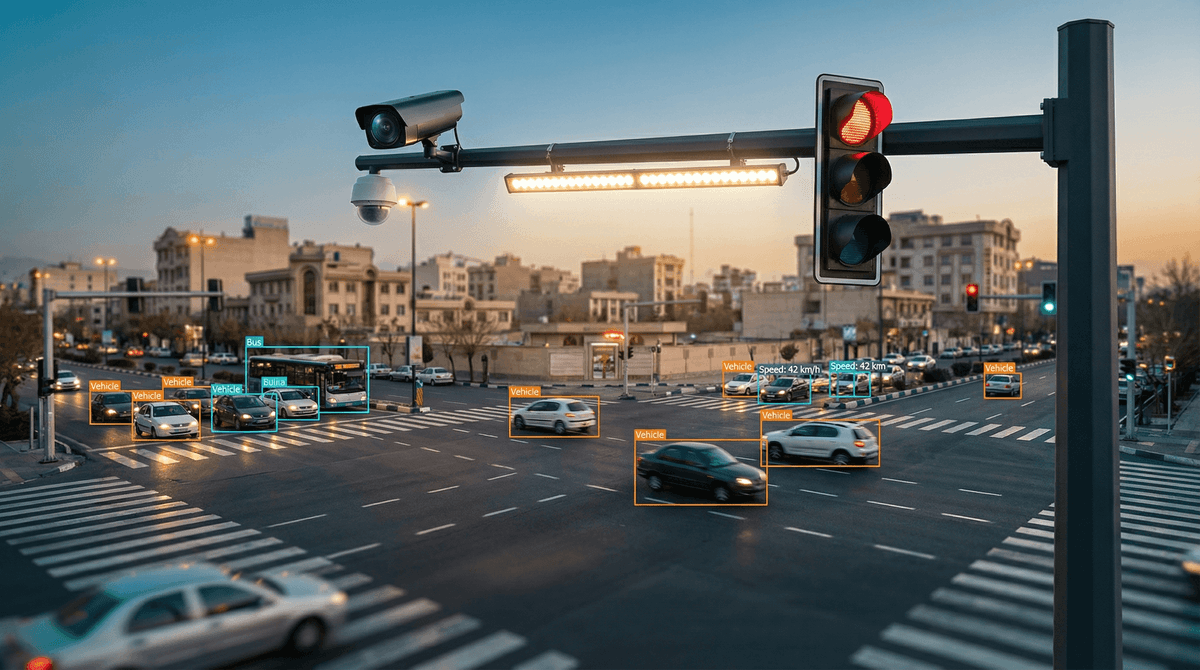
The detection layer usually includes video analytics, radar, loop detectors, edge processors, and optional UAV support for incident monitoring. In developing markets, motorcycles and e-bikes may account for 60% or more of corridor traffic, so the model must identify wrong-way riding, lane intrusion, triple riding, helmet non-compliance, and overloaded two-wheelers. If the controller ignores those classes, the optimization may improve car throughput while worsening actual safety.
SOLAR TODO smart traffic systems support broad object recognition across sedans, SUVs, buses, school buses, trucks, bicycles, pedestrians, wheelchairs, and emergency vehicles. The system can also support auto-priority for emergency vehicles and evidence capture with blockchain-secured chain of custody. For legal enforcement, that reduces disputes around timestamp integrity and event tampering.
Safety constraints inside the control logic
Safety must be treated as a hard constraint, not a soft preference, and that means minimum pedestrian clearance, red intervals, and conflict thresholds cannot be traded away for a 5-10% speed gain.
A mature design uses surrogate safety measures because waiting for crash data can take 12-36 months. Useful indicators include red-light violations, short headway events, hard braking frequency, speed variance, and pedestrian-vehicle conflict counts. The controller can reject a timing plan if post-encroachment time falls below a threshold or if turning conflicts exceed a set limit during a 15-minute interval.
The U.S. Department of Transportation states, “Intelligent transportation systems improve transportation safety and mobility while enhancing American productivity.” That is the correct procurement lens: safety and mobility should be specified together. A city should not accept a bid that promises 20% lower delay without a documented safety floor.
Emissions modeling and carbon impact
Signal optimization reduces emissions mainly by cutting idling, stop-and-go acceleration, and queue spillback, and corridor coordination can reduce stops by up to 40% when offsets are tuned correctly.
Emissions can be estimated from speed profiles, acceleration events, and delay using embedded models or external tools. Even if direct tailpipe measurement is not installed, comparative before/after analysis is still useful if methodology is fixed. According to deployment results cited for Pittsburgh, AI signal control reduced emissions by 20%. For municipal buyers with climate targets, that converts traffic control from a pure mobility project into a measurable decarbonization project.
SOLAR TODO adds another layer by supporting solar-powered traffic poles and off-grid operation. In suitable regulatory environments, a distributed solar traffic asset can provide dual value: traffic management plus local renewable generation. That is especially relevant where grid extension costs are high or where roadside power quality is poor.
Deployment Architecture, Use Cases, and Performance Measurement
A practical AI signal project should start with 3-5 intersections over 1-3 months, then expand to 50-100 intersections over 3-9 months once KPI gains and failure modes are documented.
The deployment architecture usually includes field controllers, cameras or radar, edge AI units, a communication backbone, a central management platform, and a Digital Twin for simulation. Edge processing is important because not every decision can wait for a cloud round trip of 100-300 milliseconds. For safety-critical phase changes, local logic should continue operating during network loss.
A Digital Twin allows agencies to compare timing plans before field activation. That is useful when corridors carry freight, school traffic, or high pedestrian volumes at different times of day. According to reported results in Singapore, digital-twin-supported traffic management reduced commute time by 15%. For procurement teams, simulation evidence should be included in factory acceptance and site acceptance criteria.
Typical use cases
Different corridors need different objective weights, and a freight route, school zone, CBD grid, and rural highway should not use the same optimization profile.
- Urban CBD corridors: prioritize delay, pedestrian safety, bus progression, and curbside turnover within 60-120 second cycle ranges.
- School and hospital zones: prioritize pedestrian clearance, speed compliance, and emergency access, even if average vehicle delay rises by 5-10 seconds.
- Arterial green waves: prioritize progression and stop reduction; coordinated systems can reduce stops by up to 40%.
- Rural or off-grid highways: prioritize solar-powered reliability, incident detection, and wrong-way alerts where utility power is unstable.
- Mixed two-wheeler corridors: prioritize motorcycle conflict analytics because two-wheelers may exceed 60% of total volume.
Reported market examples show why this matters. London deployments have reported 10-30% travel-time reduction, while transit or emergency priority can reduce response time by up to 50%. In Greece, 8 cameras detected 29,000 violations within weeks, showing that analytics and enforcement can scale quickly when evidence quality is high.
For SOLAR TODO customers in Africa, Southeast Asia, Latin America, and the Middle East, off-grid capability is often not optional. Solar-powered poles with LFP storage reduce dependence on unstable feeders and simplify deployment in corridors where trenching costs are high. That changes project economics because civil works often consume 20-40% of roadside system budgets.
Comparison and Selection Guide
The best procurement choice is the system that meets target KPIs at the lowest 5-10 year total cost, not the system with the lowest controller price in year 1.
Buyers should compare architecture, data quality, safety logic, power design, cybersecurity, and commercial terms. A low-cost adaptive controller without edge analytics, encrypted evidence handling, or off-grid resilience may create higher operating cost after 12-24 months. The same applies if the system cannot support future V2X interfaces expected between 2026 and 2028.
| Criteria | Fixed-Time Signals | Basic Adaptive Control | AI Multi-Objective Control | SOLAR TODO Smart Traffic Option |
|---|---|---|---|---|
| Optimization targets | 1-2 metrics | 2-3 metrics | 3+ metrics with constraints | 3+ metrics plus solar power resilience |
| Update interval | Seasonal or manual | 5-15 min | 1-5 sec | 1-5 sec |
| Safety analytics | Limited | Moderate | Conflict-aware | Conflict-aware with evidence chain |
| Emissions control | Indirect | Moderate | Directly weighted | Directly weighted + carbon-neutral operation potential |
| Detector coverage | Loops/basic video | Video/radar | Multi-sensor AI | 45+ object types |
| Off-grid operation | No | Rare | Possible | Native with solar + LFP battery |
| Emergency priority | Basic preemption | Supported | Predictive priority | Supported |
| Scale path | Corridor | District | City-wide + Digital Twin | City-wide + Digital Twin + TrafficGPT roadmap |
Selection should also consider cybersecurity and legal defensibility. Zero-trust architecture, end-to-end encryption, role-based access, and GDPR-compliant data controls are no longer optional when video and license plate data are processed. If the project includes enforcement, evidence retention policy and chain-of-custody design should be reviewed by legal teams before procurement award.
EPC Investment Analysis and Pricing Structure
For multi-intersection smart traffic projects, EPC turnkey delivery typically reduces interface risk by 15-25% because one contractor manages supply, installation, commissioning, and performance acceptance under one scope.
EPC in this context means Engineering, Procurement, and Construction with one accountable delivery structure. Engineering includes site survey, traffic study, pole and foundation design, controller logic design, communications topology, power design, and integration drawings. Procurement covers controllers, cameras, edge AI units, poles, solar modules where specified, LFP batteries, cabinets, and networking equipment. Construction covers civil works, installation, testing, commissioning, operator training, and handover documents.
A practical B2B pricing structure should be presented in 3 tiers:
- FOB Supply: equipment only, ex-port shipment, suitable for buyers with local installers and traffic engineers.
- CIF Delivered: equipment plus freight and insurance to destination port, useful where import logistics are complex.
- EPC Turnkey: full delivery including design, installation, commissioning, and acceptance testing.
Volume guidance should be explicit for budget planning:
- 50+ units/intersections: 5% discount
- 100+ units/intersections: 10% discount
- 250+ units/intersections: 15% discount
Sample deployment scenario (illustrative): a 20-intersection corridor upgrading from fixed-time control to AI adaptive operation may target 10-20% travel-time reduction, 10-20% emissions reduction, and lower incident response time through integrated detection. Payback often comes from reduced delay cost, lower fuel waste, fewer field maintenance visits, and avoided grid-extension work where solar poles are used. In off-grid or weak-grid corridors, annual savings versus diesel-powered roadside equipment can be material within 3-6 years depending on fuel price and maintenance frequency.
Payment terms for export projects are typically:
- 30% T/T deposit + 70% against B/L
- 100% L/C at sight
Financing is available for large projects above $1,000K, subject to project scope, buyer profile, and jurisdiction. For commercial quotations, EPC scope review, and warranty terms, buyers can contact [email protected]. SOLAR TODO follows an inquiry to offline quotation process rather than online checkout, which is standard for infrastructure projects with custom BoQ and compliance requirements.
FAQ
A well-scoped FAQ should answer at least 10 buyer questions on performance, safety, cost, deployment, and maintenance because smart traffic projects involve both IT and roadside electrical infrastructure.
Q: What is multi-objective traffic signal optimization? A: Multi-objective traffic signal optimization is AI control that improves more than one target at the same time, usually delay, safety, and emissions. Instead of only shortening queues, it can also limit conflict risk and reduce idling. In practice, agencies define weighted KPIs and hard safety constraints before deployment.
Q: How is it different from normal adaptive traffic control? A: Normal adaptive control often focuses on flow efficiency, such as split and offset adjustment every 5-15 minutes. Multi-objective AI adds safety and emissions into the decision logic and can update every 1-5 seconds using live detector inputs. That gives better control on mixed traffic corridors and irregular demand patterns.
Q: How much performance improvement is realistic? A: Realistic improvement depends on corridor quality, detector coverage, and baseline timing. Reported deployments have shown 10-30% travel-time reduction, about 20% lower emissions, and up to 40% fewer stops on coordinated corridors. Buyers should request a pilot with before/after methodology rather than accept generic claims.
Q: Can AI signal optimization improve safety, not just speed? A: Yes, if safety is treated as a hard constraint and measured with conflict analytics. The system can monitor red-light violations, short headways, hard braking, and pedestrian conflict events, then reject timing plans that increase risk. This is important because a 5-10% speed gain is not acceptable if conflict rates rise.
Q: What sensors and data sources are required? A: Most projects use video analytics, radar, controller logs, and optional loop detectors. A stronger setup also includes edge AI processors, emergency vehicle priority inputs, and central software for KPI reporting. On mixed traffic roads, detection should cover motorcycles, e-bikes, buses, trucks, and pedestrians rather than only passenger cars.
Q: Does this work in off-grid or weak-grid locations? A: Yes, provided the roadside system is designed with solar power and battery storage. SOLAR TODO supports pole-top solar with LFP batteries for 24/7 operation, which is useful on rural highways, peri-urban corridors, and developing regions with unstable feeders. This can also reduce trenching and utility connection cost.
Q: How long does deployment usually take? A: A practical rollout starts with a 1-3 month pilot across 3-5 intersections. Expansion to 50-100 intersections usually takes 3-9 months, while city-wide deployment with Digital Twin integration may take 9-18 months. Schedule depends on civil works, communications availability, and local approvals.
Q: What should be included in the KPI acceptance test? A: The acceptance test should include at least 6 metrics: average delay, queue length, stop rate, travel time, conflict indicators, and emissions estimate. It should also define data periods, such as peak and off-peak windows over 2-4 weeks, plus fail-safe behavior during communication or power loss.
Q: How should buyers compare vendors? A: Buyers should compare 5-10 year total cost, not only equipment price. Review detector accuracy, update interval, cybersecurity, evidence handling, off-grid capability, and support for future V2X interfaces. A lower bid can become more expensive if field maintenance, false detections, or legal disputes increase after commissioning.
Q: What are the EPC and pricing options? A: Smart traffic projects are commonly quoted as FOB Supply, CIF Delivered, or EPC Turnkey. SOLAR TODO also provides volume guidance of 5% discount for 50+, 10% for 100+, and 15% for 250+ units or intersections. Standard payment terms are 30% T/T plus 70% against B/L, or 100% L/C at sight.
Q: What maintenance is required after commissioning? A: Routine maintenance includes camera cleaning, cabinet inspection, battery health checks, firmware updates, and detector recalibration. Most operators schedule inspections every 3-6 months and software reviews monthly. In dusty or coastal environments, cleaning intervals may need to be shorter to preserve detection accuracy.
Q: How does data security and privacy get handled? A: Security should include end-to-end encryption, role-based access, audit logs, and zero-trust network design. If license plates or personal data are processed, GDPR-style retention and access controls should be defined before activation. For enforcement projects, evidence chain integrity is also important for legal use.
References
- IEA (2023): Energy Technology Perspectives and digitalization findings on system efficiency, flexibility, and sustainability in infrastructure operations.
- IRENA (2023): Renewable Power Generation Costs and renewable integration data relevant to solar-powered roadside infrastructure economics.
- IEEE (2016): IEEE 802.11p and related ITS communications framework for vehicular environments and roadside connectivity.
- NEMA/TS 2 (2016): Traffic Controller Assemblies standard widely used for signal controller functional requirements and cabinet interoperability.
- U.S. Department of Transportation ITS Joint Program Office (2024): ITS program materials describing safety, mobility, and productivity benefits of intelligent transportation systems.
- IEC (2019): IEC 62443 industrial communication network and system security framework applicable to traffic control cybersecurity architecture.
- GDPR / European Union (2018): Data protection regulation governing personal data processing, retention, and access control for camera-based traffic systems.
Conclusion
AI multi-objective traffic signal optimization can deliver 10-30% travel-time reduction, up to 40% fewer stops, and about 20% lower emissions when safety constraints are built into the control logic from day 1.
For agencies and EPC buyers, the bottom line is clear: specify at least 3 objectives, validate them on a 3-5 intersection pilot, and choose a platform such as SOLAR TODO that supports off-grid power, encrypted evidence handling, and scalable deployment to 50-100 intersections and beyond.
About SOLARTODO
SOLARTODO is a global integrated solution provider specializing in solar power generation systems, energy-storage products, smart street-lighting and solar street-lighting, intelligent security & IoT linkage systems, power transmission towers, telecom communication towers, and smart-agriculture solutions for worldwide B2B customers.
Further Reading
About the Author

SOLARTODO Editorial Team
Solar Energy & Infrastructure Expert Team
SOLAR TODO is a professional supplier of solar energy, energy storage, smart lighting, smart agriculture, security systems, communication towers, and power tower equipment.
Our technical team has over 15 years of experience in renewable energy and infrastructure, providing high-quality products and solutions to B2B customers worldwide.
Expertise: PV system design, energy storage optimization, smart lighting integration, smart agriculture monitoring, security system integration, communication and power tower supply.
Cite This Article
SOLARTODO Editorial Team. (2026). AI Traffic Signal Optimization for Safety and Emissions. SOLARTODO. Retrieved from https://solartodo.com/knowledge/multi-objective-traffic-signal-optimization-balancing-efficiency-safety-and-emissions-with-ai
@article{solartodo_multi_objective_traffic_signal_optimization_balancing_efficiency_safety_and_emissions_with_ai,
  title = {AI Traffic Signal Optimization for Safety and Emissions},
  author = {SOLARTODO Editorial Team},
  journal = {SOLARTODO Knowledge Base},
  year = {2026},
  url = {https://solartodo.com/knowledge/multi-objective-traffic-signal-optimization-balancing-efficiency-safety-and-emissions-with-ai},
  note = {Accessed: 2026-10-19}
}
Published: July 12, 2026 | Available at: https://solartodo.com/knowledge/multi-objective-traffic-signal-optimization-balancing-efficiency-safety-and-emissions-with-ai
Subscribe to Our Newsletter
Get the latest solar energy news and insights delivered to your inbox.
View All Articles