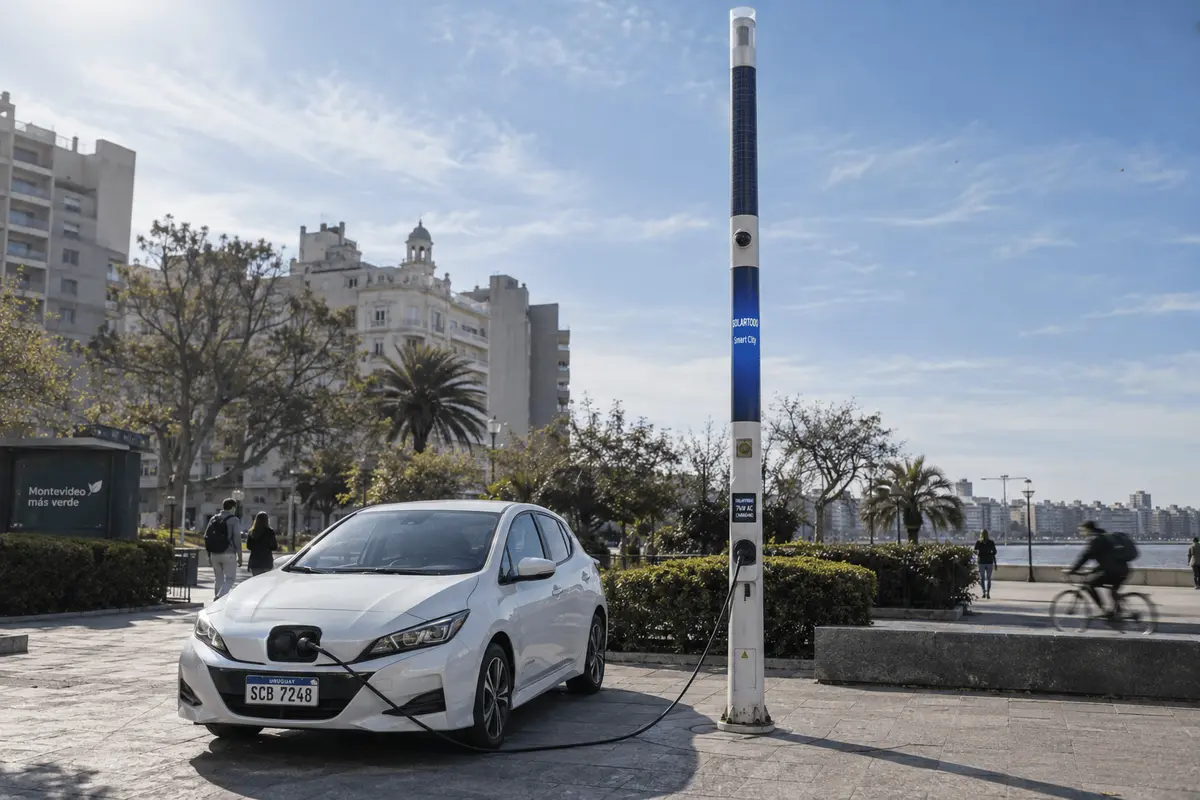
Montevideo Coastal Salt-Air Smart Streetlight Fit: 10m Flush Cylindrical Pole Configuration
Summary
Montevideo Smart Streetlight planning should address 1,302,954 residents, 230/400 V low-voltage supply, and coastal salt-air exposure with approximately 43 flush 10m poles at 25m spacing.
Key Takeaways
For a 1.075 km Montevideo corridor, a typical 43-unit Smart Streetlight package at 25m spacing would prioritize sealed Ø200mm cylindrical hardware.
- Montevideo Department recorded 1,302,954 residents in Uruguay’s 2023 census, concentrating urban-service demand in the capital.
- Uruguay’s regulated low-voltage classes are 230 V and 400 V, with medium-voltage classes including 6.4 kV, 15 kV, and 22 kV.
- The recommended SOLARTODO configuration is 43 units of 10m Ø200mm seamless cylindrical poles, each with 5mm wall thickness.
- Each pole integrates a 100W, 15,000 lm, 4000K LED ring-light band, matching urban-street rather than highway lighting class.
- Spacing at 25m yields approximately 40 poles per km, inside the 30-50 poles/km smart-streetlight density band.
- Each pole includes ~183W CIGS wrap, 3,000Wh LFP storage, MPPT, 5G NR n78 antenna, 8MP fisheye camera, and 7kW EV charging.
- Uruguay’s renewable-electricity share was 91.5% in IRENA’s 2025 statistics, making grid-backed smart poles compatible with low-carbon municipal electrification.
Market Context for Montevideo
Montevideo’s Smart Streetlight need is shaped by 1.3 million residents, coastal exposure, 230/400 V distribution practice, and narrow historic streets.
According to Uruguay’s Instituto Nacional de Estadística (2024), Montevideo Department had 1,302,954 residents in the 2023 census, making it the country’s largest and densest municipal service area. The city sits on the Río de la Plata coast near latitude -34.88, where salt air, wind-driven humidity, and marine corrosion risk are more relevant than desert dust. For pole procurement, this favors hot-dip galvanized steel, sealed embedded modules, and a finish system that limits exposed brackets.
Climate is a technical constraint, not a marketing detail. According to WorldClim/CRU-based climate analysis (2025), Montevideo’s annual mean temperature is about 16.6°C; public climate summaries commonly place annual rainfall around 950-1,140 mm, spread across the year. A Smart Streetlight in this environment should expect wet-season drainage, wind-blown salt film, and repeated cleaning cycles around camera windows, LCD glass, Type 2 charging caps, and SOS buttons.
Grid interface is equally local. According to URSEA (2024), Uruguay’s regulated nominal low-voltage classes include 230 V and 400 V, while distribution and subtransmission classes include 6.4 kV, 15 kV, 22 kV, 31.5 kV, and 63 kV. For Montevideo smart poles, that means a corridor package should be treated as low-voltage urban equipment with protection, metering, and UTE coordination, not as a medium-voltage power-tower project.
Municipal procurement also matters. The Intendencia de Montevideo’s Plan de Movilidad Urbana states its objective is the modernization of urban transport; the same public page links the plan to an IDB credit line of US$100 million and includes road works, public lighting, and traffic-signal modernization. The city also has a Unidad Técnica de Alumbrado Público, whose functions include handling public-lighting supply and energy failures with UTE. Montevideo therefore has the institutional pattern for integrated lighting, mobility, and power coordination, but vendors should expect formal documentation rather than informal site-by-site decisions.
According to ITU (2025), Uruguay had 107 active mobile-broadband subscriptions per 100 inhabitants in 2023, supporting demand for dense urban connectivity and small-cell-ready street furniture. URSEC’s 5G trial authorization for Montevideo referenced 3300-3400 MHz and 3600-3800 MHz bands, which sit around the n78 ecosystem. That makes embedded 5G NR n78 antenna readiness relevant for Montevideo corridors where visual clutter, pole permissions, and fiber backhaul are harder than radio demand.
UNIT states, 'normas internacionales IEC respectivas' are used as principal antecedents for Uruguay public-lighting standards work. The Intendencia de Montevideo states, 'reestructura y modernización del transporte urbano de Montevideo' as the mobility-plan objective. Together, these sources point to a procurement environment where technical compliance, visual integration, and maintainable infrastructure are stronger arguments than decorative smart-city claims.
Recommended Technical Configuration
A typical Montevideo coastal-corridor deployment would use 43 units of 10m cylindrical Smart Streetlight poles over approximately 1.075 km.
The recommended SOLARTODO Smart Streetlight form is [cyl_219], specified here as a 10m seamless cylindrical Ø200mm pole with constant diameter from top to bottom. This selection is stronger for Montevideo than an arm-mounted octagonal pole because Ciudad Vieja, Rambla-adjacent avenues, bus corridors, and dense sidewalks already carry signage, overhead services, balconies, trees, and curbside utility furniture. A monolithic flush pole reduces snag points, avoids side-arm wind loading, and presents a cleaner profile in heritage-sensitive streets.
A typical 43-unit deployment of this scale would consist of 43 identical poles at 25m spacing, not a claim of a completed SOLARTODO project. At 25m spacing, the package covers about 1,075 m of urban corridor and lands at roughly 40 poles/km, consistent with the 30-50 poles/km design density used for city streets. The pole height is 10m, appropriate for urban avenues and mixed pedestrian-vehicle environments; it is not positioned as a highway mast or a park garden-lighting product.
The configuration should connect to Montevideo low-voltage supply where available, while using each pole’s 3,000Wh LFP battery and ~183W CIGS wrap as resilience and auxiliary generation. Because Uruguay’s electricity mix is already highly renewable, the product value is not simply solar offset; it is integration. The same vertical asset provides lighting, charging, sensing, emergency call, display, and 5G-ready communications without multiplying cabinets along the sidewalk.
SOLARTODO should frame this model as a premium urban-integration Smart Streetlight for waterfront roads, modal-transfer areas, and high-visibility civic corridors. The visible design rule is strict: no side arms, no external boxes, no widened base, no speaker columns, and no advertising imagery. That is a good fit for Montevideo’s coastal, compact, design-sensitive public realm.
Technical Specifications
The Montevideo configuration uses 43 flush 10m poles, each combining 100W lighting, 183W CIGS wrap, 3,000Wh LFP storage, and 7kW charging.
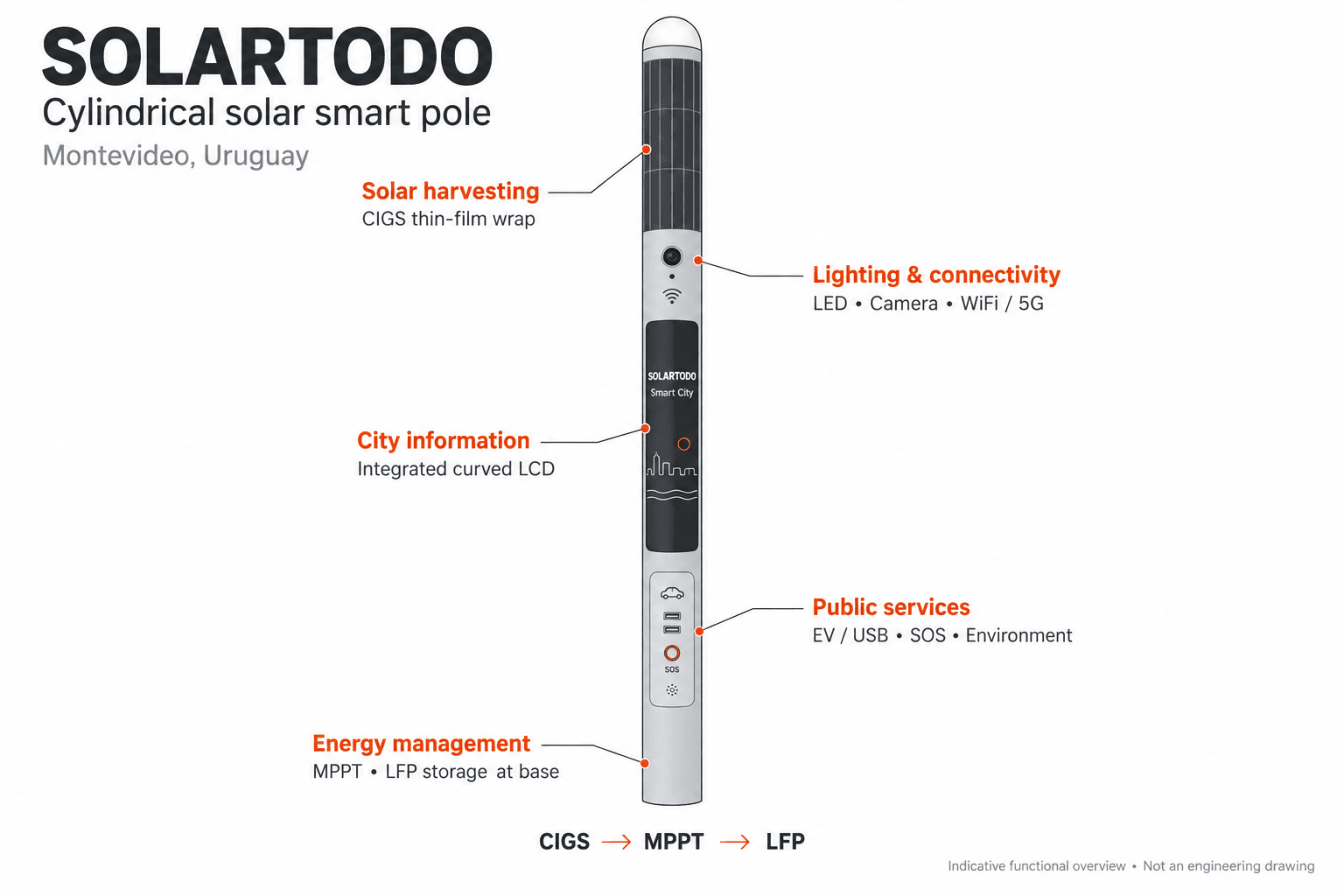
- Product: SOLARTODO Smart Streetlight, cyl_219 premium cylindrical configuration.
- Quantity: approximately 43 units for a 25m-spaced, 1.075 km urban corridor.
- Pole body: 10m seamless cylindrical Ø200mm pole, constant diameter top-to-bottom, 5mm wall, hot-dip galvanized steel.
- Finish: matte white RAL9003 for coastal visibility and low visual weight.
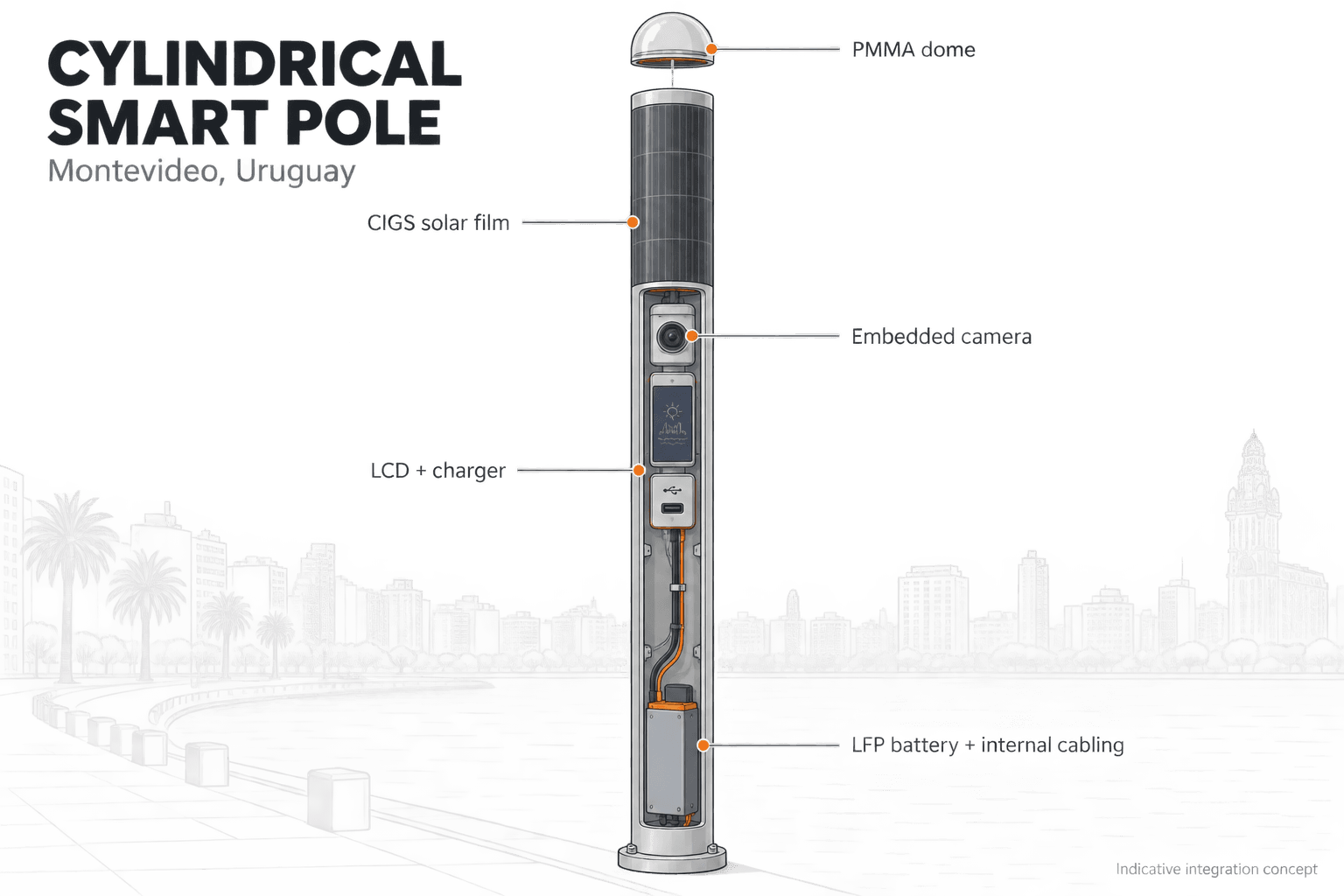
- Integration rule: all modules flush-integrated into the cylinder skin, with no side arms, no luminaire outriggers, no external cabinets, and no separate bollards.
- Luminaire: Ø200mm LED ring-light band at pole top, 360° glow, 100W, 15,000 lm, 4000K.
- Solar: CIGS flexible thin-film cells wrapped 360° around the 6.5m-9.3m mid-section, approximately 183W total, laminated flush with no brackets or tilt frame.
- Storage and control: 3,000Wh LFP battery inside pole base with MPPT.
- Sensing: top dome 8-parameter sensor for temperature, humidity, wind, pressure, noise, PM2.5, PM10, and illuminance.
- Camera: flush 8MP, 180° panoramic fisheye camera behind a dome glass window.
- Communications: embedded 5G NR n78 internal antenna plus smart-controller compatibility with 4G or LoRaWAN.
- Emergency interface: flush SOS button and two-way audio through pinhole speaker grille only.
- EV charging: embedded 7kW dual-outlet charger with Type 2 and Type 1 flush flip-caps, 5m coiled Type 2 cable, and flush touchscreen at 1.5m.
- Display: 2,000mm x ~170mm vertical curved LCD, bent to Ø200mm radius, front face only, showing SOLARTODO Smart City text in white on deep blue.
- Standards alignment: IEC 60598 for luminaires and GB/T 37024 for smart streetlight system guidance.
According to IEC (2020), IEC 60598-1 covers general requirements and tests for luminaires. For Montevideo, the practical interpretation is that LED, enclosure, wiring, thermal, and ingress-protection evidence should be documented before municipal approval. GB/T 37024 adds the smart-pole system lens, which is useful when lighting, sensors, communications, charging, and cloud control share one asset.
Implementation Approach
A 43-unit Montevideo Smart Streetlight rollout would typically move through 5 phases: survey, approvals, CKD logistics, installation, and commissioning.
Phase 1 should map the corridor at 25m intervals and classify each location by sidewalk width, curb parking, existing luminaire position, drainage inlet proximity, tree canopy, underground services, and UTE service availability. In Ciudad Vieja and other dense areas, the design team should confirm turning radius, delivery windows, and crane access because older street grids leave less staging space than peripheral avenues. Along the Rambla and bay-facing corridors, corrosion class, wind exposure, and salt spray cleaning access should receive extra review.
Phase 2 should cover technical submittals to the relevant municipal and utility interfaces. The package should include pole drawings, foundation loads, low-voltage protection, IEC 60598 luminaire evidence, charging-interface documentation, communications frequencies, cybersecurity notes, and display-content restrictions. Because the specified LCD content is only SOLARTODO Smart City text, the display should be treated as a status/identity surface, not as an advertising screen.
Phase 3 is logistics and assembly planning. CKD or semi-assembled shipping should protect the curved LCD, CIGS laminate, dome glass, charging flip-caps, and RAL9003 coating from abrasion. For Montevideo port arrival, packaging should allow inspection without exposing the CIGS wrap to sharp strapping or saltwater contamination. Each pole should be traceable by serial number, controller ID, and factory test sheet.
Phase 4 is civil and electrical installation. Foundations should be installed before pole delivery where possible, with conduit entries positioned to keep the Ø200mm cylindrical form uninterrupted. Low-voltage feeders should be protected and metered according to local UTE practice. The 7kW charger introduces higher point load than lighting alone, so circuit grouping and demand assumptions must be reviewed before energization.
Phase 5 is commissioning. A practical checklist should verify 15,000 lm LED output behavior, dusk schedule, camera focus through the dome, 8-parameter sensor reporting, n78 antenna readiness, SOS intercom audio, Type 1 and Type 2 flap closure, LCD text rendering, MPPT charging, battery telemetry, and remote controller status. SOLARTODO should also provide maintenance training for dome cleaning, LCD inspection, charger cable handling, and corrosion checks.
Expected Performance & ROI
Montevideo performance should be evaluated over 10-15 years, with ROI driven by 100W LED efficiency, shared pole assets, and reduced cabinet clutter.
Expected energy performance starts with the luminaire. A 100W LED at 15,000 lm produces 150 lm/W, which is efficient for city-street lighting while maintaining 4000K neutral visibility. If operated for 11-12 hours per night, each pole’s lighting load is roughly 1.1-1.2 kWh/day before controls; motion dimming or adaptive scheduling can reduce this, while EV charging should be evaluated separately as a user service load.
The CIGS wrap is not sized to make a 7kW charger energy-independent. It is better understood as auxiliary generation for controls, sensing, communications, and partial battery support. The 3,000Wh LFP battery provides resilience for lighting-control electronics and service continuity, while grid backup keeps the installation predictable during long wet periods.
ROI should include avoided duplicate infrastructure. A conventional corridor might require separate light poles, camera posts, emergency call boxes, WiFi or small-cell brackets, EV pedestals, and signage/display mounts. In Montevideo’s narrow sidewalks and coastal public realm, consolidation can reduce civil work, approvals, visual clutter, and maintenance visits. According to IRENA (2025), Uruguay’s renewable share of electricity production reached 91.5%, so electrified smart infrastructure can align with national decarbonization without relying on overstated solar-only claims.
Results and Impact
For Montevideo planning, the expected impact is a 43-pole integrated corridor model, not a past deployment or claimed operating result.
A typical project would deliver about 1.075 km of visually controlled smart-streetlight coverage, 43 integrated EV charging points with dual Type 1 and Type 2 interfaces, 43 environmental sensing nodes, and 43 camera-ready observation points. The impact is strongest where streets have competing demands for lighting, security, pedestrian information, EV top-up, and telecom readiness. The main planning benefit is fewer individual sidewalk assets for the same functional envelope.
The model also supports staged public procurement. Montevideo can pilot a limited corridor, validate corrosion behavior, charging utilization, camera privacy rules, and maintenance workload, then extend the same bill of materials to additional corridors if results meet acceptance criteria. This article does not claim SOLARTODO has installed these units in Montevideo; it defines a technically coherent configuration for buyers evaluating the city’s needs.
Comparison Table
The 10m cylindrical Smart Streetlight is best for Montevideo corridors where 25m spacing, Ø200mm flush form, and 7kW embedded charging matter.
| Option | Best-fit Montevideo location | Height / form | Energy and charging | Visual impact | Technical fit |
|---|---|---|---|---|---|
| Recommended cyl_219 | Rambla, Ciudad Vieja edge, civic corridors | 10m Ø200mm constant cylinder | 183W CIGS, 3,000Wh LFP, 7kW embedded EV | Lowest: no arms, boxes, or bollards | Best for salt-air premium streets |
| Standard modular pole | Wider avenues and utility corridors | 6-12m octagonal | LED plus modular EV / camera / WiFi | Medium: accessories may be visible | Good for cost-sensitive expansion |
| Hybrid 12m pole | Peripheral roads with weaker grid backup | 12m octagonal with wind-solar | 100-300W wind plus panels and LFP | Higher: visible turbine and panels | Useful where self-power matters more |
| Grid 12m pole | Large road corridors | 12m octagonal with integrated charger cabinet | Grid-powered AC charger | Higher: charger base is larger | Better for MENA-style flagship corridors |
Pricing & Quotation
Montevideo quotations should separate 43-unit equipment supply, freight, installation scope, and 1-year warranty assumptions without publishing fixed prices.
SOLARTODO offers three pricing tiers for this product line: FOB Supply (equipment ex-works China), CIF Delivered (including ocean freight and insurance), and EPC Turnkey (fully installed, commissioned, with 1-year warranty). Volume discounts are available for large-scale deployments. Configure your system online for an instant estimate, or request a custom quotation from our engineering team at [email protected].
For technical review, see the SOLARTODO Smart Streetlight product page. Buyers comparing waterfront, old-town, and mobility-corridor applications should contact us with corridor length, sidewalk widths, utility-connection assumptions, EV charging policy, telecom requirements, and privacy constraints.
Frequently Asked Questions
These 10 FAQs cover Montevideo Smart Streetlight specs, timeline, ROI, maintenance, EPC scope, warranty, installation, and alternatives.
Q1: Why is the Ø200mm cylindrical pole recommended for Montevideo? The Ø200mm cylindrical pole suits Montevideo because coastal salt air, dense sidewalks, and heritage-sensitive streets reward sealed, flush integration. The specified 10m pole keeps all lighting, camera, sensor, EV, display, and SOS hardware within one constant-diameter body, reducing exposed brackets and external cabinets that would increase corrosion points and visual clutter.
Q2: How many SOLARTODO Smart Streetlight units would a typical Montevideo corridor need? At 25m spacing, a typical 43-unit deployment would cover approximately 1.075 km of urban corridor. That equals about 40 poles per km, within the 30-50 poles/km planning range for city streets. Final quantity depends on intersections, trees, driveways, existing foundations, UTE connection points, and required lighting uniformity.
Q3: Is the 183W CIGS wrap enough to power the 7kW EV charger? No. The ~183W CIGS wrap is an auxiliary energy source for controls, sensors, communications, and battery support, not a full EV-charging supply. The 7kW embedded charger should be treated as a grid-backed low-voltage load. This is appropriate in Uruguay, where IRENA reports a 91.5% renewable-electricity share.
Q4: What deployment timeline should a Montevideo buyer expect? A practical 43-unit corridor could be planned in phases: survey and design, municipal and utility approval, manufacturing, ocean freight, foundations, pole erection, electrical connection, and commissioning. Depending on permit speed and civil-work access, buyers should usually plan in months rather than weeks, especially where old-town streets restrict staging.
Q5: What maintenance is most important in Montevideo’s coastal environment? Maintenance should focus on salt-film removal, dome glass cleaning, CIGS laminate inspection, charger flip-cap seals, LCD surface checks, grounding continuity, and corrosion monitoring at base interfaces. Because all modules are flush, maintenance access is cleaner than bracketed systems, but wet coastal air still requires a scheduled inspection program.
Q6: How does this compare with a conventional LED streetlight pole? A conventional LED pole mainly provides lighting, while this SOLARTODO Smart Streetlight adds 7kW EV charging, 8-parameter environmental sensing, 8MP panoramic camera capability, SOS intercom, curved LCD identity display, LFP battery, MPPT, and 5G n78 readiness. The comparison is strongest where Montevideo wants fewer sidewalk assets, not just lower luminaire wattage.
Q7: Does SOLARTODO provide EPC pricing for Uruguay? SOLARTODO can quote FOB Supply, CIF Delivered, or EPC Turnkey tiers for Uruguay-bound projects. EPC pricing depends on local civil works, utility connection, foundation design, logistics, installation labor, testing, commissioning, and warranty scope. This guide intentionally avoids fixed prices because site access and grid work can dominate final cost.
Q8: What warranty expectation is appropriate for this product line? The standard EPC paragraph specifies a 1-year warranty for fully installed and commissioned turnkey scope. Buyers can request extended service or spare-parts terms during quotation. For Montevideo, warranty review should pay special attention to coastal corrosion treatment, charging components, LCD seals, CIGS laminate adhesion, and camera dome performance.
Q9: Which standards should be referenced in procurement documents? Procurement should reference IEC 60598 for luminaire safety and testing, GB/T 37024 for smart streetlight system guidance, and Uruguay’s URSEA/UTE low-voltage framework for 230/400 V service. UNIT’s LED public-lighting standards work also matters because Uruguay has considered IEC-based requirements in public-lighting tenders.
Q10: Is this Smart Streetlight intended for highways or parks? No. This configuration is for city and urban street classes, with 10m height and 25m spacing. It is not a highway lighting mast; highways generally need 12m-plus traffic-pole designs and different photometrics. It is also not a 6-8m garden-lighting product for parks or landscape paths.
References
The references below combine 7 public authorities and standards bodies covering Montevideo demographics, voltage classes, mobility procurement, telecom, energy, and luminaire standards.
- Instituto Nacional de Estadística Uruguay (2024): Censo 2023 final department data reports Montevideo Department at 1,302,954 residents.
- URSEA (2024): Electricity service quality FAQ lists Uruguay voltage classes including 230/400 V low voltage, 6.4/15/22 kV medium voltage, and 31.5/63 kV subtransmission.
- UTE (2024): Low-voltage regulations note 230 V and 400 V values under the URSEA-approved distribution service quality regulation.
- Intendencia de Montevideo (2025): Plan de Movilidad Urbana describes urban-transport modernization, public-lighting road works, traffic signals, and an IDB credit line of US$100 million.
- UNIT (2024): LED public-lighting standards work references Montevideo public-lighting tender experience and IEC standards as principal antecedents.
- ITU (2025): Measuring Digital Development reports Uruguay at 107 active mobile-broadband subscriptions per 100 inhabitants in 2023.
- IRENA (2025): Renewable Energy Statistics reports Uruguay’s renewable share of electricity production at 91.5% in the latest listed series.
- IEC (2020): IEC 60598-1 defines general requirements and tests for luminaires used in public lighting procurement.
Equipment Deployed
- 43 units × 10m seamless cylindrical Ø200mm Smart Streetlight pole, 5mm wall, hot-dip galvanized, matte white RAL9003
- Ø200mm embedded LED ring-light band, 360° top glow, 100W, 15,000 lm, 4000K
- 360° CIGS flexible thin-film solar wrap from 6.5m to 9.3m, approximately 183W total, flush laminated
- LFP 3,000Wh battery inside pole base with MPPT controller
- Flush 8MP 180° panoramic fisheye camera behind dome glass window
- Top 8-parameter environmental sensor: temperature, humidity, wind, pressure, noise, PM2.5, PM10, illuminance
- Embedded 5G NR n78 internal antenna with smart-controller compatibility for 4G or LoRaWAN
- Fully flush 7kW dual-outlet EV charger with Type 2 + Type 1 flip-caps and 5m coiled Type 2 cable
- Flush SOS button with two-way audio through pinhole speaker grille
- Vertical curved LCD display 2000mm × ~170mm, SOLARTODO Smart City text only