Maximizing labor cost reduction with Smart Agriculture…

SOLAR TODO
Solar Energy & Infrastructure Expert Team
Watch the video
TL;DR
Smart Agriculture Monitoring Systems reduce labor cost by replacing manual scouting, irrigation checks, and weather patrols with 10-minute automated monitoring. For 30-50 ha crop fields, well-designed LoRaWAN or 4G systems can cut routine labor by 30-60%, reduce water use by up to 50%, and often reach payback in 2-5 years when labor savings, crop protection, and operational efficiency are combined.
Smart Agriculture Monitoring Systems can cut routine field scouting labor by 30-60%, shift data collection to 10-minute automated intervals, and reduce irrigation water use by up to 50% in monitored operations. This article explains how crop-field operators use sensors, LoRaWAN, 4G, and cloud alerts to lower labor cost per hectare.
Summary
Smart Agriculture Monitoring Systems can cut routine field scouting labor by 30-60%, shift data collection to 10-minute automated intervals, and reduce irrigation water use by up to 50% in monitored operations. This article explains how crop-field operators use sensors, LoRaWAN, 4G, and cloud alerts to lower labor cost per hectare.
Key Takeaways
- Replace manual scouting rounds with 10-minute automated monitoring to reduce routine labor hours by 30-60% across 30-50 ha crop fields.
- Deploy LoRaWAN sensor networks with 10-20 field devices to cover 30-40 ha blocks while reducing technician travel distance and inspection frequency.
- Use automated irrigation control with soil probes and weather data to cut water use by up to 50% and reduce valve-operation labor on daily schedules.
- Set SMS, email, and app alerts at threshold points such as 0°C to -2.5°C frost risk or soil moisture limits to avoid 1-3 hour response delays.
- Standardize data collection with 10 weather parameters and 7 soil parameters to reduce manual logging errors and improve agronomic decisions within one shift.
- Compare FOB Supply, CIF Delivered, and EPC Turnkey models before procurement; orders above 50 units typically qualify for 5% volume discounts.
- Calculate ROI from labor savings, water savings, and yield protection; many 30-50 ha projects target payback in about 2-5 years depending on labor rates and crop value.
- Verify IEC, IEEE, ISO 11783, and IP67/IP68 compliance criteria before purchase to reduce maintenance visits and improve year-round field uptime.
Why Smart Agriculture Monitoring Reduces Labor Cost in Crop Fields
Smart Agriculture Monitoring Systems lower labor cost by automating 10-minute data capture, reducing field scouting by 30-60%, and helping managers supervise 30-50 ha with fewer routine site visits.
Labor cost in crop production is not only wages. It also includes transport time, manual note-taking, repeated irrigation checks, weather watching, night frost patrols, and delayed response when one supervisor covers several zones. In many crop fields, a worker may spend 2-6 hours per day collecting readings that fixed sensors can transmit every 10 minutes. That difference is where labor reduction starts.
According to IEA (2024), digitalization improves operational efficiency across energy-linked infrastructure by increasing visibility and reducing manual intervention. In agriculture, the same logic applies when weather stations, soil probes, and gateways replace repetitive inspection loops. According to IRENA (2023), digital monitoring and control improve renewable-powered productive use systems by reducing operating uncertainty, which directly affects staffing levels in remote sites.
For B2B buyers, the key question is not whether sensors collect data. The key question is whether the system removes paid labor hours from recurring tasks without creating extra maintenance work. A practical system for 30-50 ha should therefore include solar-powered nodes, IP67/IP68 outdoor protection, cloud dashboards, and threshold alerts that eliminate unnecessary trips.
SOLAR TODO addresses this requirement with configurable Smart Agriculture Monitoring Systems for orchard, tea, and desert reclamation applications. Examples include the Orchard Frost Early Warning 40ha with 10 sensing points and LoRaWAN, the Tea Garden Precision Monitoring 30ha with 15 sensors/devices, and the Desert Reclamation Solar+Agriculture 50ha with 20 sensors and 4G LTE.
Where labor savings usually come from
The largest labor savings usually come from replacing 4 repetitive tasks with automated sensing, alerts, and remote control across 30-50 ha field blocks.
- Manual weather observation every 1-3 hours during risk periods
- Soil moisture checks with handheld meters across multiple irrigation zones
- Night patrols for frost, pump status, or disease-prone microclimates
- Paper or spreadsheet logging that later requires office re-entry
According to NREL (2024), high-frequency monitoring improves system performance visibility and supports better operational decisions. In crop fields, that same principle reduces the number of low-value labor hours spent collecting basic data instead of acting on it.
System Architecture and Technical Mechanisms
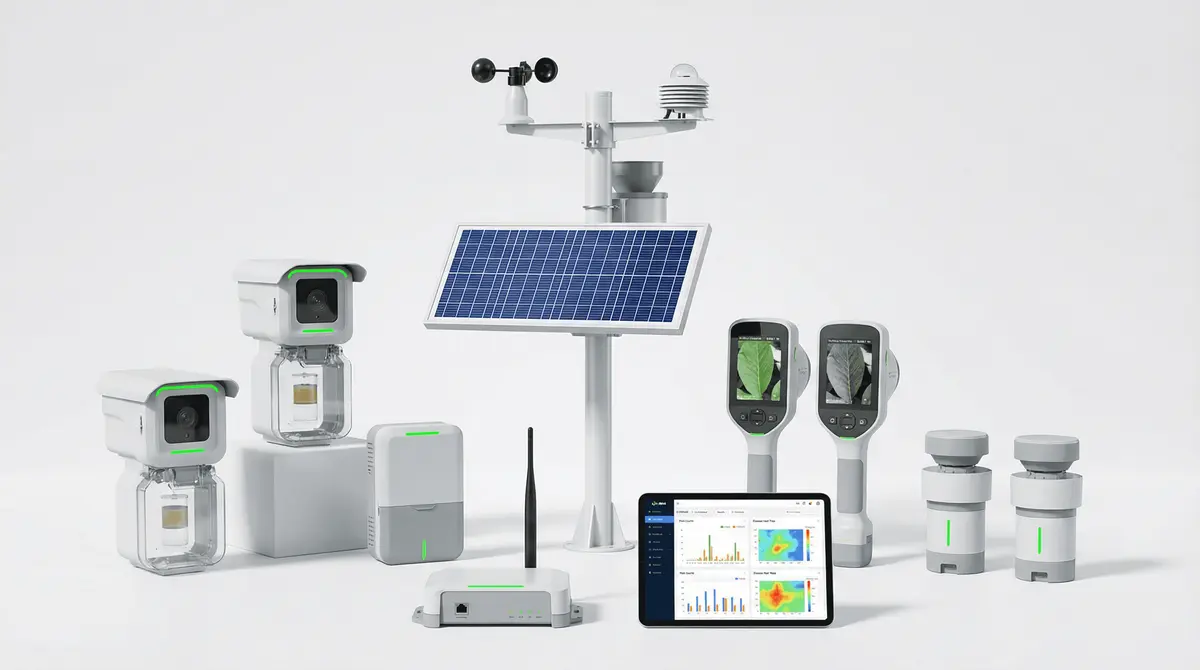
A labor-saving field system typically combines 1 weather station, 10-20 sensing devices, solar-powered nodes, and either LoRaWAN or 4G communication to automate routine inspection work.
The technical design matters because labor reduction depends on reliability. If a network drops out every few days, staff return to manual checks. A workable architecture for crop fields usually includes distributed field nodes, one or more gateways, cloud software, and alarm logic. Data intervals of 10 minutes are common because they balance battery life, agronomic usefulness, and manageable data traffic.
SOLAR TODO product configurations show how this works in practice. The Orchard Frost Early Warning 40ha package covers 40 ha with 10 field sensing points, LoRaWAN communication, weather monitoring, soil moisture-temperature monitoring, and SMS + Email + App Push alerts. The Tea Garden Precision Monitoring 30ha package covers 30 ha with 15 sensors/devices, 10-minute intervals, and 1 multispectral leaf scanner for AI disease detection. The Desert Reclamation Solar+Agriculture 50ha package adds 500 kW solar PV, 20 sensors, 2 gateways, 4 water-quality points, and automated drip-irrigation control.
Core components that reduce labor
The most effective labor-saving architecture uses 5 component groups: sensing, communications, power, software, and control outputs.
- Weather station: typically 10 parameters including temperature, humidity, wind speed, wind direction, rainfall, solar radiation, atmospheric pressure, and evapotranspiration
- Soil layer: moisture and temperature probes, with advanced packages adding 7-parameter soil analysis
- Communications: LoRaWAN for long-range low-power coverage, or 4G LTE where field topology or distance requires cellular backhaul
- Power: solar-powered outdoor nodes with LFP battery support for year-round operation
- Control: irrigation valves, wind machine control, or pump logic triggered by threshold rules
WMO guidance supports standardized weather observation because poor measurement quality leads to poor operational decisions. ISO 11783 supports agricultural data interoperability, which matters when farm managers need to connect sensor data with irrigation records, machinery logs, or ERP workflows.
Why LoRaWAN and 4G matter for staffing
Long-range wireless links reduce labor only when they cut walking, driving, and troubleshooting time across 10-500 m terrain variation and multi-zone layouts.
LoRaWAN is often the lower-operating-cost option for 30-40 ha blocks with distributed low-power nodes. It is suitable where one gateway can collect data from multiple sensing points. 4G LTE is useful when sites are larger, more remote, or need higher-bandwidth backhaul for cloud access without local network setup. The wrong communication choice can add service visits, so procurement teams should match terrain, crop density, and distance to the network design.
The International Energy Agency states, "Digitalization can make energy systems more connected, intelligent, efficient, reliable and sustainable." That statement also fits smart agriculture infrastructure where connectivity quality directly affects labor efficiency. NREL also notes that "data-driven operations and maintenance can reduce unnecessary field interventions," which is the exact labor objective in monitored crop fields.
Labor Cost Reduction Models, ROI, and Field Use Cases
Most crop-field projects reduce labor cost through fewer inspection hours, faster exception response, and lower rework, with payback often falling in a 2-5 year range.
The labor case is strongest where fields are large enough that travel time dominates. A 30 ha tea garden with slope variation may need several daily checks across 10 m to 500 m elevation differences. A 40 ha orchard may require frost monitoring during critical bloom windows when damage can occur within 1-3 hours. A 50 ha desert reclamation site may need irrigation, water quality, and power checks in one integrated workflow. In each case, the system reduces labor by replacing routine patrols with exception-based management.
Sample deployment scenario (illustrative): a 40 ha orchard uses 10 sensing points and 10-minute monitoring instead of 4 manual rounds per day. If each round takes 2 hours including travel and logging, automation removes about 8 labor hours per day during critical periods. If labor is valued at $8-20/hour depending on market, that is roughly $64-160/day in direct labor value before counting crop-loss prevention.
Sample deployment scenario (illustrative): a 50 ha irrigation site uses automated drip control with soil and weather inputs. If staff previously checked and adjusted 8-12 zones manually, the system can cut 1-3 operator hours per day while also reducing water use by up to 50%, consistent with precision-agriculture benchmarks referenced in the SOLAR TODO desert reclamation package.
Comparison of labor-saving system options
The table below compares three SOLAR TODO smart agriculture configurations relevant to labor reduction.
| System | Coverage | Devices/Points | Communication | Main Labor-Saving Function | Typical Use Case |
|---|---|---|---|---|---|
| Orchard Frost Early Warning 40ha | 40 ha | 10 sensing points | LoRaWAN | Replaces night frost patrols and manual weather checks | Apple and citrus orchards |
| Tea Garden Precision Monitoring 30ha | 30 ha | 15 sensors/devices | LoRaWAN | Reduces scouting for moisture stress and disease symptoms | Tea estates with slope variation |
| Desert Reclamation Solar+Agriculture 50ha | 50 ha | 20 sensors + 2 gateways | 4G LTE | Cuts irrigation inspection labor and utility-power dependency | Reclaimed desert agriculture |
Selection criteria for procurement teams
Procurement teams should compare 6 factors before purchase: hectares, sensor density, communication method, control outputs, service model, and expected labor hours removed per week.
A low-cost sensor package may collect data but fail to reduce labor if it lacks alerts, control outputs, or stable power. A better evaluation method is to estimate how many paid hours per hectare the system removes. For example, if a 30 ha site cuts 20 labor hours per week and the annual loaded labor cost is $6,000-20,000 per worker, the ROI model becomes concrete rather than theoretical.
SOLAR TODO usually discusses projects through inquiry, offline quotation, and project design review. That is appropriate for B2B buyers because labor savings depend on field layout, crop type, irrigation zoning, and communication conditions rather than a one-price-fits-all catalog approach.
EPC Investment Analysis and Pricing Structure
EPC Turnkey delivery combines engineering, procurement, construction, commissioning, and training into one contract, which can reduce project-management labor by 10-20% on multi-zone agricultural sites.
For smart agriculture projects, EPC scope usually includes site assessment, sensor layout, gateway positioning, solar power kit sizing, control cabinet integration, cloud setup, commissioning tests, and operator training. On larger sites, EPC also covers trenching, mast installation, irrigation-control wiring, and acceptance testing. This matters because internal project-management labor is also a cost, even if it does not appear in field payroll.
Three-tier pricing model
A practical B2B quotation should compare 3 commercial structures so buyers can match capex, logistics responsibility, and internal labor availability.
| Pricing Model | What It Includes | Best For | Cost Position |
|---|---|---|---|
| FOB Supply | Hardware only, factory handover, standard documentation | Importers with local installation teams | Lowest upfront price |
| CIF Delivered | Hardware, export handling, sea freight, insurance to destination port | Buyers wanting simpler logistics | Mid-level landed cost |
| EPC Turnkey | Hardware, engineering, installation, commissioning, training | Owners seeking one-point responsibility | Highest upfront, lowest internal coordination labor |
Volume pricing guidance for planning purposes:
- 50+ units or device sets: about 5% discount
- 100+ units or device sets: about 10% discount
- 250+ units or device sets: about 15% discount
Payment terms commonly used in export projects:
- 30% T/T deposit + 70% against B/L
- 100% L/C at sight
Financing may be available for large projects above $1,000K, subject to project scope, jurisdiction, and credit review. For quotation support, EPC discussion, or financing screening, buyers can contact [email protected] or reach SOLAR TODO at +6585559114.
ROI logic versus conventional operations
The strongest ROI case combines labor savings, water savings, and crop-risk reduction rather than relying on one benefit alone.
A conventional operation may require 1-2 weekly farm visits for basic checks in low-intensity management or several daily visits in high-risk seasons. A monitored system can reduce those visits, improve timing, and lower overtime. If annual labor savings equal $8,000, water savings equal $5,000, and avoided crop loss equals $10,000 in one frost or disease event, a $30,000-60,000 project may reach payback in about 2-4 years. Actual ROI depends on wages, crop value, field size, and response discipline.
Warranty terms vary by configuration, but buyers should request hardware warranty details, cloud-service duration, spare-parts policy, and sensor recalibration intervals in the quotation stage. The Desert Reclamation Solar+Agriculture 50ha package, for example, specifies a 2-year hardware warranty and 1-year professional cloud service.
Implementation, Maintenance, and Data Governance
Long-term labor reduction depends on correct installation, 12-month maintenance planning, and clear alarm workflows so staff act only on exceptions that matter.
Installation should start with zoning. A 30-50 ha site normally needs sensor placement based on microclimate, irrigation sectors, low points, wind exposure, and representative soil conditions. If sensors are placed only where access is easy, the data may not reduce labor because staff still need manual checks in unmonitored risk zones. Gateway placement should be verified with a communication survey before full deployment.
Maintenance planning is straightforward but necessary. Outdoor equipment should meet IP67/IP68 practice, yet field conditions still require periodic inspection. A typical annual plan includes 2-4 cleaning and visual inspection rounds, battery checks, mast and enclosure checks, and calibration review for weather and soil instruments. Compared with daily or weekly manual scouting, this is a much lower labor burden.
Data governance also matters. Managers should define who receives SMS, email, and app alerts, what threshold triggers require action, and how response time is logged. Without this workflow, farms may collect 10-minute data but fail to convert it into labor savings. SOLAR TODO systems support cloud monitoring, but the buyer still needs operating rules, such as irrigation thresholds, frost response points, and escalation contacts.
The World Meteorological Organization states, "Weather, climate and water observations are the foundation for services and early warnings." In agriculture, that foundation only creates financial value when observations are linked to staffing rules, response windows, and measurable KPIs such as labor hours per hectare, water use per hectare, and incident response time.
FAQ
Smart Agriculture Monitoring Systems usually reduce labor by automating 10-minute data collection, replacing 30-60% of routine scouting time, and improving response speed across 30-50 ha crop fields.
Q: What is a Smart Agriculture Monitoring System in crop fields? A: A Smart Agriculture Monitoring System is a network of weather sensors, soil probes, gateways, and cloud software that collects field data automatically, often every 10 minutes. It helps managers supervise 30-50 ha or more without sending workers for repeated manual checks. The main value is lower labor input and faster response to irrigation, frost, or disease risks.
Q: How much labor cost can these systems realistically reduce? A: Many projects target a 30-60% reduction in routine monitoring labor, especially where staff currently perform daily scouting, irrigation checks, or night patrols. Actual savings depend on field size, crop value, and workflow discipline. The largest gains usually come from removing repetitive travel and manual data logging rather than reducing skilled agronomy work.
Q: Which field tasks are most suitable for automation? A: Weather observation, soil moisture checks, irrigation scheduling, frost alerts, and water-quality monitoring are the easiest tasks to automate. These activities often repeat every day or every few hours during critical periods. When sensors and alerts handle baseline monitoring, staff can focus on intervention rather than inspection.
Q: What communication method is better, LoRaWAN or 4G LTE? A: LoRaWAN is usually better for 30-40 ha sites with many low-power nodes and one local gateway because operating cost is low. 4G LTE is often better for remote or dispersed sites that need direct cloud backhaul. The correct choice depends on terrain, distance, and whether the farm can maintain local network infrastructure.
Q: How do these systems help reduce irrigation labor? A: Soil probes, weather data, and automated valve logic reduce the need for manual zone-by-zone checks and repeated field visits. On some monitored sites, irrigation water use can drop by up to 50% when decisions are based on measured moisture and evapotranspiration. That also cuts labor spent correcting overwatering or missed irrigation windows.
Q: Can smart monitoring reduce frost-protection labor in orchards? A: Yes. Frost systems with 10 sensing points, 10-minute intervals, and SMS/email/app alerts can replace manual night patrols and improve reaction time. This is important because blossom or young fruit damage can occur within 1-3 hours. Systems that also support wind machine control reduce both labor and response delay.
Q: What is included in an EPC turnkey package for smart agriculture? A: EPC turnkey usually includes engineering, procurement, installation, commissioning, cloud setup, and operator training. On larger sites, it may also include control-cabinet work, trenching, mast installation, and acceptance testing. This model costs more upfront than FOB or CIF, but it reduces internal coordination labor and project risk.
Q: What are the usual pricing and payment terms? A: B2B quotations commonly follow three models: FOB Supply, CIF Delivered, and EPC Turnkey. Planning discounts are often about 5% for 50+ units, 10% for 100+, and 15% for 250+. Payment terms are typically 30% T/T plus 70% against B/L, or 100% L/C at sight. Financing may be available for projects above $1,000K.
Q: How long is the payback period? A: Many crop-field projects target payback in about 2-5 years when labor savings are combined with water savings and crop-loss prevention. Sites with high labor rates, remote access, or high-value crops often recover investment faster. Payback should be modeled using labor hours removed per week, not just equipment price.
Q: What maintenance is required after installation? A: Most systems need 2-4 inspection rounds per year, plus cleaning, battery checks, communication checks, and periodic sensor calibration review. That maintenance load is much lower than manual daily scouting across 30-50 ha. Buyers should ask for spare-parts policy, recalibration intervals, and cloud-service terms before purchase.
Q: How should procurement teams compare suppliers? A: Compare suppliers on measurable items: hectares covered, number of sensing points, communication architecture, IP rating, cloud functions, control outputs, warranty, and service response. A lower hardware price may cost more later if the system lacks alerts or requires frequent site visits. Always ask how many labor hours per week the proposed system is expected to remove.
Q: Why choose SOLAR TODO for this category? A: SOLAR TODO offers configurable smart agriculture systems for 30 ha, 40 ha, and 50 ha applications, including LoRaWAN, 4G LTE, solar-powered nodes, and cloud monitoring. The company works through inquiry and offline quotation, which suits B2B projects that need layout review, EPC options, and financing discussion rather than a fixed online checkout model.
References
A practical procurement decision should rely on at least 6 authoritative references covering monitoring, interoperability, PV support power, and distributed control standards.
- NREL (2024): PVWatts Calculator methodology and solar resource modeling used to estimate solar-powered field system performance and support energy autonomy calculations.
- IEA (2024): Reports on digitalization and energy system efficiency, relevant to remote monitoring, reduced manual intervention, and data-driven operations.
- IRENA (2023): Renewable energy for productive uses and digitalized energy applications, supporting the business case for monitored off-grid and hybrid agricultural systems.
- World Meteorological Organization (2023): Weather observation guidance for reliable environmental monitoring and early warning services in field conditions.
- ISO 11783 (2024): Agricultural machinery and data communication framework supporting interoperability between farm equipment and digital monitoring systems.
- IEEE 1547-2018: Standard for interconnection and interoperability of distributed energy resources, relevant where solar-powered systems or hybrid farm power systems connect to electrical infrastructure.
- IEC 60529 (2013): Degrees of protection provided by enclosures, including IP67/IP68 practices commonly specified for outdoor agricultural electronics.
- IEC 62368-1 (2023): Safety requirements for audio/video, information, and communication technology equipment, relevant to gateways, controllers, and communication hardware.
Conclusion
Smart Agriculture Monitoring Systems reduce crop-field labor cost most effectively when they automate 10-minute monitoring, cover 30-50 ha with reliable communications, and convert routine patrols into exception-based response.
For B2B operators, the bottom line is simple: if a system removes 30-60% of routine monitoring labor, cuts water use by up to 50%, and protects high-value crops from 1-3 hour response failures, it can justify investment quickly. SOLAR TODO is a practical supplier to evaluate when you need configurable sensing, EPC options, and export-ready project support for smart agriculture deployments.
About SOLARTODO
SOLARTODO is a global integrated solution provider specializing in solar power generation systems, energy-storage products, smart street-lighting and solar street-lighting, intelligent security & IoT linkage systems, power transmission towers, telecom communication towers, and smart-agriculture solutions for worldwide B2B customers.
About the Author

SOLAR TODO
Solar Energy & Infrastructure Expert Team
SOLAR TODO is a professional supplier of solar energy, energy storage, smart lighting, smart agriculture, security systems, communication towers, and power tower equipment.
Our technical team has over 15 years of experience in renewable energy and infrastructure, providing high-quality products and solutions to B2B customers worldwide.
Expertise: PV system design, energy storage optimization, smart lighting integration, smart agriculture monitoring, security system integration, communication and power tower supply.
Cite This Article
SOLAR TODO. (2026). Maximizing labor cost reduction with Smart Agriculture…. SOLAR TODO. Retrieved from https://solartodo.com/knowledge/maximizing-labor-cost-reduction-with-smart-agriculture-monitoring-systems-in-crop-fields
@article{solartodo_maximizing_labor_cost_reduction_with_smart_agriculture_monitoring_systems_in_crop_fields,
  title = {Maximizing labor cost reduction with Smart Agriculture…},
  author = {SOLAR TODO},
  journal = {SOLAR TODO Knowledge Base},
  year = {2026},
  url = {https://solartodo.com/knowledge/maximizing-labor-cost-reduction-with-smart-agriculture-monitoring-systems-in-crop-fields},
  note = {Accessed: 2026-05-09}
}
Published: May 9, 2026 | Available at: https://solartodo.com/knowledge/maximizing-labor-cost-reduction-with-smart-agriculture-monitoring-systems-in-crop-fields
Subscribe to Our Newsletter
Get the latest solar energy news and insights delivered to your inbox.
View All Articles