Maputo Coastal Corrosion and 4G Capacity Decision: Telecom Tower Configuration Guide
Summary
Maputo’s 1.13M-city telecom upgrade case favors approximately 19 units of 30m galvanized Telecom Tower, with 60m/s wind design, high-corrosion protection, and CKD shipping reducing volume by 60-70%.
Key Takeaways
A 30m monopole program in Maputo should balance 1.13M urban users, Indian Ocean corrosion, and 4G densification needs within a 30-year tower life.
- Approximately 19 units of 30m tapered steel monopole towers would suit regional macro coverage around Maputo and Matola approaches.
- Each SOLARTODO Telecom Tower should weigh about 15t, following the engineering rule of approximately 500kg/m × 30m.
- The recommended antenna load is 9 panel antennas, 1 microwave dish, and 6 RRUs on 2 antenna platforms.
- Wind class 3 means 60m/s design wind with a 1.35 factor under TIA-222-H engineering assumptions.
- CKD sectional shipping can reduce container volume by 60-70%, useful for Port of Maputo import staging.
- Q345 hot-dip galvanized steel and a high-corrosion specification are required for salt-laden coastal exposure.
- Production should be planned at 30-45 days before marine shipping, customs clearance, foundation works, and erection.
- A drilled concrete pier foundation is preferred for the 30m, 15t pole where urban plots are tight and soils require geotechnical confirmation.
Market Context for Maputo
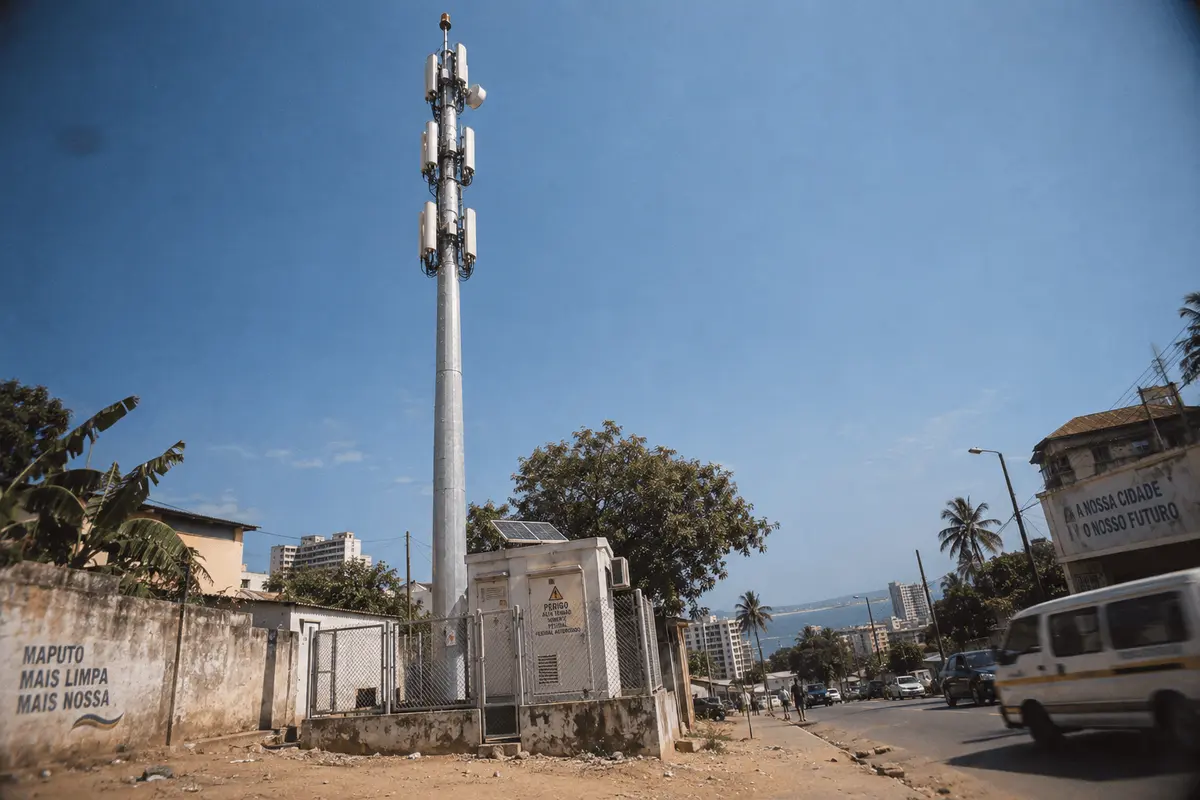
Maputo’s Telecom Tower specification is driven by a coastal capital of about 1.13 million people, humid salt air, dense traffic corridors, and uneven national connectivity.
Maputo sits on the Indian Ocean at approximately -25.97 latitude and 32.57 longitude, making corrosion control a first-order engineering issue rather than a cosmetic preference. According to Mozambique’s Conselho Nacional de Combate ao SIDA using INE census/projection data (2023), Maputo City has about 1,133,235 inhabitants. That population is concentrated in a coastal municipality where rooftops, road medians, port logistics, and established neighborhoods compete for radio sites.
The city’s climate supports year-round telecom demand but increases asset stress. According to Timeanddate climate normals for Maputo/Mavalane (1992-2021), annual mean temperature is about 75°F, humidity averages about 72%, and January rainfall averages about 5.94 inches. For towers, that means galvanized steel, sealed cable routing, stainless fastener strategy, and grounding inspections matter more than in dry inland markets.
Telecom demand is also shaped by Mozambique’s national digital gap. According to DataReportal and GSMA Intelligence (2023), Mozambique had 16.72 million cellular mobile connections at the start of 2023, equal to about 50.0% of population. According to ITU (2023), Africa had 48 mobile-broadband subscriptions per 100 inhabitants, far below the Americas at 116 per 100. ITU states, "Mobile-broadband subscriptions grew by 27 per cent," showing demand is rising even where coverage quality remains uneven.
Maputo is better connected than rural Mozambique, but capacity pressure is still visible in regulator testing. According to INCM (2023), 4G download averages in national drive tests reached 26.57 Mbps for Vodacom, 11.47 Mbps for Tmcel, and 9.37 Mbps for Movitel. INCM also reported that 4G coverage targets were met in 77% of tested areas by Vodacom, 71% by Movitel, and 55% by Tmcel, confirming that urban densification and backhaul resilience remain buyer concerns.
The power and permitting context also affects tower configuration. Mozambique commonly uses 230V, 50Hz low-voltage service, while national distribution networks use voltage classes such as 11kV, 22kV, and 33kV, with EDM as the utility and ARENE as the electricity regulator. According to the World Bank (2025), Mozambique’s electricity access rose from 31% in 2018 to 60% by the end of 2024, but telecom sites still need grounding, lightning protection, and battery-ready power cabinets because outages and voltage variation can affect uptime.
Logistically, Maputo has advantages and constraints. The Port of Maputo allows import staging for CKD steel sections, but Baixa streets, port-adjacent traffic, and low-lying flood-prone areas can restrict crane access and delivery windows. A SOLARTODO Telecom Tower package should therefore prioritize flanged sectional design, smaller transport modules, and foundation drawings that can be adjusted after soil investigation.
Recommended Technical Configuration
A typical 19-unit deployment of this Maputo profile would use 30m steel monopoles in the 25-35m suburban/residential size class.
The correct engineering match is the 25-35m Telecom Tower class: 2 platforms, 6-9 panel antennas, and 15-22t per tower. Maputo does not require 45-55m rural wide-coverage towers for every macro site because the city has dense neighborhoods, coastal road corridors, and many shorter inter-site distances. A 30m pole gives enough elevation for regional macro coverage while keeping visual impact, foundation demand, and erection logistics manageable.
The recommended SOLARTODO configuration is approximately 19 units × 30m tapered steel monopole tower, not lattice, not FRP, and not joint-use power infrastructure. Each tower uses hot-dip galvanized Q345 steel, flanged bolt-on sections, and a high-corrosion coastal specification. The antenna loading should be 9 panel antennas, 1 microwave dish, and 6 RRUs, making it suitable for 4G/5G urban capacity and microwave backhaul where fiber is not immediately available.
Wind design should use wind class 3: 60m/s with a 1.35 factor under TIA-222-H. That is appropriate for a coastal capital exposed to storms and open marine winds. The foundation recommendation is a drilled concrete pier foundation, because pier foundations reduce footprint in urban plots and are easier to adapt to site-specific soil investigations than a broad pad in constrained streets.
For procurement teams comparing product fit, the key decision is whether the tower is treated as a corrosion-critical telecom asset rather than a generic steel pole. SOLARTODO should specify Q345 steel, full hot-dip galvanizing, grounding, lightning rod, safety cage, climbing ladder, cable tray, aircraft warning light, and 2 antenna platforms. The target design life is 30 years, with factory production planned at 30-45 days before shipping and site works.
Technical Specifications
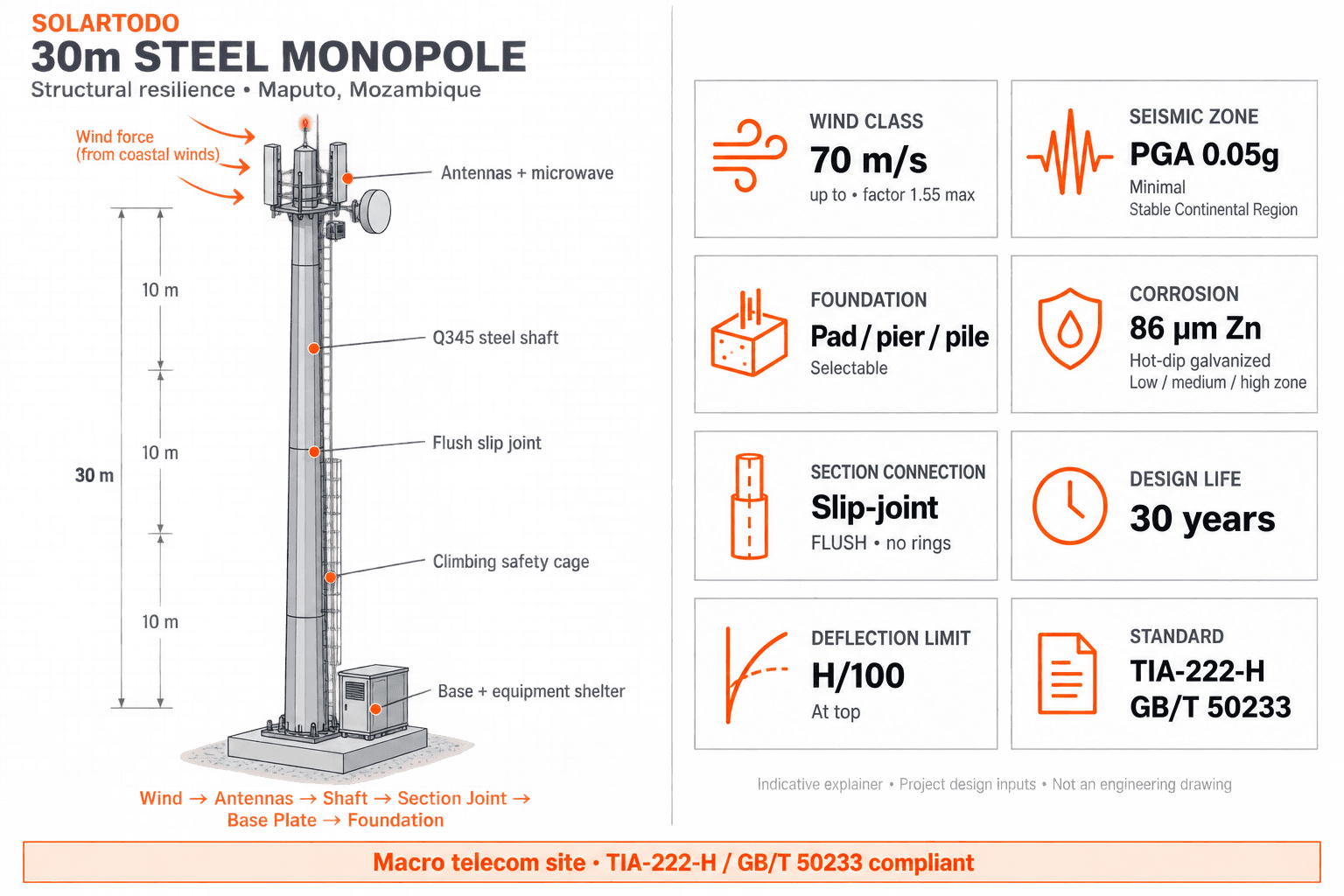
The Maputo recommendation is a 30m, 15t Q345 galvanized steel Telecom Tower with 9 panels, 1 microwave dish, 6 RRUs, and 60m/s wind design.
- Product form: tapered round or octagonal steel monopole, not lattice and not FRP.
- Quantity basis: approximately 19 units for a typical Maputo regional macro deployment profile.
- Height class: 30m, within the 25-35m suburban/residential class.
- Size class rule: 2 platforms, 6-9 panel antennas, and 15-22t per tower.
- Weight rule: approximately 15t per tower, calculated as 500kg/m × 30m.
- Steel material: hot-dip galvanized Q345 steel, with Q420 available for higher stress sections if engineering requires.
- Antenna load: 9 panel antennas, 1 microwave dish, and 6 RRUs.
- Wind class: class 3, 60m/s, factor 1.35, designed with TIA-222-H reference practice.
- Foundation: drilled concrete pier foundation, subject to geotechnical confirmation.
- Connection system: flanged bolt-on sectional design for CKD packing and controlled erection.
- Accessories: climbing ladder, cable tray, aircraft warning light, grounding system, lightning rod, 2 antenna platforms, and safety cage.
- Corrosion zone: high, due to Maputo’s coastal humidity and salt exposure.
- Design life: 30 years with periodic inspection and recoating policy.
- Production lead time: 30-45 days after approved drawings and antenna loading confirmation.
- Shipping mode: CKD sections with 60-70% volume reduction for ocean freight efficiency.
- Standards basis: TIA-222-H for telecom structural loading and GB/T 50233 for tower construction reference.
According to TIA-222-H practice, telecom tower design must evaluate wind, appurtenance loading, serviceability, and structural capacity rather than only pole height. For Maputo, the decisive engineering variables are salt corrosion, cyclone-season wind exposure, limited urban laydown areas, and the mix of panel antennas with microwave backhaul. SOLARTODO’s /products/telecom-tower configuration should therefore be reviewed against operator RF plans before final flange thickness, base plate size, and anchor bolt schedule are frozen.
Implementation Approach
A Maputo rollout would typically move through 6 controlled phases: survey, permitting, fabrication, CKD shipping, foundation works, erection, and commissioning.
The first phase is RF and civil survey. Engineers should confirm coordinates, road access, nearby structures, salt exposure, flood history, soil bearing assumptions, and obstruction profiles. In Maputo’s older downtown and port-adjacent corridors, this step should include crane positioning and off-hour delivery planning.
The second phase is design approval and procurement. Tower drawings should lock the 30m height, 15t weight class, 9-panel antenna load, microwave allowance, grounding grid, warning light, and drilled pier foundation concept. Because INCM regulates communications and local municipalities control site permissions, telecom operators or EPC contractors should align documentation early rather than after materials arrive.
The third phase is manufacturing and CKD shipping. SOLARTODO would fabricate hot-dip galvanized Q345 steel sections, trial-check flange alignment, pack anchor bolts and accessories, and ship tower sections in CKD form. The 60-70% volume reduction helps when container planning must absorb port dwell time and inland delivery scheduling.
The fourth phase is civil construction. Contractors drill the pier foundation, set reinforcement cages and anchor templates, pour concrete, and verify curing strength before tower erection. Coastal groundwater and flood-prone lowland conditions should be checked during geotechnical review; a site that looks simple on satellite imagery may require casing, dewatering, or deeper embedment.
The final phase is tower erection and commissioning. Sections are lifted, flange bolts are torqued, ladder and cable tray are installed, antennas are mounted, grounding resistance is tested, and the lightning protection path is verified. Commissioning should include antenna azimuth checks, microwave alignment, RRU cable labeling, warning light operation, and maintenance handover records.
Expected Performance & ROI
A 30m Maputo Telecom Tower should deliver 30-year structural service, faster urban 4G/5G densification, and lease-driven payback without relying on price claims.
Expected performance should be framed around capacity and uptime rather than fabricated deployment outcomes. With 9 panel antennas and 6 RRUs, each 30m tower can support multi-sector macro coverage and future radio upgrades within the approved load envelope. The 1 microwave dish provides backhaul flexibility where fiber availability, road works, or right-of-way delays make wireless backhaul the practical first phase.
According to the World Bank (2022), Mozambique’s internet access more than doubled from 15% to 32% between 2015 and 2021, while more than two-thirds of Mozambicans remained offline. The World Bank states, "Access is a critical piece of this equation," which is directly relevant to passive telecom infrastructure. For Maputo buyers, tower availability is not the only constraint, but it is a prerequisite for denser coverage, better sectorization, and backhaul redundancy.
ROI for a tower owner or neutral-host operator depends on tenancy, ground lease, energy system, civil works, and permitting duration. A conservative model would evaluate one anchor mobile network operator plus later co-location potential, with payback commonly modeled over a multi-year lease term rather than a single equipment purchase cycle. CKD shipping, standardized 30m height, and repeatable pier foundations can improve lifecycle economics by reducing logistics volume, spare-part variation, and engineering rework.
Maintenance planning should assume annual visual inspection, post-storm inspection, grounding checks, bolt torque verification, and corrosion monitoring. In high-corrosion coastal zones, exposed steel edges, ladder attachments, cable tray brackets, and platform interfaces deserve extra inspection. A 30-year design life is realistic only when inspection records and corrective maintenance are treated as part of the asset, not optional paperwork.
Results and Impact
A typical 19-unit Maputo Telecom Tower plan could improve macro-site readiness across 570m of total tower height and about 285t of galvanized steel assets.
The expected impact is a more resilient passive network layer for operators serving Maputo’s residential districts, port activity, business corridors, and peri-urban growth toward Matola. The towers do not create bandwidth alone; radios, spectrum, transmission, and power systems determine service quality. However, the 30m macro platform gives RF planners predictable height, consistent load allowance, and backhaul space across multiple sites.
This configuration also supports procurement discipline. Using one repeated tower class simplifies spares, inspections, foundation templates, bolt schedules, and erection training. For a buyer comparing imported monopoles, the Maputo-specific differentiator is not simply price; it is whether the tower package accounts for salt air, flood-sensitive logistics, 60m/s wind, INCM-regulated telecom expansion, and local power conditions.
Comparison Table
The recommended 30m Maputo Telecom Tower is the balanced option among 25m infill, 35m suburban, and 40m peri-urban macro alternatives.
| Option | Best Fit in Maputo | Antenna Load | Approx. Weight | Foundation | Main Trade-Off |
|---|---|---|---|---|---|
| 25m monopole | Rooftop substitute or tight urban infill | 3-6 panels | ~12.5t | Concrete pad or pier | Lower coverage height, easier streets |
| 30m SOLARTODO recommended | Regional macro and dense residential corridors | 9 panels + 1 microwave + 6 RRUs | ~15t | Drilled concrete pier | Best balance of height, load, and logistics |
| 35m monopole | Wider suburban cells toward Matola approaches | 6-9 panels + microwave | ~17.5t | Pier foundation | More coverage, higher civil demand |
| 40m monopole | Highway/peri-urban edge coverage | 6-9 panels + 1-2 microwave | ~20t | Pier or pile | Better reach, harder urban approvals |
The table shows why the 30m tower is the recommended default. It stays inside the 25-35m class while carrying the specified 9-panel load and keeping the structural weight aligned with the 500kg/m rule. For higher flood-risk or weak-soil plots, the foundation can shift from drilled pier to engineered pile only after geotechnical review.
Pricing & Quotation
SOLARTODO structures Telecom Tower quotations in 3 commercial formats while keeping engineering scope separate from any site-specific civil cost estimate.
SOLARTODO offers three pricing tiers for this product line: FOB Supply (equipment ex-works China), CIF Delivered (including ocean freight and insurance), and EPC Turnkey (fully installed, commissioned, with 1-year warranty). Volume discounts are available for large-scale deployments. Configure your system online for an instant estimate, or request a custom quotation from our engineering team at [email protected].
For Maputo, a quotation should include antenna schedule, wind class, corrosion class, foundation responsibility, delivery term, accessories, and inspection documentation. Buyers should also confirm whether the EPC scope includes geotechnical tests, municipal permits, crane mobilization, RF installation, power connection, and grounding certification. That separation prevents a tower supply price from being confused with a complete commissioned-site budget.
Frequently Asked Questions
These 10 FAQ answers cover 30m tower specification, Maputo corrosion risk, timeline, installation, ROI, EPC scope, maintenance, comparison, warranty, and quotation inputs.
Q1: Why is a 30m Telecom Tower recommended for Maputo? A 30m monopole fits the 25-35m suburban/residential class, which supports 2 platforms, 6-9 panel antennas, and 15-22t tower weight. Maputo needs macro coverage without making every site a tall rural tower. The height is practical for urban streets, port logistics, and residential corridors while still supporting 9 panels, 1 microwave dish, and 6 RRUs.
Q2: Is this a lattice tower or an FRP pole? No. The recommended SOLARTODO product is a tapered steel monopole tower made from hot-dip galvanized Q345 steel. It is not lattice, not FRP, and not a joint-use power pole. The structure uses flanged bolt-on steel sections, which are better suited to CKD shipping, controlled erection, and predictable telecom appurtenance loading.
Q3: What wind rating should be used in Maputo? The project-specific recommendation uses wind class 3: 60m/s with a 1.35 factor under TIA-222-H design practice. Coastal exposure, storm events, and antenna appurtenances make wind loading critical. Final calculations should use the confirmed site category, antenna dimensions, mounting elevations, and local engineering approval requirements before fabrication.
Q4: How long would production and deployment take? Factory production should be planned at 30-45 days after approved drawings, antenna loading, and foundation assumptions are confirmed. Total deployment time also depends on shipping, customs clearance, municipal permits, geotechnical work, concrete curing, crane scheduling, and radio commissioning. In Maputo, dense streets and rainy-season logistics can affect installation windows.
Q5: What maintenance does a coastal Maputo tower need? A high-corrosion coastal tower should receive annual visual inspection, post-storm checks, bolt torque verification, grounding tests, and corrosion review around platforms, ladders, cable trays, and flange interfaces. Hot-dip galvanizing is essential, but maintenance still matters. The 30-year design life assumes documented inspections and timely corrective action.
Q6: How should ROI be evaluated without using equipment price in the article? ROI should be modeled from tenancy, lease duration, co-location potential, uptime targets, logistics savings, and avoided redesigns. A 19-unit standardized 30m program can improve economics by repeating drawings, foundations, accessories, and spare parts. Buyers should compare lifecycle cost and revenue readiness, not only initial tower supply cost.
Q7: What is included in an EPC turnkey scope? A turnkey scope can include site survey, engineering drawings, geotechnical checks, foundation construction, tower erection, accessory installation, grounding, lightning protection, antenna support, and commissioning. Commercial boundaries must be explicit. Power connection, operator radio equipment, permits, and fiber or microwave backhaul may be included or excluded depending on contract responsibility.
Q8: How does the 30m option compare with a 40m tower? A 40m tower can improve highway or peri-urban reach, but it increases wind moment, foundation demand, crane requirements, and approval sensitivity. The 30m option weighs about 15t and fits Maputo’s denser corridors better. For regional macro sites, it offers a practical balance of antenna load, coverage height, and constructability.
Q9: What warranty language is appropriate for this product line? SOLARTODO’s quotation paragraph defines EPC Turnkey as fully installed, commissioned, and supplied with a 1-year warranty. Buyers should request written warranty terms covering steel fabrication, galvanizing workmanship, accessories, and installation scope. Corrosion exclusions, maintenance obligations, and damage from unauthorized antenna additions should be clarified before contract signing.
Q10: What data is needed for a custom quotation? A custom quotation needs target coordinates, tower height, antenna count and weight, microwave dish size, RRU quantity, wind class, corrosion class, foundation preference, access constraints, delivery term, and EPC boundary. For Maputo, include flood risk, salt exposure, road width, crane access, and whether the site connects to 230V/50Hz utility power.
References
These 7 references support the Maputo Telecom Tower analysis with population, climate, telecom, energy access, standards, and regulator context.
- INE / CNCS (2023): Maputo City population projection of 1,133,235 inhabitants based on 2017 census data, https://cncs.gov.mz/conselho-provincial/maputo-cidade/.
- World Bank (2025): Mozambique electricity access rose from 31% in 2018 to 60% by end-2024; ProEnergia connected over 514,000 households, https://www.worldbank.org/en/results/2025/09/02/energy-for-all-accelerating-mozambique-s-pace-towards-universal-energy-access.
- ITU (2023): Africa recorded 48 mobile-broadband subscriptions per 100 inhabitants and global mobile-broadband subscriptions grew 27% in five years, https://www.itu.int/itu-d/reports/statistics/2023/10/10/ff23-subscriptions/.
- INCM (2023): Mozambique telecom QoS drive tests reported 4G download averages of 26.57 Mbps, 11.47 Mbps, and 9.37 Mbps across operators, https://incm.dotcom.co.mz/2025/01/14/resultados-da-afericao-de-qualidade-dos-servicos-prestados-pelas-operadoras-de-telefonia-movel-celular-em-2023/.
- DataReportal / GSMA Intelligence (2023): Mozambique had 16.72 million mobile connections, equal to 50.0% of population, https://datareportal.com/reports/digital-2023-mozambique.
- Timeanddate (1992-2021 normals): Maputo/Mavalane climate averages show 75°F mean temperature, 72% humidity, and January rainfall of 5.94 inches, https://www.timeanddate.com/weather/mozambique/maputo/climate.
- TIA (2017): ANSI/TIA-222-H provides structural standard practice for antenna supporting structures and appurtenance wind loading; GB/T 50233 supports steel tower construction reference practice.
Equipment Deployed
- 19 units × 30m tapered steel monopole Telecom Tower
- ~15t per tower, based on 500kg/m × 30m engineering rule
- Hot-dip galvanized Q345 steel for high-corrosion coastal exposure
- Wind class 3: 60m/s design wind, factor 1.35
- Antenna load: 9× panel antenna + 1× microwave dish + 6× RRU
- Concrete drilled pier foundation, subject to geotechnical confirmation
- 2 antenna platforms with climbing ladder, safety cage, and cable tray
- Aircraft warning light, grounding system, and lightning rod
- Flanged bolt-on sectional design shipped CKD with 60-70% volume reduction
- 30-year design life and 30-45 day production window