Стандарты ГОСТ для lithium iron phosphate систем | SOLARTODO

Cinn Song
Founder & Chief Solutions Architect
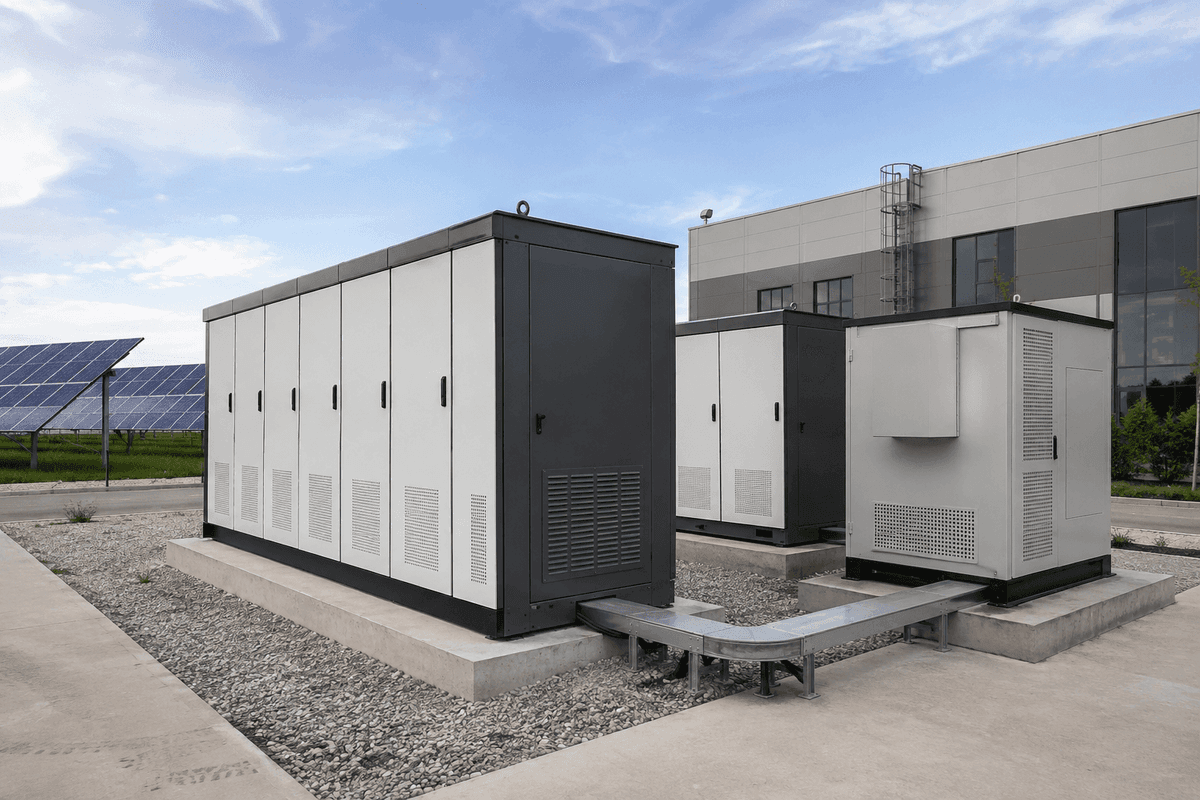
Watch the video
TL;DR
GOST compliance for lithium iron phosphate systems starts with GOST R IEC 62619-2023 for industrial battery safety, then adds GOST R 58092.5.2-2024 and GOST R 58092.5.1-2025 for grid-integrated ESS safety. For 200kWh-1MWh SOLARTODO projects, buyers should request a standards matrix, PCS evidence, fire documentation, and FOB/CIF/EPC pricing before quotation.
GOST compliance for LFP BESS requires GOST R IEC 62619-2023, GOST R 58092.5.2-2024, and grid rules such as IEEE 1547-2018 for 100kW-500kW PCS systems, 200kWh-1MWh capacity, and 6,000+ cycle assets.
Summary
GOST compliance for LFP BESS requires GOST R IEC 62619-2023, GOST R 58092.5.2-2024, and grid rules such as IEEE 1547-2018 for 100kW-500kW PCS systems, 200kWh-1MWh capacity, and 6,000+ cycle assets.
Key Takeaways
For Russian-market LFP projects, buyers should map at least 5 standards before quotation: battery safety, ESS safety, grid interconnection, fire protection, and transport.
- Specify GOST R IEC 62619-2023 for industrial lithium batteries, including stationary telecom, UPS, and electrical energy storage applications.
- Require GOST R 58092.5.2-2024 for grid-integrated electrochemical ESS safety before commissioning any 100kW-500kW PCS project.
- Verify GOST R 58092.5.1-2025 for risk identification and mitigation on all grid-integrated ESS capacities from 200kWh to 1MWh.
- Match IEC 62933-5-2 and IEEE 1547-2018 documentation when importing SOLARTODO BESS equipment for utility or C&I interconnection.
- Budget 3-7 years payback for LFP storage through peak shaving, solar self-consumption, or arbitrage depending on tariff spread.
- Use 6,000+ cycle LFP systems with liquid cooling for 15-year industrial operation and reduced thermal-risk exposure.
- Prepare 30% T/T plus 70% against B/L or 100% L/C at sight for supply contracts, with financing for projects above $1,000K.
- Request FOB, CIF, and EPC turnkey pricing for 50+, 100+, and 250+ unit volumes to capture 5%, 10%, and 15% discount bands.
What GOST Means for Lithium Iron Phosphate Systems
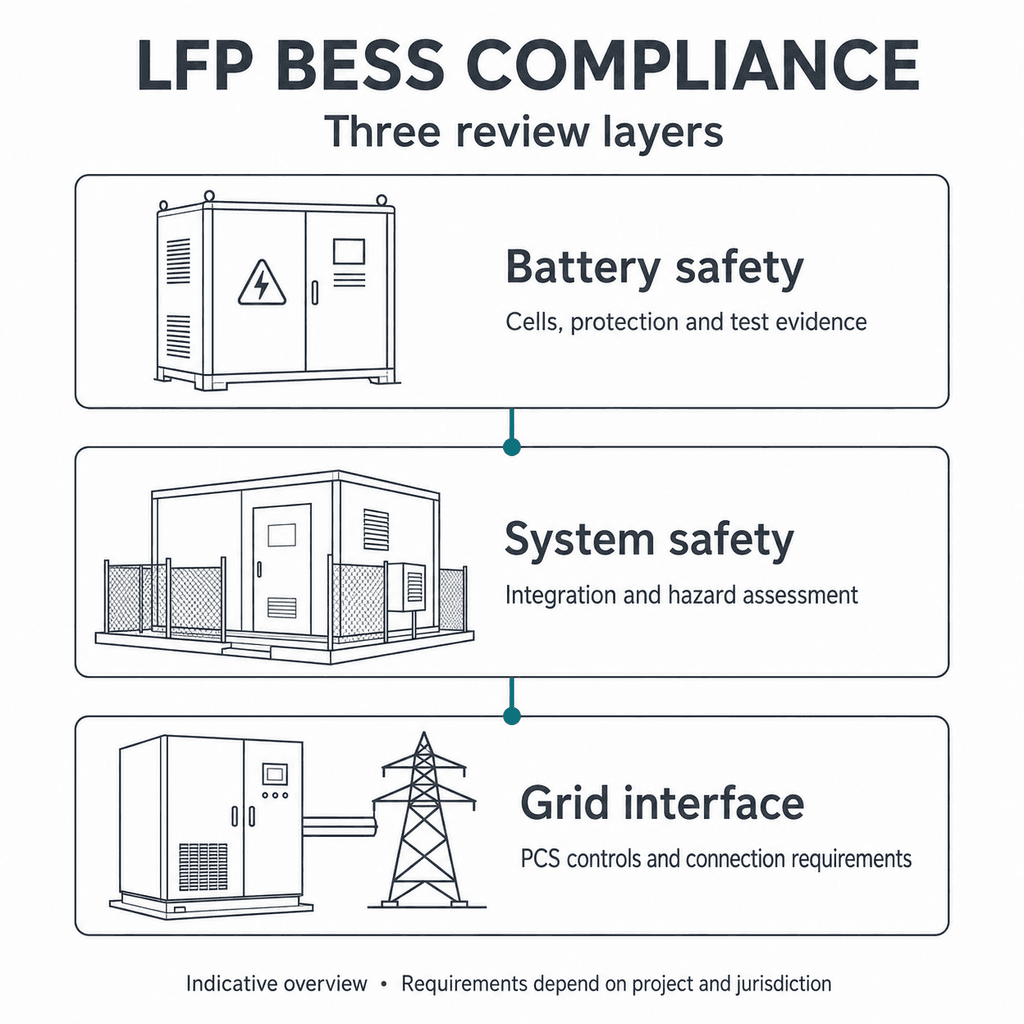
GOST standards define the Russian compliance baseline for LFP battery systems, with GOST R IEC 62619-2023 covering industrial lithium safety from 1 September 2023.
For procurement teams, GOST is not a single certificate; it is a standards framework that connects battery cells, battery modules, battery systems, grid-connected energy storage, transportation, installation, and risk documentation. A lithium iron phosphate system may be technically strong, but it still needs the correct Russian standard mapping before customs clearance, local permitting, insurance review, and grid acceptance.
The most relevant starting point is GOST R IEC 62619-2023, which is identical to IEC 62619:2022 and applies to secondary lithium cells and batteries for industrial applications. Rosstandart lists stationary applications such as telecommunication, UPS, backup power, and electrical energy storage systems under its scope. For SOLARTODO, this standard is directly relevant to 200kWh, 500kWh, and 1MWh LFP BESS configurations supplied for C&I facilities.
GOST R 58092.1-2021 provides the terminology layer for electrical energy storage systems, while GOST R 58092.5.2-2024 applies to grid-connected electrical energy storage systems using electrochemical subsystems. From 1 January 2025, this standard became a key safety reference for grid-integrated BESS in Russia. GOST R 58092.5.1-2025, effective from 1 June 2026, adds general safety requirements for grid-integrated ESS, including hazard identification, risk assessment, and risk reduction.
According to IEC (2022), IEC 62619 specifies safety requirements and tests for secondary lithium cells and batteries used in industrial applications, including stationary energy storage. IEC states, "stationary applications" include telecom, UPS, and electrical energy storage systems. That scope is important because LFP projects are often procured as complete containers, but compliance evidence is reviewed from the cell level upward.
Technical Compliance Stack for LFP BESS
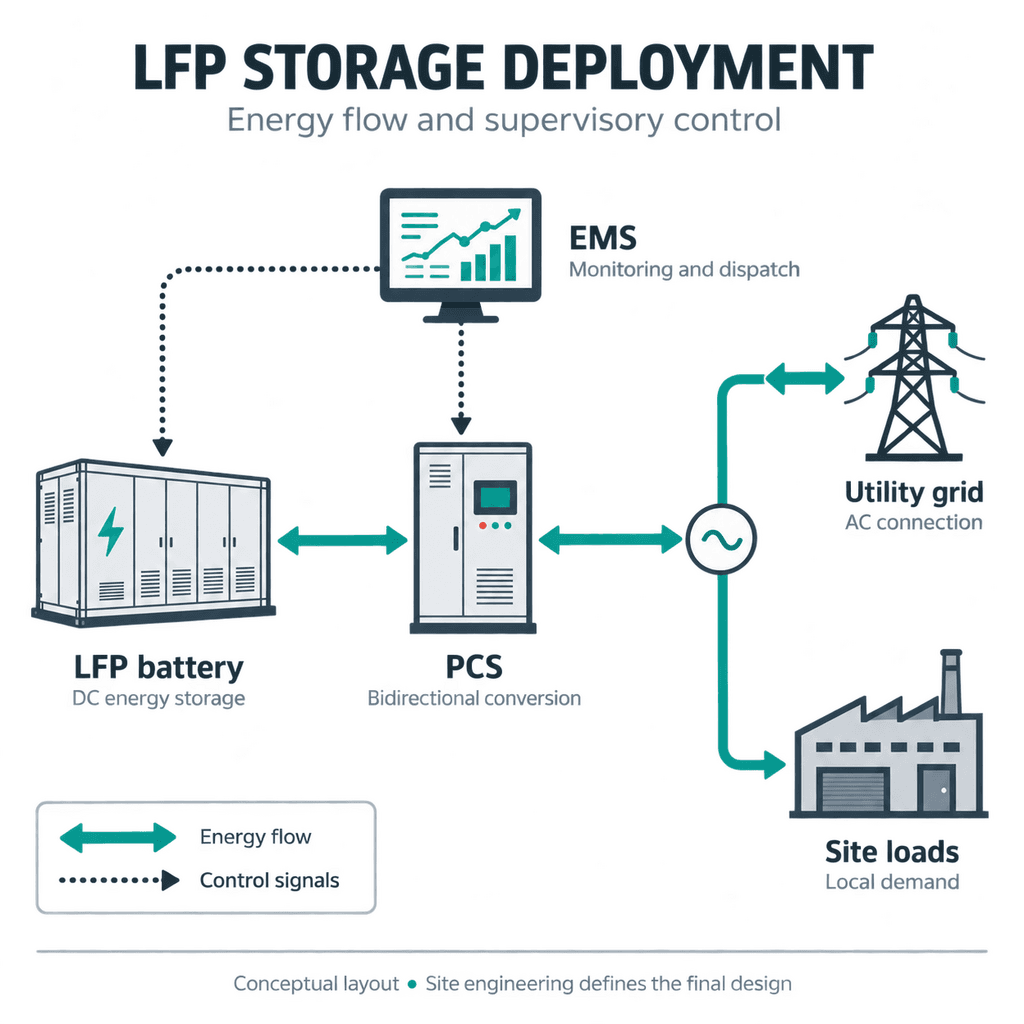
A compliant LFP BESS should align at least 4 layers: cell safety, battery-system safety, grid ESS safety, and site fire-risk control.
At the cell and battery level, GOST R IEC 62619-2023 is the primary Russian standard for industrial lithium batteries. It covers minimum safety requirements and test methods for first intended use. For buyers, the practical documentation package should include cell chemistry declaration, module configuration, BMS protection logic, fault testing evidence, short-circuit protection, overcharge protection, thermal monitoring, and battery-system drawings.
At the energy-storage-system level, GOST R 58092.5.2-2024 corresponds to IEC 62933-5-2:2020 and focuses on grid-integrated EES systems with electrochemical storage. IEC (2020) describes IEC 62933-5-2 as addressing safety for people, surroundings, and living beings in grid-connected electrochemical storage systems. This is the layer where PCS behavior, isolation, emergency shutdown, ventilation, environmental exposure, access control, and operating procedures become central.
At the interconnection layer, Russian project owners commonly compare local grid requirements with IEEE 1547-2018, especially when evaluating imported PCS and inverter functions. IEEE (2018) states that IEEE 1547 covers performance, operation, testing, safety, maintenance, power quality, abnormal conditions, and islanding for distributed energy resources. For a 250kW or 500kW PCS, this means the compliance review must include voltage and frequency ride-through, anti-islanding, protection settings, communications, and commissioning test records.
Fire and installation documentation should reference both local Russian fire rules and internationally recognized ESS safety frameworks. NFPA 855 is not a Russian GOST standard, but it is frequently used as a technical benchmark for stationary ESS hazard mitigation. NFPA lists 2026, 2023, and 2020 editions of NFPA 855 for stationary energy storage systems, while UL 9540 and UL 9540A are commonly requested by insurers and financiers for containerized BESS projects.
SOLARTODO LFP systems are designed around prismatic LFP cells, BMS supervision, bidirectional PCS, and liquid thermal management. The 200kWh system pairs 100kW continuous output with 6,000+ cycle life, while the 500kWh system pairs 250kW continuous power with peak shaving capability around 200kW. The 1MWh container scales to 500kW continuous power for high-throughput C&I arbitrage.
Applications and Procurement Use Cases
GOST-aligned LFP systems are most practical for 3 C&I use cases: solar self-consumption, demand-charge control, and backup power.
For industrial self-consumption, a 200kWh LFP BESS can store midday PV surplus and discharge during evening production or peak tariff periods. The commercial value is strongest where export compensation is low and retail electricity rates are high. According to IRENA (2025), utility-scale solar PV reached a global weighted-average LCOE of USD 0.043/kWh in 2024, making solar-plus-storage more attractive for facilities exposed to time-of-use tariffs.
For manufacturing demand-charge control, a 500kWh LFP system can discharge 200kW for about 2.5 hours, reducing the metered peak seen by the utility. This application depends on accurate load data, usually 15-minute interval demand records for at least 12 months. SOLARTODO normally recommends matching the battery dispatch profile to the plant's motors, compressors, chillers, welding lines, or process loads rather than oversizing capacity without tariff evidence.
For arbitrage, a 1MWh LFP container with a 500kW PCS can charge during off-peak periods and discharge during peak-price windows. The economics improve when the peak-to-off-peak spread exceeds about USD 0.10/kWh and when the local interconnection agreement allows predictable dispatch. According to IRENA (2025), battery storage costs declined 93% from 2010 to 2024, falling from USD 2,571/kWh to USD 192/kWh, which materially improves project bankability.
The International Renewable Energy Agency states, "Renewables continued to represent the most cost-competitive source of new electricity generation in 2024." The International Energy Agency has also emphasized that solar PV and battery storage are central to modern power-system flexibility, especially as variable renewable penetration increases. For procurement managers, the implication is clear: GOST compliance should be treated as a bankability requirement, not only a paperwork task.
EPC Investment Analysis and Pricing Structure
EPC delivery for LFP BESS should separate 3 price levels: FOB supply, CIF delivered equipment, and full turnkey construction.
FOB Supply covers factory-tested equipment at the export port. For a SOLARTODO LFP project, this normally includes battery racks or container, BMS, PCS, EMS, HVAC or liquid cooling system, fire detection hardware where specified, basic drawings, packing, and export documentation. FOB is suitable when the buyer has an experienced local EPC, customs broker, and grid consultant.
CIF Delivered adds international freight and insurance to the destination port. This is often the best structure for distributors, utilities, and project developers that want logistics visibility but will still manage inland transport, civil works, lifting, local electrical installation, and permitting themselves. CIF does not usually include site foundations, MV transformer, switchgear integration, grid-study fees, or local authority approvals unless separately quoted.
EPC Turnkey covers Engineering, Procurement, and Construction as an integrated delivery model. For BESS, turnkey scope may include site survey, single-line diagram, foundation design, grounding, MV/LV integration, transformer and switchgear coordination, container placement, cable trenching, SCADA connection, commissioning, performance testing, operator training, and handover documents. EPC is best for 500kWh-1MWh projects where schedule risk, interface risk, and compliance risk are more expensive than the EPC margin.
Volume guidance should be stated early in the RFQ. SOLARTODO can structure indicative pricing with 5% discount for 50+ units, 10% for 100+ units, and 15% for 250+ units, subject to configuration, destination, certification package, and commodity pricing. Standard payment terms are 30% T/T deposit plus 70% against bill of lading, or 100% L/C at sight. Financing is available for large projects above $1,000K, subject to project credit review and documentation.
ROI should be calculated against the avoided alternative, not only against equipment cost. A 500kWh system used for 200kW peak shaving can produce a 3-5 year payback where demand charges are high. A 200kWh system for solar self-consumption often falls in the 5-7 year range, while a 1MWh arbitrage container can reach under 4 years in favorable tariff markets. For quotations, contact [email protected] with load data, grid voltage, location, target capacity, and required GOST or IEC evidence.
Comparison and Selection Guide
The correct LFP BESS choice depends on at least 5 variables: usable kWh, PCS kW, tariff structure, GOST scope, and EPC responsibility.
| Project Need | Typical SOLARTODO Configuration | Relevant Standards | Best Commercial Model | Expected Payback |
|---|---|---|---|---|
| Solar self-consumption | 200kWh / 100kW | GOST R IEC 62619-2023, GOST R 58092.5.2-2024 | FOB or CIF | 5-7 years |
| Manufacturing peak shaving | 500kWh / 250kW | GOST R IEC 62619-2023, IEC 62933-5-2, IEEE 1547-2018 | CIF or EPC | 3-5 years |
| C&I energy arbitrage | 1MWh / 500kW | GOST R 58092.5.1-2025, GOST R 58092.5.2-2024 | EPC Turnkey | Under 4-6 years |
| Telecom backup | 50kWh-200kWh modular LFP | GOST R IEC 62619-2023 | FOB | Site-specific |
| Microgrid resilience | 500kWh-1MWh container | IEC 62619, IEC 62933, IEEE 1547 | EPC Turnkey | 4-7 years |
Procurement teams should ask suppliers for a compliance matrix instead of a generic certificate list. The matrix should map each GOST or IEC clause to a test report, drawing, factory inspection record, software function, or commissioning procedure. This reduces approval delays because the engineer, insurer, and grid reviewer can see how the system satisfies each safety function.
A practical RFQ package should include site voltage, target kWh, required PCS output, maximum fault current, grid connection point, ambient temperature range, installation altitude, fire-safety expectations, monitoring protocol, export destination, warranty target, and expected daily cycles. For GOST-driven projects, ask whether documents are available in Russian or English and whether the test basis is identical, modified, or equivalent to the Russian adoption.
FAQ
GOST questions for LFP BESS usually fall into 10 procurement topics: scope, certification, grid connection, safety, pricing, warranty, and documentation.
Q: What GOST standard applies first to lithium iron phosphate batteries? A: GOST R IEC 62619-2023 is the first standard to check for industrial LFP batteries. It is identical to IEC 62619:2022 and applies to lithium cells, batteries, modules, blocks, and battery systems used in stationary industrial applications such as telecom, UPS, backup power, and electrical energy storage.
Q: Does GOST R IEC 62619-2023 cover a complete containerized BESS? A: It covers the lithium battery safety layer, but not every site-level BESS requirement. A complete containerized BESS also needs ESS-level safety review under GOST R 58092.5.2-2024, interconnection review for the PCS, fire protection review, commissioning records, and installation documentation.
Q: Why is GOST R 58092.5.2-2024 important for LFP systems? A: GOST R 58092.5.2-2024 applies to grid-connected electrical energy storage systems using electrochemical storage subsystems. It is important because it moves the review beyond cells and modules into system safety, user protection, environmental surroundings, grid integration, and operating conditions.
Q: What documents should a buyer request before importing LFP BESS into Russia? A: Buyers should request a standards matrix, IEC or GOST test reports, cell datasheets, BMS protection logic, PCS certificates, single-line drawings, packing list, HS code, transport documents, warranty terms, and commissioning procedure. For 500kWh or 1MWh projects, also request fire-safety and emergency-response documentation.
Q: Are IEC 62619 and GOST R IEC 62619-2023 the same? A: GOST R IEC 62619-2023 is listed as identical to IEC 62619:2022. That helps international suppliers align test evidence, but buyers should still confirm the certificate issuer, language, product model numbers, and whether the tested configuration matches the shipped battery system.
Q: How does GOST compliance affect EPC pricing? A: GOST compliance can increase engineering cost because the EPC must prepare documentation, translate evidence, coordinate approvals, and support inspections. However, it reduces project risk for insurers, utilities, and financiers, especially on 500kWh-1MWh systems where permitting delays can cost more than documentation work.
Q: What is included in SOLARTODO EPC turnkey delivery? A: EPC turnkey delivery can include engineering, procurement, civil works, foundations, electrical installation, PCS integration, monitoring setup, commissioning, operator training, and handover documents. Scope is quoted project by project, because grid voltage, transformer needs, fire requirements, and local permitting vary widely.
Q: What payment terms are typical for SOLARTODO LFP projects? A: Typical payment terms are 30% T/T deposit and 70% against bill of lading, or 100% L/C at sight. Large projects above $1,000K may qualify for financing support, subject to buyer credit, project documentation, destination market, and lender approval.
Q: How long does an industrial LFP BESS usually last? A: Industrial LFP systems are commonly designed for 6,000+ cycles and about 15 years of operation under controlled temperature and cycling conditions. Actual service life depends on depth of discharge, C-rate, ambient temperature, thermal management, maintenance, and whether the EMS prevents abusive operating patterns.
Q: Can one GOST certificate cover 200kWh, 500kWh, and 1MWh systems? A: Not always. Certification evidence must match the product family, electrical architecture, module type, BMS, PCS rating, and enclosure configuration. A 200kWh cabinet and a 1MWh container may share cells, but the system-level safety and grid documentation can differ significantly.
References
- Rosstandart GOST R IEC 62619-2023 (2023): Industrial lithium cell and battery safety requirements, identical to IEC 62619:2022, effective 1 September 2023. https://protect.gost.ru/gost/details/32add51d-7b51-4114-8fa4-9c21acbb5a04 — https://webstore.iec.ch/
- IEC 62619:2022 (2022): Safety requirements for secondary lithium cells and batteries for industrial applications, including stationary ESS. https://webstore.iec.ch/en/publication/64073 — https://webstore.iec.ch/
- IEC 62933-5-2:2020 (2020): Safety requirements for grid-integrated electrical energy storage systems using electrochemical storage subsystems. https://webstore.iec.ch/en/publication/32177 — https://webstore.iec.ch/
- IEEE 1547-2018 (2018): Interconnection and interoperability standard for distributed energy resources connected to electric power systems. https://standards.ieee.org/ieee/1547/5915/ — https://standards.ieee.org/ieee/1547/7382/
- IRENA Renewable Power Generation Costs in 2024 (2025): Reports USD 0.043/kWh global solar PV LCOE and 93% battery storage cost decline from 2010 to 2024. https://www.irena.org/Publications/2025/Jun/Renewable-Power-Generation-Costs-in-2024 — https://www.irena.org/Data/View-data-by-topic/Capacity-and-Generation These 8 references establish the standards baseline for LFP BESS procurement, from GOST adoption dates to IEC, IEEE, NFPA, UL, and IRENA market data.
- Rosstandart (2023): GOST R IEC 62619-2023, industrial lithium cell and battery safety requirements, effective 1 September 2023. https://protect.gost.ru/gost/details/32add51d-7b51-4114-8fa4-9c21acbb5a04
- Rosstandart (2024): GOST R 58092.5.2-2024, grid-integrated EES safety requirements for electrochemical storage systems, effective 1 January 2025. https://protect.gost.ru/gost/details/7a084e09-8d5e-4aee-87cd-0a5a66bb9c31
- Rosstandart (2025): GOST R 58092.5.1-2025, general safety specification for grid-integrated EES systems, effective 1 June 2026. https://protect.gost.ru/gost/details/ff6ac569-3fb9-49e6-82af-55ecd91718ec
- IEC (2022): IEC 62619:2022, safety requirements for secondary lithium cells and batteries for industrial applications. https://webstore.iec.ch/en/publication/64073
- IEC (2020): IEC 62933-5-2:2020, safety requirements for grid-integrated EES systems using electrochemical storage. https://webstore.iec.ch/en/publication/32177
- IEEE (2018): IEEE 1547-2018, interconnection and interoperability requirements for distributed energy resources. https://standards.ieee.org/ieee/1547/5915/
- NFPA (2026): NFPA 855, Standard for the Installation of Stationary Energy Storage Systems, listed with 2026, 2023, and 2020 editions. https://link.nfpa.org/all-publications/655/2012
- IRENA (2025): Renewable Power Generation Costs in 2024, reporting USD 0.043/kWh solar PV LCOE and 93% battery storage cost decline since 2010. https://www.irena.org/Publications/2025/Jun/Renewable-Power-Generation-Costs-in-2024
Conclusion
GOST-ready LFP BESS procurement should combine 3 evidence sets: GOST battery safety, grid-integrated ESS safety, and bankable IEC/IEEE/UL documentation.
Bottom line: for 200kWh-1MWh commercial and industrial storage, SOLARTODO recommends mapping GOST R IEC 62619-2023, GOST R 58092.5.2-2024, and GOST R 58092.5.1-2025 before final quotation, then selecting FOB, CIF, or EPC delivery based on local approval risk.
About SOLARTODO
SOLARTODO is a global integrated solution provider specializing in solar power generation systems, energy-storage products, smart street-lighting and solar street-lighting, intelligent security & IoT linkage systems, power transmission towers, telecom communication towers, and smart-agriculture solutions for worldwide B2B customers.
Procurement paths
About the Author

Cinn Song
Founder & Chief Solutions Architect
Cinn Song founded SOLARTODO LIMITED and leads its smart-city infrastructure engineering — from solar, storage and integrated smart poles to the company's push into physical-AI city edge nodes: pole-mounted edge computing, vertical LLMs for smart cities, drone-based O&M with autonomous battery swapping, robotic maintenance, and high-speed counter-UAS interception. Since 2010, he has directed turnkey EPC + BOT delivery across 50+ countries, including telecom monopole supply for national grid operators, off-grid solar street-lighting for African municipalities, and integrated smart-pole programs for Gulf smart cities.
Cite This Article
Cinn Song. (2026). Стандарты ГОСТ для lithium iron phosphate систем | SOLARTODO. SOLARTODO. Retrieved from https://solartodo.com/knowledge/lithium-iron-phosphate
@article{solartodo_lithium_iron_phosphate,
  title = {Стандарты ГОСТ для lithium iron phosphate систем | SOLARTODO},
  author = {Cinn Song},
  journal = {SOLARTODO Knowledge Base},
  year = {2026},
  url = {https://solartodo.com/knowledge/lithium-iron-phosphate},
  note = {Accessed: 2026-09-06}
}
Published: September 6, 2026 | Available at: https://solartodo.com/knowledge/lithium-iron-phosphate
Subscribe to Our Newsletter
Get the latest solar energy news and insights delivered to your inbox.
View All Articles