Licitaciones de Energía Renovable en Chile: Guía para…

Cinn Song
Founder & Chief Solutions Architect
Watch the video
TL;DR
Chile renewable energy tenders favor smart poles that prove efficiency, durability, and lifecycle value. A SOLARTODO 9 m or 10 m pole can combine 120 W LED lighting, IP66 protection, 150 km/h wind resistance, cameras, sensors, WiFi, and display modules, with FOB, CIF, or EPC turnkey pricing and financing review for projects above US$1,000K.
Chile renewable energy tenders increasingly reward integrated smart poles that combine 120 W LED lighting, IP66 protection, 150 km/h wind resistance, sensors, WiFi, and optional solar or grid power for municipal, mining, port, and highway projects.
Summary
Chile renewable energy tenders increasingly reward integrated smart poles that combine 120 W LED lighting, IP66 protection, 150 km/h wind resistance, sensors, WiFi, and optional solar or grid power for municipal, mining, port, and highway projects.
Key Takeaways
Tender teams in Chile should treat smart poles as 6-in-1 infrastructure assets, not only lighting products, because 1 pole can consolidate up to 6 municipal functions.
- Define 6-in-1 scope clearly with 120 W LED lighting, 4K camera, environmental sensors, WiFi, display, and IP audio before pricing.
- Specify IP66 enclosures, hot-dip galvanized steel, and more than 150 km/h wind resistance for coastal, desert, and seismic Chilean sites.
- Compare FOB, CIF, and EPC turnkey bids because installation, foundations, grid connection, and commissioning can change total cost by 25-45%.
- Use 50+, 100+, and 250+ pole volume tiers to request 5%, 10%, and 15% supply discounts in municipal framework purchases.
- Calculate ROI against 250-400 W HID lighting; 120 W LED systems can cut connected lighting load by about 52-70% before controls.
- Require IEC 60598-1:2024 luminaire safety evidence and ASTM A123/A123M-24 galvanizing compliance for long service life.
- Align bid language with ChileCompra procedures, where about 850 public entities use Mercado Público for transparent procurement.
- Include remote monitoring and maintenance SLAs because networked lighting can reduce outage response time by more than 20%.
Chile Renewable Tender Context for Smart Poles
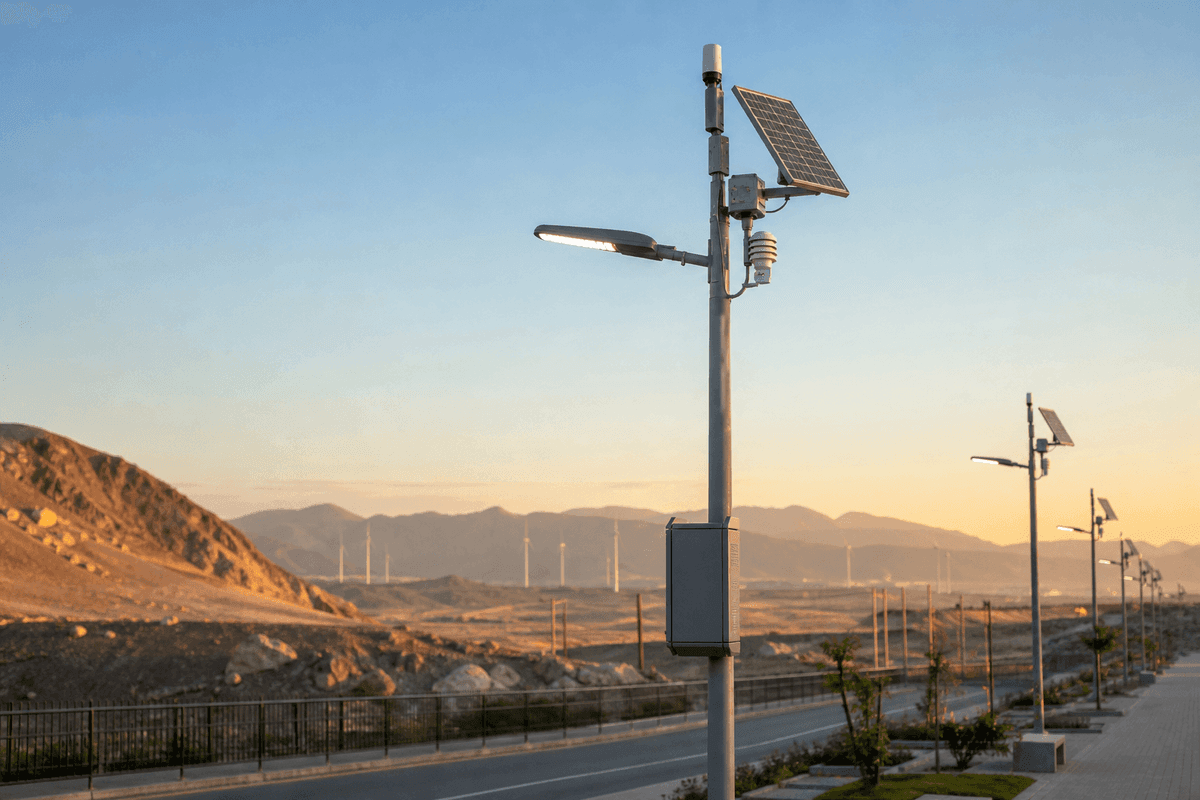
Chile smart pole tenders are strongest when they connect 2050 carbon-neutral policy, 2026 energy efficiency planning, and 6-in-1 public infrastructure value in one technical proposal.
Chile is one of Latin America’s most active renewable energy markets, and municipal infrastructure tenders increasingly reflect the same policy direction. The Biblioteca del Congreso Nacional reports that Law 21,455 established Chile’s climate framework with the objective of reaching and maintaining greenhouse gas neutrality by 2050. For smart pole bidders, this means proposals should quantify energy savings, resilience, public safety, and digital monitoring instead of presenting a conventional lighting bill of materials.
According to ChileCompra, approximately 850 public entities use Mercado Público for state procurement, making it the central discovery platform for municipalities, ministries, universities, hospitals, and public agencies. The practical implication is simple: suppliers must prepare Spanish-language administrative documents, technical annexes, bid guarantees when required, and traceable compliance matrices, even when the final technical article or export documentation is in English.
Chile’s grid is already moving quickly toward renewable electricity. According to the Coordinador Eléctrico Nacional (2025), solar and wind supplied close to 38% of total energy injected into the National Electric System during 2025, and total renewable generation reached about two-thirds of electricity. The same source reported that solar and wind met up to 79% of demand during some hours, reinforcing the value of electric infrastructure that can operate with clean power and support distributed sensing.
The International Energy Agency states, “Chile has remarkable renewable and critical mineral resources.” This is directly relevant to smart pole tenders because mining regions, logistics corridors, industrial parks, ports, and municipalities need infrastructure that supports electrification without adding clutter. SOLARTODO should therefore position smart poles as renewable-compatible urban nodes that improve lighting efficiency, communications coverage, security, and environmental visibility from one foundation.
Technical Specification Strategy for Smart Pole Bids
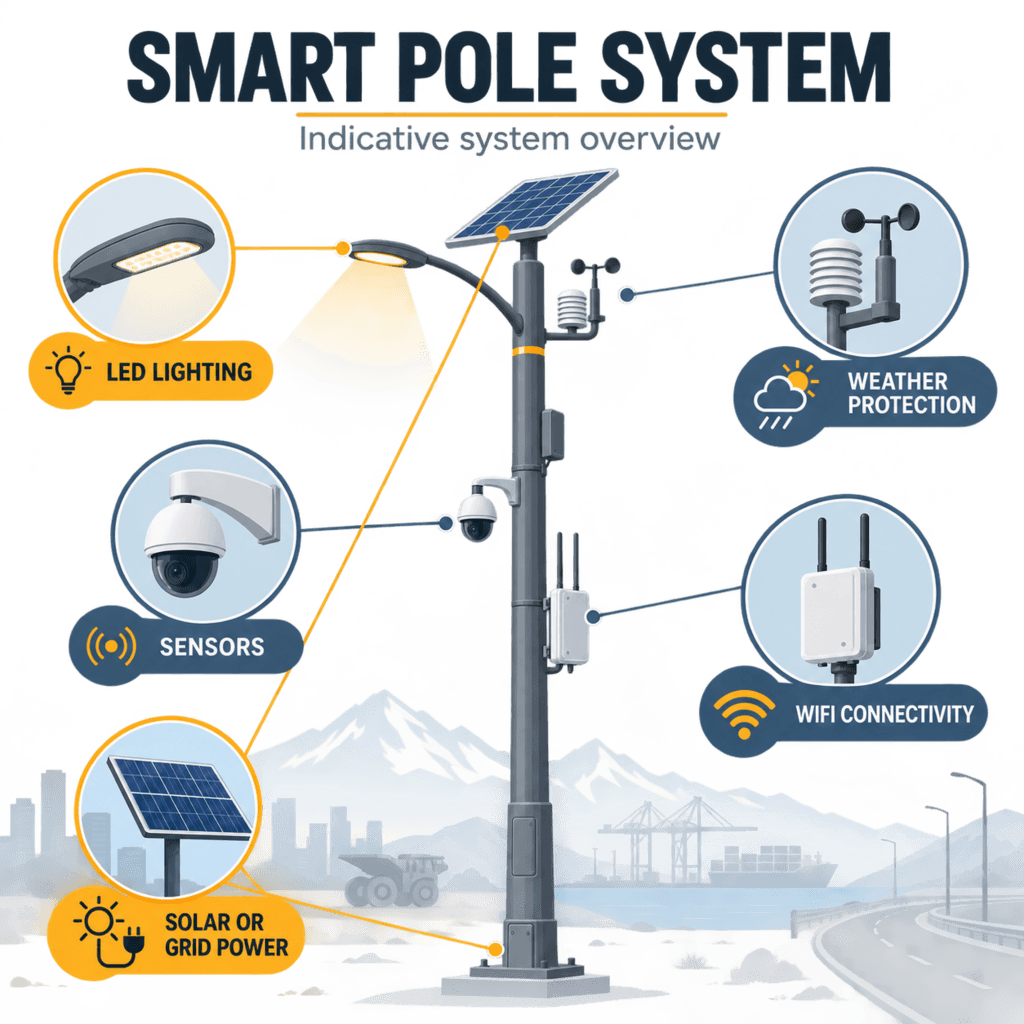
A Chile-ready smart pole specification should combine 120 W LED output, 170 lm/W efficacy, IP66 protection, and 25-year galvanized steel durability.
The baseline SOLARTODO smart pole configuration for Chilean tenders should be a 9 m or 10 m octagonal tapered steel pole with integrated LED lighting, camera surveillance, environmental monitoring, communication modules, and optional digital display. A 9 m commercial-street version typically uses a 120 W LED luminaire producing about 20,400 lumens at 170 lm/W, with recommended spacing near 28 m depending on road width, pole setback, and photometric target.
For coastal Chile, northern desert corridors, and high-wind sites, structural durability is not optional. SOLARTODO should specify Q235 or Q355 steel, hot-dip galvanizing, fluorocarbon coating, wind resistance above 150 km/h, and project-specific foundation calculations. ASTM International (2024) defines ASTM A123/A123M-24 for zinc hot-dip galvanized coatings on iron and steel products, making it a strong reference for corrosion protection in port, highway, and coastal municipality bids.
Lighting safety and performance evidence should be explicit. IEC 60598-1:2024 covers general safety requirements and tests for luminaires operating at supply voltages up to 1,000 V, while IEC 62722-2-1:2014 addresses particular performance requirements for LED luminaires. A compliant tender submittal should include luminaire test reports, ingress protection rating, surge protection design, earthing method, driver specifications, and photometric files when requested.
The U.S. Department of Energy states, “connected lighting systems can monitor and report their own energy use.” That short point matters in Chile because many streetlighting assets are still billed, maintained, or inspected through fragmented workflows. Networked controllers help municipalities verify consumption, identify failures, schedule dimming, and build stronger evidence for energy efficiency reporting.
Typical SOLARTODO tender-ready modules include:
- LED luminaire: 80-180 W options, with 120 W common for 9 m commercial streets.
- Camera: 4K fixed or PTZ model, with optional 20x optical zoom and IR night vision.
- Sensors: PM2.5, PM10, temperature, humidity, noise, O3, NO2, and wind-related data.
- Connectivity: WiFi 6, Ethernet, fiber backhaul, LoRaWAN, 4G, or 5G depending on site policy.
- Display: Outdoor LED information screen, often P4 class for public notices and emergency messages.
- Audio: IP speaker for public announcements, site alerts, or emergency communication.
Tender Evaluation, Compliance, and Selection Guide
A strong Chile tender matrix should score smart poles across 8 factors: compliance, lifecycle cost, energy savings, connectivity, durability, cybersecurity, warranty, and EPC readiness.
Procurement teams often compare smart poles incorrectly by using only unit price. For Chilean renewable energy and infrastructure tenders, total evaluated cost should include logistics, import duties, local installation, foundation works, grid connection, commissioning, remote platform setup, warranty response, and spare parts availability. This is especially important for projects in Antofagasta, Atacama, Valparaíso, Biobío, Los Lagos, and Magallanes, where environmental exposure and logistics can materially affect lifecycle cost.
According to the Ministry of Energy of Chile (2021-2026 plan), national energy efficiency measures are expected to reduce energy intensity by 10% by 2030 and generate accumulated savings of US$15.2 billion. Smart pole proposals should translate this national objective into project-level numbers: lower watts per pole, adaptive dimming, reduced site visits, consolidated assets, and measurable service continuity.
| Evaluation Factor | Conventional Streetlight | SOLARTODO Smart Pole Bid Position |
|---|---|---|
| Typical lighting load | 250-400 W HID | 120 W LED at about 20,400 lm |
| Asset functions | 1 lighting function | 6-in-1 or 10-in-1 integrated platform |
| Protection level | Often IP54-IP65 | IP66 recommended for outdoor electronics |
| Wind design | Project dependent | More than 150 km/h available |
| Maintenance points | 3-6 separate assets | 1 pole location and 1 asset ID |
| Data capability | Manual inspection | Remote monitoring and alerts |
| Procurement model | Supply only | FOB, CIF, or EPC turnkey |
| Best use case | Basic illumination | Smart city, port, campus, mining, highways |
For public procurement, compliance documentation should be packaged like an engineering dossier rather than a sales brochure. Recommended annexes include a product datasheet, structural drawing, wiring diagram, foundation reference drawing, lighting calculation, warranty terms, installation manual, cybersecurity notes, platform overview, certificate list, and country-of-origin documents. SOLARTODO can support inquiry-to-quotation workflows and adapt technical schedules to the tender’s exact scoring matrix.
Selection should also reflect Chile’s geography. Desert municipalities need dust-resistant enclosures and thermal design up to +55°C. Southern and coastal regions need corrosion protection, water ingress control, and maintenance access planning. Mining roads need higher pole strength, camera analytics, and integration with access control or operations centers. Urban commercial streets usually prioritize aesthetics, pedestrian safety, WiFi, digital notices, and lower visual clutter.
EPC Investment Analysis and Pricing Structure
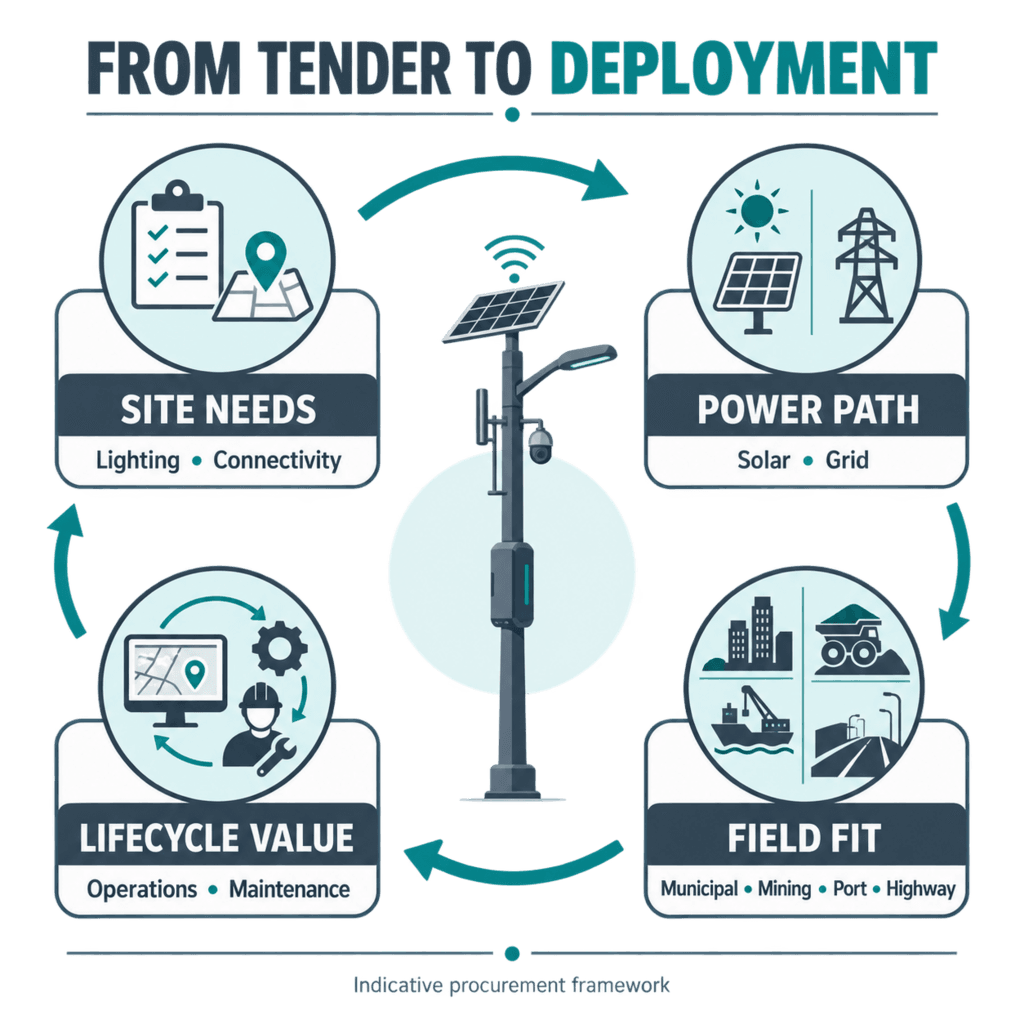
EPC delivery for Chile smart pole projects should separate 3 price layers: FOB supply, CIF delivered, and turnkey installation with 5-15% volume discounts.
A professional EPC proposal covers Engineering, Procurement, and Construction. For smart pole projects, engineering includes lighting layout, foundation assumptions, power architecture, communications design, device schedule, bill of quantities, installation method statement, and commissioning plan. Procurement includes poles, luminaires, cameras, sensors, controllers, displays, cabinets, cables, protection devices, and spare parts. Construction includes civil works, foundations, lifting, wiring, testing, platform activation, and handover training.
SOLARTODO should present pricing in three tiers. FOB Supply covers factory supply from origin port, suitable when the Chilean buyer or EPC contractor controls logistics and installation. CIF Delivered adds sea freight and insurance to a Chilean port such as San Antonio, Valparaíso, or Iquique, depending on project geography. EPC Turnkey adds site survey, foundations, installation, commissioning, testing, documentation, and practical completion handover through local partners or buyer-appointed contractors.
Volume pricing should be transparent for procurement teams. For supply-only orders, a 50+ pole package can target a 5% unit discount, 100+ poles can target 10%, and 250+ poles can target 15%, subject to module mix, display size, camera model, steel price, and delivery schedule. This allows municipalities and developers to compare budget options without forcing an early final configuration.
ROI should compare smart poles against separate infrastructure, not only against a basic lamp post. A 120 W LED luminaire replacing a 250-400 W HID fixture can reduce connected lighting load by roughly 52-70%, and adaptive dimming can add 10-15% further energy reduction in low-traffic hours. If one integrated pole replaces a lighting pole, CCTV mast, display frame, air-quality node, WiFi AP, and speaker point, the buyer may also reduce trenching interfaces by 30-40% and maintenance dispatch locations from 5 assets to 1.
Payment terms for export projects should be stated early: 30% T/T deposit plus 70% against bill of lading, or 100% irrevocable L/C at sight for qualified buyers. Project financing is available for large projects above US$1,000K, subject to credit review, country risk, buyer profile, and bankable contract structure. For a technical quotation, procurement teams can contact [email protected] and include tender ID, quantity, pole height, module list, site city, grid or solar preference, and deadline.
FAQ
Smart pole tender FAQs should answer 10 procurement questions covering scope, price, installation, standards, warranty, and Chile-specific bidding requirements.
Q: What is a smart pole for Chile renewable energy tenders? A: A smart pole is an integrated outdoor infrastructure platform that combines LED lighting with digital services such as cameras, sensors, WiFi, display, and public audio. For Chile, a common SOLARTODO tender configuration is a 9 m or 10 m pole with 120 W LED lighting, IP66 protection, and more than 150 km/h wind resistance.
Q: How does a smart pole support renewable energy procurement? A: A smart pole supports renewable procurement by reducing lighting energy demand and enabling solar-ready or grid-powered smart infrastructure. A 120 W LED luminaire can replace 250-400 W HID fixtures, lowering connected load by about 52-70% before controls. Solar, battery, or hybrid power can be evaluated when the site has good irradiance and limited grid access.
Q: What should an EPC turnkey smart pole package include? A: EPC turnkey delivery should include engineering drawings, lighting calculations, foundation design assumptions, procurement, logistics, installation, wiring, commissioning, testing, and handover training. For Chilean projects, the EPC scope should also define grid connection responsibility, communications backhaul, civil permits, maintenance access, and acceptance tests for each pole location.
Q: How should buyers compare FOB, CIF, and EPC turnkey pricing? A: FOB pricing covers factory supply only, CIF adds freight and insurance to a Chilean port, and EPC turnkey adds site execution and commissioning. Buyers should compare all 3 levels because foundations, lifting equipment, cabling, permits, and local labor can shift final project cost by 25-45% depending on region and site complexity.
Q: What standards should be requested in a smart pole tender? A: Buyers should request IEC 60598-1:2024 for luminaire safety, IEC 62722-2-1:2014 for LED luminaire performance, ASTM A123/A123M-24 for hot-dip galvanizing, and IEEE 802.11ax for WiFi 6. Projects with grid interconnection, batteries, or telecom equipment may require additional local Chilean electrical and communications approvals.
Q: What is the expected payback period for smart poles? A: Lighting-only payback often depends on the avoided cost of replacing 250-400 W HID fixtures with 120 W LEDs and local electricity tariffs. Broader smart pole payback is stronger when 1 pole replaces 5 separate assets, reduces maintenance dispatches, supports advertising or telecom leasing, and enables remote fault detection within a 5-7 year investment model.
Q: How many smart poles are needed for a commercial street? A: Quantity depends on road width, target lux, pole height, arm outreach, and photometric distribution. A 9 m SOLARTODO commercial street pole with a 120 W LED luminaire commonly uses about 28 m spacing, so a 1 km single-side corridor may require roughly 36 poles before intersections, setbacks, and lighting-class adjustments.
Q: Can smart poles be solar powered in Chile? A: Yes, smart poles can be solar powered, grid powered, or hybrid, but module loads determine feasibility. Lighting-only solar poles are easier than 6-in-1 display or 5G poles because cameras, WiFi, displays, and sensors increase daily energy demand. Northern Chile has strong solar potential, while southern sites may require larger batteries or grid backup.
Q: What maintenance is required after installation? A: Maintenance should include quarterly visual inspections, annual electrical checks, lens cleaning where dust is heavy, firmware updates, and verification of cameras, sensors, WiFi, and displays. For IP66 outdoor electronics, buyers should also inspect gaskets, surge protection, grounding, cabinet ventilation, and corrosion points after storms or coastal exposure.
Q: What warranty terms are realistic for smart pole procurement? A: Warranty terms vary by component, but tenders often request separate coverage for the steel pole, LED luminaire, driver, camera, sensors, display, and control platform. A practical structure is 5 years for LED and electrical modules, longer anti-corrosion expectations for hot-dip galvanized steel, and defined spare-part availability for 10 years.
Q: Why choose SOLARTODO for Chile smart pole tenders? A: SOLARTODO is a B2B manufacturer and exporter focused on solar energy, energy storage, smart streetlights, smart poles, telecom towers, and smart infrastructure. For Chile, SOLARTODO can support inquiry-based quotation, configurable 6-in-1 or 10-in-1 designs, FOB/CIF/EPC pricing, and financing review for projects above US$1,000K.
Conclusion
Chile smart pole bids should combine 120 W LED efficiency, IP66 outdoor durability, 150 km/h wind design, and EPC pricing clarity to win renewable infrastructure tenders.
The bottom line: SOLARTODO smart poles are best positioned for Chile when the proposal proves measurable energy savings, integrated public services, lifecycle cost control, and standards-based engineering. For commercial streets, ports, campuses, mining access roads, and municipalities, a 6-in-1 pole can reduce asset fragmentation while supporting Chile’s 2050 carbon-neutrality pathway.
References
- International Energy Agency, Chile 2050 Energy Transition Roadmap (2026): Analysis describing Chile’s renewable electricity progress, investment pathway, and more than 95% low-emissions electricity by 2035 in the APS. — https://www.iea.org/reports/world-energy-outlook-2024
- IEC 60598-1:2024 (2024): International luminaire safety standard covering general requirements and tests for luminaires operating at supply voltages up to 1,000 V. — https://webstore.iec.ch/
- IEC 62722-2-1:2014 (2014): LED luminaire performance standard used to support technical evaluation of outdoor LED lighting equipment. — https://webstore.iec.ch/
- ASTM A123/A123M-24 (2024): Standard specification for zinc hot-dip galvanized coatings on iron and steel products used in durable outdoor smart pole structures. — https://www.astm.org/ Authoritative references for Chile smart pole tenders should combine 2024-2026 standards, official Chile policy, procurement rules, and international energy data.
- ChileCompra (2026): Mercado Público guidance stating that about 850 public entities in Chile use the platform for transparent public procurement opportunities.
- Biblioteca del Congreso Nacional de Chile, Law 21,455 (2022): Framework climate change law establishing Chile’s objective to reach and maintain greenhouse gas neutrality by 2050.
- Coordinador Eléctrico Nacional (2025): Reported solar and wind near 38% of total injected energy in 2025, with renewables reaching about two-thirds of electricity.
- Ministry of Energy of Chile (2022-2026): National Energy Efficiency Plan targeting 10% lower energy intensity by 2030 and US$15.2 billion in accumulated savings.
- IEA (2026): Chile 2050 Energy Transition Roadmap describing close to 70% renewable electricity generation and more than 95% low-emissions electricity by 2035 in the APS.
- IEC 60598-1:2024 (2024): International standard for general safety requirements and tests for luminaires up to 1,000 V supply voltage.
- IEC 62722-2-1:2014 (2014): LED luminaire performance standard used to support technical evaluation of LED streetlighting equipment.
- ASTM A123/A123M-24 (2024): Standard specification for zinc hot-dip galvanized coatings on iron and steel products used in durable outdoor poles.
About SOLARTODO
SOLARTODO is a global integrated solution provider specializing in solar power generation systems, energy-storage products, smart street-lighting and solar street-lighting, intelligent security & IoT linkage systems, power transmission towers, telecom communication towers, and smart-agriculture solutions for worldwide B2B customers.
About the Author

Cinn Song
Founder & Chief Solutions Architect
Cinn Song founded SOLARTODO LIMITED and leads its smart-city infrastructure engineering — from solar, storage and integrated smart poles to the company's push into physical-AI city edge nodes: pole-mounted edge computing, vertical LLMs for smart cities, drone-based O&M with autonomous battery swapping, robotic maintenance, and high-speed counter-UAS interception. Since 2010, he has directed turnkey EPC + BOT delivery across 50+ countries, including telecom monopole supply for national grid operators, off-grid solar street-lighting for African municipalities, and integrated smart-pole programs for Gulf smart cities.
Cite This Article
Cinn Song. (2026). Licitaciones de Energía Renovable en Chile: Guía para…. SOLARTODO. Retrieved from https://solartodo.com/knowledge/licitaciones-de-energa-renovable-en-chile-gua-para-smart-pole
@article{solartodo_licitaciones_de_energa_renovable_en_chile_gua_para_smart_pole,
  title = {Licitaciones de Energía Renovable en Chile: Guía para…},
  author = {Cinn Song},
  journal = {SOLARTODO Knowledge Base},
  year = {2026},
  url = {https://solartodo.com/knowledge/licitaciones-de-energa-renovable-en-chile-gua-para-smart-pole},
  note = {Accessed: 2026-10-19}
}
Published: August 27, 2026 | Available at: https://solartodo.com/knowledge/licitaciones-de-energa-renovable-en-chile-gua-para-smart-pole
Subscribe to Our Newsletter
Get the latest solar energy news and insights delivered to your inbox.
View All Articles