LFP battery storage system manufacturer | SOLARTODO

SOLAR TODO
Solar Energy & Infrastructure Expert Team
Watch the video
TL;DR
An LFP battery storage system manufacturer should be evaluated on complete system integration, not cell supply alone. For B2B projects, the key benchmarks are 200 kWh to 1 MWh capacity, 6,000+ cycles, more than 90% efficiency, and compliance with UL 9540, UL 9540A, IEC 62619, and IEEE 1547. Many industrial peak-shaving projects reach 3-5 year payback when the supplier also provides clear EPC scope, warranty terms, and EMS controls.
LFP battery storage system manufacturers supply 200 kWh to 1 MWh BESS with 6,000+ cycles, 250 kW-class power, and 3-5 year ROI in peak shaving. This article explains technical specs, EPC pricing, safety standards, and how SOLAR TODO fits industrial procurement.
Summary
LFP battery storage system manufacturers supply commercial and utility BESS with 200 kWh to 1 MWh capacity, 6,000+ cycle life, and typical 3-5 year ROI for peak shaving. SOLAR TODO focuses on LFP systems with UL 9540 and IEC 62619 aligned safety for industrial projects.
Key Takeaways
- Select LFP battery storage systems with 6,000+ cycles and 16+ year design life to reduce replacement risk in daily cycling applications.
- Match power-to-energy ratio carefully; a 500 kWh / 250 kW system supports 2-hour discharge and about 200 kW peak shaving for factories.
- Verify compliance with UL 9540, UL 9540A, IEC 62619, and IEEE 1547 before procurement to reduce permitting and interconnection delays.
- Use EPC pricing tiers to compare offers clearly: FOB supply, CIF delivered, and turnkey EPC can shift project cost by 10-25%.
- Target applications with high demand charges first; many industrial sites reach 3-5 year payback when monthly peak demand exceeds 150-200 kW.
- Specify LFP chemistry over NCM for stationary storage where safety, thermal stability, and long cycle life matter more than maximum energy density.
- Plan volume procurement early; orders of 50+ units can reduce pricing by 5%, 100+ by 10%, and 250+ by 15%.
- Require EMS and BMS visibility at cell, rack, and system level so operators can track SOC, SOH, alarms, and round-trip efficiency above 90%.
What Defines an LFP Battery Storage System Manufacturer
An LFP battery storage system manufacturer supplies complete BESS packages from 200 kWh to 1 MWh+ using Lithium Iron Phosphate cells, power conversion systems, BMS, and safety architecture designed for 6,000+ cycles.
For B2B buyers, the manufacturer matters as much as the battery chemistry. A credible supplier does not only assemble cells into cabinets. It controls system integration, thermal management, DC protection, EMS logic, and compliance documents such as UL 9540, UL 9540A, IEC 62619, and grid interface requirements under IEEE 1547. These items directly affect bankability, insurance acceptance, and commissioning time.
SOLAR TODO positions itself in this segment as a manufacturer and exporter focused on commercial and industrial LFP battery storage. Its portfolio covers modular systems from 200 kWh to 500 kWh and containerized solutions up to 1 MWh for peak shaving, backup power, renewable integration, and microgrid support. For procurement teams, that means one supplier can cover standard industrial loads and larger utility-adjacent projects with similar control architecture.
According to the International Energy Agency, battery storage is a critical flexibility resource for grids with growing solar and wind penetration. The International Energy Agency states, "Battery storage will be essential to balance variable renewable electricity generation." That statement matters because manufacturers are no longer selling only backup batteries; they are supplying grid assets with measurable dispatch value in 15-minute to 2-hour duty cycles.
According to NREL (2024), system design, controls, and duty cycle assumptions strongly influence storage economics and degradation. That is why experienced manufacturers publish usable energy, continuous power, operating temperature range, depth of discharge, and warranty throughput instead of only nameplate capacity. A 500 kWh nameplate system with poor thermal control can underperform a properly managed 500 kWh LFP system over 10 years.
Technical Architecture and Performance Criteria
A bankable LFP battery storage system combines 250 kW-class PCS, rack-level BMS, and thermal controls to deliver more than 90% round-trip efficiency and stable operation across 6,000+ cycles.
The technical review should start with chemistry. LFP, also written as Lithium Iron Phosphate or LiFePO4, is widely selected for stationary energy storage because of its thermal stability and long cycle life. Compared with NCM, LFP usually has lower energy density, but stationary projects rarely value compactness more than safety and service life. In industrial yards, substations, and plant rooms, that tradeoff is usually acceptable.
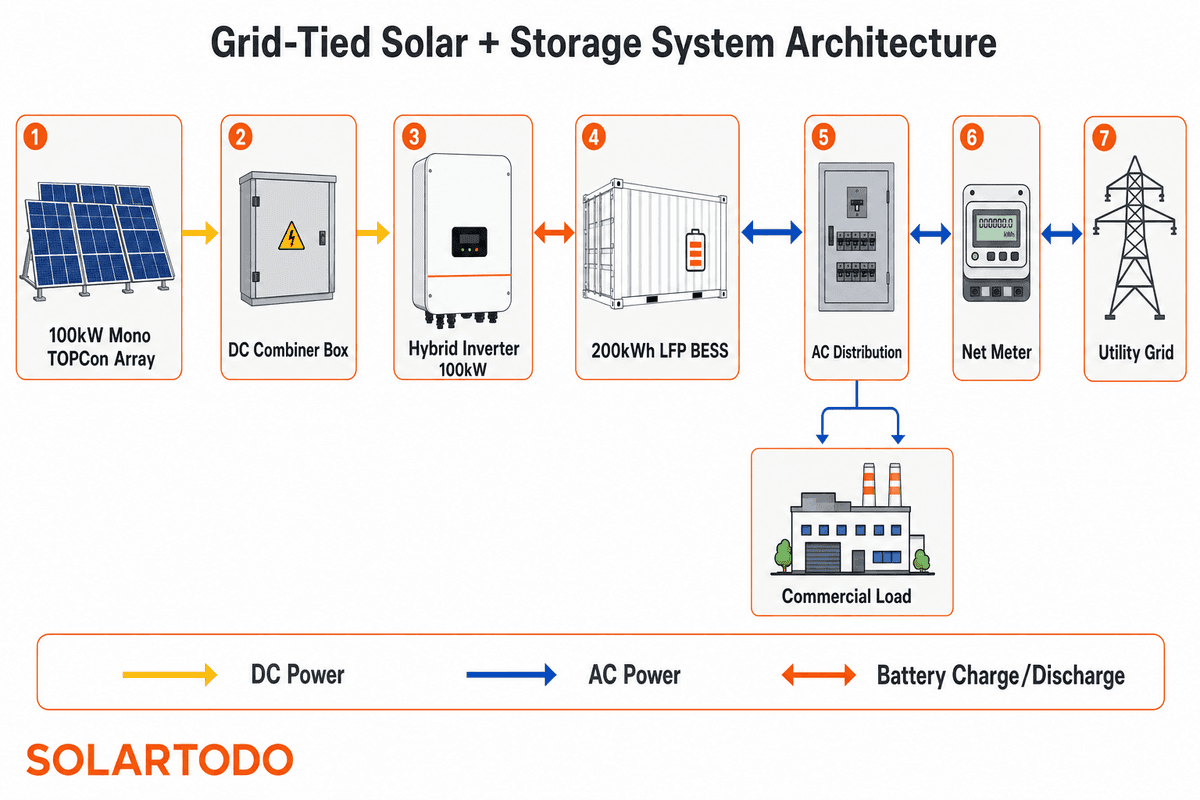
A typical commercial system from SOLAR TODO uses modular battery racks, a battery management system, inverter or PCS, HVAC or forced-air thermal control, fire detection, suppression interface, and an energy management system. In the 500 kWh configuration referenced here, the system provides 500 kWh usable energy and 250 kW continuous power. That 2-hour ratio fits peak shaving, load shifting, and solar self-consumption better than short-duration UPS-only designs.
Core specifications procurement teams should verify
A technical datasheet should define at least 10 core items before RFQ comparison:
- Usable energy capacity: 200 kWh, 500 kWh, or 1 MWh
- Continuous power rating: for example 100 kW, 250 kW, or 500 kW
- Peak shaving capability: for example 200 kW in a 500 kWh industrial setup
- Cell chemistry: LFP only, not mixed chemistry
- Cycle life: 6,000+ cycles at stated depth of discharge
- Round-trip efficiency: typically above 90%
- Ingress protection: often IP54 to IP55 for outdoor enclosures
- Compliance: UL 9540, UL 9540A, IEC 62619, IEC 62477, IEEE 1547 as applicable
- Grid voltage and frequency: such as 400 V, 480 V, 50 Hz, or 60 Hz
- Warranty terms: years, cycles, retained capacity, and throughput limits
Safety documentation needs separate attention. UL 9540 covers the complete energy storage system. UL 9540A covers thermal runaway fire propagation test methods. IEC 62619 addresses safety requirements for secondary lithium cells and batteries for industrial use. If a manufacturer cannot provide these references, the project team will likely face delays with AHJ review, insurer questions, or lender due diligence.
According to IRENA (2024), battery storage costs have continued to decline, but project value still depends heavily on dispatch strategy and utilization. In practice, that means the EMS is not optional. A weak EMS can erase savings even when cell quality is acceptable. Good manufacturers provide logic for demand charge control, time-of-use optimization, generator support, black start, and PV smoothing in one controller.
The U.S. National Renewable Energy Laboratory notes that performance testing and degradation modeling should reflect actual duty cycle rather than generic annual averages. NREL states, "Battery lifetime depends strongly on temperature, depth of discharge, and charge-discharge rates." For buyers, that means warranty review should include operating assumptions such as 25°C reference temperature, 80-90% DoD, and maximum C-rate.
Applications, ROI, and Buyer Selection Criteria
Industrial LFP storage delivers the strongest value where demand charges exceed 20-40% of the electricity bill and peak events last 30-120 minutes.
The first high-value use case is demand charge management. A factory with a monthly peak 200 kW above baseline can use a 500 kWh / 250 kW system to shave that spike without changing production schedules. If the utility tariff penalizes maximum 15-minute demand, even a few discharge events per month can materially reduce operating cost. This is why many manufacturing sites see 3-5 year ROI under stable tariff conditions.
The second use case is solar plus storage. When rooftop or ground-mount PV exports at low compensation rates, an LFP system stores midday excess and discharges during evening production or tariff peaks. According to IEA PVPS (2024), self-consumption strategies become more important as export compensation declines in many markets. For commercial users, storage can increase solar utilization while reducing grid imports during high-price windows.
The third use case is backup and power quality support. LFP systems can support critical loads during outages, transfer events, or generator startup gaps. In telecom, industrial automation, water treatment, and logistics sites, even a 5-minute interruption can create production losses larger than the battery payment. Here, the manufacturer should define transfer logic, autonomy time, and black-start sequence in exact kW and minutes.
Comparison table: what buyers should compare
| Criteria | LFP BESS | NCM BESS | Lead-acid storage |
|---|---|---|---|
| Typical cycle life | 6,000+ cycles | 3,000-5,000 cycles | 500-1,500 cycles |
| Thermal stability | High | Moderate | High |
| Energy density | Moderate | High | Low |
| Best use case | C&I, utility, daily cycling | Space-limited systems | Short backup, low CAPEX |
| Maintenance profile | Low | Low | Higher |
| Typical project focus | Peak shaving, PV shifting, microgrid | Compact installations | Basic backup |
Comparison table: sample SOLAR TODO range
| Model class | Usable energy | Continuous power | Typical use case | Indicative duration |
|---|---|---|---|---|
| Modular C&I | 200 kWh | 100 kW | Small factory, telecom hub | 2 hours |
| Industrial BESS | 500 kWh | 250 kW | Demand charge control | 2 hours |
| Containerized system | 1 MWh | 500 kW | Microgrid, utility support | 2 hours |
Buyer selection should also include manufacturing scope. Some vendors buy third-party cells, third-party PCS, and third-party enclosures, then only relabel the package. Others control integration, testing, and firmware internally. For a 500 kWh to 1 MWh project, the second model usually gives better response on commissioning, spare parts, and warranty claims.
SOLAR TODO should be evaluated on the same basis as any serious manufacturer: documented bill of materials, test protocol, FAT process, communication protocol support such as Modbus TCP/IP, and after-sales response. B2B procurement should request single-line diagrams, protection coordination notes, foundation loads, HVAC power consumption, and communication point lists before award.
EPC Investment Analysis and Pricing Structure
EPC delivery for LFP battery storage typically includes design, procurement, civil and electrical installation, testing, commissioning, and operator training, while pricing usually differs by 10-25% between FOB supply, CIF delivered, and turnkey EPC scope.
For B2B buyers, the most common mistake is comparing incomplete price scopes. A battery cabinet quote is not equal to a commissioned storage plant. The procurement team should separate supply scope from logistics and construction scope before evaluating ROI. This is especially important for projects above 200 kWh, where transformer, switchgear, fire integration, and utility studies can materially change total installed cost.
What EPC turnkey delivery includes
A full EPC package usually includes:
- Load analysis and application sizing
- Single-line diagram and protection design
- Battery system, PCS, EMS, and enclosure supply
- Civil works and equipment foundation
- AC/DC cabling and terminations
- Transformer and switchgear interface
- SCADA or BMS communication integration
- Site testing, commissioning, and operator training
- O&M manuals, spare parts list, and warranty handover
Three-tier pricing explanation
The three procurement tiers below help standardize commercial comparison:
| Pricing tier | Scope included | Best for |
|---|---|---|
| FOB Supply | Factory supply only; buyer handles freight, customs, installation | EPC contractors with local execution teams |
| CIF Delivered | Supply plus ocean freight and insurance to destination port | Importers and distributors |
| EPC Turnkey | Delivered, installed, tested, and commissioned system | End users seeking one contract |
In many markets, CIF pricing can add 5-12% over FOB depending on freight and insurance. Turnkey EPC can add another 10-25% depending on civil work, transformer scope, grid studies, and local labor rates. Those percentages vary by project, but they are useful for first-pass budgeting.
Volume pricing, payment terms, and financing
SOLAR TODO follows standard B2B volume pricing guidance for larger orders:
- 50+ units: 5% discount
- 100+ units: 10% discount
- 250+ units: 15% discount
Typical payment terms are 30% T/T deposit and 70% against B/L, or 100% L/C at sight. For large projects above $1,000K, financing support may be available subject to project review, jurisdiction, and buyer credit profile. Commercial inquiries can be directed to [email protected] or +6585559114.
ROI analysis framework
A simple ROI model should use five inputs: installed cost, demand charge reduction, energy arbitrage benefit, outage loss avoided, and annual O&M. Sample deployment scenario (illustrative): a 500 kWh / 250 kW system reducing 200 kW monthly peaks can often reach 3-5 year payback where tariffs include high demand charges. If backup value and solar self-consumption are added, payback can improve further, but only if actual dispatch frequency supports the model.
Warranty review should cover years, cycles, retained capacity, and response obligations. For example, a 10-year warranty with a throughput cap is not equal to a 10-year warranty with daily cycling assumptions. Procurement teams should request a degradation curve and warranty claim process in writing before PO release.
How to Evaluate a Manufacturer Before Purchase
A qualified LFP battery storage manufacturer should provide at least 8 document sets, including test reports, drawings, warranty terms, and communication maps, before contract award.
Start with technical compliance. Ask for datasheets, GA drawings, single-line diagrams, battery rack architecture, PCS make and model, EMS functions, and protection list. If the supplier only offers a brochure and a price sheet, the project risk is high. For systems from 200 kWh to 1 MWh, document quality often predicts commissioning quality.
Next, review manufacturing and QA process. A serious manufacturer should describe incoming cell inspection, module assembly checks, insulation testing, communication validation, FAT sequence, and packing method. If possible, request FAT witness points such as charge-discharge test, alarm simulation, communication check, and emergency stop verification. These are standard controls, not extras.
Then review service capability. B2B buyers should ask response time for remote diagnosis, spare parts lead time, firmware update process, and field support availability. A low-cost quote can become expensive if a PCS fault takes 8 weeks to resolve. For industrial operations, service SLAs matter almost as much as capex.
Finally, confirm commercial fit. SOLAR TODO is a manufacturer and exporter, not an online marketplace. The process is inquiry, technical clarification, offline quotation, and project execution. That model suits EPC firms, distributors, and end users that need project-level configuration rather than fixed web-store pricing.
FAQ
A practical FAQ should answer sizing, safety, cost, installation, and warranty questions in 40-80 words so procurement teams can compare suppliers quickly.
Q: What does an LFP battery storage system manufacturer actually supply? A: A manufacturer should supply more than battery cells. For commercial projects, the package normally includes LFP battery racks, PCS or inverter, BMS, EMS, enclosure, thermal management, protection devices, drawings, and test documents. For EPC scope, installation, commissioning, and training may also be included.
Q: Why is LFP preferred over NCM for stationary energy storage? A: LFP is preferred in many stationary projects because it offers high thermal stability, long cycle life above 6,000 cycles, and lower fire risk than higher-energy chemistries. For factories and utility sites, those factors usually matter more than compact size. The tradeoff is lower energy density, which is less critical in fixed installations.
Q: What size system is suitable for an industrial facility? A: The right size depends on load profile, demand charge structure, and outage requirements. A 200 kWh / 100 kW system may fit a small site, while a 500 kWh / 250 kW system is common for peak shaving in manufacturing. Facilities with microgrid or renewable integration needs may move to 1 MWh or larger.
Q: How long does an LFP battery storage system last? A: Most commercial LFP systems are specified for 6,000+ cycles under defined operating conditions such as 80-90% depth of discharge and controlled temperature. At 1 cycle per day, that can equal about 16 years of service. Actual life depends on temperature, C-rate, and dispatch strategy.
Q: What certifications should I require before procurement? A: Require system and battery safety documentation relevant to your market. Common references include UL 9540, UL 9540A, IEC 62619, and IEEE 1547 for grid interconnection. Depending on project location, you may also need local utility approvals, fire code review, and enclosure IP ratings such as IP54 or IP55.
Q: What is the typical ROI for an industrial LFP BESS? A: Many industrial projects target 3-5 year payback when demand charges are high and peak events are predictable. ROI improves when one system handles multiple value streams such as peak shaving, solar self-consumption, and backup support. The model should use actual tariff data, not generic savings percentages.
Q: How should I compare FOB, CIF, and EPC pricing? A: Compare pricing only after normalizing scope. FOB covers factory supply, CIF adds freight and insurance to port, and EPC turnkey includes installation and commissioning. For large projects, turnkey cost can be 10-25% above supply-only pricing, but it reduces interface risk between equipment and site works.
Q: What payment terms are common for B2B battery storage orders? A: Standard export terms often use 30% T/T in advance and 70% against B/L, or 100% L/C at sight. For projects above $1,000K, structured financing may be available after technical and credit review. Buyers should also confirm Incoterms, warranty start date, and spare parts scope before signing.
Q: What maintenance does an LFP battery storage system require? A: Maintenance is usually lighter than lead-acid systems, but not zero. Operators should perform periodic inspections of HVAC, filters, terminals, alarms, firmware, and communication logs. A planned inspection every 6-12 months is common, with additional checks after grid faults, site flooding, or high-temperature events.
Q: How long does installation and commissioning take? A: Delivery and commissioning time depends on project size and grid interface scope. A modular 200-500 kWh system can move faster than a containerized 1 MWh project requiring transformer work and utility review. Buyers should separate manufacturing lead time, shipping time, civil readiness, and utility approval in the project schedule.
Q: Can SOLAR TODO support EPC and large project financing? A: Yes, SOLAR TODO supports inquiry-based project development with offline quotation, and financing may be available for projects above $1,000K. The company also provides supply-only and broader project support depending on scope. Commercial contact is [email protected] and phone +6585559114.
Conclusion
For commercial and industrial projects, an LFP battery storage system manufacturer should be judged on 6,000+ cycle life, 200 kWh to 1 MWh system range, and documented compliance such as UL 9540 and IEC 62619.
The bottom line is simple: choose a manufacturer that can prove safety, integration quality, and ROI with real documents, not only a low battery price. For buyers comparing suppliers, SOLAR TODO is relevant where 3-5 year payback, EPC clarity, and scalable LFP storage from 200 kWh to 1 MWh are required.
References
- NREL (2024): Battery lifetime and performance modeling guidance used for storage system evaluation and dispatch assumptions.
- IEA (2024): Global energy storage outlook and the role of batteries in balancing variable renewable generation.
- IRENA (2024): Renewable power and storage cost trends, including battery economics and project value drivers.
- UL (2023): UL 9540 energy storage system safety standard for complete ESS installations.
- UL (2023): UL 9540A test method for evaluating thermal runaway fire propagation in battery energy storage systems.
- IEC (2022): IEC 62619 safety requirements for secondary lithium cells and batteries for industrial applications.
- IEEE (2018): IEEE 1547 standard for interconnection and interoperability of distributed energy resources.
- IEA PVPS (2024): Market and application trends for PV systems, including self-consumption and storage integration.
About SOLARTODO
SOLARTODO is a global integrated solution provider specializing in solar power generation systems, energy-storage products, smart street-lighting and solar street-lighting, intelligent security & IoT linkage systems, power transmission towers, telecom communication towers, and smart-agriculture solutions for worldwide B2B customers.
About the Author

SOLAR TODO
Solar Energy & Infrastructure Expert Team
SOLAR TODO is a professional supplier of solar energy, energy storage, smart lighting, smart agriculture, security systems, communication towers, and power tower equipment.
Our technical team has over 15 years of experience in renewable energy and infrastructure, providing high-quality products and solutions to B2B customers worldwide.
Expertise: PV system design, energy storage optimization, smart lighting integration, smart agriculture monitoring, security system integration, communication and power tower supply.
Cite This Article
SOLAR TODO. (2026). LFP battery storage system manufacturer | SOLARTODO. SOLARTODO. Retrieved from https://solartodo.com/knowledge/lfp-battery-storage-system-manufacturer
@article{solartodo_lfp_battery_storage_system_manufacturer,
  title = {LFP battery storage system manufacturer | SOLARTODO},
  author = {SOLAR TODO},
  journal = {SOLARTODO Knowledge Base},
  year = {2026},
  url = {https://solartodo.com/knowledge/lfp-battery-storage-system-manufacturer},
  note = {Accessed: 2026-06-06}
}
Published: June 6, 2026 | Available at: https://solartodo.com/knowledge/lfp-battery-storage-system-manufacturer
Subscribe to Our Newsletter
Get the latest solar energy news and insights delivered to your inbox.
View All Articles