LFP BESS Design: Battery Selection & C-Rate Standards

SOLARTODO Editorial Team
Solar Energy & Infrastructure Expert Team
Watch the video
TL;DR
For most stationary projects, LFP is selected because it offers 6,000+ cycles, >90% round-trip efficiency, and better thermal stability for daily use. Choose about 0.5C for 2-hour renewable shifting and 1C for 1-hour frequency regulation, then verify compliance with IEC 62933, UL 1973, UL 9540, UL 9540A, and IEEE 1547 before comparing EPC price alone.
LFP Battery Energy Storage System design depends on matching chemistry and C-rate to duty. LFP commonly delivers 6,000+ cycles, >90% efficiency, and supports 0.5C for 2-hour shifting or 1C for 1-hour regulation with sub-100 ms response.
Summary
LFP Battery Energy Storage System design depends on matching cell chemistry, duty cycle, and C-rate to the application. For grid assets, LFP delivers 6,000+ cycles, >90% round-trip efficiency, and sub-100 ms response, but 0.5C, 1C, and hybrid duty require different sizing, thermal, and PCS choices.
Key Takeaways
- Select LFP chemistry when the project needs 6,000+ cycles, 90% depth of discharge, and a 10-year service horizon for daily or high-frequency cycling.
- Match C-rate to duty: use about 0.5C for 2-hour renewable shifting, 1C for 1-hour frequency regulation, and verify PCS power in kW equals battery power demand.
- Size usable energy, not nameplate only; a 10 MW / 10 MWh system at 1C supports fast ancillary services, while 1.5 MW / 3 MWh better fits wind smoothing.
- Control thermal rise with liquid cooling when cycle intensity exceeds 0.5C, because cell temperature spread should typically stay within about 3-5°C for stable life and safety.
- Reserve operating SOC bands, often 40-60% for regulation duty, to keep symmetric up/down dispatch and reduce degradation during AGC operation.
- Verify compliance with IEC 62933, UL 1973, UL 9540, UL 9540A, and IEEE 1547 before procurement to reduce interconnection, safety, and insurance risk.
- Compare EPC pricing in three layers—FOB Supply, CIF Delivered, and EPC Turnkey—and apply volume discounts of 5% at 50+, 10% at 100+, and 15% at 250+ units.
- Calculate ROI against the displaced asset: remote diesel hybrid sites can cut generator runtime by 20% to 45%, while grid regulation assets monetize sub-100 ms response and high availability.
LFP Battery Energy Storage System Design Basics
LFP Battery Energy Storage System design starts by aligning 0.5C to 1C battery capability, 90% depth of discharge, and 6,000+ cycle life with the site’s real dispatch profile.
For B2B buyers, the main design question is not simply battery capacity in kWh. The real question is how much power in kW must be delivered, for how long in hours, at what ambient temperature, and under which grid code or off-grid operating standard. A 1 MW / 2 MWh system and a 1 MW / 1 MWh system may share the same PCS power, but their C-rate, thermal load, revenue model, and degradation path are different.
LFP chemistry is commonly selected because it balances safety, cycle life, and cost better than many high-energy chemistries for stationary use. According to IEA (2024), battery storage deployment continues to expand as grids add more variable renewable generation and require fast-response flexibility. According to NREL (2024), battery systems can provide response in less than 1 second, which is materially faster than conventional thermal reserve assets that may need several minutes.
SOLAR TODO typically discusses LFP Battery Energy Storage System design in three linked layers: cell and rack selection, power conversion and C-rate matching, and full system integration including EMS, cooling, fire protection, and compliance. That structure helps procurement managers compare bids on usable capacity, not just brochure capacity, and helps engineers confirm whether the proposed system can actually meet 0.5C or 1C duty for 10 years.
The International Energy Agency states, "Battery storage is a key technology for today’s power systems and tomorrow’s clean energy transitions." That statement matters because storage value is now tied to measurable performance: response time below 100 ms, round-trip efficiency above 90%, and dispatch accuracy under AGC or hybrid microgrid control.
LFP Battery Selection Criteria
LFP battery selection should prioritize 6,000+ cycles, cell consistency, 90% usable depth of discharge, and thermal behavior at the target 0.5C or 1C operating window.
The first selection parameter is the duty cycle. If the project is daily solar shifting with a 2-hour discharge window, 0.5C is often sufficient. If the project is frequency regulation or fast reserve, 1C may be required because the system must move from idle to full power in less than 100 ms to a few seconds, depending on the grid operator’s control logic and PCS settings.
The second parameter is usable energy versus installed energy. Many buyers ask for 1 MWh, 3 MWh, or 10 MWh, but procurement documents should define whether that means gross DC nameplate or usable AC-delivered energy. For example, a utility asset may need 10,000 kWh usable with auxiliary loads, inverter losses, and SOC reserve included. If those items are ignored, the delivered regulation window can be shorter than planned by 5% to 15%.
Cell Chemistry and Form Factor
LFP cells are selected for stationary storage because they offer strong thermal stability relative to several other lithium-ion chemistries and can support high cycle counts above 6,000 cycles under controlled conditions. Cell format matters. Prismatic LFP cells are common in containerized systems because they simplify rack packing density, busbar routing, and maintenance planning. The battery management system must track cell voltage, module temperature, insulation status, and fault propagation risk.
Cycle Life, SOC Window, and Degradation
Cycle life claims must be tied to temperature, depth of discharge, and C-rate. A 6,000-cycle claim at 25°C and 0.5C is not identical to 6,000 cycles at 35°C and 1C. For regulation projects, operators often keep the battery around 40% to 60% SOC so the system can move power up or down symmetrically. That narrower SOC band can reduce stress, but high-frequency partial cycling still requires careful EMS logic and thermal control.
According to IRENA (2024), battery value improves when storage is matched to the exact service need rather than oversized generically. In practice, that means selecting LFP racks with enough current capability for the intended PCS rating, while avoiding unnecessary oversizing that raises CAPEX without improving revenue.
C-rate Selection Standards and Engineering Rules
C-rate selection should be based on service duration, heat generation, PCS rating, and warranty conditions, with 0.5C common for 2-hour duty and 1C common for 1-hour regulation duty.
C-rate is the ratio of power to energy. A 1C battery can charge or discharge its rated energy in 1 hour. A 0.5C battery takes 2 hours. In BESS procurement, this ratio directly affects cell current, busbar sizing, thermal management, PCS matching, and warranty terms. It is not only a battery parameter; it is a full-system parameter.
For renewable shifting, 0.25C to 0.5C is often used because the objective is energy delivery over 2 to 4 hours. For wind smoothing and short dispatch support, 0.5C is common. For frequency regulation, AGC, and fast reserve, 1C is often selected because the market rewards power response more than long discharge duration. The SOLAR TODO 10MWh Grid Frequency Regulation example follows this logic with 10 MW / 10 MWh at 1C and sub-100 ms response.
Practical C-rate Selection Guide
Use these engineering rules during concept design and bid review:
- 0.25C: suitable for about 4-hour energy shifting where thermal stress is lower and revenue comes from energy arbitrage.
- 0.5C: suitable for about 2-hour renewable integration, wind smoothing, and moderate ramp support.
- 1C: suitable for about 1-hour frequency regulation, AGC following, and high-power reserve duty.
- Above 1C: possible in some chemistries or pulse applications, but usually less attractive for long-life stationary BESS because thermal and degradation penalties rise.
Standards That Matter in C-rate Decisions
Standards do not prescribe a single universal C-rate, but they define the test, safety, and interconnection framework around it. IEC 62933 covers electrical energy storage system considerations. UL 1973 addresses battery safety for stationary applications. UL 9540 covers the complete energy storage system, and UL 9540A provides the thermal runaway fire propagation test method. IEEE 1547 addresses interconnection and interoperability for distributed energy resources. These standards shape how aggressively a battery can be used in a compliant project.
The U.S. Department of Energy notes through national-lab guidance that thermal management and controls are central to safe battery operation under high-power duty. In practical terms, a 1C container almost always needs stronger cooling design, denser sensing, and tighter control logic than a 0.5C energy-shifting container of the same kWh size.
System Architecture, Safety, and Integration
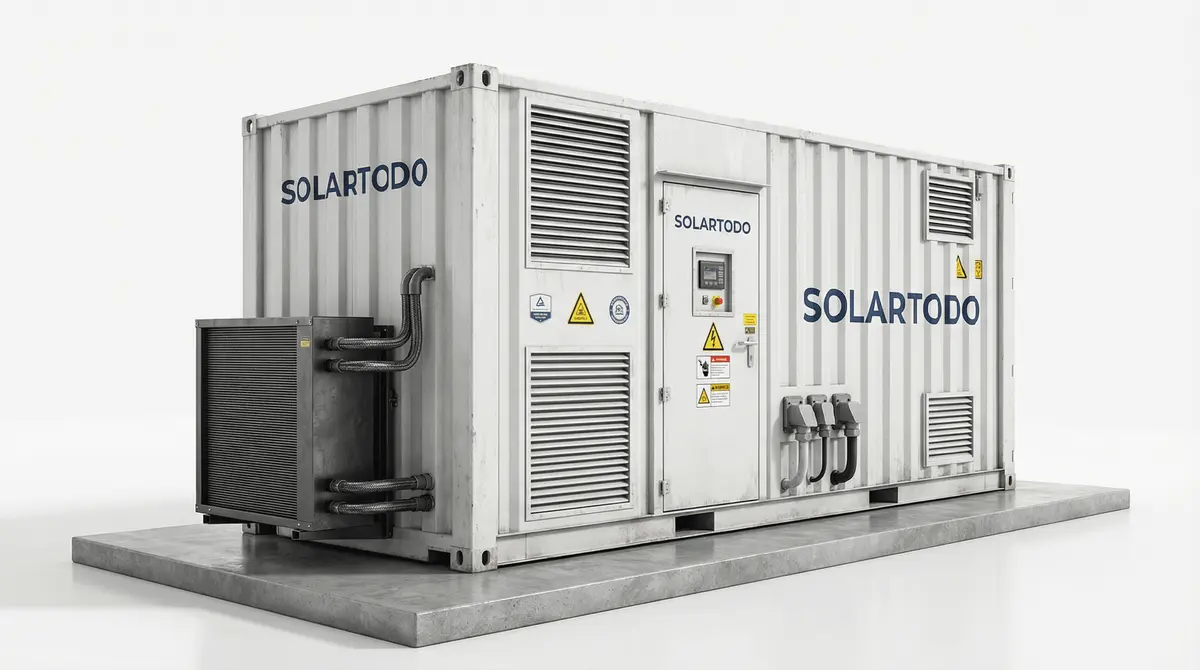
A compliant LFP Battery Energy Storage System typically combines battery racks, BMS, PCS, EMS, HVAC or liquid cooling, fire suppression, and switchgear into a tested architecture under UL 9540 or equivalent project requirements.
System design should start from the single-line diagram and load profile, not from a catalog photo. Engineers need to define DC voltage window, AC interconnection voltage, transformer arrangement, auxiliary load budget, and redundancy philosophy. At utility scale, multi-container architecture is common because it simplifies transport, phased installation, and maintenance isolation. At commercial and industrial scale, skid or cabinet formats may reduce site work.
Thermal management is a major design divider between low-C and high-C systems. Air cooling may be acceptable for lighter duty in some climates, but liquid cooling is often preferred when cycle intensity reaches 0.5C to 1C with frequent daily cycling. A temperature spread above about 5°C across modules can accelerate imbalance and degradation. Keeping cell temperatures in a narrower band supports both warranty compliance and dispatch consistency.
Fire safety design must be discussed early with the EPC, insurer, and authority having jurisdiction. UL 9540A test data, gas detection, off-gas monitoring, smoke detection, and suppression strategy all affect project approval. Separation distances, container layout, and emergency response planning are site-specific. Procurement teams should request tested system documentation, not only cell-level certificates.
According to NREL (2023), battery storage performance and safety depend on controls, thermal design, and integration quality as much as on cell chemistry. That is why SOLAR TODO treats the battery, PCS, EMS, and cooling package as one engineered supply scope rather than four unrelated line items.
Applications, Use Cases, and Selection Comparison
LFP Battery Energy Storage System selection should match the use case: 1C for 10 MW / 10 MWh regulation, 0.5C for 1.5 MW / 3 MWh wind integration, and hybrid 100 kW / 200 kWh for off-grid mining.
The three most common B2B use cases show why C-rate selection matters. First, frequency regulation values fast response and accurate power tracking. A 10 MW / 10 MWh system can deliver full power in about 0.1 seconds and is suited to primary response, secondary regulation, and AGC. Second, renewable integration values smoothing and short-duration firming. A 1.5 MW / 3 MWh system at 0.5C can absorb wind variability and improve export stability over 15-minute to 60-minute settlement windows. Third, off-grid industrial sites value fuel displacement and generator support. A 100 kW / 200 kWh hybrid system can reduce generator runtime by 20% to 45% when paired with solar PV and proper controls.
Comparison Table: LFP BESS Design by Application
| Application | Typical Power / Energy | Typical C-rate | Main Objective | Key Design Priority | Example from SOLAR TODO |
|---|---|---|---|---|---|
| Frequency regulation | 10 MW / 10 MWh | 1C | Fast ancillary services | Response 90% efficiency, and strong safety margins, then size the system around real kW, real usable kWh, and the correct standard set. For utility, C&I, and off-grid buyers, SOLAR TODO recommends validating C-rate, usable energy, and EPC scope before comparing price alone. |
About SOLARTODO
SOLARTODO is a global integrated solution provider specializing in solar power generation systems, energy-storage products, smart street-lighting and solar street-lighting, intelligent security & IoT linkage systems, power transmission towers, telecom communication towers, and smart-agriculture solutions for worldwide B2B customers.
Procurement paths
About the Author

SOLARTODO Editorial Team
Solar Energy & Infrastructure Expert Team
SOLAR TODO is a professional supplier of solar energy, energy storage, smart lighting, smart agriculture, security systems, communication towers, and power tower equipment.
Our technical team has over 15 years of experience in renewable energy and infrastructure, providing high-quality products and solutions to B2B customers worldwide.
Expertise: PV system design, energy storage optimization, smart lighting integration, smart agriculture monitoring, security system integration, communication and power tower supply.
Cite This Article
SOLARTODO Editorial Team. (2026). LFP BESS Design: Battery Selection & C-Rate Standards. SOLARTODO. Retrieved from https://solartodo.com/knowledge/lfp-battery-energy-storage-systems-system-design-lfp-batteries-selection-and-c-rate-selection-standards
@article{solartodo_lfp_battery_energy_storage_systems_system_design_lfp_batteries_selection_and_c_rate_selection_standards,
  title = {LFP BESS Design: Battery Selection & C-Rate Standards},
  author = {SOLARTODO Editorial Team},
  journal = {SOLARTODO Knowledge Base},
  year = {2026},
  url = {https://solartodo.com/knowledge/lfp-battery-energy-storage-systems-system-design-lfp-batteries-selection-and-c-rate-selection-standards},
  note = {Accessed: 2026-10-19}
}
Published: July 12, 2026 | Available at: https://solartodo.com/knowledge/lfp-battery-energy-storage-systems-system-design-lfp-batteries-selection-and-c-rate-selection-standards
Subscribe to Our Newsletter
Get the latest solar energy news and insights delivered to your inbox.
View All Articles