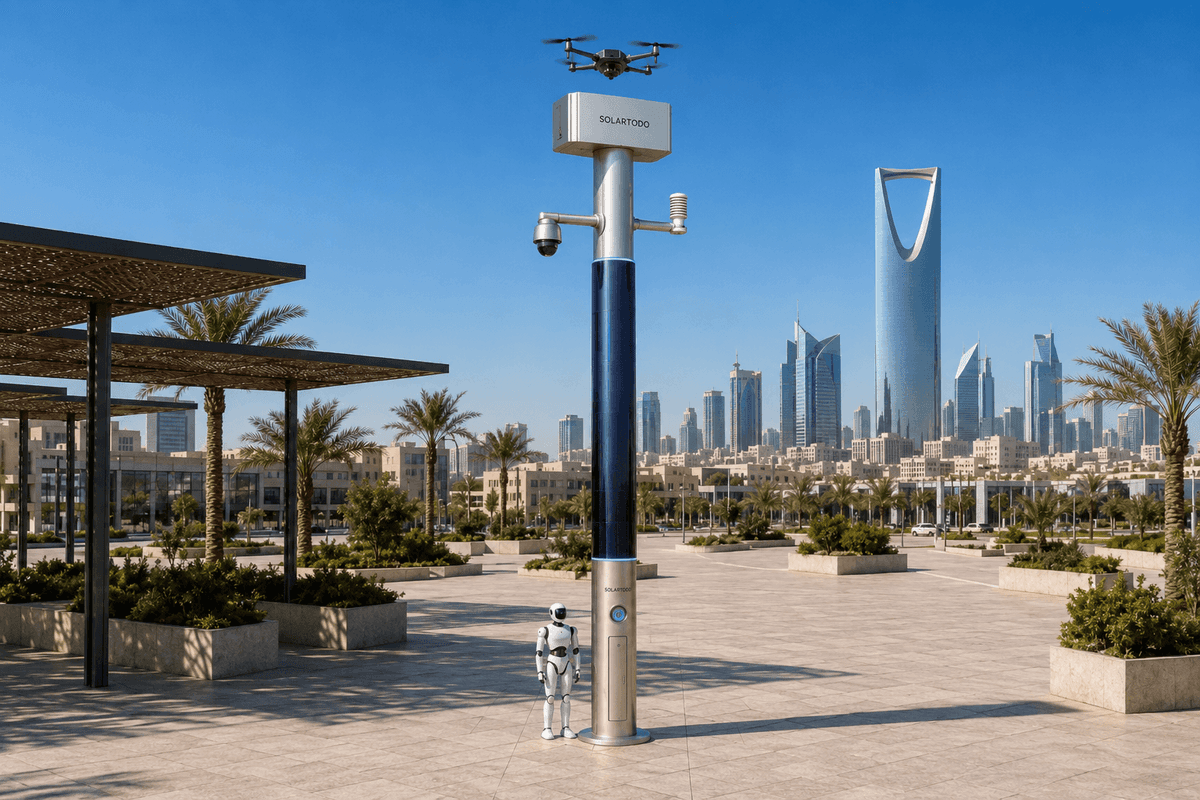
A City AI Pole, in this case SOLARTODO Sentinel Sky Hub, is a fully off-grid, non-lighting physical-AI edge node that combines local sensing, edge compute, drone operations, ground robot support, battery storage and solar replenishment. This Kuala Lumpur configuration supports power-utility night patrol across outage-prone hill and corridor zones while keeping raw data processed locally on the pole.
1. Procurement Context: Kuala Lumpur, Power Utility, Night Patrol
Kuala Lumpur is a dense tropical capital built inside a valley basin with hilly urban edges, elevated roads, utility corridors, drainage channels, substations, campuses, industrial pockets and forested slopes sitting close to residential and commercial load centers. For a power utility, the difficult task is not only maintaining equipment in normal weather. The harder procurement problem appears during typhoon-season regional storm influence, Northeast Monsoon downpours, strong wind bursts, slope runoff, vegetation movement, partial communication failures and night-time access constraints. Crews may be managing feeder alarms, perimeter alerts, landslip risks near assets, and public-safety calls while the network itself is degraded.
This case frames a proposed SOLARTODO Sentinel Sky Hub deployment as a grid-mesh of physical-AI edge-node poles for night patrol. Grid-mesh here means a distributed operational mesh along utility-relevant zones, not dependence on city power. Each node is fully off-grid: battery storage plus 360-degree wrapped flexible CIGS thin-film solar replenishment on the pole body. It is a pure smart pole and includes no lighting system. The value is not illumination. The value is persistent local intelligence, autonomous field operations and resilient common-operating-picture reporting when city communications are intermittent.
The buyer is a power utility evaluating how to reduce response time during outage conditions without adding permanent human presence at every vulnerable site. The proposed procurement scope would prioritize substations, hill-slope feeder corridors, cable landing areas, service roads, industrial park boundaries and critical perimeter segments where manual patrols are slow at night. The KPI frame is target response-time improvement: shorten the interval from anomaly detection to verified triage, from verified triage to authorized dispatch, and from dispatch to recorded field evidence. These are evaluation targets, not claimed achieved results, and remain subject to final engineering confirmation, site survey and operating rules.
2. Node Role in the Utility Operations Loop
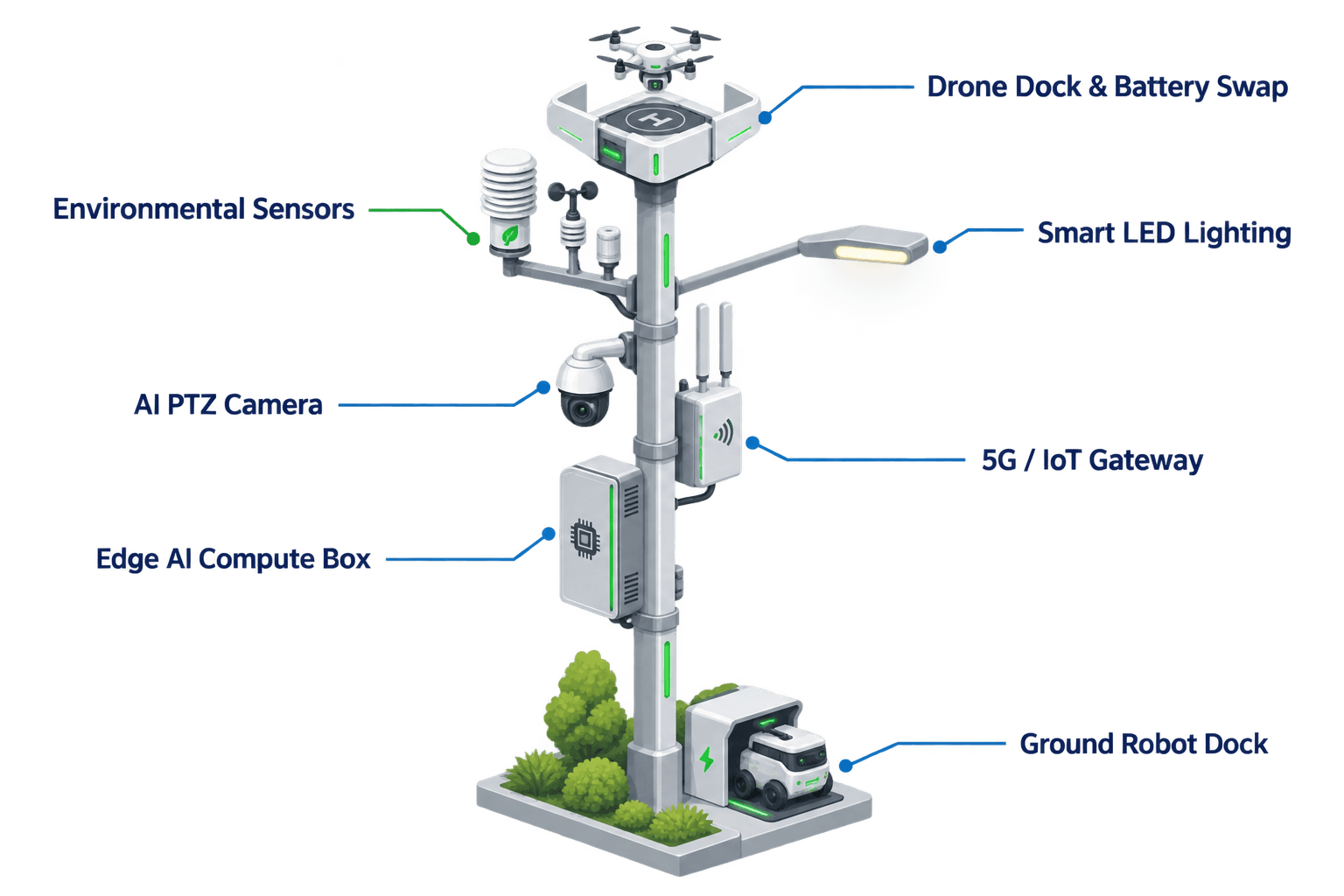
The Sky Hub node is configured around the utility task rather than as a generic pole installation. Its operating loop follows sensing, authorized assessment and response, edge-compute scheduling, field operations and maintenance, presented in a single COP command view. A PTZ camera and local perception services watch for anonymous vehicle count, crowd density near assets, intrusion, perimeter movement and environmental triggers. The environmental package tracks wind speed, wind direction, temperature, humidity, atmospheric pressure, noise, PM10, PM2.5 and illuminance, giving operators a local weather and site-condition record during storm nights.
Edge AI compute is performed on-pole by a Jetson-class module, in an Orin- or Thor-class performance envelope depending on procurement profile. Raw video and sensor streams stay on the pole and are processed locally. Only de-identified event, health and status metadata may leave the node. For Kuala Lumpur utility operations, this matters because outage response often occurs under public scrutiny and around private property. The data posture is PDPL/LGPD-oriented by design, supporting local processing and minimization without claiming certification.
The node can coordinate three field layers from the same command view. First, it detects and classifies local anomalies. Second, it schedules compute, power budget and mission priority on the pole. Third, it dispatches either an autonomous drone sortie, a ground robot patrol or both, subject to operating policy and human authorization where required. For example, a night-time perimeter anomaly at a hill-edge substation can be scored locally, summarized to the COP, and assigned to a short drone inspection while a service robot remains available at the pole base for closer ground response or follow-up inspection. If the network is unstable, the node continues local event processing and stores mission records until metadata synchronization is possible.
3. Battery-Swap as the Response-Time Module
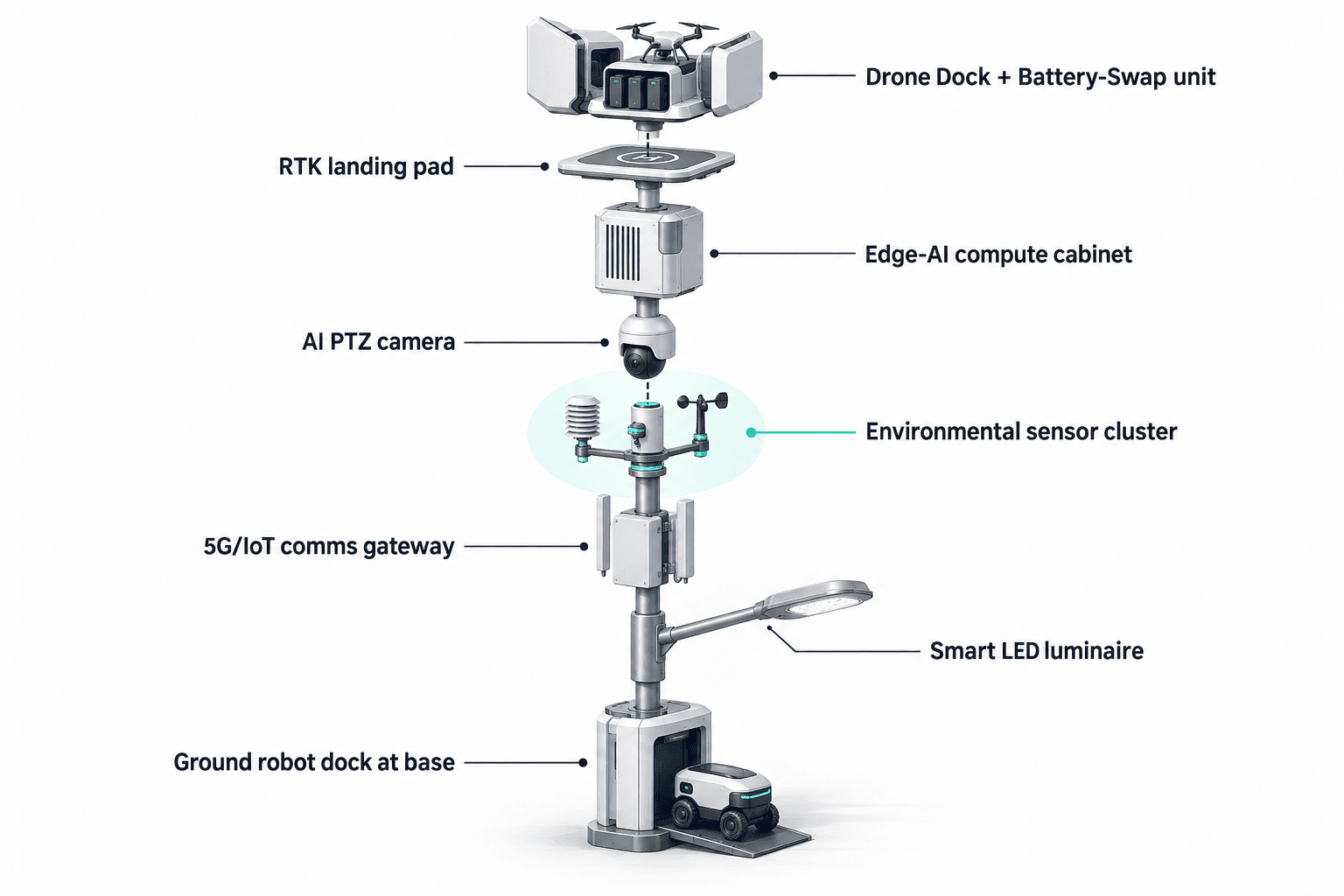
The module focus for this Kuala Lumpur case is the drone battery hot-swap system, because response time during network outage conditions depends on whether the node can keep field operations moving without waiting for a crew or a manual battery change. The Sky Hub configuration includes a rear-service multi-bay battery magazine. A landed drone can return to the pole, align for service, exchange a depleted pack for a charged pack and relaunch. Multiple bays support several consecutive sorties, with the state machine managing bay availability, battery status, landing clearance, mission queueing and relaunch authorization.
In a storm-night utility scenario, this changes the procurement logic. A conventional inspection plan often depends on a crew driving from a depot, reaching a site through rain or blocked roads, and visually confirming whether an alarm is vegetation contact, trespass, floodwater, equipment casing damage or a communications false alarm. The Sky Hub grid-mesh moves first verification closer to the asset. The node can run a local night patrol route, return the drone for battery exchange, and redeploy it to inspect the next priority segment while the COP records mission logs and edge-classified event metadata.
The same battery-swap logic is integrated with energy management. The pole is fully off-grid, but the solar layer is not represented as unlimited self-sufficiency. The vertical cylindrical body carries about 15 square meters of 360-degree wrapped flexible CIGS thin-film over an approximately 8 meter tall, 0.6 meter wide form, with about 2.4 to 2.7 kWp nameplate. Because a vertical cylinder collects direct sun mainly on its sun-facing projection rather than the full wrap at once, realistic clear-sky output in a high-irradiance region is roughly 0.8 to 1.1 kW DC peak, typically peaking mid-morning or mid-afternoon, and about 6 to 9 kWh per day. Kuala Lumpur site yield must be confirmed by local shading and weather assessment. High-power drone and robot tasks are therefore buffered by 5 to 20 kWh-class storage and scheduled by duty cycle, battery state, storm priority and mission urgency.
4. Grid-Mesh Deployment Pattern for Outage-Prone Terrain
A proposed Kuala Lumpur procurement would place nodes as a utility-facing operational mesh across terrain and asset patterns, rather than as a continuous streetscape. Priority zones include feeder corridors near wooded slopes, substation perimeters with limited night visibility, flood-adjacent service roads, industrial park boundaries, campus energy assets and hill-edge access points where manual confirmation can be slow. The mountain-city archetype is expressed through steep local gradients, vegetation pressure, drainage flow and access-road constraints, not through a claim that Kuala Lumpur is a remote mountain town.
Each Sky Hub acts as a local micro-station. Its pure smart pole body hosts sensing, compute, power storage, drone service, robot support and communications. The ground robot workflow gives the utility a second response mode: autonomous patrol around the pole zone, alarm response, inspection of accessible ground paths, air-ground coordination with the drone, and return to the pole base for wireless charging. The drone provides elevated or regional inspection where line of sight, slope, water or access barriers slow ground movement. Together, they help the utility separate urgent field events from low-priority anomalies before sending crews.
Counter-UAS coordination is included as a bounded safety workflow for unauthorized drones near critical utility assets. The pole may detect and track an unauthorized drone and command the node's own friendly drone to perform soft aerial net-capture or close-approach deterrence only where authorized. This is non-kinetic, human-authorized mitigation. It is not a shoot-down, not jamming, not autonomous attack and not a weapon function. Radar is not built into the pole; if required, radar would be treated only as an optional or partner-sensor input to the local COP.
The procurement benefit of the grid-mesh mode is resilience. During a network outage, each node retains local decision support and task records. When connectivity is available, the utility command view receives de-identified status, event summaries, mission logs, energy state and maintenance flags. When connectivity is degraded, the node continues sensing, local inference, mission scheduling and on-site response within authorized rules. The target KPI is faster validated awareness: a shorter path from alarm to classified situation to authorized field action.
5. Evaluation Method and Buyer Governance
The proposed evaluation should be written into procurement as operational acceptance criteria rather than marketing claims. A utility buyer can define target response-time bands for night patrol: anomaly-to-local-classification, local-classification-to-COP alert, COP-alert-to-human decision, human decision-to-drone launch, drone return-to-hot-swap completion, and redeployment to the next route. These targets should be tested under realistic weather windows, low-light conditions, partial communications, battery-state limits and site-specific terrain constraints.
Governance matters as much as hardware. The COP should separate detection, decision support and actuation. Anonymous counts, density estimates, perimeter events, environmental readings, drone mission state, robot state, battery magazine status and node health can be shown together, while raw video remains locally processed on the pole. Human-in-the-loop authorization remains required for regulated actions, especially C-UAS coordination or any response that affects third parties. Mission logs should record what the node detected, what the edge AI scored, what the operator authorized, which asset was dispatched, and what de-identified result was stored.
For Kuala Lumpur, procurement should also include site engineering confirmation: solar exposure, rain load, wind conditions, corrosion environment, communications coverage, service access, drone operating permissions, robot path suitability, battery storage sizing and maintenance cadence. The Sky Hub product is positioned as a mature, in-service physical-AI edge-node capability, but the exact node count, siting, duty cycle and KPI targets must be engineered for the utility's corridors. That keeps the business case credible: the pole is not a streetlight, not a generic camera mast and not an unlimited solar machine. It is an off-grid city-AI node designed to keep local intelligence and field response available when outage pressure is highest.
System Configuration
| Parameter | Configuration |
|---|---|
| Pole form | SOLARTODO Sentinel Sky Hub pure smart pole, non-lighting, fully off-grid cylindrical body |
| Energy system | ~15 m² 360° wrapped flexible CIGS thin-film, 5-20 kWh-class battery storage, duty-cycle scheduling |
| Edge AI compute | Jetson-class on-pole inference module, Orin- or Thor-class profile, local workload scheduling |
| Drone service | Autonomous launch, return, rear-service multi-bay battery hot-swap and task redeployment |
| Ground robot support | Patrol and inspection coordination with pole-base wireless charging |
| Sensing package | AI PTZ for anonymous vehicle count, crowd density, intrusion and perimeter awareness; nine-parameter environmental monitoring |
| Data handling | Raw video and sensor data processed locally on the pole; only de-identified event and status metadata may leave |
How It Works
- On-pole sensing flags a night-time perimeter or environmental anomaly near a utility asset.
- Edge AI classifies the event locally, scores priority and keeps raw video and sensor data on the pole.
- The COP presents de-identified event metadata, node energy state, battery-swap status and recommended response.
- A human operator authorizes drone launch, robot dispatch or bounded C-UAS coordination when required.
- The drone completes inspection, returns for automated battery hot-swap and redeploys if the queue requires another sortie.
- Mission logs, response timestamps and de-identified status metadata are recorded for KPI review and maintenance planning.
Planning Assumptions (Indicative)
Illustrative planning inputs a buyer can recompute — target metrics, not achieved results. Subject to final engineering confirmation.
| Metric | Planning assumption | Indicative value |
|---|---|---|
| Response-time evaluation | Target interval from local anomaly flag to COP event summary during night patrol | ~1-3 minutes target planning band |
| Inspection labor | Drone patrol replaces selected manual confirmation trips on outage-prone nights | ~5-10 patrol checks/week automated per priority zone |
| Battery-swap continuity | Multi-bay magazine supports consecutive sorties before manual replenishment | ~3-6 short sorties per service window |
| Crew dispatch filtering | Local edge classification separates urgent events from low-priority anomalies before truck roll | ~20-40% triage reduction target to validate |
| Outage resilience | Node continues local inference and mission logging during intermittent backhaul | ~4-12 hours local autonomy target, storage-dependent |
| Environmental context | Nine-parameter sensor record supports storm-night incident review | ~1 local condition snapshot per event plus scheduled health reports |
Deployed Equipment
- SOLARTODO Sentinel Sky Hub non-lighting pole body
- 360° wrapped flexible CIGS thin-film solar layer
- 5-20 kWh-class battery storage and power management cabinet
- Rear-service multi-bay drone battery hot-swap magazine
- Autonomous drone operations bay and landing/service interface
- Pole-base wireless charging interface for ground robot
- AI PTZ camera with local perception
- Nine-parameter environmental monitoring sensor package
Frequently Asked Questions
Is Sky Hub a smart streetlight for Kuala Lumpur road lighting?
No. In this procurement case, Sky Hub is specified as a pure smart pole with no lighting system. Its role is physical-AI edge operations for power-utility zones: local sensing, edge inference, drone operations, ground robot support, battery storage, solar replenishment and COP reporting. It should not be scoped, budgeted or evaluated as a street-lighting upgrade.
How does the battery-swap module affect response time during network outages?
The multi-bay battery magazine lets a returning drone receive a charged pack and relaunch without an on-site operator. During night patrol, this can reduce waiting time between inspection sorties and keep verification close to the asset. The KPI should be measured as a target interval from anomaly flag to authorized launch, return, swap and redeployment, not as a guaranteed result before site testing.
Does the fully off-grid design mean the pole can run unlimited drone and robot missions on solar alone?
No. The pole is fully off-grid because it does not depend on city, site or grid power, but the CIGS wrap is a replenishment layer rather than an unlimited energy source. High-power drone and robot work is buffered by 5-20 kWh-class storage and scheduled by duty cycle, local weather, battery state and operational priority.
What data leaves the pole in the proposed Kuala Lumpur configuration?
Raw video and sensor data stay on the pole and are processed locally. The command view may receive de-identified event summaries, mission status, health telemetry, energy state and maintenance flags. This is PDPL/LGPD-oriented local-processing language, not a claim that the deployment is already certified or legally compliant without buyer review.
Can the node identify faces or licence plates during utility patrol?
No active face recognition or licence-plate recognition capability is claimed for this case. The security sensing scope is anonymous vehicle count, crowd density, intrusion and perimeter awareness using local perception. That keeps the procurement focused on utility operations, situational awareness and privacy-conscious event triage rather than identity surveillance.
How is Counter-UAS handled around critical utility infrastructure?
Counter-UAS coordination is limited to detection, tracking and human-authorized non-lethal response. The node may command its own friendly drone for soft aerial net-capture or close-approach deterrence where permitted by operating rules. It is not a shoot-down system, does not jam RF or GNSS, and does not conduct autonomous attack. Radar, if needed, is only an optional partner-sensor input.
What should the utility verify before procurement approval?
The buyer should confirm site solar exposure, battery sizing, drone operating permissions, robot path quality, backhaul coverage, weather survivability, service access, cybersecurity governance and human authorization procedures. KPI targets should be tested under Kuala Lumpur night-rain conditions and partial communications rather than assumed from a datasheet.
Explore Further
- City AI Pole / smart streetlight product line
- More smart-city deployment cases
- Talk to our engineering team
Planning a similar physical-AI deployment for streets, campuses or public spaces? Request an engineering consultation