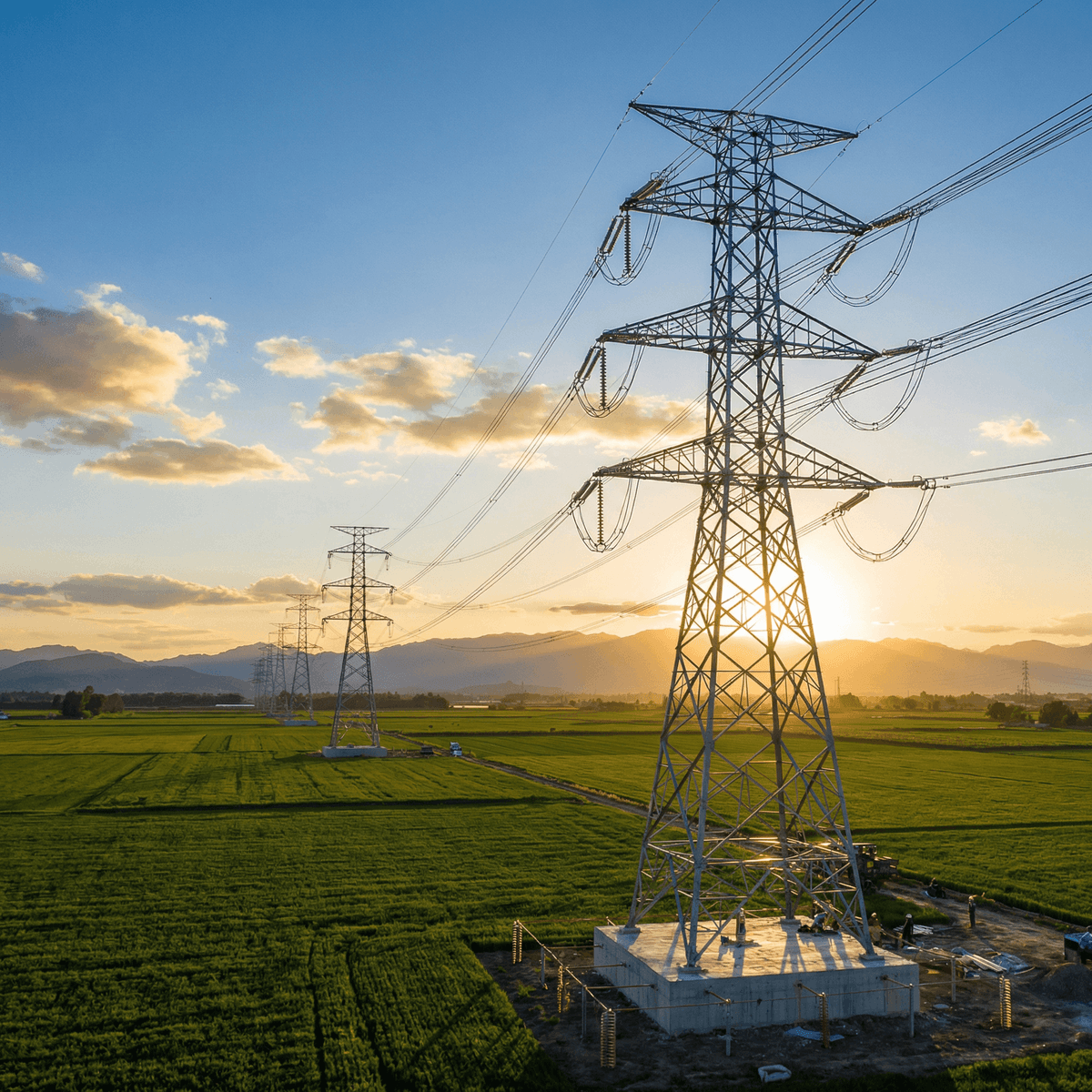
Kingston Power Transmission Tower Market Analysis: 10kV Municipal Distribution Configuration Guide
Summary
Kingston’s dense urban load profile, tropical storm exposure, and medium-voltage distribution needs make a 10kV single-circuit steel tubular line a practical fit; a typical 9km route would use approximately 144 poles, 25m height, 60m spans, and 35m/s wind design.
Key Takeaways
- Kingston’s urbanized parish population exceeds 660,000, which supports continued medium-voltage network reinforcement for municipal and mixed-use districts, according to STATIN Jamaica (2023).
- Jamaica Public Service operates islandwide transmission and distribution assets, and urban feeders in Kingston commonly require resilient 10kV-class municipal distribution structures rather than lattice towers, according to JPS network documentation and planning materials.
- A typical Kingston profile at this scale would use approximately 144 tapered steel tubular poles across about 9km, with 60m average spans and single-circuit 10kV configuration.
- The project-specific configuration calls for 25m hot-dip galvanized Q345 steel poles, about 10t per pole, with flanged sections and anchor-bolt cage foundations.
- Electrical fit is based on ACSR 120 conductor rated at about 470kg/km with maximum tension of 38kN, 0.8m phase spacing, and 0.5m insulator length.
- Structural fit should account for Wind Class 3 at 35m/s, which is relevant for Kingston’s hurricane and tropical storm exposure under IEC 60826 loading methodology.
- For municipal distribution, accessories would typically include climbing steps, cross-arms, grounding, bird guards, and vibration dampers to support a 30-year design life.
- Buyers comparing options should note that SOLAR TODO’s steel tubular Power Transmission Tower format reduces urban footprint versus lattice structures and is suitable for tighter road reserves and utility corridors.
Market Context for Kingston
Kingston’s electricity distribution environment favors compact steel monopole-style line structures because the city combines high load density, constrained road corridors, and recurring wind exposure above 30m/s during severe weather events. According to the Statistical Institute of Jamaica (STATIN) (2023), the Kingston and St. Andrew metropolitan area accounts for well over 660,000 residents, making it Jamaica’s largest urban demand center and a priority zone for medium-voltage feeder reliability.
According to the World Bank (2023), Jamaica’s urban population remains above 55% of the national total, and Kingston functions as the country’s administrative, port, and commercial core. In practical grid terms, that means municipal distribution assets must support mixed residential, public-service, and commercial loads over relatively short route lengths such as 5km to 15km. For this profile, steel tubular poles are often preferred where the right-of-way is narrower than what lattice structures would comfortably require.
Climate is a decisive design factor at 18, -76.79. According to the Meteorological Service of Jamaica (2023), Kingston is exposed to tropical storm and hurricane conditions during the Atlantic season, and utility structures must be checked for wind loading, corrosion, and conductor motion. IEC states, "This part of IEC 60826 specifies reliability-based design criteria for overhead transmission lines," which is directly relevant when selecting pole geometry, span, and foundation parameters for coastal Caribbean cities.
Jamaica’s grid also has a strong dependence on reliable distribution infrastructure because outage costs are high in urban service areas. According to the Inter-American Development Bank (2022), Caribbean utilities face elevated resilience requirements due to storm risk and concentrated coastal infrastructure. For Kingston, this supports the use of hot-dip galvanized steel tubular Power Transmission Tower systems with compact foundations and standardized bolt-section assembly.
The local fit is therefore less about extra-tall transmission structures and more about durable medium-voltage municipal distribution hardware. Based on the project-specific configuration provided, the most relevant recommendation is a 10kV single-circuit steel tubular line using 25m tapered poles, even though generic distribution classes often start at 12m to 18m. In Kingston, the 25m selection can be justified where road crossings, tree clearance, and urban corridor geometry require additional vertical separation while still serving a medium-voltage municipal distribution function.
SOLAR TODO should therefore position this product in Kingston as a compact urban distribution structure rather than a long-span bulk transmission tower. That distinction matters for utility engineers, EPC contractors, and municipal buyers comparing steel tubular poles against concrete poles or lattice alternatives. For product details, buyers can review the Power Transmission Tower product page or contact us for route-specific engineering review.
Recommended Technical Configuration
For Kingston’s 10kV municipal distribution profile, a typical 9km deployment would consist of approximately 144 single-circuit steel tubular poles at 25m height, using ACSR 120 conductor, 60m average spans, and anchor-bolt cage foundations designed for 35m/s wind.
The recommended structure is a tapered steel tubular Power Transmission Tower fabricated from hot-dip galvanized Q345 steel. The project-specific configuration uses approximately 144 units, each about 25m in height and about 10t in unit weight, with an indicative linear steel consumption of about 400kg/m. This is not a lattice tower recommendation; it is a steel monopole-format municipal distribution line designed for constrained urban corridors.
Electrically, the line configuration is 10kV single circuit. The specified conductor is ACSR 120, with a mass of about 470kg/km and maximum tension of 38kN. Phase spacing is 0.8m, insulator length is 0.5m, and minimum ground clearance is 5m. For Kingston, these parameters are suitable where feeder routing crosses municipal roads, mixed-use districts, and service corridors that require compact geometry and controlled conductor swing.
Structurally, Wind Class 3 at 35m/s is the key local design input. According to IEC (2019), overhead line design must consider wind, conductor tension, and reliability factors rather than only nominal pole height. In Kingston, that means the pole shell thickness, base plate, anchor cage, and foundation embedment should be checked against local geotechnical conditions, especially in reclaimed, coastal, or variable-fill urban soils.
The foundation recommendation is a reinforced concrete anchor-bolt cage foundation. This is appropriate for flanged bolt-section steel poles because it simplifies transportation, on-site assembly, and replacement planning. In a Kingston municipal context, this approach also reduces corridor occupation time compared with larger cast-in-place alternatives that require more extensive temporary works.
Accessories should include climbing steps, cross-arm brackets, grounding, bird guards, and vibration dampers. Those items are not optional in a coastal Caribbean environment. According to IEEE, proper grounding and hardware coordination are essential to reduce outage risk, hardware fatigue, and maintenance frequency on overhead lines exposed to salt-laden air and seasonal storms.
SOLAR TODO’s recommended fit for Kingston is therefore a medium-voltage steel tubular line package that prioritizes compact footprint, corrosion protection, and repeatable assembly. The configuration is suitable for municipal distribution reinforcement, feeder rerouting, industrial-park supply extensions, and road-widening relocations where a 9km route length and approximately 144 poles are within normal planning range.
Technical Specifications
For the specified Kingston 10kV route, the technical configuration is 25m height, single circuit, approximately 10t per pole, 60m span, ACSR 120 conductor, and 35m/s wind design under IEC 60826 and GB 50545.
- Product type: Steel tubular Power Transmission Tower for medium-voltage municipal distribution
- Pole form: Tapered round steel monopole, flanged bolt sections
- Voltage class: 10kV
- Circuit arrangement: Single circuit
- Pole quantity: Approximately 144 units
- Route length: Approximately 9km
- Pole height: 25m
- Unit weight: Approximately 10t per pole
- Linear steel indicator: Approximately 400kg/m
- Steel grade: Q345
- Surface treatment: Hot-dip galvanized
- Conductor type: ACSR 120
- Conductor mass: Approximately 470kg/km
- Maximum conductor tension: 38kN
- Phase spacing: 0.8m
- Insulator length: 0.5m
- Minimum ground clearance: 5m
- Average span: 60m
- Wind class: Class 3
- Design wind speed: 35m/s
- Foundation type: Reinforced concrete anchor-bolt cage foundation
- Accessories: Climbing steps, cross-arm, grounding set, bird guard, vibration damper
- Design life: 30 years
- Standards basis: IEC 60826 / GB 50545
Implementation Approach
A typical Kingston rollout for a 9km, 144-pole 10kV line would proceed in 5 phases: route survey, foundation works, pole erection, conductor stringing, and commissioning, usually over about 4 to 7 months depending on permits and weather windows.
Phase 1 is route confirmation and design freeze. This usually includes topographic survey, utility conflict checks, geotechnical sampling, and span-by-span spotting. In Kingston, route engineering should review road reserve width, building setbacks, drainage channels, and salt-exposure zones within 1km to 5km of the coastline. According to IEC (2019), loading cases should include wind, broken conductor scenarios, and construction conditions.
Phase 2 is procurement and logistics. Steel tubular poles are commonly fabricated in flanged sections to fit container or breakbulk transport. For a 25m pole class, buyers typically evaluate section count, bolt grade, galvanizing thickness, and packing method before shipment. SOLAR TODO can support technical submittals, drawing review, and bill-of-material alignment before delivery to Jamaica.
Phase 3 is civil works. Anchor-bolt cage foundations are installed first, followed by concrete curing and bolt-position verification. In a tropical urban environment, foundation scheduling should account for rainfall intensity, groundwater variability, and traffic management. A 144-unit route would usually be sequenced in blocks of 15 to 30 foundations to keep erection crews productive.
Phase 4 is mechanical and electrical assembly. Pole sections are lifted and bolted, cross-arms and accessories are fixed, and ACSR 120 conductors are strung under controlled tension up to 38kN. At 60m average spans, sagging and clearance checks are critical, especially at road crossings where the 5m minimum ground clearance must be maintained under operating temperature and wind conditions.
Phase 5 is testing and energization. This includes grounding continuity checks, hardware torque verification, insulator inspection, conductor sag records, and as-built documentation. According to IEEE, documented commissioning records reduce later maintenance uncertainty and improve fault-response planning. For Kingston, post-installation inspection after the first severe weather season is also a sensible practice.
Expected Performance & ROI
For Kingston’s municipal 10kV network, a galvanized steel tubular line with 30-year design life can reduce lifecycle maintenance frequency versus untreated alternatives and improve corridor efficiency, with payback typically driven by outage reduction, lower replacement cycles, and faster urban installation.
The performance case is based on durability, urban fit, and maintenance economics rather than energy generation. According to NREL (2023), lifecycle infrastructure decisions in grid systems should compare capital cost against maintenance burden, resilience value, and service continuity. For Kingston, steel tubular poles offer a smaller footprint than lattice structures, which can lower land-use conflict and simplify roadside placement in built-up districts.
Corrosion resistance is a major ROI factor. Hot-dip galvanized Q345 steel is well suited to coastal and humid environments when galvanizing thickness and inspection intervals are properly specified. According to IRENA (2022), resilience investments in island power systems often show value through avoided outage costs and reduced storm-recovery expenditure rather than through a simple equipment-only payback model.
A practical planning assumption for Kingston is that a 30-year design life, periodic bolt and coating inspection, and standardized accessory replacement can produce lower total ownership cost than ad hoc mixed-asset networks. Utilities also benefit from repeatable pole geometry and standardized ACSR 120 hardware because spare parts, stringing tools, and maintenance procedures remain consistent across the 9km line.
From an EPC perspective, installation speed can also affect ROI. Tubular flanged sections are generally faster to erect in urban corridors than wider-footprint structures requiring larger assembly areas. That can reduce road occupation time, traffic disruption, and contractor standby costs. For municipal owners, those indirect savings often matter as much as direct material cost.
Results and Impact
For Kingston, the expected impact of a 144-pole, 9km 10kV steel tubular line is improved municipal feeder resilience, controlled right-of-way use, and a 30-year asset base that is easier to inspect and standardize than mixed legacy structures.
The first operational benefit is corridor efficiency. A tubular pole occupies less visual and physical space than many lattice alternatives, which matters in Kingston where road reserves, sidewalks, and drainage channels compete for limited width. The second benefit is structural consistency. With 25m poles, 60m spans, and one conductor family, maintenance teams can apply one inspection logic across the route.
The third impact is storm-readiness. Wind Class 3 at 35m/s does not eliminate weather risk, but it gives a rational basis for structural design under IEC 60826. The fourth impact is municipal service continuity. In dense urban areas, avoiding prolonged feeder outages can protect commercial activity, public lighting, traffic systems, and essential services connected to the distribution network.
For buyers evaluating supply options, SOLAR TODO should be assessed on technical conformity: Q345 steel chemistry, galvanizing process control, conductor compatibility, foundation detailing, and documentation quality. Those factors have more long-term value than a simple comparison of pole mass alone.
Comparison Table
For Kingston buyers, the main comparison is not only height or steel weight but corridor fit, wind design, and maintenance logic across a 9km, 10kV municipal distribution route.
| Parameter | Recommended Kingston Configuration | Generic Concrete Pole Option | Lattice Structure Option |
|---|---|---|---|
| Product form | Tapered steel tubular pole | Prestressed/spun concrete pole | Steel lattice tower |
| Voltage application | 10kV municipal distribution | 10kV distribution | Usually better suited to larger corridors |
| Typical route in this guide | 9km | 9km | 9km |
| Quantity basis | Approx. 144 poles | Similar quantity depending on span | Lower quantity only if spans increase |
| Pole height | 25m | Often lower or corridor-dependent | Corridor-dependent |
| Span in this guide | 60m | Often similar or shorter | Can be longer with larger footprint |
| Wind design | 35m/s, Class 3 | Must be checked case by case | Must be checked case by case |
| Corrosion protection | Hot-dip galvanized steel | Concrete with steel reinforcement | Hot-dip galvanized steel |
| Urban footprint | Compact | Moderate | Largest footprint |
| Foundation type | Anchor-bolt cage concrete foundation | Direct embed or concrete foundation | Larger pad or stub foundation |
| Maintenance logic | Standardized bolts, coating, hardware | Crack/spall inspection | More members and bolts to inspect |
| Best fit in Kingston | Narrow municipal corridors | Lower-cost simple feeders | Open corridors with more land |
Pricing & Quotation
SOLAR TODO offers three pricing tiers for this product line: FOB Supply (equipment ex-works China), CIF Delivered (including ocean freight and insurance), and EPC Turnkey (fully installed, commissioned, with 1-year warranty). Volume discounts are available for large-scale deployments. Configure your system online for an instant estimate, or request a custom quotation from our engineering team at [email protected].
Frequently Asked Questions
A Kingston buyer evaluating a 10kV steel tubular line typically asks about pole height, conductor fit, foundation type, installation duration, maintenance cycle, and commercial scope more than about tower aesthetics.
Q1: Is this Power Transmission Tower suitable for Kingston’s urban distribution network?
Yes. The specified configuration is suitable for 10kV municipal distribution where road corridors are constrained and wind exposure reaches 35m/s. The 25m steel tubular format supports compact siting, 60m spans, and standardized accessories. It is a better fit for urban feeder reinforcement than a bulk transmission lattice structure in many Kingston corridors.
Q2: Why use a steel tubular pole instead of a lattice tower in Kingston?
A tubular pole uses less ground space and creates fewer obstruction points in narrow municipal rights-of-way. For a 9km urban route with approximately 144 positions, that matters for traffic management, drainage, and visual clearance. It also simplifies hardware inspection because there are fewer exposed members than on a lattice structure.
Q3: What conductor is recommended for this configuration?
The project-specific recommendation is ACSR 120, with a mass of about 470kg/km and maximum tension of 38kN. This conductor size fits the specified 10kV single-circuit arrangement, 0.8m phase spacing, and 60m span planning basis. Final conductor selection should still be checked against feeder load, fault duty, and utility standards.
Q4: How long would a typical 9km installation take?
A practical schedule is about 4 to 7 months, depending on permits, shipping, weather, and foundation productivity. The sequence usually includes survey, civil works, pole erection, stringing, and commissioning. In Kingston, rainy-season timing and traffic-control constraints can affect the critical path more than steel fabrication time.
Q5: What maintenance does this tower type require over 30 years?
Maintenance usually includes periodic bolt torque checks, galvanizing inspection, grounding continuity tests, hardware replacement, and conductor clearance review. In a coastal Caribbean environment, inspection intervals should be tighter where salt exposure is high. Bird guards and vibration dampers should also be checked after major storm seasons to confirm attachment integrity.
Q6: What is the expected ROI or payback logic for this product?
ROI is usually measured through avoided outage costs, lower replacement frequency, and reduced corridor disruption during installation and maintenance. A 30-year galvanized steel asset can improve lifecycle economics compared with less standardized assets. In Kingston, resilience value during storm seasons is often a major part of the business case, not just direct material savings.
Q7: Does SOLAR TODO provide EPC or supply-only quotations?
Yes. SOLAR TODO can quote the product line under FOB Supply, CIF Delivered, or EPC Turnkey commercial structures. Buyers should prepare route length, voltage class, wind speed, soil conditions, and conductor data before requesting a quote. That information improves accuracy for steel tonnage, foundation scope, shipping method, and installation planning.
Q8: What standards should be specified in the tender documents?
At minimum, this configuration should reference IEC 60826 and GB 50545, plus project-specific requirements for galvanizing, bolt grades, grounding, and conductor hardware. Utilities may also add local utility specifications and civil design codes. Tender packages should clearly state 10kV, single circuit, 25m height, 35m/s wind, and anchor-bolt cage foundation requirements.
Q9: What warranty terms are typical for this kind of procurement?
Commercial warranty terms vary by scope, but the mandatory pricing structure here includes EPC Turnkey with a 1-year warranty. Buyers should also request coating records, mill certificates for Q345 steel, bolt certificates, and inspection reports. For long-life assets, documentation quality is often as important as the formal warranty period.
Q10: Can this configuration be adapted if Kingston requires different spans or clearances?
Yes, within engineering limits. Span, shell thickness, base reactions, and foundation dimensions can be recalculated if route geometry changes. However, changes should remain consistent with the 10kV municipal distribution duty and verified loading assumptions. If longer spans are needed, conductor tension, pole stress, and clearance margins must all be rechecked.
References
- Statistical Institute of Jamaica (STATIN) (2023): Population and Housing data for Kingston and St. Andrew, supporting urban load-density context.
- World Bank (2023): Urban population data for Jamaica, indicating concentration of infrastructure demand in urban service areas.
- Meteorological Service of Jamaica (2023): Hurricane season and severe weather guidance relevant to wind loading and resilience planning.
- IEC (2019): IEC 60826, Design criteria of overhead transmission lines, covering wind, reliability, and loading methodology.
- Government of Jamaica / Jamaica Public Service (latest available utility and sector publications): National electricity network and distribution planning context for urban feeders.
- Inter-American Development Bank (2022): Caribbean energy resilience analysis, highlighting storm-risk exposure and infrastructure hardening needs.
- IRENA (2022): Power system resilience and island energy infrastructure guidance, including avoided outage and lifecycle value considerations.
- IEEE (relevant overhead line guidance, latest available): Grounding, inspection, and overhead line maintenance practices applicable to municipal distribution assets.
"IEC states, 'This part of IEC 60826 specifies reliability-based design criteria for overhead transmission lines,'" which directly supports the loading approach used for Kingston’s 35m/s wind profile. "IRENA states, 'Energy infrastructure resilience is increasingly critical for island systems,'" which aligns with the case for galvanized steel municipal distribution assets in Jamaica.
SOLAR TODO can support specification review, drawing alignment, and quotation development for Kingston buyers assessing medium-voltage steel tubular line options. Additional technical inquiries can be sent through the Power Transmission Tower page or the contact page.
Equipment Deployed
- 144 × 25m tapered steel tubular Power Transmission Tower poles, single-circuit, approximately 10t per pole
- Q345 hot-dip galvanized steel pole sections with flanged bolted connections
- ACSR 120 conductor, approximately 470kg/km, maximum tension 38kN
- Cross-arm brackets for 10kV single-circuit line arrangement
- 0.5m insulator assemblies for medium-voltage distribution duty
- Anchor-bolt cage reinforced concrete foundations
- Grounding system set for each pole position
- Climbing steps for maintenance access
- Bird guards for urban/coastal line protection
- Vibration dampers for conductor motion control at 60m spans