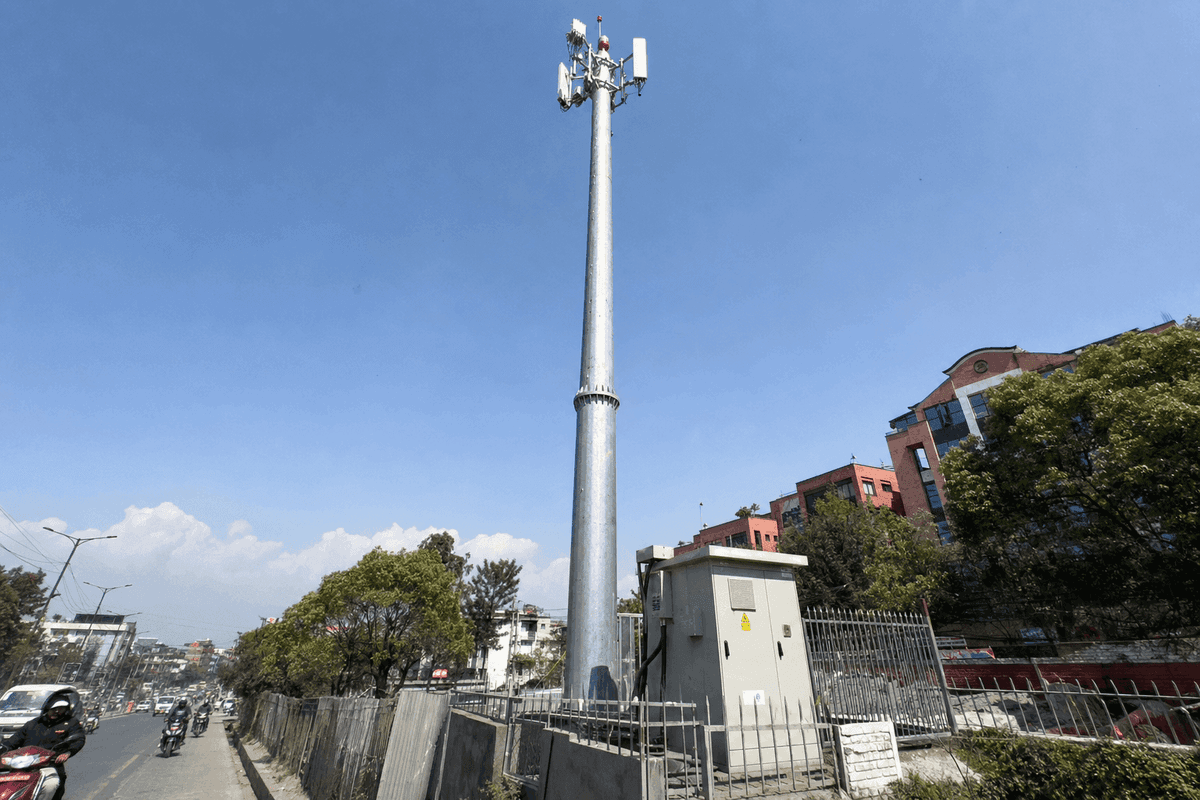
Kathmandu Telecom Tower Market Analysis: 20m Urban Macro Steel Monopole Configuration Guide
Summary
Kathmandu's 862,400 residents across 49.45 km2 make 20m steel monopoles suitable for urban macro infill; a typical 24-unit configuration uses 7t Q345 poles, 50 m/s wind class, and pile foundations.
Key Takeaways
A 24-unit Kathmandu telecom-tower program should prioritize 20m galvanized Q345 monopoles because dense wards need low-visual-impact macro coverage and rapid 30-45 day production.
- A typical 24-unit deployment would use 24 units x 20m tapered steel monopoles, creating 480m of aggregate vertical infrastructure.
- Each tower is approximately 7t, so the structural steel package is about 168t before accessories, fasteners, and foundation steel.
- The antenna baseline is 3 panel antennas at 25kg each, or 75kg of primary antenna load per pole.
- Wind class 2 means 50 m/s basic design wind with a 1.15 factor under the TIA-222-H design basis.
- The recommended form is one steel monopole type only: not lattice, not FRP, and not joint-use utility construction.
- CKD shipping should reduce packed volume by 60-70%, which matters for inland delivery into the Kathmandu Valley.
- A 30-year design life and high-corrosion hot-dip galvanizing support lifecycle planning beyond the 1-year EPC warranty.
Market Context for Kathmandu
Kathmandu's 49.45 km2 municipal core, 32 wards, and approximately 17,440 residents per km2 create a capacity-led telecom tower market rather than a rural coverage problem. According to National Statistics Office Nepal (2021), Nepal counted 29,164,578 people, and Bagmati Province counted 6,116,866, making the capital region the country's largest demand center. According to Kathmandu Metropolitan City (2021), the city is organized into 32 wards across about 49.45 km2; using the 862,400 local population figure, the implied urban density is approximately 17,440 people per km2. This density favors short urban macro and infill sites rather than tall rural coverage towers.
According to the World Bank (2013), Kathmandu Valley had about 2.5 million people by 2010 and was growing at roughly 4% per year, one of the fastest metropolitan growth rates in South Asia. That expansion pushes mobile networks toward densification: more sites, lower heights, and tighter visual footprints near roads, markets, hospitals, education clusters, and apartment corridors. The relevant design question is therefore not maximum line-of-sight range, but how to add durable antenna positions without creating excessive land, transport, or permitting friction.
According to the Department of Hydrology and Meteorology (2005), Kathmandu receives about 1,400mm of annual rainfall, with roughly 65% concentrated in the June-September monsoon. This supports a high corrosion-zone assumption for exposed bolts, cable trays, platforms, ladder cages, grounding bonds, and aviation warning-light brackets. Hot-dip galvanized Q345 steel is a practical fit because coating continuity and inspection access are more important than decorative finishes in a polluted, wet urban basin.
According to Nepal Telecommunications Authority (2024), ISP records show about 62 broadband providers and roughly 3.40 million fixed-broadband subscribers, indicating a competitive access market that still depends on mobile macro coverage for mobility and backup connectivity. Nepal Telecommunications Authority states, 'healthy competition among service providers,' which makes neutral, standard passive structures preferable to proprietary pole forms. According to ITU (2024), 4G networks were available to about 93% of the global population, so Kathmandu planning should reserve structural and cable-management margins for ongoing 4G densification and selective 5G overlays. ITU states, 'universal and meaningful connectivity,' a goal that translates in Kathmandu into more reliable infill capacity rather than taller landmark towers.
Recommended Technical Configuration
A typical 24-unit deployment of this scale would use 20m tapered steel monopoles, 3 panel antennas per tower, and pile foundations for constrained urban sites. For SOLARTODO, the recommended configuration is approximately 24 units x 20m tapered steel monopole towers for Kathmandu urban macro and infill applications. The correct size class is the 15-25m rooftop/urban infill class, because the sites use 3 panel antennas rather than 6-9 panels plus microwave backhaul. The product should be specified as a tapered round or octagonal steel tube, hot-dip galvanized Q345, with flanged bolt-on sectional design for predictable erection and maintenance access.
This recommendation deliberately avoids lattice, FRP, and joint-use pole framing. Lattice towers occupy more ground area and create more visual impact in dense wards, while FRP is not the appropriate primary structural material for this 50 m/s wind-class macro site. Joint-use power or lighting poles would introduce third-party loading assumptions that are not part of the Telecom Tower design basis.
A typical 24-unit deployment in this profile would consist of approximately 24 towers, 72 panel antennas, 48 antenna platforms, 24 climbing ladders, 24 cable-tray systems, 24 aircraft warning lights, 24 grounding systems, 24 lightning rods, and 24 safety cages. SOLARTODO's Telecom Tower configuration should keep spare bolt sets, grounding lugs, cable clamps, and aviation-light parts in the maintenance package. For detailed site review, buyers should contact us with GPS coordinates, soil notes, operator antenna schedules, and local aviation-clearance requirements.
Technical Specifications
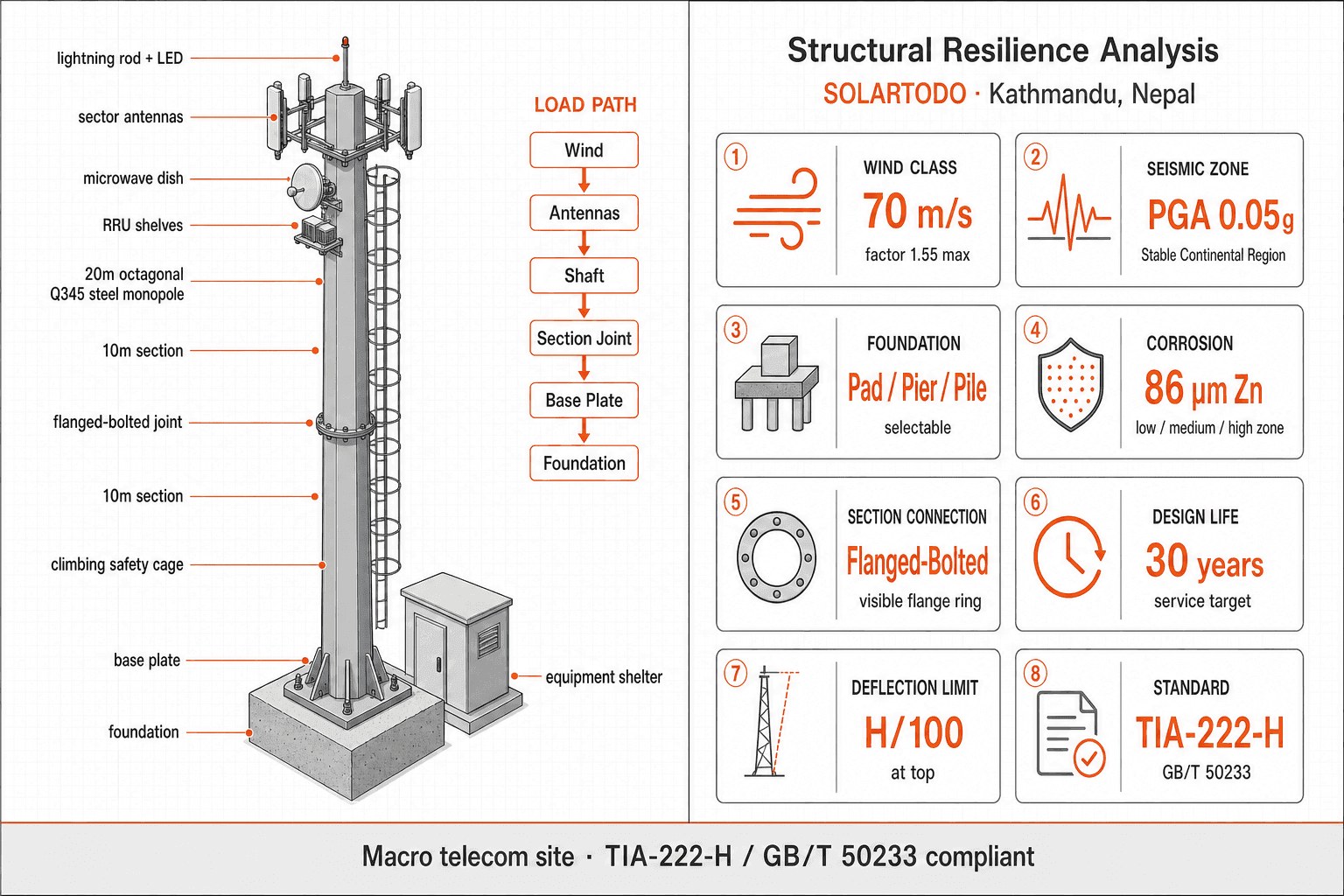
The recommended Kathmandu specification uses 24 units x 20m Q345 steel monopoles, each approximately 7t, rated for 50 m/s wind under TIA-222-H.
- Product form: tapered steel monopole tower, round or octagonal tube, not lattice, not FRP, not joint-use.
- Quantity and height: approximately 24 units x 20m, classed as urban macro / rooftop-urban infill.
- Material: hot-dip galvanized Q345 steel, with Q420 optional only if later RF loads require structural redesign.
- Tower weight: approximately 7t per tower, or about 350kg/m for this low-height, 3-panel urban infill configuration.
- Size class basis: 15-25m urban infill class, normally associated with 3-6 panel antennas and compact urban placement.
- Antenna load: 3 x panel antennas at 25kg each, totaling 75kg primary antenna load per tower.
- Platforms and access: 2 antenna platforms, climbing ladder, safety cage, and cable tray on each tower.
- Wind design: wind class 2, 50 m/s, factor 1.15, checked against TIA-222-H load methodology.
- Foundation: pile foundation, selected for urban soil variability, constrained plots, and 20m monopole overturning control.
- Connections: flanged bolt-on sectional design; slip-joint alternatives should be used only after section transport checks.
- Corrosion zone: high; all exposed structural steel should use continuous hot-dip galvanizing and maintainable fastener access.
- Electrical safety: grounding system and lightning rod per site earthing design, with continuity checks after erection.
- Aviation safety: aircraft warning light included on each pole, subject to local civil aviation siting review.
- Logistics: CKD shipping with 60-70% volume reduction versus fully assembled transport.
- Production and lifecycle: 30-45 day production window and 30-year design life under planned inspection.
- Standards: TIA-222-H for antenna-supporting structures and GB/T 50233 for construction and acceptance discipline.
Implementation Approach
A 24-unit Kathmandu rollout would typically move through survey, geotechnical checks, 30-45 day fabrication, CKD shipping, pile works, erection, and RF commissioning. The first phase is desktop and field verification. Engineers would confirm ward-level candidate sites, roof or ground access, utility conflicts, soil class, drainage, aviation constraints, and available backhaul routes. A geotechnical check is especially important because the recommended foundation is pile-based, and pile depth should respond to local bearing strata rather than a generic drawing.
The second phase is procurement and fabrication. SOLARTODO would prepare manufacturing drawings for the 20m flanged steel sections, platforms, ladder, safety cage, cable tray, grounding lugs, lightning rod mount, and aviation-light bracket. Production is normally planned at 30-45 days after technical approval, while CKD packing supports the 60-70% logistics-volume reduction required for efficient container and inland truck movement.
The third phase is civil works and erection. A typical sequence is pile drilling or driving, reinforcement placement, concrete works, curing, anchor-template verification, section lifting, flange bolting, platform installation, cable-tray installation, grounding continuity testing, and verticality checks. RF commissioning would follow tower acceptance, using the operator's antenna azimuth, tilt, feeder, RRU, and power-connection plan.
Expected Performance & ROI
A 24-unit, 20m configuration would provide 72 panel positions, 480m of aggregate monopole height, about 168t of steel, and 30-year structural life. The core performance outcome is additional mobile access capacity in dense urban corridors, not a claim of measured traffic uplift. With 3 panel antennas per tower, the baseline plan supports 72 panel positions before any future structural approval for heavier radios or additional carriers. The 20m height is appropriate for urban macro fill where cell-edge performance, street canyon coverage, and handover reliability matter more than rural range.
ROI should be modeled rather than asserted. For Kathmandu, a buyer should compare 6-year, 8-year, and 10-year payback scenarios using tenant count, site rent, civil works, maintenance, power connection, and backhaul cost assumptions. The 30-year design life allows lifecycle economics to be spread across multiple radio generations, while the 1-year EPC warranty covers the initial installed and commissioned scope where selected.
The most measurable logistics impact is the 60-70% CKD shipping-volume reduction. That reduces transport complexity for 24 towers and about 168t of steel arriving as sections rather than oversized assemblies. For long-term OPEX control, specify annual structural inspection, post-monsoon coating review, grounding resistance checks, bolt-torque sampling, and aviation-light function tests.
Results and Impact
For Kathmandu planning, the expected impact is 24 compact macro sites that add 72 panel positions while reducing shipment volume by 60-70% through CKD packing. A recommended 20m Telecom Tower program would help operators add capacity without moving into the 25-35m suburban tower class. That matters in Kathmandu because the densest wards need shorter zoning profiles, lower visual obstruction, and easier truck access. The use of pile foundations also supports more predictable overturning resistance where surface space is limited.
The technical impact is a repeatable passive-infrastructure kit: 24 galvanized Q345 poles, 48 platforms, 24 ladder-and-safety systems, and 24 grounding and lightning-protection sets. The commercial impact is scenario-dependent, but the structure gives tower owners a 30-year asset that can be reviewed for later radio changes. SOLARTODO should treat future microwave dishes, RRUs, or small-cell attachments as engineering-change events rather than automatic add-ons.
Comparison Table
The 20m Kathmandu recommendation fits the 15-25m urban infill class, while taller 25-55m monopoles serve suburban, highway, and rural coverage profiles.
| Option | Height / size class | Typical antenna load | Tower weight guidance | Foundation fit | Kathmandu fit | Quotation scope |
|---|---|---|---|---|---|---|
| Recommended Kathmandu Telecom Tower | 20m, within 15-25m urban infill | 3 x 25kg panel antennas | ~7t specified, 350kg/m | Pile foundation | Best for dense wards and compact macro infill | FOB, CIF, or EPC |
| Standard urban/suburban monopole | 25-35m suburban/residential | 6-9 panels, 2 platforms | 15-22t per tower | Pad or pier by soil | Useful outside core districts | FOB, CIF, or EPC |
| Highway/peri-urban monopole | 35-45m highway/peri-urban | 6-9 panels plus 1-2 microwave dishes | 22-30t per tower | Pier or pile | Too tall for many core infill plots | FOB, CIF, or EPC |
| Rural wide-coverage monopole | 45-55m rural/wide coverage | 9-12 panels, 3 platforms | 30-40t per tower | Pile by geotechnical design | Better for valley-edge coverage | FOB, CIF, or EPC |
Pricing & Quotation
Quotation should separate 24-unit steel supply, 60-70% CKD logistics, pile foundations, installation, commissioning, and the 1-year EPC warranty. SOLARTODO offers three pricing tiers for this product line: FOB Supply (equipment ex-works China), CIF Delivered (including ocean freight and insurance), and EPC Turnkey (fully installed, commissioned, with 1-year warranty). Volume discounts are available for large-scale deployments. Configure your system online for an instant estimate, or request a custom quotation from our engineering team at [email protected].
For Kathmandu, quotation inputs should include coordinates near 27.72, 85.32, required tower count, antenna schedule, desired flange section lengths, soil report, corrosion expectations, civil-access constraints, and whether installation is supply-only or EPC. SOLARTODO should not quote a pile foundation from tower height alone; pile design depends on bearing capacity, groundwater, access, and overturning loads. Buyers comparing FOB, CIF, and EPC should keep technical scope identical so logistics and installation responsibility are the only variables.
Frequently Asked Questions
These 10 FAQs cover the 20m Kathmandu Telecom Tower configuration, including timeline, maintenance, EPC quotation, ROI modeling, installation, comparison, and warranty.
Q1: What Telecom Tower specification fits Kathmandu's dense urban core? A typical Kathmandu infill specification is approximately 24 units x 20m tapered steel monopole towers using hot-dip galvanized Q345 steel. Each tower is about 7t, carries 3 panel antennas at 25kg each, and uses a pile foundation. This is a steel monopole solution, not lattice, FRP, or joint-use construction.
Q2: Why is the 15-25m urban infill class the correct size class? The 20m pole sits inside the 15-25m urban infill class, which matches compact sites and 3-6 panel antenna loads. Kathmandu's municipal density is about 17,440 residents per km2, so low-height macro infill is more practical than 35-45m highway or 45-55m rural coverage structures.
Q3: How long would procurement and deployment typically take? After technical approval, production is typically 30-45 days for the galvanized steel sections and accessories. Total deployment depends on survey, permits, soil checks, pile foundation works, curing time, transport, and RF commissioning. A practical Kathmandu program should model civil works and approvals separately from factory production time.
Q4: What ROI or payback period should buyers model? Do not use a universal payback number. For Kathmandu, model 6-year, 8-year, and 10-year scenarios because site rent, tenant count, power connection, civil works, and backhaul determine ROI. The 24-unit configuration creates 72 initial panel positions and 30-year passive assets, so additional tenants materially improve economics.
Q5: What maintenance does a 20m steel monopole require? Recommended maintenance includes annual visual inspection, post-monsoon galvanizing checks, bolt-torque sampling, grounding continuity tests, aviation-light function checks, and cable-tray inspection. High corrosion exposure means fasteners, platform weld zones, drainage points, and ladder connections should receive special attention. Maintenance planning should extend across the 30-year design life.
Q6: How does this compare with lattice towers or FRP poles? A tapered steel monopole has a smaller footprint and cleaner visual profile than a lattice tower, which helps in dense Kathmandu wards. FRP is not the recommended primary structure for this wind class and macro-site load. The specified product is one steel monopole form with Q345 steel and hot-dip galvanizing.
Q7: What is included in EPC Turnkey quotation scope? EPC Turnkey generally covers installed and commissioned scope with a 1-year warranty, while FOB and CIF separate equipment supply from installation responsibility. For Kathmandu, EPC scope should define pile foundations, crane access, grounding, aviation light, tower erection, platform installation, cable-tray works, and acceptance testing before quotation comparison.
Q8: What warranty and design life should be assumed? The recommended configuration uses a 30-year design life for the steel monopole structure under planned inspection and correct loading. EPC Turnkey includes a 1-year warranty in the quoted product line. Warranty should not be confused with design life; long-term performance depends on maintenance, corrosion checks, and approved antenna loading.
Q9: What installation method is recommended for the pile foundation? A typical pile-foundation installation starts with geotechnical confirmation, pile layout, drilling or driving, reinforcement placement, concrete work, curing, anchor-template verification, and verticality checks. Tower sections are then lifted and flanged together. The installation method should be finalized after soil capacity, access width, and equipment staging are confirmed.
Q10: Can the 20m tower support future 5G equipment? It can support future equipment only within the approved structural reserve and after engineering review. The baseline load is 3 panel antennas at 25kg each, not a dense 9-panel 5G hotspot package. Adding RRUs, microwave dishes, or small cells should trigger a TIA-222-H load check and updated foundation review.
References
These 7 references support Kathmandu demographics, telecom demand, climate exposure, structural design standards, and global 4G market context for the 24-unit recommendation.
- National Statistics Office Nepal (2021): National Population and Housing Census 2021 reports Nepal's 29,164,578 population and Bagmati Province's 6,116,866 population. https://censusnepal.cbs.gov.np/
- Kathmandu Metropolitan City (2021): Municipal profile and local administration materials describe Kathmandu's 49.45 km2 area and 32 wards. https://kathmandu.gov.np/
- World Bank (2013): Managing Nepal's Urban Transition identifies Kathmandu Valley's rapid urban growth, including about 2.5 million people by 2010 and roughly 4% annual growth. https://www.worldbank.org/en/country/nepal
- Department of Hydrology and Meteorology Nepal (2005): Kathmandu climate records indicate about 1,400mm average annual rainfall with monsoon concentration. https://www.dhm.gov.np/
- Nepal Telecommunications Authority (2024): MIS and ISP records track broadband providers, telecom subscriptions, and sector competition in Nepal. https://www.nta.gov.np/
- International Telecommunication Union (2024): Facts and Figures 2024 reports global 4G availability near 93% of population and frames universal meaningful connectivity. https://www.itu.int/itu-d/reports/statistics/
- Telecommunications Industry Association / Standardization Administration of China (2017/2014): ANSI/TIA-222-H covers antenna-supporting structures; GB/T 50233 supports construction and acceptance discipline for tower works. https://www.tiaonline.org/
Equipment Deployed
- 24 units x 20m tapered steel monopole tower, hot-dip galvanized Q345, approximately 7t per tower
- Wind class 2 structural design: 50 m/s basic wind, factor 1.15, TIA-222-H basis
- 3 x 25kg panel antennas per tower for urban macro infill load profile
- Pile foundation package selected for constrained Kathmandu urban sites
- 2 antenna platforms per tower with climbing ladder, cable tray, and safety cage
- Aircraft warning light, grounding system, and lightning rod for each tower
- Flanged bolt-on sectional design with CKD shipping and 60-70% volume reduction
- 30-year design-life steel structure with 30-45 day production window