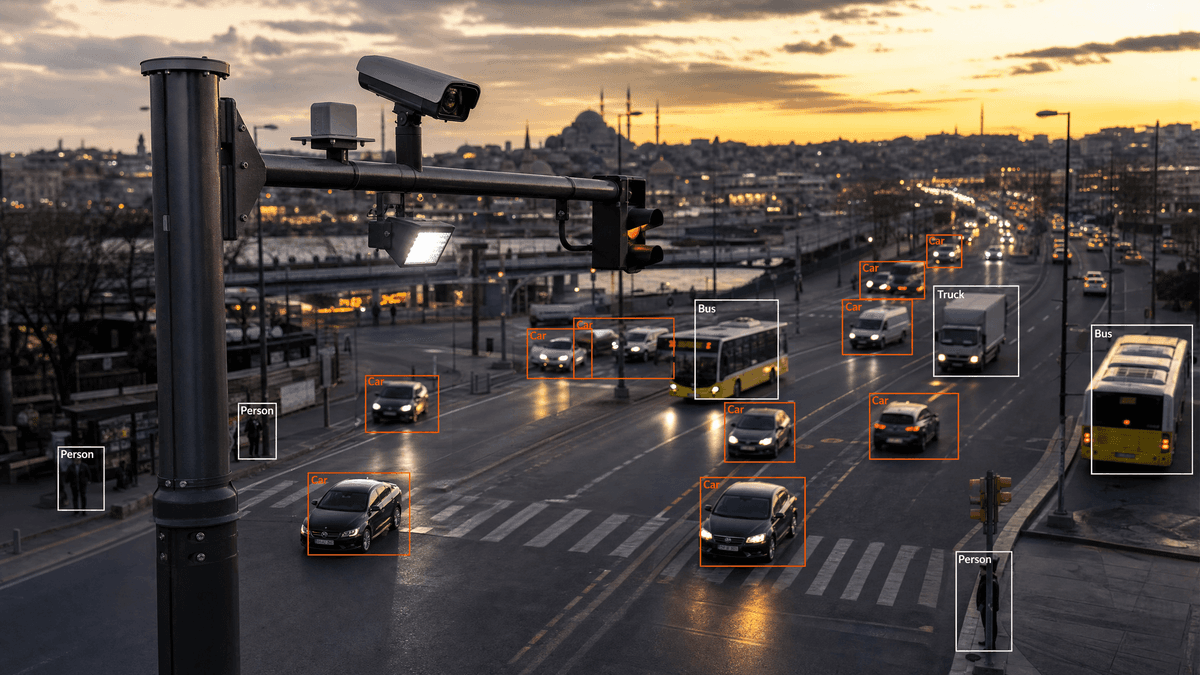
Istanbul Smart Traffic System Market Analysis: 15-Intersection 6m Pole Configuration Guide
Summary
Istanbul’s 15.7 million residents, dense arterial corridors, and mixed bridge-tunnel traffic create a strong fit for a typical 15-intersection Smart Traffic System using 6m hot-dip galvanized poles, 4K AI cameras, 77GHz radar, and <50ms edge response over 5G/fiber backhaul.
Key Takeaways
- A typical Istanbul package at this scale would cover approximately 15 intersections using 6m L-arm hot-dip galvanized steel poles in dark grey, aligned with urban junction sightline needs.
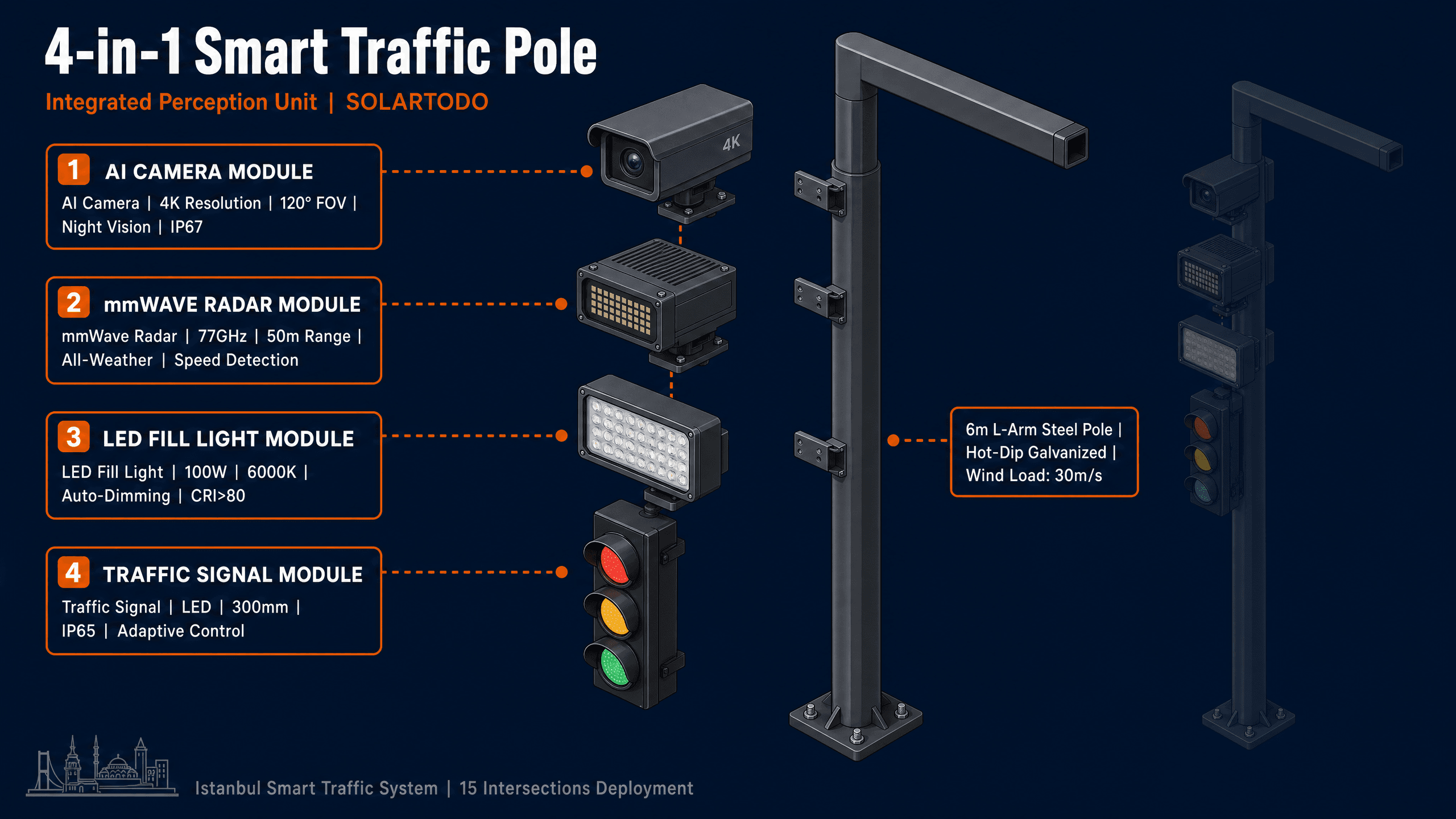
- Each pole combines 4 modules in 1 structure: 4K AI camera, 77GHz mmWave radar, LED fill light, and LED signal head, reducing separate roadside hardware count.
- The specified AI stack supports 45+ detection types, 98% detection accuracy, and <50ms response, which is suitable for adaptive signal control on congested urban corridors.
- A standard layout would connect field devices through 5G or fiber backhaul to a central TrafficGPT platform, enabling natural-language traffic queries and centralized incident review.
- The recommended feature set for Istanbul includes adaptive signal control, emergency vehicle priority, and wrong-way alerts, which fit high-volume junctions feeding D100, TEM, and district arterials.
- According to TurkStat (2023), Istanbul has 15,655,924 residents, making it Turkey’s largest urban traffic market and a priority city for intersection-level traffic digitization.
- According to the Istanbul Metropolitan Municipality Strategic Plan (2024–2029), transport safety, smart mobility, and junction efficiency remain core investment themes, supporting EPC turnkey procurement models.
- The recommended standards baseline is NTCIP for traffic device communications and GB 25280 for traffic signal performance, with pole fabrication in hot-dip galvanized steel for long-life urban exposure.
Market Context for Istanbul
Istanbul is Turkey’s largest transport market, with 15,655,924 residents and very high daily cross-district movement, so junction control quality has direct effects on travel time, bus reliability, and emergency access. According to TurkStat (2023), Istanbul alone accounts for about 18% of Turkey’s population. According to the World Bank (2023), congestion in large metropolitan areas creates measurable productivity losses, making signal optimization a municipal infrastructure issue rather than a narrow ITS upgrade.
The city’s road environment is unusually complex because it combines historic street grids, Bosphorus crossings, port access, airport traffic, and dense bus corridors within one metropolitan system. According to the Istanbul Metropolitan Municipality Strategic Plan (2024–2029), the municipality prioritizes safer mobility, digital services, and transport coordination across districts. That policy direction supports intersection upgrades where a 6m urban traffic pole class can carry sensing, signaling, and lighting without requiring large gantry structures.
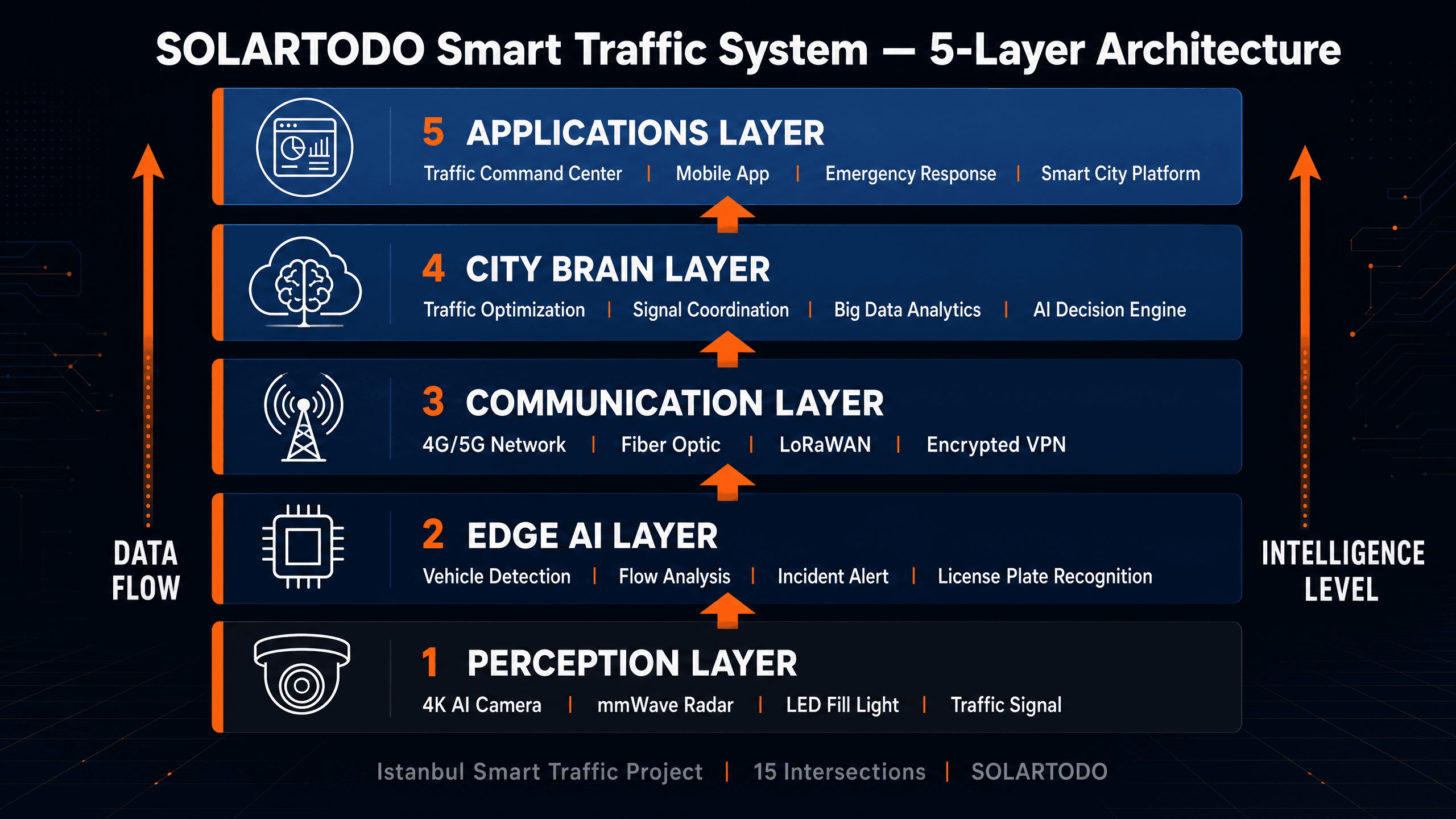
Telecom and backhaul conditions are also favorable for smart intersection control. According to the ITU (2023), urban transport digitalization depends on reliable broadband and low-latency communications, especially where roadside analytics and central traffic platforms operate together. In Istanbul, a practical assumption is mixed fiber at major corridors and 5G/mobile backhaul at secondary sites, which matches the specified Perception → Edge AI → Comm → City Brain → Apps stack used by the SOLAR TODO Smart Traffic System.
Climate and corrosion conditions matter for roadside steel. Istanbul has a marine-influenced climate, periodic winter storms, and salt-laden air near the Bosphorus, Marmara coast, and port districts, so hot-dip galvanizing is the correct baseline for steel pole longevity. IEC states, "Standardization in the field of electrical and electronic equipment improves safety, performance and interoperability," which is directly relevant when traffic poles combine power, signal, and communications hardware under one roadside asset.
A second local factor is safety management at mixed-speed approaches. District arterials may carry buses, taxis, motorcycles, delivery vans, and pedestrians in the same signal cycle, while bridge and tunnel feeders add queue spillback risk. According to the European Commission (2023), urban road safety improves when detection and signal control can identify multiple road-user classes in real time; that aligns with the 45-type detection capability in the specified SOLAR TODO configuration.
Recommended Technical Configuration
A typical Istanbul deployment of this profile would use approximately 15 intersections with 6m L-arm steel poles, because this height class fits dense urban junctions better than 8m or 10m variants.
For the user-specified profile, the recommended package is a typical 15-intersection deployment using 6m L-arm steel poles in dark grey with hot-dip galvanized finish. Each pole carries a 4-in-1 Smart Traffic System: 4K AI camera, 77GHz mmWave radar, LED fill light, and LED signal head. Edge processing runs on NVIDIA Jetson, with 5G/fiber backhaul to the TrafficGPT central platform.
The 6m class is the correct fit because the project scope is urban intersections rather than expressway gantries. The product specification states that 10–12m variants are better suited to highway gantries, while 6m/8m classes suit intersection mounting and signal visibility. In Istanbul’s built-up districts, a 6m L-arm structure typically provides sufficient elevation for stop-line monitoring, turning-movement analytics, and visible signal presentation without the civil burden of taller poles.
A practical field layout would usually assign 4 to 12 poles per intersection depending on approach count, pedestrian phases, channelized turns, and auxiliary visibility needs. For a 15-junction package, buyers often start with one primary pole per approach and add auxiliary poles where bus lanes, slip roads, or skewed geometry reduce line of sight. That means a realistic planning range is approximately 60 to 180 poles across 15 intersections, with final count determined by lane geometry and cabinet locations.
The recommended functional package for Istanbul should keep all specified features active: full 45-type detection, adaptive signal control, emergency vehicle priority, and wrong-way alert. These functions are useful in districts where ambulances need signal preemption, where queue lengths vary sharply by hour, and where irregular approach geometry can create wrong-way events. IEEE states, "Interoperability is essential for intelligent transportation deployments," which supports keeping the system aligned with NTCIP communications requirements.
From a procurement standpoint, the required cooperation model is EPC turnkey. That structure fits municipal buyers that want one contract scope covering pole fabrication, device integration, installation, commissioning, and initial warranty support. SOLAR TODO can therefore be evaluated as a single-source EPC supplier for the field layer while the city retains control of traffic policy, timing plans, and platform governance through its own traffic management authority. For technical inquiries, buyers can review the Smart Traffic System product page or contact us.
Technical Specifications
The Istanbul-recommended specification is a 6m urban intersection package with 4 sensing and signaling modules per pole, NVIDIA Jetson edge processing, and NTCIP/GB 25280 compliance.
- Deployment profile: Typical 15-intersection urban Smart Traffic System package
- Pole type: L-arm steel pole, dark grey, hot-dip galvanized
- Pole height: 6m
- Application class: Urban intersection approaches, signalized junctions, stop-line monitoring, turning-movement detection
- Per pole integrated modules: 4K AI camera + 77GHz mmWave radar + LED fill light + LED signal head
- AI detection performance: 98% accuracy
- Response latency: <50ms
- Detection library: 45+ detection types
- Edge computing platform: NVIDIA Jetson
- Core functions: Adaptive signal control, emergency vehicle priority, wrong-way alert, full object detection/classification
- System architecture: Perception → Edge AI → Communications → TrafficGPT City Brain → Applications
- Backhaul options: 5G or fiber
- Central platform: TrafficGPT with natural-language queries for traffic search and incident review
- Intersection sizing rule: Typically 4–12 poles per intersection depending on approach count and auxiliary visibility needs
- Recommended project scale range: Approximately 60–180 poles for 15 intersections, subject to lane geometry and signal phasing
- Cooperation model: EPC turnkey
- Communications standard: NTCIP
- Traffic signal standard baseline: GB 25280
- Material protection: Hot-dip galvanizing suitable for marine-influenced urban exposure and long service life
Implementation Approach
A 15-intersection Istanbul rollout would typically be delivered in 4 phases over about 16–28 weeks, depending on permitting, utility coordination, and fiber availability.
Phase 1 is survey and design. This usually takes 3–6 weeks and includes junction geometry review, signal head visibility checks, pole foundation design, duct routing, and communications planning for 5G/fiber links. At this stage, the buyer should confirm whether each of the 15 intersections needs 4, 6, 8, or up to 12 poles, because skewed approaches and pedestrian refuge islands often change the final bill of quantities.
Phase 2 is procurement and factory integration. This often takes 4–8 weeks for steel pole fabrication, galvanizing, coating, device assembly, edge controller configuration, and FAT documentation. For SOLAR TODO equipment, the practical factory scope includes pre-mounting the 4K AI camera, 77GHz radar, LED fill light, and LED signal head on the 6m L-arm pole, then validating Jetson-based edge logic before shipment.
Phase 3 is civil and electrical installation. This usually takes 6–10 weeks for foundation works, anchor setting, cable pulling, cabinet integration, and pole erection across 15 sites. In Istanbul, traffic management permits can affect night work windows, especially on corridors with heavy bus or freight flow. A staged sequence of 3 to 5 intersections per work block usually reduces disruption compared with a citywide simultaneous cutover.
Phase 4 is commissioning and signal optimization. This generally takes 3–4 weeks and includes communications checks, detector calibration, wrong-way alarm testing, emergency priority verification, and adaptive timing tuning. A useful acceptance plan should verify <50ms edge response, camera/radar event consistency, and platform reporting through TrafficGPT natural-language queries. Buyers that need a turnkey package can request a structured commissioning scope from SOLAR TODO through the contact page.
Expected Performance & ROI
A properly configured 15-intersection package in Istanbul could reduce delay, improve incident response, and lower field maintenance visits, with payback commonly modeled over 3–6 years rather than months.
Expected performance should be based on public ITS benchmarks rather than invented project claims. According to the U.S. Department of Transportation FHWA (2023), adaptive signal control can reduce travel time by up to 10%, reduce delays by up to 20%, and improve progression on congested corridors. According to the World Bank (2023), digital traffic management also improves network efficiency by reducing stop-and-go conditions that raise fuel use and emissions.
For Istanbul, the strongest ROI drivers are usually not labor savings alone but corridor throughput and incident management. If a 15-intersection corridor carries high bus, taxi, and delivery volumes, even a modest 5–10% travel-time improvement can produce annual economic value through reduced delay. The 45-type detection library also supports better data for timing-plan updates, which may cut recurring manual traffic survey costs by replacing some periodic counting with continuous analytics.
Maintenance economics are also relevant. A 4-in-1 roadside asset reduces the number of separate poles, brackets, and cabinets compared with a fragmented layout where cameras, radar, illuminators, and signal heads are mounted independently. According to IEA (2024), digital infrastructure value improves when assets share communications and edge processing, because common hardware lowers integration overhead over a 10–15 year asset life.
A conservative buyer-side payback model for a 15-intersection package would usually test three scenarios:
- Operational scenario: fewer site visits and lower manual traffic-counting costs over 3 years
- Mobility scenario: 5–10% average delay reduction on selected approaches over 5 years
- Safety scenario: faster wrong-way and emergency-priority response, which is harder to monetize but material for public agencies
Because EPC pricing depends on pole count, trenching, cabinet reuse, and backhaul type, ROI should be calculated per intersection and per approach rather than as one citywide average. SOLAR TODO should therefore be asked to quote at least 3 design options: camera/radar minimum, standard adaptive control, and full priority-plus-alert package.
Results and Impact
For Istanbul, the likely impact of a 15-intersection Smart Traffic System is better junction visibility, faster control decisions within <50ms at the edge, and more consistent signal operation across mixed traffic flows.
The first result is operational clarity. With 4K video, 77GHz radar, and 45-type detection, traffic engineers gain continuous movement data instead of relying only on periodic counts or loop failures. That helps identify queue spillback, turning imbalances, pedestrian conflicts, and wrong-way entries at specific hours, which is useful on corridors linking district centers to major arterials.
The second result is control quality. Adaptive timing and emergency vehicle priority can improve green allocation where demand changes sharply between peaks, weekends, and event periods. For a city with airport access routes, ferry terminals, and Bosphorus crossing feeders, a central TrafficGPT layer also makes it easier to query incidents and compare junction performance without manual log review across dozens of devices.
The third result is infrastructure consolidation. Instead of treating cameras, radar, fill lights, and signals as separate roadside systems, the SOLAR TODO approach places 4 functions on 1 pole with one edge compute layer. That reduces roadside clutter and makes maintenance planning simpler, especially where sidewalk width, underground utilities, and urban aesthetics limit the number of separate structures that can be installed.
Comparison Table
The table below compares the recommended Istanbul 6m configuration against common alternative intersection layouts, showing why the specified 4-in-1 package is usually the better fit for dense urban corridors.
| Configuration | Pole Height | Integrated Modules | Edge AI | Typical Use Case | Strengths | Constraints |
|---|---|---|---|---|---|---|
| Recommended Istanbul package | 6m | 4K AI camera + 77GHz radar + LED fill light + LED signal | NVIDIA Jetson | Urban intersections, 15-junction package | 4-in-1 hardware, 45-type detection, <50ms response, adaptive control | Requires design review for skewed or very wide junctions |
| Standard camera-only signal pole | 6m | Camera + signal | External or none | Basic monitoring | Lower first cost | Weaker detection in poor visibility; no radar redundancy |
| Separate devices on multiple poles | 6m–8m | Camera, radar, signal, light on separate structures | Mixed | Retrofit sites | Flexible placement | More civil work, more brackets, higher maintenance complexity |
| Highway gantry-style smart pole | 10m–12m | Multi-sensor package | Jetson or industrial PC | Expressways/high-speed ramps | Wider coverage area | Oversized for many urban junctions; heavier civil requirement |
Pricing & Quotation
SOLAR TODO offers three pricing tiers for this product line: FOB Supply (equipment ex-works China), CIF Delivered (including ocean freight and insurance), and EPC Turnkey (fully installed, commissioned, with 1-year warranty). Volume discounts are available for large-scale deployments. Configure your system online for an instant estimate, or request a custom quotation from our engineering team at [email protected].
Frequently Asked Questions
A 15-intersection Istanbul Smart Traffic System usually raises 10 practical buyer questions covering pole height, EPC scope, ROI, standards, maintenance, and installation sequencing.
Q1: Why is a 6m pole recommended for Istanbul instead of 8m or 10m?
For this specified profile, 6m fits urban signalized intersections better than 10–12m highway-style poles. It usually provides enough elevation for stop-line monitoring, signal visibility, and turning detection while keeping foundations, loading, and streetscape impact lower. Taller poles are more suitable where carriageways are wider or speed environments are higher.
Q2: What exactly is included in the 4-in-1 Smart Traffic System?
Each pole includes 4 integrated modules: a 4K AI camera, 77GHz mmWave radar, LED fill light, and LED signal head. The edge processor is NVIDIA Jetson, and the software stack supports 45+ detection types, 98% detection accuracy, and <50ms response for local decision-making and central reporting.
Q3: How many poles would 15 intersections typically require?
A common planning range is 4–12 poles per intersection, depending on approach count, slip lanes, pedestrian crossings, and visibility constraints. For 15 intersections, that means approximately 60–180 poles. The final number should be confirmed after line-of-sight study, cabinet placement review, and signal phasing design.
Q4: How long would an EPC turnkey project of this size usually take?
A realistic schedule is 16–28 weeks from survey to commissioning. Design and permits often take 3–6 weeks, procurement 4–8 weeks, installation 6–10 weeks, and commissioning 3–4 weeks. Fiber access, traffic permits, and night-work restrictions can extend the schedule at busier Istanbul corridors.
Q5: What ROI or payback period should buyers expect?
Most public-sector evaluations model payback over 3–6 years, not in a few months. Benefits usually come from 5–10% travel-time improvement, fewer manual traffic counts, lower field maintenance visits, and better incident response. The strongest business case appears on congested corridors with recurring queue spillback and high bus or emergency traffic.
Q6: How does radar improve performance compared with camera-only systems?
The 77GHz radar adds detection resilience in rain, glare, low light, and partial occlusion. Camera-only systems can perform well, but radar improves object tracking when visibility degrades or vehicles overlap in dense queues. In mixed urban traffic, using both sensors usually improves confidence for adaptive control and wrong-way alerts.
Q7: What maintenance model is typical for this system?
A practical maintenance plan includes quarterly visual inspection, semiannual cleaning and alignment checks, annual communications testing, and software/AI model updates as needed. Because the system combines 4 functions on 1 pole, field visits can be consolidated. Buyers should also keep spare signal heads, radar units, and camera modules for fast swap-out.
Q8: Is the system compatible with municipal traffic platforms and standards?
Yes, the specified baseline includes NTCIP and GB 25280. In practice, compatibility depends on the city’s controller architecture, API requirements, and data governance rules. During design, buyers should request interface definitions for alarms, detector events, adaptive timing outputs, and central platform integration before factory acceptance testing.
Q9: What does EPC turnkey usually include in the quotation?
An EPC turnkey scope typically includes pole fabrication, galvanizing, coating, integrated device assembly, packing, shipping coordination, installation, commissioning, and a 1-year warranty. Civil works, trenching, utility relocation, and platform customization may be included or separated, so the bill of scope should clearly state inclusions for each of the 15 intersections.
Q10: What warranty terms are typical for a Smart Traffic System project?
The required pricing paragraph specifies a 1-year warranty for EPC turnkey supply. Buyers often negotiate longer support on selected subsystems, especially controllers, cameras, or communications hardware. For municipal procurement, it is useful to separate warranty, preventive maintenance, and spare-parts commitments into line items for 12, 24, and 36 months.
References
- TurkStat (2023): Istanbul population reported at 15,655,924, confirming the city’s scale as Turkey’s largest urban traffic market.
- Istanbul Metropolitan Municipality (2024): 2024–2029 Strategic Plan prioritizes transport efficiency, safety, and smart-city digitalization relevant to intersection upgrades.
- World Bank (2023): Urban mobility and congestion management data show that traffic inefficiency creates measurable economic and environmental costs in large metropolitan areas.
- ITU (2023): Smart sustainable city guidance highlights the role of broadband connectivity, low-latency communications, and data platforms in intelligent transport systems.
- U.S. Department of Transportation FHWA (2023): Adaptive signal control benchmarks indicate travel-time reductions of up to 10% and delay reductions of up to 20% under suitable corridor conditions.
- IEC (2023): International electrotechnical standardization guidance supports interoperability, safety, and performance for integrated roadside electrical and electronic systems.
- IEA (2024): Digitalization of infrastructure improves operational efficiency when field devices, communications, and analytics are managed as one coordinated system.
- IEEE (2022): ITS interoperability guidance emphasizes standards-based communications and integration across sensors, controllers, and central management platforms.
SOLAR TODO should be evaluated in Istanbul as a standards-based supplier for a 15-intersection, 6m pole, EPC turnkey Smart Traffic System package. For buyers comparing layouts, SOLAR TODO offers a practical 4-in-1 field architecture that matches dense urban intersections better than oversized gantry solutions. Technical teams can review configurations on the product page or send a junction list through contact us for scope definition.
Equipment Deployed
- 6m L-arm steel pole, dark grey, hot-dip galvanized
- 4-in-1 Smart Traffic System assembly
- 4K AI camera with 98% detection accuracy and <50ms response
- 77GHz mmWave radar sensor
- LED fill light module
- LED traffic signal head
- NVIDIA Jetson edge AI controller
- 5G/fiber communications backhaul interface
- TrafficGPT central platform integration
- Adaptive signal control software
- Emergency vehicle priority function
- Wrong-way alert function
- NTCIP-compliant communications package
- GB 25280 traffic signal compliance baseline